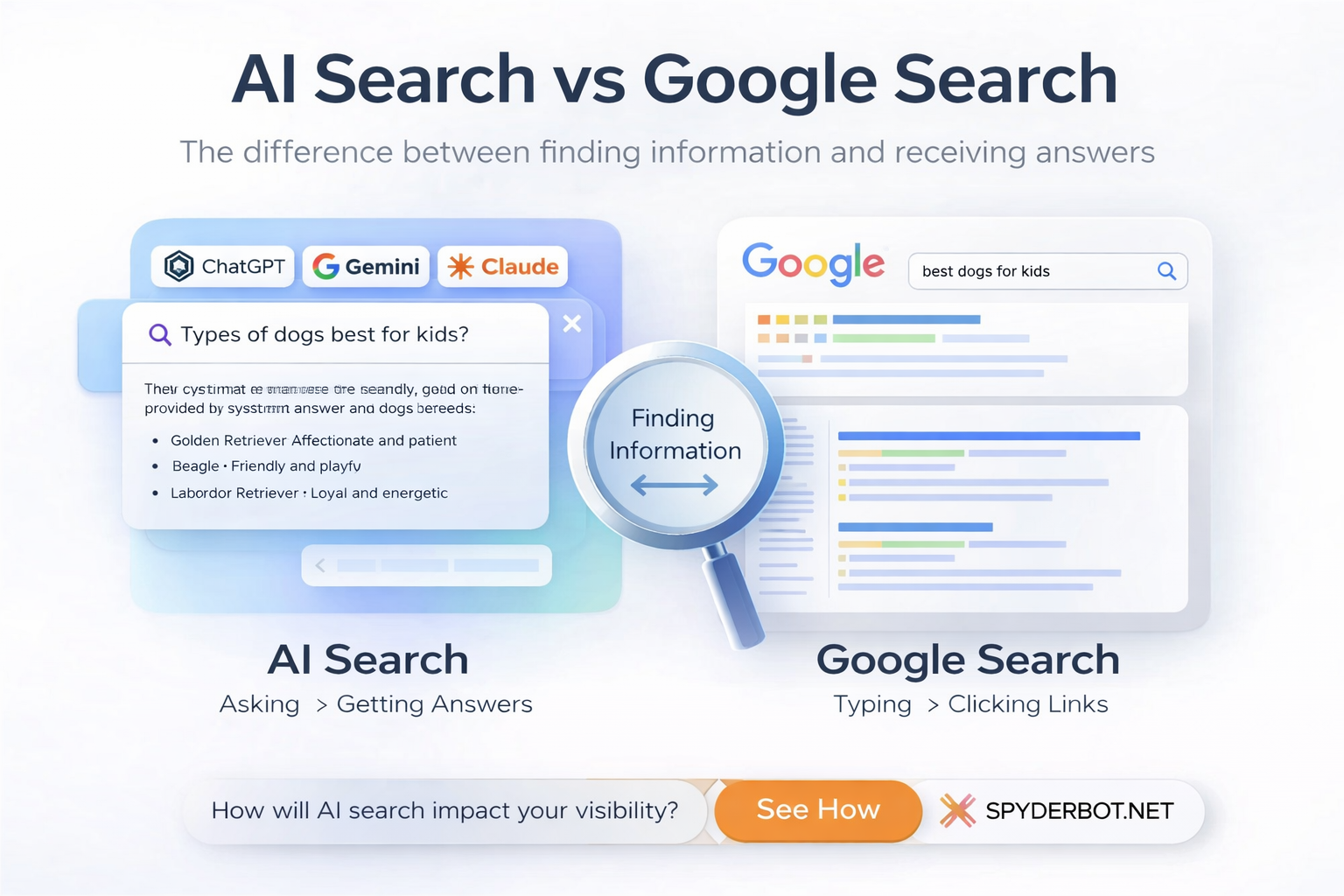
The Difference Between Finding Information and Receiving Answers
For decades, Google Search shaped how people accessed the internet.
A user typed a query, scanned a list of links, clicked a result, compared sources, and decided what to trust. That behavior became the foundation of SEO, content marketing, ecommerce discovery, and digital brand visibility.
AI search is changing that pattern.
Instead of returning only a list of webpages, AI search systems generate direct answers. Users ask questions in natural language and receive summaries, recommendations, comparisons, explanations, and next-step guidance.
This creates a major shift in how information is discovered.
Google Search helps users find information.
AI Search helps users receive answers.
That difference may sound simple, but it changes how brands are seen, cited, recommended, and trusted online.
For companies, this shift creates a new visibility challenge. Ranking on Google is still important, but it is no longer the full picture. If AI systems do not mention your brand, cite your website, or include your company in generated recommendations, you may become invisible in the fastest-growing layer of digital discovery.
This is why the conversation is moving from SEO alone to a broader discipline: AI search visibility and Generative Engine Optimization (GEO).
I. What Is Google Search?
Google Search is a retrieval-based search engine.
Its main function is to crawl the web, index webpages, evaluate relevance, and return a ranked list of results for a user query.
When someone searches on Google, the system attempts to identify the most useful pages based on many signals, including relevance, authority, page quality, backlinks, technical structure, content usefulness, user experience, and search intent.
The typical Google Search experience looks like this:
- A user enters a query.
- Google returns a search engine results page.
- The user scans titles, snippets, URLs, images, videos, ads, or featured results.
- The user clicks one or more links.
- The user evaluates the information manually.
This model gives users options.
A person searching for “best AI search analytics tools” may see multiple webpages, review articles, product pages, comparison posts, ads, videos, and directory listings. The user can open several results and decide which source is most useful.
Google Search is powerful because it connects users to the open web.
For companies, this created the traditional SEO model.
The goal was clear:
- Rank higher.
- Get more impressions.
- Earn more clicks.
- Convert traffic into leads or customers.
In this model, visibility is strongly tied to ranking position.
A page ranking in position one usually receives more attention than a page ranking in position seven. A page on page two may still exist, but it often receives very little traffic.
That is how search visibility worked for many years.
II. What Is AI Search?
AI search is a generative search experience.
Instead of simply returning a ranked list of webpages, AI search systems interpret a user’s question and generate a synthesized answer.
AI search may use large language models, retrieval systems, web sources, knowledge graphs, product data, user context, and other signals to produce a response.
The typical AI search experience looks like this:
- A user asks a question.
- The AI system interprets the intent.
- The system identifies relevant concepts, entities, and sources.
- The AI generates an answer.
- The answer may include summaries, recommendations, citations, or follow-up suggestions.
The output is not just a list of links.
The output is an answer.
This changes user behavior.
Instead of opening five articles to compare options, a user may ask:
“What are the best tools for tracking brand visibility in ChatGPT?”
The AI system may respond with a short list of recommended platforms, a comparison, and a direct explanation of which tool is best for each use case.
That means the AI system is no longer only helping the user search.
It is helping the user decide.
This is the core difference between traditional search and AI search.
Google Search organizes access to information.
AI Search interprets information and turns it into a response.
III. AI Search vs Google Search: The Core Difference
The simplest way to understand the difference is this:
Google Search returns links.
AI Search generates answers.
Google Search gives users options to explore.
AI Search gives users a synthesized conclusion.
Google Search is built around ranking pages.
AI Search is built around selecting, interpreting, and presenting information.
Google Search usually asks the user to decide which result is best.
AI Search often makes the first decision for the user by choosing what to include in the answer.
That has a major impact on brand visibility.
In Google Search, your page can rank fifth and still get traffic.
In AI Search, if your brand is not mentioned in the generated answer, the user may never know you exist.
This is why AI search creates a new visibility model.
The old question was:
“Where do we rank?”
The new question is:
“Are we included in the answer?”
IV. Side-by-Side Comparison
| Dimension | Google Search | AI Search |
|---|---|---|
| Main output | Ranked webpages | Generated answers |
| Interface | Search engine results page | Conversational answer interface |
| User behavior | Search, scan, click, compare | Ask, read, trust, refine |
| Visibility model | Ranking position | Inclusion in the answer |
| Main unit | Webpages | Entities, sources, brands, concepts |
| Primary goal | Drive traffic | Shape decisions |
| Competition | Pages competing for rankings | Brands competing for mentions |
| Measurement | Rankings, impressions, clicks | Mentions, citations, sentiment, prompt coverage |
| User control | User chooses which link to open | AI filters and summarizes options |
| Brand risk | Low ranking means less traffic | No mention means invisibility |
This comparison does not mean Google Search is outdated.
It means the search environment is expanding.
Traditional search still matters for discovery, research, navigation, and traffic acquisition.
AI search matters because it increasingly influences perception, trust, and decision-making.
The strongest digital strategies will not choose one over the other.
They will optimize for both.
V. Ranking vs Inclusion
Google Search is based on ranking.
AI Search is based on inclusion.
This is one of the most important differences for marketers, founders, SEO teams, and brand owners.
In Google Search, visibility is positional.
For example:
- Position 1 usually gets high attention.
- Position 3 can still drive meaningful traffic.
- Position 8 may still receive clicks.
- Page 2 may have low visibility, but it can still be found.
In AI Search, visibility is more compressed.
An AI answer may mention only three to five brands. Sometimes it may mention only one. Sometimes it may summarize the category without mentioning your company at all.
That creates a binary visibility problem:
- Mentioned means visible.
- Not mentioned means invisible.
This is why AI search can be more difficult for brands.
In traditional SEO, a company can still compete from lower positions and improve over time.
In AI search, if the system does not include your brand in the answer set, you may be absent from the user’s decision journey entirely.
This is especially important for high-intent prompts such as:
- “Best AI search analytics tools”
- “Top tools for tracking ChatGPT mentions”
- “Best software for AI brand monitoring”
- “How do I know if AI recommends my competitors?”
- “Which GEO tools should SaaS companies use?”
These are not casual searches.
They are decision-driven prompts.
If AI systems recommend your competitors and exclude your brand, you lose visibility before the user even reaches Google.
VI. Pages vs Entities
Google Search traditionally focuses on webpages.
AI Search focuses more heavily on entities.
An entity can be a brand, person, product, company, concept, place, category, or organization that a system can recognize and understand.
This matters because AI systems do not only evaluate one page. They try to understand what something is and how it relates to other concepts.
For example, an AI system may evaluate a brand based on:
- What the company does
- Which category it belongs to
- What problems it solves
- Which competitors it is compared against
- Whether other sources mention it
- Whether its descriptions are consistent
- Whether it is associated with trusted topics
- Whether users discuss it in relevant contexts
This is different from optimizing a single article for one keyword.
A company may publish many blog posts and still have weak AI visibility if the brand itself is unclear.
For example, if a company is described as an “SEO tool” in one place, an “AI analytics platform” in another place, and a “brand monitoring product” somewhere else, AI systems may struggle to classify it accurately.
That weakens entity clarity.
In AI search, your brand needs a clear and consistent identity.
The system should understand:
- Who you are
- What you do
- Who you serve
- What category you belong to
- What makes you different
- Why you are relevant to a specific prompt
This is why entity optimization is becoming more important.
SEO still needs strong pages.
GEO needs strong entities.
VII. Links vs Answers
Google Search gives users links.
AI Search gives users answers.
That shift changes the user journey.
In Google Search, the user must do more work:
- Open results
- Compare pages
- Read content
- Judge source quality
- Decide what to trust
In AI Search, the system does much of that work for the user.
It summarizes the topic, compares options, and often provides a direct recommendation.
This can be convenient for users, but it creates a new challenge for brands.
If the AI answer becomes the user’s primary source of understanding, the brands included in that answer gain influence.
The brands excluded from that answer may lose visibility.
For example, when a user asks:
“What is the best platform for monitoring AI brand visibility?”
The answer may list several tools and explain which one is best for each use case.
If your company is not included, the user may never search for you separately.
This is very different from Google Search, where a user can scroll, compare, and open multiple results.
AI search compresses the journey.
That compression increases the value of being mentioned.
VIII. Traffic vs Influence
Google Search is strongly connected to traffic.
AI Search is strongly connected to influence.
In the traditional model, brands optimized content to win clicks. A successful article could bring users to a website, where the brand controlled the experience.
In the AI search model, users may receive enough information directly inside the AI answer. They may not click through to the original website at all.
That does not mean AI visibility is less valuable.
It means value shifts from traffic to influence.
A brand mentioned positively in an AI answer may influence a buyer even without receiving an immediate click.
For example, AI search can influence:
- Which brands users consider
- Which tools users compare
- Which products users trust
- Which companies appear credible
- Which competitors are perceived as leaders
- Which websites receive follow-up visits later
This is why traffic alone is no longer enough to measure search performance.
A company may see stable Google rankings but still lose influence if AI systems consistently recommend competitors.
The new visibility problem is not always obvious in analytics.
A user may never visit your site because the AI answer already gave them a shortlist.
If you were not on that shortlist, there may be no click, no impression, and no measurable lost visit.
That is invisible demand loss.
IX. How Visibility Works in Each System
Visibility works differently in Google Search and AI Search.
1. Visibility in Google Search
In Google Search, visibility usually depends on ranking performance.
Common SEO visibility signals include:
- Keyword rankings
- Search impressions
- Click-through rate
- Organic traffic
- Backlinks
- Page authority
- Indexation
- Content quality
- Technical performance
- Search intent alignment
The goal is to help a page appear when users search relevant queries.
The stronger the ranking, the more likely the page is to receive traffic.
2. Visibility in AI Search
In AI Search, visibility depends on whether your brand, content, or website is included in generated answers.
Common AI visibility signals include:
- Brand mention frequency
- Citation frequency
- Prompt coverage
- Share of voice
- Recommendation position
- Sentiment
- Competitive inclusion gaps
- Entity clarity
- Contextual relevance
- Source consistency
The goal is not only to rank a page.
The goal is to be understood, trusted, mentioned, and recommended.
This is why AI visibility tracking is becoming important.
Companies need to know:
- Does ChatGPT mention us?
- Does Gemini cite us?
- Does Claude describe us accurately?
- Does Perplexity include our website as a source?
- Which competitors appear more often?
- Which prompts trigger competitor recommendations?
- Which topics exclude our brand?
- Is our brand sentiment positive, neutral, or negative?
Without these answers, companies are operating blind in AI search.
X. Why This Matters for Companies
The rise of AI search matters because it changes how buyers discover and evaluate companies.
This is especially important for SaaS, B2B technology, ecommerce, fintech, cybersecurity, agencies, consultants, publishers, and high-consideration products.
In many categories, users now ask AI systems for help before they visit websites.
They ask questions like:
- “Which product should I use?”
- “What are the best tools in this category?”
- “Which company is better for my use case?”
- “What are the pros and cons of each option?”
- “Which solution is best for a small team?”
- “Which platform is better for enterprise users?”
These prompts are close to purchase decisions.
If your brand appears in the answer, you gain consideration.
If your competitor appears and you do not, your competitor gains the advantage.
This creates three major risks.
1. Invisible Competitor Advantage
Your competitors may be gaining AI visibility even if you do not see it in standard SEO tools.
They may be mentioned more often in AI-generated answers, recommended for high-intent use cases, or cited as trusted sources.
2. Perception Drift
AI systems may describe your brand inaccurately.
They may position you as too small, too limited, too expensive, outdated, or less relevant than competitors.
Even if the description is subtle, it can influence user perception.
3. Analytics Blind Spots
Traditional analytics may not show what you are losing.
If a user gets an AI recommendation and never visits your site, there may be no traffic data to analyze.
This is why companies need to monitor AI visibility separately from traditional SEO.
XI. The Role of GEO in AI Search
Generative Engine Optimization, or GEO, is the practice of improving how a brand appears inside AI-generated answers.
GEO focuses on visibility inside generative systems such as ChatGPT, Gemini, Claude, Perplexity, Copilot, and other AI search experiences.
The goal of GEO is to improve:
- Brand mentions
- Source citations
- Prompt coverage
- Entity clarity
- Competitive positioning
- Sentiment
- Recommendation frequency
- AI answer inclusion
GEO does not replace SEO.
It extends search strategy into AI-generated environments.
Traditional SEO asks:
“How do we rank higher on Google?”
GEO asks:
“How do AI systems understand, mention, cite, and recommend us?”
A strong GEO strategy usually includes:
- Clear category positioning
- Strong entity consistency
- Authoritative content
- Structured data
- Third-party mentions
- Review signals
- Comparison content
- Prompt testing
- Competitor monitoring
- Continuous visibility tracking
For companies like SpyderBot, this is the core opportunity.
As more users rely on AI systems for research and recommendations, brands need a way to measure how AI systems see them.
That includes knowing what LLMs mention about competitors and how AI systems analyze and track a brand’s website.
XII. What Companies Should Do Now
Companies should not abandon Google Search.
They should expand their search strategy.
The future is not Google Search versus AI Search.
The future is Google Search plus AI Search.
1. Maintain Traditional SEO
Google still matters.
Companies should continue investing in:
- Technical SEO
- Helpful content
- Search intent alignment
- Internal linking
- Backlink quality
- Page speed
- Crawlability
- Indexation
- Content updates
- Conversion-focused landing pages
SEO remains the foundation of web visibility.
Strong SEO can also support AI visibility because many AI systems rely on web content and external sources.
2. Strengthen Entity Clarity
Brands need to make themselves easier for AI systems to understand.
This means creating consistent descriptions across:
- Website pages
- Social profiles
- Product pages
- Blog articles
- SaaS directories
- Review sites
- Press mentions
- Author bios
- Knowledge panels
- External references
A clear brand statement should answer:
- What does the company do?
- Who is it for?
- What category does it belong to?
- What problem does it solve?
- What makes it different?
For example:
“SpyderBot is a GEO analytics platform that helps brands monitor how AI systems mention, compare, cite, and recommend them across generative search experiences.”
A clear statement like this should be repeated consistently across important brand assets.
3. Create AI-Readable Content
AI systems need clear, structured, answerable content.
Useful content formats include:
- Definition pages
- Comparison pages
- Alternative pages
- Use case pages
- FAQ sections
- Research reports
- Data studies
- Glossaries
- Step-by-step guides
- Industry-specific resources
The content should be easy to parse.
That means:
- Clear headings
- Short definitions
- Direct answers
- Comparison tables
- Practical examples
- Consistent terminology
- Internal links
- Structured data where appropriate
4. Track AI Visibility
Companies should measure how often they appear in AI-generated answers.
Key metrics include:
- Mention frequency
- Prompt coverage
- Share of voice
- Citation frequency
- Sentiment
- Recommendation position
- Competitor inclusion
- Missing prompt opportunities
This is where AI visibility tracking becomes essential.
A company should know whether it is being included, ignored, misrepresented, or outperformed by competitors.
5. Monitor Competitor Presence
AI search is competitive.
If a competitor appears more often in generated answers, that competitor may be gaining early influence in the buyer journey.
Companies should track:
- Which competitors are mentioned
- Which prompts trigger competitor recommendations
- Which sources AI systems cite
- How competitors are described
- What categories competitors are associated with
- Where your brand is missing
This turns AI search from a mystery into a measurable strategy.
XIII. The Future of Search
Search is becoming hybrid.
Traditional search engines will continue to help users discover webpages, navigate the internet, compare sources, and access detailed information.
AI systems will increasingly help users interpret information, summarize choices, make comparisons, and decide what to do next.
This means the search journey is splitting into two layers.
Google Search supports discovery.
AI Search supports decision-making.
A user may still use Google to find websites, reviews, documents, and official sources.
But the same user may use AI search to ask:
- “Which one should I choose?”
- “What is the best option for my use case?”
- “Which company is more trusted?”
- “What are the main differences?”
- “What should I do next?”
That is where AI search becomes powerful.
The brands that win in this environment will not only be the brands that rank.
They will be the brands that are included in answers.
XIV. Conclusion
AI Search and Google Search are not the same.
Google Search helps users find information by returning ranked links.
AI Search helps users receive answers by generating summaries, recommendations, and explanations.
This changes the meaning of search visibility.
In Google Search, companies compete for ranking positions.
In AI Search, companies compete for inclusion inside generated answers.
That shift matters because users are relying more on AI systems to understand categories, compare options, evaluate brands, and make decisions.
SEO is still essential.
But SEO alone is no longer enough.
Brands now need to understand how AI systems interpret them, whether they are being mentioned, how they compare against competitors, and whether they are included in high-intent answers.
The future of search is not Google versus AI.
It is discovery plus decision.
Google helps users find.
AI helps users decide.
And in that world, the companies that win are the companies that are clearly understood, accurately represented, and consistently included in the answer.