Tag: AI search vs Google search

  • Entity Optimization vs Keyword Optimization

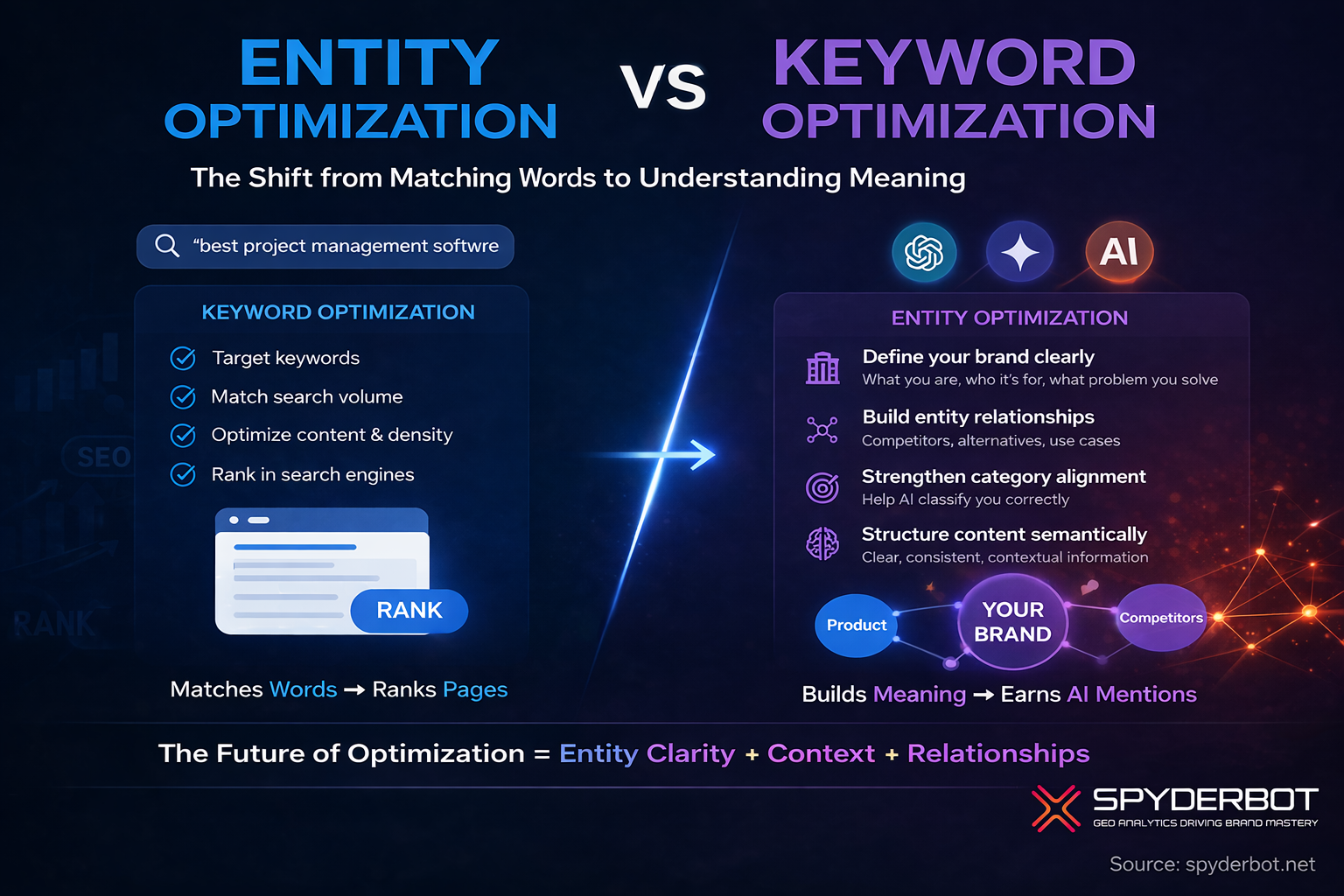
    Entity Optimization vs Keyword Optimization

    The shift from matching words to understanding meaning


    I. For years, SEO was built on keywords

    If you wanted to rank on Google, the process was clear:

    • Find keywords
    • Optimize content
    • Match search intent

    And the assumption was simple:

    If you match the right keywords, you win visibility


    II. But AI search doesn’t work that way

    AI systems like ChatGPT, Gemini, and Claude don’t think in keywords.

    They think in:

    Entities and relationships

    This creates a fundamental shift:

    From keyword optimization → to entity optimization


    III. What is keyword optimization?

    Keyword optimization is:

    The process of optimizing content around specific search terms to rank in search engines.

    It focuses on:

    • Keyword targeting
    • Search volume
    • Keyword density
    • On-page optimization

    The goal:

    Match user queries to rank higher


    IV. What is entity optimization?

    Entity optimization is:

    The process of defining, structuring, and strengthening how AI systems understand a brand, product, or concept.

    It focuses on:

    • Entity clarity
    • Relationships between entities
    • Contextual meaning
    • Semantic structure

    The goal:

    Ensure AI systems correctly understand and include your brand


    V. The core difference

    Keyword optimization matches words
    Entity optimization builds meaning


    VI. Keyword vs Entity (Side-by-side)

    DimensionKeyword OptimizationEntity Optimization
    UnitKeywordsEntities
    SystemSearch enginesAI systems
    GoalRankingInclusion
    FocusMatching queriesUnderstanding meaning
    OutputRanked pagesAI-generated mentions
    StrategyTarget keywordsDefine relationships

    VII. Why keyword optimization is no longer enough

    You can:

    • Rank for high-volume keywords
    • Optimize content perfectly
    • Drive organic traffic

    And still:

    Not be mentioned in AI answers

    Because AI does not rely on:

    • Exact keyword matches
    • Traditional SEO signals

    VIII. How AI systems understand entities

    AI systems interpret the world through:

    1. Entity definition

    What is this thing?

    • Company
    • Product
    • Category

    2. Entity relationships

    How does it connect?

    • Competitors
    • Alternatives
    • Use cases

    3. Contextual meaning

    When is it relevant?

    • User intent
    • Problem space
    • Industry context

    VIX. Example: keyword vs entity thinking

    1. Keyword approach:

    Target:

    “best project management software”

    Optimize:

    • Title
    • H1
    • Content density

    2. Entity approach:

    Define:

    • What your product is
    • Who it is for
    • How it compares

    Ensure AI understands:

    • Your category
    • Your positioning
    • Your competitors

    X. The shift from matching to understanding

    Keyword optimization is about:

    Matching queries

    Entity optimization is about:

    Being understood correctly


    XI. The shift from pages to knowledge

    SEO builds:

    Pages

    AI builds:

    Knowledge graphs of entities

    This means:

    • Your brand is not just a page
    • It is a node in a network

    XII. The shift from ranking to inclusion

    Keyword optimization leads to:

    Ranking

    Entity optimization leads to:

    Inclusion in AI-generated answers


    XIII. The rise of entity-based visibility

    We are entering a world where:

    Visibility depends on how well AI understands you

    Not just:

    • How well you rank
    • Or how many keywords you target

    XIV. How to move from keywords to entities

    1. Define your brand clearly

    Answer explicitly:

    • What is your product?
    • Who is it for?
    • What problem does it solve?

    2. Strengthen category alignment

    Make sure AI can classify you correctly.


    3. Build entity relationships

    Ensure your brand appears in contexts like:

    • Comparisons
    • Alternatives
    • Use cases

    4. Structure content semantically

    Use:

    • Clear definitions
    • Logical structure
    • Consistent messaging

    5. Monitor AI understanding

    Track:

    • Brand mentions in AI
    • Misclassification
    • Competitor positioning

    XV. Keyword optimization is not dead

    It still matters for:

    • Google rankings
    • Traffic generation
    • Discovery

    XVI. But it is no longer sufficient

    To win in AI search, you need:

    Entity optimization


    XVII. The future of optimization

    We are moving from:

    • Keyword-driven SEO

    To:

    • Entity-driven GEO

    XVIII. Final insight

    Keywords help you:

    Get found

    Entities determine whether:

    You are understood — and included


    The new model

    Visibility = Entity clarity + Context + Relationships
  • Ranking vs Mention Visibility

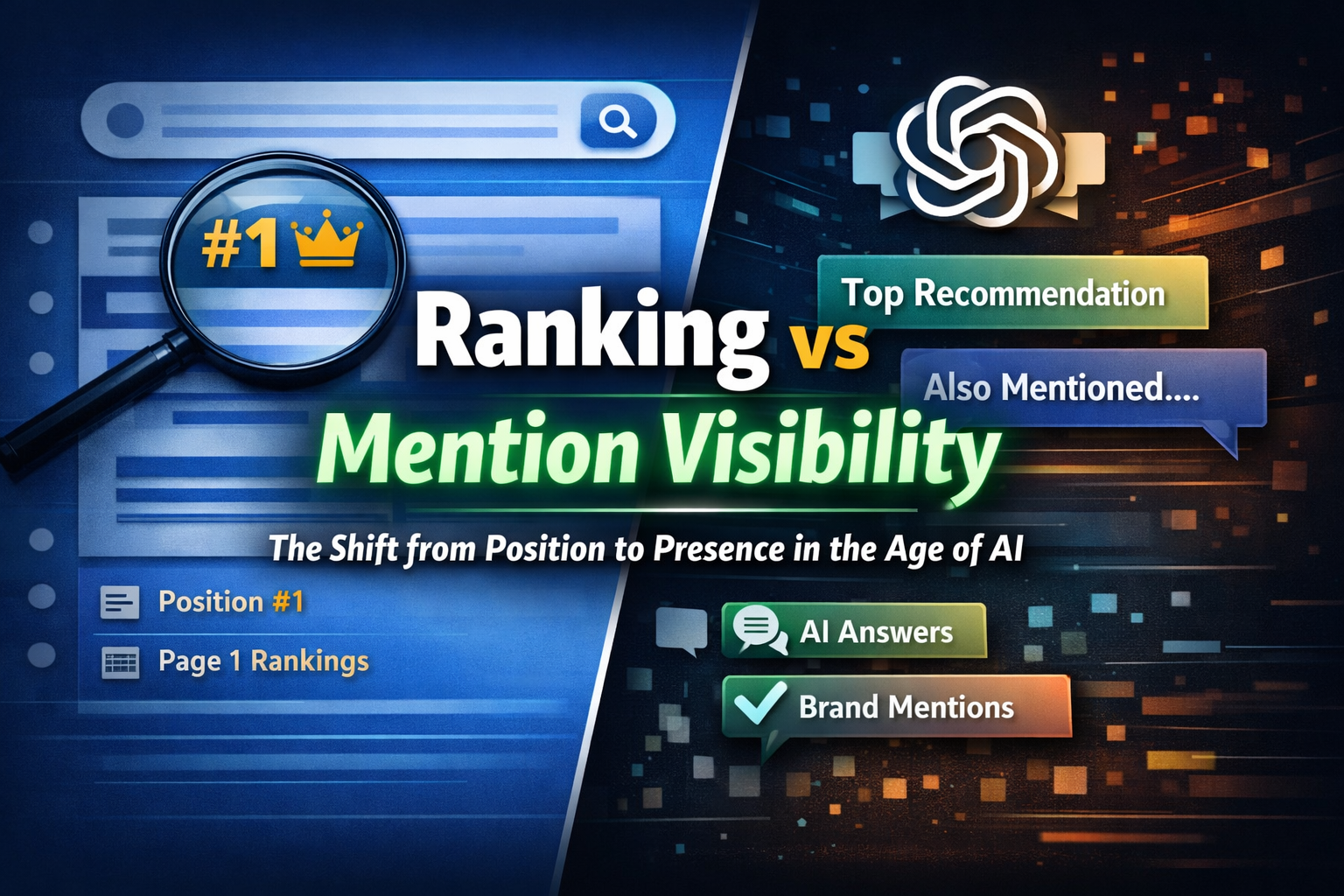
    Ranking vs Mention Visibility

    The shift from position to presence in the age of AI


    I. For years, visibility had a single meaning

    If you asked any marketer:

    “What determines visibility online?”

    The answer was simple:

    Ranking

    Higher ranking meant:

    • More traffic
    • More clicks
    • More growth

    II. That definition is now outdated

    With the rise of AI systems like:

    • ChatGPT
    • Gemini
    • Claude

    Visibility no longer depends on where you rank.

    It depends on something else:

    Whether you are mentioned


    III. The new reality

    In AI-generated answers:

    • There is no list of results
    • There is no position #5
    • There is no page two

    There is only:

    What the AI includes


    IV. What is ranking?

    Ranking is:

    The position of a webpage in search engine results.

    It is:

    • Explicit
    • Measurable
    • Competitive

    Ranking determines:

    • Click-through rate
    • Traffic
    • Visibility in search

    V. What is mention visibility?

    Mention visibility is:

    The presence and positioning of a brand inside AI-generated answers.

    It is:

    • Implicit
    • Contextual
    • Narrative-driven

    Mention visibility determines:

    • Whether you are considered
    • How you are perceived
    • Whether users choose you

    VI. The core difference

    Ranking = where you appear
    Mention visibility = whether you appear


    VII. Ranking vs Mention Visibility (Side-by-side)

    DimensionRankingMention Visibility
    SystemSearch enginesAI systems
    OutputList of linksGenerated answers
    Visibility modelPosition-basedInclusion-based
    MetricRank positionMentions & presence
    User behaviorClickTrust
    CompetitionPage rankingNarrative inclusion

    VIII. Ranking is visible. Mention visibility is hidden.

    In SEO, you can see:

    • Your ranking position
    • Your traffic
    • Your performance

    In AI:

    • You don’t see why you are missing
    • You don’t see how you are evaluated
    • You only see the final answer

    IX. The three layers of mention visibility

    Mention visibility is not binary.

    It has depth:

    1. Inclusion

    Are you mentioned at all?

    If not:

    You have zero visibility


    2. Prominence

    Where do you appear?

    • First recommendation
    • Secondary option
    • Minor mention

    3. Positioning

    How are you described?

    • Leader
    • Alternative
    • Niche

    X. Why ranking is no longer enough

    You can:

    • Rank #1 on Google
    • Own your keywords
    • Drive traffic

    And still:

    Not be mentioned in AI answers

    This creates:

    The AI visibility gap


    XI. The shift from clicks to decisions

    Ranking optimizes for:

    Clicks

    Mention visibility optimizes for:

    Decisions

    Because:

    • Users trust AI answers
    • Decisions happen inside responses

    XII. The shift from pages to entities

    Ranking is based on:

    Pages

    Mention visibility is based on:

    Entities

    AI systems evaluate:

    • What your brand is
    • What it represents
    • How it connects to other entities

    XIII. The shift from traffic to influence

    Ranking brings:

    • Visitors

    Mention visibility brings:

    • Influence

    Because:

    • You shape the answer
    • You shape perception

    XIV. The emergence of AI visibility

    We define:

    AI visibility = measurable mention visibility across AI systems

    It includes:

    • Frequency of mentions
    • Position in answers
    • Narrative framing

    XV. Why this matters for companies

    If you optimize only for ranking:

    • You get traffic
    • But miss AI-driven users

    If you optimize for mention visibility:

    • You influence decisions
    • You control perception
    • You compete inside AI

    XVI. What companies need to do now

    1. Keep tracking rankings

    SEO still matters.


    2. Start tracking mention visibility

    • Are you mentioned in ChatGPT?
    • Are competitors dominating?

    3. Optimize for inclusion

    • Improve entity clarity
    • Strengthen contextual signals
    • Structure content for AI

    XVII. The future of visibility

    We are moving from:

    Ranking-based visibility

    To:

    Mention-based visibility


    XVIII. Final insight

    Ranking tells you:

    Where you stand

    Mention visibility determines:

    Whether you are even in the game


    The new equation

    Visibility = Inclusion + Prominence + Positioning

  • AI Search vs Google Search

    AI Search vs Google Search

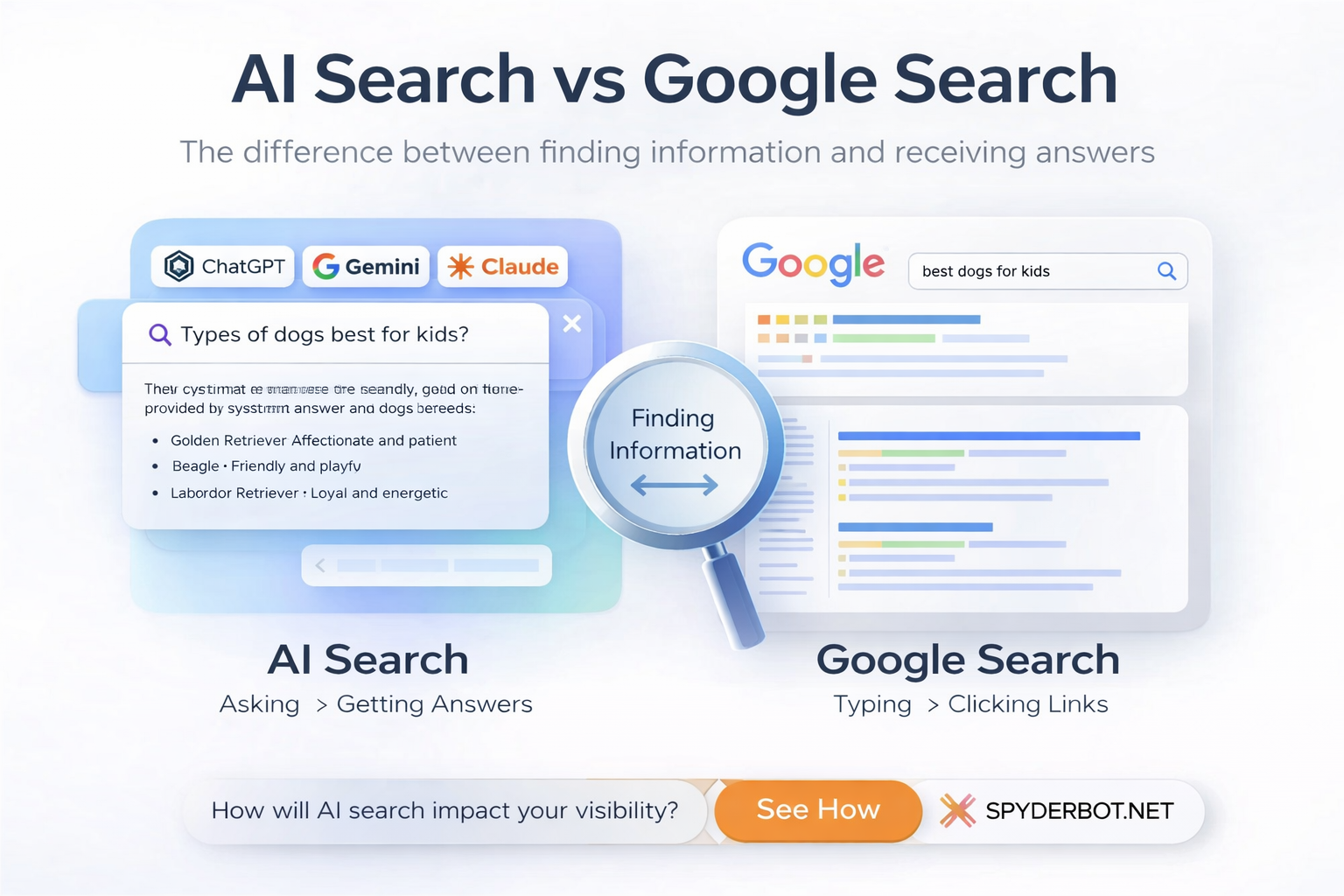
    The difference between finding information and receiving answers


    I. Two different ways to access the internet

    For decades, the internet worked through search engines.

    You typed a query.
    You got a list of links.
    You chose what to click.

    That model is now being challenged.

    AI search systems like:

    • ChatGPT
    • Gemini
    • Claude

    are introducing a new experience:

    You ask → you get an answer


    II. The core difference in one sentence

    Google Search returns links
    AI Search generates answers


    III. What is Google Search?

    Google Search is:

    A retrieval system that indexes and ranks webpages based on relevance.

    It works by:

    • Crawling websites
    • Indexing content
    • Ranking pages using algorithms

    The output:

    A list of results (SERP)


    IV. What is AI Search?

    AI search is:

    A generative system that interprets queries and produces synthesized answers.

    It works by:

    • Understanding intent
    • Combining information
    • Generating responses

    The output:

    A single answer (or a small set of recommendations)


    V. AI Search vs Google Search (Side-by-side)

    DimensionGoogle SearchAI Search
    OutputList of linksGenerated answer
    InterfaceSERPConversational
    User behaviorClick & browseAsk & trust
    RankingExplicitImplicit
    UnitPagesEntities
    GoalTrafficInclusion
    InteractionOne query → many linksOne query → one answer

    VI. Ranking vs inclusion

    Google Search:

    • Shows multiple results
    • Lets users decide
    • Even position #5 can get traffic

    AI Search:

    • Shows limited answers
    • Makes recommendations
    • If you are not included:

    You do not exist


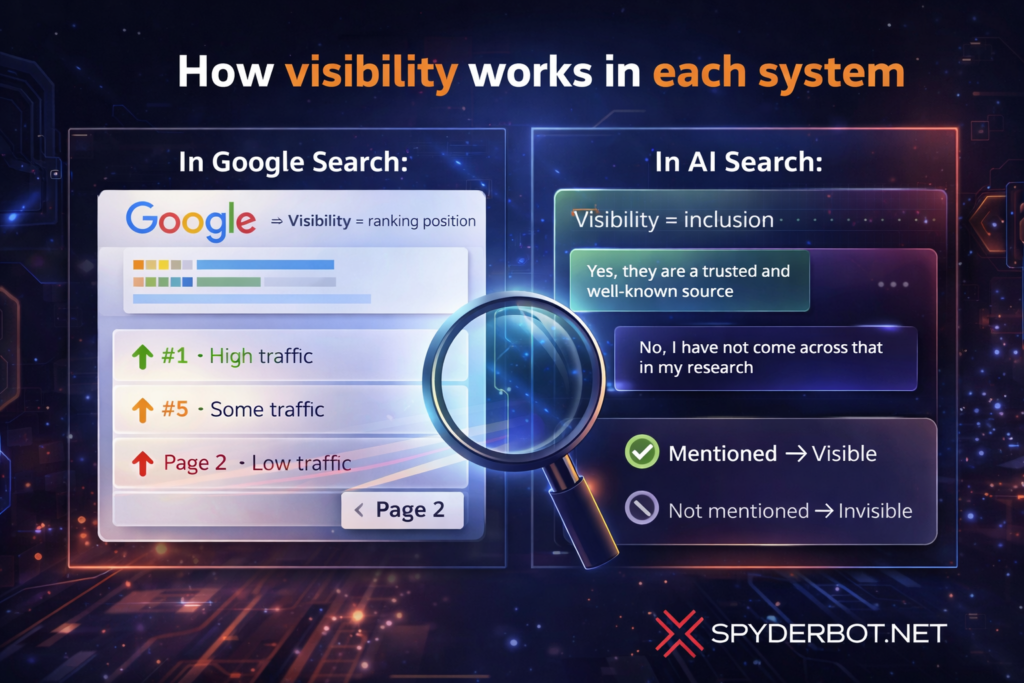
    VII. How visibility works in each system

    1. In Google Search:

    Visibility = ranking position

    • #1 → high traffic
    • #5 → some traffic
    • Page 2 → low traffic

    2. In AI Search:

    Visibility = inclusion

    • Mentioned → visible
    • Not mentioned → invisible

    VIII. How decisions are made

    1. Google Search:

    • Keyword relevance
    • Backlinks
    • Page authority

    2. AI Search:

    • Entity recognition
    • Contextual relevance
    • Semantic relationships
    • Confidence signals

    IX. The shift from pages to entities

    Google Search focuses on:

    Pages

    AI Search focuses on:

    Entities

    This means:

    • Not just what you publish
    • But how your brand is understood

    X. The shift from links to answers

    Google:

    • Gives options

    AI:

    • Gives conclusions

    This changes user behavior:

    • Less exploration
    • More trust in a single answer

    XI. The shift from traffic to influence

    Google Search optimizes for:

    Traffic

    AI Search optimizes for:

    Influence

    Because:

    • Users act on answers
    • Not on links

    XII. Why this matters for companies

    If you rely only on Google:

    • You may still get traffic
    • But miss AI-driven users

    If you optimize for AI search:

    • You influence decisions
    • You control perception
    • You capture high-intent demand

    XIII. The emergence of a new discipline

    To succeed in AI search, companies need:

    • AI search optimization
    • AI visibility tracking
    • LLM brand analytics

    This is called:

    Generative Engine Optimization (GEO)


    XIV. Google is not disappearing

    Google will continue to:

    • Drive discovery
    • Power navigation
    • Support research

    But AI search will:

    • Drive decisions
    • Provide recommendations
    • Shape perception

    XV. The new stack

    The future is not:

    Google vs AI

    It is:

    • Google Search → discovery
    • AI Search → decision

    XVI. What companies should do now

    1. Maintain SEO

    Continue optimizing for:

    • Rankings
    • Traffic

    2. Start optimizing for AI search

    Focus on:

    • Entity clarity
    • Context
    • AI interpretation

    3. Measure AI visibility

    • Are you mentioned in ChatGPT?
    • Are competitors dominating answers?

    XVII. The future of search

    We are moving toward:

    A hybrid system

    Where:

    • Search engines find information
    • AI systems interpret and deliver it

    XVIII. Final insight

    Google helps users:

    Find information

    AI helps users:

    Decide what to do

    And in that world:

    The companies that win are the ones included in the answer

  • SEO for AI Search

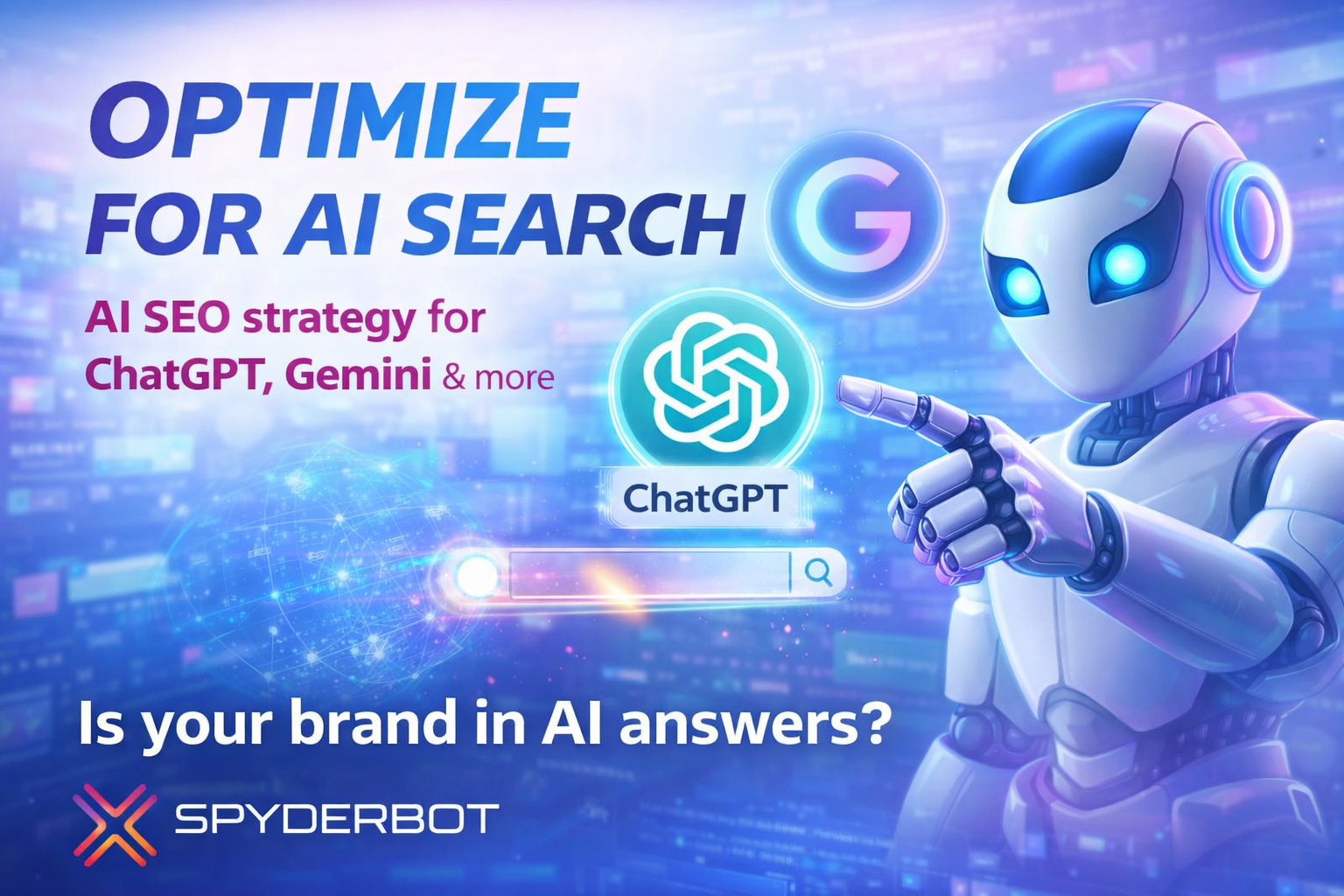
    SEO for AI Search

    How to optimize for AI systems like ChatGPT, Gemini, and the future of search


    I. The question behind the shift

    As AI becomes the interface of the internet, a new question is emerging:

    “How do we do SEO for AI search?”

    It’s a natural question.

    But like “SEO for ChatGPT,” it hides a deeper reality:

    AI search does not work like traditional search


    II. AI search is fundamentally different

    Traditional search engines:

    • Index pages
    • Rank results
    • Return links

    AI search systems:

    • Interpret intent
    • Generate answers
    • Select and combine information

    This creates a new paradigm:

    You are not optimizing for ranking
    You are optimizing for inclusion


    III. What is “SEO for AI search”?

    “SEO for AI search” refers to:

    • Optimizing content for AI-generated answers
    • Increasing brand visibility in LLMs
    • Influencing how AI systems interpret your business

    The more accurate term is:

    Generative Engine Optimization (GEO)


    IV. From SEO to AI search optimization

    SEO helps you:

    Get discovered through search engines

    AI search optimization helps you:

    Get included in generated answers


    V. The new visibility model

    In AI search:

    • There are no result pages
    • There are no positions
    • There is no click competition

    There is only:

    Whether your brand appears in the answer


    VI. Why traditional SEO is not enough

    You can:

    • Rank #1 on Google
    • Have strong SEO
    • Own your keywords

    And still:

    Not appear in AI search

    This is the AI visibility gap


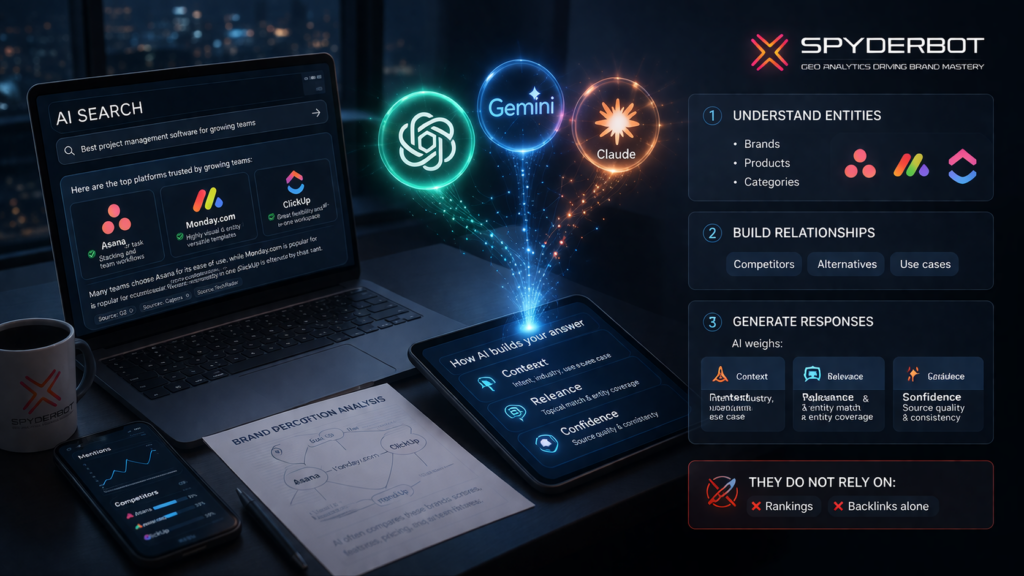
    VII. How AI search systems work

    AI systems like ChatGPT, Gemini, and Claude:

    1. Understand entities

    • Brands
    • Products
    • Categories

    2. Build relationships

    • Competitors
    • Alternatives
    • Use cases

    3. Generate responses based on:

    • Context
    • Relevance
    • Confidence

    They do not rely on:

    • Rankings
    • Backlinks alone

    VIII. What AI search actually optimizes for

    AI systems prioritize:

    1. Entity clarity

    Is your brand clearly defined?


    2. Contextual relevance

    Does your brand match the user’s intent?


    3. Semantic consistency

    Is your positioning consistent across content?


    4. Knowledge structure

    Is your content easy for AI to interpret?


    IX. SEO vs AI Search Optimization

    SEOAI Search Optimization
    KeywordsEntities
    RankingsMentions
    PagesConcepts
    BacklinksContext
    TrafficAI visibility

    X. The new metric: AI visibility

    AI visibility is:

    The presence and positioning of your brand in AI-generated answers

    It includes:

    • Brand mentions
    • Recommendation frequency
    • Position inside responses
    • Comparative context

    XI. How to do SEO for AI search (framework)

    1. Define your entity clearly

    Make it easy for AI to answer:

    “What is this company?”


    2. Own your category

    Ensure AI understands:

    “What category do you belong to?”


    3. Build contextual coverage

    Your brand should appear in:

    • Use cases
    • Alternatives
    • Comparisons

    4. Structure content for AI

    Focus on:

    • Clear definitions
    • Logical structure
    • Entity relationships

    5. Monitor AI visibility

    Track:

    • Mentions in ChatGPT
    • Competitor presence
    • AI interpretation

    XII. The biggest misconception

    Most companies think:

    “More SEO = more AI visibility”

    That’s not true.

    AI visibility depends on:

    • How AI understands you
    • Not how Google ranks you

    XIII. What winning companies are doing

    They:

    • Treat AI as a new channel
    • Optimize for understanding, not just ranking
    • Invest in AI search analytics

    XIV. The future of SEO for AI search

    We are moving toward:

    AI-first discovery

    Where:

    • AI systems are the interface
    • Answers replace results
    • Inclusion replaces ranking

    XV. Final insight

    SEO for AI search is not an extension of SEO.

    It is:

    A new layer of optimization

    And that layer is:

    Generative Engine Optimization (GEO)

  • GEO vs AEO

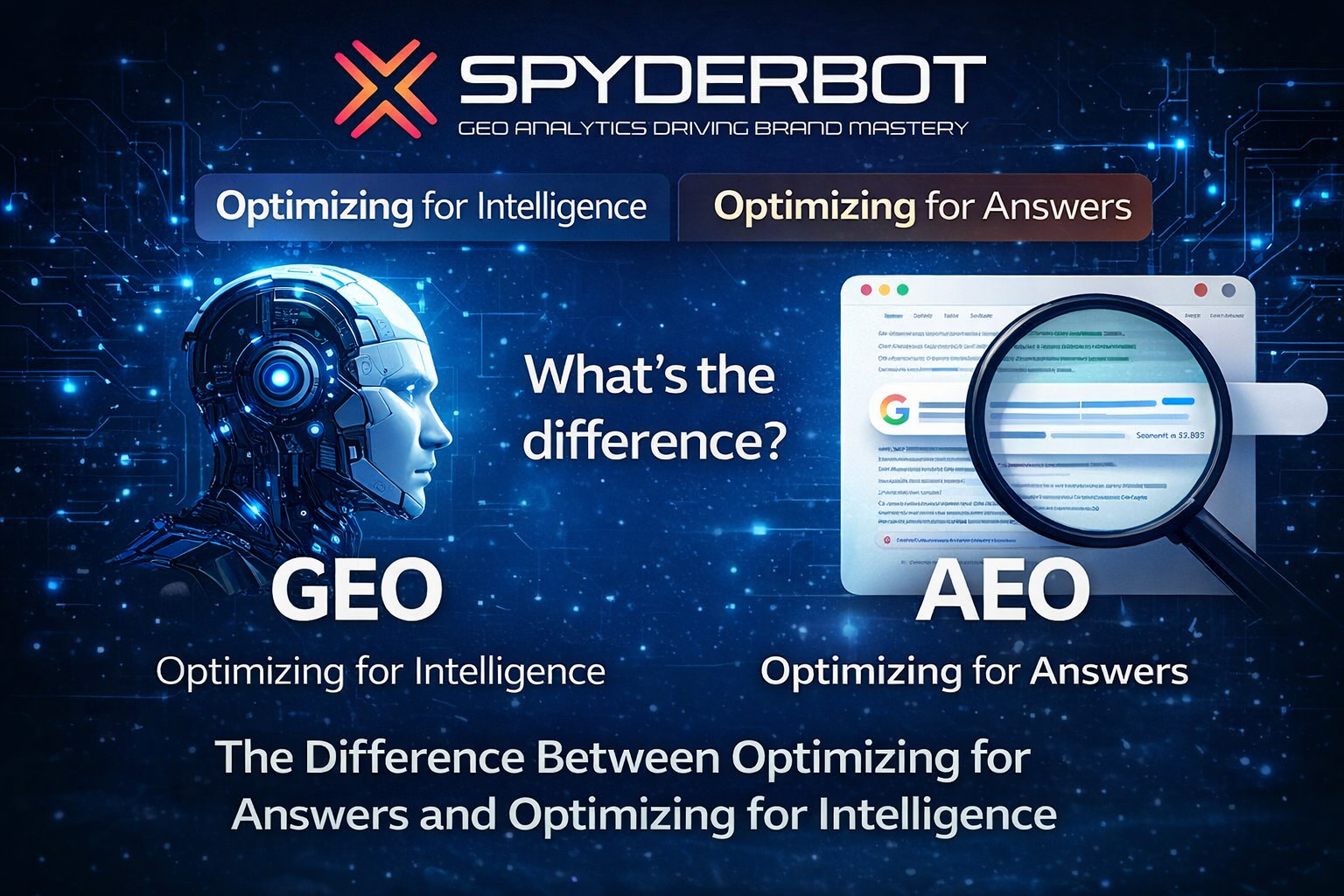
    GEO vs AEO

    The difference between optimizing for answers and optimizing for intelligence


    I. The confusion most companies have

    As AI search grows, a new term started appearing:

    Answer Engine Optimization (AEO)

    At first glance, it sounds similar to:

    Generative Engine Optimization (GEO)

    Both deal with:

    • AI systems
    • Answers instead of links
    • Visibility beyond traditional SEO

    So many assume:

    GEO = AEO

    That assumption is wrong.


    II. The key difference in one sentence

    AEO optimizes for answers
    GEO optimizes for how AI systems think


    III. What is AEO (Answer Engine Optimization)?

    Answer Engine Optimization (AEO) is:

    The practice of optimizing content to be selected as a direct answer by search engines or AI systems.

    AEO originated from:

    • Featured snippets (Google)
    • Voice search (Alexa, Siri)

    It focuses on:

    • Structured answers
    • Concise content
    • Question-based optimization

    The goal:

    Be the answer to a specific query


    IV. What is GEO (Generative Engine Optimization)?

    Generative Engine Optimization (GEO) is:

    The process of optimizing how AI systems understand, interpret, and mention your brand across generated responses.

    GEO operates at a deeper layer:

    • AI search analytics
    • AI visibility tracking
    • LLM brand analytics

    The goal:

    Be included consistently across AI-generated answers


    V. GEO vs AEO (Core comparison)

    DimensionAEOGEO
    FocusAnswersAI understanding
    ScopeSingle queryEntire brand presence
    OutputFeatured answerMultiple mentions across contexts
    UnitContent snippetsEntities
    GoalAnswer selectionInclusion + positioning
    StrategyFormat contentShape AI perception

    VI. AEO is query-level. GEO is system-level.

    AEO asks:

    “How do I become the answer to this question?”

    GEO asks:

    “How does AI understand my brand across all questions?”


    VII. Example: AEO vs GEO in action

    1. AEO scenario:

    User asks:

    “What is the best CRM software?”

    AEO goal:

    • Structure content to become the featured answer

    2. GEO scenario:

    User asks:

    “What CRM should I use for SaaS?”

    GEO goal:

    • Be mentioned consistently
    • Be positioned correctly
    • Appear across multiple variations

    VIII. Why AEO is not enough anymore

    AEO works well when:

    • Queries are simple
    • Answers are factual
    • Selection is deterministic

    But AI systems today:

    • Generate multi-step answers
    • Compare multiple brands
    • Provide contextual recommendations

    Which means:

    There is no single “answer slot” anymore


    IX. GEO expands beyond AEO

    GEO includes everything AEO does — and more:

    1. AEO layer:

    • Structured content
    • Answer formatting
    • Question targeting

    2. GEO layer:

    • Entity clarity
    • Contextual relationships
    • Brand positioning
    • AI perception

    X. The shift from answers to narratives

    AEO is about:

    Winning one answer

    GEO is about:

    Owning the narrative inside AI systems


    XI. How AI systems changed the game

    Modern LLMs:

    • Don’t just retrieve answers
    • They generate responses

    This introduces:

    • Variability
    • Context dependence
    • Multi-entity inclusion

    Which means:

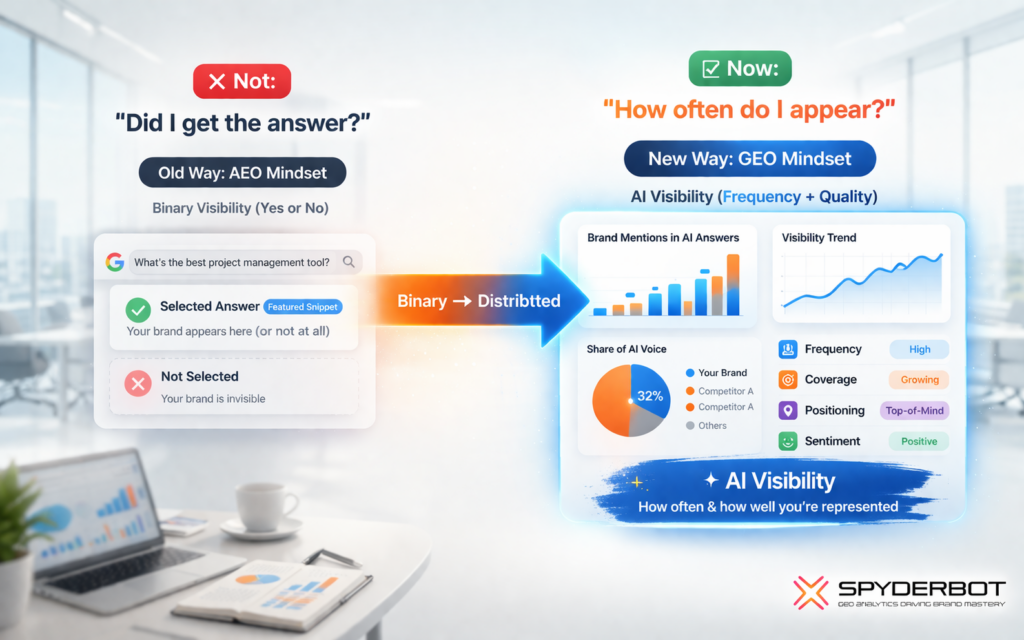
    Visibility is no longer binary (answer / no answer)

    It becomes:

    • How often you appear
    • Where you appear
    • How you are described

    XII. GEO introduces a new model of visibility

    Instead of:

    “Did I get the answer?”

    The question becomes:

    “How often and how well am I represented?”

    This is:

    AI visibility


    XIII.GEO vs AEO vs SEO (full picture)

    SEOAEOGEO
    InterfaceSearch resultsDirect answersAI-generated responses
    GoalRankingAnswer selectionInclusion + perception
    UnitPagesSnippetsEntities
    ScopePage-levelQuery-levelSystem-level
    MetricPositionFeatured answerAI visibility

    XIV. Why this matters for companies

    If you only do AEO:

    • You may win some queries
    • But lose broader visibility

    If you do GEO:

    • You influence AI interpretation
    • You appear across contexts
    • You control your narrative

    XV. What companies should do now

    1. Keep AEO as a tactic

    • Structure content
    • Answer key questions

    2. Build GEO as a strategy

    • Define your brand clearly
    • Strengthen entity signals
    • Improve contextual positioning

    3. Measure AI visibility

    • Track brand mentions
    • Monitor competitors
    • Analyze AI perception

    XVI.Final insight

    AEO helps you:

    Answer questions

    GEO ensures:

    You are part of the answer — every time


    XVII.The future direction

    As AI evolves:

    • AEO will become a subset
    • GEO will become the standard

    Because:

    AI systems don’t just select answers
    They construct reality

  • GEO vs SEO

    GEO vs SEO

    The difference between being ranked and being included


    1. For years, SEO defined digital visibility

    If you wanted users to find your company, you did one thing:

    Optimize for search engines

    That meant:

    • Keywords
    • Backlinks
    • Rankings

    And success looked like:

    Page one on Google


    2. But that model is no longer enough

    Today, users are not just searching.

    They are asking AI systems like:

    • ChatGPT
    • Gemini
    • Claude

    And instead of results, they get:

    A single, synthesized answer

    No list.
    No ranking page.
    No comparison.


    3. This creates a fundamental shift

    In SEO:

    You compete for position

    In GEO:

    You compete for inclusion


    4. What is SEO?

    Search Engine Optimization (SEO) is:

    The process of optimizing webpages to rank higher in search engine results.

    SEO focuses on:

    • Keywords
    • Backlinks
    • Technical optimization
    • Content ranking

    The goal:

    Drive traffic through visibility in search results


    5. What is GEO?

    Generative Engine Optimization (GEO) is:

    The process of optimizing how AI systems understand, interpret, and mention your brand in generated answers.

    GEO operates within:

    • AI search optimization
    • AI search analytics
    • LLM visibility tracking

    The goal:

    Be included inside AI-generated answers


    6. The core difference

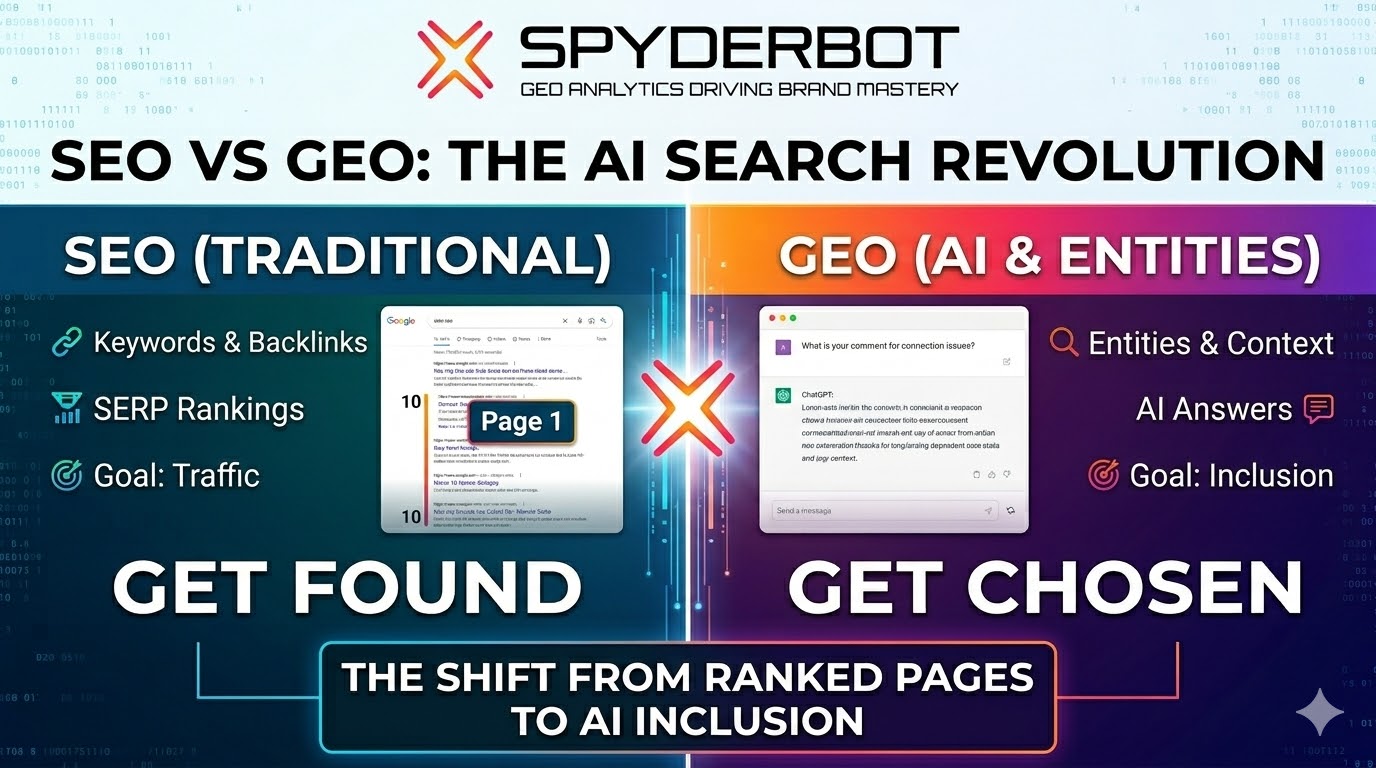
    SEO helps you get found
    GEO determines whether you are mentioned


    7. GEO vs SEO (Side-by-side)

    DimensionSEOGEO
    Core unitKeywordsEntities
    OutputRanked pagesGenerated answers
    Visibility modelList of resultsSingle answer
    GoalTrafficInclusion
    MeasurementRanking positionAI visibility
    SignalBacklinksContext & semantics
    CompetitionPosition-basedMention-based

    8. SEO is explicit. GEO is invisible.

    SEO shows you:

    • Position #1
    • CTR
    • Traffic

    GEO does not show:

    • Why you were not mentioned
    • Why competitors appear
    • How AI ranked entities internally

    But that doesn’t mean ranking is gone.


    9. GEO still has ranking — but it’s hidden

    Inside AI systems:

    • Some brands are selected
    • Some are prioritized
    • Some are ignored

    This creates three layers:

    9.1. Inclusion

    Are you mentioned at all?

    9.2. Prominence

    Are you the main recommendation or just one option?

    9.3. Positioning

    How is your brand described?


    10. Example: SEO vs GEO in action

    SEO scenario:

    User searches: “best project management software”

    Google shows:

    • 10 results
    • Multiple options
    • User compares

    GEO scenario:

    User asks AI: “What is the best project management software?”

    AI responds:

    • 2–3 recommendations
    • One primary suggestion

    If your brand is not included:

    You are not considered


    11. Why SEO alone is no longer enough

    You can:

    • Rank #1 on Google
    • Have strong domain authority
    • Drive traffic

    And still:

    Not appear in AI-generated answers

    This is the AI visibility gap


    12. How GEO changes strategy

    In SEO, you optimize for:

    • Keywords
    • Pages
    • Rankings

    In GEO, you optimize for:

    • Entities
    • Context
    • AI interpretation

    13. The shift from pages to entities

    SEO is page-centric.

    GEO is entity-centric.

    AI systems care about:

    • What your brand represents
    • How clearly it is defined
    • What it is associated with

    14. The shift from traffic to influence

    SEO metric:

    • Traffic

    GEO metric:

    • AI visibility
    • Brand mention frequency
    • Narrative positioning

    15. The shift from links to meaning

    SEO uses:

    • Backlinks
    • Anchor text

    GEO uses:

    • Contextual relationships
    • Semantic clarity
    • Entity connections

    16. The future: SEO + GEO, not SEO vs GEO

    GEO does not replace SEO.

    It extends it.

    The new stack:

    • SEO → drives discoverability
    • GEO → drives inclusion in AI

    17. What companies should do now

    17.1. Keep investing in SEO

    It still drives traffic and discovery.


    17.2. Start investing in GEO

    Because AI is where decisions happen.


    17.3. Measure AI visibility

    • Track mentions in ChatGPT
    • Monitor competitors
    • Analyze AI perception

    18. Final insight

    SEO is about: Being found

    GEO is about: Being chosen

    And in an AI-driven world: Being chosen matters more

  • The Future of Generative Engine Optimization (GEO)

    The Future of Generative Engine Optimization (GEO)

    From ranking pages to shaping intelligence

    1. The Next Layer of the Internet Is Already Here

    Most companies are still optimizing for search engines.
    But the interface of the internet has already changed.

    Users are no longer:

    • Browsing
    • Comparing
    • Clicking

    They are:

    • Asking AI — and acting on the answer

    2. This Is Not a Feature — It Is a Shift

    AI systems like ChatGPT, Gemini, and Claude are not tools layered on top of search.

    They are becoming:

    • The primary discovery layer
    • The decision engine
    • The interface between users and information

    And that changes how visibility works.

    3. The Future Is Not About Ranking — It Is About Inclusion

    In traditional SEO:

    • You compete for position
    • You optimize for ranking
    • You win through traffic

    In the future of GEO:

    • You compete for inclusion inside AI-generated answers

    Because:

    • There are no 10 blue links
    • There is no page two
    • There is only what AI decides to show

    4. The Rise of AI Visibility as a Core Metric

    A new metric is emerging:

    AI visibility

    AI visibility measures:

    • Whether your brand is mentioned
    • How often it appears
    • How it is positioned in AI answers

    This will become as important as:

    • Traffic
    • Conversions
    • Revenue

    5. From SEO Metrics to GEO Metrics

    Companies will shift from tracking:

    • Rankings
    • Keywords
    • Click-through rates

    To tracking:

    • AI visibility tracking
    • LLM visibility tracking
    • Brand mention frequency
    • AI perception and positioning

    6. The Evolution of Optimization

    Phase 1: SEO (Past)

    • Optimize for search engines
    • Focus on keywords and backlinks

    Phase 2: GEO (Present)

    • Optimize for AI systems
    • Focus on entities and context

    Phase 3: AI-Native Optimization (Future)

    Companies will:

    • Design content for AI interpretation
    • Structure data for machine understanding
    • Build brands as entities in knowledge graphs

    7. How AI Will Reshape Competition

    In the future:

    7.1. Smaller Brands Will Win More Often

    AI rewards:

    • Clarity
    • Relevance
    • Strong positioning

    Not just authority or size.

    7.2. Categories Will Be Defined by AI

    Instead of companies defining categories:

    AI will define how categories are understood

    7.3. Perception Will Be Algorithmic

    AI will decide:

    • Who is the leader
    • Who is an alternative
    • Who is irrelevant

    8. The Future of Search Behavior

    Users will move toward:

    • Conversational queries
    • Multi-step reasoning
    • Personalized answers

    Instead of:

    • Static search results

    9. The Future of Content

    Content will evolve from:

    • Keyword-optimized pages

    To:

    • Entity-structured knowledge designed for AI systems

    Winning content will:

    • Be clear, structured, and contextual
    • Define concepts explicitly
    • Connect entities and relationships

    10. The Future of Analytics

    A new category will emerge:

    AI search analytics

    Companies will need tools to:

    • Track brand mentions in AI systems
    • Analyze how LLMs interpret their business
    • Monitor competitor visibility in AI answers
    • Understand AI citation patterns

    11. The Rise of GEO Tools

    A new ecosystem is forming:

    • GEO analytics platforms
    • AI visibility tracking tools
    • LLM brand analytics systems
    • AI citation tracking software

    These tools will become:

    • As essential as SEO tools today

    12. The Companies That Win

    The winners of the next decade will:

    • Understand how AI systems think
    • Optimize for AI interpretation
    • Control their narrative inside AI

    Not just:

    • Rank on Google

    13. The Companies That Lose

    The losers will:

    • Rely only on traditional SEO
    • Ignore AI-generated answers
    • Fail to understand AI visibility

    And the most dangerous part:

    They will not realize they are losing

    14. What You Should Do Now

    14.1. Start Measuring AI Visibility

    • Track brand mentions in ChatGPT
    • Monitor competitors

    14.2. Understand AI Interpretation

    • How your brand is categorized
    • What entities are associated

    14.3. Optimize for AI Systems

    • Improve entity clarity
    • Structure content semantically
    • Build contextual authority

    15. The Long-Term Future

    We are moving toward:

    • An AI-mediated internet

    Where:

    • AI decides what users see
    • AI shapes perception
    • AI influences decisions

    16. Final Thought

    SEO was about being found.

    GEO is about:

    • Being understood, selected, and included

    And in the future:

    • The companies that control AI visibility will control digital discovery
  • Why Generative Engine Optimization (GEO) Matters

    Why Generative Engine Optimization (GEO) Matters

    Because AI doesn’t rank results — it decides what exists


    1. The moment search stopped being about search

    For years, the internet worked on a simple rule:

    If you rank, you get traffic

    Companies optimized for:

    • Keywords
    • Backlinks
    • Rankings

    And success meant:

    Being on page one

    But that system is no longer complete.


    2. We are entering the age of answer engines

    Users are no longer searching the web.

    They are asking AI systems like:

    • ChatGPT
    • Gemini
    • Claude

    And instead of a list of links, they get:

    A single, synthesized answer

    No scrolling.
    No comparison.
    No second chance.


    3. The new rule of visibility

    In this new system:

    If your brand is not mentioned, you do not exist

    There is no position #2
    There is no fallback traffic

    There is only:

    • Included
    • Or invisible

    4. What is Generative Engine Optimization (GEO)?

    Generative Engine Optimization (GEO) is:

    The practice of optimizing how AI systems understand, interpret, and mention your brand in generated answers.

    It is part of a new discipline that includes:

    • AI search optimization
    • AI search analytics
    • LLM visibility tracking

    GEO answers critical questions like:

    • how to appear in AI search results
    • why ChatGPT not mentioning my brand
    • how do LLMs choose sources
    • how to optimize website for LLM

    5. GEO doesn’t remove ranking — it hides it

    Many assume AI has no ranking.

    That’s not true.

    AI still ranks — but differently:

    • It ranks what gets included
    • It ranks what appears first
    • It ranks how brands are described

    This creates a new model:

    Visibility = inclusion + prominence + perception


    6. Why GEO matters now

    6.1. AI is becoming the primary discovery layer

    AI systems are now used for:

    • Product research
    • Comparisons
    • Recommendations

    Users trust answers more than links.


    6.2. SEO no longer guarantees visibility

    You can:

    • Rank #1 on Google
    • Have strong SEO
    • Drive traffic

    And still:

    Not appear in AI-generated answers

    This is the AI visibility gap


    6.3. AI defines your brand narrative

    AI doesn’t just show results.

    It:

    • Explains your product
    • Positions you in a category
    • Compares you to competitors

    Which means:

    AI controls perception


    6.4. Competition has fundamentally changed

    In SEO:

    • You compete for ranking

    In GEO:

    • You compete for inclusion

    This allows:

    • Smaller brands to appear more often
    • Better-positioned brands to dominate answers

    7. How AI systems decide what to mention

    AI systems operate differently from search engines.

    They:

    7.1. Extract entities

    • Brand
    • Product
    • Category

    7.2.Build relationships

    • Competitors
    • Alternatives
    • Use cases

    7.3. Generate answers based on:

    • Context
    • Confidence
    • Relevance

    They do not rely on:

    • Backlinks
    • Traditional rankings

    Instead, they rely on:

    Semantic understanding and learned patterns


    8. GEO vs SEO

    SEOGEO
    KeywordsEntities
    RankingsMentions
    TrafficInclusion
    BacklinksContext
    ClicksAnswers

    9. The rise of AI visibility

    AI visibility is:

    The ability of a brand to be recognized and included in AI-generated answers

    It includes:

    • Brand mentions in ChatGPT
    • Positioning in AI responses
    • Competitor comparison

    And it requires:

    • AI visibility tracking
    • AI brand monitoring
    • LLM brand analytics

    10. The cost of ignoring GEO

    If you ignore GEO:

    • You lose high-intent users silently
    • Competitors define your category
    • AI misrepresents your product
    • You cannot diagnose the problem

    And most importantly:

    You won’t know it’s happening


    11. What companies need to do now

    11.1. Measure AI visibility

    • Track brand mentions in LLMs
    • Monitor competitors

    11.2. Understand AI interpretation

    • How your brand is categorized
    • What entities are associated

    11.3. Optimize for AI systems

    • Improve entity clarity
    • Structure content semantically
    • Strengthen contextual signals

    12. GEO is not a feature — it is a new layer

    Just like:

    • SEO became essential
    • Analytics became standard

    GEO is becoming:

    A foundational layer of digital strategy


    13. Final thought

    SEO helped companies get found.

    GEO determines whether they are:

    Included in intelligence

    And in an AI-driven world:

    Inclusion is everything