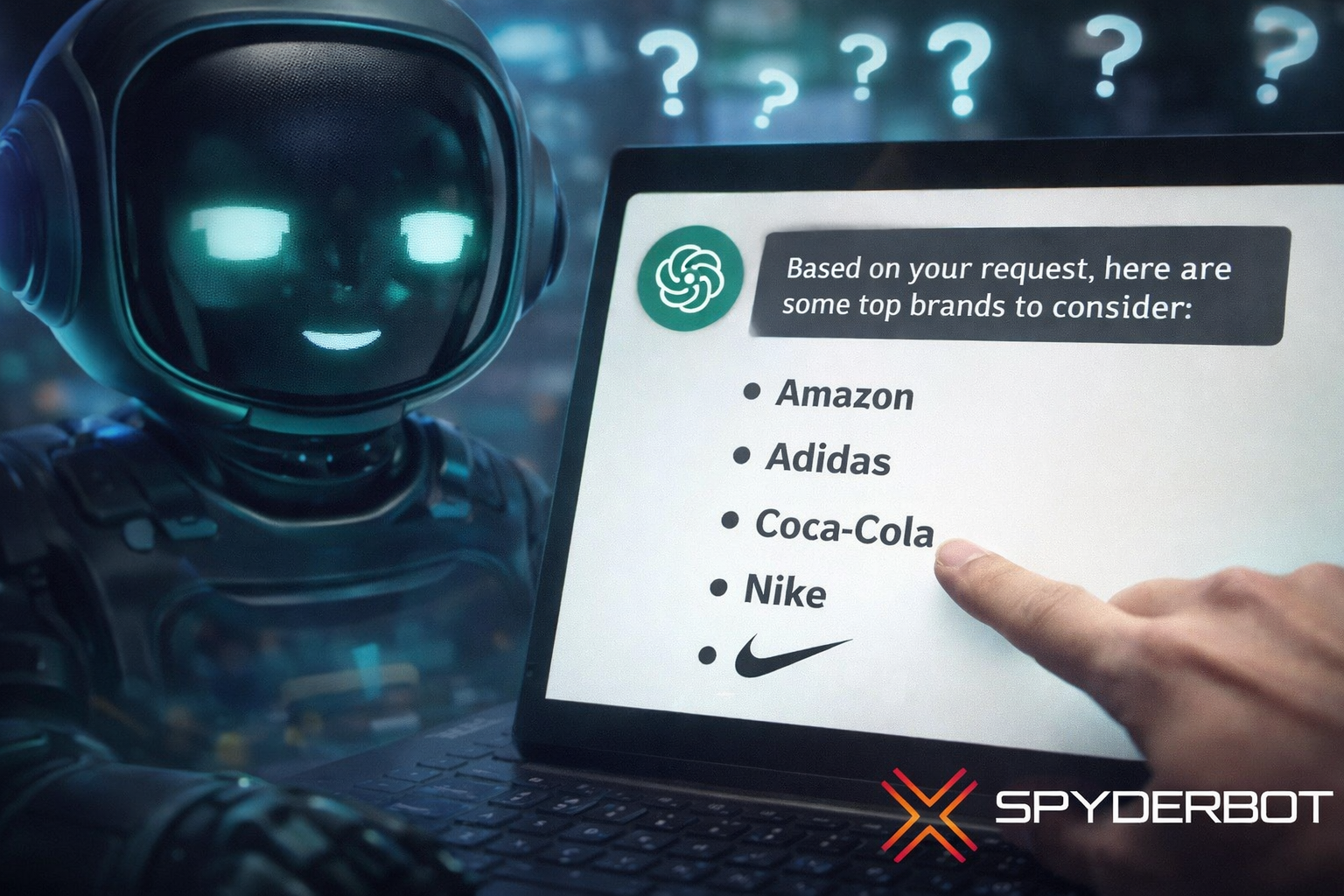
A deep dive into how ChatGPT selects, describes, and prioritizes brands in answers
What does it mean for ChatGPT to “mention” a brand?
When ChatGPT mentions a brand, it is not:
- Pulling from a database
- Listing search results
- Ranking pages
Instead, it is:
Generating an answer and probabilistically selecting brands to include
The key difference
ChatGPT does not retrieve brands
It constructs answers that include brands
The 4-step process of how ChatGPT mentions brands
To understand brand mentions in ChatGPT, we need to break it into 4 practical steps:
- Query interpretation
- Candidate selection
- Brand scoring (implicit)
- Answer construction
1. Query interpretation
“What is the user really asking?”
ChatGPT first interprets:
- Intent
- Context
- Level of specificity
Example:
User asks:
“What are the best SEO tools?”
ChatGPT translates this into:
- Category: SEO tools
- Intent: comparison / recommendation
- Output format: list
Key insight
If your brand is not aligned with how ChatGPT interprets the query, you will not be considered
2. Candidate selection
“Which brands could potentially be included?”
ChatGPT generates a mental candidate set based on:
- Known entities
- Category associations
- Common examples
This is not a fixed list
It depends on:
- Training data
- Context
- Prompt wording
Key insight
You must first enter the candidate pool before you can be selected
3. Brand scoring (implicit)
“Which brands are most likely to be included?”
ChatGPT does not assign explicit scores.
But internally, brands are selected based on:
1. Entity clarity
- Does ChatGPT clearly understand what you are?
2. Context relevance
- Do you fit the query?
3. Association strength
- Are you strongly linked to this category?
4. Prominence patterns
- Are you commonly mentioned in similar contexts?
Key insight
ChatGPT selects brands with the highest probability of relevance
4. Answer construction
“How are brands presented in the final answer?”
Once brands are selected, ChatGPT decides:
- How many brands to include
- In what order
- With what description
This determines:
- Primary vs secondary mentions
- Framing (leader, alternative, niche)
- Visibility prominence
Key insight
Being selected is only half the battle — positioning matters
The ChatGPT Brand Mention Model
Mentions = Interpretation × Selection × Positioning
Why some brands never get mentioned in ChatGPT
1. Not in the candidate set
- ChatGPT doesn’t recognize you in the category
2. Weak relevance
- You don’t match the query intent
3. Weak associations
- Competitors are more strongly linked
4. Low priority in answer construction
- Limited space → you are excluded
The most important factor: association strength
Among all factors:
Association strength is the strongest predictor of being mentioned
Why?
Because ChatGPT relies on:
- Learned patterns
- Co-occurrence
- Repetition across contexts
Example
If users frequently ask:
“Best SEO tools”
And the model has learned:
- SEMrush
- Ahrefs
- Moz
→ These brands become default selections
The role of context in ChatGPT mentions
Mentions are highly context-dependent.
Example:
Query 1:
“Best SEO tools”
→ Enterprise tools dominate
Query 2:
“Best SEO tools for beginners”
→ Different brands appear
Key insight
There is no universal visibility — only contextual visibility
Types of brand mentions in ChatGPT
1. Primary mentions
- Top of the answer
- Strong recommendation
2. Secondary mentions
- Listed among alternatives
3. Comparative mentions
- Compared with competitors
4. Contextual mentions
- Only appear in specific use cases
Why SEO success does not guarantee ChatGPT mentions
Even if you:
- Rank #1
- Have strong backlinks
- Get high traffic
You may still:
Not be mentioned in ChatGPT
Because ChatGPT does not use:
- Rankings
- Click data
- SERP positions
It uses:
- Entity understanding
- Associations
- Contextual relevance
The biggest misconception
“If we create more content, ChatGPT will mention us more”
Not necessarily.
Content only works if it improves:
- Entity clarity
- Associations
- Context coverage
How to improve brand mentions in ChatGPT
1. Strengthen entity clarity
- Clearly define what you are
- Align messaging across sources
- Avoid ambiguity
2. Expand contextual presence
- Appear in multiple use cases
- Cover key scenarios
- Align with user intent
3. Build strong associations
- Be linked to your category
- Appear alongside competitors
- Reinforce relevance
4. Improve positioning signals
- Shape how your brand is described
- Align with desired perception
- Strengthen narrative consistency
A realistic scenario
A company:
- Has strong SEO
- Produces content
But:
- Rarely mentioned in ChatGPT
Root cause:
- Weak category association
- Misaligned positioning
- Limited contextual coverage
Where SpyderBot fits
SpyderBot analyzes:
- Whether you are in the candidate set
- How often you are selected
- How you are positioned
- Why competitors outperform you
It helps answer:
- Why ChatGPT does not mention you
- Where you lose in selection
- How to improve inclusion probability
The honest conclusion
ChatGPT does not “rank” brands.
It:
Selects and constructs answers based on probability
Final insight
You are not competing for position
You are competing for:
Inclusion in the answer
The shift
We are moving from:
- Search-based visibility
To:
- AI-driven selection