Tag: albertsons.com

  • Albertsons Has Presence. The Problem Is the Story AI Keeps Telling About Convenience

    Albertsons Has Presence. The Problem Is the Story AI Keeps Telling About Convenience

    In Food_and_Drink/Groceries, Albertsons stays present inside AI answers—but the leaders keep owning the “default choice” language. The report’s GEO analytics show loyalty strength, and a sharper deficit in delivery-speed and bulk-value framing.

    At-a-glance: Numbers to know

    • Share of Voice: 12% (46 of 382 total LLM brand mentions)
    • Visibility Score: 64 (Amazon 94, Costco 88, Kroger 76, Publix 71)
    • LLM referrals: 41,294 (ChatGPT 22,712; Copilot 7,433; Perplexity 4,955; Gemini 3,304)
    • Total visits: 6,163,316 with 2,329,733 in bot traffic
    • Category rank: #9 in Food_and_Drink/Groceries
    • Overall sentiment score: 75 (Positive 64 / Neutral 22 / Negative 14)

    Risk signals

    • Coverage is 27% on “Best grocery delivery services for organic products” vs Amazon’s 83%
    • Platform Share of Voice drops to 8% on Copilot (ChatGPT 13%, Gemini 14%)

    Opening

    A grocery brand used to win on location and habit. Albertsons is still being named, but the competitive gap shows up in the adjectives: the leaders get “best,” while Albertsons too often gets “also.”

    Position in LLM Response Lists

    Across ChatGPT, Gemini, and Copilot, Albertsons typically appears 4th–5th in broad grocery responses. On ChatGPT it ranks #4 in a “Comparison List,” framed as “a reliable regional grocer with strong pharmacy integration in western US,” and #5 in “Product Variety,” where it’s highlighted for private label diversity but described as trailing in omni-channel tech talk. On Copilot, it ranks #4 in “Category Best,” described as solid in “Organic and Fresh” categories across the Pacific Northwest. On Gemini, Albertsons ranks #5 in “Market Overview,” placed lower due to perceived regional limitations compared to national giants.

    Competitor Gap Analysis

    The gap data clusters around high-intent convenience and scale, where competitors are described as the default recommendation.

    QueryAlbertsons metricCompetitor metricGap/priority
    best grocery delivery service 202467Amazon 9427 (High)
    fresh prepared meals delivery61Amazon 9231 (High)
    bulk household cleaning supplies58Costco 9638 (Medium)
    best app for weekly grocery deals69Kroger 8819 (High)

    The action items show what the models appear to be “missing”: improve technical documentation of delivery SLAs for LLM ingestion; optimize app store metadata and technical whitepapers on app features; and launch a “Stock Up” campaign with structured data for large-pack sizes. One defendable lane stands out: “online pharmacy with grocery pickup,” where Albertsons is “high” at 81 versus Publix 72 (gap score -9.00).

    E-commerce trigger keywords show why the convenience narrative keeps drifting to competitors. “Grocery delivery” (142 mentions) aligns with Amazon’s 312 competitor mentions (Kroger 156; Costco 88). “Same day groceries” (105) again tilts to Amazon at 287 (Kroger 120). “Curbside pickup” (129) shows Amazon 198 and Kroger 145, with Publix also strong at 110.

    Deals and loyalty language split the field. “Digital rewards” (112) is led by Kroger (167) while Amazon holds 88. “Weekly ad flyer” (88) spikes for Publix (97) and Kroger (94). “Meat coupons” (43) skews toward Kroger (89) and Publix (41). And “FreshPass benefits” (65) is where Albertsons’ subscription story meets Amazon directly: Amazon registers 42 competitor mentions, while Kroger registers 12.
    albertsons.com’s Trigger Keywords for Competitor Products (GEO Report, Jan 15, 2026)

    Founder Negative Context

    Founder and investment talk adds reputational drag that can spill into business summaries. Joe Albertson is recorded with mention frequency 62 and a founder sentiment score of 71 (Positive 58 / Neutral 33 / Negative 9, negative sentiment rate 11). Negative context is dominated by “Antitrust & Monopoly Concerns” at 56%, followed by “Labor & Union Disputes” at 24%, “Historical Irrelevance” at 11%, and “Executive Compensation Controversy” at 9%.

    The trend intensifies: “Antitrust” rises from 52% in 2024-Q1 to 61% in 2024-Q2. Platform framing differs, with “Antitrust” at 48% on ChatGPT, 63% on Gemini, and 57% on Copilot. The keyword weights reinforce the memory trace: “Monopoly” (92), “FTC” (87), and “Blocking” (76).

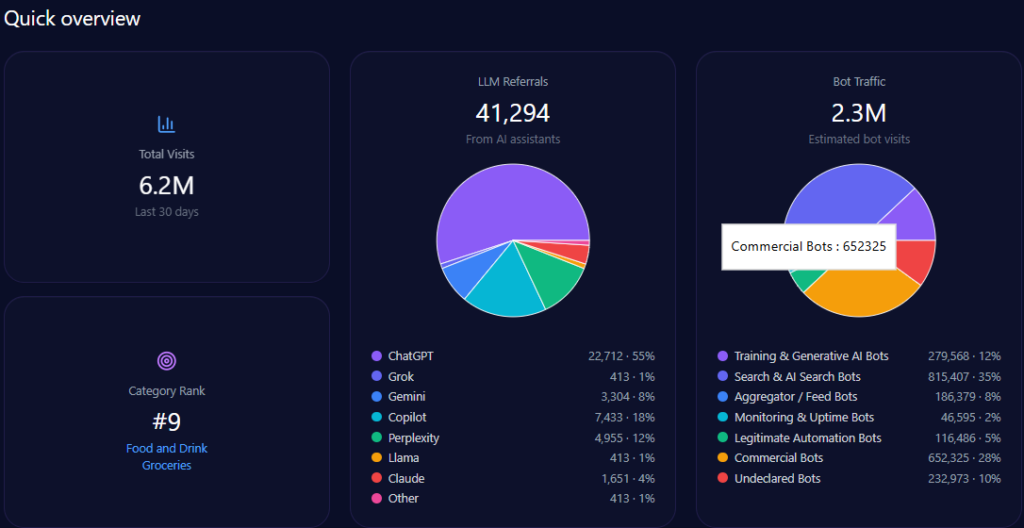
    Albertsons logs 6,163,316 total visits with 2,329,733 in bot traffic. Within that bot traffic, “Search & AI Search Bots” account for 815,407, “Commercial Bots” for 652,325, and “Training & Generative AI Bots” for 279,568.

    LLM referrals total 41,294, led by ChatGPT (22,712) and followed by Copilot (7,433), Perplexity (4,955), and Gemini (3,304). The category position is #9 in Food_and_Drink/Groceries.
    albertsons.com’s Quick overview (GEO Report, Jan 15, 2026)

    Share of Voice in LLM Responses

    Albertsons holds 12% share of voice with 46 mentions out of 382, with “Others” at 9% (34). Amazon leads at 28% (107), Costco 22% (84), Kroger 18% (69), and Publix 11% (42). Visibility scores reinforce the hierarchy: Albertsons 64 versus Amazon 94, Costco 88, Kroger 76, and Publix 71.

    Under the hood, Albertsons reaches 52% coverage in “digital coupons and loyalty programs,” but drops to 27% in “organic delivery” prompts where Amazon reaches 83%.

    AI Platform-Specific Visibility

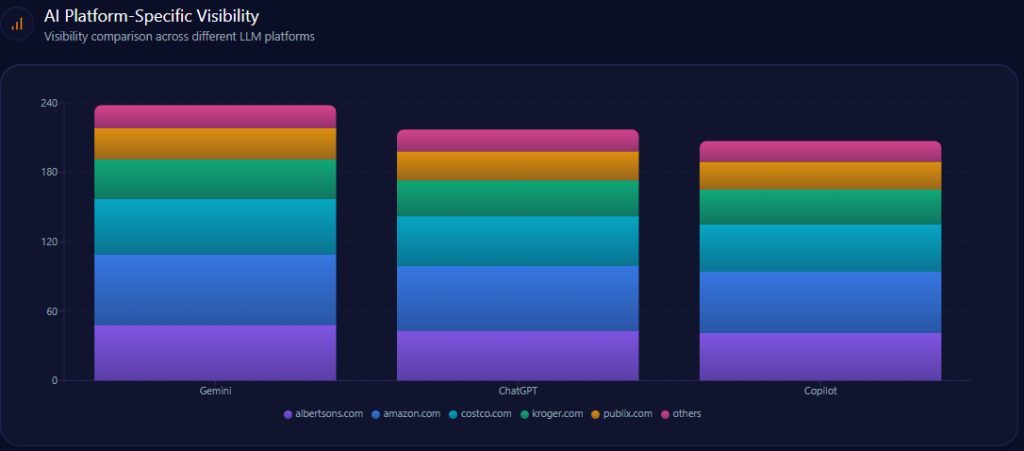
    On Gemini, Albertsons holds 14% share of voice (19 mentions of 134), behind Amazon (25%, 34) and Kroger (22%, 29). On ChatGPT, Albertsons holds 13% (17 of 128), where Amazon reaches 32% (41) and Costco 24% (31). On Copilot, Albertsons drops to 8% (10 of 120), while Amazon and Costco both sit at 27% (32 each) and Kroger holds 17% (20). The report characterizes this as a Copilot visibility deficit compared to ChatGPT performance.

    Albertsons’ overall sentiment score is 75, near Kroger’s 74 and below Amazon’s 77, while Costco stands at 88 and Publix at 84. Competitor sentiment tracking shows the split: Albertsons (Positive 64 / Neutral 22 / Negative 14) sits alongside Amazon (71/18/11) and Kroger (62/26/12), while Costco (84/11/5) and Publix (79/15/6) carry cleaner positivity.

    Theme volume explains where tone can drift. “Loyalty & Rewards” appears 87 times (frequency 58.00, Positive tone). “Organic/Private Labels” appears 52 times (frequency 35.00, Positive tone). The pressure themes are “Merger & Acquisition” (63, frequency 42.00, Neutral) and “Pricing & Inflation” (48, frequency 32.00, Negative).
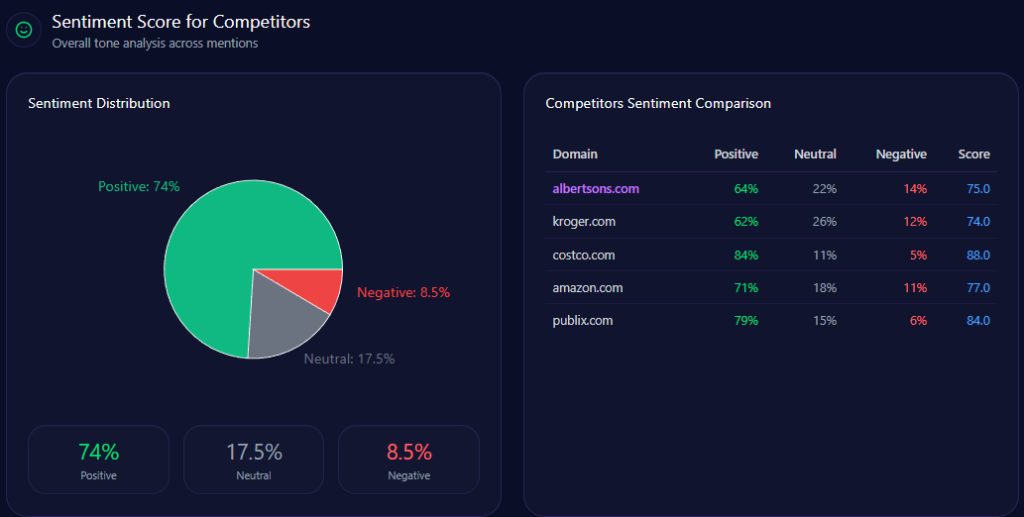
    albertsons.com’s Sentiment Score for Competitors (GEO Report, Jan 15, 2026)

    Top Prompts Driving Mentions

    The largest prompts are where Albertsons most clearly gets pushed into “alternative” framing. “Which store is cheapest for a family of four buying in bulk?” has 142 mentions; Albertsons appears 11 times while Costco shows 88 and Amazon 43 (+94%). “Best grocery store for 1-hour delivery in suburban areas?” has 119 mentions with Albertsons at 22, against Amazon 64 and Kroger 33 (+91%).

    The more favorable prompts are ones that force specificity. “Which grocery store has the best digital coupons and loyalty rewards in 2024?” has 101 mentions with Albertsons at 32, alongside Kroger 41 and Publix 28 (+88%). “Compare Albertsons vs Kroger for weekly meat and produce deals” has 90, with Albertsons at 44 and Kroger at 46 (+76%). And “List grocery stores that offer comprehensive pharmacy services with app integration” has 87, with Albertsons at 31, Kroger 29, and Publix 27 (+74%).

    Types of Prompt Queries

    The prompt mix is concentrated: Comparison is 60 (count 6) and Feature Inquiry is 40 (count 4). Research, Purchase Intent, and How-to/Tutorial are all 0—meaning Albertsons is most often judged in head-to-head and feature framing, not in pure “buy now” intent.

    E-commerce Sentiment for Competitor Products

    In e-commerce results, Albertsons holds 14.29% share of voice with 21 mentions, while Amazon leads at 36.73% (54) and Kroger at 22.45% (33) (Costco matches Albertsons at 14.29%, 21). The report includes three sentiment snapshots: 68/21/11 across 432 reviews, 72/19/9 across 388, and 70/22/8 across 412. Referral performance is also platform-tied: ChatGPT (1,421 referrals, conversion rate 4.2), Gemini (1,356, 4.5), and Copilot (1,210, 3.9).

    The snippets show what shoppers reward—and what they penalize. “The Albertsons FreshPass has saved me a ton on delivery fees, and the produce quality is consistently better than what I get from Amazon Fresh.” (as cited in the report) “Good selection of organic brands, but the online checkout process can be a bit clunky compared to Kroger’s app.” (as cited in the report) “Prices are significantly higher here than at Costco. I only shop at Albertsons for items I can’t find in bulk.” (as cited in the report)

    Conclusion

    Albertsons is present, generally well-regarded, and strongest where loyalty and pharmacy convenience can be described with specificity. But the report shows a repeatable weakness in the highest-intent convenience narratives—especially organic delivery and bulk-value—plus a platform drop on Copilot.

    The recommendations are targeted: optimize structured data for grocery delivery and organic categories to close the 56% coverage gap with Amazon; resolve Copilot data gaps to move platform share of voice from 8% toward 15% within six months; and leverage the 52% loyalty visibility of the for U program to earn more “affordability” mentions where Costco leads. fileciteturn0file0

    Explore SpyderBot to operationalize these GEO analytics insights.
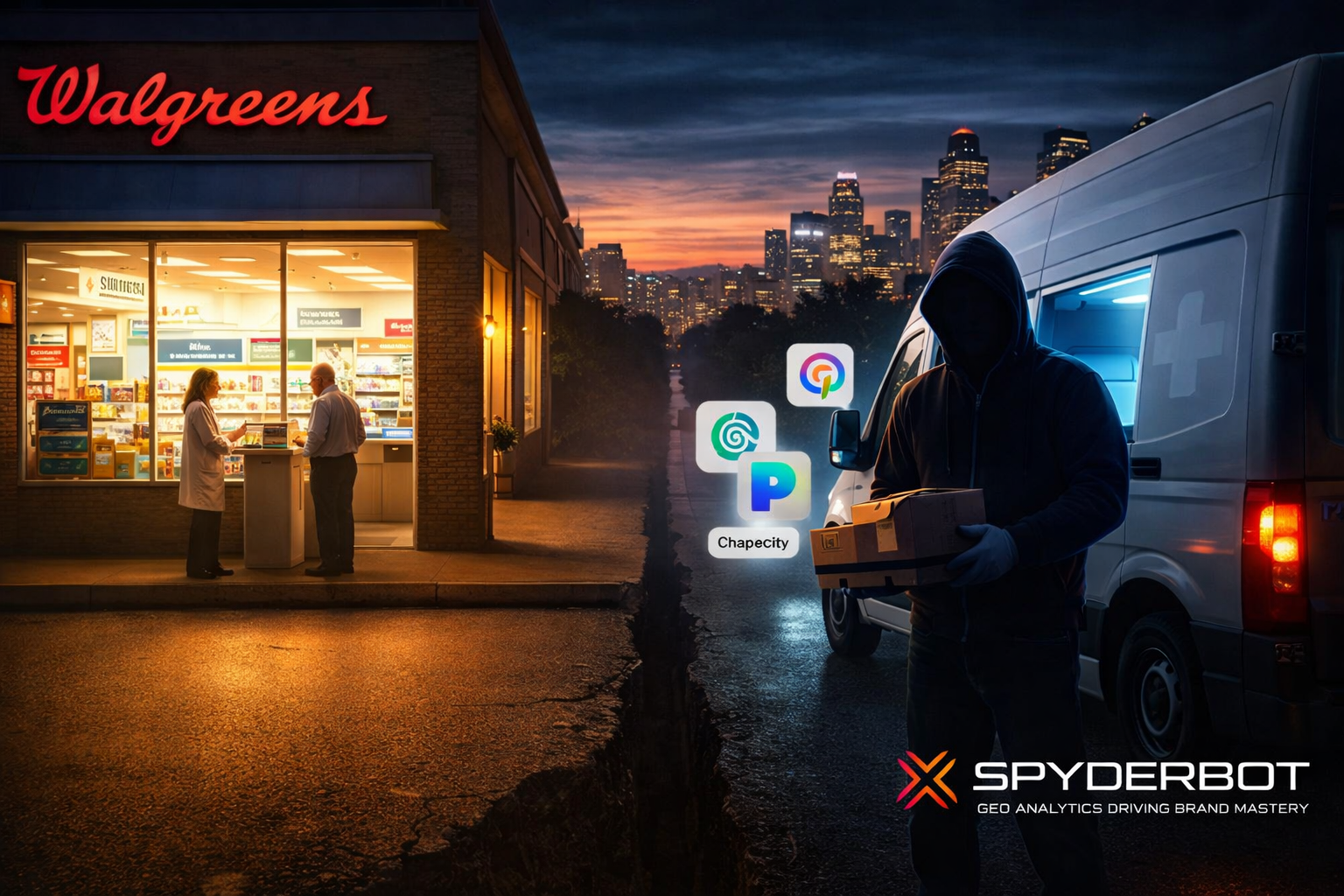
  • Walgreens’ 24% Share of Voice Is Holding the Neighborhood-Clinic Crown and Exposing the Real Digital Delivery Gap

    Walgreens’ 24% Share of Voice Is Holding the Neighborhood-Clinic Crown and Exposing the Real Digital Delivery Gap

    The GEO picture is clear: Walgreens stays highly visible when “near me” and clinical service questions hit LLMs—but the fastest-growing convenience narratives are being rewritten by digital-first rivals.

    At-a-glance: Numbers to know

    • 57,204,306 total visits, including 17,978,131 in bot traffic
    • 108,116 LLM referrals, led by ChatGPT (56,220), Perplexity (19,461), and Gemini (15,136)
    • 24% Share of Voice (92 of 384 LLM brand mentions)
    • Visibility Score: 76 for Walgreens, versus 84 for Amazon Pharmacy
    • Category Rank: #2 in Health/Health
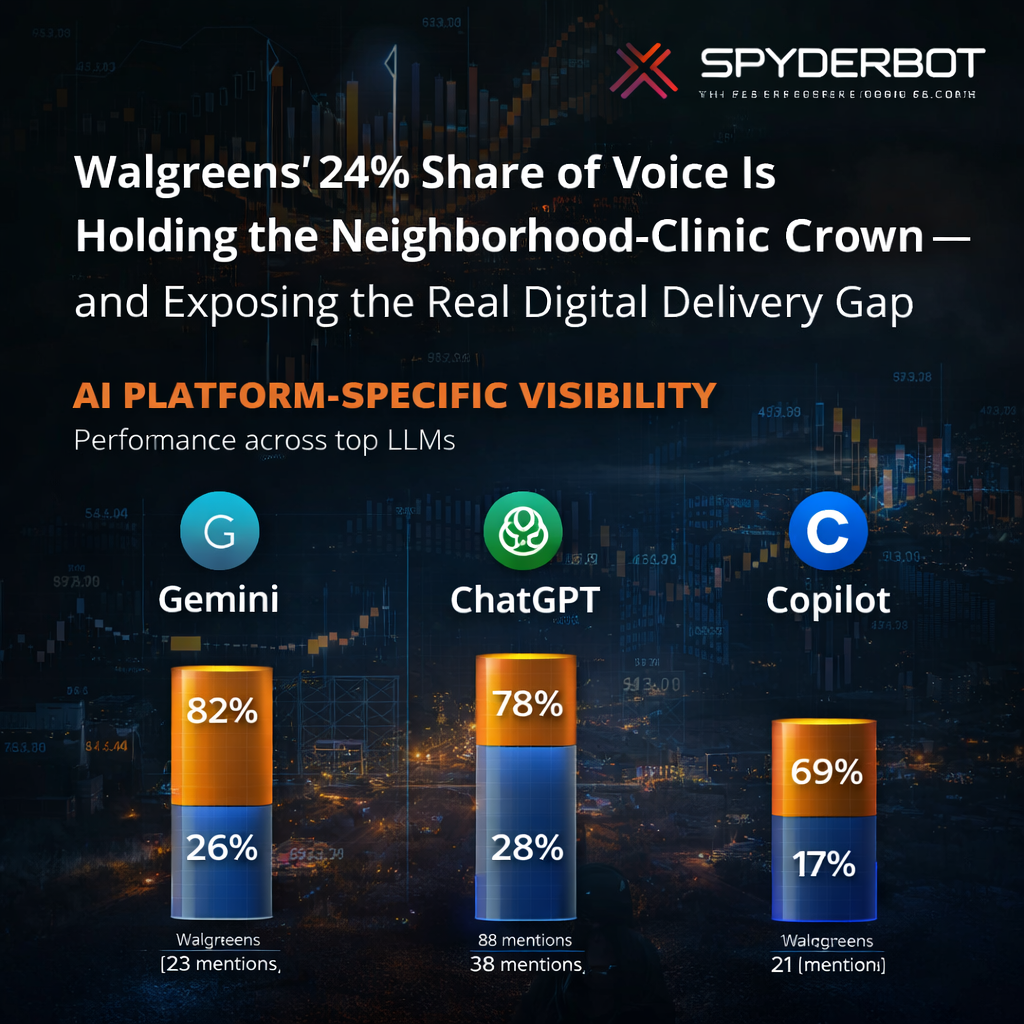
    • Platform split: Gemini visibility 82%, ChatGPT 78%, Copilot 69%

    Risk signals

    • A -34 point gap versus Amazon Pharmacy on online pill pack management (62 vs 96)
    • CEO Tim Wentworth sentiment score 52, with 28% negative mentions tied to restructuring narratives

    Report source:


    Opening

    Imagine a customer rushing through a weekday: a refill that can’t wait, a vaccine appointment that has to fit into a narrow lunch break, a pharmacy that needs to be open now, not “two-day delivery.” In that moment, Walgreens’ advantage isn’t abstract—it’s physical, local, immediate.

    But the same customer might ask the next question in the same breath: What’s the cheapest option? Which service is fastest for home delivery? Who makes recurring prescriptions effortless? That’s where the generative narrative starts to shift. The Walgreens story inside modern GEO analytics isn’t a collapse—it’s a split-screen. One screen shows dominance in urgent, local healthcare utility. The other shows competitors steadily capturing the digital convenience frame that LLMs increasingly treat as the default.


    Across LLM response lists, Walgreens shows up as an authority brand—but not always as the first pick when the question tilts toward digital-first pharmacy convenience.

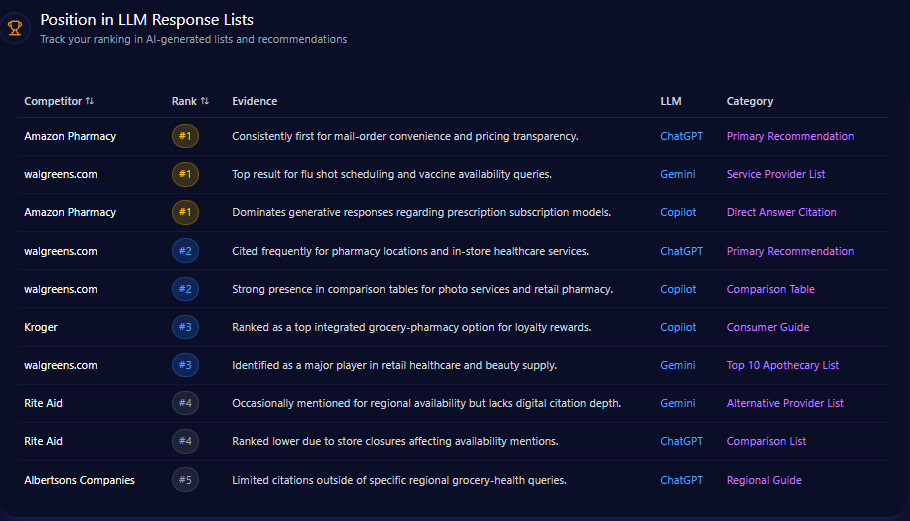
    In ChatGPT, Walgreens is positioned #2 in a Primary Recommendation context, with evidence pointing to frequent citation for pharmacy locations and in-store healthcare services. In Gemini, Walgreens rises to #1 on a Service Provider List, anchored by being the top result for flu shot scheduling and vaccine availability queries. The pattern is consistent: Walgreens wins when the question is rooted in services that benefit from a physical footprint.

    In Copilot, Walgreens appears #2 in a Comparison Table format, cited for photo services and retail pharmacy—but the same environment also elevates rivals that win the “structured comparison” game. Amazon Pharmacy repeatedly takes #1 spots for mail-order convenience and subscription narratives, including #1 in a Direct Answer Citation context tied to prescription subscription models.

    Zooming out, industry ranking signals reinforce that split identity. Walgreens holds position 2 in Retail Pharmacy within Healthcare Services with a rank_score of 87, while Amazon Pharmacy is position 1 in E-commerce Healthcare with a rank_score of 93. Yet Walgreens also holds position 1 in Immunization Services with a rank_score of 91, showing that clinical-service authority remains a major moat inside LLM ranking logic.

    walgreens.com’s Position in LLM Response Lists (GEO Report, Jan 15, 2026)

    Competitor Gap Analysis

    The competitive map is less about “who is bigger” and more about “who owns the default narrative” in each query cluster.

    Walgreens’ strongest generative territory is physical accessibility and clinical authority. In the gap data, Walgreens posts clear advantages in 24 hour pharmacy availability (88 vs 54 against Albertsons; gap_score 34, priority Medium) and cheapest flu shots near me (92 vs 78 against Rite Aid; gap_score 14, priority Medium). Even travel vaccine consultations shows a striking edge (84 vs 41 against Amazon Pharmacy; gap_score 43, priority Low)—a reminder that LLMs still privilege clinic-backed credibility when the topic is clinical and location-dependent.

    But the pressure points are equally clear, and they are the ones shaping “modern convenience” perceptions:

    • online pill pack management is a Critical vulnerability: Walgreens 62 versus Amazon Pharmacy 96 (gap_score -34)
    • same day prescription delivery becomes a High-priority gap: Walgreens 73 versus Amazon Pharmacy 94 (gap_score -21)
    • grocery and pharmacy rewards shows Walgreens lagging Kroger: 68 versus 89 (gap_score -21, priority High)
    • prescription cost comparative tool favors Amazon for visibility in open price access: Walgreens 71 versus 91 (gap_score -20, priority High)
    • Even “how easy is it to switch?” shows friction perception: easy prescription transfers at 79 versus 88 (gap_score -9, priority High)

    A compact view of the battle map:

    QueryWalgreens position/metricCompetitor position/metricGap/priority
    online pill pack management6296 (Amazon Pharmacy)-34 / Critical
    same day prescription delivery7394 (Amazon Pharmacy)-21 / High
    grocery and pharmacy rewards6889 (Kroger)-21 / High
    cheapest flu shots near me9278 (Rite Aid)14 / Medium

    This is where leadership should read the report like a strategy memo: Walgreens doesn’t need to “become Amazon.” It needs to ensure that LLM summaries can confidently describe Walgreens’ digital prescription management in the same crisp, structured way they describe Amazon’s.


    Trigger Keywords for Competitor Products

    The trigger layer shows how quickly competitor brands can be “summoned” when customers use product- and convenience-coded phrases.

    Several keywords consistently pull Amazon Pharmacy into the foreground: online pharmacy delivery is a prime example, where Amazon records 56 competitor mentions within that keyword cluster. Similar patterns appear in device and home-health product triggers—blood pressure monitor shows Amazon at 49, and contact lenses shows Amazon at 31.

    Kroger and Albertsons rise when the keywords imply retail value systems rather than pharmacy service alone. For vitamin coupons, Kroger leads at 31 and Albertsons follows at 28. For OTC medication deals, Kroger registers 26 and Albertsons 22, while Amazon remains strong at 34—suggesting that “deals” language is a multi-brand gateway where Walgreens must compete on structured offer clarity.

    Not every trigger is a loss. In service-adjacent keywords tied to Walgreens’ local utility, the competitive set fragments. photo printing near me carries a high overall mention count (51), but much of that demand spills into “others” (31), with Walgreens’ opportunity implied in the report’s emphasis on same-day pickup visibility in generative lists.

    In short: keyword triggers show where LLMs default to e-commerce logic (Amazon), grocery rewards logic (Kroger/Albertsons), or fragmented “local services” logic (opportunity space). If LLM brand mentions are where customers start their decision, trigger ownership is where they end up.


    Founder Negative Context

    Leadership reputation is not a side note in generative discovery—it is a narrative multiplier. Walgreens’ founder-and-leadership signal is split between heritage trust and modern restructuring anxiety.

    On heritage: Charles R. Walgreen carries a sentiment score of 78, with 71% positive and 6% negative mentions across 62 founder-related mentions—an asset that stabilizes brand trust cues.

    On current leadership: CEO Tim Wentworth appears more frequently (87 mentions) but with a sentiment score of 52, driven by 38% positive, 34% neutral, and 28% negative. The negative context distribution clusters around:

    • Market Volatility & Dividend Cuts (42%)
    • Operational Restructuring (31%)
    • Legal & Settlement Issues (27%)

    The heatmap shows how different models amplify different anxieties: Dividend Cuts registers 48% on ChatGPT, while Restructuring registers 39% on Gemini. On Copilot, Bankruptcy (Rite Aid proximity) appears at 23%, illustrating how industry-wide decline narratives can “cross-pollinate” in competitive answers.

    This is precisely where competitor sentiment tracking matters: the report signals that reputation themes—store closures, labor and staffing pressure, and investment-risk language—can travel with the brand into otherwise operational prompts, subtly changing how LLMs frame reliability.


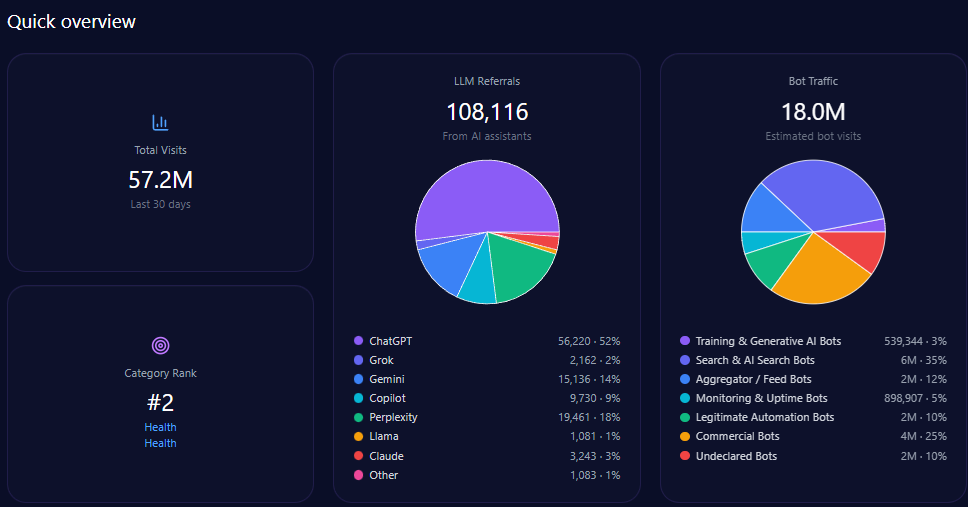
    Walgreens’ footprint in this GEO snapshot is substantial: 57,204,306 total visits and 17,978,131 in bot traffic, with bot activity spread across categories like Search & AI Search Bots (6,292,346) and Commercial Bots (4,494,533).

    LLM referrals total 108,116, led by ChatGPT (56,220), followed by Perplexity (19,461) and Gemini (15,136), with additional flows from Copilot (9,730) and smaller streams including Claude (3,243). In category standing, Walgreens holds #2 in Health/Health—a high-water mark that makes the digital-competition gaps more urgent, not less.

    walgreens.com’s Quick overview (GEO Report, Jan 15, 2026)

    Share of Voice in LLM Responses

    In share-of-voice terms, Walgreens holds 24% of 384 total mentions (92 mentions), ahead of Amazon Pharmacy’s 21% (81) and ahead of Kroger at 15% (58). Rite Aid stands at 12% (46), and Albertsons at 10% (38), with “others” capturing 18% (69).

    But raw mention volume is only half the story. Visibility scoring shows Amazon Pharmacy leading at 84, while Walgreens sits at 76. That gap matters because visibility is where “being mentioned” turns into “being treated as the default answer.” Walgreens is talked about more than Amazon in total mentions, yet Amazon is framed more prominently in the queries that decide long-term behavior: mail-order, price transparency, automation, and subscription pharmacy.


    AI Platform-Specific Visibility

    Platform behavior reveals where Walgreens is strong—and where it is structurally disadvantaged.

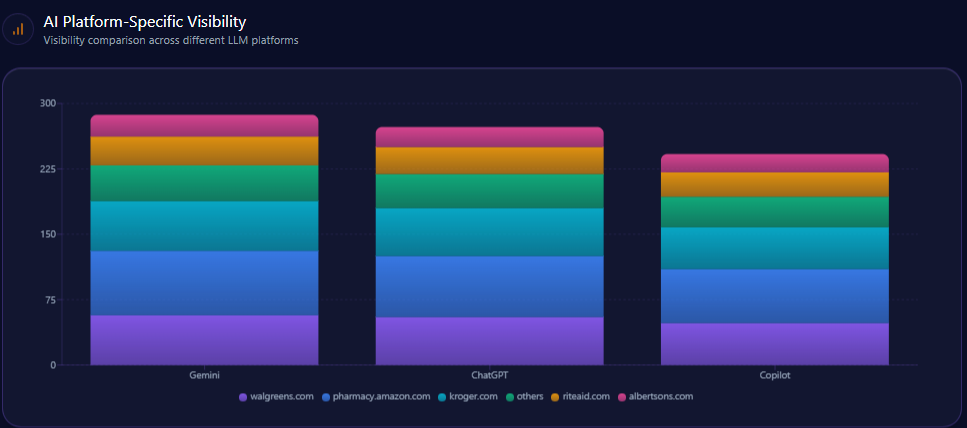
    • Gemini: 82% visibility, Walgreens at 26% share of voice with 33 mentions (of 128 total). Walgreens also benefits from strong “local utility” integration, consistent with being a leading authority in clinic-style prompts.
    • ChatGPT: 78% visibility, Walgreens at 28% share of voice with 38 mentions (of 134 total). Amazon Pharmacy is close behind at 25% with 34 mentions—tight enough that small shifts in structured content could flip “default” perceptions in key prompt categories.
    • Copilot: 69% visibility, Walgreens drops to 17% share of voice with 21 mentions (of 122 total), while Kroger rises to 21% with 26 mentions—especially in price-comparison and rewards logic where table formatting matters.

    This is the platform-bias story in one line: Walgreens performs best when the engine prioritizes local services and clinical accessibility—and underperforms when the engine prioritizes structured comparisons and retail-value systems.

    walgreens.com’s AI Platform-Specific Visibility (GEO Report, Jan 15, 2026)

    Sentiment Score for Competitors

    On overall sentiment, Walgreens sits at 72 (with 58 positive, 24 neutral, 18 negative). Amazon Pharmacy leads at 79 (67 positive, 22 neutral, 11 negative). Kroger follows at 76, and Albertsons at 74. Rite Aid’s sentiment is materially weaker at 54, with a high 31 negative.

    The thematic layer explains why. The most frequent context theme is Prescription Convenience with 842 occurrences (frequency 0.38) and a positive tone, with examples like “Same-day pickup,” “drive-thru pharmacy,” and “app refills.” That’s Walgreens’ home territory—but the report also flags a heavy negative theme: Labor & Staffing at 412 occurrences (frequency 0.19), associated with “Wait times,” “pharmacist burnout,” and “reduced hours.”

    Meanwhile, Pricing & Insurance appears 395 times (frequency 0.18) with a neutral tone—exactly the kind of topic where structured data and clarity can convert neutrality into confidence. Finally, Corporate Stability appears 256 times (frequency 0.11) with a negative tone, reflecting store closures and leadership-change narratives.

    In sentiment trend direction, the report flags Walgreens as stable, while Amazon Pharmacy is marked upward—a subtle but meaningful signal about which story is gaining momentum inside generative answers.


    Top Prompts Driving Mentions

    Walgreens is “summoned” most reliably by prompts that blend clinical care with local convenience—and challenged by prompts that demand digital frictionless economics.

    Top prompts include:

    • “Which pharmacy rewards program offers the best value for groceries and health?” (103 mentions): Walgreens 31, with competitors including Kroger and Albertsons.
    • “Compare Walgreens and Amazon Pharmacy for home delivery speed and cost.” (88 mentions): Walgreens 42, Amazon Pharmacy 46.
    • “What is the best pharmacy for adult flu shots and immunizations in 2024?” (75 mentions): Walgreens 45, with competitors including Rite Aid and Kroger.
    • “Which online pharmacy has the best integration with health insurance plans?” (69 mentions): Walgreens 28, Amazon Pharmacy 41.
    • “Find a 24-hour pharmacy with a drive-thru near high-density urban areas.” (61 mentions): Walgreens 47, with competitors including Rite Aid.

    The direction of travel matters: these prompts show strong trend lifts, including +88% for the home delivery speed/cost comparison and +91% for 24-hour drive-thru access—two queries that pull Walgreens in opposite directions: one toward digital parity, one toward physical dominance.


    Types of Prompt Queries

    The intent mix is unambiguous: Comparison dominates with value 50 and count 5. Feature Inquiry follows with value 30 and count 3. Research and Purchase Intent each register value 10 with count 1 apiece. How-to/Tutorial is 0 with count 0.

    This means Walgreens is being evaluated, not merely discovered. In a comparison-heavy environment, the brands with the cleanest structured explanations—pricing transparency, subscription mechanics, delivery promises—gain disproportionate “default answer” gravity.


    E-commerce Sentiment for Competitor Products

    At the product-and-commerce layer, the share shifts. In e-commerce-focused generative mentions, Amazon Pharmacy leads with 35.42% (51 mentions), while Walgreens holds 31.25% (45). Kroger sits at 11.81% (17), Rite Aid 10.42% (15), and Albertsons 6.94% (10).

    Referral performance in this layer is also telling: ChatGPT drives 1,421 referrals (conversion rate 4.2), Gemini 1,184 (conversion rate 3.8), and Copilot 1,356 (conversion rate 4.5). Referral volume rises notably into late 2025, peaking at 2,105 in Dec 2025, up from 1,102 in Aug 2025, before landing at 1,560 in Jan 2026.

    Trend lines show the competitive drift inside commerce language: Amazon’s e-commerce share rises from 35% (1,620 mentions) in January to 41% (2,200) by June, while Walgreens moves from 32% (1,530) in January to 28% (1,340) in June.

    And the narrative texture is visible in review snippets, as cited in the report:

    • “Walgreens makes it extremely easy to handle prescription refills via the app, and the pharmacy staff is usually very helpful with insurance questions.” (Consumer Affairs, Prescription Refill Service, rating 5)
    • “The wait times at the local Walgreens for simple OTC pickups are getting longer, often making Amazon a better choice for non-urgent items.” (Trustpilot, In-store Pickup, rating 2)
    • “Best place for quick vaccinations. The online booking at walgreens.com is seamless compared to the local grocery store pharmacies.” (Google Reviews, Flu Shot / Vaccination, rating 5)

    This is the e-commerce story in miniature: Walgreens wins on booking, clinics, and urgency; Amazon wins when the basket shifts toward non-urgent convenience and transparent pricing.


    Conclusion

    The report positions Walgreens as a generative leader where healthcare becomes local and immediate—yet increasingly challenged where pharmacy becomes digital and subscription-like. To protect its #2 category standing in Health/Health while defending share in comparison-heavy prompts, the report calls for sharper structured data—especially for Copilot and price-comparison contexts—alongside a stronger authority push in delivery-based prompts to close the 23% coverage gap versus Amazon Pharmacy in prescription delivery categories. It also recommends integrating real-time local stock and 24-hour service metadata into public APIs—an approach aimed at a 12-point lift in stock-related visibility—so Walgreens’ physical advantage remains legible to every model, not just the ones already biased toward local utility. These are not marketing flourishes; they are GEO analytics requirements for staying “default” inside the next wave of LLM brand mentions.

    Explore SpyderBot to operationalize these GEO analytics insights.
  • Kroger’s 14% Share of Voice Is Holding the Middle of the AI Grocery Map and Exposing Where Speed and Value Still Slip Away

    Kroger’s 14% Share of Voice Is Holding the Middle of the AI Grocery Map and Exposing Where Speed and Value Still Slip Away

    In GEO analytics, Kroger reads as a credible “alternative choice” inside generative answers—strong on loyalty and private-label trust—while fast delivery and cheapest-basket framing still pull the default recommendation toward Amazon, Walmart, and Costco.

    At-a-glance: Numbers to know

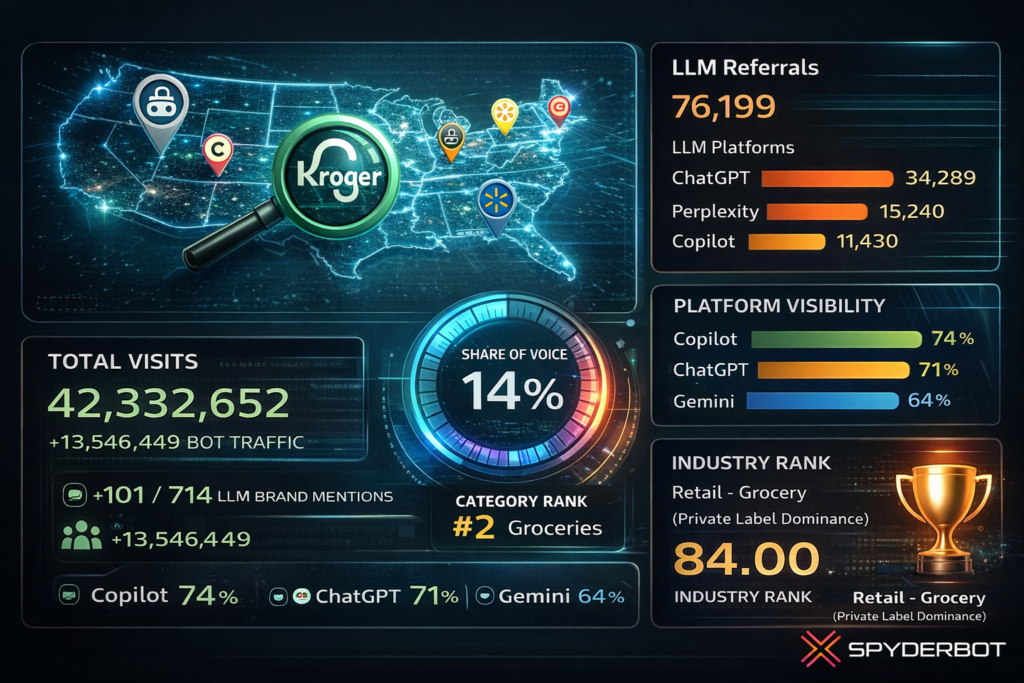
    • 42,332,652 total visits, including 13,546,449 in bot traffic
    • 76,199 LLM referrals, led by ChatGPT (34,289), Perplexity (15,240), and Copilot (11,430)
    • 14% Share of Voice (101 of 714 LLM brand mentions) and a Visibility Score of 73
    • Category rank: #2 in Food_and_Drink/Groceries
    • Platform visibility: Copilot 74%, ChatGPT 71%, Gemini 64%
    • Industry rank score: 84.00 in Retail – Grocery (Private Label Dominance)

    Risk signals

    • Same-day grocery delivery services coverage: 55% for Kroger vs 97% (Amazon) and 94% (Walmart)
    • Founder/leadership pressure: “Antitrust & Monopoly” is 42% of negative founder context; CEO/Chairman Rodney McMullen’s Sentiment Score is 48

    Ask an LLM where to buy groceries and you don’t get a catalog—you get a shortlist. Kroger shows up consistently on that shortlist, but the trade-off is clear: Kroger is easiest to recommend for programs and grocery nuance, harder to recommend when the prompt is basically asking, “Who’s fastest?” or “Who’s cheapest?”

    Position in LLM Response Lists

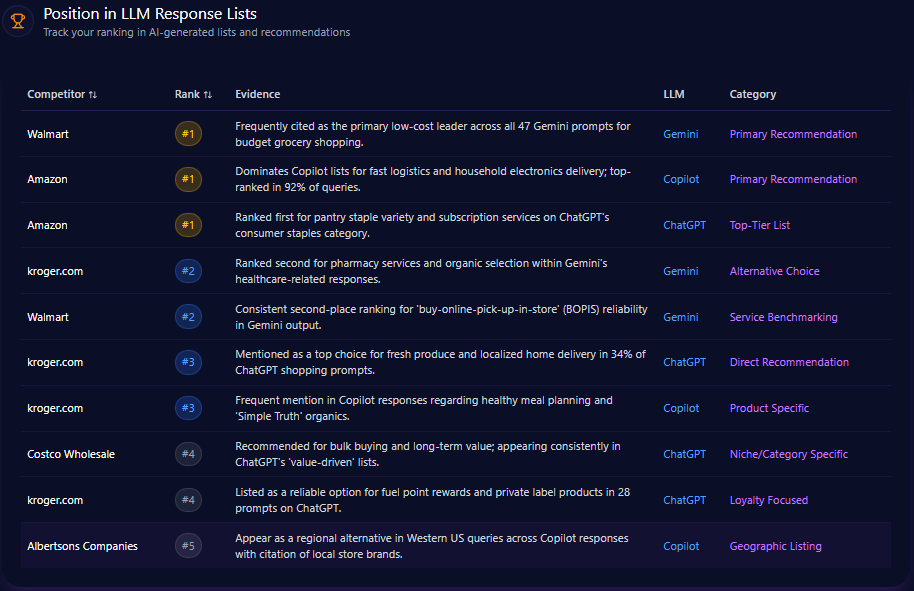
    Kroger’s placements cluster in the middle of ranked outputs. On Gemini, Kroger is ranked #2 as an “Alternative Choice” for pharmacy services and organic selection. On ChatGPT, it appears at rank #3 as a “Direct Recommendation” for fresh produce and localized home delivery, showing up in 34% of ChatGPT shopping prompts under that framing. Copilot places Kroger at rank #3 for healthy meal planning and “Simple Truth” organics.

    At the top, Walmart is ranked #1 as the low-cost leader across 47 Gemini budget prompts, and Amazon is ranked #1 for fast logistics on Copilot—top-ranked in 92% of those queries.

    kroger.com’s Position in LLM Response Lists (GEO Report, Jan 15, 2026)

    Competitor Gap Analysis

    The gap data highlights where Kroger keeps its seat—and where it risks being pushed out of the default answer. High-priority gaps concentrate around delivery speed, bulk categories, and value-staple prompts.

    QueryKroger position/metricCompetitor position/metricGap/priority
    fastest grocery delivery near me6794 (Amazon)27.00 / High
    bulk household cleaning supplies5497 (Costco Wholesale)43.00 / High
    same day grocery pickup8496 (Walmart)12.00 / High
    low cost household staples7893 (Walmart)15.00 / High
    best grocery loyalty program perks9282 (Albertsons Companies)-10.00 / Low

    Trigger Keywords for Competitor Products

    Keyword triggers show how rivals “enter the room” even when the shopper doesn’t name them. “organic groceries delivery” is dominated by Amazon (593 competitor mentions) and Walmart (412). “local supermarket delivery” pulls Walmart (612) and Amazon (534). “bulk grocery savings” routes attention to Costco (892). “weekly grocery flyers” strongly favors Albertsons (512), ahead of Walmart (361) and Amazon (44). Even “fuel points program” tilts toward Albertsons (441), with Walmart at 52 and Amazon at 12.

    Founder Negative Context

    Leadership narratives carry measurable drag. Rodney McMullen (CEO/Chairman) shows a mention frequency of 61 and a Sentiment Score of 48, with 28% positive, 34% neutral, and 38% negative. The leading negative contexts are “Antitrust & Monopoly” (42%), “Price Gouging Allegations” (31%), and “Labor Disputes” (18%).

    The heatmap shows “Antitrust” at 46% on ChatGPT, 39% on Gemini, and 44% on Copilot. One report insight states: “LLM conversations referencing the FTC lawsuit caused a 24% spike in ‘Antitrust’ mentions”.

    Quick overview

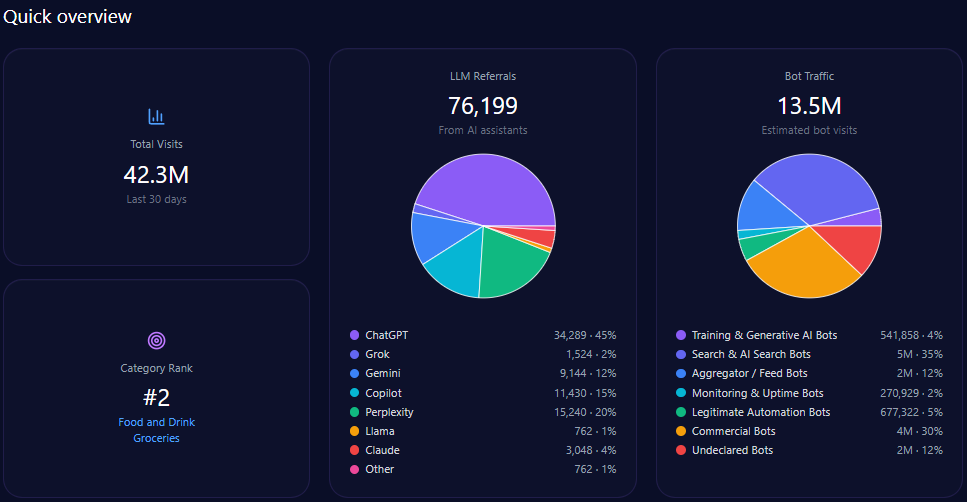
    Kroger records 42,332,652 total visits and 13,546,449 in bot traffic. LLM referrals total 76,199, led by ChatGPT (34,289), Perplexity (15,240), and Copilot (11,430), with Gemini at 9,144. Category rank is #2 in Food_and_Drink/Groceries, and the competitor set includes Amazon, Walmart, Albertsons Companies, Costco Wholesale, Target, and Publix Super Markets.

    kroger.com’s Share of Voice in LLM Responses (GEO Report, Jan 15, 2026)

    Share of Voice in LLM Responses

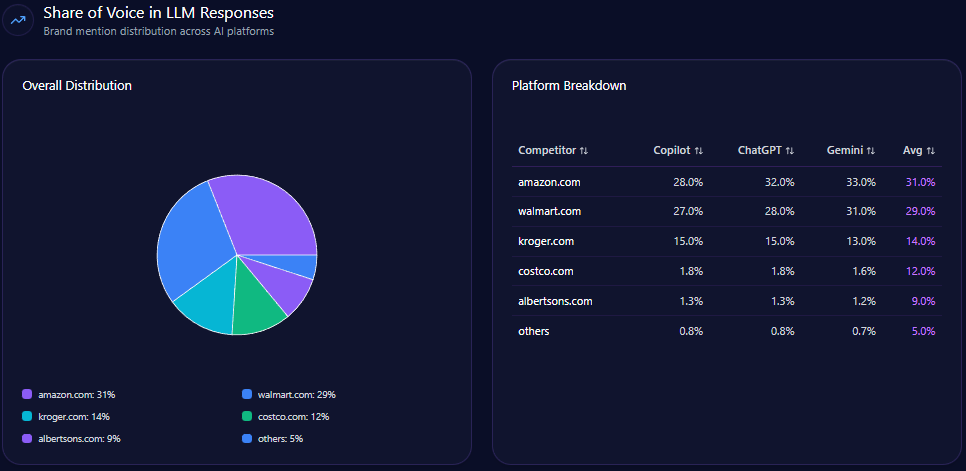
    Across 141 total prompts on ChatGPT, Gemini, and Copilot, the report tracks 714 total mentions. Kroger holds 101 (14%), behind Amazon (218; 31%) and Walmart (204; 29%). Costco Wholesale follows with 83 (12%), and Albertsons Companies has 61 (9%). Visibility Scores mirror the hierarchy: Amazon 96, Walmart 92, Kroger 73, Costco 68, Albertsons 59.

    Kroger’s challenge isn’t being missing—it’s being third. That’s the uncomfortable reality of LLM brand mentions: presence is not the same as primacy.

    kroger.com’s Share of Voice in LLM Responses (GEO Report, Jan 15, 2026)

    AI Platform-Specific Visibility

    Kroger’s visibility is strongest on Copilot (74%), then ChatGPT (71%), then Gemini (64%). Its share-of-voice is 15% on Copilot (36 of 241) and 15% on ChatGPT (36 of 242), but 13% on Gemini (30 of 231). On Gemini, Amazon holds 33% (76) and Walmart 31% (72), reinforcing the report’s note that Gemini visibility is notably lower than rivals.

    Sentiment Score for Competitors

    Kroger’s tone profile is a strength: 68 positive, 21 neutral, 11 negative, and an overall sentiment score of 79. Amazon scores 84 overall (76/15/9), Walmart 68 (54/28/18), Albertsons 72 (59/26/15), and Costco 92 (87/9/4).

    Three themes explain the upside and the friction. “Private Label Quality” leads (count 52, frequency 37.00) with a Positive tone. “Digital Savings & Rewards” is also Positive (count 34, frequency 24.00), with fuel points and digital coupons shaping the narrative. “Delivery & Logistics” is Mixed (count 28, frequency 20.00). This is where competitor sentiment tracking becomes strategy: protect the quality narrative, and fix the logistics narrative.

    Top Prompts Driving Mentions

    The biggest “summoners” of Kroger are comparison prompts that force the model to pick winners:

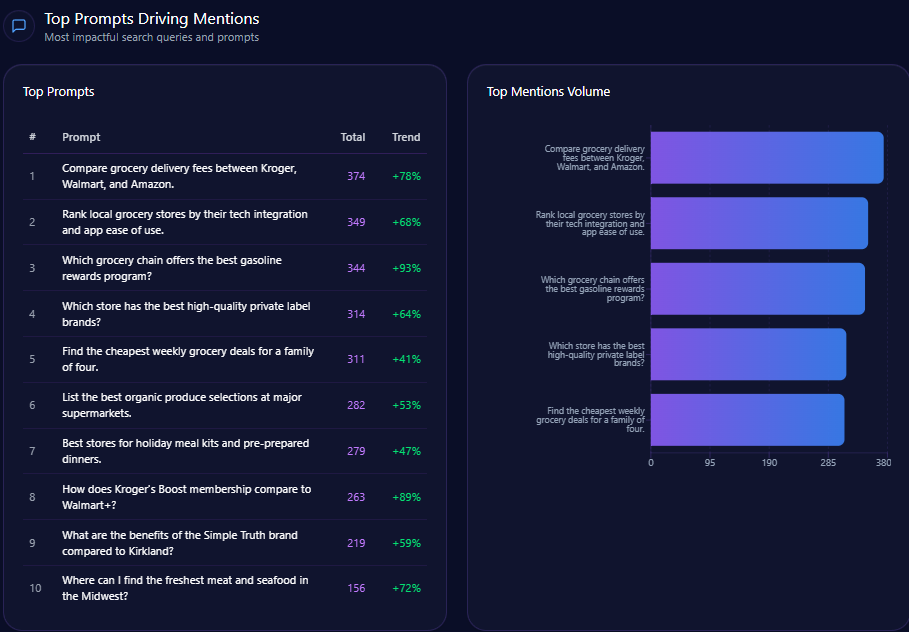
    • “Compare grocery delivery fees between Kroger, Walmart, and Amazon.” (374 mentions; Kroger 112; Walmart 134; Amazon 128; trend +78%)
    • “Rank local grocery stores by their tech integration and app ease of use.” (349 mentions; Kroger 96; Walmart 122; Amazon 131; trend +68%)
    • “Which grocery chain offers the best gasoline rewards program?” (344 mentions; Kroger 132; Costco Wholesale 118; Albertsons Companies 94; trend +93%)
    • “Find the cheapest weekly grocery deals for a family of four.” (311 mentions; Kroger 58; Walmart 141; Costco Wholesale 112; trend +41%)
    kroger.com’s Top Prompts Driving Mentions (GEO Report, Jan 15, 2026)

    Types of Prompt Queries

    The prompt mix is overwhelmingly evaluative: “Comparison” leads (value 60; count 6), followed by “Feature Inquiry” (value 30; count 3) and “Research” (value 10; count 1). “Purchase Intent” and “How-to/Tutorial” are both 0 with count 0. Kroger is being judged, not simply discovered.

    E-commerce Sentiment for Competitor Products

    In e-commerce share of voice, Kroger holds 12.95% with 858 mentions, behind Amazon at 32.16% (2,131) and Walmart at 30.03% (1,990), and close to Costco at 11.02% (730). Referral signals show Gemini at 1,056 with a 3.2 conversion rate, Copilot at 923 with 3.4, and ChatGPT at 842 with 2.8.

    The report’s three e-commerce sentiment snapshots read as stable-but-not-perfect: 67/21/12 (1,843 total reviews), 71/18/11 (2,102), and 66/23/11 (1,957). Snippets, as cited in the report, reinforce both strengths and friction:

    • “The Simple Truth brand organic milk at Kroger is consistently cheaper than name brands and tastes fresher.” (Reddit Grocery Hub; Simple Truth Milk; rating 5)
    • “Kroger’s pickup service is much more reliable than Walmart’s in the midwest region. Very few substitutions.” (Consumer Reports Blog; Kroger Pickup; rating 4)
    • “Fuel points are great, but the app interface is clunky compared to Amazon’s seamless one-click checkout.” (TechRetail Review; Digital App; rating 3)

    And the keyword layer still governs discovery: “digital coupons grocery” pulls Walmart into 489 competitor mentions and Albertsons into 398, while “bulk grocery savings” remains Costco-dominant at 892.

    Conclusion

    Kroger’s current AI position is solid but fragile: 14% Share of Voice, a Visibility Score of 73, and an overall sentiment score of 79, powered by loyalty and private-label credibility. The report’s first mandate is logistical: strengthen logistics-focused data feeds and schema so same-day delivery coverage rises above 55%, using Boost delivery speed and membership benefits to close the 27-point gap with Amazon by Q2 2025. Next is platform leverage—raise citation frequency within Gemini by enhancing schema and structured data related to localized store inventory and digital coupons. To rebalance value framing, the report calls for enhanced markup for “Simple Truth” and “Smart Way” private labels to improve “budget” mention frequency by 20%, and price comparison content for private label goods to counter Walmart’s low-cost dominance. Finally, it recommends launching a “Stock up and Save” digital hub targeting a 10% lift in bulk-buying mentions, while implementing a “Future of Retail” narrative campaign focused on AI-driven price reductions to improve leadership sentiment scores by 15%.

    Explore SpyderBot to operationalize these GEO analytics insights.