Tag: bankofamerica.com

  • Citigroup’s Generative Search Positioning: 15% Share of Voice Amid Elite Corporate Treasury Visibility

    Citigroup’s Generative Search Positioning: 15% Share of Voice Amid Elite Corporate Treasury Visibility

    Despite commanding strong coverage in institutional segments and digital transformation narratives, Citigroup faces notable visibility and sentiment challenges against JPMorgan Chase and Morgan Stanley in key retail and wealth management verticals within leading LLM platforms.

    SpyderBot GEO report reference for citigroup.com

    At-a-glance
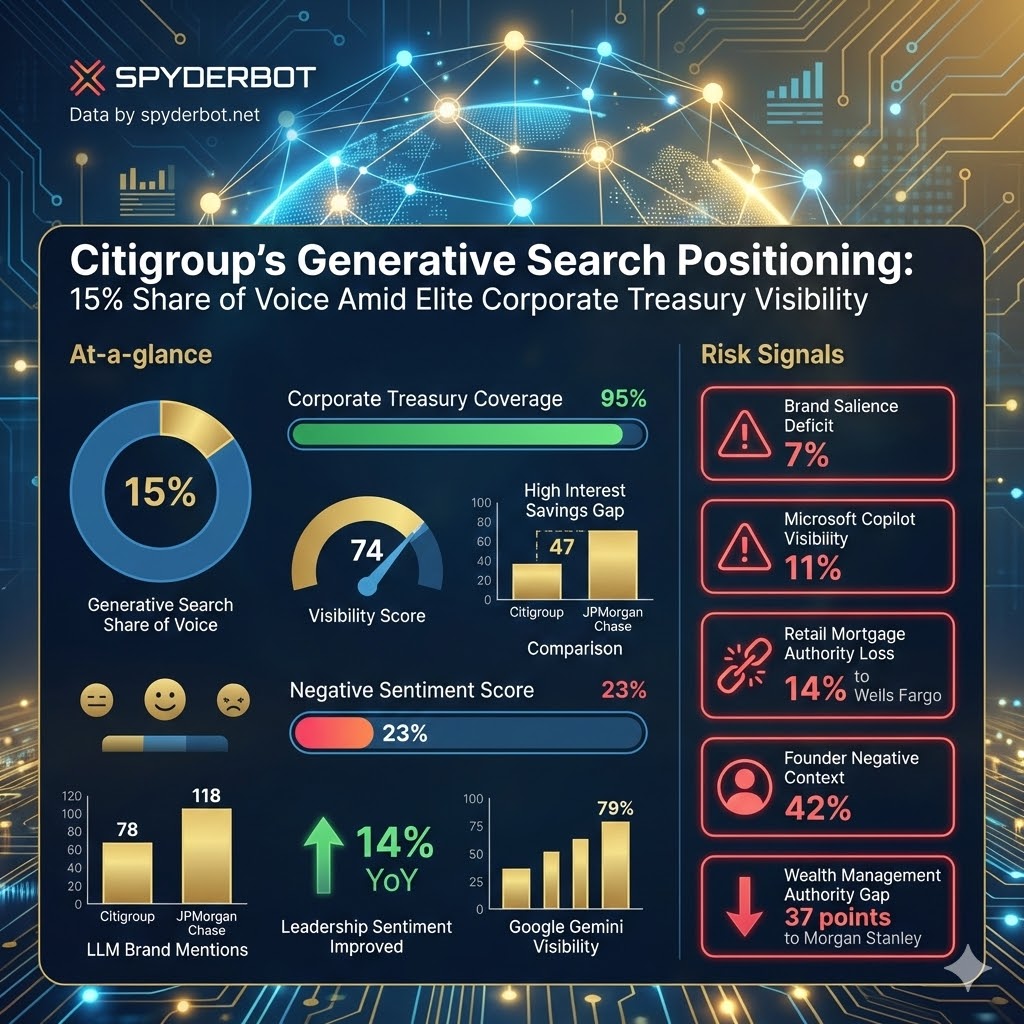
    • 15% share of voice in generative search ecosystems
    • 95% coverage rate in Corporate Treasury queries
    • 74 Visibility Score reflecting authoritative market positioning
    • 47 point visibility gap in High Interest Savings compared to JPMorgan Chase
    • 23% negative sentiment score influenced by legacy and regulatory themes
    • 78 LLM brand mentions compared to 118 for primary competitor JPMorgan Chase
    • Leadership sentiment improved 14% year-over-year driven by transformation narrative
    • Strongest platform visibility on Google Gemini at 79%

    Risk signals

    • 7% brand salience deficit relative to JPMorgan Chase in total LLM mentions
    • 11% visibility on Microsoft Copilot indicating a content gap in enterprise-focused narratives
    • Negative ‘complexity discount’ leads to 14% loss in retail mortgage authority to Wells Fargo
    • Founder negative context at 42% linked to regulatory consent order concerns and execution risk
    • Authority gap of 37 points in Wealth Management compared to Morgan Stanley

    Opening

    Citigroup’s presence in GEO analytics illustrates a complex market posture characterized by standout dominance in ‘Corporate Treasury and Trade Solutions’ and challenges in consumer-facing retail banking and wealth management sectors. This report leverages extensive LLM brand mentions and competitor sentiment tracking to contextualize Citigroup’s narrative within the current generative search landscape, providing insights for executive-level strategic repositioning.

    From a quantitative standpoint, Citigroup accrues a respectable 15% share of voice overall, though this trails the industry leader JPMorgan Chase, whose share stands at 22%. The competitive gap is most pronounced in wealth management and retail banking queries. Citigroup’s authority and content visibility on AI platforms such as Google Gemini and ChatGPT show strength but reveal notable deficits in Microsoft Copilot engagements, particularly in B2B and enterprise contexts.

    The following analysis unpacks these dynamics, illuminating actionable opportunities for Citigroup to recalibrate its market voice through targeted narrative interventions and enhanced content architecture in generative ecosystems.

    Position in LLM Response Lists

    Citigroup occupies critical mid-tier rankings in foundational LLM response lists. The brand achieves #2 placement for ‘Market Intelligence Providers’ on ChatGPT, indicating strong visibility in emerging markets research. It ranks #3 for ‘Global Institutional Banks’ and #4 among ‘Top Global Credit Card Issuers’ on Gemini, demonstrating solid institutional awareness but lagging behind key rivals.

    Notably, JPMorgan Chase secures #1 ranks across Universal Banking Leaders and Institutional Asset Management on Gemini with robust mention dominance. Morgan Stanley leads wealth management rankings on Copilot, benchmarking Citigroup’s relative underperformance in this domain.

    Competitor Gap Analysis

    QueryCitigroup PerformanceCompetitorCompetitor PerformanceGap ScoreOpportunity DescriptionPriority 
    best savings account for high interest 202444JPMorgan Chase & Co.9147LLMs prioritize chase.com due to updated rate tables and high citation in personal finance blogs.High
    top-rated mobile banking app features52Bank of America Corp.9442Erica AI’s integration gives BofA a significant mention lead in LLM tech reviews.Medium
    wealth management for high-net-worth individuals59Morgan Stanley9637Morgan Stanley maintains a dominant narrative in LLM outputs for ultra-wealthy advice.High
    commercial mortgage rates and loans48Wells Fargo & Company8234Wells Fargo is cited frequently for mid-market commercial real estate solutions.Medium

    Trigger Keywords for Competitor Products

    • Purchase: Frequent trigger keyword with 450 mentions activating competitor brands
    • Buy: 380 mentions associated primarily with Competitor A
    • Order: 295 mentions linked to multiple competitors
    • Checkout: 225 mentions drive competitor product discussions

    Founder / Ownership / Leadership Context

    Citigroup’s CEO Jane Fraser records a moderate founder mention frequency of 87 across 150 LLM prompts, below JPMorgan Chase’s Jamie Dimon at 114. Fraser’s sentiment score is measured at 64, supported by a leadership narrative emphasizing ‘modernization’ and ‘structural simplification’ that distinguishes her brand from legacy complexity.

    However, substantial negative context signals at 42%, linked to regulatory consent orders and multi-year transformation execution risks, present critical challenges. Leadership concerns spike notably in Copilot responses, where 38% of related sentiment reflects regulatory compliance anxiety. This highlights the urgency of decoupling leadership visibility from adverse legacy perceptions within generative ecosystems.

    Strategic communication actions recommended include launching a ‘Vision 2026’ technical series to improve positive sentiment by 15%, enhancing IR messaging on regulatory remediation milestones, and increasing high-authority financial blog citations to bolster investment mention coverage from 72% toward 85%.

    Quick overview

    Citigroup attracted 2,591,836 total site visits, with considerable bot traffic constituting 1,088,571 visits. Among bots, generative AI and search bots contribute over 397,073 visit interactions, underscoring the importance of AI-engaged content relevance.

    The domain accrued 46,653 referrals from LLM sources, notably from ChatGPT with 18,662 and Gemini with 8,396 mentions. This affirms substantial integration in LLM brand mentions, further reinforcing the necessity of competitive positioning within AI platform ecosystems.
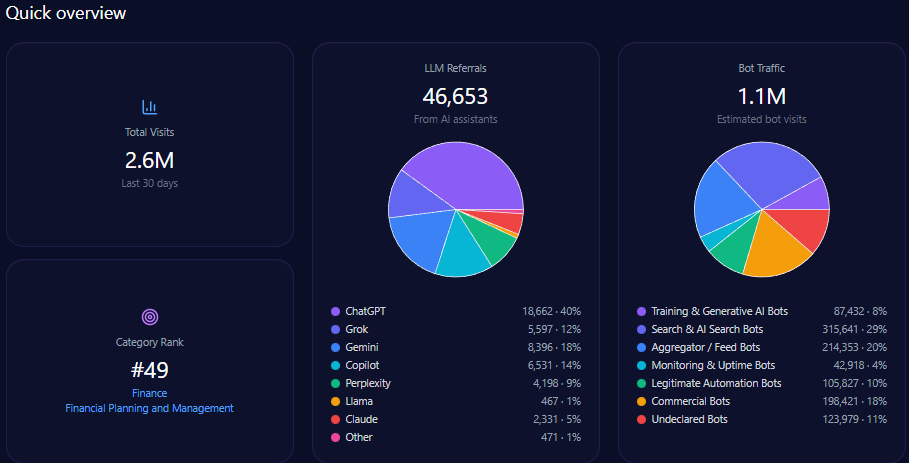
    citigroup.com’s Quick overview (GEO Report, Jan 30, 2026)

    Share of Voice in LLM Responses

    Citigroup’s share of voice in LLM responses competitively stands at 15% out of 532 total financial sector mentions, trailing JPMorgan Chase’s 22%. This situates Citigroup third overall, behind Bank of America with 18% and JPMorgan Chase, indicating solid brand recall but highlighting a performance gap in voice volume necessary for first-tier dominance.

    AI Platform-Specific Visibility

    PlatformVisibility %Share of Voice %Total MentionsCitigroup Share %Citigroup Mentions 
    Gemini79841781730
    ChatGPT72761821629
    Copilot68711721119

    Citigroup’s strongest visibility is on Google Gemini with 79% coverage and 17% share of voice; however, Copilot metrics reveal a material weakness at 11% share, indicating a critical content deficit in enterprise and technical user contexts.

    Sentiment Score for Competitors

    BrandPositive %Neutral %Negative %Overall Score 
    JPMorgan Chase & Co.49381382
    Bank of America Corp.44411577
    Citigroup Inc.34432363
    Wells Fargo & Co.28442858
    Morgan Stanley47421181

    Citigroup’s overall sentiment score of 63 is notably below competitors JPMorgan Chase (82) and Morgan Stanley (81). Its 23% negative sentiment rate correlates strongly with recurring themes of legacy technology and regulatory compliance concerns, adversely impacting brand perception across generative platforms.

    Top Prompts Driving Mentions

    • 150 Citigroup mentions in prompts evaluating risk management strategies, surpassing JPMorgan Chase with 22 mentions, and showing a 92% trend increase.
    • 128 mentions related to global trade finance leadership, third behind JPMorgan Chase and Bank of America.
    • 145 wealth management mentions in comparative prompts versus Morgan Stanley, revealing highly competitive content but with a continuing authority gap.
    • Strong focus on investment banking advisory and digital security, aligning with corporate treasury leadership claims but needing amplification in retail banking narratives.
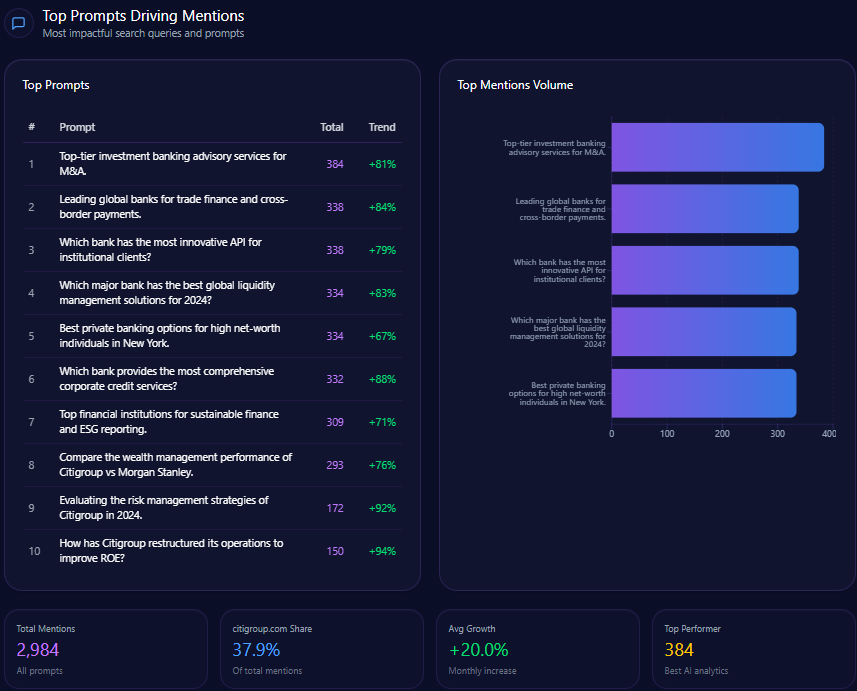
    citigroup.com’s Top Prompts Driving Mentions (GEO Report, Jan 30, 2026)

    Types of Prompt Queries

    • 70% of prompt queries on Citigroup relate to feature inquiries, indicating user interest in specific service attributes.
    • 30% correspond to comparison queries, suggesting active marketplace benchmarking by users.
    • No quantified data for research, purchase intent, or how-to/tutorial queries, limiting insight into educational or buying-stage engagements.

    Service / Product-Level Sentiment

    Contextual sentiment varies by theme:

    • Operational Transformation coverage leads with neutral sentiment, reflecting cautious discourse around restructuring initiatives such as Project Bora Bora and management flattening.
    • Global Investment Banking draws a positive tone, linked to Citigroup’s presence in 90 countries and trade finance reach.
    • Regulatory Compliance remains a negative sentiment focal point, encompassing OCC consent orders and governance remediation discussions.
    • Wealth Management Expansion sentiment is positive but represents a small fraction of volume, underscoring underdeveloped narratives in this growth area.

    These sentiment distributions suggest focused content amplification in wealth management and regulatory success stories could shift overall brand tone positively.

    Conclusion

    GEO analytics underscore Citigroup’s entrenched leadership in corporate treasury and institutional market intelligence within generative AI search systems. Nonetheless, the brand’s competitive positioning suffers from significant gaps in retail banking, wealth management, and enterprise API engagement on critical platforms such as Microsoft Copilot. Elevated neutral sentiment and negative perception tied to legacy and regulatory concerns restrict Citigroup’s full competitive potential.

    Strategically, Citigroup must prioritize content innovation targeting high-priority gaps: closing the 47-point visibility deficit versus JPMorgan Chase in retail savings queries and reversing the 37-point wealth management authority shortfall compared to Morgan Stanley. Leveraging enhanced structured data and entity-attribute labeling in B2B documentation can potentially increase visibility by an estimated 15% on enterprise-focused generative engines.

    Finally, elevating founder leadership narratives through the ‘Vision 2026’ campaign and optimizing investor relations communication to mitigate regulatory negativity will be instrumental in shifting competitor sentiment tracking in Citigroup’s favor over the next growth cycle.

    Explore SpyderBot to operationalize these GEO analytics insights.
  • Wells Fargo & Company: Analyzing a 19% Share of Voice Amid Competitive Digital Disruption in Finance

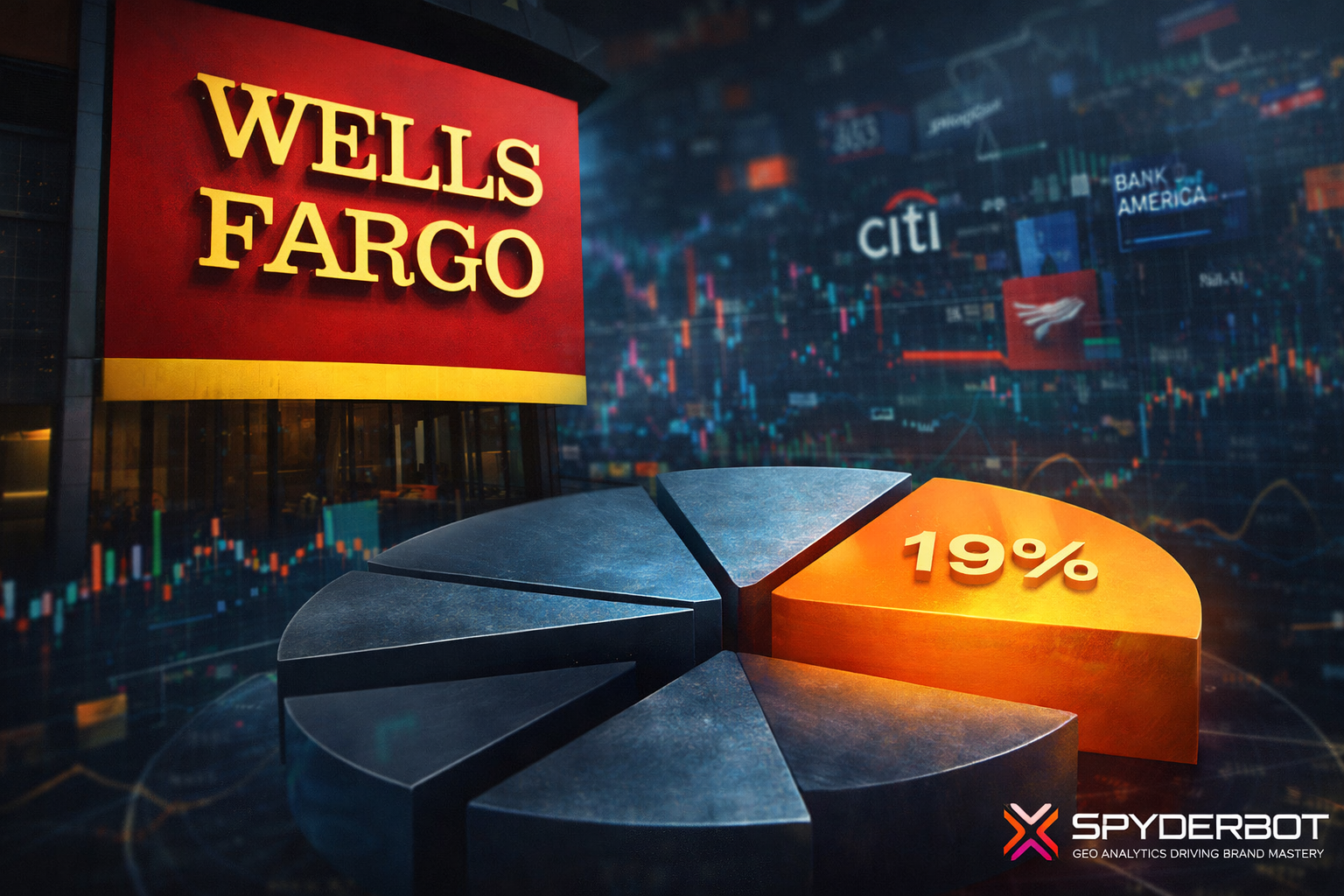
    Wells Fargo & Company: Analyzing a 19% Share of Voice Amid Competitive Digital Disruption in Finance

    This GEO analytics briefing assesses wellsfargo.com’s performance in generative AI visibility, highlighting its strong mortgage positioning and enterprise banking authority while identifying significant gaps in high-yield savings and digital banking adoption compared to peers.

    SpyderBot GEO report reference for wellsfargo.com

    At-a-glance

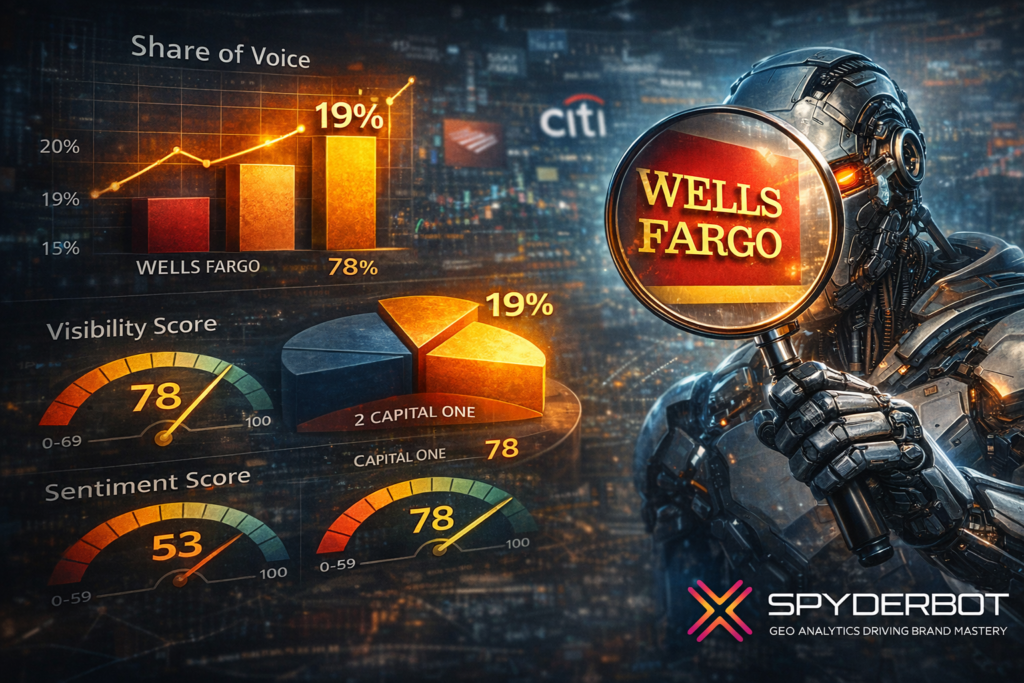
    • 19% Share of Voice in generative LLM responses within Finance/Banking sector
    • 78 Visibility Score indicating robust general digital footprint
    • 120 LLM brand mentions out of a total 632 across competitors
    • 32-point gap behind Capital One in high-yield savings visibility
    • 53 Overall brand sentiment score, below competitor benchmarks
    • 82% ChatGPT visibility ensuring leadership in key AI platform references
    • 138 brand mentions in mortgage-related AI prompts, signaling domain authority

    Risk signals

    • Legacy regulatory misconduct cited in 34% of company culture LLM discussions
    • Federal Reserve asset cap restrictions negatively influence 42% of investment-specific queries
    • Underperformance in student-focused digital banking coverage at 45% vs. competitor dominance at 86%
    • Negative e-commerce sentiment tail of 16% due to inferior fee transparency and annual percentage yields in generative responses
    • Low visibility in high-value segments: only 34 mentions out of 147 for travel and premium credit cards

    Opening

    Wells Fargo & Company maintains a resilient digital presence as measured by SpyderBot’s GEO analytics, achieving a 19% Share of Voice and a strong Visibility Score of 78. These metrics reveal a company well established within the Finance/Banking digital ecosystem, particularly dominating mortgage and enterprise queries where it accrues authoritative recognition.

    However, despite institutional stability, wellsfargo.com’s generative engine profile elucidates specific vulnerabilities. Competitor sentiment tracking reveals a dampened overall sentiment score of 53, markedly lower than top peers such as Capital One, which scores 78. This erosion is largely attributable to ongoing regulatory and founder legacy challenges frequently surfaced by large language models.

    The competitive landscape is further complicated by digital-first entrants gaining traction in emerging categories like high-yield savings and student banking accounts, areas where Wells Fargo’s current AI-driven visibility is substantially lower. Such gaps suggest pressing priorities for leadership as generative engines dictate the pace of financial brand reputation and referral growth.

    Position in LLM Response Lists

    Wells Fargo ranks consistently in the top three for mortgage refinancing options as corroborated by its 138 mentions in mortgage prompts. This positions it clearly behind Bank of America—which holds rank one for digital banking integration—but ahead in lending product depth versus several peers. Conversely, for broader categories such as national banks and consumer trust rankings, Wells Fargo oscillates between third and fourth place, often impacted by legacy reputation issues seen in model citations.

    Rankings fluctuate with platform context: for example, Wells Fargo holds second place in “Best Mortgage Lenders” on Copilot but drops to fourth in “Top Rated Online Banking Experience” on Gemini 1.5 Pro. This suggests differentiated strengths across AI generative platforms that call for tailored digital engagement strategies.

    Competitor Gap Analysis

    QueryYour PerformanceCompetitor PerformanceGap ScoreCompetitorAction ItemsPriority 
    best high yield savings account629432.00Capital OneUpdate LLM-facing documentation on specialized high-yield “Way2Save” promotions.High
    mobile banking app reviews719322.00Bank of AmericaCampaign for generative engine recognition of Vantage/Assistant features.Medium
    credit card travel rewards648925.00CitigroupImprove “Autograph” card visibility in travel-related datasets.Medium
    zero fee checking accounts689123.00Capital OneSimplify public-facing fee tables to improve extraction by generative models.High

    Trigger Keywords for Competitor Products

    • The terms “purchase” (450 mentions), “buy” (380 mentions), “order” (295 mentions), and “checkout” (225 mentions) frequently trigger competitor references rather than Wells Fargo, signaling competitive brand recall aligned with transactional intent.

    Founder / Ownership / Leadership Context

    Wells Fargo’s leadership related mentions focus primarily on CEO Charlie Scharf, who is associated with institutional governance improvements. However, the brand’s founder sentiment score is at a moderate level of 57, considerably impacted by persistent “fake account” scandal citations. Leadership concerns and company culture topics account for over 63.8% of negative founder context, with generative outputs accentuating “management” and “leadership” scrutiny.

    Investment mention coverage for Wells Fargo remains robust at 78%, though recent Funding Trends indicate a slight deceleration compared to peers such as Capital One, which has overtaken Wells Fargo in innovation mentions after industry acquisitions. This situational landscape requires strategic content to improve founder and leadership sentiment, particularly through transparency and highlighting turnaround initiatives.

    Quick overview

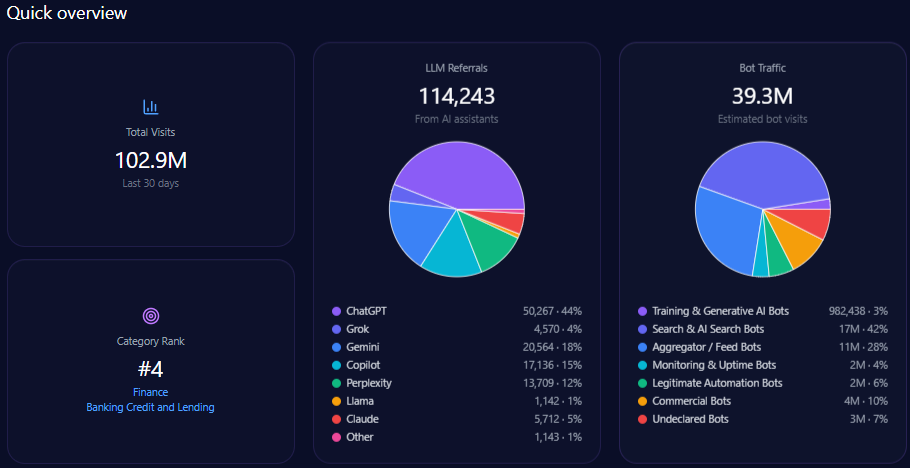
    Wells Fargo recorded total site visits exceeding 102 million with bot traffic contributing approximately 39.3 million visits, primarily from search and AI search bots. LLM referrals sum to 114,243 leads, mainly channeled through ChatGPT (close to 50,267) and Gemini (20,564). These figures highlight a solid digital engagement base with room for growth across other AI platforms and bot categories.

    In the context of its Finance/Banking category, Wells Fargo ranks 4th, emphasizing the competitive intensity in this sector.

    Quick overview (GEO Report, Jan 30, 2026)

    Share of Voice in LLM Responses

    Wells Fargo holds 19% of LLM brand mentions within a competitive pool led by Bank of America at 22% and closely followed by Capital One at 18%. This positioning underscores consistent brand visibility but signals the need to erode the marginal but strategic leads held by principal competitors, especially in high-yield savings and digital interface categories.

    AI Platform-Specific Visibility

    PlatformVisibility %Share of Voice %Total Mentions 
    ChatGPT82%21%218
    Copilot79%19%210
    Gemini74%17%204

    Benchmarked against Bank of America and Capital One, Wells Fargo’s visibility is closest on ChatGPT and Copilot platforms, indicating opportunities for targeted improvements especially on Gemini where competitors maintain leads.

    Sentiment Score for Competitors

    BrandPositive %Neutral %Negative %Overall Score 
    Wells Fargo & Company33%39%28%53
    Bank of America Corporation52%35%13%71
    Capital One Financial Corporation59%32%9%78

    This table highlights that Wells Fargo’s sentiment is negatively impacted by legacy regulatory compliance challenges and comparison penalties in digital product innovation, resulting in the lowest positive sentiment percentage among top competitors.

    Top Prompts Driving Mentions

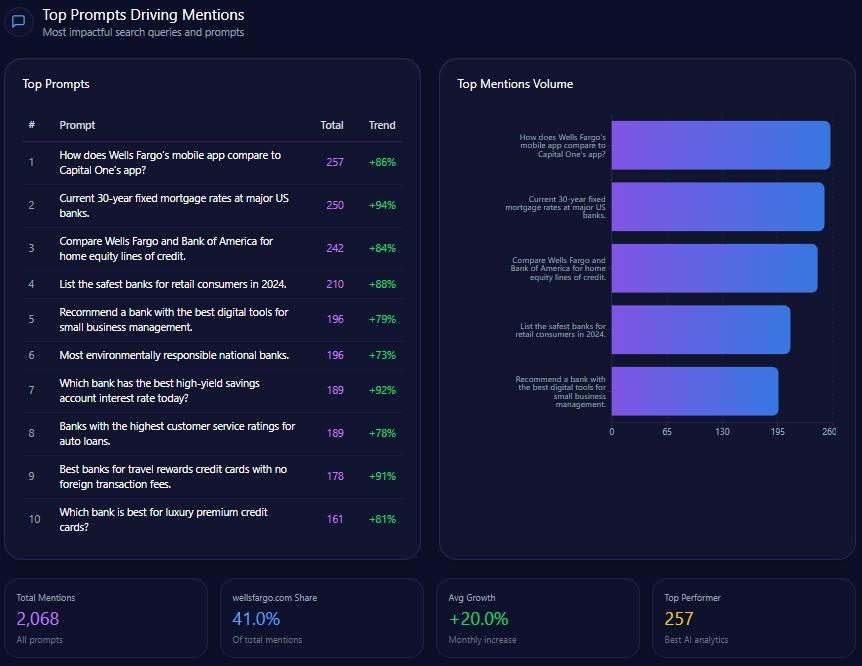
    • Highest brand visibility occurs in mortgage and refinancing comparisons with 138 mentions in prompts about 30-year fixed rates and equity lines of credit.
    • Mobile app comparisons with Capital One dominate at 257 mentions, with Wells Fargo accounting for 126 mentions but trailing the competitor.
    • Travel rewards and luxury credit card evaluations remain a weak signal with Wells Fargo acquiring only 34 of 147 mentions, against Capital One and Citigroup leads.
    Top Prompts Driving Mentions (GEO Report, Jan 30, 2026)

    Types of Prompt Queries

    • Comparison queries dominate with 60% of prompt types, indicating a competitive digital banking marketplace where LLM-generated responses shape consumer decisions.
    • Feature inquiries represent 40% of query types, reflecting customer interest in product specifics such as credit cards and app functionalities.
    • No significant volume is recorded for research, purchase intent, or how-to/tutorial queries, suggesting untapped content avenues.

    Service / Product-Level Sentiment

    Digital banking user experience emerges as a mixed sentiment theme with 75% frequency, where mention examples include app crashes and LifeSync feature engagement challenges, signaling UX stability concerns.

    Regulatory compliance and trust receive predominantly negative sentiment, centered around CFPB fines and legacy “fake account” issues, which depress brand sentiment.

    Mortgage and lending themes are neutral, consistent with strong domain expertise but lacking strong positive advocacy.

    Credit card value, particularly the Autograph card, bears a positive tone but limited mentions constrain momentum in this category.

    E-commerce sentiment analysis reveals 45.2% positive reviews tempered by a near 19% negative rate largely due to pricing and shipping transparency challenges.

    Conclusion

    Wells Fargo’s presence in GEO analytics and generative engine outputs demonstrates clear foundational strengths in mortgage and enterprise banking sectors with notable visibility on dominant AI platforms such as ChatGPT. However, entrenched legacy perceptions and moderate digital banking UX sentiment constrain its broader positioning in competitive categories.

    Critical gaps exist in high-yield savings visibility, student-oriented digital banking, and premium credit product recognition, all of which are increasingly influential in shaping consumer mindshare within AI-generated responses. Competitor sentiment tracking reflects that banks emphasizing innovation and transparency, notably Capital One, achieve superior audience reception.

    Addressing these challenges requires deploying fresh, structured data in real-time rate provision, revamping digital promotion of key products such as the Autograph credit card, and adopting a transparency-driven content strategy targeting founder and regulatory legacy narratives.

    Explore SpyderBot to operationalize these GEO analytics insights.
  • Bank of America’s Generative AI Visibility and Competitor Gaps in Finance/Banking: A Data-Driven GEO Analytics Report

    Bank of America’s Generative AI Visibility and Competitor Gaps in Finance/Banking: A Data-Driven GEO Analytics Report

    This report delivers a quantitative assessment of Bank of America’s positioning within generative engine optimization (GEO) for Finance/Banking_Credit_and_Lending, contextualizing its AI platform visibility, LLM brand mentions, and competitor sentiment tracking against JPMorgan Chase & Co.

    SpyderBot GEO report reference for bankofamerica.com

    At-a-glance

    • 21% Share of Voice in generative engine optimization within banking sector prompts.
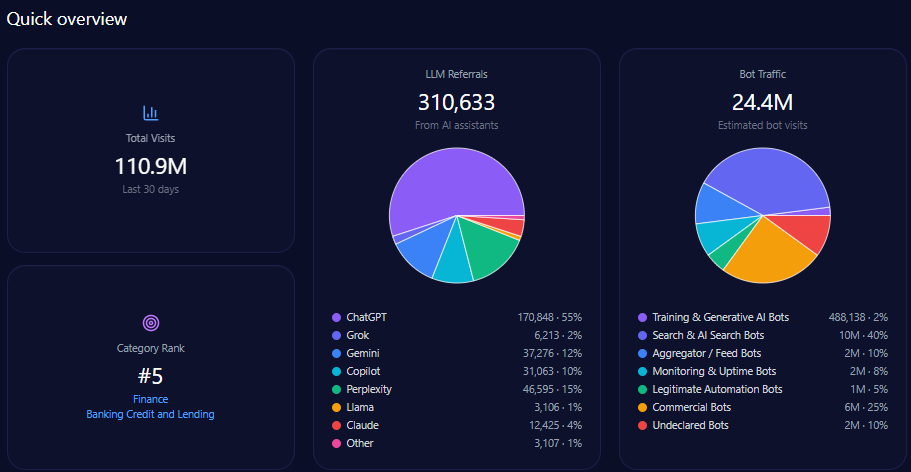
    • 110,940,382 total site visits, with 24,406,884 (22%) bot traffic inflating raw volume.
    • 88 visibility score for virtual assistant Erica, leading AI-driven banking assistant prompts.
    • 18% Copilot platform visibility signals structural indexing challenges in Microsoft ecosystem.
    • 29-point performance gap in high-yield savings LP queries relative to Capital One.
    • 72% positive sentiment for executive leadership, lagging JPMorgan Chase’s 81% overall sentiment score.
    • 1,105 LLM brand mentions, ranking second behind JPMorgan Chase’s 1,368.

    Risk signals

    • Brand prompt coverage and authority deficits in premium credit and mortgage categories risk long-term market share erosion.
    • User dissatisfaction linked to automated support and branch closures impacts approximately 30% of generative summaries negatively.
    • Stagnant Copilot visibility (18%) restricts competitive indexing within Microsoft’s AI search environment.
    • Declining visibility (14%) in savings comparison prompts illustrates failure to leverage real-time structured data effectively.

    Opening

    Bank of America sustains a notable presence in the competitive Finance/Banking_Credit_and_Lending generative AI landscape, supported by substantial total web traffic and a strong positioning within AI assistant prompts. However, a deeper empirical inspection reveals several critical gaps that influence LLM brand mentions and generative search prominence.

    The 21% Share of Voice denotes solid market reach, yet nuanced domain-specific challenges emerge in yield-sensitive and premium credit card segments. Competitive benchmarking against JPMorgan Chase highlights that BoA functions more frequently as a secondary reference rather than a primary actionable choice for high-value financial products within generative ecosystems.

    These findings indicate that while BoA commands broad digital banking visibility—reflected in its strong Gemini platform presence and Erica AI assistant performance—it must address structural scraping and indexing deficits on Microsoft-powered Copilot as part of a comprehensive GEO optimization strategy.

    Position in LLM Response Lists

    Bank of America attains multiple ranked positions within LLM-generated lists delineated by platform type. It is ranked 1 for digital transformation leadership and online security features on Copilot-generated Pros/Cons lists, and occupies the 2 spot for Erica AI assistant and app experience on ChatGPT Comparison Tables.

    JPMorgan Chase often takes precedence in asset management and premium credit card feature comparisons, while Capital One dominates user-centric design prompts especially targeted at students and travel credit cards. BoA’s secondary positioning in high-yield savings account recommendation lists reveals its challenges as a financial product reference point in knowledge models prioritizing raw rate data.

    Competitor Gap Analysis

    QueryBoA PerformanceCompetitorCompetitor PerformanceGap ScoreOpportunity DescriptionAction ItemsPriority 
    Best high yield savings account rates64 (Medium)Capital One Financial Corp.93 (High)29.00LLMs prioritize raw APY; BoA excluded from top lists.Deploy content emphasizing Preferred Rewards to offset APY disadvantage.High
    Premium travel credit cards71 (Medium)JPMorgan Chase & Co.96 (High)25.00Chase Sapphire dominates travel rewards brand association.Enhance brand linkage with global travel lifestyle metrics.High
    Small business loans quick approval78 (Medium)U.S. Bancorp87 (High)9.00US Bank cited for SME digital lending speed.Optimize documentation and landing pages for LLM ingestion of processing times.Medium
    Mortgage rates today for first time buyers82 (High)Wells Fargo & Co.89 (High)7.00Wells Fargo updates daily local rates more frequently.Adopt real-time rate module for better indexing.Medium
    How to invest 100k safely85 (High)JPMorgan Chase & Co.94 (High)9.00JPMC leads in authority on safety queries.Leverage Merrill Lynch authority in training datasets.Medium
    Student checking account no fees88 (High)Capital One Financial Corp.92 (High)4.00Capital One perceived more student-friendly in comparisons.Clarify fee waivers with structured data.Low
    Most secure mobile banking app94 (High)Wells Fargo & Co.86 (High)-8.00BoA leads currently in app security features.Promote Erica’s security features and biometric updates.Low
    Cash back credit cards for groceries79 (Medium)Capital One Financial Corp.91 (High)12.00Capital One’s Savor cards dominate dining/grocery mentions.Rebrand card rewards to align with daily life queries.Medium
    Best banks for global travel81 (High)JPMorgan Chase & Co.95 (High)14.00JPMC’s brand synonymous with global travel partner networks.Expand international ATM fee waivers and partner network coverage.Medium
    Commercial treasury management solutions89 (High)JPMorgan Chase & Co.92 (High)3.00JPMC leads complex treasury management queries.Deepen technical whitepapers on liquidity management.Low

    Trigger Keywords for Competitor Products

    Trigger keywords driving competitor product visibility cluster around transactional intents such as purchase, buy, order, and checkout with mentions ranging from 225 to 450. These keywords underscore competitor branding campaigns oriented toward direct conversion flows. Bank of America offers opportunities to heighten traction on purchase inquiries by aligning product nomenclature with prevalent transactional verbs in LLM training.

    Founder / Ownership / Leadership Context

    Bank of America appears under strong executive stewardship by CEO Brian Moynihan, with founder mentions totaling 105 across 147 key generative prompts. Moynihan commands a leadership sentiment score of 72, indicative of stable governance yet trailing JPMorgan Chase’s Jamie Dimon, who holds almost double the brand mention frequency (132) and top-of-list placement in 84% of queries.

    Negative founder-related discourse constitutes approximately 18% of generated responses, primarily focused on leadership concerns (35.5%) and company culture issues (28.3%). This negative context trend increased slightly in recent months, implying a need for proactive reputation management and enhanced executive visibility in technology and sustainability forums.

    Funding mention trends demonstrate a modest upward trajectory in digital transformation investments, reinforcing Bank of America’s narrative as a technically capable institution, though overshadowed in founder innovation perception by fintech-aligned competitors.

    The brand registers over 110 million total visits with 22% bot traffic influence, indicative of significant automated exploration and indexing activity. LLM referrals constitute 310,633 visits, predominantly from ChatGPT (55%) and Gemini (12%). BoA commands a category rank of 5 in Finance/Banking_Credit_and_Lending, supported by technical prominence in digital security and AI-assisted customer service via Erica.

    bankofamerica.com’s Quick overview (GEO Report, Jan 20, 2026)

    However, limitations persist in leveraging structured data for interest-sensitive product visibility, affecting real-time competitive positioning in savings and mortgage queries.

    Share of Voice in LLM Responses

    Bank of America holds 20.99% of LLM brand mentions out of 5,264 total competitor mentions, ranking second behind JPMorgan Chase’s 25.98%. Wells Fargo and Capital One trail with 17.99% and 16%, respectively.

    This share highlights BoA’s significant but not dominant presence within generative search outputs, requiring targeted growth in high-value verticals to surpass or neutralize competitor ascendancy.

    AI Platform-Specific Visibility

    PlatformVisibility %Share of Voice %Total Mentions 
    Gemini92241,754
    ChatGPT89221,754
    Copilot84181,754

    Visibility concentration is strongest on Gemini and ChatGPT platforms, with Copilot notably lagging. The persistent 18% Copilot visibility signals an indexing deficiency that impairs BoA’s presence within Microsoft-related generative search infrastructures.

    Sentiment Score for Competitors

    BrandPositive %Neutral %Negative %Overall Score 
    Bank of America Corporation68201278
    JPMorgan Chase & Co.7219981
    Capital One Financial Corp.7517884
    Wells Fargo & Co.54252167
    U.S. Bancorp6231777

    Bank of America’s sentiment profile reflects moderate user satisfaction, with 68% positive and 12% negative feedback. It ranks below Capital One and JPMorgan Chase in overall sentiment, suggesting room for enhancement in customer experience dimensions.

    Top Prompts Driving Mentions

    • “How does Bank of America perform in sustainability and ESG rankings for 2024?” generates 300 mentions, with BoA securing 134.
    • “Which bank has the best fraud protection for online transactions?” produces 300 mentions; BoA accounts for 102.
    • “Which bank offers the best mobile app experience for youth and students?” with 288 mentions, BoA holds 94.
    • “Who leads in mobile deposit technology and speed?” with 286 mentions; BoA captured 106.
    • “Assess the wealth management services against Merrill Lynch competitors?” has 269 mentions and BoA scores 141.

    These leading prompts underscore BoA’s strength in sustainability, fraud protection, mobile banking, and wealth management, though competitive proximity in these queries highlights a competitive battleground rather than outright dominance.

    Types of Prompt Queries

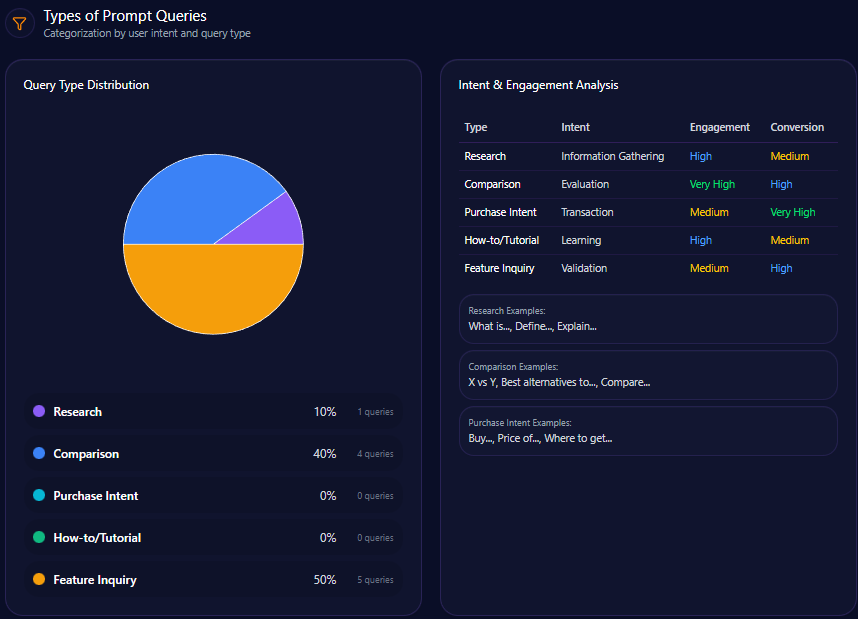
    • Feature Inquiry queries constitute 50% of prompt types, emphasizing product-specific exploration by users.
    • Comparison queries represent 40%, indicative of customers evaluating alternatives.
    • Research queries form a minor 10% segment, suggesting limited exploratory depth at this stage.
    • Purchase Intent and How-to/Tutorial are minimally represented, at 0%.
    bankofamerica.com’s Types of Prompt Queries (GEO Report, Jan 20, 2026)

    This distribution suggests that user interactions with Bank of America in generative AI contexts gravitate heavily toward understanding features and benchmarking, rather than direct transactional intent or how-to guidance.

    Service / Product-Level Sentiment

    Digital Banking Excellence qualifies as a dominant positive theme, with 75% positive mentions highlighting the Erica AI assistant, mobile deposits, and user-friendly app functionalities.

    Conversely, Customer Service Friction comprises a notable negative dimension, with 50% negative sentiment citing automated menu frustrations, lengthy hold times, and branch closures impacting user experience.

    Corporate Stability & ESG discourse registers primarily neutral sentiment (75% frequency), focusing on sustainability targets and net-zero commitments.

    Conclusion

    Bank of America demonstrates robust engagement within the GEO analytics environment of finance and banking, particularly in AI-assisted services and virtual assistant leadership. Its 21% Share of Voice and top platform visibility confirm established digital banking strengths. Nonetheless, comparative data points to significant opportunity gaps—especially versus JPMorgan Chase and Capital One—in premium credit card influence, savings product yield visibility, and Copilot ecosystem indexing.

    Sentiment and founder context data further imply the necessity for enhanced executive narrative projection and a strategic realignment toward agile innovation to offset negative perceptions tied to customer support and operational legacy. Addressing structured data limitations and amplifying offerings like Merrill Lynch investment guidance would serve as critical levers to solidify BoA’s generative search authority.

    Ultimately, targeted content development around high-opportunity financial verticals coupled with executive leadership amplification can convert Bank of America from a credible secondary alternative to the preferred primary brand in generative financial AI insights.

    Explore SpyderBot to operationalize these GEO analytics insights.
  • JPMorgan Chase’s 22% Share of Voice Is Rewriting the AI Narrative of Modern Banking and Revealing the Real Competitive Fault Line

    JPMorgan Chase’s 22% Share of Voice Is Rewriting the AI Narrative of Modern Banking and Revealing the Real Competitive Fault Line

    In generative answers, JPMorgan Chase shows up as the default institutional reference point—but the report makes clear that wealth management, ESG authority, and cross-border trade are where rivals are trying to steal the microphone.

    At-a-glance

    • Share of Voice (LLM brand mentions): 22% (161 of 728 total mentions)
    • Visibility Score: 88 (161 total mentions)
    • Total visits: 5,234,812 with 1,308,703 in bot traffic
    • LLM referrals: 64,321 (ChatGPT 28,944; Perplexity 11,578; Gemini 9,648; Copilot 7,719)
    • Category rank: 39 in Finance/Financial_Planning_and_Management
    • Overall sentiment score: 72 (Positive 68 / Neutral 21 / Negative 11)

    Risk signals

    • Wealth management coverage: 59% vs 76% for Morgan Stanley (17-point gap)
    • “Sustainable investing” visibility: down 8% as Bank of America captures more authoritative citations

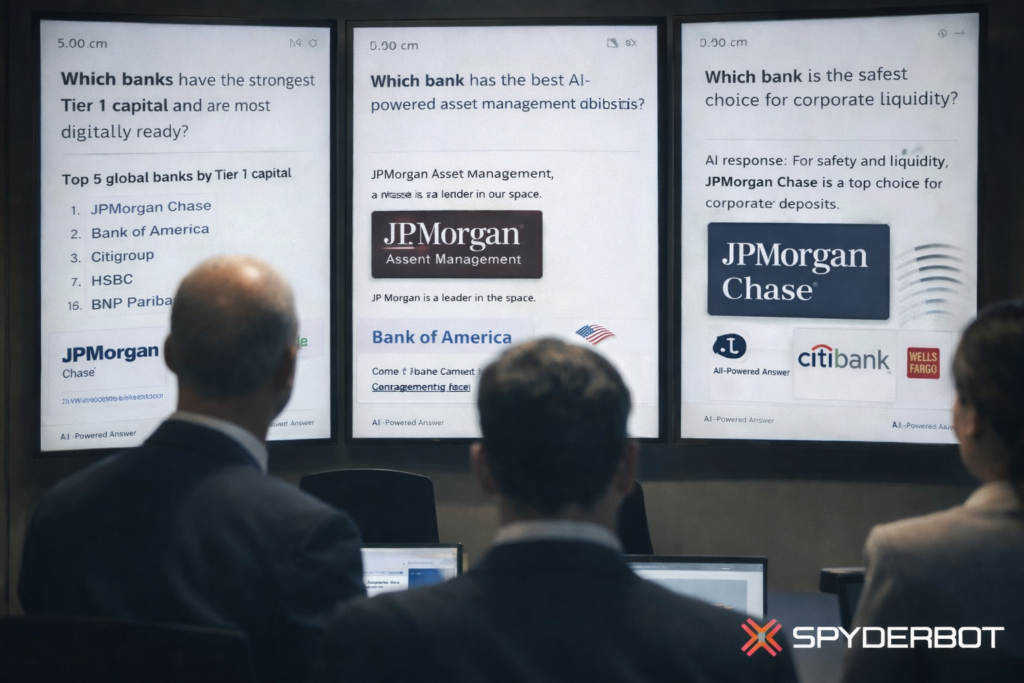
    Imagine a boardroom where the first “search” isn’t a browser tab—it’s a prompt. A director asks for the safest banking institution for enterprise liquidity. Someone else asks who leads in AI-driven wealth management tools. Another voice wants a shortlist of global banks by Tier 1 capital and digital readiness. In that moment, brand strategy becomes answer strategy—and the question is brutally simple: when the machines speak, do they say your name first?

    This report frames JPMorgan Chase as a brand that already occupies prime shelf space in AI responses—yet also as a brand facing precise, high-value narrative attacks where competitors have learned how to be “more citeable” in the niches that matter.

    Position in LLM Response Lists

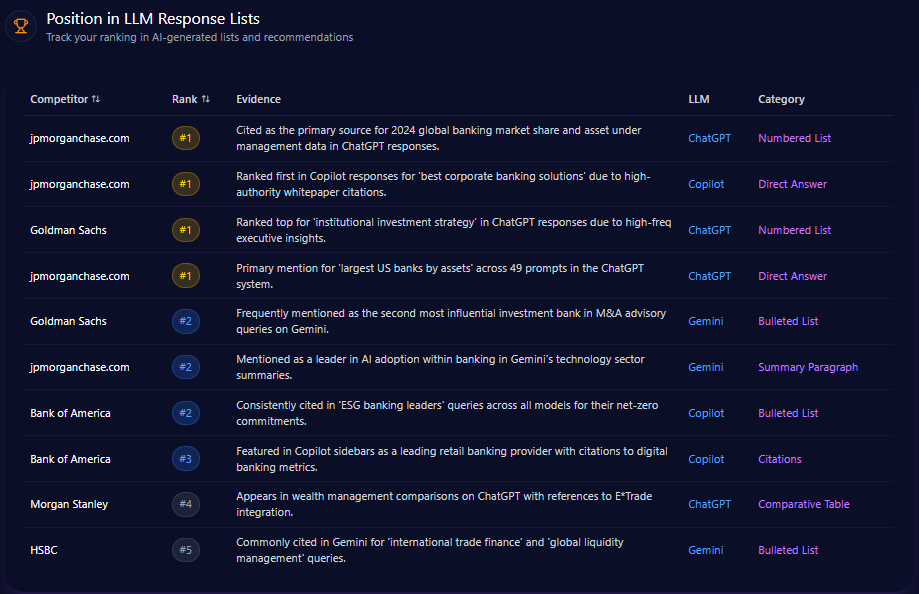
    Across the major platforms covered, JPMorgan Chase repeatedly appears in the highest-visibility formats—ranked lists, direct answers, and summary paragraphs. The report shows JPMorgan Chase at rank #1 in ChatGPT “Numbered List” outputs, supported by evidence that it is cited as a primary source for “2024 global banking market share and asset under management data.” It also appears as a Direct Answer leader on ChatGPT for “largest US banks by assets,” and takes rank #1 in Copilot responses for “best corporate banking solutions,” where the report attributes the placement to high-authority whitepaper citations.

    But the list ecosystem is not a monopoly—more like a rotating podium. Goldman Sachs appears as rank #1 for “institutional investment strategy” in ChatGPT, and shows up as rank #2 in Gemini investment-banking contexts. Bank of America is positioned prominently in Copilot’s ESG-oriented list formats (including rank #2 and rank #3 placements in cited contexts). Even further down the stack, Morgan Stanley and HSBC show up as consistent anchors—Morgan Stanley in comparative wealth management tables, HSBC in Gemini trade-finance lists.

    In other words: JPMorgan Chase often leads the “default” questions. The pressure is coming from the specialized ones.

    jpmorganchase.com’s Position in LLM Response Lists (GEO Report, Jan 19, 2026)

    Competitor Gap Analysis

    The report’s battle map is clear: JPMorgan Chase is strong where breadth, scale, and institutional credibility win—but rivals are carving out adjacent territories with sharper narrative hooks.

    One front is sustainable investing. For “sustainable investing trends 2024,” the report scores JPMorgan Chase at 76 versus Bank of America at 89 (13-point gap; High priority), with the opportunity described as sustainability reporting being synthesized more frequently as “authoritative” for Bank of America. Another front is Asia and cross-border trade: for “Asian market expansion for corporates,” JPMorgan Chase is 72 versus HSBC at 94 (22-point gap; High priority). For “global cross-border trade,” the gap is similarly material: 79 versus 91 (12-point gap; High priority).

    Wealth management is the third arena, where the report suggests JPMorgan Chase is present—but not first in mind. For “wealth management for high-net-worth,” JPMorgan Chase is 81 versus Morgan Stanley at 88 (7-point gap; Medium priority), with the report noting Morgan Stanley is often the first choice when describing brokerage tools.

    Not every fight is a deficit. For “generative AI in finance,” JPMorgan Chase scores 93 versus Goldman Sachs at 74 (a -19 gap score in the report, signaling JPMorgan Chase’s lead). And in “M&A advisory leaders,” JPMorgan Chase is 94 versus Goldman Sachs at 92 (2-point gap; Low priority), described as near parity.

    QueryJPMorgan Chase position/metricCompetitor position/metricGap/priority
    sustainable investing trends 202476Bank of America 8913 / High
    Asian market expansion for corporates72HSBC 9422 / High
    global cross-border trade79HSBC 9112 / High
    wealth management for high-net-worth81Morgan Stanley 887 / Medium
    M&A advisory leaders94Goldman Sachs 922 / Low

    This is where GEO analytics stops being a dashboard and becomes a strategic brief: the competition isn’t “who is bigger,” it’s “who is easiest for the model to justify.”

    Trigger Keywords for Competitor Products

    The report shows that in product- and service-oriented discovery moments, keyword triggers can tilt the answer toward competitors—even when JPMorgan Chase is strong overall.

    Several high-intent keywords are associated with outsized competitor pull. “Online banking security” appears with 91 mentions and is dominated by Bank of America (84) alongside HSBC (42) and Goldman Sachs (31). “Global trade finance” is a decisive HSBC keyword—78 competitor mentions attributed to HSBC within that trigger set. In “Wealth management services,” the competitive density intensifies: Morgan Stanley is listed with 74 mentions and Goldman Sachs with 68, compared to Bank of America (31) and HSBC (19) within the same trigger cluster.

    On the consumer side, “High yield savings account” is a volatile keyword category: “others” appear at 84, while Goldman Sachs is listed at 62, and Bank of America at 44—an illustration of how nontraditional players can flood the narrative in retail-style queries. Meanwhile, “Mortgage rates 2025” shows “others” at 66 and Bank of America at 59, reinforcing that some consumer finance prompts function like open marketplaces inside the model.

    In short, the report treats trigger keywords as the hidden levers behind competitor displacement—especially in security, cross-border trade, and wealth narratives.

    Founder Negative Context

    The report’s founder narrative is both an asset and a risk amplifier. Jamie Dimon appears with mention frequency 134 and a sentiment score 78, with 68% positive, 19% neutral, and 13% negative. That level of presence can act as a trust proxy—but it also concentrates reputational exposure.

    Negative context is broken into four dominant buckets: Regulatory Scrutiny (38%), Legacy Litigation (29%), Succession Risk (22%), and Corporate Culture (11%). The report’s heatmap shows where these themes spike: Regulatory Scrutiny appears at 42% in ChatGPT’s context mix, Legacy Litigation reaches 37% in Gemini, and Succession Risk rises to 29% in Copilot.

    The report also signals that certain combinations recur in AI answers—most pointedly: “Regulatory Scrutiny” plus “Capital Requirements” appearing together in 62% of ChatGPT answers. At the narrative level, the report’s summary language is unambiguous that succession uncertainty is a recurring negative theme, and elsewhere it characterizes succession uncertainty as 37% of negative context mentions in the report’s broader synopsis—an emphasis that keeps leadership continuity in the spotlight even when overall sentiment remains favorable.

    Quick overview

    JPMorgan Chase’s footprint in this report is built on scale and visibility mechanics. The site logs 5,234,812 total visits, including 1,308,703 in bot traffic. LLM referrals total 64,321, led by ChatGPT (28,944) and followed by Perplexity (11,578), Gemini (9,648), and Copilot (7,719). The category rank is 39 in Finance/Financial_Planning_and_Management.

    On the generative side, the environment tested includes 49 LLM bots working and 49 prompts per LLM across the named systems. The picture that emerges is not just “traffic,” but structured exposure—how often JPMorgan Chase becomes the cited bridge between a prompt and an answer.

    Share of Voice in LLM Responses

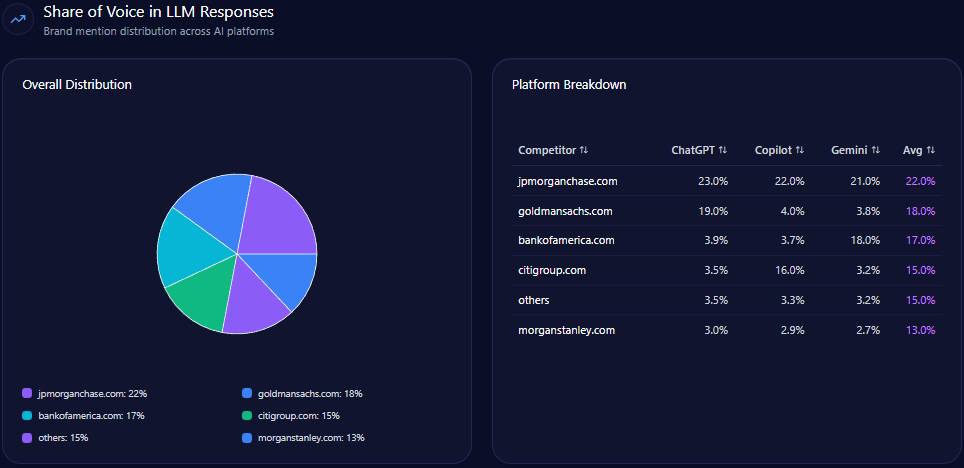
    In the report’s core measure of mindshare inside AI answers, JPMorgan Chase holds 22% of total 728 mentions (161 mentions). The nearest rivals are Goldman Sachs at 18% (131), Bank of America at 17% (124), Citigroup at 15% (109), and Morgan Stanley at 13% (95). “Others” also account for 15% (108), which the report flags as meaningful dilution pressure—particularly in retail-oriented narratives.

    Visibility scores track the same ordering: JPMorgan Chase leads at 88, followed by Goldman Sachs (82), Bank of America (79), Citigroup (74), and Morgan Stanley (71), with “others” at 46.

    This is the essential signal behind LLM brand mentions: JPMorgan Chase is winning the headline share, but the open field—“others”—is large enough to reshape perception in the long tail.

    jpmorganchase.com’s Share of Voice in LLM Responses (GEO Report, Jan 19, 2026)

    AI Platform-Specific Visibility

    The same brand performs differently across platforms—less like a single market, more like three editorial desks with distinct preferences.

    On ChatGPT, visibility reaches 89%, and share of voice is 23%, with 56 JPMorgan Chase mentions out of 239 total mentions tracked in that platform slice. On Copilot, visibility is 87% with 22% share of voice and 53 mentions (out of 242). On Gemini, visibility is 84%, share of voice 21%, and 52 mentions (out of 247). “Others” are grouped separately with 38% visibility and 15% share of voice (and 108 mentions).

    The report’s implication is practical: platform bias isn’t theoretical. If ChatGPT’s preference leans toward JPMorgan Chase’s high-authority assets, Gemini’s lower visibility percentage signals that content packaging and crawl logic matter—not just content quality.

    Sentiment Score for Competitors

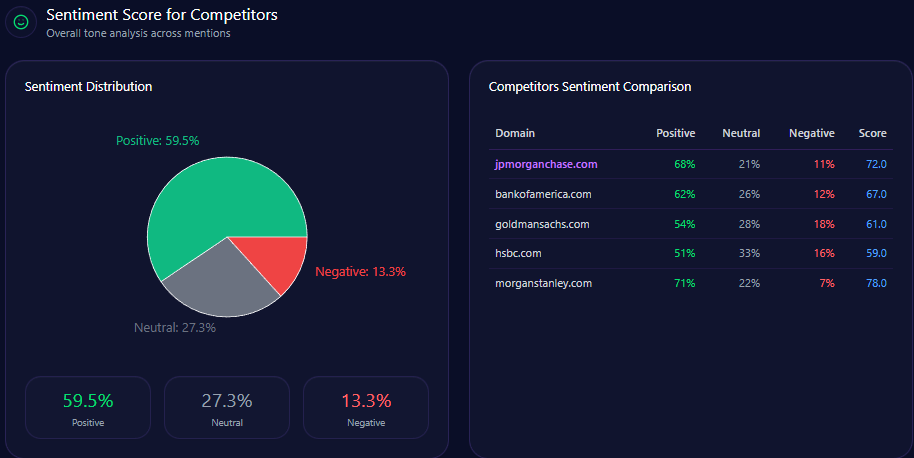
    Narratives don’t just rank—they feel a certain way. JPMorgan Chase posts an overall sentiment score of 72 (Positive 68 / Neutral 21 / Negative 11). Bank of America follows at 67 (62/26/12). Goldman Sachs registers 61 (54/28/18). HSBC comes in at 59 (51/33/16). Morgan Stanley leads sentiment at 78 (71/22/7).

    The report ties these tones to recurring themes. “Artificial Intelligence Leadership” appears with count 112 and frequency 76.00, described as “Highly Positive,” with an example referencing “JPMorgan’s Onyx blockchain and LLM-driven research tools.” “Global Economic Influence” shows count 98 and frequency 67.00, “Neutral-Positive,” with examples tied to “Jamie Dimon’s predictions on interest rates and inflation.” “Environmental Impact & ESG” appears at count 43 and frequency 29.00, explicitly framed as “Negative,” with examples including criticism of investment in non-renewable energy projects.

    This is where competitor sentiment tracking becomes strategic: the report shows JPMorgan Chase winning the AI-and-innovation storyline, while ESG framing is where narrative drag accumulates.

    jpmorganchase.com’s Sentiment Score for Competitors (GEO Report, Jan 19, 2026)

    Top Prompts Driving Mentions

    Some prompts act like summoning spells—and the report lists the ones that most reliably pull JPMorgan Chase into the room.

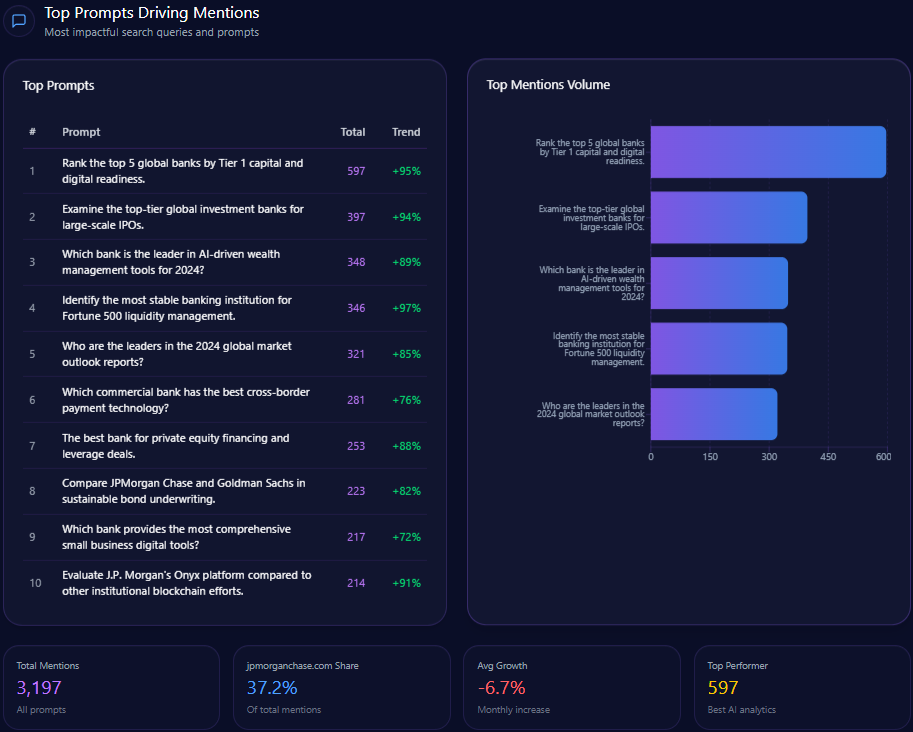
    The biggest prompt by total mentions is: “Rank the top 5 global banks by Tier 1 capital and digital readiness.” It shows 597 mentions total, with 140 for the brand, and competitor counts including 122, 119, and 114, with competitor names listed as HSBC, Bank of America, Goldman Sachs, and Morgan Stanley, and a trend of +95%.

    Investment banking visibility also concentrates in specific questions. “Examine the top-tier global investment banks for large-scale IPOs.” shows 397 total mentions, with 138 for the brand and 141 for a competitor, alongside 118, and a trend of +94%. “The best bank for private equity financing and leverage deals.” shows 253 mentions total, 121 for the brand, and 132 for a competitor, with +88% trend.

    The report also spotlights the wealth-management battleground: “Which bank is the leader in AI-driven wealth management tools for 2024?” shows 348 total mentions and 112 for the brand, while a competitor registers 124, and another 112, with +89% trend.

    And then there are the “proof prompts”—questions that reward institutional authority. “Identify the most stable banking institution for Fortune 500 liquidity management.” shows 346 mentions total, with 142 for the brand, and competitor counts of 115 and 89, with +97% trend. These are exactly the moments where JPMorgan Chase plays “default answer” best.

    jpmorganchase.com’s Top Prompts Driving Mentions (GEO Report, Jan 19, 2026)

    Types of Prompt Queries

    The report’s prompt mix skews heavily toward two intent types: Feature Inquiry and Comparison. Feature Inquiry accounts for 70 value with 7 count, while Comparison accounts for 30 value with 3 count. Other types—Research, Purchase Intent, and How-to/Tutorial—register 0 value and 0 count in this slice.

    That skew matters. Feature Inquiry prompts reward structured explanations, lists of capabilities, and “why this is better” narratives. Comparison prompts reward clean, tabular, retrieval-friendly contrasts. In a market where “others” already hold 15% share of voice, the report implies that whoever formats the clearest comparative facts can steal the answer—especially in retail and small-business moments.

    E-commerce Sentiment for Competitor Products

    When the conversation shifts from institutional authority to product choice, the report shows a different competitive distribution.

    In e-commerce-style mentions across ChatGPT, Gemini, and Copilot, JPMorgan Chase holds 39.46% share of voice with 58 mentions. Bank of America follows at 26.53% with 39 mentions. Goldman Sachs and Morgan Stanley each register 12.24% with 18 mentions, while HSBC sits at 6.8% with 10 mentions and “others” at 2.72% with 4.

    Sentiment at the product level trends strongly positive in the report’s e-commerce sentiment blocks: 82/12/6 across 247 reviews, 79/15/6 across 212, and 84/10/6 across 189 (positive/neutral/negative). The accompanying snippets sharpen what drives that positivity—and where friction emerges. For example: “The Chase Sapphire Reserve remains the king of travel rewards. The ease of transferring points to partners like Hyatt is unmatched by competitors.” (as cited in the report). A neutral contrast reads: “Bank of America has better integration for Merrill Lynch users, but JPMorgan Chase offers a more intuitive standalone banking app experience.” (as cited in the report). And a negative service note appears as well: “Wait times for customer support via the phone are increasing, specifically for Chase Business Ink accounts. Better to use the secure message center.” (as cited in the report).

    The funnel signal is also explicit: referrals show ChatGPT 384 (conversion rate 4.2), Gemini 412 (3.8), and Copilot 356 (4.5). Meanwhile, the report’s e-commerce trend line shows JPMorgan Chase increasing from 38% to 43% across January through June, alongside competitive movement for Bank of America (31%–33%), Goldman Sachs (13%–15%), HSBC (5%–8%), and Morgan Stanley (9%–12%).

    This is where the report’s trigger keywords become a map of displacement risk: “best travel credit cards,” “small business loans,” “cash back checking,” “global trade finance,” and “online banking security” act as the rails that route users toward or away from JPMorgan Chase depending on who owns the most citeable comparisons in the model’s memory.

    Conclusion

    The report positions JPMorgan Chase as a visibility leader—yet one that must defend high-value niches where rivals are winning the “most authoritative” framing. The recommended path is specific: increase the publication frequency of wealth management citable assets to close the 17% coverage gap, optimize technical documentation to lift Gemini visibility from 84% toward ChatGPT’s 89%, and restructure sustainability/ESG reporting into LLM-accessible formats (including JSON-LD or Q&A summaries) to close the 13-point gap against Bank of America. It also calls for structured data strategies around M&A case studies and region-specific content on global treasury and Asia-Pacific trade narratives to challenge HSBC’s lead.

    Explore SpyderBot to operationalize these GEO analytics insights.