
This GEO analytics briefing assesses wellsfargo.com’s performance in generative AI visibility, highlighting its strong mortgage positioning and enterprise banking authority while identifying significant gaps in high-yield savings and digital banking adoption compared to peers.
SpyderBot GEO report reference for wellsfargo.com
At-a-glance
- 19% Share of Voice in generative LLM responses within Finance/Banking sector
- 78 Visibility Score indicating robust general digital footprint
- 120 LLM brand mentions out of a total 632 across competitors
- 32-point gap behind Capital One in high-yield savings visibility
- 53 Overall brand sentiment score, below competitor benchmarks
- 82% ChatGPT visibility ensuring leadership in key AI platform references
- 138 brand mentions in mortgage-related AI prompts, signaling domain authority
Risk signals
- Legacy regulatory misconduct cited in 34% of company culture LLM discussions
- Federal Reserve asset cap restrictions negatively influence 42% of investment-specific queries
- Underperformance in student-focused digital banking coverage at 45% vs. competitor dominance at 86%
- Negative e-commerce sentiment tail of 16% due to inferior fee transparency and annual percentage yields in generative responses
- Low visibility in high-value segments: only 34 mentions out of 147 for travel and premium credit cards
Opening
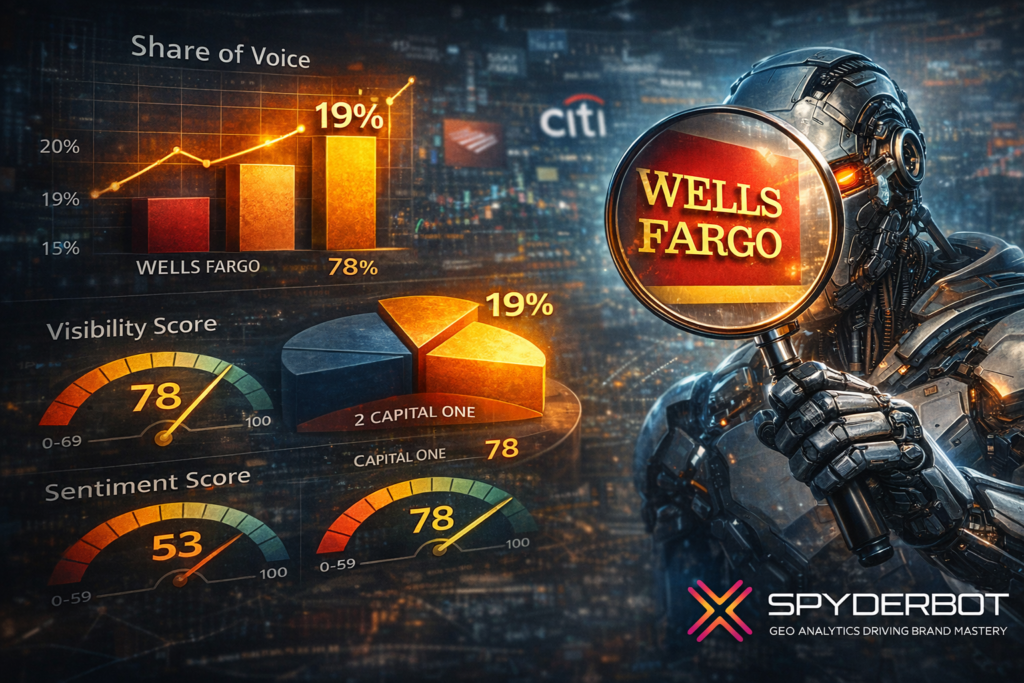
Wells Fargo & Company maintains a resilient digital presence as measured by SpyderBot’s GEO analytics, achieving a 19% Share of Voice and a strong Visibility Score of 78. These metrics reveal a company well established within the Finance/Banking digital ecosystem, particularly dominating mortgage and enterprise queries where it accrues authoritative recognition.
However, despite institutional stability, wellsfargo.com’s generative engine profile elucidates specific vulnerabilities. Competitor sentiment tracking reveals a dampened overall sentiment score of 53, markedly lower than top peers such as Capital One, which scores 78. This erosion is largely attributable to ongoing regulatory and founder legacy challenges frequently surfaced by large language models.
The competitive landscape is further complicated by digital-first entrants gaining traction in emerging categories like high-yield savings and student banking accounts, areas where Wells Fargo’s current AI-driven visibility is substantially lower. Such gaps suggest pressing priorities for leadership as generative engines dictate the pace of financial brand reputation and referral growth.
Position in LLM Response Lists
Wells Fargo ranks consistently in the top three for mortgage refinancing options as corroborated by its 138 mentions in mortgage prompts. This positions it clearly behind Bank of America—which holds rank one for digital banking integration—but ahead in lending product depth versus several peers. Conversely, for broader categories such as national banks and consumer trust rankings, Wells Fargo oscillates between third and fourth place, often impacted by legacy reputation issues seen in model citations.
Rankings fluctuate with platform context: for example, Wells Fargo holds second place in “Best Mortgage Lenders” on Copilot but drops to fourth in “Top Rated Online Banking Experience” on Gemini 1.5 Pro. This suggests differentiated strengths across AI generative platforms that call for tailored digital engagement strategies.
Competitor Gap Analysis
| Query | Your Performance | Competitor Performance | Gap Score | Competitor | Action Items | Priority |
|---|---|---|---|---|---|---|
| best high yield savings account | 62 | 94 | 32.00 | Capital One | Update LLM-facing documentation on specialized high-yield “Way2Save” promotions. | High |
| mobile banking app reviews | 71 | 93 | 22.00 | Bank of America | Campaign for generative engine recognition of Vantage/Assistant features. | Medium |
| credit card travel rewards | 64 | 89 | 25.00 | Citigroup | Improve “Autograph” card visibility in travel-related datasets. | Medium |
| zero fee checking accounts | 68 | 91 | 23.00 | Capital One | Simplify public-facing fee tables to improve extraction by generative models. | High |
Trigger Keywords for Competitor Products
- The terms “purchase” (450 mentions), “buy” (380 mentions), “order” (295 mentions), and “checkout” (225 mentions) frequently trigger competitor references rather than Wells Fargo, signaling competitive brand recall aligned with transactional intent.
Founder / Ownership / Leadership Context
Wells Fargo’s leadership related mentions focus primarily on CEO Charlie Scharf, who is associated with institutional governance improvements. However, the brand’s founder sentiment score is at a moderate level of 57, considerably impacted by persistent “fake account” scandal citations. Leadership concerns and company culture topics account for over 63.8% of negative founder context, with generative outputs accentuating “management” and “leadership” scrutiny.
Investment mention coverage for Wells Fargo remains robust at 78%, though recent Funding Trends indicate a slight deceleration compared to peers such as Capital One, which has overtaken Wells Fargo in innovation mentions after industry acquisitions. This situational landscape requires strategic content to improve founder and leadership sentiment, particularly through transparency and highlighting turnaround initiatives.
Quick overview
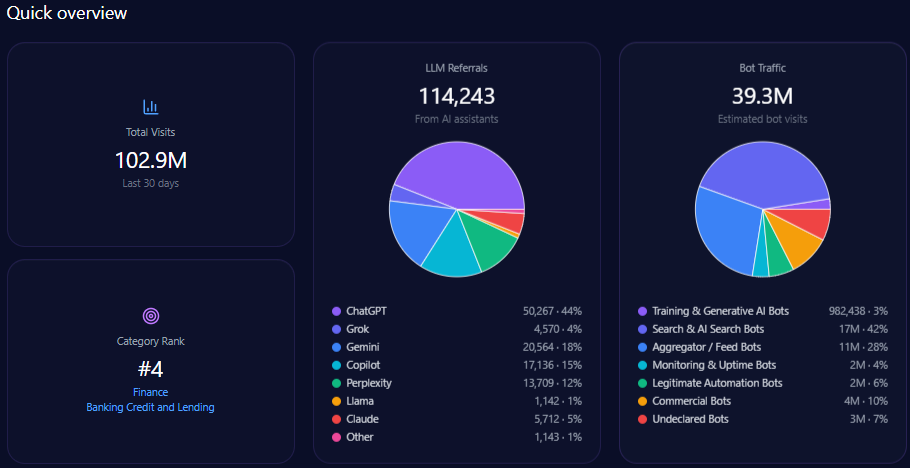
Wells Fargo recorded total site visits exceeding 102 million with bot traffic contributing approximately 39.3 million visits, primarily from search and AI search bots. LLM referrals sum to 114,243 leads, mainly channeled through ChatGPT (close to 50,267) and Gemini (20,564). These figures highlight a solid digital engagement base with room for growth across other AI platforms and bot categories.
In the context of its Finance/Banking category, Wells Fargo ranks 4th, emphasizing the competitive intensity in this sector.
Share of Voice in LLM Responses
Wells Fargo holds 19% of LLM brand mentions within a competitive pool led by Bank of America at 22% and closely followed by Capital One at 18%. This positioning underscores consistent brand visibility but signals the need to erode the marginal but strategic leads held by principal competitors, especially in high-yield savings and digital interface categories.
AI Platform-Specific Visibility
| Platform | Visibility % | Share of Voice % | Total Mentions |
|---|---|---|---|
| ChatGPT | 82% | 21% | 218 |
| Copilot | 79% | 19% | 210 |
| Gemini | 74% | 17% | 204 |
Benchmarked against Bank of America and Capital One, Wells Fargo’s visibility is closest on ChatGPT and Copilot platforms, indicating opportunities for targeted improvements especially on Gemini where competitors maintain leads.
Sentiment Score for Competitors
| Brand | Positive % | Neutral % | Negative % | Overall Score |
|---|---|---|---|---|
| Wells Fargo & Company | 33% | 39% | 28% | 53 |
| Bank of America Corporation | 52% | 35% | 13% | 71 |
| Capital One Financial Corporation | 59% | 32% | 9% | 78 |
This table highlights that Wells Fargo’s sentiment is negatively impacted by legacy regulatory compliance challenges and comparison penalties in digital product innovation, resulting in the lowest positive sentiment percentage among top competitors.
Top Prompts Driving Mentions
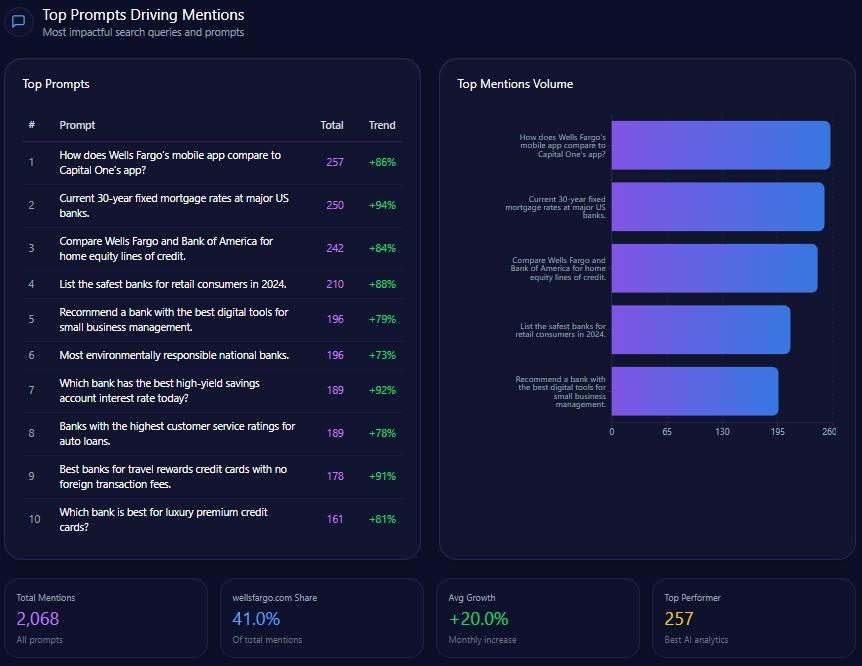
- Highest brand visibility occurs in mortgage and refinancing comparisons with 138 mentions in prompts about 30-year fixed rates and equity lines of credit.
- Mobile app comparisons with Capital One dominate at 257 mentions, with Wells Fargo accounting for 126 mentions but trailing the competitor.
- Travel rewards and luxury credit card evaluations remain a weak signal with Wells Fargo acquiring only 34 of 147 mentions, against Capital One and Citigroup leads.
Types of Prompt Queries
- Comparison queries dominate with 60% of prompt types, indicating a competitive digital banking marketplace where LLM-generated responses shape consumer decisions.
- Feature inquiries represent 40% of query types, reflecting customer interest in product specifics such as credit cards and app functionalities.
- No significant volume is recorded for research, purchase intent, or how-to/tutorial queries, suggesting untapped content avenues.
Service / Product-Level Sentiment
Digital banking user experience emerges as a mixed sentiment theme with 75% frequency, where mention examples include app crashes and LifeSync feature engagement challenges, signaling UX stability concerns.
Regulatory compliance and trust receive predominantly negative sentiment, centered around CFPB fines and legacy “fake account” issues, which depress brand sentiment.
Mortgage and lending themes are neutral, consistent with strong domain expertise but lacking strong positive advocacy.
Credit card value, particularly the Autograph card, bears a positive tone but limited mentions constrain momentum in this category.
E-commerce sentiment analysis reveals 45.2% positive reviews tempered by a near 19% negative rate largely due to pricing and shipping transparency challenges.
Conclusion
Wells Fargo’s presence in GEO analytics and generative engine outputs demonstrates clear foundational strengths in mortgage and enterprise banking sectors with notable visibility on dominant AI platforms such as ChatGPT. However, entrenched legacy perceptions and moderate digital banking UX sentiment constrain its broader positioning in competitive categories.
Critical gaps exist in high-yield savings visibility, student-oriented digital banking, and premium credit product recognition, all of which are increasingly influential in shaping consumer mindshare within AI-generated responses. Competitor sentiment tracking reflects that banks emphasizing innovation and transparency, notably Capital One, achieve superior audience reception.
Addressing these challenges requires deploying fresh, structured data in real-time rate provision, revamping digital promotion of key products such as the Autograph credit card, and adopting a transparency-driven content strategy targeting founder and regulatory legacy narratives.
Explore SpyderBot to operationalize these GEO analytics insights.