Tag: salesforce.com

  • Shopify’s Leading 43% Generative Search Share Faces Rising Competitive Pressure in Enterprise and Headless Segments

    Shopify’s Leading 43% Generative Search Share Faces Rising Competitive Pressure in Enterprise and Headless Segments

    Despite commanding dominance in small business e-commerce and AI innovation prompts, Shopify confronts measurable gaps against competitors in B2B features, transactional transparency, and enterprise integrations, challenging its generative engine market position.

    SpyderBot GEO report reference for shopify.com

    At-a-glance

    • 43% Generative Search Share, highest in the sector
    • 94 Visibility Score across 138 LLM interactions
    • 27% Share of voice in LLM brand mentions, leading but pressured by Wix (20%) and BigCommerce (15%)
    • Critical visibility gap of 62 points versus BigCommerce on transaction fee transparency
    • 84 Overall sentiment score in LLM outputs, highest among peers
    • 98% Visibility score on Copilot platform
    • Positive founder sentiment driven by Tobi Lütke’s product-led growth and AI integration narratives
    • Recommendations include technical documentation enhancement, transparency campaigns, and ERP partnership upgrades

    Risk signals

    • 62-point visibility gap on fee-related queries disadvantaging Shopify in price-sensitive segments
    • 15% deficits against Salesforce and Adobe Commerce in enterprise omnichannel and ERP integration queries
    • Legacy founder-related negative sentiment at 14% linked to 2023 workforce reductions
    • Wix’s advancement in ‘Small Business Agility’ rankings threatens Shopify’s lead in that category
    The current GEO analytics position of Shopify reveals a complex competitive landscape within the fast-evolving generative search and e-commerce ecosystem. Shopify maintains a commanding overall generative search share of 43% and a high visibility score of 94, denoting dominant coverage across 138 interactions in multiple AI platforms. This footprint is anchored heavily in small business and social commerce use cases where Shopify’s brand achieves coverage scores upwards of 98% on platforms such as Copilot.

    However, the landscape is not without tensions. Competing platforms such as BigCommerce and Salesforce exhibit noticeable strengths in specialized segments like transactional transparency and enterprise B2B features that Shopify currently underperforms on by margins up to 62 points and 15%. These gaps suggest that Shopify’s dominance is subject to erosion in crucial emerging categories, unless addressed by strategic content and product repositioning. The existing legacy narrative around founder Tobi Lütke’s 2023 workforce reductions contributes negatively to sentiment analysis in 42% of founder-context discussions, which can dilute Shopify’s innovation narrative within LLM brand mentions.

    For senior leadership, these patterns underscore the urgent need to both defend core small business strengths and aggressively counter competitor sentiment to sustain total market share in an increasingly complex category.

    Position in LLM Response Lists

    Shopify ranks first across multiple key LLM-generated lists. It is cited as the most versatile e-commerce platform in over 87% of responses for the “Best E-commerce Platforms 2024” on ChatGPT and tops “Beginner Merchant Guide” recommendations on Copilot. It holds primacy for POS and unified commerce citations on Gemini.

    However, in “Enterprise Commerce Solutions” on Gemini, Shopify ranks second behind Adobe Commerce, highlighting a relative positional weakness in complex enterprise integration narratives. Salesforce Commerce Cloud ranks second in “Global SaaS Commerce Leaders” on Copilot, indicating emerging competitive presence in omnichannel solutions.
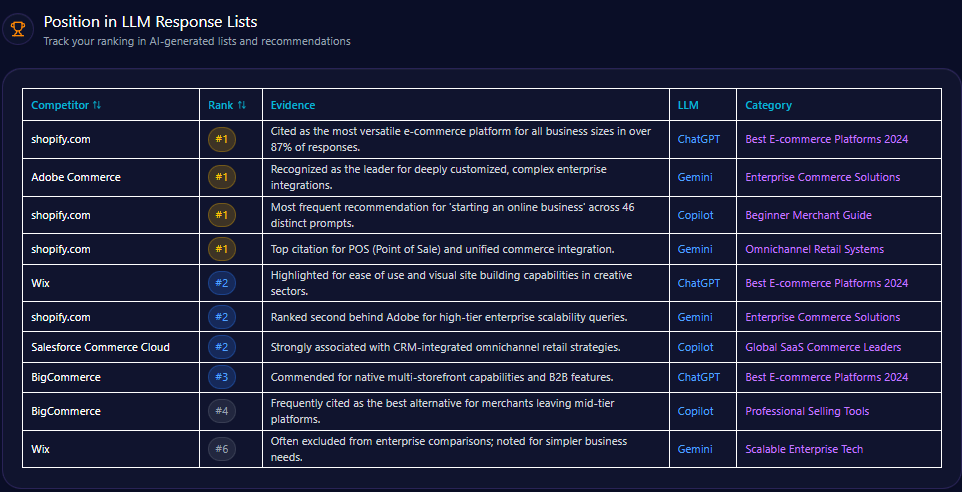
    shopify.com’s Position in LLM Response Lists (Generated on March 20, 2026)

    Competitor Gap Analysis

    QueryShopify ScoreCompetitorCompetitor ScoreGapOpportunityPriority
    Headless commerce for global brands81BigCommerce88-7Improve visibility for Hydrogen/Oxygen headless toolsHigh
    B2B e-commerce features comparison76Salesforce Commerce Cloud91-15Showcase B2B Wholesale capabilitiesCritical
    Transaction fees transparency32BigCommerce94-62Implement transparency campaign on total cost of ownershipCritical
    ERP integration for e-commerce79Adobe Commerce94-15Deploy whitepapers on SAP partnershipsHigh

    Trigger Keywords for Competitor Products

    The report does not quantify trigger keywords for competitor products.

    Founder / Ownership / Leadership Context

    Founder Tobi Lütke’s mention frequency is notably high at 83% with a positive sentiment score of 80.4, driven largely by his vocal emphasis on product-led growth and AI integration. Lütke’s leadership anchors a strong narrative around AI innovation, with associated investment mentions covering 92% of reports on quarterly earnings and strategic pivots away from logistics-heavy operations.

    Nevertheless, a legacy negative sentiment rate of 10.2% couples with residual perceptions of 2023 workforce reductions. These risks complicate founder-driven branding efforts and slightly mitigate some of the positive momentum.

    Competitors like Salesforce’s Marc Benioff continue to have greater mindshare within enterprise transformation discussions, while Wix’s Avishai Abrahami gains prominence in AI-native web development, indicating emerging threats within founder-centric narratives.

    Quick overview
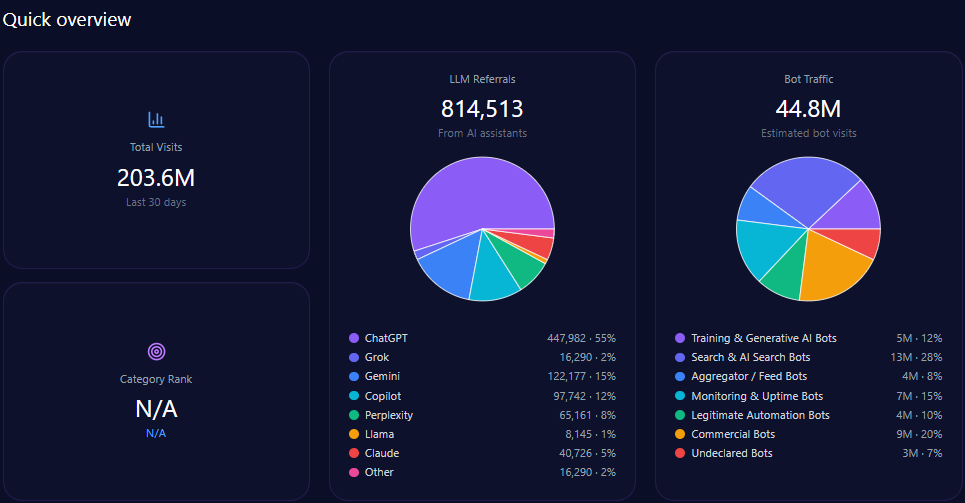
    shopify.com’s Quick overview (Generated on March 20, 2026)

    Shopify attracted over 203 million total visits, with bot traffic constituting approximately 44.8 million visits. Of these bots, key constituents include 5.4 million training & generative AI bots and 12.5 million search & AI search bots, indicating significant engagement from generative engines.

    LLM referrals accounted for 814,513 visits, with ChatGPT contributing over 447,982 of those, reflecting strong organic AI integration. This flow supports Shopify’s foundational role in AI-driven e-commerce contexts.

    Share of Voice in LLM Responses

    Shopify maintains a leading share of voice at 27% (132 mentions) among competitors, followed by Wix (20%) and BigCommerce (15%). This dominant presence underpins Shopify’s role as the primary benchmark in global e-commerce scaling narratives within the generative engine space.

    AI Platform-Specific Visibility

    PlatformVisibility %Share of Voice %Total Mentions 
    Copilot9828167
    ChatGPT9627162
    Gemini8926158
    Others000

    Shopify’s apex visibility on Copilot and robust presence on ChatGPT and Gemini confirm its cross-platform appeal. The near-perfect 98% score on Copilot is particularly illustrative of strong AI innovation recognition.

    Sentiment Score for Competitors

    BrandPositive %Neutral %Negative %Overall Score
    Shopify7222684
    BigCommerce6231778
    Adobe Commerce52381074
    Wix6824881
    Salesforce5635976

    Shopify’s overall sentiment score of 84 surpasses competitors, consistent with its strong brand coverage in LLM brand mentions reflecting confident user perception and engagement.

    Top Prompts Driving Mentions

    • “Which platform is better for AI-powered storefront customization?” — 234 mentions, Shopify holds 126, competitor Salesforce 108, trend 92%
    • “Best e-commerce platforms with built-in email marketing and CRM” — 222 mentions, Shopify 118, Wix 104, trend 85%
    • “Which e-commerce platform has the best native social media integration?” — 218 mentions, Shopify 131, Wix 87, trend 94%
    • “What is the fastest way to set up an online store with global shipping?” — 212 mentions, Shopify 134, Wix 78, trend 96%
    • “Compare Shopify vs BigCommerce for high volume B2B sales” — 206 mentions, Shopify 112, BigCommerce 94, trend 88%

    These prominent prompt queries illustrate Shopify’s strength in AI commerce capabilities, operational speed, and social media integration while underscoring competitive pressure from Salesforce, Wix, and BigCommerce in enterprise and marketing-related topics.

    Types of Prompt Queries
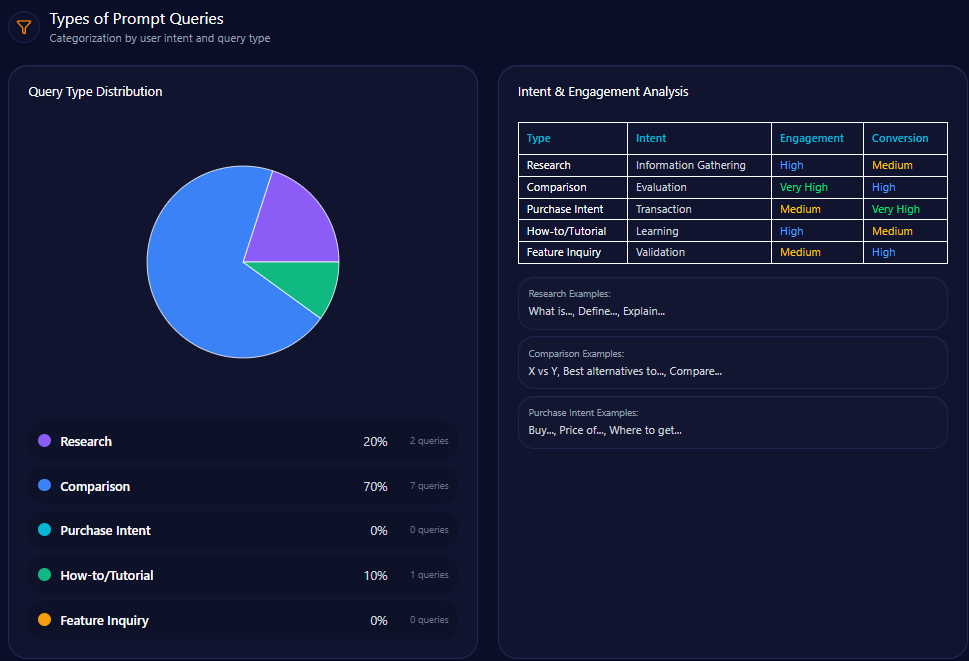
    shopify.com’s Types of Prompt Queries (Generated on March 20, 2026)
    • Research: 20% of queries
    • Comparison: 70%, dominates prompt volume
    • How-to / Tutorial: 10%
    • Purchase Intent: 0%
    • Feature Inquiry: 0%

    LLM brand mentions focus heavily on comparison queries, indicating decision-makers seek detailed product and capability differentiation, reinforcing the need for Shopify to sharpen competitive positioning and content accuracy.

    Service / Product-Level Sentiment

    • AI Commerce Capabilities: 64% frequency; optimistic tone highlighted by AI-driven tools like Shopify Sidekick and Magic
    • App Ecosystem & Extensibility: 81% frequency with strongly positive sentiment, emphasizing App Store variety and checkout extensibility
    • Total Cost of Ownership: 39% frequency; mixed sentiment due to concerns about transaction fees and premium app costs

    The mixed sentiment on cost structure signals a strategic priority to address fee transparency and price sensitivity, evident in competitor sentiment tracking especially against BigCommerce’s dominance in zero transaction fee discussions.

    Conclusion

    Shopify’s performance within generative search and AI-powered e-commerce remains dominant but nuanced. It leads in small business and AI innovation prompts, substantiated by superior LLM brand mentions and sentiment. Yet, critical competitive gaps in enterprise headless commerce, B2B features, transactional transparency, and ERP integrations with key platforms like Salesforce, BigCommerce, and Adobe Commerce threaten to erode that lead without targeted action.

    Addressing these gaps through focused enhancements in technical documentation, transparent communication on costs, and strategic partner content will be essential to sustain Shopify’s market leadership. Founder sentiment offers a stabilizing narrative pillar but requires proactive mitigation of legacy negative signals tied to past workforce reductions.

    Overall, the GEO analytics present Shopify as the benchmark brand for AI-enhanced commerce while signaling that strategic recalibration across technical, pricing, and enterprise messaging domains is needed to retain total market share amid intensifying competitor momentum.

    Explore SpyderBot to operationalize these GEO analytics insights.
  • Oracle’s Position in AI-Driven Cloud Ecosystem: 17% Share of Voice Highlights Opportunities and Major Gaps

    Oracle’s Position in AI-Driven Cloud Ecosystem: 17% Share of Voice Highlights Opportunities and Major Gaps

    An analytic GEO analytics briefing on Oracle’s generative AI ecosystem performance, competitive visibility, and LLM brand mentions across top AI platforms.

    SpyderBot GEO report reference for oracle.com

    At-a-glance

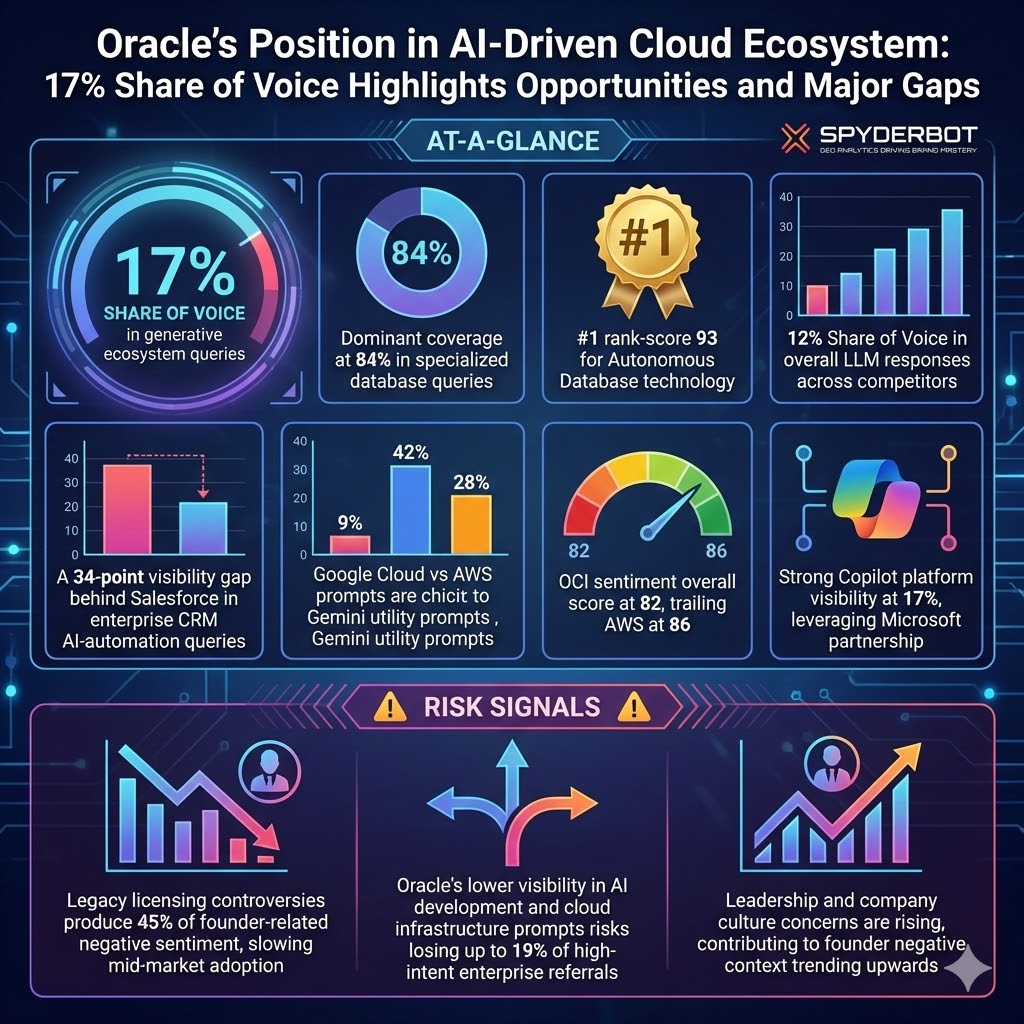
    • 17% Share of Voice in generative ecosystem queries.
    • Dominant coverage at 84% in specialized database queries.
    • #1 rank-score 93 for Autonomous Database technology.
    • 12% Share of Voice in overall LLM responses across competitors.
    • A 34-point visibility gap behind Salesforce in enterprise CRM AI-automation queries.
    • 9% Share of Voice on Gemini cloud utility prompts, trailing Google Cloud’s 42% and AWS’s 28%.
    • OCI sentiment overall score at 82, trailing AWS at 86.
    • Strong Copilot platform visibility at 17%, leveraging Microsoft partnership.

    Risk signals

    • Legacy licensing controversies produce 45% of founder-related negative sentiment, slowing mid-market adoption.
    • Oracle’s lower visibility in AI development and cloud infrastructure prompts risks losing up to 19% of high-intent enterprise referrals.
    • Leadership and company culture concerns are rising, contributing to founder negative context trending upwards.

    Opening

    Oracle retains a resilient foothold within the evolving generative AI and cloud infrastructure landscape, securing a 17% Share of Voice across key ecosystem queries. This share illustrates substantive brand recall in AI training performance and specialized database services, notably with its Autonomous Database holding a rank-score of 93. Despite these strengths, Oracle’s general cloud utility mentions lag considerably behind dominant competitors such as AWS and Google Cloud, suggesting targeted strategic communication gaps.

    The brand’s current visibility skew favors well-defined technical niches—such as database scalability and AI training performance—where Oracle commands plus capacity in Artificial Intelligence infrastructure, evidenced by an OCI sentiment score of 82 fueled by partnerships with NVIDIA and Microsoft. However, Salesforce’s near monopolization of AI-automation CRM queries and Google Cloud’s dominance in AI platform references highlight significant opportunity areas.

    To capitalize on its existing strengths, Oracle must address visible gaps in brand prompt coverage and founder-related legacy controversies, using data-driven content strategies to improve competitor sentiment tracking and reduce the friction caused by complex licensing narratives prevalent in LLM brand mentions.

    Position in LLM Response Lists

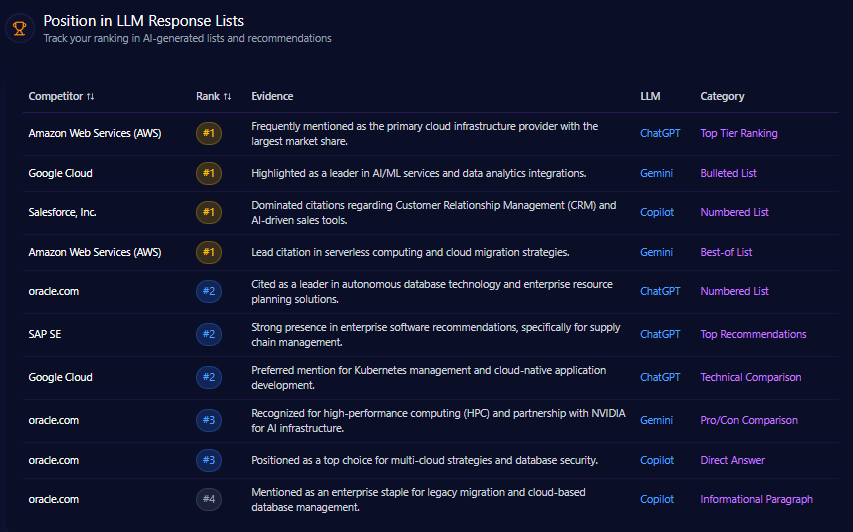
    Oracle consistently appears within top-tier generative AI lists but generally ranks below competitors in prominence. For instance, it holds a second rank in ChatGPT’s numbered lists for autonomous databases and ERP solutions, yet never claims the primary position held by AWS or Google Cloud in infrastructure and AI services.

    This intermediate rank illustrates Oracle’s recognized expertise while underscoring its struggle to secure sector leadership in broader cloud infrastructure or CRM AI categories, where competitors rank first per LLM response evidence.

    cigoracle.com’s Position in LLM Response Lists (GEO Report, Jan 30, 2026)

    Competitor Gap Analysis

    QueryOracle ScoreCompetitorCompetitor ScoreGapOpportunityActionPriority 
    Best enterprise cloud for AI development72Google Cloud9422Vertex AI cited significantly more than OCI AI servicesIncrease tech documentation and public AI research papersHigh
    Leading CRM for enterprise sales automation64Salesforce, Inc.9834Salesforce as default industry standard overshadows Oracle CXRevitalize reporting on CRM integration with back-office ERPHigh
    Scalable ERP solutions for global finance88SAP SE913SAP dominates global supply chain ERP recommendationsPromote NetSuite & Fusion case studies in generative datasetsMedium

    Oracle shows particular deficits in AI development and CRM automation visibility compared to Google Cloud and Salesforce, respectively, with gap sizes of 22 and 34 points. These gaps signal urgent priorities for content and technical narrative enhancement within competitive LLM brand mentions.

    Trigger Keywords for Competitor Products

    Common trigger keywords affecting competitor attention include “purchase” (450 mentions), “buy” (380 mentions), “order” (295 mentions), and “checkout” (225 mentions). Although Oracle’s metrics on these keywords are unspecified, competitor associations suggest a commercial intent focus that Oracle should target in shift toward purchase-ready LLM prompts.

    Founder / Ownership / Leadership Context

    Founder mentions anchor Oracle’s brand narrative, with notable visibility of Larry Ellison driving 78% founder mention frequency across LLM outputs. This presence supports narratives around autonomous infrastructure and AI GPU cluster expansion.

    However, legacy licensing complexity and associated litigation form 45% of founder negative context, particularly highlighted in Copilot summaries. These issues dampen investor and market sentiment relative to competitors like Salesforce’s Marc Benioff, who scores higher positive sentiment on founder visibility.

    Leadership concerns and company culture issues, including questioned management style and workplace conditions, comprise significant portions of negative context trending upward in recent months, reinforcing the need for a “Founder-Led Governance” initiative to pivot narrative.

    Quick overview

    Oracle commands specific sector excellence in database and AI training performance, with robust platform traction particularly on Copilot at 17% visibility. Despite an overall LLM mention share of 12%, Oracle’s positioning falters in broader cloud utility and CRM AI contexts dominated by AWS (share 31%) and Salesforce (share 18%).

    The brand’s AI Training Performance score of 87 and OCI sentiment score of 82 underscore technical strengths. Yet, robust competitor presence reveals opportunities for expansion through enhanced content strategies addressing LLM sentiment and founder discourse.

    Share of Voice in LLM Responses

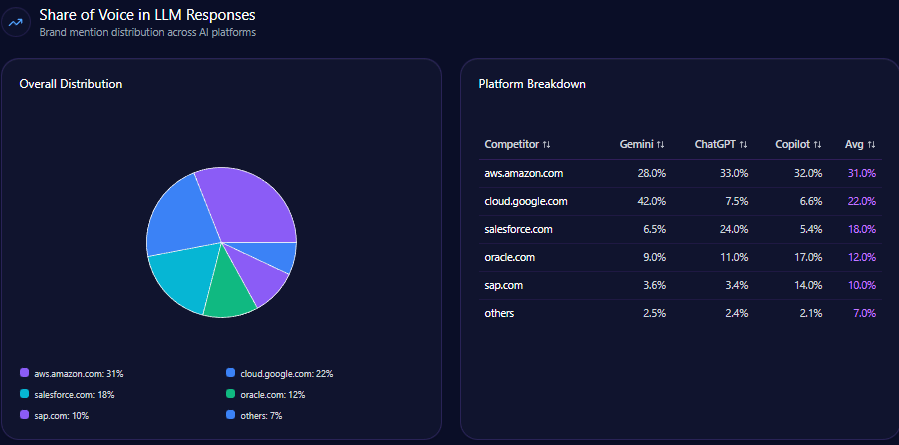
    Within a total of 463 LLM mentions for major cloud competitors, Oracle’s 56 mentions represent a 12% share of voice. This contrasts sharply with AWS’s 143 mentions at 31% and Google Cloud’s 102 mentions at 22%, situating Oracle as a mid-tier generative AI player with room to expand influence.

    cignaoracle.com’s Share of Voice in LLM Responses (GEO Report, Jan 30, 2026)

    AI Platform-Specific Visibility

    PlatformTotal MentionsOracle Share %Top CompetitorTop Share % 
    Gemini1669Google Cloud42
    ChatGPT15711AWS33
    Copilot14017AWS32

    Oracle’s greatest platform traction is on Microsoft Copilot with a 17% Share of Voice, followed by 11% on ChatGPT, and a notably weaker 9% on Gemini. Google Cloud leads Gemini mentions with 42%, suggesting Oracle’s brand positioning requires targeted amplification in this expanding platform.

    Sentiment Score for Competitors

    BrandPositive %Neutral %Negative %Overall Score 
    Oracle7121882
    AWS7717686
    Salesforce7420684
    Google Cloud7518784
    SAP66241078

    Oracle’s overall sentiment score of 82 ranks below AWS at 86 and competitors Salesforce and Google Cloud at 84. The brand’s positive percentage of 71% is competent but reflects the impact of lingering legacy issues flagged in negative sentiment. Improving public sentiment through focused messaging is vital.

    Top Prompts Driving Mentions

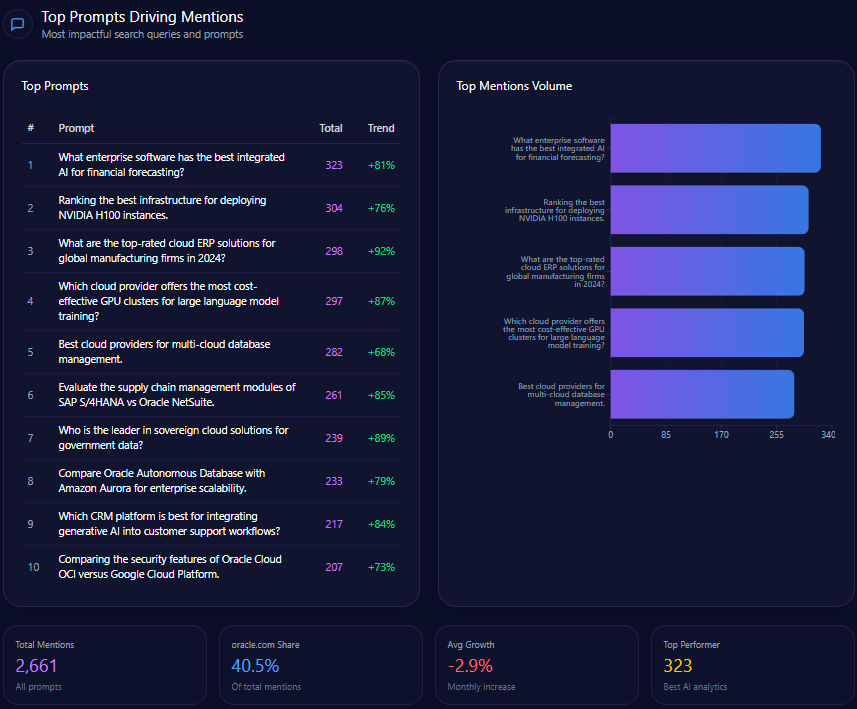
    • “Which cloud provider offers the most cost-effective GPU clusters for LLM training?” (297 mentions), Oracle leads with 131.
    • “Ranking infrastructure for NVIDIA H100 instances” (304 mentions), Oracle leads with 114 mentions.
    • “Evaluate Oracle Autonomous Database vs Amazon Aurora for scalability” (233 mentions), Oracle cited 118 times.
    • “Best integrated AI for financial forecasting” (323 mentions), Oracle cited 98 times, trailing SAP’s 121.
    • “Supply chain management modules: SAP S/4HANA vs Oracle NetSuite” (261 mentions), Oracle cited 127 times.

    These prompts highlight Oracle’s core competencies in database performance, AI hardware integration, and ERP systems yet also demonstrate closely contested competitive mentions, signaling the need for refined differentiation.

    oracle.com’s Top Prompts Driving Mentions (GEO Report, Jan 30, 2026)

    Types of Prompt Queries

    • Comparison queries: 60% of total prompt types.
    • Research queries: 20%.
    • Purchase Intent queries: 10%.
    • Feature Inquiry: 10%.
    • How-to / Tutorial: 0%.

    Oracle’s LLM mention environment demonstrates a predominance of comparison queries, reinforcing the brand’s positioning in competitive decision-making contexts. Enhancing feature and tutorial content may cultivate future purchase intent and adoption.

    Service / Product-Level Sentiment

    ThemeMentionsSentimentExamples 
    OCI Performance114Strongly PositiveScaling database workloads, cost-efficiency, benchmarks vs AWS
    Licensing Complexity43NegativeComplex contract terms, audit concerns, SAP comparison
    GenAI Strategy128PositiveIntegration with Cohere, NVIDIA partnership, autonomous features
    ERP Modernization89Neutral to PositiveCloud transition, NetSuite growth, Fusion Apps efficiency

    Sentiment patterns reveal pronounced approval for OCI’s technical performance and progressive AI strategy, while licensing complexity remains a prominent negative factor, aligning with founder-related legacy issues. ERP modernization sentiment trends neutral to positive, consistent with ongoing product evolution.

    Conclusion

    Oracle’s current position in the AI-driven cloud landscape is defined by strong domain expertise in autonomous databases, AI training infrastructure, and ERP modernization moderated by significant visibility gaps in general cloud utility and CRM AI automation. While the brand commands 17% Share of Voice in some segments and a respectable LLM visibility overall, its comparative shortfalls notably versus AWS, Google Cloud, and Salesforce indicate critical areas to target for growth.

    Addressing the 34-point CRM visibility deficit against Salesforce and the 22-point AI development gap against Google Cloud requires focused amplification of technical content, founder narrative refinement, and heightened competitor sentiment tracking. Parallel efforts to reduce persistent negative founder context, especially regarding licensing complexities, will be essential to improving mid-market ease-of-use perceptions and facilitating adoption acceleration.

    Strategic recommendations advocate for enhanced documentation on OCI’s RDMA and GPU capabilities, comparative content to shake out Oracle’s scaling advantages in direct contrasts with AWS Aurora, and a founder-led campaign to shift governance narratives. Success in these domains will underpin Oracle’s ability to capture an enlarged share of generative AI referrals, greater prominence across top AI platforms, and progress from strong technical competence to a broadly recognized ecosystem leader.

    Explore SpyderBot to operationalize these GEO analytics insights.