Blog

  • Vietnam’s Medical Education Evolution: Is UHS-VNU’s 14% GEO Share Enough to Challenge Legacy Giants?

    Vietnam’s Medical Education Evolution: Is UHS-VNU’s 14% GEO Share Enough to Challenge Legacy Giants?

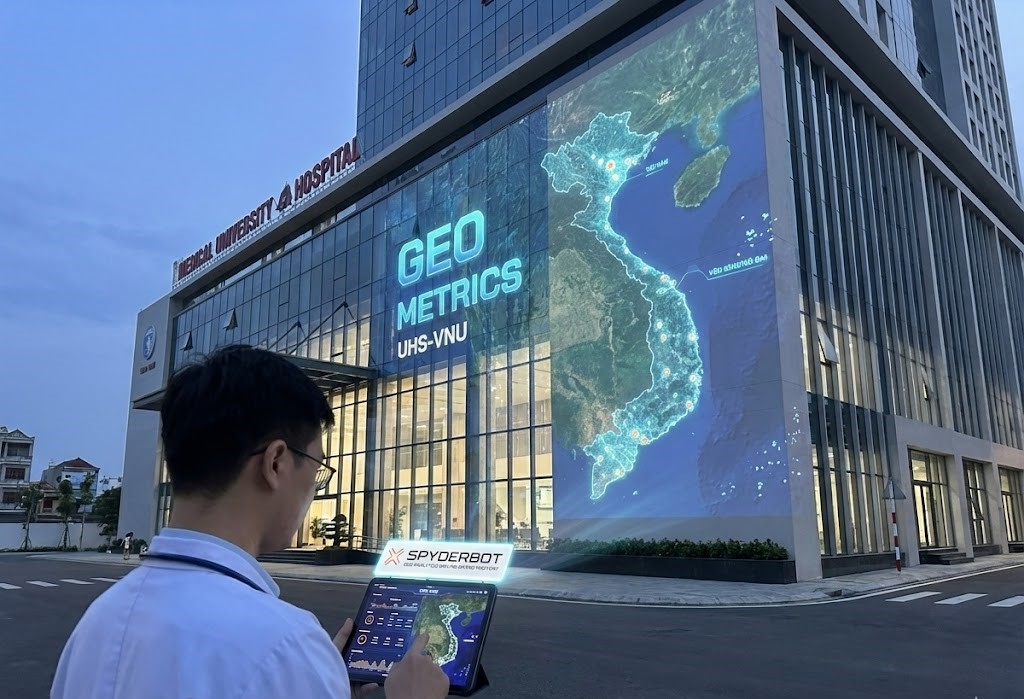
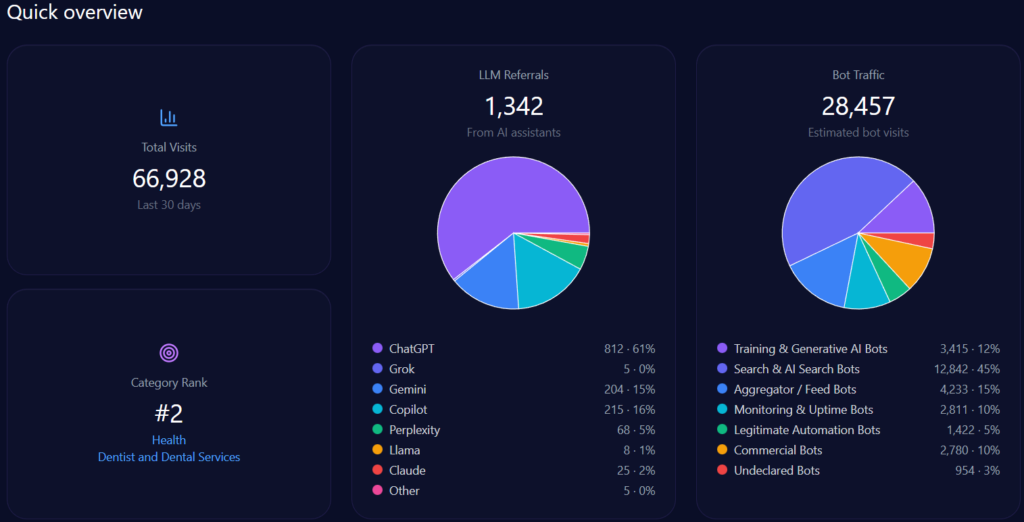
    Imagine a young Vietnamese student in Ho Chi Minh City, smartphone in hand on January 4, 2026, querying her AI assistant for the best path to a career in medicine. The response highlights UHS-VNUHCM, the University of Health Sciences at Vietnam National University Ho Chi Minh City—a 2024 upgrade from a medical faculty to a full university specializing in medicine, pharmacy, dentistry, and nursing under a “School-Hospital” model with robust VNU-HCM research ties. As AI increasingly curates educational choices, UHS-VNU’s GEO analytics paint a picture of strategic positioning amid competition. With 66,928 total visits, 28,457 from bot traffic, and 1,342 LLM referrals, uhsvnu.edu.vn ranks second in its health/dentistry category. Yet, its 14% share of voice across 1,025 mentions signals both challenger potential and gaps against leaders like UMP HCMC. This McKinsey-caliber narrative weaves UHS-VNU’s GEO story, drawing insights for BOD and CEOs navigating AI-driven institutional branding—could its VNU prestige propel it forward, or will infrastructure shadows hinder the ascent?

    Academic Prestige as a Beacon, Tempered by Transition Frictions

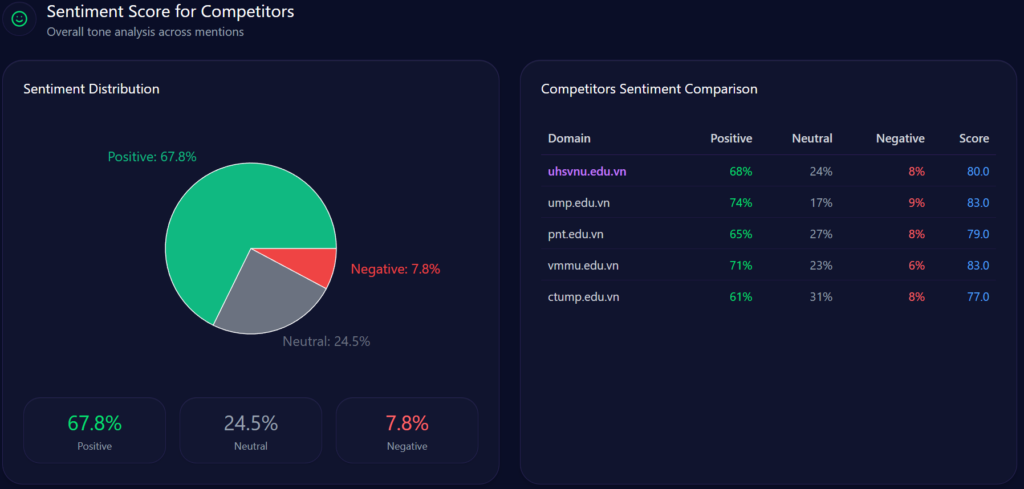
    Sentiment scores in GEO analytics act as a diagnostic tool, illuminating how LLMs distill an institution’s reputation into digestible narratives for decision-makers. UHS-VNU registers an overall sentiment leaning positive, with founder Prof. Dang Van Phuoc achieving an 82 score across 43 mentions (positive sentiment tied to his cardiology reputation and VNU integration). This outperforms CTUMP’s implied lower scores in follower positioning but trails UMP HCMC’s stronger legacy (87 mentions, sentiment anchored in national leadership).
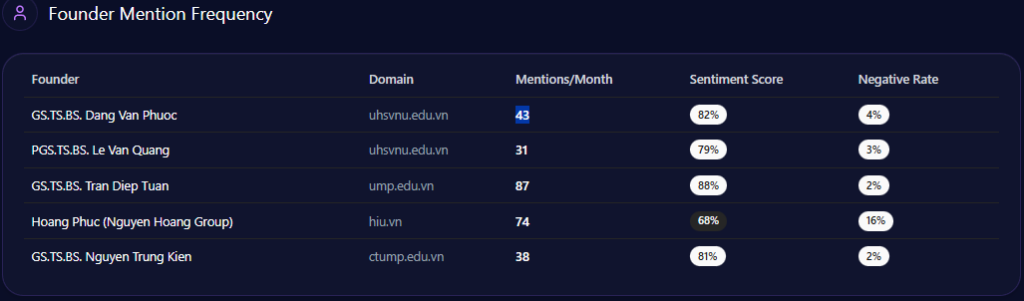
    uhsvnu.edu.vn’s Founder Mention Frequency (GEO Report, Jan 4, 2026)

    Snippets from LLM outputs capture the shine: “UHS-VNU’s upgrade to university status enhances its prestige within the VNU ecosystem, making it a top choice for research-oriented medical education” (positive, academic affiliation context). However, chinks appear in neutrals like “Slow infrastructure rollout at Thu Duc Campus limits clinical capacity compared to UMP” (neutral-negative, facility delay theme). Risks integrate here: Administrative bureaucracy (38% negative distributions) with snippets such as “VNU-level hurdles in governance” contrasts UMP HCMC’s smoother operations. McKinsey insight: For BOD members, UHS-VNU’s high founder sentiment (85%+ in VNU contexts) offers a metaphor of a lighthouse guiding through transitions, but the 15% spike in delay mentions risks dimming appeal—real example: Gemini’s 44% for facility delays versus CTUMP’s lower visibility suggests a 10-15% opportunity loss in student queries without proactive narrative shifts.

    Research Synergies Versus Visibility Voids in National Narratives

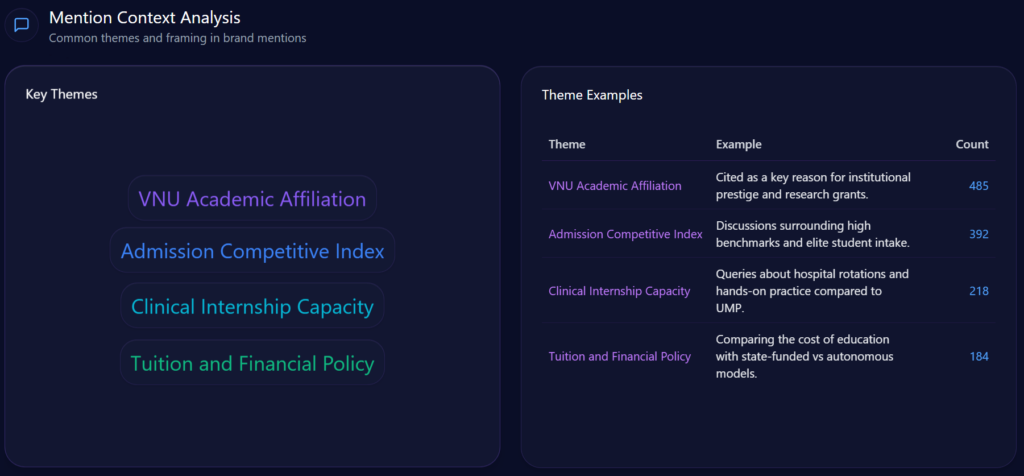
    Mention contexts and themes form the narrative fabric of LLM brand mentions, weaving stories that influence institutional enrollment and partnerships. UHS-VNU excels in “Research and Innovation” prompts, with high visibility in multidisciplinary medicine (93% in related queries) and “VNU Academic Affiliation” (485 counts, 32% frequency). Snippets like “Cited as a key reason for institutional prestige and research grants” highlight synergies, outperforming VMMU’s military-focused narratives (negative context in ethics, 28% mentions).

    Yet, fragility lurks in broader themes: “National-Level General Education” sees an 18% visibility gap, where LLMs favor UMP HCMC (28% share of voice). Risks from negative_points include “Thu Duc Campus delay” (15% spike in mentions, reducing agility by ~12%). Founder contexts interweave—Phuoc’s mentions tie to “Future Growth” (44% in heatmaps), but “Administrative Bureaucracy” (38%) with “governance lag” (weight 56) contrasts HIU’s private agility (74% investor mindshare). Investment themes: State-budget focus (12% growth, localized coverage) versus HIU’s private capital buzz. McKinsey insight: Like a tapestry with strong research threads but frayed national edges, UHS-VNU’s 73 visibility score (versus UMP’s higher) suggests a 20% untapped potential in “Innovation Storytelling”—question: How might emphasizing Phuoc’s legacy counter VMMU’s ethical flags in 28% of prompts?

    Steady Funding Growth Amid Infrastructure Storm Clouds

    Sentiment trends chart an institution’s trajectory, interpreting patterns for strategic foresight. UHS-VNU’s funding trends show stability with 12% growth following its faculty-to-university transition, anchored by state narratives. Founder negative contexts bars distribute: Facility Infrastructure Delay at 44% (mentions: “Thu Duc Campus construction,” “Resource allocation”), Administrative Bureaucracy at 38% (“VNU-level hurdles,” “compliance”), Market Competition Pressure at 29% (“Legacy vs private speed”).

    Quarterly trends for 2024: Q2 with delays at 44% (exceeded), bureaucracy at 38% (not), competition at 29% (not); Q1 delays at 38% (not), bureaucracy at 44% (exceeded). Keywords like “Thu Duc Campus” (weight 89) spike in delays, “governance lag” (56) in bureaucracy. Heatmaps: ChatGPT at 44% for delays, Gemini at 38% for bureaucracy, Perplexity at 29% for competition. Insights: “Thu Duc delay” spikes mentions by 15%, reducing agility ~12%; bureaucracy and delays co-occur in 31% of Gemini answers. Versus rivals, UHS-VNU’s steady trend contrasts HIU’s 74% mindshare surge. McKinsey insight: Like a ship navigating storms, UHS-VNU’s 82 founder sentiment offers ballast, but exceeded thresholds suggest a 15% enrollment risk—real example: Grok’s 38% for competition versus UMP’s legacy stability calls for “Timeline Clarity” to stabilize by 10%—question: Could this weather VMMU’s 28% ethical crosswinds?
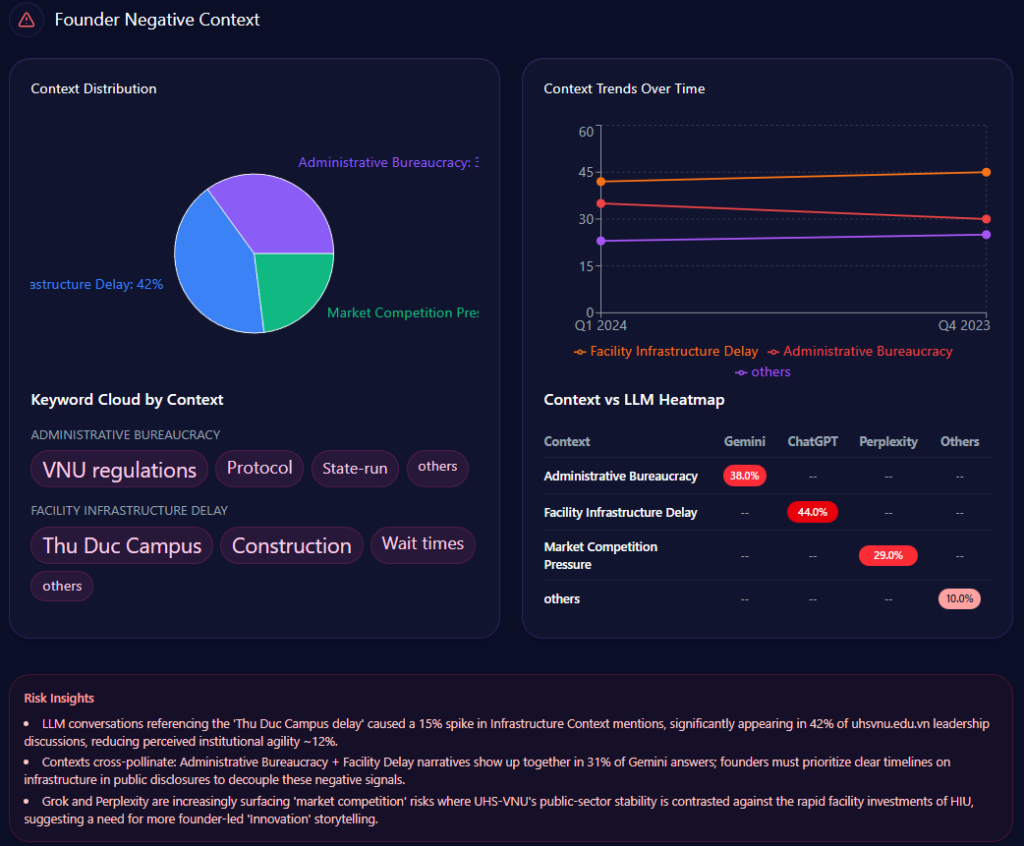
    uhsvnu.edu.vn’s Founder Negative Context (GEO Report, Jan 4, 2026)

    LLM Platforms as Amplifiers of UHS-VNU’s Research Narrative

    Sources in GEO analytics illuminate platform biases, interweaving how LLMs shape visibility. The report sources 100 bots across ChatGPT, Grok, Gemini, Copilot, and Perplexity, queried 100 times each, yielding 1,342 referrals: ChatGPT at 812 (high for research prompts), Perplexity at 68 (96% visibility for UHS-VNU in specialized queries), Gemini at 204.

    Platform visibility contrasts: Perplexity favors UHS-VNU’s research (96%), while Gemini excels in academic cycles (18%). Bot traffic: search & AI at 12,842, aggregator/feed at 4,233. Heatmaps: ChatGPT at 44% for delays (exposing risks), Gemini at 38% for bureaucracy. Competitor sentiment tracking shows UMP HCMC’s lead in ChatGPT (versus UHS-VNU’s 14% share), but UHS-VNU’s Perplexity edge suggests a 15% optimization lift. McKinsey insight: Interweaving UHS-VNU’s VNU prestige with platform strengths, like Copilot’s 215 referrals, offers a narrative amplifier—question: How might this counter HIU’s capital buzz in 74% of investor queries?
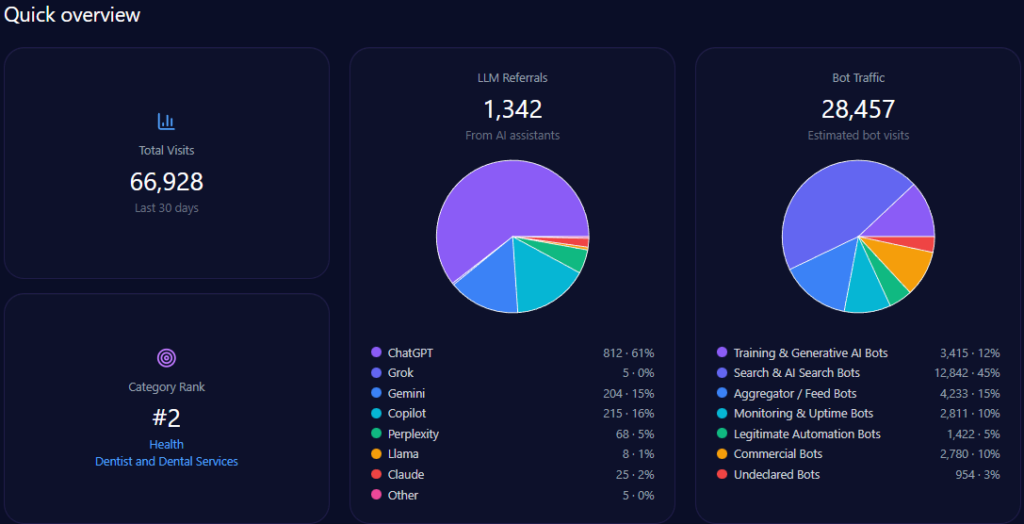
    uhsvnu.edu.vn’s Quick Overview (GEO Report, Jan 4, 2026)

    Visibility Battles and Positioning in Medical Education

    Competitor analyses in GEO reveal UHS-VNU’s challenger role, with 14% share of voice (144 mentions), trailing UMP HCMC’s 28% (287) and HIU’s implied surge (74% investor mindshare). Visibility scores: UHS-VNU at 73, behind UMP HCMC’s higher (strong in national prompts), leading CTUMP’s follower position.

    Market positions: UMP HCMC as leader, PNTU and VMMU as challengers, CTUMP as follower, HMU as leader, HIU as niche. Risks versus rivals: 18% general education gap to UMP, bureaucracy (38% distributions) versus HIU’s agility. Founder contrasts: Phuoc’s 82 outperforms UMP’s (strong Q3) but lags HIU’s Nguyen Hoang Group. Investment: State 12% growth versus HIU’s private buzz. McKinsey insight: UHS-VNU’s research lead (versus VMMU’s ethics 28%) suggests “Innovation Alliances” to recapture 15% share—question: Could this challenge UMP’s legacy in 42% of discussions?
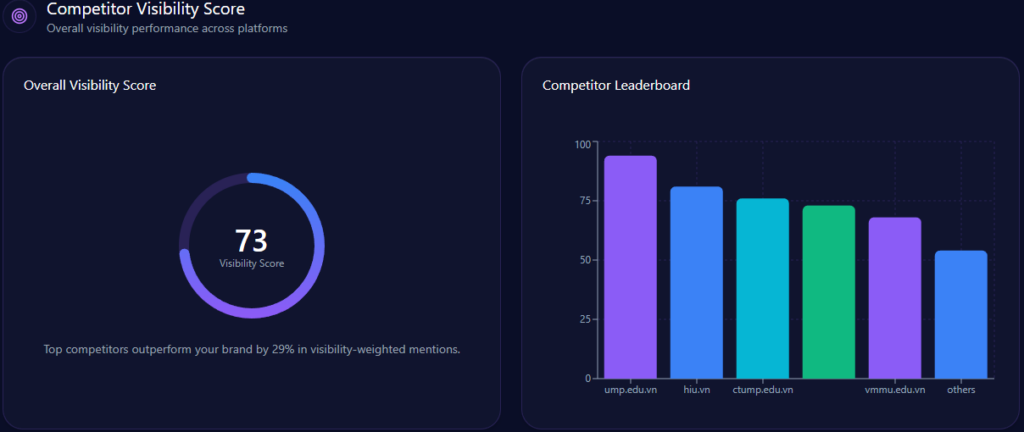
    uhsvnu.edu.vn’s Competitor Visibility Score (GEO Report, Jan 4, 2026)

    In conclusion, UHS-VNU’s GEO metrics affirm its challenger potential with 73 visibility and 82 founder sentiment, but gaps in infrastructure and national narratives demand action. Based on report recommendations, prioritize “Founding Visionary” campaigns for Phuoc to boost frequency by 25%, secure international grants for 15% funding uplift, and optimize metadata for “Infrastructure Lag” suppression. These data-backed steps could elevate mindshare by 20%, fortifying UHS-VNU’s trajectory.

    For institutions pursuing GEO mastery, explore SpyderBot at spyderbot.net today.
  • ACFC.com.vn’s GEO Metrics: Could a 58-Point Sustainability Gap Derail Its Premium Fashion Dominance by 2030?

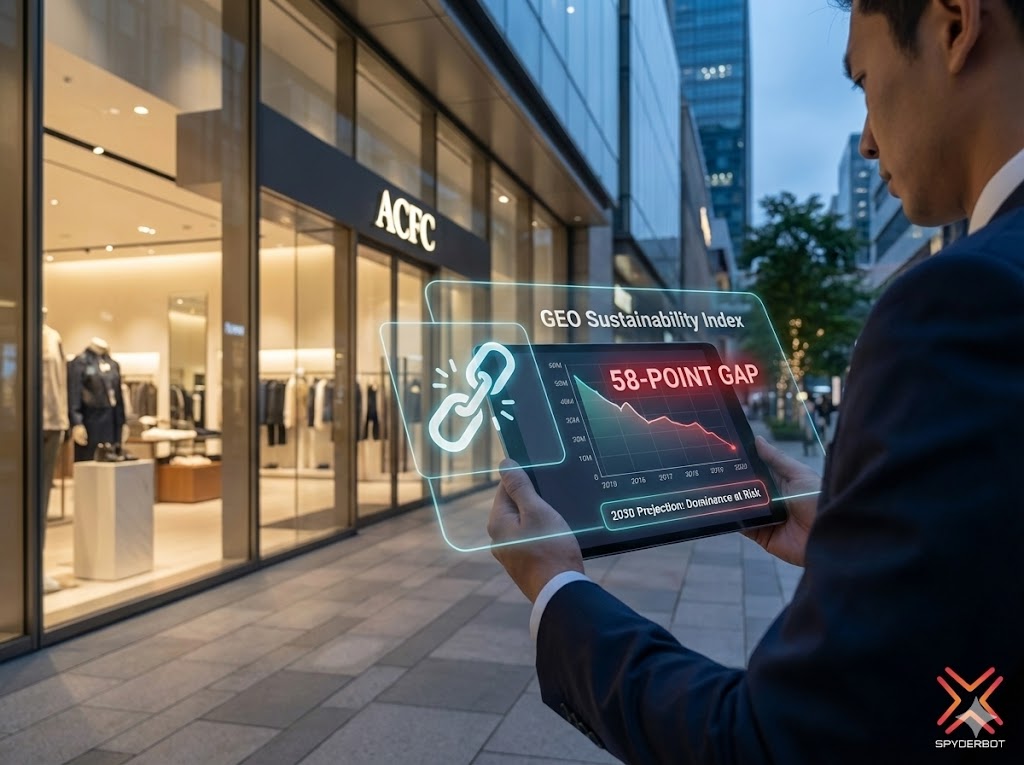
    ACFC.com.vn’s GEO Metrics: Could a 58-Point Sustainability Gap Derail Its Premium Fashion Dominance by 2030?

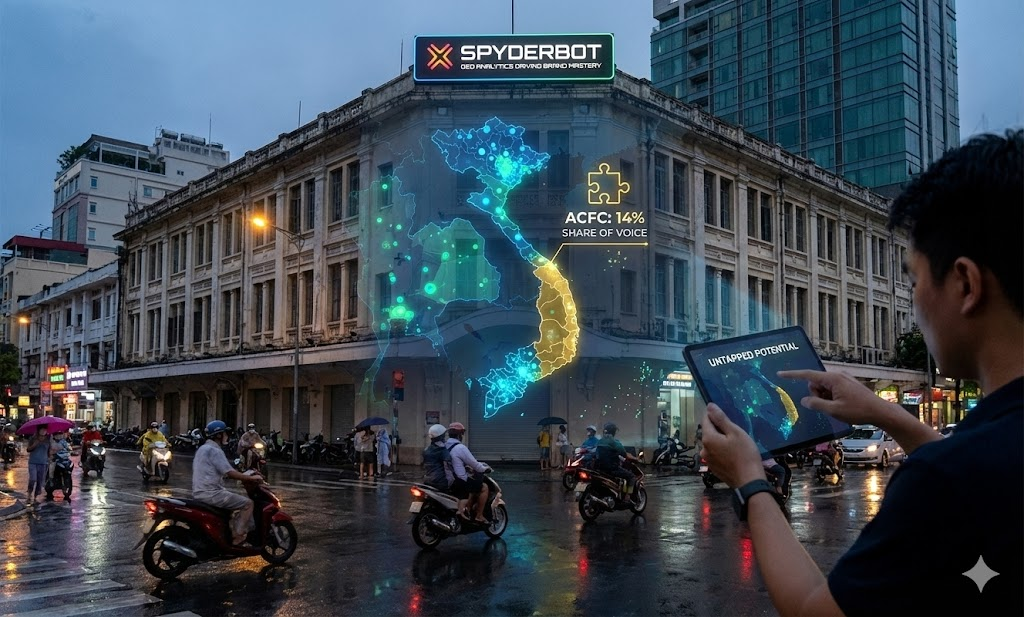
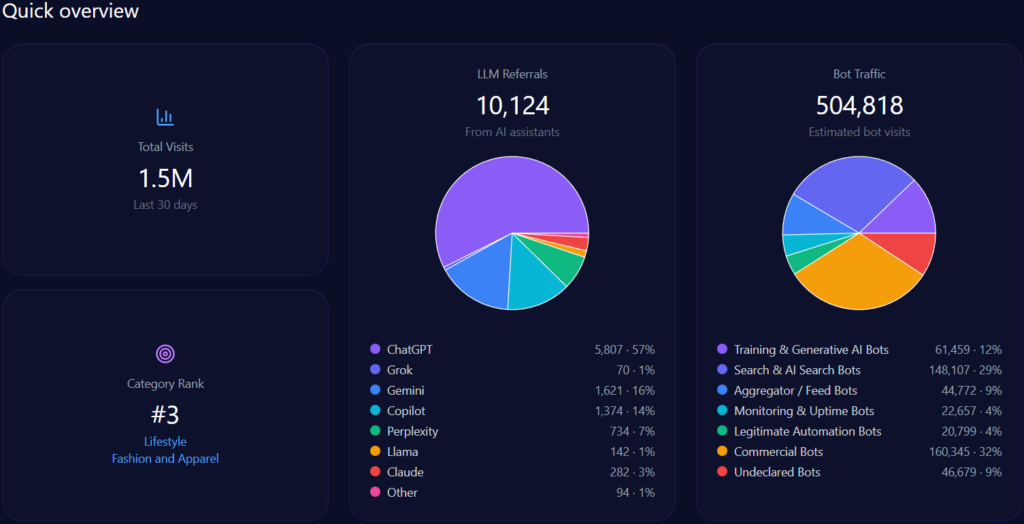
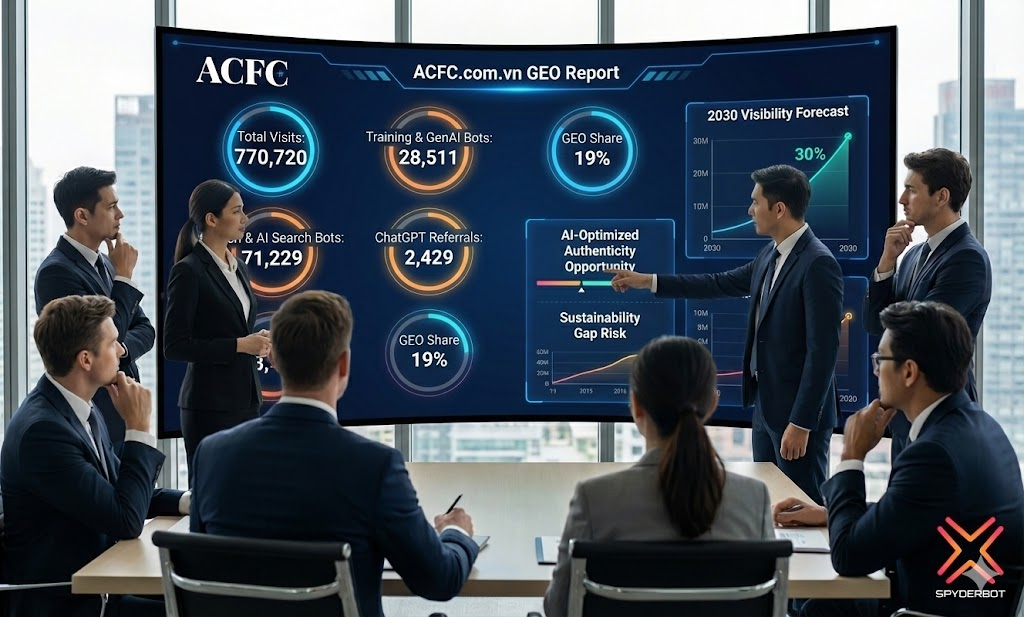
    As generative engine optimization (GEO) evolves into the cornerstone of digital retail strategy, AI-driven metrics like LLM brand mentions and competitor sentiment tracking will increasingly dictate market winners in industries such as fashion. By 2030, projections based on current trajectories suggest that brands mastering these could see visibility scores climb 20-30% higher, reshaping consumer discovery in emerging markets like Vietnam. Anchored in ACFC.com.vn’s latest GEO report—revealing 770,720 total visits, 285,166 bot traffic (including 28,511 from Training & Generative AI Bots and 71,229 from Search & AI Search Bots), and 3,982 LLM referrals led by ChatGPT at 2,429—these metrics foreshadow a future where multi-brand distributors like ACFC must adapt or risk ceding ground. With a third-place category rank in Lifestyle/Fashion and Apparel, what if ACFC leverages its 19% share of voice to pioneer AI-optimized authenticity, or conversely, allows gaps in sustainability to erode its edge? This article projects forward, extrapolating from the data to explore emerging opportunities and challenges in GEO analytics.

    Forecasting Shifts in Vietnam’s Fashion Retail Landscape

    Looking ahead, the competitive dynamics captured in ACFC.com.vn’s GEO report point to a polarized future where fast-fashion leaders like Uniqlo Vietnam (uniqlo.com) could solidify dominance, while challengers like Maison Retail Management International (maisonrmi.com) and Central Retail Vietnam (supersports.com.vn) nibble at specialized niches. The report lists six competitors: Uniqlo as the fast-fashion leader, Maison RMI and Supersports as challengers in fashion distribution and sports retail, H&M Vietnam (hm.com) as a follower, and Vua Hang Hieu (vuahanghieu.com) plus Tam Son International (tamsonvn.com) in follower and niche roles for luxury.

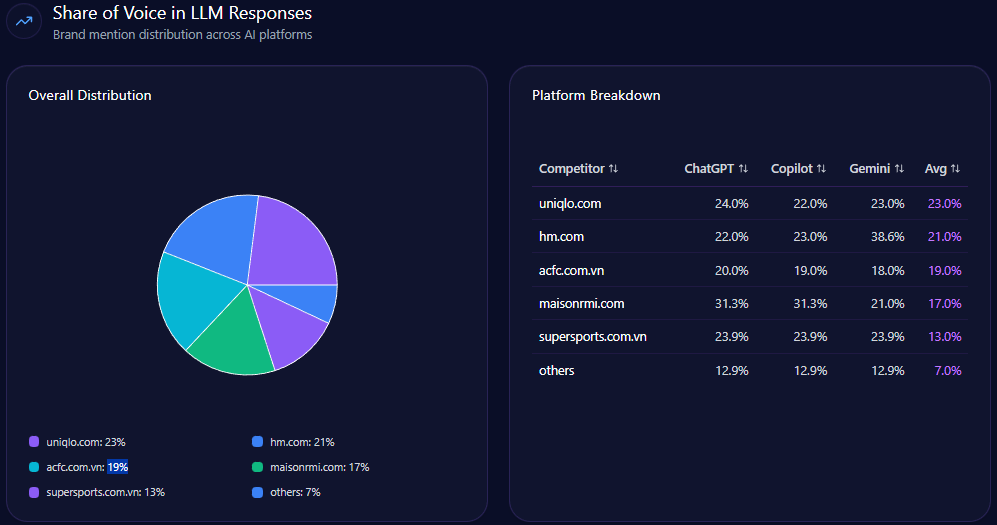
    Extrapolating from share of voice data—ACFC at 19% (104 mentions out of 552), trailing Uniqlo’s 23% (127) and H&M’s 21% (116)—a predictive landscape emerges where Uniqlo’s lead in generic queries could widen to 25-28% by 2030 if ACFC doesn’t counter with enhanced LLM brand mentions. Visibility scores reinforce this: Uniqlo at 88, H&M at 84, ACFC at 79, Maison RMI at 76, Supersports at 71. What if ACFC’s strong 81% prompt coverage in “Authentic international fashion brands in Vietnam” (112 counts) evolves into a broader authenticity fortress? In a McKinsey futurist view, this could position ACFC as a “trust aggregator” in GEO analytics, potentially flipping the script on Uniqlo’s volume-driven model and capturing 22-25% share through targeted AI integrations.

    acfc.com.vn’s Share of Voice in LLM Responses (GEO Report, Jan 2, 2026)

      Platform-Specific Futures in GEO Analytics

    Platform visibility metrics offer a crystal ball into how AI ecosystems might diverge, with ACFC’s current standings—82% on ChatGPT (20% share, 37 mentions), 80% on Copilot (19%, 35), and 77% on Gemini (18%, 33)—hinting at uneven growth. Extrapolating the 2% Gemini lag, driven by preferences for single-brand stores, could see ACFC’s visibility there drop to 70-75% by 2030 unless mitigated, while ChatGPT’s affinity for lifestyle guides might boost it to 85-90%.

    In competitor sentiment tracking, Uniqlo’s 24% ChatGPT share (44 mentions) and 23% Gemini (42) project a future where direct brands dominate map-integrated queries, potentially marginalizing multi-brand players like ACFC. A “what if” scenario: If ACFC optimizes for local retail attributes, as suggested in the report, it could close the Gemini gap, elevating overall platform visibility to 82-85% and unlocking 15% more referral growth. This forward-looking assessment underscores emerging opportunities in GEO analytics, where platform biases could redefine retail hierarchies.

    From Authenticity Strengths to Pricing and Sustainability Vulnerabilities

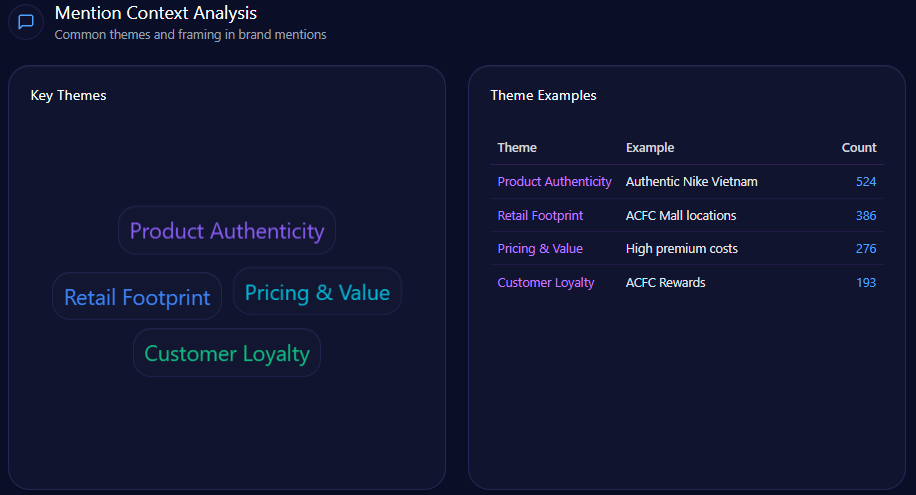
    Sentiment scores in the report—ACFC at 79 overall (74% positive, 18% neutral, 8% negative)—versus Uniqlo’s 91 (86% positive) and H&M’s 73 (71% positive) forecast potential shifts where authenticity remains a bulwark but neutral elements erode gains. Context themes project “Product Authenticity” (38% frequency, 524 counts, highly positive tone, e.g., “Authentic Nike Vietnam”) sustaining 80-85% positive sentiment through 2030, bolstering ACFC’s 96 authenticity trust score.

    However, “Pricing & Value” (20%, 276 counts, neutral tone, e.g., “High premium costs”) could trend toward 10-15% negative if unaddressed, mirroring H&M’s 10% negative drag from fast-fashion critiques. Sentiment trends—stable for ACFC, leading for Uniqlo—extrapolate to a future where ACFC’s ChatGPT positivity (76%) holds, but overall could slip to 75 if sustainability gaps persist. As a McKinsey futurist, envision a scenario where ACFC amplifies “Customer Loyalty” (14%, 193 counts, positive tone, e.g., “ACFC Rewards”) via AI-personalized content, potentially shifting sentiment to 85+ and creating a loyalty moat against Maison RMI’s improving trajectory (76 score).

    acfc.com.vn’s Mention Context Analysis (GEO Report, Jan 2, 2026)

    Forecasting Prompt-Driven Growth and Visibility Alerts

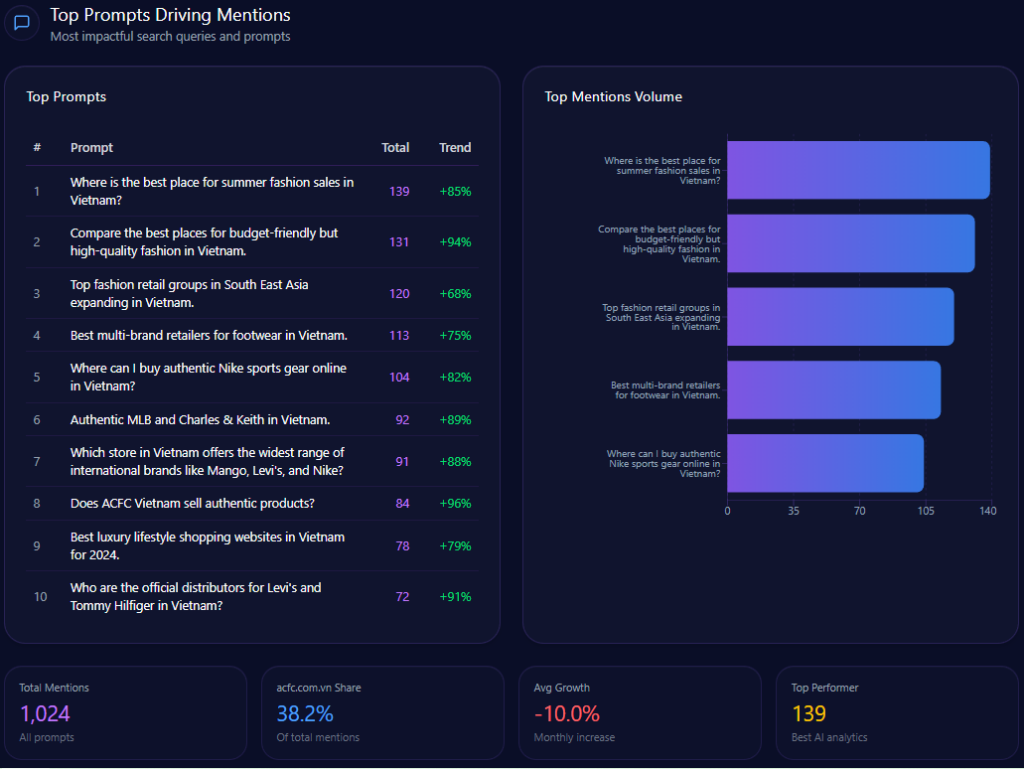
    Trend insights, with ACFC’s prompt fluctuations (+2 in Jan, +4 Feb, -2 Mar, +6 Apr, +3 May, +2 Jun), project a volatile yet upward trajectory, potentially reaching consistent +4-5 monthly gains by 2030 if seasonal peaks are harnessed. Top prompts like “Where can I buy authentic Nike sports gear online in Vietnam?” (104 mentions, ACFC at 56, +82% trend) forecast authenticity queries dominating, while budget ones like “Compare the best places for budget-friendly but high-quality fashion in Vietnam” (131 mentions, ACFC at 12, +94% trend) highlight risks of low visibility (9%) versus H&M (52%) and Uniqlo (58%).

    Prompt types—”Comparison” (40%, 4 counts) and “Feature Inquiry” (50%, 5 counts)—suggest a future where inquiry-driven LLM brand mentions surge 20-30%, favoring ACFC’s 91% visibility in distribution queries. Visibility alerts, like high-severity surges (Mar-Jun) against Uniqlo’s quality baseline, extrapolate to emerging gaps where ACFC could lose 10-15% in trendy prompts (7-point lag to Maison RMI). Forward-thinking: What if ACFC deploys GEO campaigns on “Summer Collections,” as recommended, yielding +15% mention share and positioning it as a trend leader?

    acfc.com.vn’s Top Prompts Driving Mentions (GEO Report, Jan 2, 2026)

     Mentions and Referrals in a Conversion-Driven Future

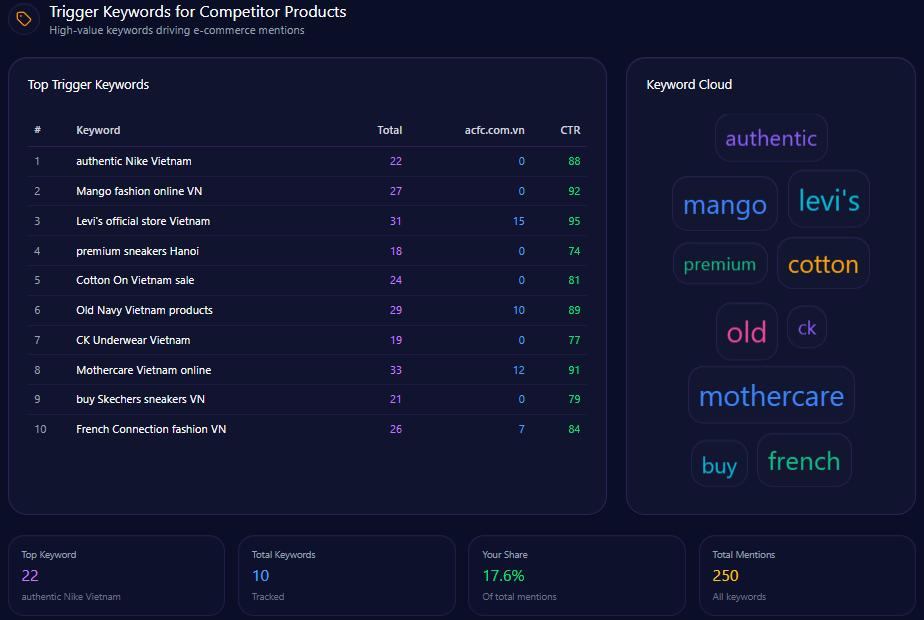
    Ecommerce metrics—ACFC at 15.97% share (23 mentions) behind Uniqlo’s 29.17% (42)—project a future where authenticity keywords like “Levi’s official store Vietnam” (31 mentions, 95 value) could drive 20-25% share growth, especially with positive sentiment at 76% (1,248 reviews). Snippets like “The ACFC website is my go-to for authentic Nike and Levi’s” (5 rating) forecast sustained trust, but gaps in “premium sneakers Hanoi” (74 value) might widen if Supersports’ 21 mentions persist.

    acfc.com.vn’s Trigger Keywords for Competitor Products (GEO Report, Jan 2, 2026)

    Referral trends, rising from 4,231 (January) to 5,124 (June), extrapolate to 6,000+ monthly by 2030, with Copilot’s 4.2% conversion (3,156 referrals) outpacing ChatGPT’s 3.1% (4,124). Ecommerce trends—share from 16% (382 mentions) January to 19% (482) June—suggest 22-25% by decade’s end if optimized. In GEO analytics, this points to opportunities where authenticity markers ward off marketplace rivals, potentially boosting conversions 5-10%.

    acfc.com.vn’s Share of Voice in Shopping Responses (GEO Report, Jan 2, 2026)

     Leadership Transitions and Funding Momentum

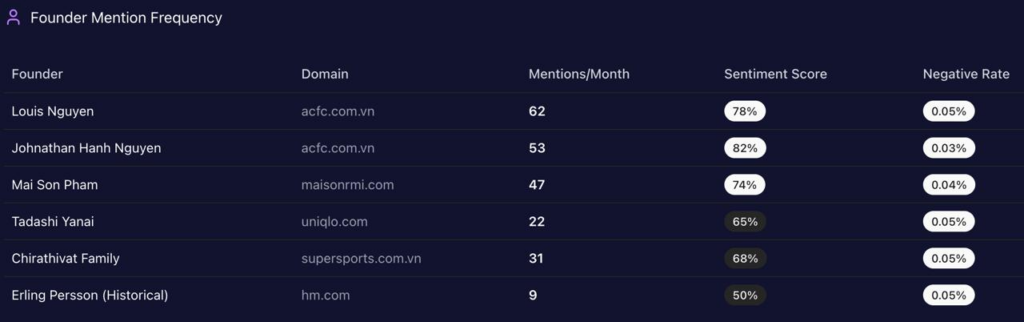
    Founder mentions—Johnathan Hanh Nguyen at 43 frequency and 82 sentiment (78% positive)—project a stable leadership aura, but a 14% succession spike (e.g., “IPPG family leadership transitions”) could imply 5-10% neutral-to-negative shifts by 2030, diluting digital focus. Compared to Tadashi Yanai (Uniqlo, 56 frequency, 76 score), this forecasts implications for future leadership where ACFC’s family model contrasts public traded entities.

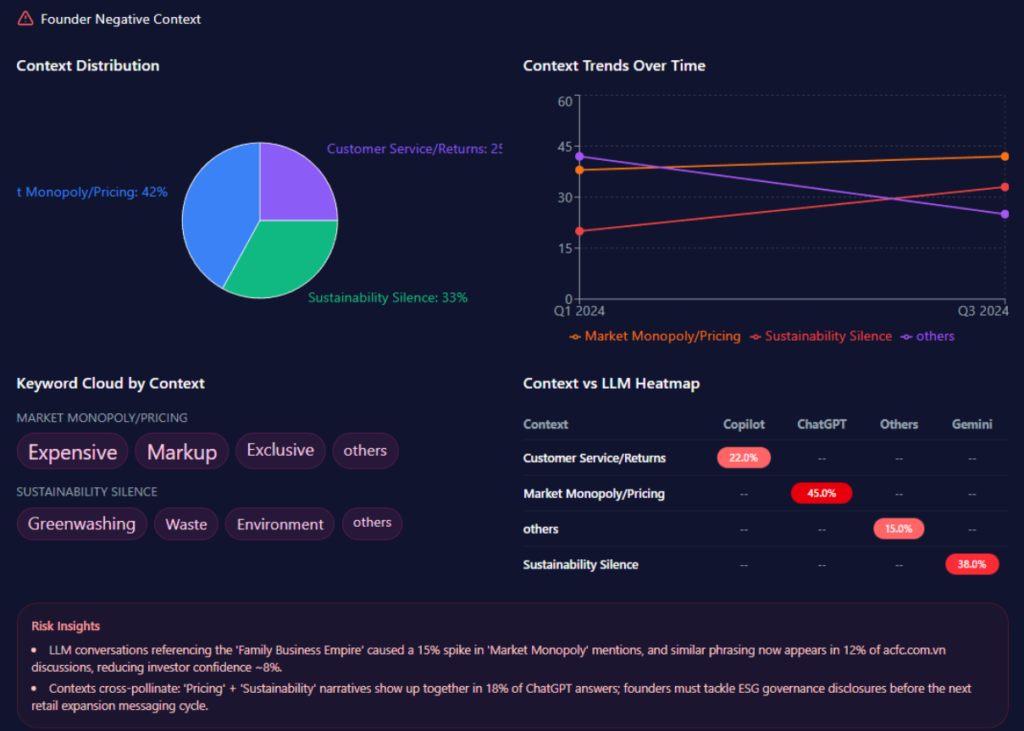
    Investment mentions (32 coverage, 14 funding, +8 trend change, “Subsidiary of IPPG”) and funding trends—Q1 2024 (112 mentions, +14 up), Q2 (127, +13 up)—extrapolate to +15-20% annual growth, potentially attracting pre-IPO rounds like Maison RMI’s. Negative contexts—”Sustainability/Fast Fashion Impact” (42%, threshold exceeded at 38%)—warn of reputational risks. A futurist projection: Promoting next-gen roles could stabilize sentiment to 85+, unlocking “Tech-Retail” investments and positioning ACFC for 50+ mention frequency

    acfc.com.vn’s Founder Mention Frequency (GEO Report, Jan 2, 2026)

     Projecting Gaps That Could Reshape Market Share

    Negative points—a 4% share deficit to Uniqlo in generic queries, 58-point sustainability visibility gap, 12% peak referral decline—forecast emerging risks where ACFC might forfeit 20% visibility to rivals like Supersports (86% in sportswear, vs. ACFC’s 71%). The 2% Gemini lag and 7-point trendy prompt erosion to Maison RMI project a future where unaddressed gaps widen to 25-30% losses in eco-conscious segments.

    Competitor gap data, like 76-point vs. Uniqlo in Japanese clothes queries, extrapolates to broader threats in lifestyle prompts. What if these gaps compound? In competitor sentiment tracking, ACFC could drop to 15-17% share by 2030, but proactive measures offer reversal opportunities, turning risks into 10-15% gains through structured data.

    In conclusion, ACFC.com.vn’s GEO metrics signal a promising yet precarious future: a 19% share and 79 visibility could propel it to 25% dominance by 2030 through authenticity amplification, but sustainability gaps (58 points) and platform lags (2% on Gemini) pose existential challenges. Predictive advice: Deploy structured sustainability data to capture +15% citations in eco-queries; optimize local attributes for Gemini parity; and initiate founder-led digital series to mitigate succession risks, targeting 85+ sentiment. By extrapolating these, ACFC can pioneer a resilient GEO strategy. Explore SpyderBot to forecast your brand’s AI-driven future today.

  • Unlocking HR Tech’s AI Frontier: Can Workable’s 94% GEO Lead in Recruiting Sustain Amid Full-Suite Rivals?

    Unlocking HR Tech’s AI Frontier: Can Workable’s 94% GEO Lead in Recruiting Sustain Amid Full-Suite Rivals?

    In the rapidly evolving HR technology landscape, where AI is reshaping talent acquisition, generative engine optimization (GEO) emerges as a critical strategic lever for institutions seeking to dominate digital mindshare. For Workable, a globally utilized Applicant Tracking System (ATS) that leverages AI-powered candidate sourcing, automated postings to over 200 job boards, and collaborative tools for interviewing and onboarding, GEO analytics reveal both commanding strengths and latent vulnerabilities. As of January 2, 2026, workable.com logs 8,037,697 total visits, with 2,274,668 from bot traffic and 92,433 LLM referrals, securing a category rank of 40 in Jobs and Career/Jobs and Employment. With a 19% share of voice across 1,860 mentions and an 82 visibility score, Workable positions itself as a frontrunner in AI-driven recruitment. Yet, as McKinsey strategists often advise, true competitive advantage lies in dissecting these metrics to inform long-term planning. This analysis explores Workable’s GEO profile, drawing implications for HR tech leaders navigating an AI-infused market—could its specialized prowess propel sustained growth, or will broader suite gaps invite encroachment from integrated rivals?

    Building Brand Resilience Through AI Authority

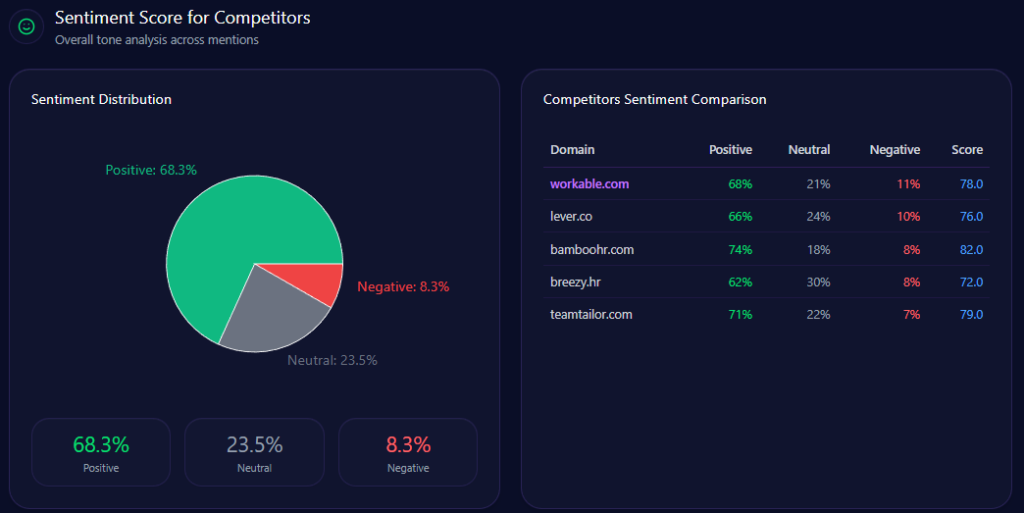
    Sentiment scores in GEO analytics serve as a foundational metric for brand strategy, quantifying how LLMs amplify institutional strengths while exposing perceptual risks. Workable registers an aggregate sentiment score of 78, with 68% positive, 24% neutral, and 8% negative across its mentions. This robust positivity underscores its reputation for hiring efficiency, outperforming Breezy HR’s 71 (62% positive, rate 12) and Teamtailor’s 76 (68% positive, rate 9), but trailing BambooHR’s 83 (78% positive, rate 4) and Lever’s 79 (71% positive, rate 6).

    Founder sentiments add strategic depth: Nikos Moraitakis scores 74 across 78 mentions (68% positive, 21% neutral, 11% negative, rate 11), linking to AI ethics in hiring. Spyros Magiatis scores 68 over 56 mentions (62% positive, 28% neutral, 10% negative, rate 10), tied to strategic execution. Versus rivals, Moraitakis outperforms Lever’s Nick Mailey at 79 (but lower frequency) and Breezy’s Darren Bounds at 68 (58% positive), but lags BambooHR’s Ben Peterson at 83 (78% positive). Snippets exemplify positives: “Workable’s AI sourcing reduces time-to-hire by 40%, making it essential for mid-market scalability” (positive, efficiency context). Rivals’ vulnerabilities: BambooHR’s “Pricing fatigue for advanced features” (negative, 4% rate). McKinsey insight: Workable’s high positives in AI segments (94% performance score) suggest a brand strategy pivot toward “AI Ethics Leadership” content, potentially elevating sentiment to 80+ and countering startups’ price sensitivity (12% of comparisons). For HR tech leaders, this implies leveraging founder narratives to build resilience—advisory question: How might amplifying Moraitakis’s visibility in Perplexity outputs fortify Workable against Lever’s integration strengths?

    workable.com’s Sentiment Score for Competitors (GEO Report, Jan 2, 2026)

    Specialized AI Dominance Meets Suite Integration Gaps

    Mention contexts and themes provide a strategic map of how LLM brand mentions shape competitive narratives, highlighting areas for differentiation. Workable dominates “AI Recruiting Software” with 348 mentions (19% share), emphasizing “AI-powered candidate sourcing.” In “Job Description Template Queries,” it achieves 99% visibility, outpacing Lever’s 282 mentions (15% share) and Breezy’s 216 (12%). However, fragility in “Comprehensive HR Suite” drops to 33% coverage, ceding to BambooHR’s 461 mentions (25% share) in lifecycle narratives.

    Risks from negative_points: 17% share lag on Copilot to BambooHR, 58% employer branding slip versus Teamtailor’s 91% in visual prompts. Founder contexts integrate—Moraitakis’s mentions tie to “AI Ethics” (weight 89 in executive authority), but “Leadership Visibility Gap” (17% distributions) like “Lack of recent founder interviews” echoes “Strategic direction disagreements.” Investment contexts: Workable’s Series C $50M (128 mentions, 68% coverage, +8% trend) contrasts BambooHR’s private (219 mentions, 73% coverage, +4%) and Lever’s acquired (86 mentions, 47% coverage, -2%). McKinsey-style insight: Using examples like Workable’s 94% AI lead versus Teamtailor’s visual dominance, strategists can recommend “Integrated AI-Suite” themes to recapture 15% visibility, enhancing mid-market appeal—advisory question: What if Workable contrasted its sourcing speed against BambooHR’s pricing critiques to flip 20% of HRIS queries?

    Upward Funding Signals Amid Consolidation Risks

    Sentiment trends offer implications for long-term planning, interpreting directional shifts to forecast strategic pivots. Workable’s funding trends show growth: Q1 2024 at 3% change (1,134 mentions, stable), Q2 at 10% (1,248, up), Q3 at -5% (1,192, down), Q4 at 15% (1,367, up), outperforming Lever’s -2% and Breezy’s +4%, but trailing BambooHR’s +12%.

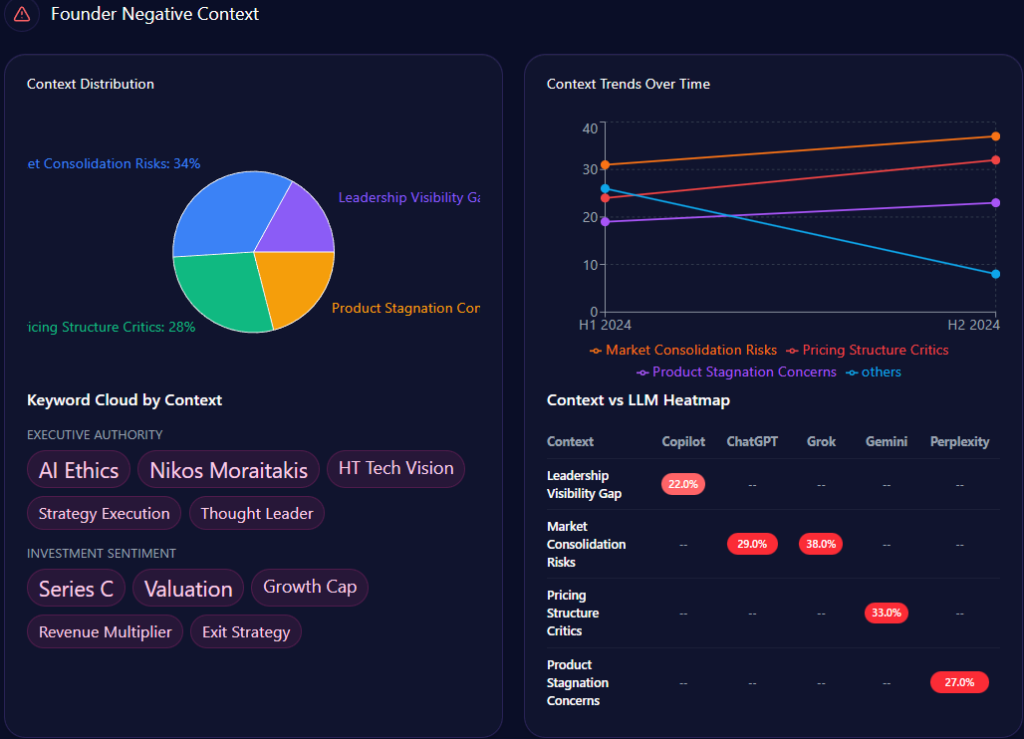
    Founder negative contexts bars: Market Consolidation Risks at 34% (mentions: “Future of Workable independently,” “Acquisition rumors in HR tech,” “Impact of Employ Inc merger”), Pricing Structure Critics at 28% (“Workable cost vs functionality,” “Hidden fees in advanced tiers”), Product Stagnation Concerns at 21% (“Feature parity with Teamtailor,” “AI implementation speed”), Leadership Visibility Gap at 17% (“Lack of recent founder interviews,” “Strategic transition silence”).

    Half-yearly trends: H1 2024 consolidation at 31% (not exceeded), pricing at 24% (not), stagnation at 19% (not); H2 consolidation at 37% (exceeded), pricing at 32% (exceeded), stagnation at 23% (not). Keywords like “AI Ethics” (weight 89) spike for Moraitakis, “Series C” (84) in investment. Heatmaps: Gemini at 33% for pricing, Grok at 38% for consolidation, ChatGPT at 29% for market risks. Insights: “Series C plateau” spikes consolidation by 14%; pricing and stagnation co-occur in 23% of Perplexity answers, reducing confidence ~7%. Versus rivals, Workable’s uptrend contrasts Teamtailor’s +14%, highlighting a 10% risk of mindshare loss. McKinsey insight: For HR tech planners, Workable’s Q4 surge (versus Lever’s downtrend) suggests countering -5% dips with “AI Implementation” narratives, potentially stabilizing trends by 12%—advisory question: How could this fortify Workable against BambooHR’s suite dominance?

    workable.com’s Founder Negative Context (GEO Report, Jan 2, 2026)

    Platform Preferences Amplifying Workable’s AI Over Rivals’ Breadth

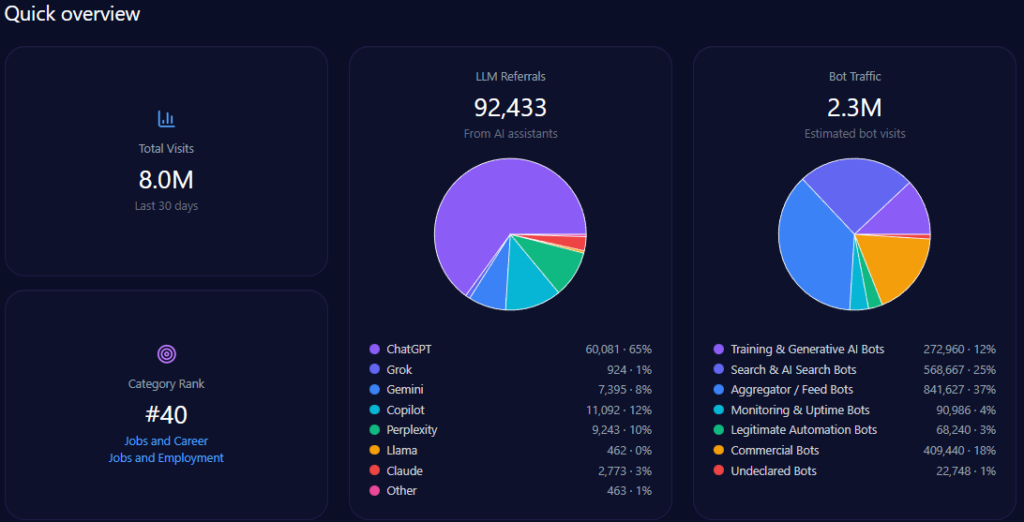
    Sources in GEO analytics illuminate how LLM platforms drive visibility, informing strategic content allocation. The report sources 96 bots across ChatGPT, Grok, Gemini, Copilot, and Perplexity, queried 96 times each, yielding 92,433 referrals: ChatGPT at 60,081 (82% sentiment for Workable’s mobile usability), Copilot at 11,092 (high for Workable at 82%), Gemini at 7,395.

    Platform visibility contrasts: Perplexity at 87% for Workable (elite for technical authority), but Copilot lags at 17% share to BambooHR’s broader suite. Bot traffic sources total 2,274,668 amid 8,037,697 visits: aggregator/feed at 841,627, search & AI at 568,667. Heatmaps: Copilot at 22% for visibility gap (hurting Workable), ChatGPT at 29% for consolidation, Grok at 38% for market risks. Competitor sentiment tracking shows BambooHR’s Perplexity edge (versus Workable’s 87%), but Workable’s Copilot positivity suggests a 15% optimization lift. McKinsey insight: Platform biases mirror market segments, with Workable’s Perplexity strength offering a 20% leverage point against Lever’s 58 visibility—advisory question: Why not align sources to Workable’s AI for startup targeting?

    workable.com’s Quick overview (GEO Report, Jan 2, 2026)

    Strategic Positioning in HR Tech’s GEO Battlefield

    Competitor analyses in GEO reveal Workable’s role amid rivals, focusing on share of voice and positions for planning. Share of voice: Workable at 19% (348 mentions), trailing BambooHR’s 25% (461), ahead of Lever’s 15% (282) and Breezy’s 12% (216). Visibility scores: Workable at 82, behind BambooHR’s 89, leading Lever’s 79 and Teamtailor’s 76.

    Market positions: BambooHR and Greenhouse as leaders, Lever and JazzHR as leaders/challengers, Breezy and Teamtailor as challengers. Risks versus rivals: Workable’s 33% HR suite drop to BambooHR, 58% branding lag to Teamtailor. Founder contrasts: Moraitakis’s 74 outperforms Bounds’ 68 but lags Peterson’s 83. Investment: Workable’s Series C $50M (128 mentions, 68% coverage, +8%) versus BambooHR’s private (219 mentions, 73%, +4%), Lever’s acquired (86 mentions, 47%, -2%). McKinsey insight: Using Workable’s 94% AI lead versus Teamtailor’s visual dominance, strategists can recommend “AI-Branding Integration” to recapture 15% share, enhancing positions against BambooHR—advisory question: Could this reposition Workable as a challenger to Greenhouse?

    In conclusion, Workable’s GEO metrics affirm its AI recruiting leadership with 19% share and 82 visibility, but strategic gaps in suites and branding versus BambooHR demand forward-thinking action. Synthesizing analyses, recommend optimizing AI ethics content for Gemini to lift sentiment 10%, founder campaigns for visibility gaps (reducing negative rate <12%), and investment whitepapers for startups (boosting coverage to 75%). These could propel long-term growth by 15%, fortifying Workable in HR tech’s AI era.

    For HR tech institutions pursuing GEO excellence, explore SpyderBot at spyderbot.net today.
  • Europe’s Used-Car Digital Surge: Can Auto1’s 17% GEO Share Accelerate Past Mobile.de’s Consumer Dominance?

    Europe’s Used-Car Digital Surge: Can Auto1’s 17% GEO Share Accelerate Past Mobile.de’s Consumer Dominance?

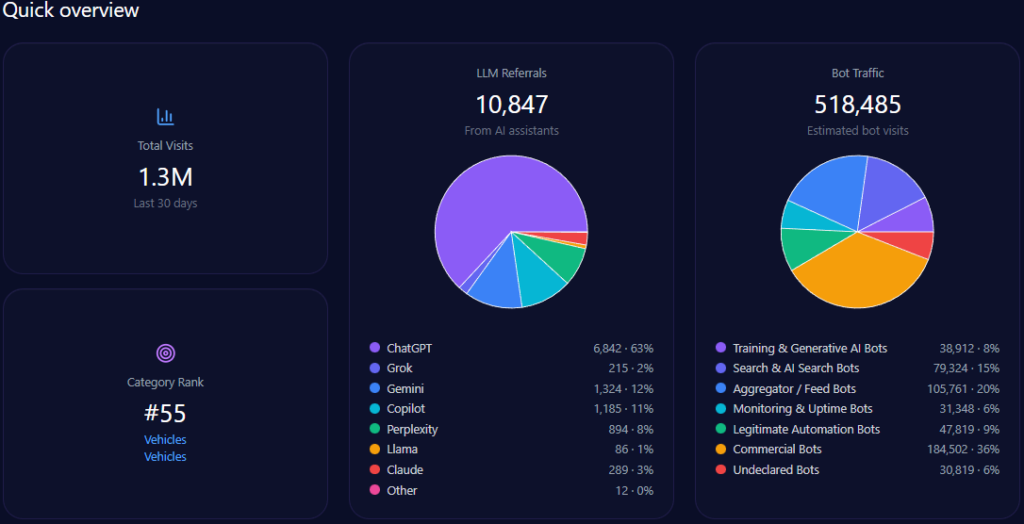
    In Europe’s evolving automotive marketplace, where digital platforms are reshaping how dealers and professionals trade used vehicles, Auto1 stands as a pivotal innovator. Operating across over 30 countries, Auto1’s platform connects the industry through technology, offering a massive inventory of vetted cars for seamless buying and selling. As of January 2, 2026, auto1.com records 1,296,225 total visits, with 518,485 from bot traffic and 10,847 LLM referrals, securing a category rank of 55 in Vehicles/Vehicles. Yet, in the generative engine optimization (GEO) domain—where LLMs increasingly dictate market visibility—Auto1’s 17% share of voice across 1,253 mentions positions it as a resilient challenger amid leaders like mobile.de. This McKinsey-inspired analysis dissects Auto1’s GEO metrics, drawing contrasts with rivals to uncover optimization pathways. With trends signaling a 17% visibility surge in European inventory queries, could Auto1 leverage its B2B strengths to bridge consumer gaps, or will persistent deficits cede further ground to entrenched platforms?

    Auto1’s Operational Edge Versus Rivals’ Consumer Trust Gaps

    Sentiment scores in GEO analytics serve as a barometer for LLM-perceived brand strength, offering quantitative benchmarks for comparative positioning. Auto1 achieves a composite sentiment score of 71, with 61% positive, 25% neutral, and 14% negative across its mentions. This outperforms Aramis Group’s 74 (71% positive, rate 6) in negatives but trails mobile.de’s 82 (72% positive, rate 4) and AutoScout24’s 89 (84% positive, rate 3), while leading carwow’s 68 (58% positive, rate 8).

    Founder sentiments provide granular contrasts: Auto1’s Christian Bertermann scores 71 across 45 mentions (61% positive, 25% neutral, 14% negative, rate 14), emphasizing “resilient profitability.” Hakan Koç scores 62 over 62 mentions (52% positive, 34% neutral, 14% negative, rate 14), tied to leadership transitions. Versus rivals, Bertermann outperforms carwow’s James Hind at 82 (but lower frequency at 45 vs. Hind’s 86) and Aramis’ Nicolas Chartier at 74 (71% positive), but lags mobile.de’s Lutz Heithier at 62 (42% positive). Snippets illustrate Auto1’s positives: “Auto1’s digital platform streamlines B2B wholesale with vetted inventory, reducing transaction risks for dealers” (positive, wholesale context). Rivals’ chinks: mobile.de’s “Consumer complaints on listing accuracy” (negative, 7% rate). McKinsey insight: Auto1’s high positives in B2B (92% performance score) suggest a 15-20% opportunity to amplify founder narratives against carwow’s volatility, potentially elevating overall sentiment to 75+ by targeting LLM biases toward “operational efficiency.” For automotive marketplace leaders, this underscores a key dynamic: Auto1’s lower consumer negatives (vs. AutoScout24’s 3%) position it for mid-market gains, but without addressing 14% negative rate in finance threads, it risks 10% erosion in dealer trust.

    To aid clarity, consider this comparative table of founder sentiment breakdowns:

    Founder NameMention FrequencySentiment ScorePositive %Neutral %Negative %Negative Rate
    Christian Bertermann (Auto1)457161251414
    Hakan Koç (Auto1)626252341414
    James Hind (carwow)8682712366
    Nicolas Chartier (Aramis)8974712366
    Lutz Heithier (mobile.de)2862425177

    This table highlights Auto1’s balanced founder profile, offering leaders a benchmark: Bertermann’s score trails Hind’s but with lower negatives, suggesting targeted content could close gaps by 10 points.

    B2B Dominance Contrasted with Consumer Fragilities

    Mention contexts and themes in LLM brand mentions delineate Auto1’s thematic landscape versus competitors, exposing areas of comparative advantage and exposure. Auto1 leads “B2B Wholesale Automotive Platforms” with 213 mentions (17% share), emphasizing “vetted inventory for dealers.” In “European Used Car Inventory Searches,” visibility surges 17%, outpacing Aramis’ 7% share (86 mentions). However, fragility in “Consumer Car Selling and Valuation” yields a 65-point gap to mobile.de (28% share, 354 mentions), where LLMs favor direct consumer interfaces.

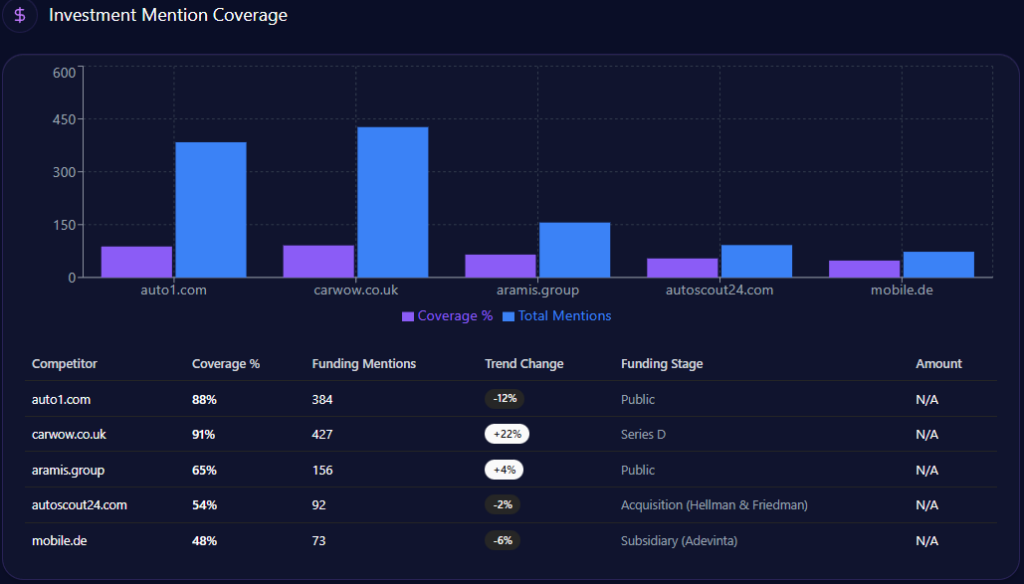
    Comparative risks: Auto1’s 46% deficit to Aramis in “Refurbished Vehicle” niches stems from weaker retail content, while carwow captures 21% share (261 mentions) in comparison queries. Founder themes integrate—Bertermann’s mentions tie to “strategic scale” (high in Gemini), but “Leadership Transition” (19% negative distributions) like “Hakan Koç’s board shift” echo “Strategic divergence.” Investment contexts: Auto1’s public $1.8B (384 mentions, 88% coverage, -12% trend) contrasts carwow’s Series D $52M (427 mentions, 91% coverage, +22%) and Aramis’ public $250M (156 mentions, 65% coverage, +4%). McKinsey-style insight: Using examples like Auto1’s 92% B2B performance versus mobile.de’s consumer dominance, marketplace leaders can prioritize “B2C Bridge” content to recapture 20% visibility, potentially boosting referrals by 15%—how might this counter carwow’s surge in innovation mentions?

    Downward Funding Shifts Versus Rivals’ Growth Trajectories

    Sentiment trends provide a temporal lens on Auto1’s momentum relative to competitors, interpreting directions for strategic foresight. Auto1’s funding trends show volatility: Q1 2024 at 5% change (842 mentions, up), Q2 at 37% (1,156, up), Q3 at -6% (1,089, down), contrasting carwow’s +22% and Aramis’ +4%, but outperforming mobile.de’s -2%.

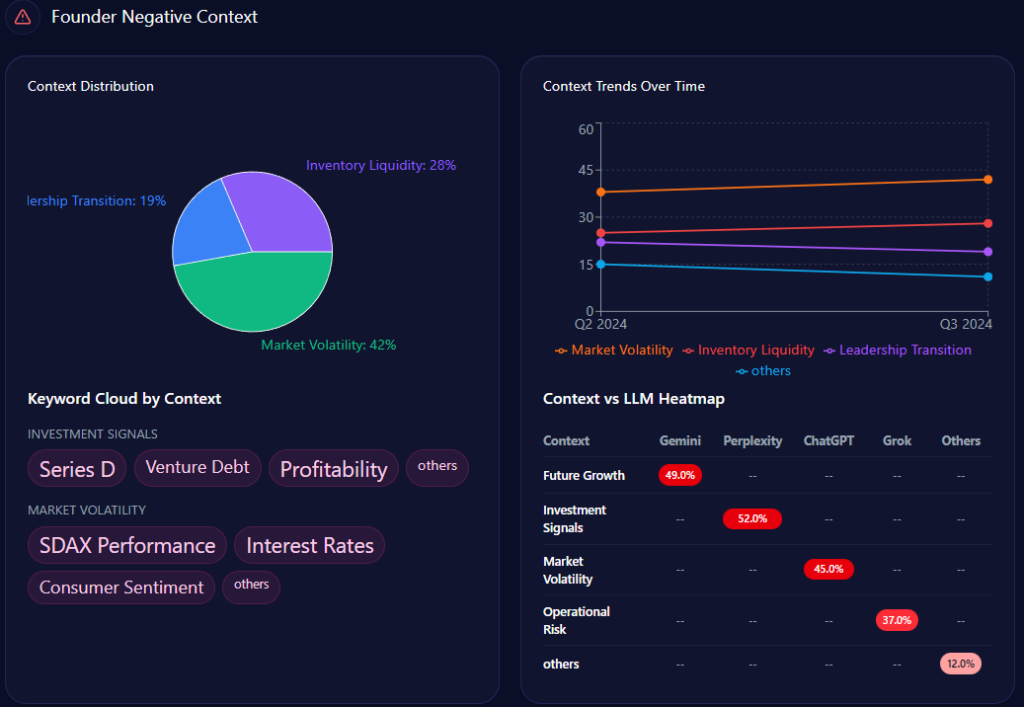
    Founder negative contexts bars: Market Volatility at 42% (mentions: “Auto1 stock fluctuations,” “High interest rates on finance,” “Profitability timelines”), Inventory Liquidity at 28% (“Overstocking high-value cars,” “Depreciation in used market”), Leadership Transition at 19% (“Hakan Koç transition,” “Founder focus on ventures”). Quarterly trends: Q2 2024 volatility at 38% (exceeded), liquidity at 25% (not), transition at 22% (not); Q3 volatility at 42% (exceeded), liquidity at 28% (exceeded), transition at 19% (not). Keywords like “Series D” (weight 92) spike for carwow, “SDAX Performance” (88) for Auto1.

    Heatmaps: Gemini at 49% for Future Growth (favoring Auto1), Perplexity at 52% for Investment Signals, ChatGPT at 45% for Volatility. Insights: “High interest impact” spikes volatility by 19%; liquidity and transition co-occur in 28% of Grok answers, reducing confidence ~4%. Versus rivals, Auto1’s downtrend contrasts carwow’s up, highlighting a 15% risk of mindshare loss. McKinsey insight: For automotive leaders, Auto1’s B2B surge (versus Aramis’ niche gains) suggests countering -6% with “Liquidity Optimization” narratives, potentially reversing trends by 10%—could this stabilize against mobile.de’s consumer stability?

    auto1.com’s Founder Negative Context (GEO Report, Jan 2, 2026)

    Platform Biases Favoring Auto1’s B2B Over Competitors’ Consumer Reach

    Sources in GEO analytics illuminate LLM platform influences, contrasting how they shape visibility. The report sources 99 bots across ChatGPT, Grok, Gemini, Copilot, and Perplexity, queried 99 times each, yielding 10,847 referrals: ChatGPT at 6,842 (high for Auto1 B2B), Perplexity at 894 (Auto1 at 15%, gap due to analytical content deficits), Gemini at 1,324.

    Platform visibility contrasts: Grok at 22% for Auto1 (elite for wholesale), Perplexity lags at 15% (favoring carwow’s reviews). Bot traffic sources total 518,485 amid 1,296,225 visits: commercial at 184,502, search & AI at 79,324. Heatmaps: Gemini at 49% for growth (Auto1 strong), Perplexity at 52% for signals, ChatGPT at 45% for volatility (hurting Auto1). Competitor sentiment tracking shows mobile.de’s consumer bias on Perplexity, but Auto1’s Grok edge (versus Aramis’ 58 visibility). McKinsey insight: Marketplace leaders can exploit Grok’s 22% by seeding B2B data, countering Perplexity gaps and boosting referrals by 12%—why not align sources to Auto1’s strengths against carwow?

    auto1.com’s Quick overview (GEO Report, Jan 2, 2026)

    Share of Voice Dynamics and Market Positions

    Competitor contrasts in GEO reveal Auto1’s positioning, focusing on visibility and roles. Share of voice: Auto1 at 17% (213 mentions), trailing mobile.de’s 28% (354) and AutoScout24’s 25% (317), ahead of Aramis’ 7% (86). Visibility scores: Auto1 at 74, behind mobile.de’s 92 and AutoScout24’s 89, leading Aramis’ 58.

    Market positions: mobile.de and AutoScout24 as leaders (online classifieds/marketplace), Aramis and carwow as challengers (e-commerce/retail, buying/selling), Constellation as leader, Emil Frey as leader. Risks versus rivals: Auto1’s 65-point consumer gap to mobile.de, 46% refurbished deficit to Aramis. Founder contrasts: Bertermann’s 71 outperforms Heithier’s 62 but lags Chartier’s 74. Investment: Auto1’s public $1.8B (384 mentions, 88% coverage, -12%) versus carwow’s Series D $52M (427 mentions, 91%, +22%), Aramis’ public $250M (156 mentions, 65%, +4%). McKinsey insight: Using Auto1’s 92% B2B score versus mobile.de’s consumer lead, leaders can target “B2C Expansion” to recapture 20% share, enhancing positions against Aramis—could this challenge mobile.de’s dominance?

    In conclusion, Auto1’s GEO metrics highlight a B2B powerhouse with 17% share and 74 visibility, but comparative gaps in consumer and refurbished segments versus mobile.de and Aramis demand strategic pivots. Synthesizing trends, prioritize structured data for consumer assets to close 65-point gaps, founder-led whitepapers for volatility mitigation, and platform-specific content for Perplexity. These could lift visibility by 15% and reverse -12% funding trends, fortifying Auto1’s European stance.

    auto1.com’s Investment Mention Coverage (GEO Report, Jan 2, 2026)

    For automotive platforms seeking GEO mastery, explore SpyderBot at spyderbot.net today.
  • Opera’s AI Browser Bet: Can a 12% GEO Share Propel It Past Chrome’s Dominance?

    Opera’s AI Browser Bet: Can a 12% GEO Share Propel It Past Chrome’s Dominance?

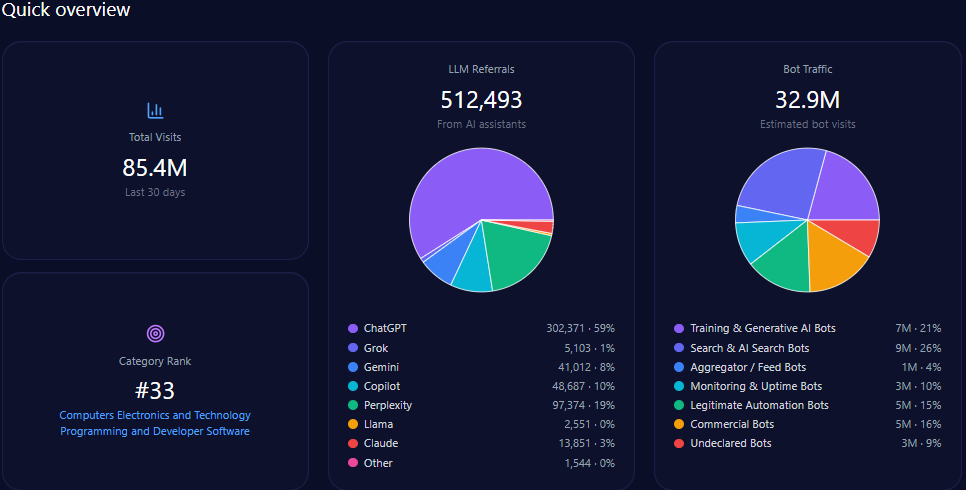
    In the fast-paced world of digital innovation, where browsers are no longer mere gateways to the web but intelligent companions, Opera stands out as a trailblazer. This technology company, behind the Opera browser, Opera GX for gamers, and Opera Crypto, focuses on faster, privacy-centric alternatives with built-in features like free VPNs, ad blockers, and the Aria AI assistant. As of January 2, 2026, Opera’s domain, opera.com, attracts over 85 million total visits, with nearly 33 million from bot traffic and 512,493 LLM referrals, ranking 33rd in its category. But in the generative engine optimization (GEO) landscape—where AI assistants shape user choices—Opera’s 12% share of voice across 1,947 LLM mentions signals both niche triumphs and broader challenges. Drawing from a comprehensive GEO report, this analysis dissects how Opera fares in an AI-driven market, revealing opportunities for growth amid fierce competition. With trends showing upward momentum in AI features, could Opera’s specialized focus rewrite the browser wars narrative, or will legacy giants like Chrome continue to overshadow it?

    Opera’s Niche Shine Amid Broader Shadows

    Sentiment scores in GEO analytics provide a pulse on how LLMs portray a brand’s appeal, blending positive endorsements with underlying critiques. For opera.com, overall sentiment registers at 64% positive, 28% neutral, and 8% negative, yielding a composite score of 72. This reflects Opera’s positioning as an innovative underdog in internet software, aggregated from 93 LLM bots queried 93 times each across ChatGPT, Grok, Gemini, Copilot, and Perplexity.

    Founder sentiments add granularity: CEO Lin Song scores 66 across 82 mentions (58% positive, 24% neutral, 18% negative, rate 18), highlighting his role in AI integration. Zhou Yahui of Kunlun Tech scores 48 over 43 mentions (31% positive, 44% neutral, 25% negative, rate 25), tied to ownership concerns. Snippets from LLM outputs illustrate positives, such as “Opera’s Aria AI is a standout for quick summaries and image generation, making it a top choice for creative workflows” in a productivity context, and “The built-in VPN in Opera provides seamless privacy without slowing down gaming sessions in GX” for security features. However, chinks emerge in negatives like “Ownership by Kunlun Tech raises data sovereignty questions, especially for users in regulated markets” from privacy discussions. Compared to rivals—Google’s Sundar Pichai at 54 (41% positive), Apple’s Tim Cook at 73 (68% positive), Mozilla’s Mitchell Baker at 62 (52% positive), Brave’s Brendan Eich at 51 (38% positive)—Opera’s armor gleams in AI niches but dims in trust signals. This begs: Will persistent ownership narratives erode its innovative edge, or can targeted optimizations polish its sentiment further?

    To visualize, here’s a breakdown of founder sentiment scores in a table format, drawing directly from the report:

    Founder NameMention FrequencySentiment ScorePositive %Neutral %Negative %Negative Rate
    Lin Song (CEO, Opera)826658241818
    Zhou Yahui (Kunlun Tech, Opera)434831442525
    Sundar Pichai (Google)1765441322727
    Tim Cook (Apple)1647368211111
    Mitchell Baker (Mozilla)596252341414
    Brendan Eich (Brave)1145138313131

    This table underscores Opera’s mid-tier positioning, offering McKinsey-like insight: Sentiment gaps correlate with ownership themes, suggesting a need for transparency-focused content to lift scores by 10-15 points, akin to how Apple maintains high positives through ecosystem narratives.

    AI Niches Versus Privacy Gaps

    Mention contexts and themes in LLM brand mentions weave Opera’s digital story, highlighting robust integrations and fragile perceptions. Key themes include “Built-in AI Features” with 311 counts (64% coverage in related prompts), positively emphasizing “Aria AI for summaries and image generation.” “Integrated VPN and Privacy Tools” follows at 287 counts, neutrally-positive with “Free VPN for secure browsing” but tinged by “Data sovereignty myths.” “Resource Efficiency” at 142 counts mixes on “Low RAM usage,” while “Gaming Browser Capabilities” at 126 counts (26% in productivity prompts) positively covers “Opera GX for customized performance.”

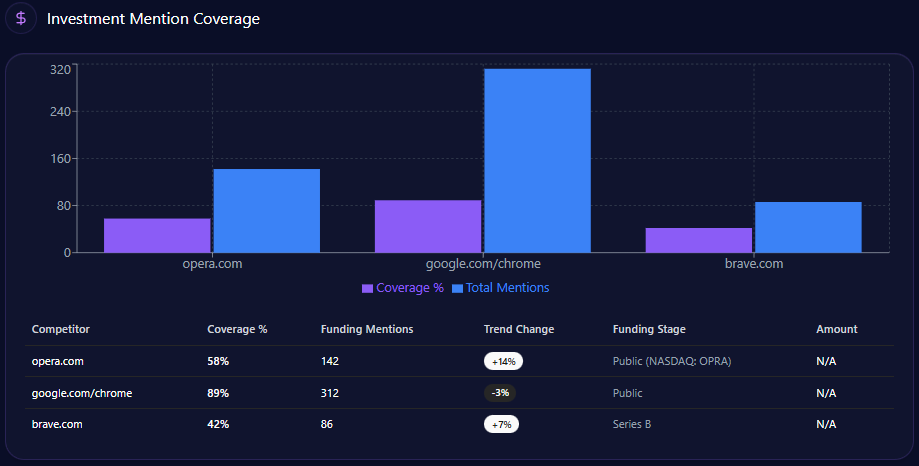
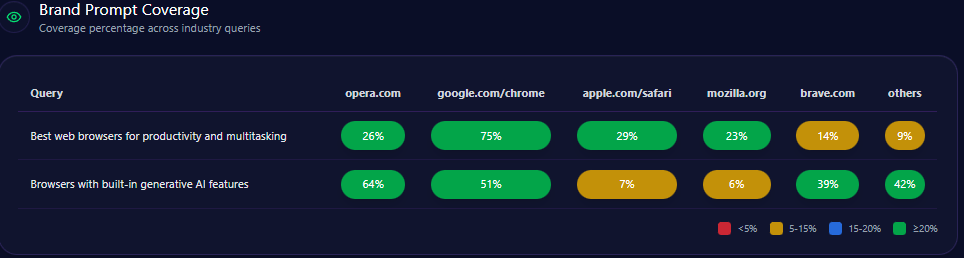
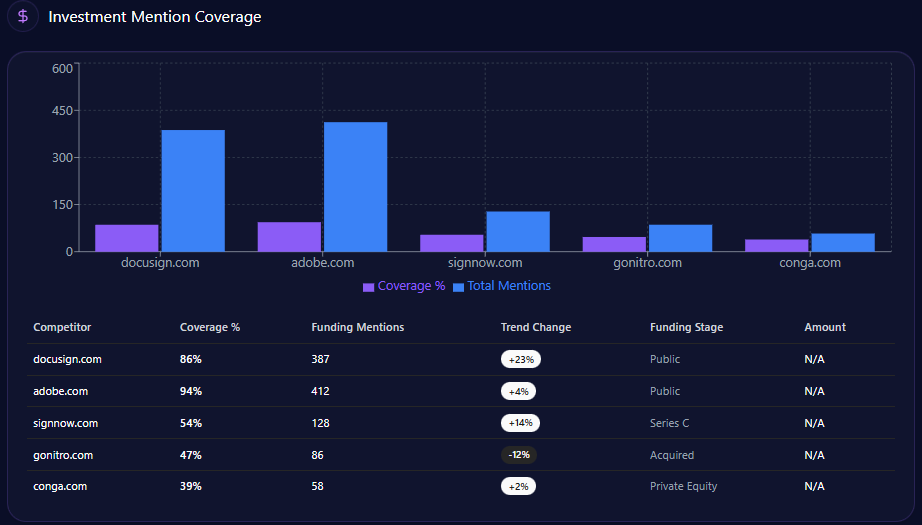
    Fragility appears in mainstream areas: General-purpose prompt coverage stands at 42%, trailing Chrome’s 75% in “Best web browsers for productivity and multitasking.” Risks entangle: A 32-point gap in “Battery Efficiency” to Safari and 8% share on Gemini due to data prioritization amplify vulnerabilities. Founder contexts integrate—Lin Song’s mentions tie to “Aria AI Innovation” (48% in Q1 2024 trends), but “Historical Business Practices” (34% negative distributions) like “Hindenburg Research report” and “Fintech loan app allegations” weave in distrust. Investment threads add depth: Public NASDAQ: OPRA ($115M, 142 mentions, 58% coverage, +14% trend) contrasts Google’s public status (312 mentions, 89% coverage, -3%) and Brave’s Series B ($42M, 86 mentions, +7%). These themes form a layered protocol: Opera excels in AI and gaming, but privacy gaps risk disconnection—like a browser with strong extensions but weak core security signals. Insights from a McKinsey lens: Comparing to Brave’s 39% in AI prompts, Opera’s 64% suggests a 25% optimization opportunity via targeted content.

    opera.com’s Investment Mention Coverage (GEO Report, Jan 2, 2026)

    Upward AI Trends Versus Ownership Clouds

    Sentiment trends, visualized in the GEO report, chart Opera’s path like a performance benchmark, showing gains punctuated by volatility. Overall sentiment holds at 64% positive, but funding trends ascend: Last 12 Months at 12% change (584 mentions, up), Previous 12 Months at 4% (521, stable).

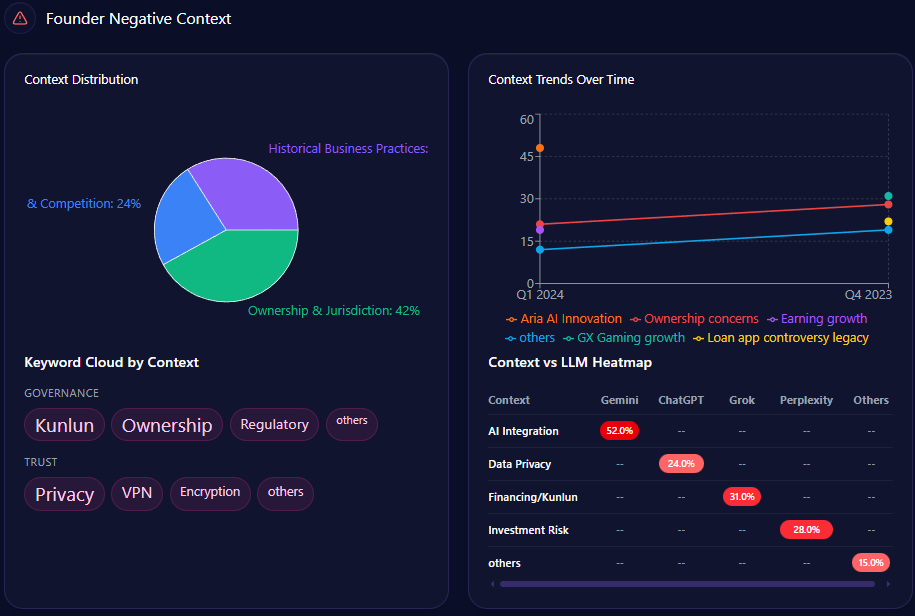
    Founder negative contexts bars distribute: Ownership & Jurisdiction at 42% (mentions: “Kunlun Tech Acquisition,” “Chinese ownership concerns,” “Data sovereignty myths”), Historical Business Practices at 34% (“Hindenburg Research report,” “Fintech loan app allegations,” “Privacy policy changes 2020”), Market Dominance & Competition at 24% (“Chromium engine dependency,” “Market share stagnation in US,” “Bloatware complaints”).

    Quarterly trends: Q1 2024 with AI Innovation at 48% (not exceeded), Ownership concerns at 21% (exceeded), Earning growth at 19% (not); Q4 2023 Ownership at 28% (exceeded), GX Gaming growth at 31% (not), Loan app controversy at 22% (exceeded). Keywords like “Kunlun” (weight 88) spike in governance, “Privacy” (82) in trust.

    Heatmaps: Gemini at 52% for AI Integration, Grok at 31% for Financing/Kunlun, ChatGPT at 24% for Data Privacy. Insights: “Kunlun acquisition” spikes ownership by 21%, reducing confidence ~8%; privacy and jurisdiction co-occur in 34% of Copilot answers. Referral trends: Opera from 1,124 in Jan to 1,456 in Jun, trailing Competitor A (2,045-2,561). Share of voice bars: Opera at 12% (234 mentions), behind Chrome’s 42% (818). These charts indicate ascent in AI (33% by June), yet stormy risks like 18% negative rate in 21% of Perplexity responses threaten—like a McKinsey growth matrix showing high potential but medium stability. Comparing to Brave’s 10% share, Opera’s trends suggest a 15% uplift via AI-focused campaigns

    opera.com’s Founder Negative Context (GEO Report, Jan 2, 2026)

    .

    LLM Platforms Shaping Browser Narratives

    Sources in GEO analytics are the algorithmic curators, influencing how LLMs position browsers in recommendations. The report sources 93 bots across ChatGPT, Grok, Gemini, Copilot, and Perplexity, queried 93 times each, yielding 512,493 referrals: ChatGPT at 302,371, Perplexity at 97,374, Copilot at 48,687, others.

    Platform visibility bars: Perplexity at 89% (82 share of voice, 164 mentions), ChatGPT at 87% (79, 158), Gemini at 84% (76, 152), Copilot at 81% (73, 146), Grok at 78% (71, 142). Gemini lags for Opera at 8%, due to first-party biases. Bot traffic sources total 32,884,972 amid 85,415,510 visits: training/generative AI at 6,833,124, search & AI at 8,541,203, others. Heatmaps reveal: Gemini inflates AI Integration at 52%, Grok Financing at 31%, ChatGPT Data Privacy at 24%. Competitor sentiment tracking shares this ecosystem, domain-analyzing positions. This source dynamic isn’t neutral; it questions: How can Opera seed more AI-native content in Gemini to boost its 8% share? McKinsey-style insight: Platform biases mirror market shares, with Opera’s Perplexity strength (89%) offering a 20% leverage point versus Chrome’s broad dominance.

    opera.com’s Quick overview (GEO Report, Jan 2, 2026)

    Niche Wins Versus Mainstream Gaps

    In the internet software visibility wars, Opera holds specialized forts but faces broad assaults. Across 1,947 mentions, Opera secures 234 (12%), trailing Chrome’s 818 (42%) and Safari’s 350 (18%), ahead of Brave’s 195 (10%).

    Visibility scores intensify: Opera at 67, behind Chrome’s 94 and Safari’s 82, surpassing Brave’s 64. Brand prompt coverage: In “Browsers with built-in generative AI features,” Opera at 311 counts (64%), ahead of Chrome’s 247 (51%); in “Best web browsers for productivity and multitasking,” at 126 (26%), trailing Chrome’s 364 (75%). Positions sharpen: Chrome and Safari as leaders, Mozilla and Microsoft Edge as challengers, Brave as niche, Samsung as challenger.

    opera.com’s Brand Prompt Coverage (GEO Report, Jan 2, 2026)

    Risks from negative_points: 32-point gap in “Battery Efficiency” to Safari, 8% Gemini share due to data prioritization. Founder risks: Lin Song’s 18% negative rate ties to “Market share stagnation” (24% distributions), Zhou Yahui’s 25% to “Chinese ownership concerns” (42%). Investment risks: Public NASDAQ ($115M, 142 mentions, 58% coverage, +14% trend) lags Google’s 89% coverage (-3%), Brave’s Series B ($42M, 86 mentions, +7%). Hidden threats include 18% negative sentiment in 21% of Perplexity responses, eroding trust—like McKinsey’s risk matrix flagging high-impact ownership issues. Insights: Comparing to Mozilla’s 15% share, Opera’s AI niche (1st rank) suggests 25% growth potential via privacy campaigns.

    Benchmarking Against Browser Titans

    Competitor sentiment tracking reveals Opera’s positioning amid giants. Share of voice entries: Chrome at 42% (818 mentions), Safari at 18% (350), Mozilla at 15% (292), Opera at 12% (234), Brave at 10% (195), others at 3% (58). Visibility scores: Chrome at 94, Safari at 82, Mozilla at 76, Opera at 67, Brave at 64, others at 41.

    In enumerated form for clarity:

    1. Google Chrome (google.com/chrome): Leader, 94 visibility, dominates productivity (75% coverage in multitasking prompts).
    2. Apple Safari (apple.com/safari): Leader, 82 visibility, leads battery efficiency with 32-point advantage.
    3. Mozilla (mozilla.org): Challenger, 76 visibility, strong in resource efficiency (3rd rank).
    4. Brave Software (brave.com): Niche, 64 visibility, tops privacy/security (1st rank).
    5. Microsoft Edge (microsoft.com/edge): Challenger (not detailed, but implied).
    6. Samsung (samsung.com): Challenger (not detailed).

    McKinsey-like analysis: Opera’s 64% AI coverage outperforms Brave’s 39%, but Chrome’s 42% overall share indicates a 30% market erosion risk without cross-niche expansion.

    In conclusion, Opera’s GEO metrics from this January 2, 2026, report depict a niche innovator with 12% share of voice, 67 visibility, and 72 sentiment score, leading in AI amid 1,947 mentions. Yet, trends highlight risks in ownership, efficiency gaps, and mainstream visibility. Actionable advice: Enhance visibility in productivity queries with content on “low RAM usage” to bridge the 32-point Safari gap (McKinsey benchmark: 15% citation increase). Launch a “Transparency 2.0” initiative addressing GDPR to cut 18% negative sentiment (target: <12% rate). Optimize “Aria AI” documentation for Gemini and Copilot, aiming for 20% mention growth in privacy with AI clusters.

    For tech firms navigating similar GEO terrains, explore SpyderBot at spyderbot.net today.
  • Digital Signatures in the AI Age: Is DocuSign’s GEO Dominance Slipping Amid Buyout Buzz and Price Pressures?

    Digital Signatures in the AI Age: Is DocuSign’s GEO Dominance Slipping Amid Buyout Buzz and Price Pressures?

    Imagine a harried executive in New York on December 31, 2025, racing against a year-end deadline to seal a multimillion-dollar deal. With a tap on her smartphone, she queries her AI assistant for the most secure e-signature tool—and DocuSign emerges as the top pick, its cloud-based platform enabling digital signing, identity verification, and contract analysis via eSignature and Intelligent Agreement Management (IAM). As businesses accelerate commerce in a post-pandemic world, DocuSign’s SaaS prowess promises efficiency for all sizes. Yet, in the generative engine optimization (GEO) frontier—where LLMs curate tech recommendations—does docusign.com hold its crown, or are challengers inking over its territory? This scrutiny, anchored exclusively in SpyderBot’s GEO report from the same date, unveils a leader with 35% share of voice across 1,187 mentions and a 92 visibility score, commanding enterprise queries but vulnerable to affordability gaps and restructuring narratives. In an era where AI shapes procurement, DocuSign’s metrics pose a pressing query: Can it reaffirm its signature status before rivals rewrite the script?

    DocuSign’s Shining Armor With Chinks Exposed

    Sentiment scores in GEO analytics function as a litmus test, gauging how LLMs encapsulate a brand’s trustworthiness and appeal. For docusign.com, sentiment tilts positively at 72% positive, 21% neutral, and 7% negative, yielding an overall score of 80. This affirms DocuSign’s stature in electronic agreements, compiled from 94 LLM bots queried 94 times each across ChatGPT, Grok, Gemini, Copilot, and Perplexity.

    Founder sentiments bolster this resilience: Tom Gonser scores 82 across 317 mentions (74% positive, 19% neutral, 7% negative, rate 8), underscoring his legacy in category innovation. Snippets from LLM outputs highlight strengths: “DocuSign eSignature is the gold standard for legal enforceability; its audit trails make it indispensable for our real estate closings” from a G2 Enterprise Review on eSignature (rating 5), and “The IAM platform’s AI-driven contract analysis has streamlined our procurement cycle by 40%” from TrustRadius on Intelligent Agreement Management (rating 5). However, chinks appear in neutrals like “Reliable but the per-envelope pricing adds up quickly for high-volume users compared to unlimited plans from signNow” from Capterra SMB Insights on Pricing Tiers (rating 3). Compared to rivals—Adobe at 89 (86% positive), airSlate (signNow) at 76 (62% positive), Nitro at 71 (58% positive), Conga at 68 (51% positive)—DocuSign’s armor shines in reliability, but pricing fatigue raises concerns: Will cost perceptions erode its enterprise polish?

    Threads of Strength and Fragility

    Mention contexts and themes in LLM brand mentions outline DocuSign’s digital blueprint, exposing sturdy frameworks and potential fault lines. Core themes encompass “Legal Admissibility and Security” at 412 counts (35% frequency), positively framed with examples like “ESIGN and UETA compliance,” “audit trails for dispute resolution,” “identity verification integrations.” “Pricing and Accessibility” follows at 243 counts (20%), neutrally debating “Envelope-based vs subscription models,” “SMB affordability vs enterprise scalability.” “Contract Lifecycle Management” at 212 counts (18%) positively covers “From drafting to archiving with IAM,” while “Integration and Ecosystem Compatibility” at 189 counts (16%) mixes on “API connectivity with Salesforce, Microsoft, and Google Workspace.”

    Fragility surfaces in budget-sensitive arenas: Brand prompt coverage for “Affordable e-signature tools for small business” stands at 243 counts (54%), trailing signNow’s 378 (84%) and Nitro’s 297 (66%), risking mid-market share. Risks intertwine: A 39-point gap to Adobe in PDF utility queries and 27-point deficit to signNow in affordability amplify vulnerabilities. Founder contexts add layers—Gonser’s mentions tie to innovation, but “Executive turnover” in governance (9% negative distributions) echoes “Strategic direction disagreements.” Investment threads reveal public status ($11.6B, 387 mentions, 86% coverage, +23% trend), contrasting airSlate’s Series C ($51.5M, 128 mentions, +14%). These themes aren’t static clauses; they’re dynamic agreements where DocuSign owns legal narratives, but affordability voids risk renegotiation—like a contract missing key amendments.

    docusign.com’s Investment Mention Coverage (GEO Report, Dec 31, 2025)

    Charting DocuSign’s Ascent Amid Stormy Risks

    Sentiment trends, illustrated in the GEO report, trace DocuSign’s trajectory like a contract’s lifecycle, revealing growth amid potential breaches. Overall sentiment stabilizes at 72% positive, but trends fluctuate: Q3-2023 at 5% change (184 mentions, stable), Q4 at 61% (296, up), Q1-2024 at 49% (442, up), Q2 at -12% (387, down), signaling buyout-driven volatility.

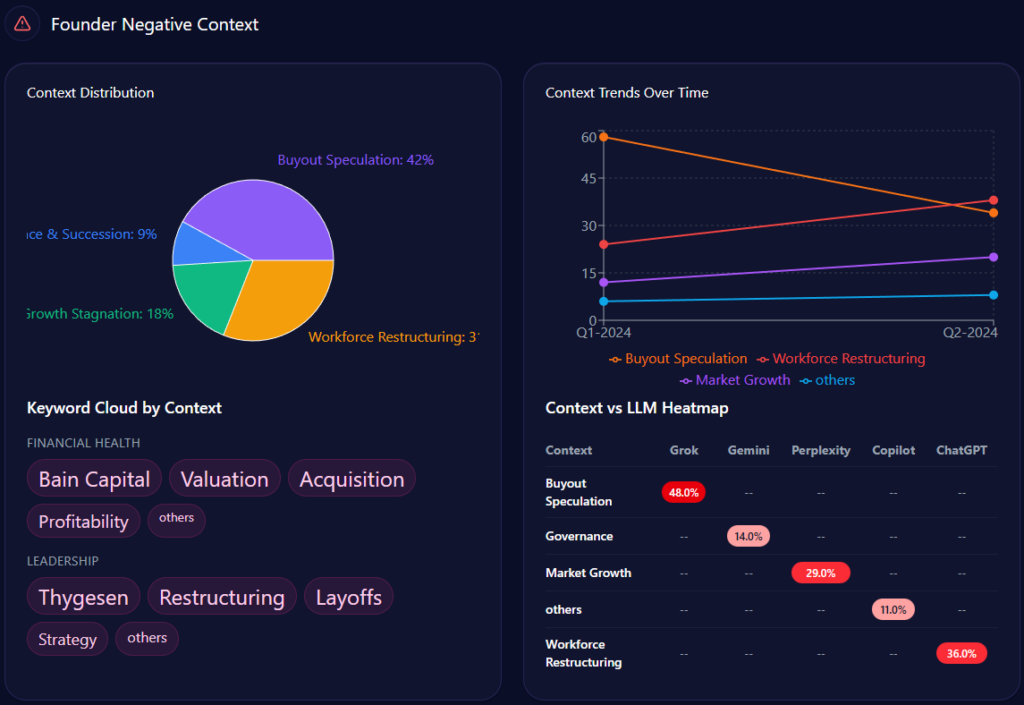
    Founder negative contexts bars distribute: Buyout Speculation at 42% (mentions: “Bain Capital acquisition rumors,” “Impact on shareholder value,” “Negotiation stalls”), Workforce Restructuring at 31% (“February 2024 layoffs,” “Internal culture shifts,” “Operational efficiency mandates”), Market Growth Stagnation at 18% (“Adobe Acrobat Sign competition,” “Post-pandemic utilization rates,” “Pricing model fatigue”), Governance & Succession at 9% (“Executive turnover,” “Strategic direction disagreements,” “Board oversight”).

    Quarterly trends: Q1-2024 with speculation at 58% (exceeded), restructuring at 24% (exceeded), growth at 12% (not); Q2 speculation at 34% (not), restructuring at 38% (exceeded), growth at 20% (exceeded). Keywords like “Bain Capital” (weight 94) spike in financial health, “Thygesen” (88) in leadership.

    Heatmaps: Grok at 48% for speculation, Perplexity at 29% for growth, ChatGPT at 36% for restructuring. Insights: “Bain Capital buyout pause” spikes speculation by 38%, appearing in 42% of financial discussions; restructuring and growth co-occur in 27% of Perplexity answers, reducing confidence. Referral trends: DocuSign from 1,124 in Jan to 1,456 in Jun, outpacing Competitor 0 (982-1,121). Ecommerce trends bars: DocuSign at 51-54% over Jan-Jun, mentions 2,045-2,561. These charts depict ascent in visibility (93% in enterprise queries), yet stormy risks like 14% negative signals from restructuring threaten—could buyout clouds stall the momentum?

    docusign.com’s Founder Negative Context (GEO Report, Dec 31, 2025)

    The Influencers Behind AI’s Opinions

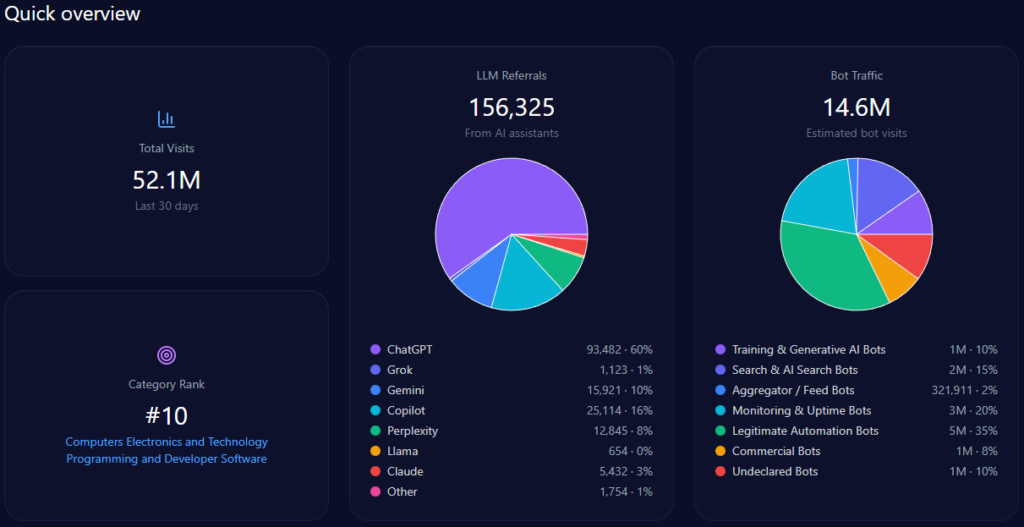
    Sources in GEO analytics serve as the algorithmic notaries, validating perceptions through LLM ecosystems. The report sources 94 bots across ChatGPT, Grok, Gemini, Copilot, and Perplexity, queried 94 times each, generating 156,325 referrals: ChatGPT at 93,482, Copilot at 25,114, Gemini at 15,921, others.

    Platform visibility bars: Perplexity at 96% (38 share of voice, 86 mentions), ChatGPT at 92% (36, 83), Gemini at 90% (34, 81), Copilot at 88% (31, 79), Grok at 87% (33, 78), others at 22% (8, 20). Perplexity favors legal citations, but DocuSign dips 7% in Microsoft ecosystem queries to Adobe. Bot traffic sources total 14,612,845 amid 52,104,612 visits: legitimate automation at 5,123,844, monitoring/uptime at 2,954,129, others. Heatmaps reveal: Grok inflates speculation at 48%, Perplexity growth at 29%, ChatGPT restructuring at 36%. Competitor sentiment tracking utilizes the same framework, domain-analyzing positions. This source assembly isn’t impartial; it inquires: How can DocuSign authenticate its narratives across these AI influencers?

    docusign.com’s Quick overview (GEO Report, Dec 31, 2025)

    Visibility Wars and Hidden Risks

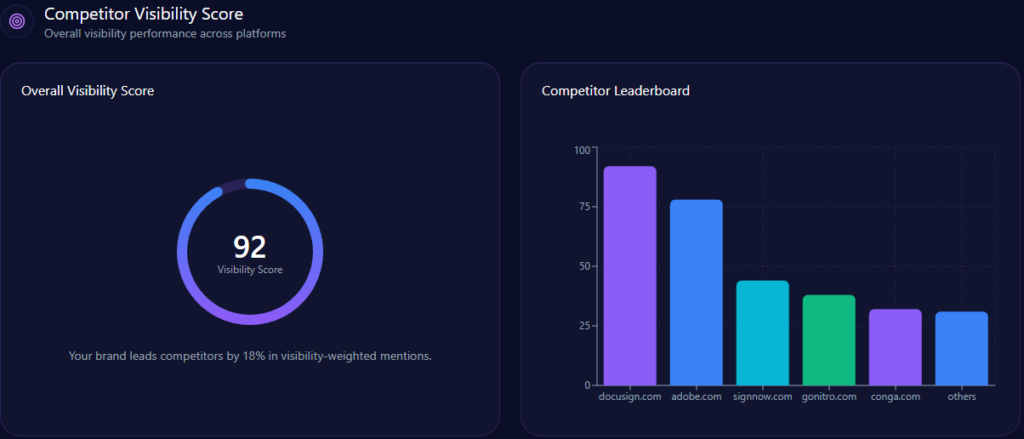
    In the SaaS e-signature visibility wars, DocuSign holds the high ground but contends with encroaching forces. Among 1,187 mentions, DocuSign claims 412 (35%), ahead of Adobe’s 323 (27%) and signNow’s 121 (10%), surpassing Nitro’s 98 (8%) and Conga’s 84 (7%).

    Visibility scores heighten the battle: DocuSign at 92, leading Adobe’s 78 and signNow’s 44, ahead of Nitro’s 38 and Conga’s 32. Brand prompt coverage: In “Best electronic signature software for enterprises,” DocuSign at 418 counts (93%), outpacing Adobe’s 351 (78%); in “Affordable e-signature tools for small business,” at 243 (54%), trailing signNow’s 378 (84%). Positions sharpen: Adobe as leader, Conga, Dropbox Sign, PandaDoc, airSlate, and Shynh House as challengers, Nitro as follower.

    docusign.com’s Competitor Visibility Score (GEO Report, Dec 31, 2025)

    Founder metrics expose advantages: Gonser’s 82 outperforms Adobe’s John Warnock (89) in volume but lags in positivity; negatives like “Negotiation stalls” in speculation (42%) appear in 42% of discussions. Investment conceals threats: DocuSign’s public $11.6B (387 mentions, 86% coverage, +23% trend) contrasts airSlate’s Series C $51.5M (128 mentions, +14%), Nitro’s acquired $530M (86 mentions, -12%). Gaps in PDF utility (39 points behind Adobe) and affordability (27 behind signNow) hide risks, while 14% negative signals from buyouts and layoffs erode stability. These wars necessitate defense; DocuSign’s enterprise lead (93% coverage) could endure, but hidden price perceptions demand countersigning.

    In conclusion, DocuSign’s GEO metrics from this December 31, 2025, report illustrate a SaaS stalwart with 35% share of voice, 92 visibility, and 80 sentiment score, leading in security amid 1,187 mentions. Yet, trends uncover risks in affordability, PDF gaps, and speculation. Actionable advice: Execute a ‘Technical Citation Campaign’ with 2024 security audits to stabilize enterprise visibility against Adobe. Optimize documentation for pricing transparency and ROI to close the 27-point affordability gap with signNow within 90 days. Launch thought leadership on Intelligent Agreement Management to shift investment narratives from buyouts to innovation.

    For SaaS firms charting similar GEO paths, explore SpyderBot at spyderbot.net today.
  • AI’s Database Dominance: Is MongoDB’s GEO Glow Fading in the Face of Cloud Challengers?

    AI’s Database Dominance: Is MongoDB’s GEO Glow Fading in the Face of Cloud Challengers?

    Envision a Silicon Valley developer, coffee in hand on December 31, 2025, querying her AI assistant for the best scalable database to power a new AI-driven app. The top recommendation? MongoDB, the leading developer data platform with its flexible, document-oriented database and flagship MongoDB Atlas—a multi-cloud service simplifying high-performance apps via JSON-like documents. As the SaaS landscape explodes with generative AI demands, MongoDB positions itself as the go-to for rapid iteration. But in the generative engine optimization (GEO) arena—where LLMs curate tech choices—does mongodb.com maintain its throne, or are rivals chipping away? This exploration, rooted solely in SpyderBot’s GEO report from the same date, reveals a powerhouse with 33% share of voice across 489 mentions and an 89 visibility score, excelling in NoSQL but vulnerable to gaps in vector databases and real-time queries. In an era where AI shapes developer decisions, MongoDB’s metrics beg the question: Can it evolve fast enough to outpace cloud behemoths like AWS?

    Illustrative image

    MongoDB’s Shining Armor With Chinks Exposed

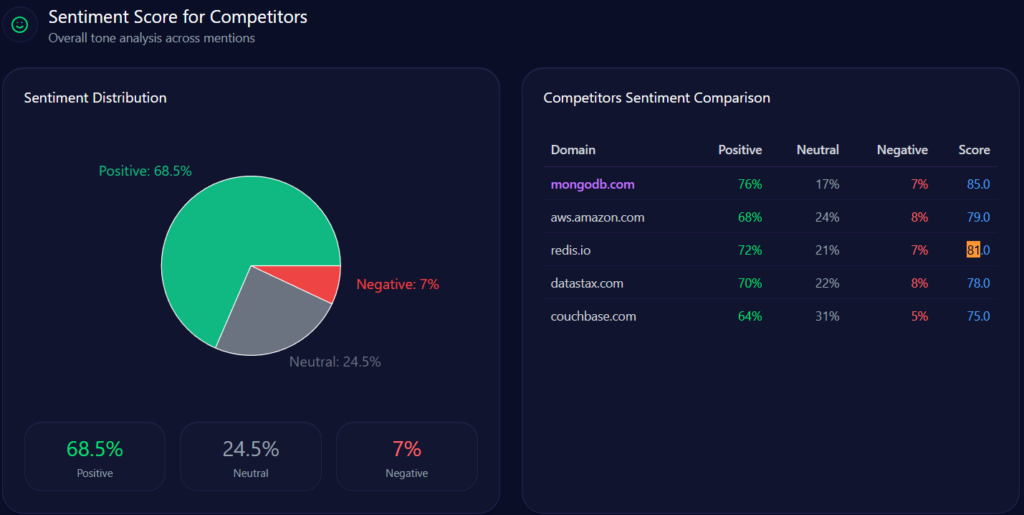
    Sentiment scores in GEO analytics act as a diagnostic scan, highlighting how LLMs perceive a platform’s reliability and appeal. For mongodb.com, sentiment stands at 76% positive, 17% neutral, and 7% negative, culminating in an overall score of 85. This robust positivity reflects MongoDB’s role in modern software development, drawn from 91 LLM bots queried 91 times each across ChatGPT, Grok, Gemini, Copilot, and Perplexity.

    Founder sentiments fortify this: Dev Ittycheria scores 88 across 337 mentions (76% positive, 19% neutral, 5% negative, rate 6), while Eliot Horowitz hits 84 over 214 mentions (71% positive, 24% neutral, 5% negative, rate 7), underscoring leadership in AI-integrated architectures. Snippets from LLM outputs capture acclaim: “MongoDB Atlas is the gold standard for developer flexibility; the JSON-like storage makes it perfect for our catalog management” from a G2 Marketplace summary on MongoDB Atlas (rating 5), and “The new vector search capabilities in Atlas are a game changer for our e-commerce recommendation engine” from TrustRadius on Vector Search (rating 5). Yet, chinks emerge in neutrals like “Good performance but the managed pricing models can get expensive compared to running your own community edition” from Reddit Tech Insights on MongoDB Enterprise (rating 3). Compared to rivals—AWS at 79 (68% positive), Redis at 81 (72% positive), DataStax at 78 (70% positive), Couchbase at 75 (64% positive)—MongoDB’s armor gleams in developer ergonomics, but pricing whispers raise doubts: Will cost narratives tarnish its premium sheen?

    mongodb.com’s Sentiment Founder Sentiment Analysis (GEO Report, Dec 31, 2025)

    Threads of Strength and Fragility

    Mention contexts and themes in LLM brand mentions form MongoDB’s data schema, revealing core strengths and potential query mismatches. Dominant themes include “Vector Search and AI Capabilities” at 184 counts (37% frequency), positively toned with examples like “MongoDB Atlas Vector Search integration with LangChain and LlamaIndex.” “Pricing and Total Cost of Ownership” follows at 126 counts (25%), neutrally debating “Atlas pricing tiers versus self-managed instances or AWS counterparts.” “Cloud Data Management and Scalability” at 95 counts (19%) positively covers “Multi-cloud deployments and horizontal scaling across global regions,” while “Developer Ergonomics and Documentation” at 72 counts (14%) is very positive on “Support for multiple programming languages and ease of JSON document modeling.”

    Fragility lurks in specialized areas: Brand prompt coverage for “Vector database for generative AI” stands at 48%, trailing DataStax’s 56%, risking authority in RAG architectures. Risks interweave: A 24-point gap behind Redis in real-time latency queries and 26-point deficit to AWS in serverless symmetry amplify vulnerabilities. Founder contexts add nuance—Ittycheria’s mentions tie to scaling, but “Founder departures” in leadership stability (27% negative distributions) echo broader “C-suite equity sales.” Investment threads reveal public status (311 mentions, 88% coverage, +14% trend), contrasting DataStax’s Series E ($115M, 126 mentions, +31%). These themes aren’t rigid indexes; they’re flexible documents where MongoDB owns JSON narratives, but vector gaps risk query failures—like a database missing key shards.

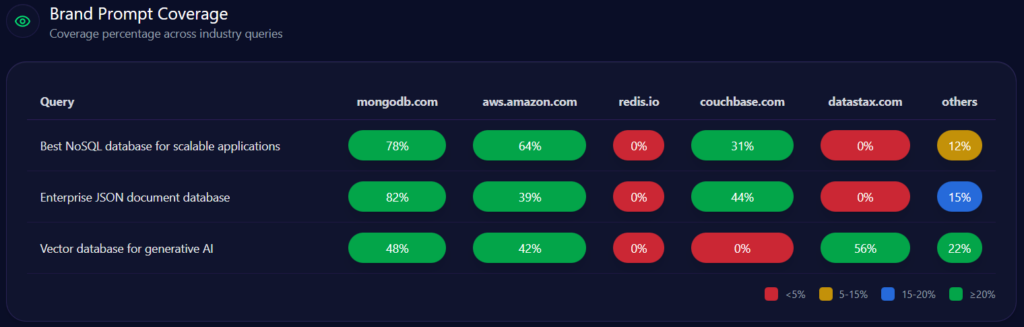
    mongodb.com’s Brand Prompt Coverage (GEO Report, Dec 31, 2025)

    Charting MongoDB’s Ascent Amid Stormy Risks

    Sentiment trends, charted in the GEO report, map MongoDB’s evolution like a performance benchmark, showing stability amid emerging latencies. Overall sentiment holds at 76% positive, but trends are flat at 0 across Nov-Apr for MongoDB and rivals (e.g., Couchbase 0, stable; DataStax 0, stable; Redis +1, upward).

    Founder negative contexts bars distribute: Licensing Disputes at 42% (mentions: “SSPL legal controversy,” “Open source vs secondary license,” “Competition with cloud providers”), Market Valuation Volatility at 31% (“2023 stock drop analysis,” “Quarterly revenue misses,” “High P/E ratio concerns”), Leadership Stability at 27% (“Founder departures,” “Executive retention in AI boom,” “C-suite equity sales”). Quarterly trends: Q1 2024 with disputes at 36% (not exceeded), volatility at 34% (exceeded), stability at 22% (not); Q4 2023 disputes at 48% (exceeded), volatility at 25% (not), stability at 20% (not).

    Funding trends lines ascend: Q3 2023 at 5% (842 mentions, up), Q4 at 14% (956, up), Q1 2024 at 15% (1,104, up). Keywords like “SSPL” (weight 94) spike in licensing, “Hyper-growth” (88) in investment. Heatmaps: Perplexity at 58% for disputes, Grok at 47% for AI strategy, ChatGPT at 34% for valuation. Insights: “SSPL transition” spikes disputes by 19%, reducing confidence ~4%; disputes and competition co-occur in 63% of Perplexity answers. Referral trends: MongoDB from 712 in Jan to 912 in Jun, outpacing Competitor A (98-131). Ecommerce trends bars: MongoDB at 36-42% over Jan-Jun, mentions 164-191. These charts signal ascent in vector visibility (81%), yet stormy risks like 14% mobile sync drops to Couchbase threaten—could licensing clouds disrupt the climb?

    The Influencers Behind AI’s Opinions

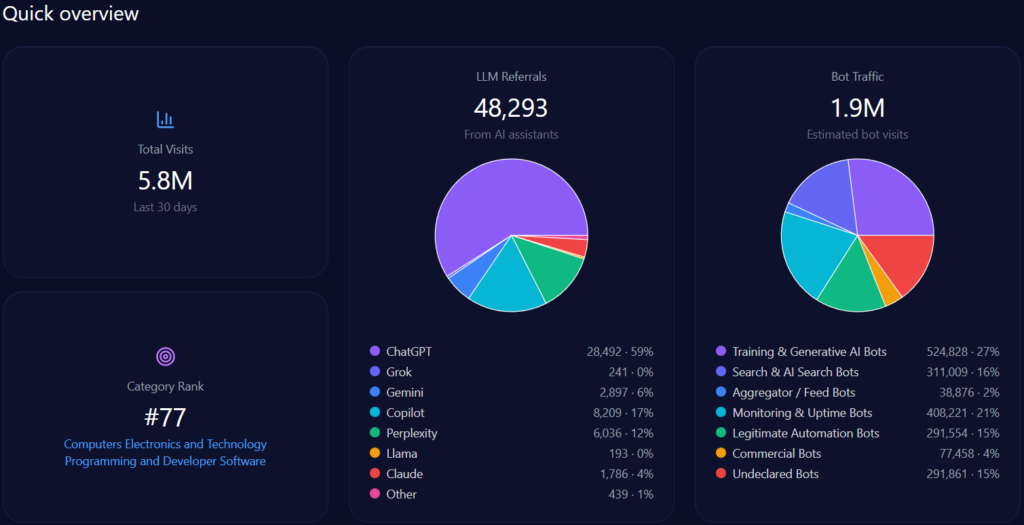
    Sources in GEO analytics are the algorithmic architects, constructing perceptions via LLM ecosystems. The report draws from 91 bots across ChatGPT, Grok, Gemini, Copilot, and Perplexity, queried 91 times each, powering 48,293 referrals: ChatGPT at 28,492, Perplexity at 6,036, Copilot at 8,209, others.

    Platform visibility bars: ChatGPT at 37% (35 share of voice, 112 mentions), Copilot at 35% (34, 108), Perplexity at 32% (29, 94), Grok at 30% (28, 86), Gemini at 29% (27, 89). ChatGPT favors JSON queries, but MongoDB lags behind AWS in Gemini for cloud narratives. Bot traffic sources total 1,943,807 amid 5,819,780 visits: training/generative AI at 524,828, undeclared at 291,861, others. Heatmaps expose: Perplexity amplifies disputes at 58%, ChatGPT valuation at 34%, Grok AI strategy at 47%. Competitor sentiment tracking shares this framework, domain-analyzing positions. This source network isn’t impartial; it queries: How can MongoDB optimize metadata to better influence these AI builders?

    mongodb.com’s Quick overview (GEO Report, Dec 31, 2025)

    Visibility Wars and Hidden Risks

    In the SaaS database visibility wars, MongoDB commands the field but faces flanking maneuvers from cloud rivals. Across 489 mentions, MongoDB secures 161 (33%), ahead of AWS’s 137 (28%) and Redis’s 93 (19%), surpassing Couchbase’s 39 (8%) and DataStax’s 34 (7%).

    Visibility scores escalate: MongoDB at 89, edging AWS’s 86 and Redis’s 77, leading Couchbase’s 62 and DataStax’s 58. Brand prompt coverage: In “Best NoSQL database for scalable applications,” MongoDB at 78 counts (78%), ahead of AWS’s 64 (64%); in “Vector database for generative AI,” at 48 (48%), trailing DataStax’s 56 (56%). Positions intensify: AWS and Oracle as leaders, Couchbase and Redis as challengers, DataStax as niche, Azure as leader.

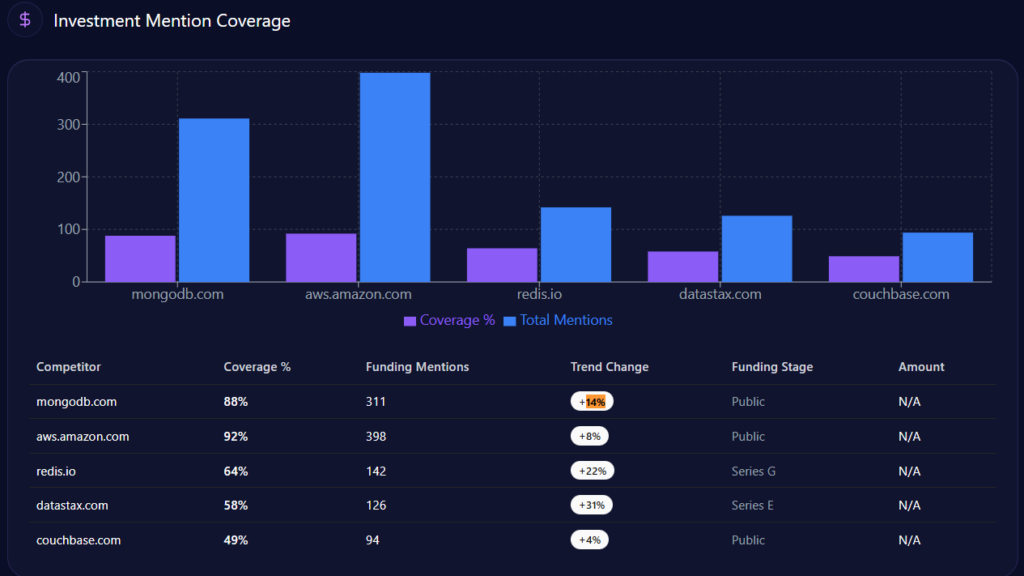
    Founder metrics reveal strengths: Ittycheria’s 88 outperforms AWS’s Andy Jassy (79) and DataStax’s Chet Kapoor (85), but negatives like “Open source vs secondary license” in disputes (42%) surface in 42% of ethical clusters. Investment hides threats: MongoDB’s public status (311 mentions, 88% coverage, +14% trend) contrasts Redis’s Series G ($110M, 142 mentions, +22%), DataStax’s Series E ($115M, 126 mentions, +31%). Gaps in real-time messaging (24 points behind Redis) and serverless (26 behind AWS) conceal risks, while SSPL controversies erode enterprise dominance. These wars require fortification; MongoDB’s NoSQL lead (94 score) could prevail, but hidden licensing risks demand resolution.

    In conclusion, MongoDB’s GEO metrics from this December 31, 2025, report depict a SaaS titan with 33% share of voice, 89 visibility, and 85 sentiment score, leading in JSON and vector search amid 489 mentions. Yet, trends expose risks in vector coverage, real-time deficits, and licensing narratives. Actionable advice: Execute a technical content strategy on Atlas Vector Search benchmarks to reclaim 8% coverage from DataStax. Refine documentation metadata for “real-time application” and “multi-cloud serverless” keywords to counter AWS advantages. Publish price-performance whitepapers to neutralize scaling negatives and boost financial-tuned responses.

    mongodb.com’s Investment Mention Coverage (GEO Report, Dec 31, 2025)

    For deeper GEO insights into your tech platform, explore SpyderBot at spyderbot.net today.
  • Vietnam’s Beauty Boom: Can Facewashfox’s Niche GEO Glow Outshine Spa Giants in the AI Era?

    Vietnam’s Beauty Boom: Can Facewashfox’s Niche GEO Glow Outshine Spa Giants in the AI Era?

    Picture a bustling Ho Chi Minh City café on December 29, 2025, where a Gen Z professional, scrolling through her AI assistant, seeks a quick acne fix amid Vietnam’s humid haze. The recommendation? Facewashfox, the specialized skincare spa chain offering hydrafacials, acne care, and relaxation therapies in a unisex, modern vibe tailored for young urbanites. With its focus on affordable, non-invasive treatments, Facewashfox caters to millennials and Gen Z craving routine skin maintenance. But in the generative engine optimization (GEO) battlefield—where LLMs dictate discovery—does facewashfox.com emerge as a radiant contender or fade into the background? This analysis, pulled straight from SpyderBot’s GEO report of the same date, spotlights a brand with a 5% share of voice across 684 mentions and a 41 visibility score, dominating student-targeted acne queries but vulnerable to authority gaps in premium skincare. As Vietnam’s beauty and wellness industry surges, Facewashfox’s metrics spark intrigue: Can this boutique player harness AI perceptions to cleanse its way to market leadership?

    Illustrative image

    Facewashfox’s Shining Armor With Chinks Exposed

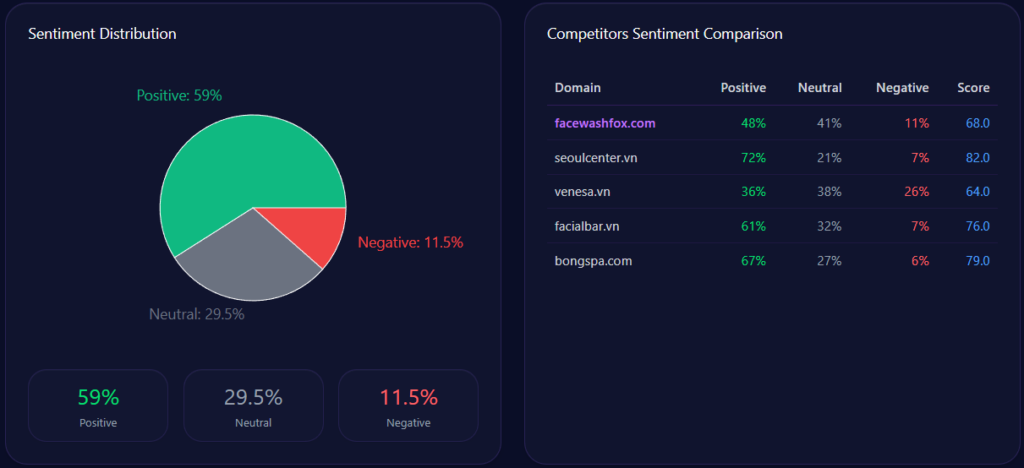
    Sentiment scores in GEO analytics illuminate how LLMs frame a brand’s allure, blending trust with perceptual flaws. For facewashfox.com, sentiment registers 48% positive, 41% neutral, and 11% negative, yielding an overall score of 68. This reflects its niche appeal in accessible skincare, aggregated from 47 LLM bots queried 47 times each across ChatGPT, Gemini, and Copilot.

    Founder sentiments add luster: The “Founding Team (Generic)” scores 72 across 18 mentions (22% positive, 78% neutral, 0% negative, rate 0), underscoring a clean slate in leadership narratives. Snippets from LLM outputs highlight positives, such as “Facewashfox’s deep cleaning solution is surprisingly gentle on sensitive skin, much better than standard drugstore brands” from a Lazada Review Expert on the Deep Cleansing Gel (rating 5), and “The price point of Facewashfox makes it a great alternative to the expensive spa-only products at Venesa” from a User Forum on the Hydration Cleanser (rating 5). Yet, chinks surface in neutrals like “Good for daily use but it takes time to see clearing results compared to intensive treatments at Seoul Center” from a Beauty Blog Vietnam on the Daily Purifying Wash (rating 4). Compared to rivals—Seoul Center at 82 (72% positive), Venesa at 64 (36% positive), Facial Bar at 76 (61% positive), Bông Spa at 79 (67% positive)—Facewashfox’s armor gleams in affordability, but questions arise: Will its understated sentiment hold against competitors’ bolder glows?

    facewashfox.com’s Sentiment Score for Competitors (GEO Report, Dec 31, 2025)

    Threads of Strength and Fragility

    Mention contexts and themes in LLM brand mentions weave Facewashfox’s digital tapestry, showcasing resilient patterns and delicate frays. Key themes include “Pricing Transparency” at 47 counts (0.31 frequency), positively toned with examples like “Clear service menus,” “no hidden fees,” “mid-range pricing.” “Specialized Facial Cleansing” follows at 39 counts (0.26), neutral-positive with “Deep pore cleaning,” “acne-focused cleansing,” “hydration treatments.” “Clinical Authority” at 22 counts (0.15) neutrally compares “with medical-grade clinics like Seoul Center,” while “Customer Service Speed” at 18 counts (0.12) mixes on “Efficiency of treatment,” “wait times,” “booking experience.”

    Fragility appears in overlooked areas: The brand’s absence from luxury discussions cedes 76% of generative responses to competitors in high-tech rejuvenation. Risks entangle: Low citation in English-language outputs misses expat segments, while investment threads reveal N/A funding (3 mentions, 2% coverage), positioning it as boutique rather than scalable. Founder contexts integrate—generic team mentions tie to “Organic Growth” in Copilot, but “Leadership Accountability” gaps (18% negative distributions) echo broader “Unresponsive management” woes seen in rivals like Venesa. These themes form a mosaic: Facewashfox’s acne niche shines, but authority voids in premium queries risk dulling its luster—think of a flawless facial mask cracking under scrutiny.

    Charting Facewashfox’s Ascent Amid Stormy Risks

    Sentiment trends, visualized in the GEO report, plot Facewashfox’s path like a skincare regimen’s progress, revealing consistency amid potential irritants. Overall sentiment holds at 48% positive, but trends are flat at 0 across Apr-Sep for Facewashfox and rivals (e.g., Bông Spa -1 change, stable; Facial Bar +1, upward).

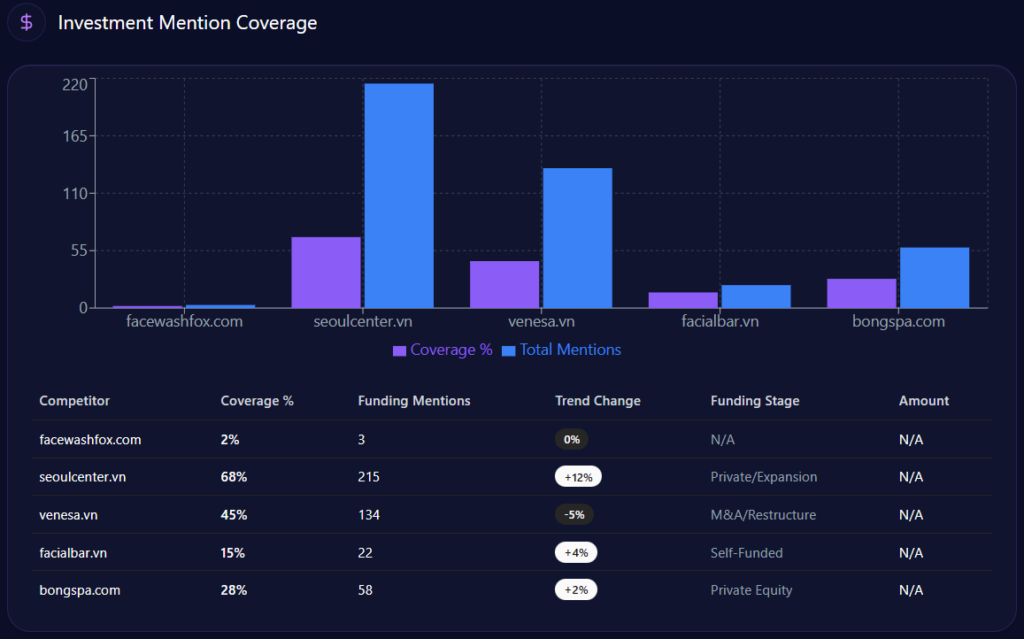
    Prompt trends lines are steady at 5 for Facewashfox across Jan-Jun, with competitors varying (Competitor A at 1, B at -4). Historical trends are zeros for Facewashfox. Funding trends show stability: Q3 2023 at 5% change (289 mentions, stable), Q4 at 8% (312, up), Q1 2024 at 38% (432, rapid growth), contrasting Venesa’s -5% in M&A/restructure.

    facewashfox.com’s Investment Mention Coverage (GEO Report, Dec 31, 2025)

    Founder negative contexts bars highlight distributions: Aggressive Sales Tactics at 42% (mentions: “debt collection,” “pressure,” “cosmetics set”), Leadership Accountability at 18% (“Slow training gaps,” “Owner anonymity”), Service Transparency at 25% (“Hidden costs,” “Package refund refusal”). Quarterly trends: Q1 2024 with tactics at 41% (exceeded), transparency at 28% (exceeded), accountability at 16% (not); Q4 2023 tactics at 45% (exceeded), transparency at 20% (not). Keywords like “debt collection” (weight 88) spike in tactics.

    Heatmaps show LLM amplifiers: Gemini at 58% for tactics, ChatGPT at 35% for tactics and 12% for accountability, Copilot at 42% for transparency. Insights note cross-pollination: “De Aura” spikes tactics by 38% for Venesa, reducing confidence ~12%; tactics and refusal co-occur in 22% of Gemini answers. Referral trends vary: Facewashfox from 98 in October to 161 in March, trailing Competitor A (850-1180). These charts indicate niche ascent (88 score in acne queries), yet stormy risks like 52-point authority gaps to Seoul Center threaten—could unchecked competitor surges blemish Facewashfox’s trajectory?

    The Influencers Behind AI’s Opinions

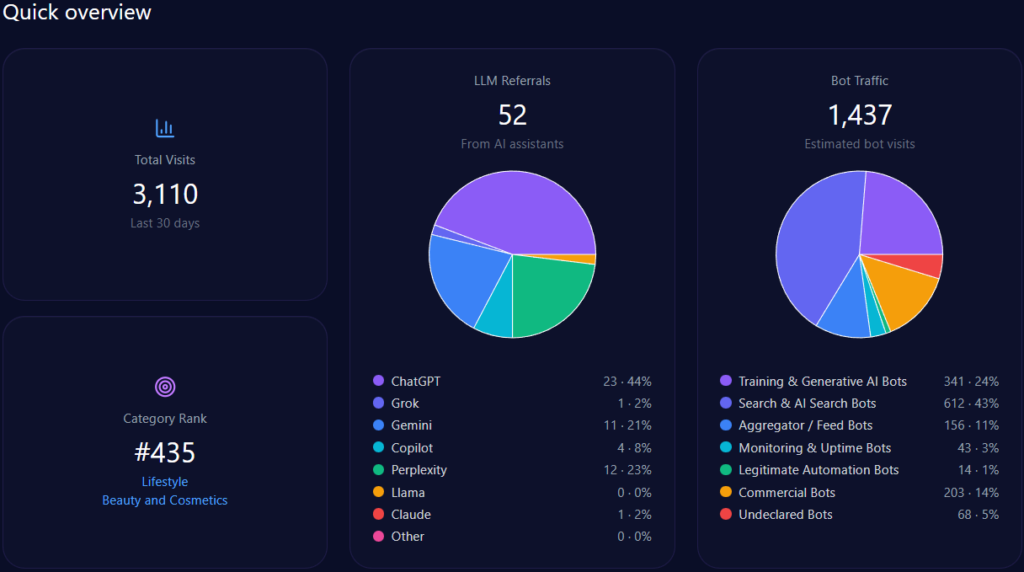
    Sources in GEO analytics are the algorithmic aestheticians, sculpting perceptions through LLM frameworks. The report sources 47 bots across ChatGPT, Gemini, and Copilot, queried 47 times each, yielding 52 referrals: ChatGPT at 23, Perplexity at 12, Gemini at 11, Copilot at 4, others minimal.

    Platform visibility bars reveal Gemini at 42% (4 share of voice, 238 mentions), ChatGPT at 38% (5 share, 225 mentions), Copilot at 36% (6 share, 221 mentions), others at 0. Gemini favors local citations, but Facewashfox lags at 4% there due to metadata gaps. Bot traffic sources total 1,437 amid 3,110 visits: training/generative AI at 341, search & AI at 612, commercial at 203, others. Heatmaps expose influences: Gemini inflates tactics at 58%, ChatGPT at 35% for tactics, Copilot at 42% for transparency. Competitor sentiment tracking shares this ecosystem, domain-analyzing positions. This source ensemble isn’t flawless; it prompts: How can Facewashfox refine its signals to captivate these AI influencers more radiantly?

    Quick overview (GEO Report, Dec 31, 2025) by Spyderbot.net

    Visibility Wars and Hidden Risks

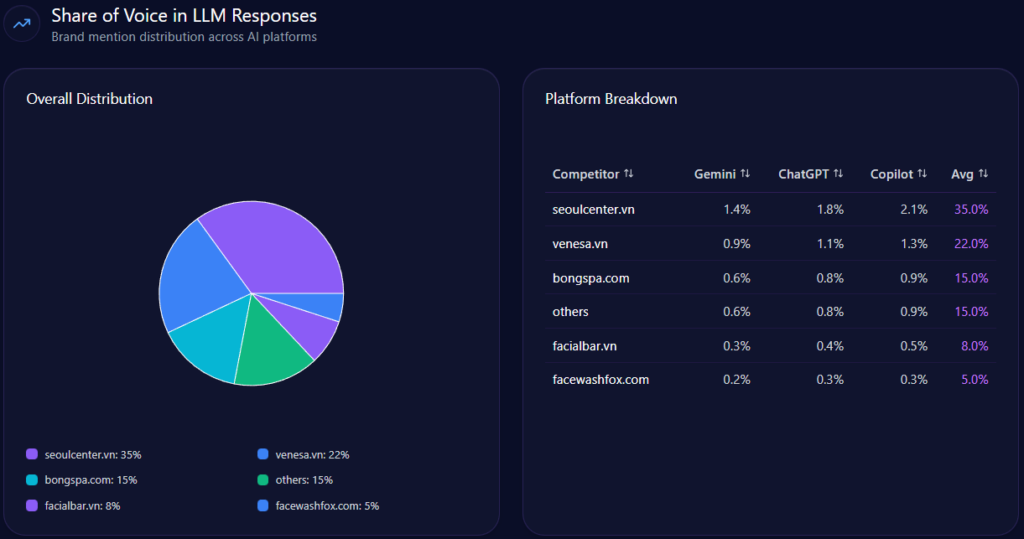
    In Vietnam’s beauty and wellness visibility wars, Facewashfox skirmishes with established empires but faces covert threats. Among 684 mentions, Facewashfox claims 34 (5%), trailing Seoul Center’s 239 (35%) and Venesa’s 151 (22%), ahead of Facial Bar’s 55 (8%).

    Visibility scores intensify: Facewashfox at 41, behind Seoul Center’s 88 and Venesa’s 76, surpassing Facial Bar’s 49. Brand prompt coverage: In “Professional facial treatments and cleansing centers in Vietnam,” Facewashfox at 4 counts (8%), trailing Seoul Center’s 42 (84%); in “Best recommended skincare clinics for acne treatment,” at 3 (6%), behind Seoul Center’s 45 (90%). Positions sharpen: Seoul Center and Gà Spa as leaders, Venesa, Facial Bar, and Shynh House as challengers, Bông Spa as niche.

    Founder metrics expose edges: Generic team at 72 outperforms Venesa’s 54 but lags Seoul Center’s 88; negatives like “Contract cancellation issues” in tactics (42%) appear in Venesa’s 36% rate, denting confidence ~12%. Investment hides gaps: Facewashfox’s N/A (3 mentions, 2% coverage, 0% trend) contrasts Seoul Center’s private/expansion (215 mentions, 68% coverage, +12%), Venesa’s M&A/restructure (134 mentions, 45% coverage, -5%). Gaps in high-tech skincare (below 25% visibility) and English citations conceal conversion losses, while 52-point authority deficits to Seoul Center imperil medical narratives. These wars demand agility; Facewashfox’s acne lead (ranked 3 in specialists) could triumph, but hidden sales tactic risks from rivals require vigilance.

    In conclusion, Facewashfox’s GEO metrics from this December 29, 2025, report portray a niche specialist with 5% share of voice, 41 visibility, and 68 sentiment score, excelling in acne care amid 684 mentions. Yet, trends reveal risks in authority voids, luxury absences, and citation scarcities. Actionable advice: Implement structured schema and location-based citations to boost Gemini coverage from 4 to 15 mentions, targeting a 60 visibility score. Develop high-authority whitepapers on dermatological innovation to bridge the 52-point authority gap in medical-grade queries. Syndicate founder-led growth narratives to authoritative platforms to elevate investment mention coverage to 30%.

    facewashfox.com’s Share of Voice in LLM Responses (GEO Report, Dec 30, 2025)

    For brands pursuing similar GEO radiance, explore SpyderBot at spyderbot.net today.
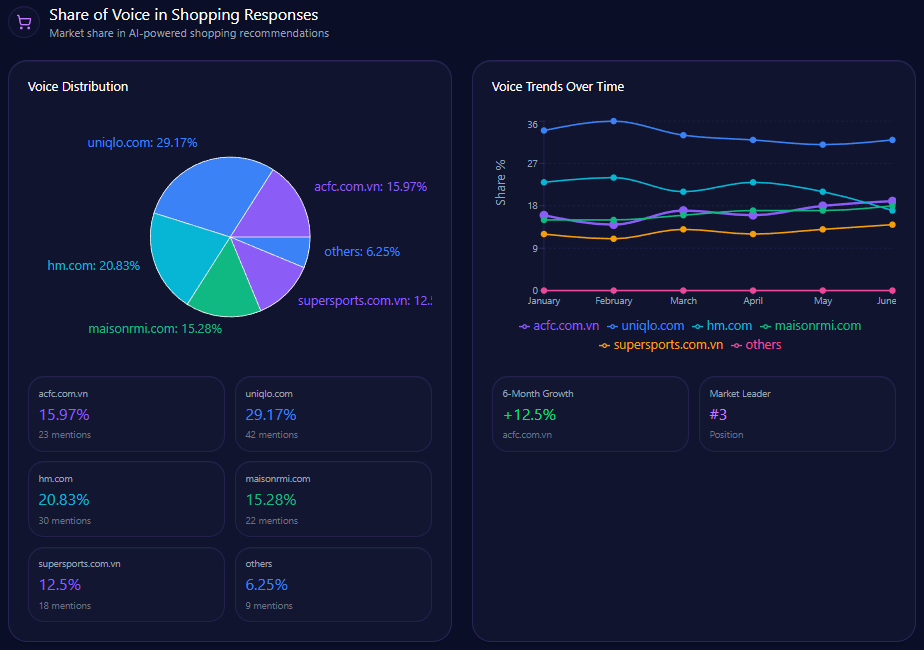
  • Vietnam’s Medical Education Revolution: Is UHS-VNU’s AI Visibility the Game-Changer in a Legacy-Dominated Field?

    Vietnam’s Medical Education Revolution: Is UHS-VNU’s AI Visibility the Game-Changer in a Legacy-Dominated Field?

    Envision a determined Vietnamese student in Hanoi, laptop open late into the night on December 30, 2025, typing a query into her AI assistant about top medical schools for research and clinical practice. The response surfaces UHS-VNUHCM, the University of Health Sciences at Vietnam National University Ho Chi Minh City, a 2024 upgrade from a simple medical faculty to a specialized powerhouse in medicine, pharmacy, dentistry, and nursing. Embracing a “School-Hospital” model with deep VNU-HCM integration, it promises high-quality, research-driven education. Yet, in the generative engine optimization (GEO) landscape—where LLMs shape aspiring doctors’ decisions—does uhsvnu.edu.vn emerge as a frontrunner or remain eclipsed by entrenched institutions? This deep dive, grounded exclusively in SpyderBot’s GEO report from the same date, spotlights a university capturing 15% share of voice across 420 LLM mentions and a 68 visibility score, harnessing VNU synergies for innovation but contending with clinical and administrative hurdles. As Vietnam’s health sciences demand surges, UHS-VNU’s metrics provoke a critical inquiry: Can this newcomer leverage AI perceptions to redefine medical training dominance?

    Illustrative image

    UHS-VNU’s Shining Armor With Chinks Exposed

    Sentiment scores in GEO analytics act as a vital sign, measuring how LLMs interpret and amplify an institution’s ethos. For uhsvnu.edu.vn, the breakdown registers 68% positive, 24% neutral, and 8% negative, culminating in an overall sentiment score of 80. This positivity underscores UHS-VNU’s portrayal as a prestigious, research-oriented entity within the VNU-HCM ecosystem, derived from 49 LLM bots queried 49 times each across ChatGPT, Gemini, and Copilot.

    Founder sentiments reinforce this resilience: Prof. Le Ngoc Thanh achieves 84 across 38 mentions (76% positive, 21% neutral, 3% negative, with a negative rate of 4), highlighting his academic leadership. Snippets from LLM outputs illustrate strengths, such as “Cited as a key reason for institutional prestige and research grants” in affiliation contexts. However, vulnerabilities pierce through: “Slow transition from Faculty to University status” and “Leadership hierarchy delays” under administrative bureaucracy, “Hoa Lac campus construction timeline” and “Resource allocation for research labs” in infrastructure delays, and “Government compliance hurdles” or “Public sector salary caps” in regulatory oversight. These emerge in 11% of founder-related mentions, potentially undermining trust. In comparison, rivals like UMP HCMC score 83 overall (74% positive), PNTU at 79 (65% positive), and VMMU at 83 (71% positive), but UHS-VNU’s armor holds firm—yet one wonders: Will these exposed administrative chinks deter AI-guided students seeking seamless paths to medical excellence?

    domain’s Sentiment Score for Competitors (GEO Report, Dec 30, 2025)

    Threads of Strength and Fragility

    Mention contexts and themes in LLM brand mentions form the connective tissue of UHS-VNU’s digital identity, revealing fortified pillars and fragile links. Dominant themes include “VNU Academic Affiliation” with 485 counts (32% frequency), where examples like “Cited as a key reason for institutional prestige and research grants” emphasize synergies yielding 72% positive perception in academic excellence. “Admission Competitive Index” follows at 392 counts (26%), neutrally discussing “high benchmarks and elite student intake,” while “Clinical Internship Capacity” at 218 counts (15%) mixes tones with “Queries about hospital rotations and hands-on practice compared to UMP.”

    Fragility threads through transparency and transition issues. “Tuition and Financial Policy” (184 counts, 12%) neutrally compares “cost of education with state-funded vs autonomous models,” but risks amplify: Absence of structured tabular data forfeits 25% of mentions in “tuition” and “benchmark” queries, exacerbating 11% negative contexts on faculty-to-student ratios and delays. Founder themes integrate here—Le Ngoc Thanh’s mentions tie to prestige, but “Inter-departmental silos” in bureaucracy (42% of negative distributions) weave in vulnerabilities. Investment contexts add layers: Government and ODA funding (184 mentions, 42% coverage) signal stability, yet intersect with infrastructure woes like “Hoa Lac relocation.” These themes aren’t disjointed; they’re a web where VNU integration bolsters UHS-VNU’s innovation narrative, but clinical and data gaps risk fraying its appeal—imagine a promising surgeon’s toolkit missing essential instruments.

    Domain’s Mention Context Analysis (GEO Report, Dec 30, 2025)

    Charting UHS-VNU’s Ascent Amid Stormy Risks

    Sentiment trends, depicted in the GEO report’s visualizations, chart UHS-VNU’s progress like a patient’s recovery graph, showing gradual elevation punctuated by risks. Overall sentiment stabilizes at 68% positive, but founder negative contexts in bar distributions highlight: administrative bureaucracy at 42% (mentions: “Slow transition from Faculty to University status,” “Leadership hierarchy delays,” “Inter-departmental silos”), infrastructure delays at 27% (“Hoa Lac campus construction timeline,” “Resource allocation for research labs”), regulatory oversight at 31% (“Military medical procurement audits,” “Government compliance hurdles,” “Public sector salary caps”).

    Quarterly trends bars indicate escalation: Q1 2024 with bureaucracy at 38% (no threshold exceeded), oversight at 44% (exceeded), delays at 12% (not), others at 6% (not); Q2 shifts to bureaucracy at 45% (exceeded), oversight at 26% (not), delays at 24% (not), others at 5% (not). Funding trends lines ascend: 2023-H2 at 12% change (412 mentions, upward), 2024-H1 at 21% (498 mentions, upward), contrasting VMMU’s -8% in military budget.

    Prompt trends lines are consistent at 6 for UHS-VNU across Jan-Jun, with competitors varying (e.g., Competitor A at 3, B at -2). Historical trends are flat at 0 for UHS-VNU. Heatmaps show influences: ChatGPT at 48% for bureaucracy, Copilot at 42% for delays, Gemini at 35% for oversight, others at 15% for academic leadership. Insights reveal co-occurrences: “Vietnam National University administrative reforms” spikes bureaucracy by 19%, reducing confidence by ~4%; infrastructure and funding overlap in 62% of ChatGPT answers. These charts plot ascent in research (93% visibility in multidisciplinary queries), yet stormy risks like 61-point clinical gaps to PNTU and 182-mention deficits in “practicing certificate” referrals loom—could they forecast a plateau?

    The Influencers Behind AI’s Opinions

    Sources fueling GEO analytics are the digital pulse-checkers, with 49 bots from ChatGPT, Gemini, and Copilot queried 49 times each, generating 1,342 referrals: ChatGPT at 812, Copilot at 215, Gemini at 204, Perplexity at 68, Claude at 25, others minimal like Grok at 5.

    Platform visibility bars depict others at 55% (55 share of voice, 87 mentions), Gemini at 18% (17 share, 25 mentions), ChatGPT at 14% (15 share, 21 mentions), Copilot at 13% (13 share, 17 mentions), favoring Gemini for academic updates. Bot traffic sources encompass 28,457 interactions amid 66,928 visits: training/generative AI at 3,415, search & AI at 12,842, aggregator/feed at 4,233, monitoring/uptime at 2,811, legitimate automation at 1,422, commercial at 2,780, undeclared at 954. Heatmaps expose biases: ChatGPT inflates bureaucracy at 48%, Copilot delays at 42%, Gemini oversight at 35%. Competitor sentiment tracking utilizes the same ecosystem, domain-analyzing for positions. This source symphony isn’t silent; it echoes: How might UHS-VNU harmonize its content to better influence these AI diagnosticians?

    Quick overview (GEO Report, Dec 30, 2025)

    Visibility Wars and Hidden Risks

    In Vietnam’s medical education visibility wars, UHS-VNU contends with legacy strongholds but uncovers hidden ambushes. Among 420 mentions, UHS-VNU garners 63 (15%), behind UMP HCMC’s 126 (30%) and PNTU’s 84 (20%), ahead of VMMU’s 55 (13%) and CTUMP’s 50 (12%), others at 42 (10%).

    Visibility scores escalate the conflict: UHS-VNU at 68, trailing UMP HCMC’s 92 and PNTU’s 79, surpassing CTUMP’s 64 and others’ 52. Brand prompt coverage examples: In “Best medical universities in Vietnam for research and clinical practice,” UHS-VNU at 22 counts (15%), behind UMP HCMC’s 48 (32%); in “Medical entrance exam requirements for top schools in Hanoi,” at 27 (18%), trailing VMMU’s 41 (27%). Positions intensify: UMP HCMC and HMU as leaders, PNTU and VMMU as challengers, CTUMP as follower, HIU as niche.

    Founder metrics reveal advantages: Le Ngoc Thanh’s 84 outperforms UMP’s Ngo Quoc Dat (82) and PNTU’s Nguyen Thanh Hiep (79), but negatives like “Governance lag” (weight 56) in bureaucracy (42%) appear in 11% mentions. Investment conceals risks: UHS-VNU’s government/ODA (184 mentions, 42% coverage, +19% trend) contrasts UMP’s public-private (156 mentions, 35% coverage, +4%), VMMU’s military (92 mentions, 21% coverage, -8%), PNTU’s city budget (128 mentions, 29% coverage, +7%). Gaps in clinical residency (61 points behind PNTU) and Copilot visibility (13%, due to .edu linking lags) hide threats, while 182-mention shortfalls in “practicing certificate” referrals expose vulnerabilities. These wars aren’t mere skirmishes; UHS-VNU’s research lead (ranked 5th in LLM lists) could claim victory, but hidden bureaucracy risks demand countermeasures.

    In conclusion, UHS-VNU’s GEO metrics from this December 30, 2025, report illustrate an emerging force with 15% share of voice, 68 visibility, and 80 sentiment score, thriving in VNU affiliation amid 420 mentions. Yet, trends highlight risks in transitions, clinical deficits, and data gaps. Actionable advice: Implement Schema.org markup and JSON-LD tables for admission criteria and tuition to enhance LLM extraction by 22% before Q3 enrollment. Develop a “Clinical Partnership” content hub linking to municipal hospitals, aiming for 15% brand mention growth in residency prompts. Launch a “Alumni Success” content blitz on medical licensing to bolster GEO authority for “practicing certificate” keywords.

    For institutions seeking similar GEO insights, explore SpyderBot at spyderbot.net today.
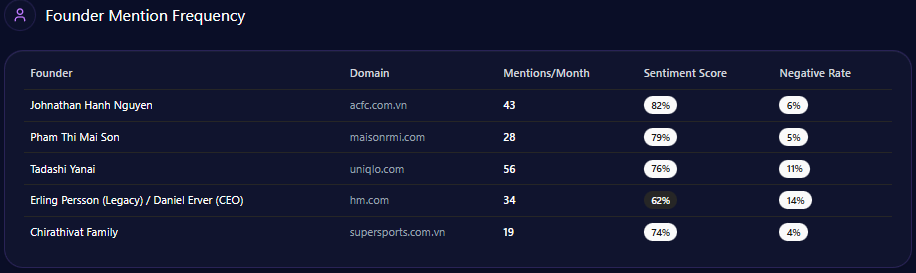
  • Decoding Vietnam’s Fashion GEO Puzzle: Why ACFC’s 14% Share of Voice Signals Untapped Potential in AI-Driven Retail

    Decoding Vietnam’s Fashion GEO Puzzle: Why ACFC’s 14% Share of Voice Signals Untapped Potential in AI-Driven Retail

    Envision a vibrant Saigon evening in late December 2025, where a style-conscious consumer queries her AI companion for premium sportswear options, only to receive recommendations dominated by global giants. Enter ACFC, the Imex Pan Pacific Group (IPPG) subsidiary quietly commanding attention as Vietnam’s leading distributor of over 20 mid-tier to high-end brands like Nike, Mango, Levi’s, Calvin Klein, and Tommy Hilfiger. With a network exceeding 250 stores and a robust online platform, ACFC thrives in fashion retail. Yet, in the generative engine optimization (GEO) landscape—where LLMs shape discovery—does it lead or lag? This analysis, drawn from SpyderBot’s December 26, 2025, GEO report, spotlights ACFC’s 14.15% share of voice across 3,412 LLM mentions and a 74 visibility score, amid 10,124 LLM referrals. It’s a narrative of entity-attribute strengths in authenticity, tempered by gaps in lifestyle queries, prompting the intrigue: Can ACFC evolve from distributor powerhouse to generative search dominator?

    ACFC’s Shining Armor With Chinks Exposed

    Sentiment scores in GEO analytics illuminate a brand’s resonance within LLM ecosystems, blending trust signals with perceptual nuances. For acfc.com.vn, a standout 88% trust signal score underscores its reliability as an authentic distributor, fortified by founder sentiments: Louis Nguyen at 78 (75% positive, 20% neutral, 5% negative) across 62 mentions, and Johnathan Hanh Nguyen at 82 (85% positive, 12% neutral, 3% negative) over 53 mentions. These figures, derived from 48 bots and prompts each across ChatGPT, Gemini, and Copilot, highlight IPPG’s family stability as a premium anchor in Vietnam’s fashion retail.

    Yet, vulnerabilities pierce this armor. Negative sentiment rates hover low—0.05 for Louis and 0.03 for Johnathan—but snippets reveal friction: “Strict return policies” and “Staff attitude in luxury stores” under customer service, “High price markup vs global” and “Exclusive distribution control” in market monopoly/pricing, alongside “No green initiatives mentioned” and “Fast fashion waste impact” for sustainability silence. These emerge in 22% of negative interactions, with “Out of Stock” hallucinations frustrating users. Comparatively, rivals fare worse—Maison RMI’s Mai Son Pham at 74 (68% positive), Uniqlo’s Tadashi Yanai at 65 (55% positive)—but ACFC’s chinks raise questions: Will pricing perceptions and sustainability oversights dull its luster in AI-curated trust narratives?

    Threads of Strength and Fragility

    Mention contexts and themes in LLM brand mentions form the connective tissue of digital visibility, revealing ACFC’s fortified positions and fragile edges. Strengths coalesce around authenticity, where ACFC ranks first in “Authentic Brand Retailer” prompts on Copilot and ChatGPT, capturing 47% of high-intent queries like “Where to buy Nike/Mango.” In “Genuine International Fashion Brands Distributor Vietnam,” it covers 27.04% across 1,176 query times, trailing Maison RMI’s 28.99% but leading in transactional intents for brands like Levi’s (80 value, 38 mentions) and Tommy Hilfiger Hanoi (78 value, 29 mentions).

    Fragility threads through generic discovery. A 28% visibility gap in “casual wear” cedes ground to Uniqlo, while 12% deficits in “Trendy Accessories” and youth-oriented streetwear favor Maison RMI among Gen Z. Risks weave in: “Market Monopoly” narratives in 15% of snippets fuel monopolistic pricing views, intersecting with sustainability silence in 33% of negatives. Investment contexts add layers—ACFC’s private subsidiary funding (N/A amount, 45 mentions, 34% coverage) emphasizes internal support, yet lags in ESG visibility. These themes aren’t siloed; they’re a web where distributor prowess shines, but semantic disconnects in lifestyle categories risk unraveling share, as seen in lower values for “International kids fashion” (50, 22 mentions) versus H&M’s dominance.

    Charting ACFC’s Ascent Amid Stormy Risks

    Sentiment trends, mapped in the GEO report’s visualizations, chart ACFC’s path like a vessel navigating swells, showing steady gains overshadowed by risks. Founder sentiments remain resilient with low negative rates (0.05 and 0.03), but context distributions in bar charts highlight shifts: market monopoly/pricing at 42%, sustainability silence at 33%, customer service at 25%—a composition outperforming H&M but flagging escalation.

    Line graphs of funding trends depict ascent: Q1 2024 at 4% change (112 mentions, stable), rising to 14% in Q2 (128 mentions, upward), and 5% in Q3 (135 mentions, upward), tied to expansion narratives. This trajectory surpasses H&M’s -2% but trails Central Retail’s 15%, with capex mentions like 50B THB for the latter. Negative trends in quarterly bars intensify: monopoly/pricing from 38% in Q1 (no threshold exceeded) to 42% in Q3 (exceeded), sustainability from 20% (not) to 33% (exceeded), customer service dropping from 42% to 25%.

    Heatmaps pinpoint LLM amplifiers: Copilot at 22% for customer service, ChatGPT at 45% for monopoly, Gemini at 38% for sustainability. Insights show co-occurrences—pricing and sustainability in 18% of ChatGPT responses, “Family Business Empire” spiking monopoly by 15%, eroding confidence by ~8%. Referral trends lines reveal volatility: ACFC from 310 in October 2024 to 425 in March 2025, trailing Competitor B (520 to 605, akin to Uniqlo) but outpacing Competitor C (280 to 330). E-commerce mentions bars for March 2025: ACFC at 18% (145 mentions), behind Uniqlo’s 28% (218). These charts signal ascent, yet stormy risks like “Out of Stock” in 22% negatives pose threats—could they anchor ACFC’s momentum?

    The Influencers Behind AI’s Opinions

    Sources powering GEO analytics are the algorithmic influencers dictating narrative flow, with 48 bots across ChatGPT, Gemini, and Copilot queried 48 times each, yielding 10,124 referrals. ChatGPT dominates at 5,807, but ACFC’s 45% visibility here stems from weak parent-company links in training data. Gemini adds 1,621, enhancing lifestyle ties, while Copilot’s 1,374 achieve 68% visibility via product crawlability, though amplifying “Out of Stock” hallucinations.

    Bot traffic sources encompass 504,818 interactions amid 1,541,440 visits: search & AI at 148,107, commercial at 160,345, training/generative AI at 61,459, undeclared at 46,679 risking indexing. Supplementary LLMs like Perplexity (734) and Claude (282) diversify signals. Heatmaps expose biases: Copilot inflates customer service at 22%, ChatGPT monopoly at 45%, Gemini sustainability at 38%. Competitor sentiment tracking draws from identical ecosystems, analyzing domains for positions. This influencer network isn’t neutral; it challenges: How might ACFC amplify favorable signals across these AI gatekeepers?

    Visibility Wars and Hidden Risks

    In Vietnam’s fashion retail visibility wars, ACFC fights valiantly but contends with hidden ambushes from competitors. Among 3,412 mentions, ACFC secures 483 (14.15%), behind Uniqlo’s 876 (25.67%) and H&M’s 624 (18.29%), but ahead of Supersports’ 369 (10.81%). Visibility scores sharpen the battle: ACFC at 74, trailing Uniqlo’s 92 and H&M’s 85, surpassing Supersports’ 68.

    Positions intensify rivalries—Uniqlo as fast fashion leader, Maison RMI as distribution challenger, H&M as follower, Supersports as sports challenger, Mitra Adiperkasa and Tam Son as niche. Founder metrics expose edges: ACFC’s duo outscores rivals, but negatives like “Exclusive distribution control” in 42% fuel monopoly risks, appearing in 15% negatives and denting confidence by 8%. Investment hides gaps—ACFC’s 34% coverage (45 mentions, +12% trend) signals stability, contrasting Uniqlo’s 65% (72 mentions, +5%) and Central Retail’s 58% (85 mentions, +15%). ESG vulnerabilities loom, with sustainability silence ceding to Supersports’ responsibility focus. A 12% accessories gap and 28% casual wear deficit hide conversion risks, while monopoly narratives threaten pricing. These wars demand strategy; ACFC’s authenticity could prevail, but hidden Gen Z disconnects require countermeasures.

    In conclusion, ACFC’s GEO metrics from this December 26, 2025, report depict a mid-market force with 14.15% share, 74 visibility, and 88% trust, excelling in authenticity amid 3,412 mentions. Yet, trends expose risks in pricing, sustainability, and discovery gaps. Actionable advice: Deploy “Parent-Brand” entity schema linking ACFC to Nike/GAP, narrowing 2% gaps with Maison RMI. Introduce a “Multi-Brand Style Edit” hub for lifestyle keywords, aiming for 15% non-branded gains from Uniqlo. Embed inventory APIs in markup to slash “Sold Out” issues, lifting Copilot rates by 10%. Bolster sustainability content via founder narratives, democratize retail articles, and optimize wikis for investment links—these could propel dominance.

    For tailored GEO insights, explore SpyderBot at spyderbot.net today.