Tag: AI brand monitoring

  • SpyderBot Recognized in HackerNoon’s Proof of Usefulness Hackathon, Marking a Milestone for AI Search Visibility

    SpyderBot Recognized in HackerNoon’s Proof of Usefulness Hackathon, Marking a Milestone for AI Search Visibility

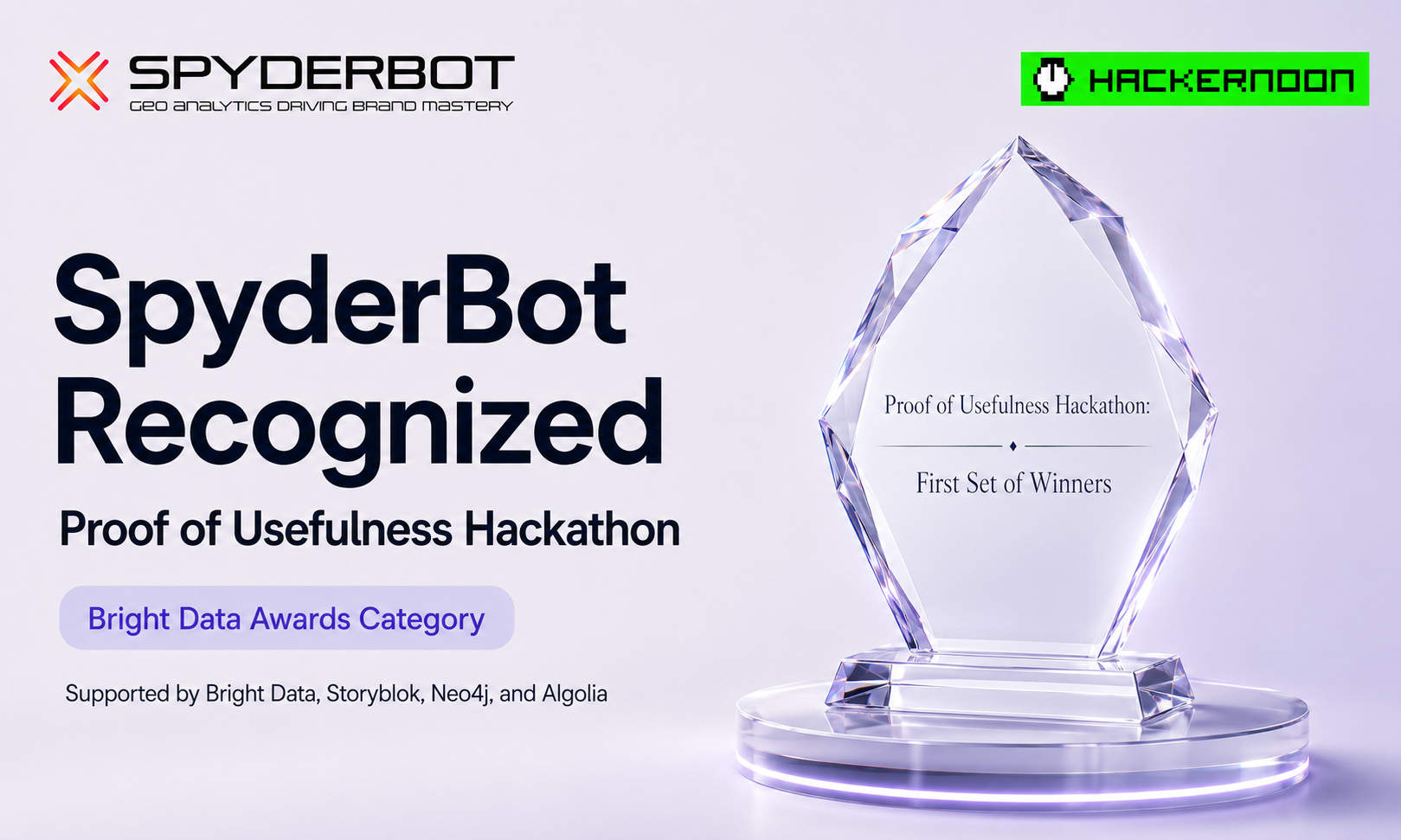
    SpyderBot has been recognized among the first set of winners in HackerNoon’s Proof of Usefulness Hackathon, marking an important milestone for the company as it continues to build analytics infrastructure for the AI Search era.

    The official announcement was published by HackerNoon under the title “Proof of Usefulness Hackathon: First Set of Winners Announced.”

    Official announcement:
    https://hackernoon.com/proof-of-usefulness-hackathon-first-set-of-winners-announced

    The Proof of Usefulness Hackathon is organized by HackerNoon and supported by Bright Data, Neo4j, Storyblok, and Algolia. The program recognizes software projects that demonstrate practical usefulness, real-world value, and measurable relevance beyond pitch deck promises.

    SpyderBot was recognized under the Bright Data Awards category, reflecting the platform’s focus on GEO analytics, AI visibility, and LLM brand monitoring.

    A Recognition Focused on Real-World Utility

    The Proof of Usefulness Hackathon is built around a simple but important idea: useful products should solve real problems for real users.

    In a technology landscape where many products are judged by vision, presentation, or early-stage hype, HackerNoon’s Proof of Usefulness framework places emphasis on practical value. It asks whether a product works, whether it addresses a real need, and whether it can create meaningful value for users.

    For SpyderBot, this recognition is significant because it aligns directly with the problem the company is trying to solve.

    Search behavior is changing. Users are no longer relying only on traditional search engines and blue links. Increasingly, they are asking AI systems for recommendations, comparisons, summaries, and vendor suggestions.

    That shift creates a new visibility challenge for brands.

    A company may rank on Google, but still be absent from AI-generated answers.

    A brand may have strong website content, but still be misunderstood or underrepresented by large language models.

    A competitor may appear more often in AI recommendations, even when another brand has stronger expertise, better positioning, or a more relevant product.

    SpyderBot was built to help companies understand and monitor this new layer of visibility.

    What SpyderBot Does

    SpyderBot is a GEO analytics platform designed to help businesses track how AI systems understand, mention, and compare brands across generative search environments.

    The platform helps teams monitor AI brand visibility, LLM mentions, competitor presence, prompt-level performance, sentiment, and how different AI models describe a brand across multiple contexts.

    This includes visibility across AI systems such as ChatGPT, Gemini, Grok, Claude, Copilot, Perplexity, and other large language models.

    At its core, SpyderBot helps brands answer two increasingly important questions:

    What do LLMs mention about your competitors to users?

    And how are LLMs analyzing and tracking your website?

    These questions are becoming critical as AI-generated answers begin to influence how users discover products, evaluate companies, and make decisions.

    Why AI Search Requires a New Measurement Layer

    Traditional SEO has long focused on rankings, backlinks, organic traffic, and keyword visibility. These metrics remain important, but they no longer provide a complete picture of brand visibility.

    In traditional search, a user sees a list of results and chooses which page to visit.

    In AI Search, the answer is often generated directly. The AI system may summarize a market, recommend a short list of brands, compare competitors, or explain which solution best fits the user’s intent.

    This means brands are no longer competing only for rankings. They are competing to be included, understood, and recommended inside AI-generated responses.

    That is where Generative Engine Optimization, or GEO, becomes important.

    While SEO focuses on search engine rankings, GEO focuses on how brands appear inside generative AI answers. It looks at whether a brand is mentioned, how it is described, what context surrounds the mention, which competitors appear nearby, and whether the brand’s positioning is accurately represented.

    SpyderBot focuses on this emerging data layer, helping marketing, SEO, growth, and brand teams monitor their presence in AI-generated discovery journeys.

    Supported by a Strong Technology Ecosystem

    The Proof of Usefulness Hackathon is supported by Bright Data, Neo4j, Storyblok, and Algolia, bringing together important areas of the modern technology stack, including data infrastructure, graph technology, content architecture, and search experience.

    This broader ecosystem makes the recognition especially relevant for companies building at the intersection of data, AI, and product usefulness.

    SpyderBot’s recognition under the Bright Data Awards category reflects the growing importance of real-world data and AI-driven analytics in understanding how brands appear across generative systems.

    As more users turn to AI tools for discovery and decision-making, brands will need more reliable ways to measure how they are represented across these systems.

    A Milestone, But Only the Beginning

    For SpyderBot, this recognition from HackerNoon is both a milestone and a starting point.

    The company will continue developing its platform with a focus on practical insights, clearer analytics, and better support for brands entering the AI Search era.

    SpyderBot’s goal is not only to help companies monitor mentions. It aims to help brands understand how AI systems interpret their identity, compare them against competitors, and surface them in response to real user questions.

    The team also looks forward to continued trust, feedback, and support from users, partners, and businesses exploring GEO, AI visibility, and LLM brand monitoring.

    The Bigger Signal for Brands

    SpyderBot’s recognition in HackerNoon’s Proof of Usefulness Hackathon points to a broader shift in digital visibility.

    Brands no longer need to focus only on being indexed by search engines. They also need to be understood by AI systems.

    They no longer need to measure only where they rank. They also need to measure whether they are mentioned, how they are framed, and which competitors appear more often in AI-generated answers.

    In the AI Search era, visibility is no longer only about traffic.

    It is about being present in the answers that shape user decisions.

    For SpyderBot, this milestone reinforces the importance of building tools for that future.

  • LLM Brand Mentions

    LLM Brand Mentions

    I. What are LLM brand mentions?

    LLM brand mentions are the ways large language models such as ChatGPT, Gemini, Claude, Copilot, Grok, and Perplexity include, describe, compare, and recommend brands in generated answers.

    This includes:

    • Whether a brand is mentioned
    • How often the brand appears
    • Which prompts trigger the mention
    • How the brand is described
    • Whether the brand is recommended or only listed
    • Which competitors appear alongside it
    • Whether the brand is framed positively, neutrally, or weakly

    In traditional search, brands compete for rankings.

    In AI-generated answers, brands compete for inclusion.

    That is why LLM brand mentions are becoming an important part of AI visibility and Generative Engine Optimization.

    II. Why LLM brand mentions matter

    LLM brand mentions matter because AI systems increasingly influence how users discover products, compare companies, and make decisions.

    In traditional search, users see multiple links and decide what to click.

    In AI systems, users often receive a synthesized answer.

    That means the AI system may decide which brands are worth mentioning before the user visits any website.

    If your brand is not mentioned, you may be invisible at the decision stage.

    If your brand is mentioned poorly, users may misunderstand your positioning.

    If your brand is mentioned strongly, you can influence decisions before the click.

    III. LLM brand mentions vs SEO visibility

    LLM brand mentions are different from SEO rankings.

    SEO visibilityLLM brand mentions
    Based on rankingsBased on inclusion
    Focuses on pagesFocuses on entities
    Measures trafficMeasures AI visibility
    Uses keywordsUses context and meaning
    Competes on SERPsCompetes inside answers

    SEO asks:

    Where do we rank?

    LLM visibility asks:

    Are we included in the answer?

    This is a major shift.

    A company can rank well on Google but still be missing from ChatGPT answers.

    IV. The 4 dimensions of LLM brand mentions

    To understand LLM brand mentions properly, companies should analyze four dimensions:

    1. Inclusion
    2. Frequency
    3. Context
    4. Framing

    Together, these dimensions show whether a brand is visible, how often it appears, when it appears, and how AI systems position it.

    V. Inclusion: is your brand mentioned at all?

    Inclusion is the most basic layer of LLM brand visibility.

    It answers:

    Does your brand appear in AI-generated answers?

    Key questions include:

    • Is the brand mentioned in relevant prompts?
    • Does it appear when users ask for recommendations?
    • Does it appear in comparison prompts?
    • Does it appear in problem-based prompts?
    • Is it included alongside competitors?

    If the brand is not included, it has no AI visibility in that context.

    No inclusion means no presence in the AI-generated decision layer.

    VI. Frequency: how often does your brand appear?

    Frequency measures how consistently a brand appears across relevant prompts.

    It answers:

    How often does AI mention the brand?

    Useful metrics include:

    • Mention rate
    • Mention share
    • Prompt coverage
    • Competitor mention comparison
    • Visibility consistency across AI systems

    A brand mentioned once is not necessarily strong.

    A brand mentioned consistently across different prompts, categories, and use cases has stronger AI visibility.

    VII. Context: when does AI mention your brand?

    Context explains the situations where a brand appears.

    It answers:

    In what kinds of questions does AI include the brand?

    Examples of useful contexts include:

    • Best tools for a category
    • Alternatives to a competitor
    • Product comparisons
    • Use-case recommendations
    • Industry-specific solutions
    • Problem-solving prompts
    • Buying decision prompts

    Context matters because not all mentions are equally valuable.

    A brand appearing in irrelevant contexts may not drive meaningful visibility.

    A brand appearing in high-intent recommendation prompts is more valuable.

    VIII. Framing: how does AI describe your brand?

    Framing is one of the most important parts of LLM brand mentions.

    It answers:

    How does AI position the brand?

    AI may frame a brand as:

    • A market leader
    • A niche solution
    • A beginner-friendly option
    • A technical platform
    • A budget alternative
    • A premium solution
    • A competitor to another brand
    • A less complete option

    Framing influences perception.

    Being mentioned is not enough.

    The way AI describes the brand can shape whether users trust it, ignore it, or compare it seriously.

    IX. The LLM Brand Mention Model

    A simple way to understand AI brand visibility is:

    LLM Brand Mentions = Inclusion + Frequency + Context + Framing

    This model helps teams move beyond basic tracking.

    A brand should not only ask:

    Are we mentioned?

    It should also ask:

    • How often are we mentioned?
    • In which contexts?
    • How are we described?
    • Who appears beside us?
    • Are we framed better or worse than competitors?

    X. How LLMs generate brand mentions

    LLMs do not work like traditional search engines.

    They do not simply rank pages and display results.

    They generate answers based on patterns, context, entity relationships, and available information.

    Several factors may influence brand mentions:

    1. Entity understanding

    AI systems need to understand what the brand is.

    This includes:

    • Brand name
    • Product category
    • Core offering
    • Target audience
    • Main use cases
    • Competitor set
    • Market positioning

    If the entity is unclear, the brand is less likely to be mentioned correctly.

    2. Context relevance

    AI systems need to determine whether the brand fits the user’s question.

    A brand may be known, but if it is not clearly associated with a specific use case, it may not appear.

    3. Association strength

    Association strength refers to how strongly a brand is connected to a topic, category, or problem.

    For example, if AI systems strongly associate a competitor with “AI visibility tracking,” that competitor may appear more often in relevant answers.

    4. Answer construction

    AI systems structure answers based on what seems useful, relevant, and coherent.

    Some brands may appear as primary recommendations.

    Others may appear only as alternatives.

    Some may be excluded entirely.

    XI. Why some brands are never mentioned by AI

    A brand may be missing from LLM-generated answers for several reasons:

    • The brand entity is unclear
    • The website does not explain the product clearly
    • The category positioning is weak
    • Competitors have stronger associations
    • The brand is not connected to relevant use cases
    • There are few trusted references about the brand
    • The brand appears in the wrong context
    • The messaging is inconsistent across sources

    This is why more content does not always create more AI visibility.

    The content must improve understanding, relevance, and associations.

    XII. Types of LLM brand mentions

    Not all LLM brand mentions are equal.

    There are several types:

    1. Primary mentions

    The brand appears as a main recommendation.

    This is usually the strongest type of mention.

    2. Secondary mentions

    The brand appears as one option among several alternatives.

    This is useful, but less powerful than being a primary recommendation.

    3. Comparative mentions

    The brand is compared directly with competitors.

    This can be valuable if the framing is strong.

    4. Contextual mentions

    The brand appears only in specific use cases or niche contexts.

    This can be useful when the context matches high-intent users.

    5. Weak mentions

    The brand is mentioned but not clearly explained or recommended.

    This may create low influence despite visibility.

    XIII. Common misconceptions about LLM brand mentions

    Misconception 1: If we rank on Google, AI will mention us

    Not always.

    SEO rankings can help, but they do not guarantee AI visibility.

    A brand can rank well and still be excluded from AI-generated answers.

    Misconception 2: More content means more mentions

    Not necessarily.

    More content only helps if it improves entity clarity, context relevance, and association strength.

    Misconception 3: Mentions are random

    LLM mentions are probabilistic, but they are not purely random.

    Patterns can be tracked, compared, and improved over time.

    Misconception 4: Any mention is good

    Not always.

    A weak or inaccurate mention can damage positioning.

    The quality of framing matters.

    XIV. How to measure LLM brand mentions

    Companies can measure LLM brand mentions through several metrics:

    • Inclusion rate
    • Mention frequency
    • Mention share vs competitors
    • Context coverage
    • Prompt coverage
    • Framing quality
    • Sentiment or positioning
    • Primary vs secondary mention rate
    • Competitor co-mentions
    • AI system consistency

    These metrics help teams understand not just whether they appear, but how strong their AI visibility really is.

    XV. How to improve LLM brand mentions

    1. Improve entity clarity

    Make it easy for AI systems to understand what the brand is.

    Clarify:

    • Brand category
    • Core product
    • Target users
    • Main use cases
    • Key differentiators
    • Competitors and alternatives

    2. Strengthen contextual relevance

    Create content that connects the brand to real user problems and buying contexts.

    Cover:

    • Use cases
    • Comparisons
    • Alternatives
    • Industry applications
    • Problem-solution pages
    • FAQs
    • Category explanations

    3. Build stronger associations

    The brand should be consistently associated with the right topics.

    For example:

    • AI visibility
    • GEO analytics
    • LLM tracking
    • AI brand monitoring
    • AI search analytics
    • Competitor mention tracking

    4. Improve brand framing

    Make sure the brand is described consistently across website copy, articles, profiles, and third-party pages.

    Strong framing helps AI systems represent the brand more accurately.

    5. Compare against competitors

    AI visibility is competitive.

    Track which competitors appear more often, how they are described, and which prompts make them show up.

    XVI. Real-world example

    Imagine a SaaS company with strong SEO traffic.

    The company ranks well on Google and receives steady organic visits.

    But when users ask AI systems for the best tools in its category, competitors appear more often.

    The problem may not be traffic.

    The problem may be weak LLM brand visibility.

    Possible root causes include:

    • The brand is not clearly categorized
    • AI does not connect the brand to high-intent use cases
    • Competitors have stronger mention patterns
    • The website does not explain the product clearly enough
    • The brand is framed as generic rather than specialized

    This is why LLM brand mentions need to be measured separately from SEO.

    XVII. Where SpyderBot fits

    SpyderBot is designed to analyze LLM brand mentions across the dimensions that matter:

    • Inclusion
    • Frequency
    • Context
    • Framing
    • Competitor mentions
    • Prompt-level behavior
    • AI interpretation
    • Brand positioning

    SpyderBot helps answer:

    • Are we mentioned in AI answers?
    • How often are we mentioned?
    • Which competitors appear instead?
    • How does AI describe our brand?
    • Why are we missing from key prompts?
    • How can we improve AI visibility?

    This turns LLM brand mentions from a vague concept into a measurable visibility layer.

    XVIII. Final conclusion

    LLM brand mentions are becoming one of the most important signals in AI search visibility.

    They show whether AI systems understand, include, and recommend a brand in generated answers.

    Traditional SEO focuses on ranking pages.

    LLM visibility focuses on brand inclusion, context, and framing.

    The brands that win in AI search will not only rank well.

    They will be selected, understood, and positioned correctly inside AI-generated answers.

  • How to Track ChatGPT SEO

    How to Track ChatGPT SEO

    A Complete Guide to Measuring Brand Visibility in AI Answers

    Many marketers are now searching for one question:

    How do you track ChatGPT SEO?

    At first, the question sounds familiar. In traditional SEO, tracking means monitoring rankings, keywords, impressions, clicks, and traffic.

    But ChatGPT does not work like a traditional search engine.

    There is no fixed search results page.

    There is no stable position number one.

    There is no classic SERP with ten blue links.

    There is no simple keyword ranking report that tells you whether you are winning.

    That is why the phrase “ChatGPT SEO tracking” can be misleading.

    What you are really trying to track is not SEO in the traditional sense.

    You are trying to track AI visibility.

    AI visibility measures whether your brand is mentioned, how often it appears, where it appears, how it is described, and how it compares with competitors inside AI-generated answers.

    The difference is important.

    Traditional SEO tracking asks:

    “Where do we rank?”

    ChatGPT visibility tracking asks:

    “Are we selected by AI when users ask relevant questions?”

    That shift changes how brands need to measure visibility in the AI search era.


    I. Why ChatGPT SEO Tracking Is Different From Google SEO Tracking

    Google Search and ChatGPT are both part of the modern discovery journey, but they do not operate in the same way.

    Google traditionally crawls pages, indexes content, ranks URLs, and displays links.

    ChatGPT generates answers.

    It may search the web when needed. OpenAI explains that ChatGPT Search can provide fast, timely answers with links to relevant web sources and that ChatGPT may choose to search the web depending on what the user asks.

    This means ChatGPT can interact with web information, but the final experience is still different from a traditional search results page.

    The user does not always browse through multiple links.

    They often receive a synthesized answer.

    That answer may mention brands, compare tools, recommend options, summarize sources, or explain a category.

    So if you try to track ChatGPT the same way you track Google, you will measure the wrong thing.

    You should not only ask:

    • What keyword do we rank for?
    • What is our average position?
    • What page gets the most traffic?

    You should ask:

    • Are we mentioned in AI-generated answers?
    • Which prompts trigger our brand?
    • Which prompts exclude us?
    • Which competitors appear instead?
    • How is our brand described?
    • Are we framed as a leader, alternative, niche option, or unknown brand?
    • Is our visibility consistent across prompt variations?
    • Does our visibility improve over time?

    This is the foundation of ChatGPT SEO tracking.

    It is not about rankings.

    It is about selection.


    II. What “Tracking ChatGPT SEO” Actually Means

    Tracking ChatGPT SEO means measuring your brand presence across AI-generated answers.

    More precisely, it means measuring:

    • Whether your brand is mentioned
    • How often your brand appears
    • Which prompts trigger your brand
    • Which prompts do not include your brand
    • Which competitors appear more often
    • How your brand is positioned
    • Whether sentiment is positive, neutral, or negative
    • Whether your visibility changes across time
    • Whether different AI systems describe your brand differently

    The uploaded draft is directionally correct: tracking ChatGPT SEO is not about tracking rankings, because ChatGPT has no traditional rankings, positions, or SERP. It is about tracking AI visibility, brand mentions, context, positioning, and competitor presence.

    That is the key idea.

    But to make it useful, you need a structured framework.

    One prompt is not tracking.

    One screenshot is not tracking.

    One manual test is not tracking.

    Real tracking requires a system.


    III. The ChatGPT SEO Tracking Framework

    To track ChatGPT SEO properly, you need five layers.

    1. Query layer: what users are asking

    The first layer is the query layer.

    This is where you define the questions users may ask AI systems.

    These are not just keywords.

    They are prompts.

    Examples include:

    • “What are the best tools for [category]?”
    • “What are the top platforms for [industry]?”
    • “What are the best alternatives to [competitor]?”
    • “Which software helps with [specific use case]?”
    • “What is the best solution for [business problem]?”
    • “Compare [your brand] with [competitor].”
    • “Which companies are leaders in [category]?”

    The goal is to map how real users ask AI systems for recommendations, comparisons, explanations, and buying advice.

    A good tracking system should include several prompt types:

    • Category prompts
    • Competitor prompts
    • Alternative prompts
    • Use-case prompts
    • Problem-based prompts
    • Comparison prompts
    • Industry-specific prompts
    • Buying-intent prompts

    If you only track one or two prompts, your visibility data will be shallow.

    You need prompt coverage.

    2. Prompt layer: how questions are executed

    Small prompt changes can produce different answers.

    For example:

    • “best SEO tools”
    • “top SEO platforms”
    • “best SEO software for startups”
    • “best SEO tools for technical audits”
    • “alternatives to Semrush”
    • “AI tools for SEO analysis”

    These prompts may look similar, but they can trigger different brands, different rankings inside the answer, and different levels of detail.

    That is why ChatGPT SEO tracking must include prompt variations.

    You should vary:

    • Wording
    • Intent
    • Audience
    • Industry
    • Use case
    • Competitor reference
    • Geographic context
    • Budget context
    • Business size

    This helps you understand whether your brand is broadly visible or only visible in narrow contexts.

    3. Output layer: what ChatGPT returns

    The output layer captures the actual AI response.

    This is where you record:

    • Which brands are mentioned
    • Whether your brand appears
    • Which competitors appear
    • The order of appearance
    • How each brand is described
    • Whether sources or links are included
    • Whether the response is confident or vague
    • Whether your brand is recommended or merely listed

    This matters because a mention alone is not enough.

    Being mentioned as “a leading platform for enterprise teams” is very different from being mentioned as “a lesser-known alternative.”

    The wording shapes perception.

    AI visibility is not only about presence.

    It is also about framing.

    4. Aggregation layer: patterns across prompts

    A single ChatGPT answer is not reliable enough for strategy.

    AI answers can vary by prompt wording, model behavior, web retrieval, user context, and time.

    That is why you need aggregation.

    Instead of looking at one response, you should analyze patterns across many prompts.

    For example:

    • You appear in 20% of category prompts
    • You appear in 60% of branded prompts
    • You appear in 10% of competitor alternative prompts
    • Competitor A appears in 75% of high-intent prompts
    • Competitor B appears mostly in enterprise prompts
    • Your brand is frequently described as “emerging” but rarely as “leading”

    This is where tracking becomes useful.

    You start seeing patterns.

    You start understanding where you win, where you lose, and where AI misunderstands your brand.

    5. Insight layer: what the data means

    The final layer is the most important.

    Tracking data should lead to insight.

    A good ChatGPT SEO tracking system should help answer:

    • Why are we appearing in some prompts but not others?
    • Which competitors dominate the most valuable contexts?
    • Which use cases are missing from our AI visibility?
    • Is our positioning strong enough?
    • Are we being grouped with the right competitors?
    • Which brand signals need improvement?
    • What content should we create next?
    • What third-party signals should we strengthen?

    This is where many tools fail.

    They show data but do not explain what to do next.

    But the point of tracking is not just measurement.

    The point is optimization.


    IV. Step-by-Step: How to Track ChatGPT SEO

    Here is a practical workflow.

    Step 1: Define your core prompt set

    Start with prompts that match real buyer intent.

    Group them into categories.

    Category prompts

    • “Best [category] tools”
    • “Top [category] platforms”
    • “Best software for [industry]”
    • “Most trusted [category] companies”

    Competitor prompts

    • “Best alternatives to [competitor]”
    • “Compare [your brand] and [competitor]”
    • “[Competitor] vs [your brand]”
    • “Tools similar to [competitor]”

    Use-case prompts

    • “Best tools for [specific problem]”
    • “Software to help with [workflow]”
    • “Platforms for [team type]”
    • “Best tools for [industry use case]”

    Problem-based prompts

    • “Why is my brand not showing in ChatGPT?”
    • “How do I track AI brand mentions?”
    • “How do I monitor AI visibility?”
    • “How do I know if ChatGPT recommends my competitor?”

    The goal is to test the actual questions that matter for business visibility.

    Step 2: Expand prompt variations

    Do not stop at one version of each prompt.

    Create variations.

    For example, instead of tracking only:

    “best AI visibility tools”

    Also test:

    • “best tools to monitor AI brand visibility”
    • “best ChatGPT brand monitoring tools”
    • “software to track LLM brand mentions”
    • “AI search analytics platforms”
    • “tools for generative engine optimization”
    • “best GEO analytics platform”
    • “how to track brand mentions in ChatGPT”

    Prompt variation helps uncover hidden visibility gaps.

    A brand may appear in one phrasing but disappear in another.

    That difference matters.

    Step 3: Run prompts consistently

    Tracking must be repeatable.

    Use the same prompt groups over time so you can compare changes.

    Do not randomly test one prompt today and a different prompt next month.

    Set a tracking schedule.

    For example:

    • Weekly for fast-moving categories
    • Monthly for stable categories
    • Before and after major content campaigns
    • Before and after PR campaigns
    • Before and after website changes
    • Before and after new third-party mentions

    The goal is not only to capture one moment.

    The goal is to monitor visibility movement.

    Step 4: Measure inclusion rate

    Inclusion rate is one of the most important ChatGPT visibility metrics.

    It measures the percentage of prompts where your brand appears.

    Formula:

    Inclusion Rate = Prompts where your brand appears / Total prompts tested × 100

    Example:

    If you test 100 prompts and your brand appears in 28, your inclusion rate is 28%.

    But do not stop there.

    Break inclusion rate down by prompt type:

    • Category inclusion rate
    • Competitor prompt inclusion rate
    • Use-case inclusion rate
    • Problem-based inclusion rate
    • Industry-specific inclusion rate
    • Branded inclusion rate

    This tells you where your visibility is strong and where it is weak.

    Step 5: Measure mention share

    Mention share compares your visibility with competitors.

    Formula:

    Mention Share = Your mentions / Total mentions across tracked competitors × 100

    Example:

    Across 100 prompts:

    • Your brand appears 25 times
    • Competitor A appears 60 times
    • Competitor B appears 40 times
    • Competitor C appears 30 times

    Your mention share is much weaker than Competitor A.

    This metric helps you understand whether you are truly competitive in AI-generated answers.

    Step 6: Track competitor dominance

    It is not enough to know that you are missing.

    You need to know who appears instead.

    Track:

    • Which competitors appear most often
    • Which competitors appear in high-intent prompts
    • Which competitors are grouped with your brand
    • Which competitors replace you in alternative queries
    • Which competitors are described as category leaders

    This reveals your real AI competitors.

    Sometimes they are not the same competitors you track in SEO.

    AI systems may group your brand with unexpected companies because of semantic associations, third-party content, or category confusion.

    That insight is valuable.

    Step 7: Analyze context coverage

    Context coverage measures how many relevant use cases your brand appears in.

    For example, a SaaS brand may want visibility across:

    • Startup prompts
    • Enterprise prompts
    • Agency prompts
    • Ecommerce prompts
    • B2B software prompts
    • Technical SEO prompts
    • AI search prompts
    • Competitor alternative prompts

    If your brand appears only in one context, your visibility is narrow.

    If it appears across many contexts, your AI visibility is broader and more resilient.

    Step 8: Analyze positioning

    Positioning analysis answers:

    “How does AI describe us?”

    Look for patterns.

    Are you described as:

    • A leader
    • A strong alternative
    • A niche tool
    • A beginner-friendly option
    • An enterprise platform
    • A low-cost solution
    • A technical product
    • An emerging brand
    • A weak or limited option

    This matters because AI answers influence perception before users visit your website.

    A weak mention can still damage your positioning.

    A strong mention can increase consideration.

    Step 9: Measure sentiment

    Sentiment analysis evaluates whether AI frames your brand positively, neutrally, or negatively.

    Positive framing may include words like:

    • Trusted
    • Leading
    • Comprehensive
    • Reliable
    • Useful
    • Specialized
    • Scalable

    Neutral framing may simply describe what you do.

    Negative framing may mention limitations, confusion, lack of maturity, poor fit, or weak coverage.

    Sentiment matters because AI does not only answer questions.

    It shapes trust.

    Step 10: Track consistency over time

    AI visibility changes.

    Models update.

    Web sources change.

    Competitors publish new content.

    Reviews accumulate.

    Press mentions appear.

    Your website changes.

    That is why consistency is a key metric.

    Track whether your brand appears reliably or only occasionally.

    A brand that appears once is not truly visible.

    A brand that appears consistently across prompt variations, models, and time periods has stronger AI visibility.


    V. The Metrics That Actually Matter

    Forget traditional rankings for a moment.

    For ChatGPT SEO tracking, these metrics matter more.

    1. Inclusion Rate

    How often does your brand appear across tracked prompts?

    This is the baseline visibility metric.

    2. Mention Share

    How often does your brand appear compared with competitors?

    This shows competitive strength.

    3. Context Coverage

    How many important prompt categories include your brand?

    This shows whether your visibility is broad or narrow.

    4. Positioning Strength

    How strong is your framing inside AI answers?

    This shows whether AI sees you as a leader, alternative, niche option, or unclear brand.

    5. Sentiment

    Is your brand described positively, neutrally, or negatively?

    This shows how AI may influence user trust.

    6. Competitor Co-occurrence

    Which brands appear with you most often?

    This reveals your AI-defined competitive set.

    7. Prompt Gap Score

    Which high-intent prompts exclude your brand?

    This helps prioritize content, positioning, and external signal improvements.

    8. Consistency Score

    How stable is your visibility across time and prompt variations?

    This shows whether your AI visibility is durable or fragile.

    These metrics are more useful than trying to force traditional ranking logic onto ChatGPT.


    VI. Common Mistakes When Tracking ChatGPT SEO

    Most companies make the same mistakes.

    Mistake 1: Tracking too few prompts

    Testing five or ten prompts is not enough.

    It can lead to false conclusions.

    A brand may look visible in a small sample but disappear across broader use cases.

    Mistake 2: Treating ChatGPT like Google

    ChatGPT does not have stable SERP rankings.

    The correct unit of measurement is not position.

    It is inclusion, context, and selection.

    Mistake 3: Ignoring competitors

    If you only track your own brand, you do not know whether you are winning or losing.

    You need a benchmark.

    Mistake 4: Measuring frequency without meaning

    A mention is not automatically valuable.

    You need to know how the brand is framed.

    A weak mention may not drive trust.

    Mistake 5: Ignoring prompt intent

    Not all prompts have equal value.

    A mention in a low-intent informational prompt may matter less than a mention in a high-intent buying prompt.

    Mistake 6: Not tracking over time

    AI visibility is dynamic.

    One-time analysis quickly becomes outdated.


    VII. A Realistic Example

    Imagine a company that sells AI analytics software.

    The team tests ten ChatGPT prompts and appears in three.

    They conclude:

    “We have 30% visibility.”

    That sounds useful, but it is incomplete.

    A deeper analysis may reveal:

    • The brand appears only in broad AI analytics prompts
    • It does not appear in high-intent buying prompts
    • It is missing from competitor alternative prompts
    • Competitors dominate prompts related to enterprise teams
    • ChatGPT describes the brand as “emerging” rather than “leading”
    • The brand is not strongly associated with AI search analytics
    • Third-party mentions are weaker than competitors

    Now the conclusion changes.

    The problem is not simply 30% visibility.

    The problem is weak visibility in the prompts that matter most.

    That insight changes the strategy.

    Instead of publishing random blog posts, the company should improve category positioning, build use-case content, strengthen comparison pages, earn third-party mentions, and track prompt-level changes over time.

    This is the difference between tracking and strategy.


    VIII. How GEO Changes ChatGPT SEO Tracking

    Generative Engine Optimization, or GEO, is the practice of improving visibility in AI-generated answers.

    The original GEO research paper introduced a framework for optimizing content visibility in generative engines and reported that GEO methods improved visibility by up to 40% across tested queries, domains, and generative engines.

    This matters because ChatGPT SEO tracking should not stop at measurement.

    It should lead to optimization.

    A GEO-driven tracking workflow looks like this:

    Track → Analyze → Optimize → Re-test

    You track where your brand appears.

    You analyze where competitors win.

    You optimize content, entity clarity, third-party signals, and positioning.

    Then you re-test to see whether visibility improves.

    This creates a feedback loop.

    That feedback loop is what most traditional SEO tracking tools were not built to provide.


    IX. Where Google AI Search Fits Into the Picture

    ChatGPT is not the only AI visibility environment.

    Google is also integrating AI-generated experiences into Search.

    Google explains that AI Overviews provide snapshots of key information with links to explore more on the web.

    Google’s Search Central documentation also provides official guidance for AI features like AI Overviews and AI Mode from a site owner’s perspective.

    This reinforces a broader trend.

    Search is becoming more conversational, more generative, and more answer-driven.

    So brands should not track only Google rankings.

    They should also track visibility across AI-generated answer environments, including:

    • ChatGPT
    • Gemini
    • Claude
    • Perplexity
    • Copilot
    • Grok
    • Google AI Overviews
    • Google AI Mode

    The future of visibility will not be measured by one search engine alone.

    It will be measured across AI answer systems.


    X. Where SpyderBot Helps

    SpyderBot is built for this new measurement layer.

    It helps brands move beyond manual prompt testing and basic mention tracking.

    SpyderBot helps teams track and analyze:

    • Brand mentions across prompts
    • Inclusion rate
    • Mention share versus competitors
    • Context coverage
    • Competitor co-occurrence
    • Positioning and sentiment
    • Prompt-level visibility gaps
    • AI interpretation patterns
    • Visibility changes across multiple AI systems

    The value is not only that SpyderBot shows whether your brand appears.

    The value is that it helps explain what the pattern means.

    That is the difference between counting mentions and understanding AI behavior.

    For example, SpyderBot can help answer:

    • Why does ChatGPT mention competitors instead of us?
    • Which prompts should we appear for but do not?
    • Which competitors dominate our category?
    • How does AI describe our brand?
    • Are we positioned as a leader or just an alternative?
    • Which contexts are missing from our visibility?
    • What should we optimize next?

    This is what makes AI visibility tracking strategic.

    The goal is not to collect screenshots.

    The goal is to build a measurable AI visibility system.


    XI. The Future of ChatGPT SEO Tracking

    The future of SEO tracking is not just keyword position monitoring.

    It is AI visibility intelligence.

    Brands will need to know:

    • How AI systems understand them
    • How often they are mentioned
    • Which competitors appear more often
    • Which prompts trigger their brand
    • Which sources influence their representation
    • Whether their positioning is improving
    • Whether AI-generated answers are helping or hurting brand perception

    The companies that win this shift will not be the ones that only track rankings.

    They will be the ones that understand how AI systems select brands.

    That is the new competitive layer.

    Traditional SEO will continue to matter.

    But AI visibility tracking will become a core part of modern search strategy.


    Final Conclusion

    So, how do you track ChatGPT SEO?

    You do not track it like Google.

    You track AI visibility.

    That means measuring inclusion, mention share, context coverage, positioning, sentiment, competitor presence, and consistency across prompt variations and AI systems.

    The old tracking model was:

    Keywords → rankings → traffic

    The new tracking model is:

    Prompts → AI answers → brand mentions → selection → influence

    This is not just a measurement change.

    It is a strategic change.

    In the AI search era, brands do not only need to rank.

    They need to be selected.

    And to be selected, they first need to understand how AI sees them.
  • Why SEO Metrics Fail in AI Systems

    Why SEO Metrics Fail in AI Systems

    The gap between ranking, traffic, and real visibility in AI


    The uncomfortable truth

    You can have:

    • #1 rankings on Google
    • Strong backlinks
    • High organic traffic

    And still:

    Not be mentioned in AI-generated answers


    This is not a bug — it’s a system mismatch

    SEO metrics were designed for:

    Search engines that rank pages

    AI systems operate on:

    Generating answers


    The core problem

    SEO metrics measure retrieval performance
    AI visibility depends on selection and generation


    The biggest misconception

    Many companies assume:

    “If we rank well, AI will mention us”

    But in reality:

    Ranking ≠ inclusion


    Why SEO metrics fail in AI systems


    1. Rankings measure position — not inclusion

    SEO tracks:

    • Position on SERP
    • Visibility in search results

    But AI works differently:

    There is no:

    • Page 1
    • Position #1
    • List of results

    Instead:

    AI decides:

    • Which brands to include
    • Which to exclude

    Key insight

    In AI, if you are not included, you are invisible


    2. Traffic does not equal influence

    SEO success often means:

    • High traffic
    • Many visitors

    But in AI:

    Users:

    • Ask a question
    • Get an answer
    • Make a decision

    No click required


    Key insight

    Traffic measures visits
    AI measures influence


    3. Keywords are not the primary unit anymore

    SEO is built on:

    • Keywords
    • Search queries

    AI systems rely on:

    • Entities
    • Relationships
    • Context

    Key insight

    Matching keywords does not guarantee being selected


    4. Backlinks do not translate directly to AI visibility

    Backlinks signal:

    • Authority
    • Trust
    • Popularity

    But AI does not “count links”

    It learns:

    • Patterns
    • Associations
    • Contextual relevance

    Key insight

    Authority in SEO ≠ authority in AI


    5. SEO metrics ignore context variability

    In SEO:

    • Ranking is relatively stable
    • Position is predictable

    In AI:

    • Output changes per prompt
    • Context matters heavily
    • Results are probabilistic

    Key insight

    Visibility in AI is dynamic, not fixed


    6. SEO tools cannot see AI outputs

    Traditional SEO tools:

    • Track rankings
    • Track traffic
    • Analyze pages

    But they cannot:

    • See ChatGPT answers
    • Analyze AI responses
    • Track brand mentions in AI

    Key insight

    You cannot optimize what you cannot measure


    The real gap: visibility vs inclusion

    SEO MetricWhat it measuresWhat it misses
    RankingPositionInclusion
    TrafficVisitsInfluence
    KeywordsMatchingUnderstanding
    BacklinksAuthorityAssociations

    The shift in visibility

    We are moving from:

    • Ranking-based visibility

    To:

    • Inclusion-based visibility

    The new problem companies face

    You may have:

    • Strong SEO performance

    But:

    • Zero AI visibility

    This creates a hidden risk

    You are losing influence without realizing it


    What replaces SEO metrics in AI?

    AI systems require new metrics:


    1. Inclusion rate

    • How often are you mentioned?

    2. Mention share

    • How often vs competitors?

    3. Context coverage

    • In how many scenarios do you appear?

    4. Positioning

    • How are you described?

    5. Consistency

    • Do you appear across prompts?

    The key insight

    AI visibility is multi-dimensional — not a single ranking


    A realistic scenario

    A company:

    • Ranks #1 for “best tools”
    • Has strong SEO metrics

    But in ChatGPT:

    • Not mentioned
    • Competitors dominate

    Result:

    • SEO → strong
    • AI influence → zero

    Why this matters now

    User behavior is changing:

    • Less searching
    • More asking

    Which means:

    Decisions are shifting from Google to AI


    What companies should do


    1. Keep SEO — but understand its limits

    SEO still drives:

    • Traffic
    • Discovery

    2. Add AI visibility tracking

    You need to measure:

    • Mentions
    • Inclusion
    • Context

    3. Shift from keywords to entities

    Focus on:

    • What you are
    • How AI understands you

    4. Optimize for inclusion

    Not just:

    • Ranking

    But:

    • Being selected

    Where SpyderBot fits

    SpyderBot is designed to measure:

    • Inclusion
    • AI visibility
    • Brand positioning
    • LLM behavior

    It answers:

    • Why you are not mentioned
    • Where you lose to competitors
    • How AI interprets your brand

    The honest conclusion

    SEO metrics are not wrong.

    They are:

    Incomplete for the AI era


    Final insight

    Ranking tells you where you stand in search

    But:

    Inclusion determines whether you exist in AI


    The shift

    We are moving from:

    • Measuring clicks

    To:

    • Measuring influence
  • SpyderBot vs Traditional SEO Tools

    SpyderBot vs Traditional SEO Tools

    A detailed, honest comparison between search engine optimization and AI visibility


    This is not a tool comparison — it’s a shift in how the internet works

    When people compare SpyderBot with traditional SEO tools, they are usually asking:

    “Do I still need SEO tools if I use SpyderBot?”

    That’s the wrong question.

    The correct question is:

    “What layer of visibility am I optimizing for?”

    Because:

    SEO tools and SpyderBot operate on two fundamentally different systems


    The simplest way to understand the difference

    Traditional SEO tools help you rank in search engines
    SpyderBot helps you understand and improve visibility in AI-generated answers


    What traditional SEO tools actually do

    Traditional SEO tools (SEMrush, Ahrefs, Moz, Google Search Console) are built around one model:

    Search engines retrieve and rank webpages


    Core capabilities:

    • Keyword research (volume, intent, difficulty)
    • Rank tracking (SERP positions over time)
    • Backlink analysis (authority, link profiles)
    • Technical SEO audits
    • Content optimization for search engines
    • Competitor analysis (ranking + keywords)

    What they are really good at:

    • Explaining why your pages rank (or don’t)
    • Helping you increase organic traffic
    • Optimizing for search engine algorithms

    What SpyderBot actually does

    SpyderBot is built around a different model:

    AI systems generate answers instead of ranking pages


    Core capabilities:

    • Track brand mentions in AI systems (ChatGPT, Gemini, etc.)
    • Analyze how LLMs interpret your brand and website
    • Monitor competitors in AI-generated answers
    • Identify AI visibility gaps
    • Diagnose why you are not included

    What it is really good at:

    • Explaining why AI includes or excludes your brand
    • Showing how AI understands your positioning
    • Measuring AI visibility across contexts and prompts

    The architectural difference (critical)

    DimensionTraditional SEO ToolsSpyderBot
    System analyzedSearch enginesAI systems (LLMs)
    Core modelRetrieval + rankingGeneration + synthesis
    Unit of analysisKeywords, pagesEntities, relationships
    OutputSERP positions, trafficMentions, AI visibility
    Decision driverUser clicksAI-generated answers
    Visibility modelPosition-basedInclusion-based

    The key insight

    SEO tools analyze how content is retrieved
    SpyderBot analyzes how answers are constructed

    This is not a feature gap.

    It is a system gap.


    Where traditional SEO tools are objectively stronger

    To be clear:

    SEO tools are still essential for:


    1. Traffic acquisition

    • Keyword discovery
    • Ranking optimization
    • Content planning

    2. Performance tracking

    • SERP rankings
    • Click-through rates
    • Organic traffic trends

    3. Technical optimization

    • Site health
    • Indexing issues
    • Page performance

    4. Competitive SEO intelligence

    • Keyword gaps
    • Backlink gaps
    • Content gaps

    Where SpyderBot is objectively stronger

    SpyderBot is built for a different layer:


    1. AI visibility tracking

    • Are you mentioned in ChatGPT?
    • How often?
    • In what context?

    2. AI behavior analysis

    • How AI interprets your brand
    • What category you are placed in
    • What entities you are associated with

    3. Diagnostic insights

    • Why you are not included
    • Why competitors are preferred
    • What signals are missing

    4. Decision-layer intelligence

    • What users actually see in AI answers
    • Which brands are recommended
    • How you are positioned

    Where SEO tools cannot help (important)

    SEO tools do NOT provide visibility into:

    • AI-generated answers
    • Brand mentions in ChatGPT or Gemini
    • AI interpretation of your product
    • AI-driven competitor positioning

    Because:

    Search engine data ≠ AI system behavior


    Where SpyderBot cannot replace SEO tools

    SpyderBot does NOT provide:

    • Keyword research
    • Backlink analysis
    • Technical SEO audits
    • SERP tracking

    Because:

    GEO is not a replacement for SEO


    A realistic scenario

    A company:

    • Ranks #1 for key keywords
    • Has strong domain authority
    • Uses SEO tools effectively

    What SEO tools show:

    • High rankings
    • Strong traffic
    • Good SEO performance

    What SpyderBot reveals:

    • Not mentioned in AI answers
    • Competitors consistently recommended
    • Weak entity positioning

    This is the real gap

    SEO success does not guarantee AI visibility


    Why this matters now

    User behavior is shifting:

    • Before: search → click → compare
    • Now: ask → get answer → decide

    Which means:

    The decision layer is moving from search engines to AI systems


    The shift in metrics

    Old metricNew metric
    RankingInclusion
    TrafficAI visibility
    ClicksInfluence
    KeywordsEntities

    The correct model going forward

    This is not:

    SEO vs GEO

    It is:

    SEO + GEO


    The new stack:

    LayerPurposeTool type
    DiscoveryGet foundSEO tools
    DecisionGet chosenSpyderBot

    What companies should do now

    1. Continue investing in SEO

    • It still drives discovery
    • It still brings traffic

    2. Add AI visibility tracking

    • Are you mentioned in AI?
    • Are competitors dominating?

    3. Start optimizing for GEO

    • Improve entity clarity
    • Strengthen contextual signals
    • Align positioning

    The honest conclusion

    Traditional SEO tools are:

    Still critical — but incomplete

    SpyderBot is:

    A new layer — not a replacement


    Final insight

    SEO tools answer:

    “How do we get traffic?”

    SpyderBot answers:

    “Are we part of the answers users trust?”


    The shift

    We are moving from:

    • Ranking-based visibility

    To:

    • AI-driven inclusion
  • SpyderBot vs Otterly

    SpyderBot vs Otterly

    I. Why this comparison matters now

    This article was updated because AI visibility is becoming a real measurement problem for brands.

    More users now ask AI systems like ChatGPT, Gemini, Claude, Copilot, Grok, and Perplexity before they visit a website.

    That means brands need to know more than whether they rank on Google.

    They need to know whether AI systems mention, understand, compare, and recommend them.

    SpyderBot and Otterly both operate in the AI visibility space, but they solve the problem at different depths.

    Otterly focuses on tracking AI mentions.

    SpyderBot focuses on understanding why those mentions happen, why they do not happen, and how brands can improve AI visibility.

    II. The simplest difference

    Otterly answers:

    Are we being mentioned by AI?

    SpyderBot answers:

    Why are we being mentioned, ignored, misunderstood, or replaced by competitors?

    Both questions are useful.

    But they represent different stages of GEO maturity.

    Otterly is mainly a monitoring layer.

    SpyderBot is a deeper analytics and diagnostic layer.

    III. What Otterly is built for

    Otterly is an AI visibility monitoring tool.

    It helps teams track whether their brand appears in AI-generated answers and how visibility changes across prompts.

    Otterly is useful for:

    • AI mention tracking
    • Prompt-based visibility monitoring
    • Brand presence snapshots
    • Simple visibility dashboards
    • Basic competitor comparison
    • Lightweight reporting
    • Quick AI visibility checks

    Otterly is especially useful for teams that are early in GEO adoption and want a simple way to monitor brand presence in AI answers.

    If your main goal is to know whether your brand shows up, Otterly can be a useful starting point.

    IV. What SpyderBot is built for

    SpyderBot is a GEO analytics platform focused on deeper AI visibility analysis.

    It does not only track whether a brand appears.

    It analyzes how AI systems interpret the brand, why competitors appear more often, and which signals may be affecting inclusion in AI-generated answers.

    SpyderBot is useful for:

    • AI mention tracking
    • LLM interpretation analysis
    • Competitor positioning analysis
    • Prompt-level behavior analysis
    • Entity positioning insights
    • AI perception analysis
    • Visibility gap diagnosis
    • Website interpretation analysis
    • GEO strategy development

    SpyderBot is designed for teams that want to improve AI visibility, not only observe it.

    V. Monitoring vs diagnostics

    The key difference is simple:

    Otterly tells you what is happening.

    SpyderBot helps explain why it is happening.

    For example, Otterly may show that your brand appears less often than competitors.

    That is useful.

    But the next question is more important:

    Why does AI prefer those competitors?

    Possible reasons may include:

    • Your product category is unclear
    • Your brand entity is weak
    • Competitors have stronger contextual associations
    • Your website does not explain the use case clearly
    • AI systems misunderstand your positioning
    • Your brand is missing from important comparison prompts

    SpyderBot is built to analyze that deeper layer.

    VI. Comparison table

    CategoryOtterlySpyderBot
    Main categoryAI visibility monitoringGEO analytics platform
    Primary focusTracking AI mentionsDiagnosing AI visibility
    Main questionAre we visible?Why are we visible or invisible?
    Workflow layerMonitoringAnalysis and improvement
    OutputDashboards and visibility snapshotsInsights, explanations, and diagnostics
    DepthMention-level trackingEntity, prompt, competitor, and context analysis
    Best forLightweight reportingStrategic GEO analysis
    Team fitEarly-stage GEO teamsTeams serious about improving AI visibility

    VII. Where Otterly is stronger

    Otterly is stronger when a team wants simplicity and speed.

    It is useful for:

    • Quick AI visibility checks
    • Simple dashboards
    • Basic mention tracking
    • Lightweight reporting
    • Observing visibility trends
    • Early GEO monitoring
    • Executive-level snapshots

    This makes Otterly suitable for teams that want to start tracking AI visibility without building a complex analysis workflow.

    VIII. Where SpyderBot is stronger

    SpyderBot is stronger when a team needs diagnostic depth.

    It is useful for:

    • Understanding why AI excludes a brand
    • Identifying missing entity signals
    • Analyzing how AI defines a company
    • Understanding category alignment
    • Comparing competitor positioning
    • Tracking prompt-level variation
    • Detecting weak brand associations
    • Improving GEO strategy over time

    SpyderBot is more analytical because it focuses on the reasons behind AI visibility, not just the visibility score.

    IX. Why AI visibility needs more than mention tracking

    Mention tracking is useful, but it is not the full GEO workflow.

    A brand may know that it appears less often than competitors.

    But that does not answer:

    • Why is the brand missing?
    • Which prompts cause the brand to disappear?
    • How does AI describe the company?
    • Is the category classification correct?
    • Are competitors framed as more relevant?
    • What needs to change to improve AI visibility?

    This is why AI visibility monitoring and AI visibility diagnostics should be treated as different layers.

    Monitoring shows the symptom.

    Diagnostics explains the cause.

    X. Real-world example

    Imagine a software company checking its AI visibility.

    The team discovers that competitors appear more often in AI-generated answers.

    Otterly may show:

    • Low mention frequency
    • Competitors appear more often
    • Visibility changes across prompts
    • Basic visibility trends

    That is a helpful starting point.

    But SpyderBot may reveal:

    • AI misclassifies the company’s product category
    • Competitors have stronger entity relationships
    • The brand is missing from important use-case prompts
    • AI does not clearly understand the website
    • The company’s positioning is too generic
    • Competitors are framed as more complete solutions

    This is where diagnostics becomes valuable.

    XI. The real difference

    Otterly identifies visibility status.

    SpyderBot explains visibility behavior.

    That is the practical difference.

    If you want to know whether your brand appears, Otterly may be enough.

    If you want to know why your brand appears or disappears, SpyderBot is built for that deeper analysis layer.

    XII. When to use Otterly

    Use Otterly if your priority is to:

    • Track AI mentions
    • Monitor basic AI visibility
    • Create simple reports
    • Check visibility across prompts
    • Compare basic competitor presence
    • Start measuring GEO quickly

    Otterly is best for lightweight monitoring.

    XIII. When to use SpyderBot

    Use SpyderBot if your priority is to:

    • Diagnose AI visibility gaps
    • Understand LLM behavior
    • Analyze AI interpretation of your brand
    • Identify why competitors are recommended
    • Track prompt-level visibility patterns
    • Improve brand positioning in AI systems
    • Build a deeper GEO strategy

    SpyderBot is best for teams that want to move from tracking to improvement.

    XIV. Can companies use both?

    Yes.

    Some companies may use both tools at different stages.

    Use caseSuitable tool
    Basic AI mention trackingOtterly
    Lightweight dashboard reportingOtterly
    AI visibility diagnosisSpyderBot
    Competitor positioning analysisSpyderBot
    Prompt-level behavior analysisSpyderBot
    GEO strategy improvementSpyderBot

    Otterly can help teams monitor AI visibility.

    SpyderBot can help teams understand and improve it.

    XV. Which tool is better for GEO strategy?

    For basic AI visibility monitoring, Otterly can be useful.

    For deeper GEO strategy, SpyderBot is stronger because it focuses on diagnostics, entity interpretation, prompt behavior, competitor positioning, and AI visibility improvement.

    GEO is not only about counting mentions.

    It is about understanding why AI systems include or exclude a brand from generated answers.

    That deeper analytical layer is where SpyderBot is positioned.

    XVI. Final conclusion

    Otterly and SpyderBot both belong to the AI visibility space, but they are not identical.

    Otterly is built for monitoring.

    SpyderBot is built for analysis, diagnostics, and improvement.

    Otterly helps answer:

    Are we being mentioned?

    SpyderBot helps answer:

    Why are we being mentioned, why are we missing, and how can we improve?

    As AI search becomes more influential, brands will need more than visibility snapshots.

    They will need to understand how AI systems interpret their brand, compare competitors, and decide what to recommend.

    That is the deeper GEO layer SpyderBot is built to analyze.

  • SpyderBot vs AthenaHQ

    SpyderBot vs AthenaHQ

    I. Why this comparison matters now

    This article was updated because more companies are starting to realize that AI visibility has two different layers:

    • The content optimization layer
    • The AI interpretation layer

    AthenaHQ and SpyderBot both operate around Generative Engine Optimization (GEO), but they focus on different parts of the workflow.

    That distinction is important because many teams assume that optimizing content automatically guarantees visibility inside AI-generated answers.

    In reality, that is not always true.

    A company can publish highly optimized content and still fail to appear in ChatGPT, Gemini, Claude, or other AI systems.

    That is why understanding the difference between AthenaHQ and SpyderBot matters.

    AthenaHQ focuses on optimizing content for AI systems.

    SpyderBot focuses on analyzing how AI systems actually interpret and recommend brands.

    II. The simplest difference

    AthenaHQ answers:

    How should we structure and optimize content for AI systems?

    SpyderBot answers:

    Did AI systems actually understand, mention, and recommend us after the content was published?

    These are connected questions, but they solve different stages of GEO.

    AthenaHQ focuses on optimization inputs.

    SpyderBot focuses on AI-generated outputs.

    III. What AthenaHQ is built for

    AthenaHQ is focused on AI-driven content optimization workflows.

    The platform is designed to help teams create content that is easier for LLMs and AI systems to process, understand, and potentially use in generated answers.

    AthenaHQ is useful for:

    • AI-friendly content optimization
    • LLM-oriented content structuring
    • Content recommendations
    • SEO and GEO hybrid workflows
    • Page structure improvements
    • Readability optimization
    • Publishing workflows
    • AI-oriented content guidance

    AthenaHQ is especially useful for teams that are actively producing content and want guidance on how to structure that content for AI systems.

    If your workflow is content-heavy, AthenaHQ can help improve execution efficiency.

    IV. What SpyderBot is built for

    SpyderBot is a GEO analytics platform focused on measuring and analyzing AI visibility outcomes.

    Instead of focusing on content creation itself, SpyderBot focuses on understanding how AI systems interpret brands after content is already live.

    SpyderBot is useful for:

    • AI mention tracking
    • LLM interpretation analysis
    • Competitor recommendation analysis
    • Prompt-level visibility tracking
    • Entity positioning analysis
    • AI perception analysis
    • Website interpretation analysis
    • GEO diagnostics
    • AI visibility monitoring

    SpyderBot is designed for teams that want to understand whether their AI visibility strategy is actually working.

    It focuses on analysis, diagnosis, and interpretation.

    V. Input optimization vs output analysis

    The biggest difference is this:

    AthenaHQ focuses on optimizing the input.

    SpyderBot focuses on analyzing the output.

    AthenaHQ helps teams improve what they publish.

    SpyderBot helps teams understand what AI systems generate after interpreting that content.

    That distinction is important because optimization alone does not guarantee inclusion in AI-generated answers.

    A page may look optimized structurally, but AI systems may still:

    • Misclassify the product
    • Ignore the brand
    • Recommend competitors instead
    • Associate the company with the wrong category
    • Fail to connect the brand to important use cases

    This is the layer SpyderBot is built to analyze.

    VI. Comparison table

    CategoryAthenaHQSpyderBot
    Main categoryAI content optimizationGEO analytics
    Main focusContent structure and optimizationAI behavior and visibility analysis
    Workflow stageContent creationAI interpretation and visibility
    Core layerInput optimizationOutput analysis
    Main questionWhat should we publish?What is AI actually doing?
    Best forContent executionGEO diagnostics
    OutputRecommendations and optimization guidanceInsights and explanations
    StrengthActionable optimization workflowsDeep AI visibility analysis

    VII. Where AthenaHQ is stronger

    AthenaHQ is stronger for execution-oriented workflows.

    It is useful for:

    • Structuring AI-friendly content
    • Improving readability for LLMs
    • Optimizing formatting
    • Guiding publishing workflows
    • Creating scalable content operations
    • Helping teams move faster
    • Supporting hybrid SEO and GEO content strategies

    AthenaHQ is especially valuable for marketing and content teams that need practical optimization guidance.

    It provides a more direct workflow for content production.

    VIII. Where SpyderBot is stronger

    SpyderBot is stronger for visibility analysis and diagnostics.

    It is useful for:

    • Understanding why AI ignores a brand
    • Diagnosing AI visibility gaps
    • Analyzing how AI interprets a website
    • Understanding competitor positioning
    • Tracking prompt-level variation
    • Measuring visibility across AI systems
    • Identifying missing entity relationships
    • Understanding contextual AI behavior

    SpyderBot is designed for teams that need deeper GEO intelligence.

    It focuses less on publishing and more on understanding AI outcomes.

    IX. Why optimization alone is not enough

    One of the biggest mistakes in GEO is assuming that optimized content automatically creates AI visibility.

    It does not.

    A company may:

    • Improve page structure
    • Add headings
    • Optimize semantic clarity
    • Create AI-friendly formatting
    • Publish optimized content

    But AI systems may still:

    • Prefer competitors
    • Misunderstand the category
    • Exclude the brand from answers
    • Fail to connect the brand to buying intent
    • Associate the company with weak signals

    This happens because AI systems evaluate more than formatting.

    They also evaluate context, entity relationships, reputation signals, associations, comparative framing, and broader semantic understanding.

    That is why GEO requires both optimization and measurement.

    X. Real-world example

    Imagine a SaaS company investing heavily in GEO content optimization.

    The team uses AthenaHQ to:

    • Improve content structure
    • Optimize headings
    • Increase readability
    • Follow AI-oriented recommendations
    • Publish AI-friendly pages

    AthenaHQ may show:

    • Better optimization scores
    • Improved structure
    • Cleaner formatting
    • Stronger AI-oriented content signals

    But when the company checks AI-generated answers, competitors still dominate recommendations.

    SpyderBot may reveal:

    • AI misunderstands the category
    • The product positioning is unclear
    • Competitors have stronger entity associations
    • The brand lacks contextual relevance in certain prompts
    • AI systems frame competitors as more authoritative

    This is the hidden gap between optimization and visibility.

    XI. The real difference

    AthenaHQ improves the content workflow.

    SpyderBot analyzes AI behavior after the workflow is complete.

    That is the practical distinction.

    AthenaHQ helps teams prepare content for AI systems.

    SpyderBot helps teams understand whether AI systems actually respond the way they expected.

    XII. When to use AthenaHQ

    Use AthenaHQ if your priority is to:

    • Create AI-friendly content
    • Improve structure and readability
    • Build scalable publishing workflows
    • Optimize content execution
    • Support SEO and GEO hybrid strategies
    • Get actionable optimization recommendations
    • Improve publishing speed

    AthenaHQ is best for teams focused on content operations.

    XIII. When to use SpyderBot

    Use SpyderBot if your priority is to:

    • Measure AI visibility
    • Diagnose visibility problems
    • Understand LLM behavior
    • Analyze AI-generated answers
    • Understand competitor positioning
    • Track prompt-level AI visibility
    • Improve GEO strategy
    • Analyze AI interpretation of your brand

    SpyderBot is best for teams focused on understanding AI behavior and improving AI inclusion.

    XIV. Should companies use both?

    Yes.

    Many advanced teams will benefit from both optimization and analytics.

    The workflow often looks like this:

    GEO workflow stageSuitable tool
    Content optimizationAthenaHQ
    AI-friendly structuringAthenaHQ
    AI visibility measurementSpyderBot
    Prompt-level diagnosticsSpyderBot
    Competitor AI analysisSpyderBot
    AI interpretation analysisSpyderBot

    AthenaHQ improves the content input layer.

    SpyderBot analyzes the AI output layer.

    Together, they provide a more complete GEO workflow.

    XV. Which tool is better for GEO strategy?

    That depends on what the team needs most.

    If the goal is content optimization and execution support, AthenaHQ is stronger.

    If the goal is understanding AI visibility behavior and diagnosing why brands are missing from AI answers, SpyderBot is stronger.

    GEO is not only about publishing optimized content.

    It is also about understanding how AI systems interpret entities, categories, competitors, and user intent.

    That deeper analysis layer is where SpyderBot is positioned.

    XVI. Final conclusion

    AthenaHQ and SpyderBot both support GEO workflows, but they solve different problems.

    AthenaHQ helps teams optimize content for AI systems.

    SpyderBot helps teams understand how AI systems actually behave after that content is published.

    AthenaHQ focuses on improving inputs.

    SpyderBot focuses on analyzing outputs.

    As AI search continues to grow, successful GEO strategies will require both optimization and visibility analysis.

    Publishing AI-friendly content is important.

    But understanding whether AI systems truly recognize, interpret, and recommend your brand is becoming equally important.

    That is the deeper visibility layer SpyderBot is built to analyze

  • SpyderBot vs Profound

    SpyderBot vs Profound

    I. Why this comparison matters now

    This article was updated because AI visibility is no longer a vague marketing concept.

    More companies are now asking a serious question:

    When users ask AI systems for recommendations, does our brand appear?

    That question has created a new category of tools: AI visibility platforms and GEO analytics tools.

    Profound and SpyderBot both operate in this category.

    Unlike comparisons between SpyderBot and traditional SEO tools, this is not a comparison between SEO and GEO.

    This is a comparison between two AI visibility platforms with different product philosophies.

    Profound is mainly focused on monitoring AI visibility.

    SpyderBot is focused on understanding, diagnosing, and improving AI visibility.

    That difference matters.

    II. The simplest difference

    Profound helps answer:

    Are we being mentioned by AI?

    SpyderBot helps answer:

    Why are we being mentioned, ignored, misunderstood, or replaced by competitors?

    Both questions are important.

    But they solve different stages of the same problem.

    The first stage is monitoring.

    The second stage is diagnosis.

    III. What Profound is built for

    Profound is an AI visibility platform focused on tracking brand presence across AI systems.

    Its core value is helping teams monitor whether their brand appears in AI-generated answers.

    Profound is useful for:

    • AI mention tracking
    • Visibility monitoring
    • Competitive mention comparison
    • High-level reporting
    • Dashboard-based tracking
    • Trend monitoring over time

    Profound is especially useful for teams that want a simple way to understand whether their brand is visible in AI answers.

    If your team needs a clean dashboard and quick visibility reporting, Profound is a strong option.

    IV. What SpyderBot is built for

    SpyderBot is a GEO analytics platform focused on deeper AI visibility analysis.

    It does not only ask whether a brand appears.

    It asks why the brand appears, why it does not appear, how AI understands it, and which competitors are being preferred.

    SpyderBot is useful for:

    • AI mention tracking
    • LLM brand interpretation analysis
    • Competitor recommendation analysis
    • Prompt-level visibility tracking
    • Entity relationship mapping
    • AI positioning diagnosis
    • Website interpretation analysis
    • GEO strategy development

    SpyderBot is built for teams that do not only want to report visibility.

    They want to understand the cause behind visibility gaps.

    V. Monitoring vs diagnostics

    The most important difference is this:

    Profound is stronger as a monitoring layer.

    SpyderBot is stronger as a diagnostic layer.

    Monitoring tells you what happened.

    Diagnostics helps you understand why it happened and what to improve.

    For example, a dashboard may show that your competitor appears more often than your brand.

    That is useful.

    But the deeper question is:

    Why does AI prefer that competitor?

    Possible reasons may include:

    • The competitor has clearer entity signals
    • Your category positioning is weak
    • Your website does not explain the product clearly
    • AI associates your competitor with more relevant use cases
    • Your brand is missing from important comparison contexts
    • Your content does not create strong semantic relationships

    This is the layer SpyderBot is designed to analyze.

    VI. Comparison table

    CategoryProfoundSpyderBot
    Main categoryAI visibility platformGEO analytics platform
    Primary focusMonitoring AI mentionsDiagnosing AI visibility
    Best forHigh-level visibility trackingDeep AI behavior analysis
    Main questionAre we visible?Why are we visible or invisible?
    OutputDashboards and visibility metricsInsights, explanations, and diagnostics
    Analysis depthMention-level trackingEntity, prompt, competitor, and context analysis
    Use caseReportingStrategy and improvement
    Team fitTeams needing simple monitoringTeams needing deeper GEO analysis

    VII. Where Profound is stronger

    Profound is stronger when a team wants simplicity.

    It is useful for:

    • Quick AI visibility checks
    • Executive dashboards
    • High-level reporting
    • Tracking changes over time
    • Monitoring basic brand mentions
    • Getting started with AI visibility

    This makes Profound a good fit for teams that want to quickly understand whether their brand is appearing in AI-generated answers.

    For many companies, this is a good starting point.

    VIII. Where SpyderBot is stronger

    SpyderBot is stronger when the team needs deeper analysis.

    It is useful for:

    • Understanding why AI excludes a brand
    • Finding weak entity signals
    • Analyzing how AI categorizes a company
    • Seeing which competitors dominate AI answers
    • Understanding prompt-level behavior
    • Identifying visibility gaps by context
    • Improving GEO strategy
    • Diagnosing website interpretation issues

    This makes SpyderBot more suitable for teams that are serious about improving AI visibility, not just observing it.

    IX. Why AI visibility cannot stop at tracking mentions

    Mention tracking is important, but it is not enough.

    Knowing that your brand appears 20 percent of the time is useful.

    But it does not explain:

    • Why the brand appears in some prompts but not others
    • Why a competitor appears more often
    • Whether the AI understands your product correctly
    • Whether your brand is associated with the right category
    • Whether the answer frames your brand positively or weakly
    • What needs to change to improve visibility

    This is why AI visibility strategy needs more than reporting.

    It needs interpretation.

    X. Real-world example

    Imagine a B2B SaaS company checking its AI visibility.

    The company finds that competitors are mentioned more often in AI-generated answers.

    Profound may show:

    • The brand has low visibility
    • Competitors are mentioned more often
    • Visibility changes over time
    • The brand is underrepresented in AI answers

    That is valuable.

    But SpyderBot goes deeper by asking:

    • Is the product category clear to AI?
    • Is the brand associated with the right use cases?
    • Does AI misunderstand what the company does?
    • Which competitor is being framed as the better option?
    • Which prompts cause the brand to disappear?
    • What entity relationships are missing?

    This turns visibility tracking into a diagnostic workflow.

    XI. The real difference

    Profound identifies visibility status.

    SpyderBot explains visibility behavior.

    That is the practical difference.

    If your goal is to know whether you appear, Profound can help.

    If your goal is to understand why you do or do not appear, SpyderBot is built for that deeper layer.

    XII. When to use Profound

    Use Profound if your priority is to:

    • Track AI mentions
    • Monitor brand visibility
    • Create simple visibility reports
    • Compare high-level competitor mentions
    • Build executive dashboards
    • Start measuring AI visibility quickly

    Profound is a good fit for teams that want a clear reporting layer.

    XIII. When to use SpyderBot

    Use SpyderBot if your priority is to:

    • Diagnose AI visibility problems
    • Understand LLM behavior
    • Improve brand interpretation in AI systems
    • Analyze competitor positioning
    • Track prompt-level performance
    • Identify why your brand is missing
    • Build a deeper GEO strategy
    • Understand how AI systems interpret your website

    SpyderBot is a good fit for teams that want to improve AI visibility, not only monitor it.

    XIV. Can teams use both?

    Yes.

    Some teams may use both platforms for different purposes.

    For example:

    Use caseSuitable tool
    High-level visibility reportingProfound
    AI mention trackingProfound or SpyderBot
    Deep diagnosisSpyderBot
    Prompt-level analysisSpyderBot
    Competitor positioning analysisSpyderBot
    GEO strategy developmentSpyderBot

    The choice depends on the maturity of the team.

    Early-stage teams may only need monitoring.

    More advanced teams need diagnostics.

    XV. Which tool is better for GEO strategy?

    For simple AI visibility tracking, Profound is a strong option.

    For deeper GEO strategy, SpyderBot is stronger because it focuses on interpretation, entity relationships, prompt behavior, and competitor positioning.

    GEO is not only about counting mentions.

    GEO is about understanding why AI systems choose certain brands, how they describe them, and what signals influence inclusion in generated answers.

    That is where SpyderBot is positioned.

    XVI. Final conclusion

    Profound and SpyderBot both belong to the AI visibility category.

    But they are not identical.

    Profound is built for monitoring.

    SpyderBot is built for analysis and diagnostics.

    Profound helps teams see whether they are visible.

    SpyderBot helps teams understand why they are visible, why they are missing, and how to improve their position inside AI-generated answers.

    The future of AI visibility will not be won by dashboards alone.

    It will be won by teams that understand how AI systems interpret brands, categories, competitors, and user intent.

    That is the deeper layer SpyderBot is built for.

  • SpyderBot vs Similarweb

    SpyderBot vs Similarweb

    I. Why this page was updated

    This article was updated because the way users discover brands is changing.

    For years, tools like Similarweb helped companies understand traffic, market share, acquisition channels, and competitor performance.

    That is still useful.

    But traffic is no longer the full picture.

    Today, users also ask ChatGPT, Gemini, Claude, Perplexity, Copilot, Grok, and other AI systems before they ever visit a website.

    That creates a new visibility problem:

    A company can have strong traffic, strong market presence, and good channel performance, but still be missing from AI-generated recommendations.

    This is where the difference between Similarweb and SpyderBot becomes important.

    Similarweb helps you understand where traffic comes from.

    SpyderBot helps you understand what AI systems say before users click.

    II. The simplest difference

    Similarweb answers:

    How are users reaching websites?

    SpyderBot answers:

    Is AI recommending, mentioning, or correctly understanding your brand?

    These are not the same question.

    Similarweb analyzes web traffic behavior.

    SpyderBot analyzes AI-generated answers and LLM interpretation.

    One looks at user movement across the web.

    The other looks at what AI tells users before they make a decision.

    III. What Similarweb is built for

    Similarweb is a digital intelligence and traffic analytics platform.

    It is mainly used to understand website performance, competitor traffic, market share, and acquisition channels.

    Similarweb is useful for:

    • Website traffic estimation
    • Competitor traffic benchmarking
    • Channel breakdown
    • Organic search traffic analysis
    • Paid search insights
    • Referral traffic analysis
    • Audience behavior
    • Industry and market trends
    • Digital market intelligence

    For growth teams, SEO teams, investors, marketers, and strategy teams, Similarweb is valuable because it shows how users move across websites and digital channels.

    If your goal is to understand traffic and market position, Similarweb is the right type of tool.

    IV. What SpyderBot is built for

    SpyderBot is a GEO analytics platform.

    GEO means Generative Engine Optimization.

    Instead of analyzing traffic, SpyderBot analyzes how AI systems interpret, mention, compare, and recommend brands.

    SpyderBot helps answer questions such as:

    • Does ChatGPT mention your brand?
    • Does Gemini understand what your company does?
    • Does Claude recommend your competitors instead of you?
    • Is your website being interpreted correctly by LLMs?
    • Which brands appear most often in AI-generated answers?
    • What does AI say about your category?
    • Is your brand missing from important AI prompts?
    • How stable is your AI visibility across different questions?

    This matters because AI visibility is becoming a separate layer of digital visibility.

    A user may never visit a comparison page if an AI system already recommends a competitor first.

    V. Traffic visibility vs AI visibility

    The biggest mistake is assuming traffic equals influence.

    It does not.

    A website can receive traffic and still lose the decision layer.

    For example, a company may have:

    • Strong monthly visits
    • Good referral traffic
    • Strong organic search performance
    • Healthy market share
    • Good brand awareness

    But when users ask AI tools for recommendations, the company may not appear.

    That means the company has traffic visibility, but weak AI visibility.

    Similarweb helps identify the first problem.

    SpyderBot helps identify the second.

    VI. Comparison table

    CategorySimilarwebSpyderBot
    Main focusWebsite traffic analyticsAI visibility analytics
    System analyzedUser behavior across websitesAI systems and LLMs
    Core data layerVisits, channels, engagementMentions, prompts, AI answers
    Main questionWhere does traffic come from?What does AI recommend?
    Best forMarket and traffic intelligenceGEO and AI brand visibility
    Competitor analysisTraffic-based competitorsAI-recommended competitors
    OutputTraffic insightsAnswer-level insights
    Visibility layerWebsite acquisitionAI-generated decision layer

    VII. Where Similarweb is stronger

    Similarweb is stronger when your goal is digital market intelligence.

    Use Similarweb when you need to:

    • Estimate competitor traffic
    • Compare website performance
    • Understand acquisition channels
    • Analyze market share
    • Study referral sources
    • Track category trends
    • Evaluate digital growth
    • Understand audience behavior

    Similarweb is especially useful when you want to know how users arrive at websites and which digital channels are driving growth.

    SpyderBot does not replace this.

    VIII. Where SpyderBot is stronger

    SpyderBot is stronger when your goal is AI visibility intelligence.

    Use SpyderBot when you need to:

    • Track whether AI systems mention your brand
    • Monitor competitor mentions in AI-generated answers
    • Understand why AI recommends another company
    • Analyze how LLMs interpret your website
    • Identify missing brand associations
    • Measure prompt-level visibility
    • Detect weak AI positioning
    • Improve visibility in AI search and answer engines

    This is a different kind of analytics.

    It is not about traffic after the click.

    It is about influence before the click.

    IX. What Similarweb cannot show

    Similarweb does not fully answer questions like:

    • Does ChatGPT recommend my brand?
    • Does Gemini mention my competitors more often?
    • How does Claude describe my product?
    • What does AI think my company does?
    • Is my brand included in AI-generated buying recommendations?
    • Why is AI ignoring my website?
    • Which prompts make my competitors appear?

    This is because traffic data does not show AI-generated answer behavior.

    Similarweb can show where users go.

    It cannot fully show what AI tells users before they go anywhere.

    X. What SpyderBot cannot replace

    SpyderBot does not replace Similarweb.

    SpyderBot is not designed for:

    • Traffic estimation
    • Channel breakdown
    • Audience demographics
    • Market share analysis
    • Referral traffic analysis
    • Website visit benchmarking

    Those are Similarweb’s strengths.

    SpyderBot focuses on AI visibility, not traffic analytics.

    The correct approach is not to replace one with the other.

    The correct approach is to understand which visibility layer you are trying to measure.

    XI. Real-world example

    Imagine a SaaS company with strong traffic.

    Similarweb may show:

    • High monthly visits
    • Strong organic search growth
    • Good referral traffic
    • Better performance than smaller competitors
    • Strong category presence

    From a traffic perspective, the company looks healthy.

    But when users ask AI:

    “What are the best tools for this problem?”

    The AI answer may recommend competitors instead.

    SpyderBot may reveal:

    • The brand is rarely mentioned
    • Competitors appear more often
    • AI does not clearly understand the product category
    • The website lacks strong entity signals
    • The brand is not associated with key use cases

    This is the hidden gap.

    Traffic is not the same as AI influence.

    XII. Why this matters now

    The buying journey is changing.

    Before, users searched, clicked, compared, and then decided.

    Now, users often ask AI first.

    That means AI systems can shape the shortlist before a user visits any website.

    This changes the role of analytics.

    Traffic analytics tells you what happened after users moved across the web.

    AI visibility analytics tells you whether your brand was included before the user made a decision.

    That is why GEO is becoming important.

    XIII. How Similarweb and SpyderBot work together

    The best teams should not treat Similarweb and SpyderBot as direct replacements.

    They should treat them as tools for different stages of visibility.

    LayerQuestionTool type
    Market intelligenceHow large is the opportunity?Similarweb
    Traffic acquisitionWhere do users come from?Similarweb
    AI recommendationWhich brands does AI suggest?SpyderBot
    Brand interpretationHow does AI understand us?SpyderBot
    Competitive visibilityWho appears before the user clicks?SpyderBot

    Similarweb helps you understand the traffic layer.

    SpyderBot helps you understand the AI answer layer.

    Both matter.

    XIV. When to use Similarweb

    Use Similarweb if your priority is to:

    • Understand website traffic
    • Benchmark competitors
    • Analyze digital channels
    • Study market trends
    • Compare audience behavior
    • Evaluate traffic growth
    • Plan digital acquisition strategy

    Similarweb is best for understanding web activity and market-level performance.

    XV. When to use SpyderBot

    Use SpyderBot if your priority is to:

    • Improve AI visibility
    • Track LLM brand mentions
    • Monitor AI competitor recommendations
    • Understand how AI interprets your website
    • Identify missing brand signals
    • Improve GEO strategy
    • Measure prompt-level visibility
    • Know whether AI includes your brand in answers

    SpyderBot is best for understanding how AI systems represent your brand.

    XVI. Should companies use both?

    Yes.

    Most serious marketing teams will need both traffic analytics and AI visibility analytics.

    Similarweb helps answer:

    Where is our traffic coming from?

    SpyderBot helps answer:

    Are we being recommended before users even visit a website?

    Those two questions support different decisions.

    Traffic matters.

    But AI recommendation is becoming a new source of influence.

    XVII. Final conclusion

    Similarweb is a strong platform for traffic analytics, market intelligence, and competitor benchmarking.

    SpyderBot is built for a different problem: understanding AI visibility, LLM mentions, competitor recommendations, and how AI systems interpret your brand.

    The difference is simple.

    Similarweb shows how users move across the web.

    SpyderBot shows what AI tells users before they move.

    In the old digital model, visibility meant traffic.

    In the AI-driven model, visibility also means being included in the answer.

    That is why brands should measure both traffic visibility and AI visibility.

  • SpyderBot vs Ahrefs

    SpyderBot vs Ahrefs

    I. Why this comparison matters now

    This article was updated because the search landscape has changed.

    For years, SEO teams used tools like Ahrefs to understand rankings, backlinks, keyword gaps, and organic traffic opportunities. That workflow is still important.

    But today, users do not only search on Google.

    They also ask ChatGPT, Gemini, Claude, Perplexity, Copilot, Grok, and other AI systems for product recommendations, vendor comparisons, and buying decisions.

    That creates a new problem:

    A brand can rank well on Google and still be invisible inside AI-generated answers.

    This is the core difference between Ahrefs and SpyderBot.

    Ahrefs helps you understand traditional search visibility.

    SpyderBot helps you understand AI visibility.

    They are not built for the same layer of discovery.

    II. The simplest difference

    Ahrefs answers:

    How does my website perform in Google search?

    SpyderBot answers:

    How does AI understand, mention, compare, and recommend my brand?

    That distinction matters because search engines and AI systems do not work the same way.

    Google search usually retrieves and ranks web pages.

    AI systems generate answers by interpreting entities, relationships, context, trust signals, and patterns across information sources.

    So the question is no longer only:

    “How do we rank higher?”

    The new question is:

    “Are we included when AI gives the answer?”

    III. What Ahrefs is built for

    Ahrefs is one of the strongest SEO analytics platforms in the market.

    It is designed for classic SEO workflows such as:

    • Keyword research
    • Backlink analysis
    • Rank tracking
    • Competitor SEO research
    • Content gap analysis
    • SERP analysis
    • Technical SEO auditing
    • Organic traffic opportunity discovery

    Ahrefs is especially strong when the goal is to understand why a page ranks, which keywords bring traffic, and how competitors earn backlinks.

    For SEO teams, content teams, and link-building teams, Ahrefs remains a powerful tool.

    If your goal is to improve Google rankings, Ahrefs is the right kind of platform.

    IV. What SpyderBot is built for

    SpyderBot is built for GEO, which means Generative Engine Optimization.

    Instead of focusing on keyword rankings and backlinks, SpyderBot focuses on how AI systems interpret and mention brands.

    SpyderBot helps answer questions such as:

    • Does ChatGPT mention your brand?
    • Does Gemini understand what your company does?
    • Which competitors are recommended instead of you?
    • What does AI say about your product category?
    • Is your brand positioned correctly in AI-generated answers?
    • Are you visible across different prompts and use cases?
    • Is your website being interpreted clearly by LLMs?

    This matters because AI visibility is not the same as search visibility.

    You can have traffic, backlinks, and keyword rankings, but still lose the recommendation layer when users ask AI what to buy, compare, or trust.

    V. SEO visibility vs AI visibility

    The biggest mistake is assuming that SEO success automatically creates AI visibility.

    It does not.

    A page can rank on Google because it has strong backlinks, optimized content, and good technical SEO.

    But an AI system may still fail to mention that brand because the entity is unclear, the product positioning is weak, the brand is not consistently associated with the right category, or competitors have stronger contextual signals.

    That is why GEO is becoming a separate discipline.

    SEO helps users find pages.

    GEO helps brands appear inside AI-generated answers.

    VI. Comparison table

    CategoryAhrefsSpyderBot
    Main focusSEO analyticsAI visibility analytics
    System analyzedSearch enginesAI systems and LLMs
    Core unitKeywords, links, pagesEntities, mentions, prompts, context
    Main outputRankings, backlinks, SEO metricsAI mentions, competitor visibility, brand interpretation
    Best forGoogle SEO strategyGEO and AI search strategy
    Key questionHow do we rank?Are we included in AI answers?
    Competitor analysisSEO competitorsAI-recommended competitors
    Visibility layerSearch result pagesAI-generated responses

    VII. Where Ahrefs is stronger

    Ahrefs is stronger for traditional SEO.

    Use Ahrefs when you need to:

    • Find keyword opportunities
    • Analyze backlink profiles
    • Track Google keyword rankings
    • Discover content gaps
    • Audit technical SEO issues
    • Study SERP competition
    • Improve organic traffic

    If your growth strategy depends heavily on Google search traffic, Ahrefs is still extremely valuable.

    SpyderBot does not replace that.

    VIII. Where SpyderBot is stronger

    SpyderBot is stronger when the question shifts from ranking to AI inclusion.

    Use SpyderBot when you need to:

    • Track brand mentions in AI-generated answers
    • Compare how AI systems mention your competitors
    • Understand how LLMs interpret your website
    • Identify missing brand associations
    • Monitor prompt-level visibility
    • Detect whether your brand is being ignored, misunderstood, or replaced
    • Improve your position in AI search and answer engines

    This is where traditional SEO tools have limited visibility.

    They can show ranking data, but they cannot fully explain how AI systems construct answers.

    IX. A practical example

    Imagine a SaaS company with strong SEO performance.

    It has:

    • Good backlinks
    • Top 3 Google rankings
    • Strong blog traffic
    • Optimized landing pages
    • Healthy domain authority

    Ahrefs may show that the SEO strategy is working.

    But when users ask AI tools:

    “What are the best tools for this problem?”

    The company may not appear.

    Instead, AI may recommend competitors.

    That is the gap SpyderBot is designed to identify.

    The issue is not ranking.

    The issue is AI visibility.

    X. Why brands need both SEO and GEO

    SEO and GEO should not fight each other.

    They solve different problems.

    Ahrefs helps you win traffic.

    SpyderBot helps you understand whether AI systems include you in the answer.

    The modern visibility stack looks like this:

    LayerGoalTool type
    Search discoveryRank on GoogleSEO tools like Ahrefs
    AI recommendationAppear in generated answersGEO tools like SpyderBot
    Brand interpretationControl how systems understand youAI visibility platforms
    Competitive intelligenceKnow who AI recommendsAI mention tracking tools

    The strongest teams will not abandon SEO.

    They will add GEO on top of it.

    XI. When to choose Ahrefs

    Choose Ahrefs if your main goal is to:

    • Grow organic traffic
    • Improve Google rankings
    • Build backlinks
    • Research keywords
    • Audit your website
    • Plan SEO content
    • Monitor SERP performance

    Ahrefs is a mature SEO platform for search engine visibility.

    XII. When to choose SpyderBot

    Choose SpyderBot if your main goal is to:

    • Understand how AI sees your brand
    • Track mentions across AI systems
    • Find out why competitors are recommended
    • Improve AI search visibility
    • Measure GEO performance
    • Monitor brand presence in generated answers
    • Analyze LLM interpretation of your website

    SpyderBot is designed for the AI answer layer.

    XIII. Does SpyderBot replace Ahrefs?

    No.

    SpyderBot does not replace Ahrefs.

    Ahrefs is for SEO.

    SpyderBot is for GEO.

    The better question is not:

    “Which one should replace the other?”

    The better question is:

    “Which visibility layer are we trying to measure?”

    If you want Google ranking data, use Ahrefs.

    If you want AI visibility data, use SpyderBot.

    If you care about both search traffic and AI-driven decisions, use both.

    XIV. Final conclusion

    Ahrefs is one of the best tools for understanding how websites perform in traditional search.

    SpyderBot is built for a newer problem: understanding how AI systems mention, interpret, compare, and recommend brands.

    The difference is simple.

    Ahrefs helps you rank.

    SpyderBot helps you get included.

    In the old search model, visibility meant appearing on page one.

    In the AI search model, visibility means being part of the answer.

    That is why GEO is becoming important.

    And that is why brands that already invest in SEO should now start measuring AI visibility too.