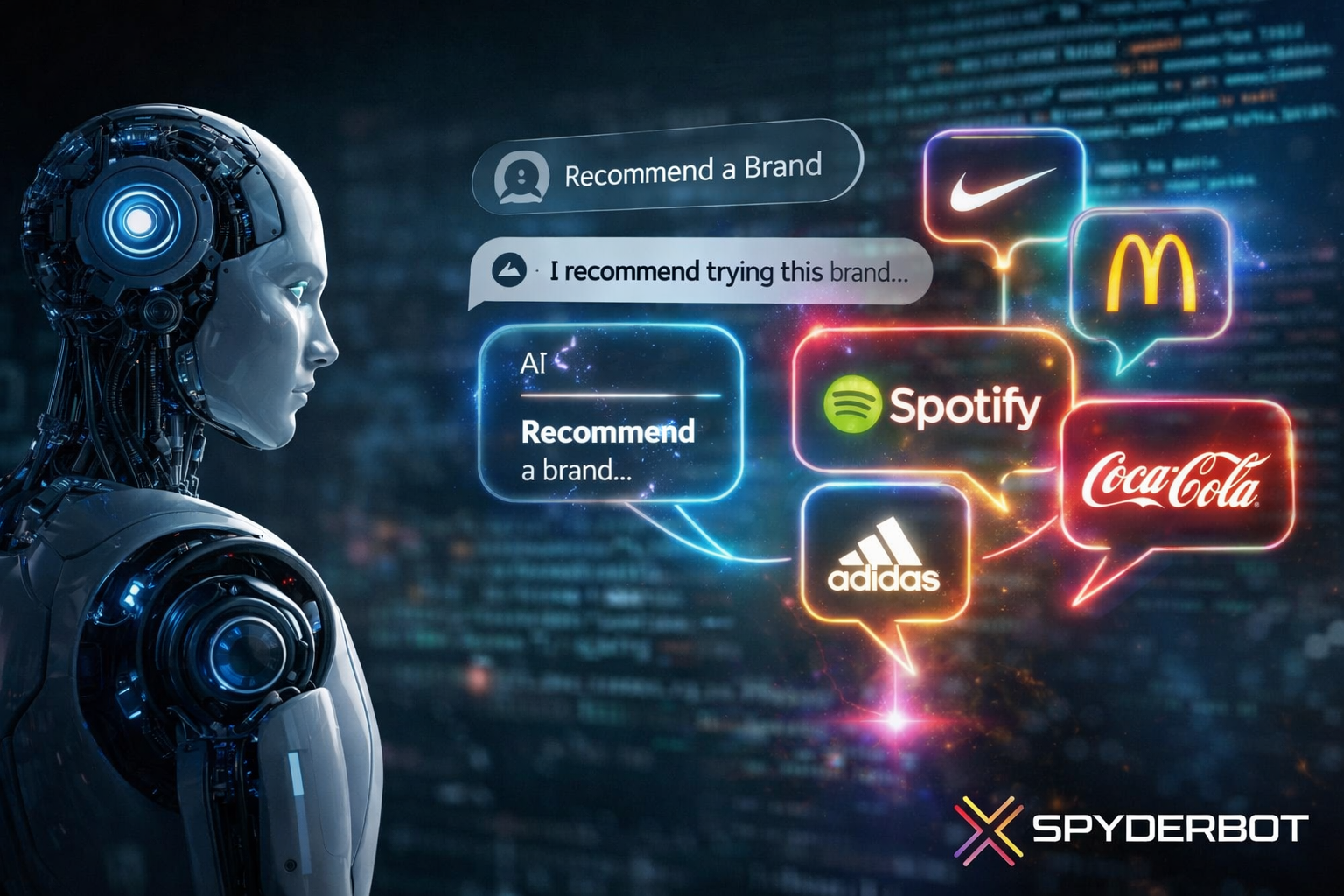
I. What are LLM brand mentions?
LLM brand mentions are the ways large language models such as ChatGPT, Gemini, Claude, Copilot, Grok, and Perplexity include, describe, compare, and recommend brands in generated answers.
This includes:
- Whether a brand is mentioned
- How often the brand appears
- Which prompts trigger the mention
- How the brand is described
- Whether the brand is recommended or only listed
- Which competitors appear alongside it
- Whether the brand is framed positively, neutrally, or weakly
In traditional search, brands compete for rankings.
In AI-generated answers, brands compete for inclusion.
That is why LLM brand mentions are becoming an important part of AI visibility and Generative Engine Optimization.
II. Why LLM brand mentions matter
LLM brand mentions matter because AI systems increasingly influence how users discover products, compare companies, and make decisions.
In traditional search, users see multiple links and decide what to click.
In AI systems, users often receive a synthesized answer.
That means the AI system may decide which brands are worth mentioning before the user visits any website.
If your brand is not mentioned, you may be invisible at the decision stage.
If your brand is mentioned poorly, users may misunderstand your positioning.
If your brand is mentioned strongly, you can influence decisions before the click.
III. LLM brand mentions vs SEO visibility
LLM brand mentions are different from SEO rankings.
| SEO visibility | LLM brand mentions |
|---|---|
| Based on rankings | Based on inclusion |
| Focuses on pages | Focuses on entities |
| Measures traffic | Measures AI visibility |
| Uses keywords | Uses context and meaning |
| Competes on SERPs | Competes inside answers |
SEO asks:
Where do we rank?
LLM visibility asks:
Are we included in the answer?
This is a major shift.
A company can rank well on Google but still be missing from ChatGPT answers.
IV. The 4 dimensions of LLM brand mentions
To understand LLM brand mentions properly, companies should analyze four dimensions:
- Inclusion
- Frequency
- Context
- Framing
Together, these dimensions show whether a brand is visible, how often it appears, when it appears, and how AI systems position it.
V. Inclusion: is your brand mentioned at all?
Inclusion is the most basic layer of LLM brand visibility.
It answers:
Does your brand appear in AI-generated answers?
Key questions include:
- Is the brand mentioned in relevant prompts?
- Does it appear when users ask for recommendations?
- Does it appear in comparison prompts?
- Does it appear in problem-based prompts?
- Is it included alongside competitors?
If the brand is not included, it has no AI visibility in that context.
No inclusion means no presence in the AI-generated decision layer.
VI. Frequency: how often does your brand appear?
Frequency measures how consistently a brand appears across relevant prompts.
It answers:
How often does AI mention the brand?
Useful metrics include:
- Mention rate
- Mention share
- Prompt coverage
- Competitor mention comparison
- Visibility consistency across AI systems
A brand mentioned once is not necessarily strong.
A brand mentioned consistently across different prompts, categories, and use cases has stronger AI visibility.
VII. Context: when does AI mention your brand?
Context explains the situations where a brand appears.
It answers:
In what kinds of questions does AI include the brand?
Examples of useful contexts include:
- Best tools for a category
- Alternatives to a competitor
- Product comparisons
- Use-case recommendations
- Industry-specific solutions
- Problem-solving prompts
- Buying decision prompts
Context matters because not all mentions are equally valuable.
A brand appearing in irrelevant contexts may not drive meaningful visibility.
A brand appearing in high-intent recommendation prompts is more valuable.
VIII. Framing: how does AI describe your brand?
Framing is one of the most important parts of LLM brand mentions.
It answers:
How does AI position the brand?
AI may frame a brand as:
- A market leader
- A niche solution
- A beginner-friendly option
- A technical platform
- A budget alternative
- A premium solution
- A competitor to another brand
- A less complete option
Framing influences perception.
Being mentioned is not enough.
The way AI describes the brand can shape whether users trust it, ignore it, or compare it seriously.
IX. The LLM Brand Mention Model
A simple way to understand AI brand visibility is:
LLM Brand Mentions = Inclusion + Frequency + Context + Framing
This model helps teams move beyond basic tracking.
A brand should not only ask:
Are we mentioned?
It should also ask:
- How often are we mentioned?
- In which contexts?
- How are we described?
- Who appears beside us?
- Are we framed better or worse than competitors?
X. How LLMs generate brand mentions
LLMs do not work like traditional search engines.
They do not simply rank pages and display results.
They generate answers based on patterns, context, entity relationships, and available information.
Several factors may influence brand mentions:
1. Entity understanding
AI systems need to understand what the brand is.
This includes:
- Brand name
- Product category
- Core offering
- Target audience
- Main use cases
- Competitor set
- Market positioning
If the entity is unclear, the brand is less likely to be mentioned correctly.
2. Context relevance
AI systems need to determine whether the brand fits the user’s question.
A brand may be known, but if it is not clearly associated with a specific use case, it may not appear.
3. Association strength
Association strength refers to how strongly a brand is connected to a topic, category, or problem.
For example, if AI systems strongly associate a competitor with “AI visibility tracking,” that competitor may appear more often in relevant answers.
4. Answer construction
AI systems structure answers based on what seems useful, relevant, and coherent.
Some brands may appear as primary recommendations.
Others may appear only as alternatives.
Some may be excluded entirely.
XI. Why some brands are never mentioned by AI
A brand may be missing from LLM-generated answers for several reasons:
- The brand entity is unclear
- The website does not explain the product clearly
- The category positioning is weak
- Competitors have stronger associations
- The brand is not connected to relevant use cases
- There are few trusted references about the brand
- The brand appears in the wrong context
- The messaging is inconsistent across sources
This is why more content does not always create more AI visibility.
The content must improve understanding, relevance, and associations.
XII. Types of LLM brand mentions
Not all LLM brand mentions are equal.
There are several types:
1. Primary mentions
The brand appears as a main recommendation.
This is usually the strongest type of mention.
2. Secondary mentions
The brand appears as one option among several alternatives.
This is useful, but less powerful than being a primary recommendation.
3. Comparative mentions
The brand is compared directly with competitors.
This can be valuable if the framing is strong.
4. Contextual mentions
The brand appears only in specific use cases or niche contexts.
This can be useful when the context matches high-intent users.
5. Weak mentions
The brand is mentioned but not clearly explained or recommended.
This may create low influence despite visibility.
XIII. Common misconceptions about LLM brand mentions
Misconception 1: If we rank on Google, AI will mention us
Not always.
SEO rankings can help, but they do not guarantee AI visibility.
A brand can rank well and still be excluded from AI-generated answers.
Misconception 2: More content means more mentions
Not necessarily.
More content only helps if it improves entity clarity, context relevance, and association strength.
Misconception 3: Mentions are random
LLM mentions are probabilistic, but they are not purely random.
Patterns can be tracked, compared, and improved over time.
Misconception 4: Any mention is good
Not always.
A weak or inaccurate mention can damage positioning.
The quality of framing matters.
XIV. How to measure LLM brand mentions
Companies can measure LLM brand mentions through several metrics:
- Inclusion rate
- Mention frequency
- Mention share vs competitors
- Context coverage
- Prompt coverage
- Framing quality
- Sentiment or positioning
- Primary vs secondary mention rate
- Competitor co-mentions
- AI system consistency
These metrics help teams understand not just whether they appear, but how strong their AI visibility really is.
XV. How to improve LLM brand mentions
1. Improve entity clarity
Make it easy for AI systems to understand what the brand is.
Clarify:
- Brand category
- Core product
- Target users
- Main use cases
- Key differentiators
- Competitors and alternatives
2. Strengthen contextual relevance
Create content that connects the brand to real user problems and buying contexts.
Cover:
- Use cases
- Comparisons
- Alternatives
- Industry applications
- Problem-solution pages
- FAQs
- Category explanations
3. Build stronger associations
The brand should be consistently associated with the right topics.
For example:
- AI visibility
- GEO analytics
- LLM tracking
- AI brand monitoring
- AI search analytics
- Competitor mention tracking
4. Improve brand framing
Make sure the brand is described consistently across website copy, articles, profiles, and third-party pages.
Strong framing helps AI systems represent the brand more accurately.
5. Compare against competitors
AI visibility is competitive.
Track which competitors appear more often, how they are described, and which prompts make them show up.
XVI. Real-world example
Imagine a SaaS company with strong SEO traffic.
The company ranks well on Google and receives steady organic visits.
But when users ask AI systems for the best tools in its category, competitors appear more often.
The problem may not be traffic.
The problem may be weak LLM brand visibility.
Possible root causes include:
- The brand is not clearly categorized
- AI does not connect the brand to high-intent use cases
- Competitors have stronger mention patterns
- The website does not explain the product clearly enough
- The brand is framed as generic rather than specialized
This is why LLM brand mentions need to be measured separately from SEO.
XVII. Where SpyderBot fits
SpyderBot is designed to analyze LLM brand mentions across the dimensions that matter:
- Inclusion
- Frequency
- Context
- Framing
- Competitor mentions
- Prompt-level behavior
- AI interpretation
- Brand positioning
SpyderBot helps answer:
- Are we mentioned in AI answers?
- How often are we mentioned?
- Which competitors appear instead?
- How does AI describe our brand?
- Why are we missing from key prompts?
- How can we improve AI visibility?
This turns LLM brand mentions from a vague concept into a measurable visibility layer.
XVIII. Final conclusion
LLM brand mentions are becoming one of the most important signals in AI search visibility.
They show whether AI systems understand, include, and recommend a brand in generated answers.
Traditional SEO focuses on ranking pages.
LLM visibility focuses on brand inclusion, context, and framing.
The brands that win in AI search will not only rank well.
They will be selected, understood, and positioned correctly inside AI-generated answers.