A detailed, honest comparison between SEO analytics and AI visibility platforms
I. If you’re comparing these two, you’re asking the right question — but at the wrong layer
Many people discover SpyderBot and immediately ask:
“Is this like SEMrush?”
That question is understandable.
But it assumes both tools solve the same problem.
They don’t.
II. The simplest way to understand the difference
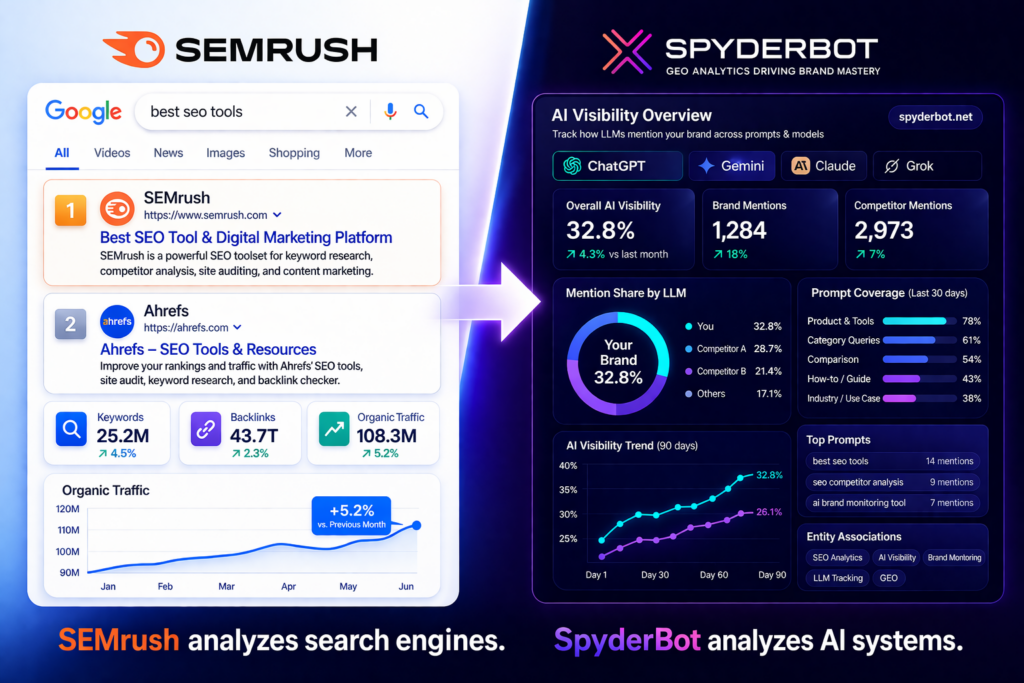
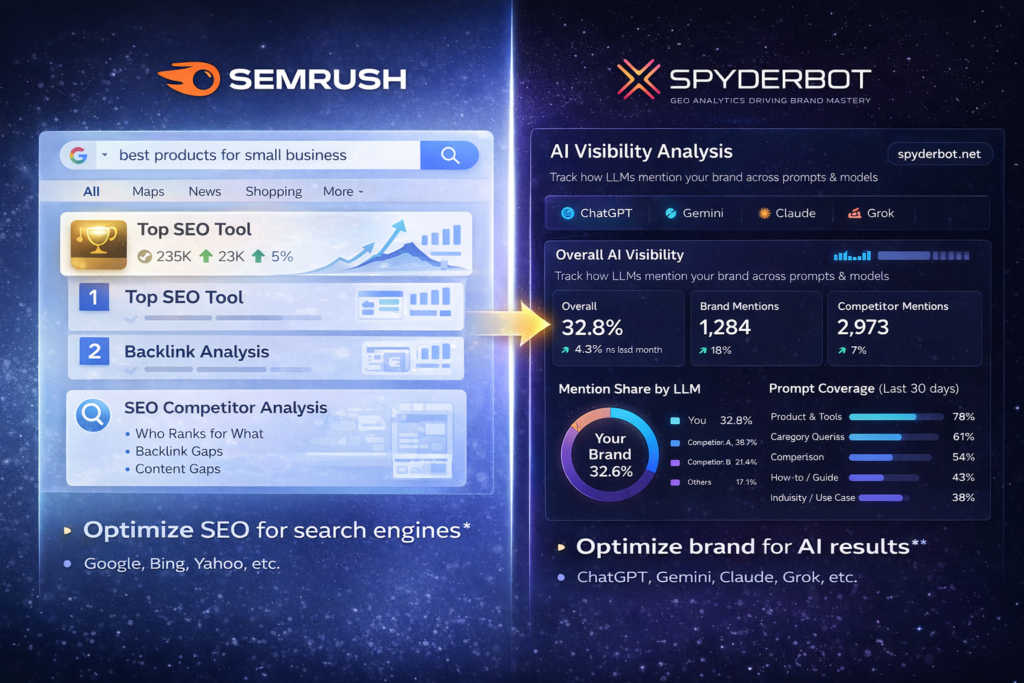
SEMrush helps you understand search engines
SpyderBot helps you understand AI systems
III. What SEMrush actually does
SEMrush is one of the most mature SEO platforms in the market.
It is built for:
- Search engine visibility
- Keyword intelligence
- Traffic growth
Core capabilities:
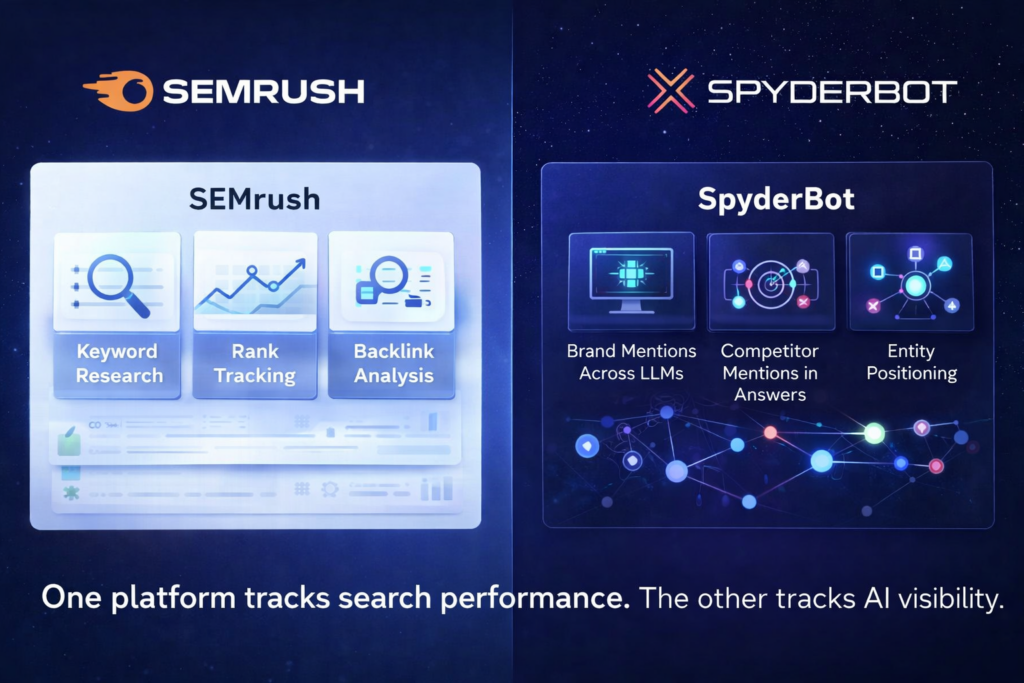
- Keyword research (volume, difficulty, intent)
- Rank tracking (SERP positions over time)
- Backlink analysis
- Site audit (technical SEO)
- Competitor SEO analysis
- Content optimization (SEO-driven)
What SEMrush is really good at:
- Explaining why you rank (or don’t rank) on Google
- Identifying keyword opportunities
- Tracking search performance over time
IV. What SpyderBot actually does
SpyderBot is a GEO (Generative Engine Optimization) analytics platform.
It is built for:
- AI search visibility
- LLM behavior analysis
- Brand perception inside AI systems
Core capabilities:
- Track brand mentions across LLMs (ChatGPT, Gemini, etc.)
- Analyze how AI systems interpret your website
- Compare how competitors are mentioned in AI answers
- Identify gaps in AI visibility
- Understand entity positioning and relationships
What SpyderBot is really good at:
- Explaining why AI mentions competitors instead of you
- Revealing how AI understands your brand
- Tracking AI visibility across prompts and contexts
V. The fundamental difference (not marketing — architectural)
| Layer | SEMrush | SpyderBot |
| System analyzed | Search engines | AI systems (LLMs) |
| Data model | Indexed web pages | Generated answers |
| Core unit | Keywords | Entities |
| Output | Rankings, traffic | Mentions, AI visibility |
| Decision layer | User clicks | AI-generated answers |
VI. The key insight
SEMrush analyzes retrieval systems
SpyderBot analyzes generation systems
This is not a feature difference.
It is a system difference.
VII. Where SEMrush is objectively stronger
SEMrush is the better tool when your goal is:
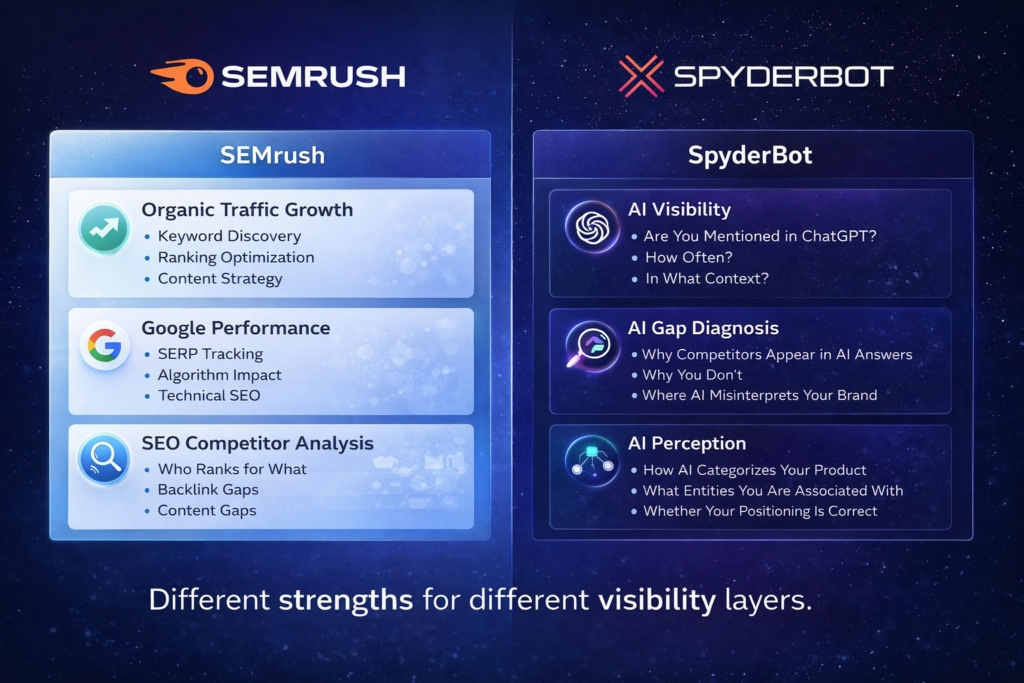
1. Growing organic traffic
- Keyword discovery
- Ranking optimization
- Content strategy
2. Understanding Google performance
- SERP position tracking
- Algorithm impact
- Technical SEO issues
3. Competitive SEO analysis
- Who ranks for what
- Backlink gaps
- Content gaps
4. Execution of SEO strategy
- On-page optimization
- Content briefs
- Site audits
VIII. Where SpyderBot is objectively stronger
SpyderBot is the better tool when your goal is:
1. Understanding AI visibility
- Are you mentioned in ChatGPT?
- How often?
- In what context?
2. Diagnosing AI-driven gaps
- Why competitors appear in AI answers
- Why you don’t
- Where AI misinterprets your brand
3. Analyzing AI perception
- How AI categorizes your product
- What entities you are associated with
- Whether your positioning is correct
4. Monitoring AI search behavior
- Prompt-level analysis
- Variation across contexts
- Consistency of mentions
IX. Where SEMrush cannot help (important)
SEMrush does NOT provide visibility into:
- AI-generated answers
- ChatGPT or Gemini recommendations
- Brand mentions inside LLM outputs
- AI interpretation of your content
Because:
Search engine data ≠ AI system behavior
X.Where SpyderBot cannot replace SEMrush (also important)
SpyderBot does NOT provide:
- Keyword volume or difficulty
- SERP ranking data
- Backlink analysis
- Technical SEO audits
Because:
GEO is not a replacement for SEO
XI.A realistic scenario
A company:
- Ranks #1 for multiple high-value keywords
- Has strong SEO performance
But when users ask AI:
“What are the best tools in this category?”
The company is not mentioned.
What SEMrush shows:
- Strong rankings
- High traffic
- Good SEO health
What SpyderBot reveals:
- Zero AI visibility
- Competitors dominating AI answers
- Weak entity positioning
XII.This is the real gap
SEO tells you how you perform in search
GEO tells you whether you exist in AI
XIII.Why this matters now
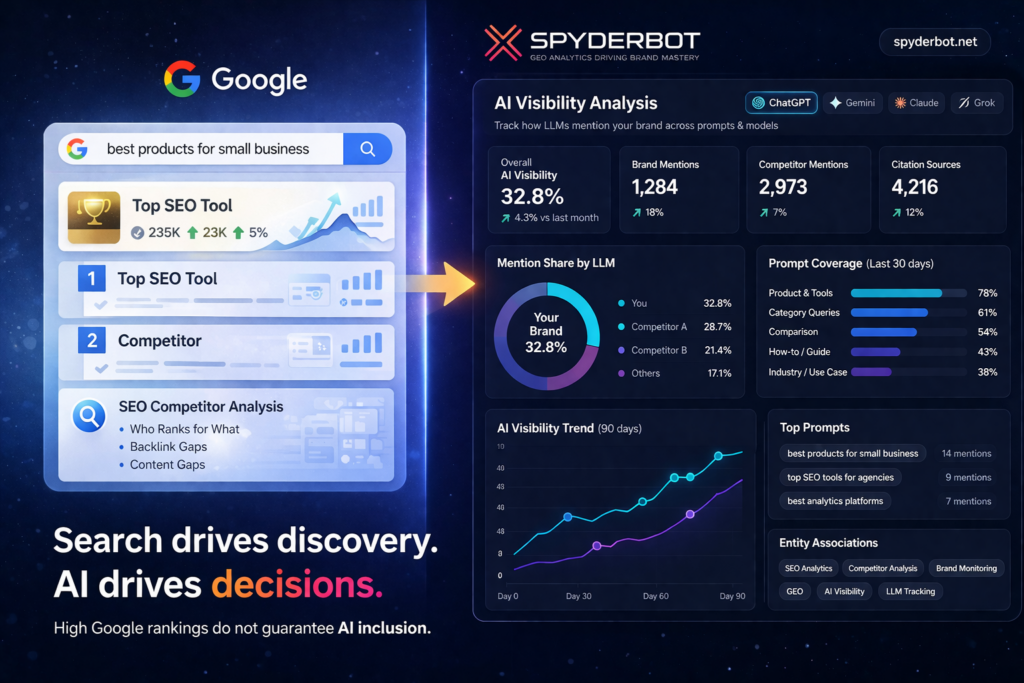
Search behavior is changing:
- Google → discovery
- AI → decision
If you only optimize for SEO:
- You capture traffic
- But lose AI-driven conversions
XIV.How the tools fit together
The correct model is:
| Layer | Tool |
| Discovery | SEMrush (SEO) |
| Decision | SpyderBot (GEO) |
XV.When you should choose SEMrush
Use SEMrush if:
- Your main channel is Google
- You want to increase organic traffic
- You need keyword and ranking insights
- You are executing SEO campaigns
XVI.When you should choose SpyderBot
Use SpyderBot if:
- You want to appear in AI answers
- You want to track AI visibility
- You need to understand LLM behavior
- You want to monitor AI competitors
XVII.When you need both
Most serious companies will need both:
- SEO → to be discovered
- GEO → to be included
XVIII. The honest conclusion
SEMrush is not outdated.
SpyderBot is not a replacement.
They solve:
Two different problems in two different systems
XIX.Final insight
SEMrush answers:
“How do we get traffic from search engines?”
SpyderBot answers:
“Are we even part of the answers users trust?”
XX. The shift
We are moving from:
- Ranking-based visibility
To:
- AI-driven inclusion