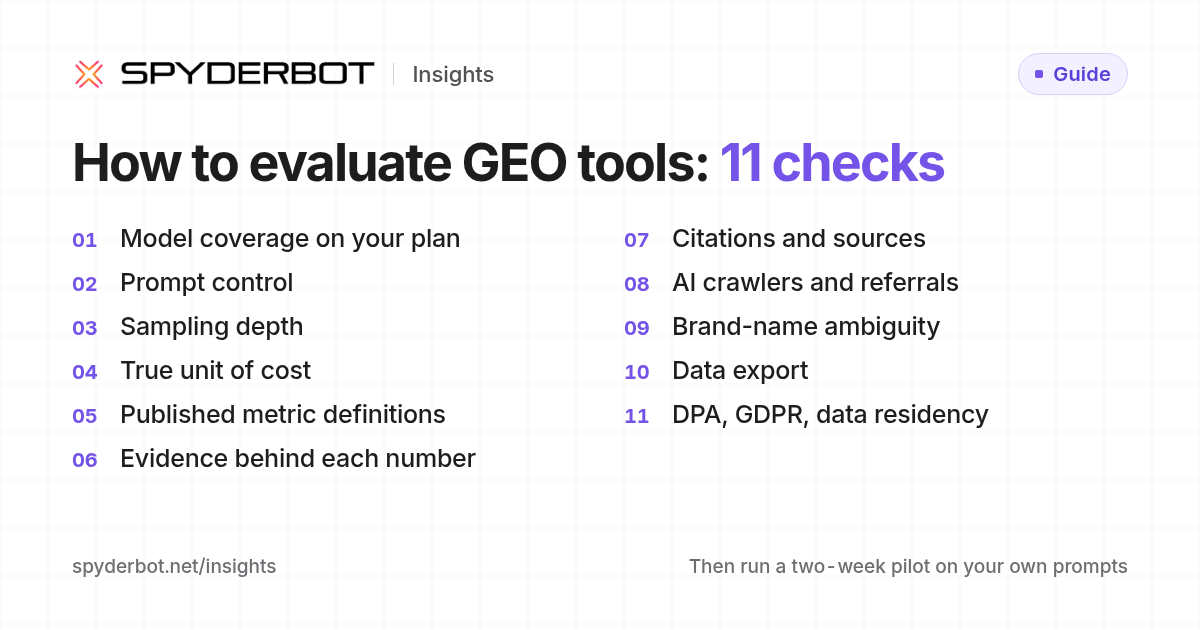
To evaluate a GEO tool, check model coverage on the plan you will buy, prompt control, sampling depth, true cost, published metrics, raw answers, citations, AI crawler data, brand disambiguation, data export, and whether the vendor publishes a DPA, GDPR terms and a data-residency position. Then run a two-week pilot on your own prompts.
Disclosure: Published by SpyderBot, which makes a GEO platform. The checklist applies to any vendor, us included. Vendor examples were read on official pages on Nov 16, 2026.
Why is evaluating GEO tools harder than SEO tools?
Rank trackers report a fairly stable position. GEO tools report rates computed from probabilistic AI answers, and every vendor makes different choices: which models, which prompts, how many repeats, and how to count a “mention”. Two tools can show different numbers for the same brand and both be “right” under their own method. You are buying a methodology as much as a dashboard.
The 11-point checklist
1. Does the plan you will buy cover the assistants and search surfaces your buyers use?
Check the entry plan, not the enterprise brochure. On Nov 16, 2026, for example, Scrunch Core listed 4 LLMs against 9 on Enterprise (Scrunch), and Profound’s trial covered 3 engines against up to 10 on Enterprise (Profound). SpyderBot covers 3 assistant LLMs on Free, 5 on Go and 7 on Pro (SpyderBot pricing), and it measures Google AI Overviews, Google AI Mode and, where available, Bing Copilot Search as distinct AI Search surfaces (AI Search metrics). A Gemini conversation is not the same surface as a Google AI Overview (SpyderBot docs).
2. Can you control the prompts?
You should be able to write, import and freeze your own prompts, and tag them by intent: discovery, comparison, pricing, brand facts. Some trials use vendor-recommended prompts only. Profound’s trial prompts, for instance, cannot be customized.
3. How many times is each prompt sampled?
Ask how often each prompt runs on each model, and whether failed calls are retried. Small samples produce noisy charts. Otterly’s own guidance is to plan for 50–100 prompts per topic or market (Otterly).
4. What is the true unit of cost?
Convert every plan to the same unit: distinct prompts × models × runs per month. Vendors count differently:
Vendor (Nov 16, 2026)
Billing unit
Example nuance
Otterly
Credits (1 prompt × 1 engine × 1 check)
Claude answers cost 3 credits
Ahrefs Brand Radar
Checks
Claude consumes 8 checks per update
Peec AI
Prompts × 3 active models, daily
Extra models are a paid add-on
AthenaHQ
Credits (1 credit = 1 AI response)
3,600 credits on Starter
Semrush AI Visibility Toolkit
Per domain, 25 prompts
+50 prompts for $60 a month
Similarweb AI Search
150 prompts on every plan
Higher tiers add SEO and ads data, not prompts
SpyderBot
Prompts per LLM, models per LLM, monthly credits
Free: 30 prompts per LLM on 3 LLMs
5. Are the metric definitions published?
Visibility, share of voice and “AI visibility score” mean different things in different tools. Semrush, for example, defines its AI Visibility Score against “the median number of mentions for your top industry competitors” (Semrush KB). Ask for the formula, the denominator and the competitor set behind each metric. SpyderBot publishes its Brand Insights metrics with definitions.
6. Can you see the evidence behind each number?
You should be able to open the actual answers behind any percentage, including model, date and prompt. Without evidence you cannot explain a change to leadership. SpyderBot documents its evidence and confidence approach in the SpyderBot methodology.
7. Does it capture citations and sources?
Citations show which domains shape the answer, and therefore where PR, content and partnerships should focus. Check whether the tool gives URL-level detail, not only domain-level.
8. Does it measure your site’s side: AI crawlers and AI referrals?
Answer measurement shows the outcome. AI crawler data shows whether AI systems can reach your pages, and referral data shows business impact. These should be reported separately, because a bot request is not a citation and a citation is not a visit.
9. Does it handle brand-name ambiguity?
If your brand name is also a common word or another company’s name, naive counting inflates or deflates mentions. In 5 of the 6 newest SpyderBot public reports, the system held back 5–13 candidate prompts because the brand name was ambiguous (public reports). Ask each vendor how it disambiguates.
10. Can you get your data out?
Check CSV exports, scheduled reports, Looker Studio, and an API with its plan gating. API access often sits on the top tier or Enterprise.
11. Does the vendor publish a DPA, GDPR terms and a data-residency position?
EU, UK and Australian buyers should ask this before a pilot, not after legal review. On Nov 16, 2026, official pages showed a mixed picture: Peec AI holds a SOC 2 Type II report (available to Custom-plan customers through sales during a vendor review) and states EU hosting in its DPA; Otterly hosts the application in AWS Frankfurt but stores public monitoring data in the US (Otterly Security); SpyderBot publishes a DPA that relies on Standard Contractual Clauses (SCCs) for transfers outside the EEA, aligns its security program with SOC 2 principles, and does not claim certification (SpyderBot Security); Semrush and Similarweb state that service data or servers sit in the United States. Ask for the current report, the DPA as signed or accepted and the hosting region in writing. Where a vendor relies on SCCs, a transfer impact assessment is also required under Clause 14 of the EU SCCs: the parties must assess the laws and practices of the destination country that apply to the transfer, document the assessment and add supplementary measures where needed (see EDPB Recommendations 01/2020), so ask the vendor for the information you need to complete it. For UK personal data sent to a destination not covered by UK adequacy regulations, also ask for the UK Addendum to the EU SCCs or the UK International Data Transfer Agreement (IDTA), and complete a transfer risk assessment: the ICO says the EU SCCs are not valid on their own for restricted transfers under the UK GDPR. The 2026 GEO tools comparison linked above summarizes each vendor’s public wording. This checklist is not legal advice; confirm data-protection requirements with your counsel.
How do you score vendors?
Criterion
Weight
Vendor A
Vendor B
Vendor C
Assistant and search-surface coverage on the target plan
10%
Prompt control and intent tagging
10%
Sampling depth and retries
15%
Cost per prompt × model × run
10%
Published metric definitions
10%
Evidence access
10%
Citations (URL level)
10%
AI crawler and referral data
10%
Brand disambiguation
5%
Export and API
5%
GDPR, DPA and published data residency
5%
Score each from 1 to 5, multiply by the weight and add the results up. Adjust the weights to your situation. An agency may weight exports higher. A team selling in the EU, UK or Australia should keep or raise the GDPR and residency weight, and a regulated brand may weight evidence higher. For any EU or UK buyer whose personal data the vendor will process, a written DPA that meets Art. 28 GDPR / UK GDPR and, where personal data leaves the EEA or UK for a destination without adequacy, a valid transfer mechanism are pass/fail gates before scoring, not a weighted 5% criterion: a vendor that fails a gate is out, whatever its total score. Regulated buyers may add further gates.
How should you run a pilot?
Freeze 30–50 prompts across discovery, comparison, pricing and brand facts, in each market you care about (for example the US, UK, EU or Australia). In SpyderBot, the playbook for deciding which questions to monitor first walks through this.
Run them in two or three shortlisted tools for 14 days on the same models.
Compare stability. How much do daily numbers move when nothing has changed?
Spot-check 20 raw answers against each tool’s reported metrics.
Test one change, such as unblocking an AI crawler or publishing a comparison page, and see which tool detects the effect and how quickly.
The pilot as a sequence: same prompts and models in every tool, then compare stability, accuracy and sensitivity to one change.
What are the red flags?
A single “AI rank” with no sample size.
No access to the raw answers.
“Guaranteed” visibility gains.
Prompt lists the vendor writes and you cannot edit, on the plan you will buy.
Mixing bot visits, citations and referrals into one “AI traffic” figure.
Prices or model lists that differ between the pricing page and the contract.
A SOC 2 or GDPR claim with no report, DPA or security page you can read.
Coverage of the assistants and search surfaces your buyers use, combined with enough repeated sampling to make the numbers stable. Without both, every other feature reports noise.
How long should a GEO tool pilot last?
Two weeks on a frozen prompt set is usually enough to judge stability, evidence quality and usability. Use the same prompts and models in every tool you compare.
How many prompts do I need to evaluate a GEO tool?
Start with 30–50 prompts per market, spread across discovery, comparison, pricing and brand-fact questions. Vendors such as Otterly recommend 50–100 per topic for stable trend reporting.
Why do GEO tools show different numbers for the same brand?
They use different models, prompts, sampling frequencies, competitor sets and metric definitions. Compare methods before you compare numbers, and pick one tool as the system of record.
Should a GEO tool also track AI crawlers?
Yes, if you want to diagnose causes. Answer metrics show outcomes, while crawler data shows whether AI systems can reach your pages at all. Keep the two reported separately.
Are free GEO tools good enough?
Free plans are useful for a baseline and for learning the workflow. They usually limit models and prompts, so they are rarely enough for a multi-market program.
What should EU, UK and Australian buyers check beyond features and price?
Ask for a Data Processing Addendum, the current SOC 2 report if the vendor claims one, and a written statement of where account and monitoring data are stored. Public pages are a starting point only; several vendors host some data in the United States even when they state GDPR compliance. The GDPR allows that when a transfer mechanism applies, such as Standard Contractual Clauses (with a transfer impact assessment, per EDPB Recommendations 01/2020) or the EU-US Data Privacy Framework for certified US companies, so ask which one the vendor relies on. For UK personal data sent to a destination not covered by UK adequacy regulations, including a US company that is not certified to the UK Extension to the EU-US Data Privacy Framework for the type of data you send, ask for the UK Addendum or the IDTA and complete a transfer risk assessment (the UK “data protection test”); EU SCCs alone are not valid for those transfers. None of these is needed for transfers to the EEA, which has full UK adequacy, or to a US company with an active UK Extension certification that covers that type of data (the UK-US data bridge, SI 2023/1028, reg. 3). This is not legal advice; confirm requirements with your counsel.
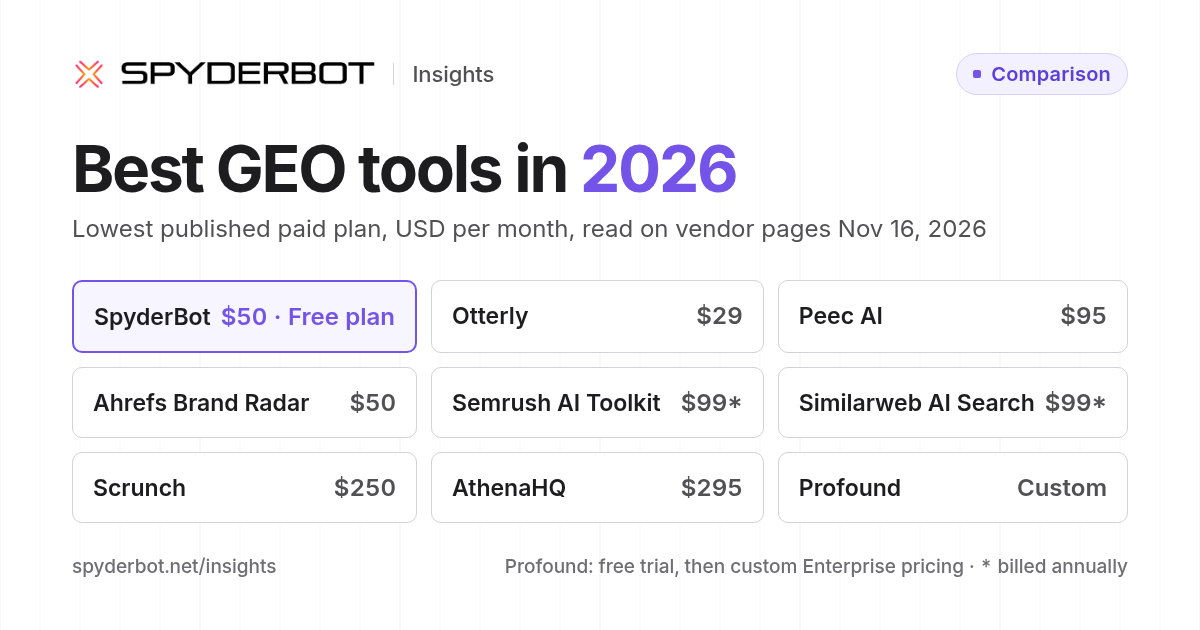
The best GEO tool depends on budget and job. As of Nov 16, 2026, SpyderBot ($0–$500) measures up to 7 assistant LLMs plus AI Search surfaces (Google AI Overviews, Google AI Mode and Bing Copilot Search), and includes AI Traffic. Otterly (from $29), Peec AI (from $95), Scrunch Core ($250) and AthenaHQ Starter ($295) also publish self-serve prices. Profound, Scrunch Enterprise and AthenaHQ Enterprise are sales-led.
Disclosure: Published by SpyderBot, one of the products compared. Every competitor figure below was read on the vendor’s own page on Nov 16, 2026 and is linked inline. Prices exclude tax and change often, so confirm them at checkout.
What does a GEO tool actually measure?
A GEO (generative engine optimization) tool samples AI-generated answers to a set of prompts and records whether a brand is mentioned, recommended, ranked or cited, and how it is described. Because AI answers are probabilistic, a credible tool reruns prompts over time and across models instead of reporting a single “position”.
Most tools now cover four layers:
Answer visibility: mentions, share of voice, recommendation rate and rank inside answers.
Sources: which domains and URLs the AI cites.
Perception: sentiment and the attributes attached to the brand.
Site-side signals: AI crawler activity and visits referred by AI platforms.
Tools differ mainly on how many prompts and models you get for the money, and on whether they measure the site-side layer. For definitions and the full metric set, see our guide to generative engine optimization.
How did we compare the tools?
We used only public, first-party information read on Nov 16, 2026: pricing pages, product pages and help-center articles. We did not run a paid side-by-side test of identical prompts in every tool, so the comparison covers what each product offers, not how accurate it is. The criteria:
Entry price and billing unit: per prompt, per credit, per domain or per seat.
AI assistants and search surfaces on the plan you will buy, including Google AI Overviews, Google AI Mode and Bing Copilot Search where the vendor measures them.
Prompt allowance and refresh cadence.
Site-side data: AI crawler (machine) traffic and AI referral traffic.
Action layer: recommendations, audits or content generation.
Access: free plan or trial, API, seats.
GDPR, DPA and data residency: what the vendor publishes for EU, UK and Australian buyers, cited from official pages only.
Comparison table: GEO tools by public pricing (Nov 16, 2026)
Tool
Entry price (monthly)
Entry plan limits
AI models named
AI crawler / referral data
Free access
SpyderBot
$0 Free; Go $50; Pro $150; Business $500
Free: 30 prompts per LLM on 3 LLMs. Go: 50 prompts per LLM on 5 LLMs
Assistants: up to 7 (ChatGPT, Gemini, Copilot, Grok, Perplexity, Claude, Llama, by plan). AI Search: Google AI Overviews, Google AI Mode and Bing Copilot Search
Yes, AI Traffic (machine and referral) on every plan, with event caps
Free plan
Otterly
$29 Lite; $189 Standard; $489 Premium
Lite: 16 prompts, 2,000 credits, 4 of 7 engines
ChatGPT, AI Overviews, Perplexity, Copilot, AI Mode, Gemini, Claude
Agent analytics from Standard
Free trial
Peec AI
$95 Starter; $245 Pro; $495 Advanced
Starter: 50 prompts, 3 models, 1 project
8 on self-serve (incl. ChatGPT, Perplexity, AI Overviews, AI Mode, Gemini); up to 26 on Enterprise
Agent analytics on all plans (4.5M bot visits on Starter)
Free trial
Profound
Free trial; Enterprise custom
Trial: 50 prompts daily for 7 days, 3 engines
Up to 10 answer engines on Enterprise
Agent Analytics (unlimited domains)
7-day trial
Scrunch
$250 Core; Enterprise custom
125 prompts, 5,000 responses, 5 site audits
Core: 4 (ChatGPT, Perplexity, AI Overviews, Copilot); Enterprise: 9
AI agent / bot traffic on Core
7-day free trial (Core)
AthenaHQ
Free Essential; $295 Starter; Enterprise custom
Starter: 3,600 credits (1 credit = 1 AI response)
“11 models” on Starter
Smart robots.txt and llms.txt management
Free tier ($25 credit)
Ahrefs Brand Radar
Custom Prompts from $50; AI Visibility Index from $199
Paid Ahrefs plans include 5–20 daily prompts
AI Overviews, AI Mode, ChatGPT, Perplexity, Gemini, Copilot; Claude in Custom Prompts
Lowest published paid plan per tool, US list prices in USD per month, excluding tax, read on vendor pricing pages on Nov 16, 2026. Other regions may differ, and entry limits differ; see the table above. Sources: vendor pricing pages listed under the table.
What makes each GEO tool different?
SpyderBot: assistants, AI Search surfaces and AI Traffic, from $0
SpyderBot is built only for AI visibility. It has three products:
Brand Insights reports how AI systems represent a brand across six groups: Mention & Visibility, Sentiment & Context, Ranking & Performance, Trend & Prompt, Commerce, and Leadership & Finance.
Prompt Intelligence investigates single prompts in Prompt Explorer and monitors important ones in Prompt Observatory.
AI Traffic measures machine traffic (AI crawlers and agents) and AI referral traffic, connected through Cloudflare, GA4, WordPress, Shopify or a script, then routes findings to a GEO Audit.
Observations run on a network of 20,000+ LLM-Agents, using the SpyderBot methodology. Assistant coverage is plan-gated on the pricing page: ChatGPT, Gemini and Copilot on Free; Grok and Perplexity from Go; Claude and Llama from Pro. Separately, SpyderBot measures AI Search surfaces — including Google AI Overviews, Google AI Mode and Bing Copilot Search — with their own metrics (answer availability, search brand-presence exposure, and a global profile that can weight assistants and search equally). A Gemini chat and a Google AI Overview are different surfaces (SpyderBot docs).
Claude and Llama start on Pro ($150). API integration is listed on Business ($500). SpyderBot’s documentation says it “does not automate GEO”: it supplies the evidence and prioritized recommendations, and your team makes the changes. If you want generated content, look at Profound, AthenaHQ or Scrunch. A good first step is the playbook for choosing which AI questions to monitor first.
Otterly: lowest published entry price
Otterly’s Lite plan costs $29 for 16 prompts on 4 of 7 engines. Credits are allocation slots, not consumables. One credit is one prompt checked once on one engine, so a prompt tracked daily on one engine uses 31 credits a month, and Claude answers count as 3 credits. Agent analytics, API and MCP access start on Standard ($189). Otterly itself advises 50–100 prompts per topic for stable trends, which puts most serious programs on Standard or above. Head-to-head: SpyderBot vs Otterly.
Peec AI: prompt analytics with unlimited seats
Peec’s self-serve plans run from $95 for 50 prompts to $495 for 350 prompts. Each tracks 3 models of your choice daily, with unlimited users. Enterprise adds SSO, custom prompt setup and up to 26 models. Peec’s model list includes regional surfaces such as Naver AI Briefing and ERNIE, which matters for Korea and China. Every plan also includes agent analytics (a robots.txt crawlability audit, AI referrals and crawl insights) and AI Shopping tracking at SKU level. API access starts on Pro ($245). Head-to-head: SpyderBot vs Peec AI.
Profound: enterprise suite with an “AI Marketer” content layer
Profound’s public pricing has two tiers: a free trial (50 prompts run daily for 7 days on ChatGPT, Gemini and Google AI Overviews) and custom Enterprise (up to 10 answer engines, SSO/SAML, SOC 2). Its pitch now centers on AI Marketer agents that research and write, billed in credits. Agent Analytics covers AI-sourced traffic through CDN and analytics integrations. Head-to-head: SpyderBot vs Profound.
Scrunch: audits and an agent-facing site layer
Scrunch Core costs $250 for 125 prompts, 5,000 responses a month, 5 site audits and AI agent/bot traffic. It covers 4 LLMs, and Enterprise covers 9. Enterprise adds AXP (Agent Experience Platform), API access and SSO. Head-to-head: SpyderBot vs Scrunch.
AthenaHQ: credits plus content optimization agents
AthenaHQ has a free Essential tier with $25 of credit. Starter costs $295 for 3,600 credits a month (one credit is one AI response) across “11 models”, with on-page and off-page actions and a content optimization agent. API access is a paid add-on on Starter. Head-to-head: SpyderBot vs AthenaHQ.
Ahrefs Brand Radar: AI visibility inside an SEO suite
Brand Radar has two modes. The AI Visibility Index (from $199) covers 572 million prompts that Ahrefs derives from its keyword database. Custom Prompts start at $50, and every paid Ahrefs plan includes a daily quota: 5 prompts on Lite, 10 on Standard and 20 on Advanced. In Custom Prompts, Claude consumes 8 checks per update. Head-to-head: SpyderBot vs Ahrefs Brand Radar.
Semrush AI Visibility Toolkit: add-on for Semrush users
The toolkit costs $99 a month per domain with 25 tracked prompts. Additional prompts cost $60 per 50, and there is no free trial. Brand Performance reports update weekly, and prompt tracking updates daily. Head-to-head: SpyderBot vs the Semrush AI Visibility Toolkit.
Similarweb AI Search Intelligence: AI visibility next to traffic intelligence
Similarweb’s plans cost $99, $333 or $542 a month billed annually. Each includes 150 tracked prompts and 1 user, and the higher tiers add SEO, competitive and ads data rather than more prompts. Brand tracking covers ChatGPT, AI Mode, Gemini and Perplexity. Referral tracking also covers Grok, Claude and Copilot. Head-to-head: SpyderBot vs Similarweb. For how all of these differ from rank trackers, see GEO tools vs traditional SEO tools.
What do SpyderBot’s public reports reveal about AI visibility?
SpyderBot publishes public GEO reports. On Nov 15, 2026 the library held 171 reports, created between Dec 29, 2025 and Nov 12, 2026. Two patterns matter when you choose a tool:
Share of voice is usually small. 152 earlier-format reports state the analyzed brand’s share of voice against its competitive set. The median was 17%. 40 brands (26%) were below 10%, and only 19 (12.5%) reached 30% or more. Where a report states a range, the low end is used. A tool that shows only “mentioned / not mentioned” hides how thin most brands’ presence is.
Brand names are often ambiguous. In 5 of the 6 reports produced with SpyderBot’s current frozen-prompt-set method (Oct–Nov 2026), the entity-ambiguity check held back between 5 and 13 candidate prompts because the brand name collided with other entities. Tools that do not disambiguate brand names will count the wrong mentions.
Share of voice of the analyzed brand against its competitive set in 152 SpyderBot public GEO reports (Dec 29, 2025 – Sep 15, 2026). Median 17%; middle half 9–23%. Source: SpyderBot public report library.
The library covers brands in SpyderBot’s target markets as well as others. Public reports include US retailers such as Macy’s (19% share of voice) and Kroger (14%), European grocery groups such as Carrefour (18%) and Schwarz Gruppe (22%), and Australian retailers such as Bunnings. Local-language and market-specific prompts matter in the US, UK, EU and Australia, so model coverage and custom prompt sets should match where your buyers are.
Caveats: brands in the library are self-selected, and 167 of the 171 reports ran on the free plan’s three assistants (ChatGPT, Gemini, Copilot), so treat these as directional benchmarks, not market statistics.
What have vendors published on GDPR, SOC 2 and data residency?
For teams in the US, UK, EU or Australia, treat privacy terms and any published hosting region as a buying criterion. The notes below are only what each vendor published on an official page on Nov 16, 2026. Confirm the current report, DPA and region in writing before you buy. SpyderBot does not claim a SOC 2 or ISO 27001 certification.
Vendor
Official public claim (read Nov 16, 2026)
Data location stated publicly
SpyderBot
DPA covers GDPR and Standard Contractual Clauses. Security and compliance pages say the program is aligned with SOC 2 Trust Services Criteria and ISO/IEC 27001 principles, and “We do not claim certification unless formally obtained.”
Privacy Policy: personal data may be transferred to and processed in the United States and other jurisdictions. No public EU-residency option.
Application hosted in AWS eu-central-1 (Frankfurt). Public monitoring data stored in the US (N. Virginia).
Peec AI
SOC 2 Type II compliant and “GDPR compliant.” Its pricing FAQ says customers on the Custom plan can get the independent auditor’s report through sales during a vendor review.
DPA: services hosted in the EU on Google Cloud, principally europe-west3 (Frankfurt).
Profound
Trust Center lists SOC 2 Type 2 and HIPAA. Pricing lists “SSO/SAML + SOC 2 compliance” on Enterprise. A company blog describes the product as “GDPR-Ready.” Published DPA.
Privacy policy: may transfer personal information from the EEA or the UK to the U.S.
Scrunch
FAQ: completed a SOC 2 Type II audit; “compliant with GDPR” and CCPA.
Privacy policy: information may be processed and stored in the United States or other countries. No public residency choice.
AthenaHQ
Enterprise page: SOC 2 Type I (Oct 2025) and Type II (Jun 2026); EU and UK data processing “Fully Compliant.” Published DPA.
The DPA lists subprocessors processing in the United States or globally and says a primary hosting region does not describe every activity. Confirm residency in writing.
Ahrefs
Publishes a DPA with pre-signed EU SCCs. FAQ: “SOC 2 certification is in progress” and “not yet complete,” so no report is available to share.
No customer-selectable residency stated on the FAQ or DPA pages reviewed.
Semrush
Security: products “adhere to GDPR requirements.” Published DPA with SCCs. The public security page does not mention SOC 2.
Security page: service data stored in data centers in the United States.
Similarweb
Privacy and Security: independently validated SOC 2 Type II and ISO 27001 certification.
Privacy policy: servers and central database in the United States; EU/UK transfers may use SCCs or the UK IDTA.
Which GEO tool should you choose?
You need a free start, published prices and Claude, Grok or Llama coverage: SpyderBot. Grok and Perplexity start on Go ($50), and Claude and Llama on Pro ($150).
You need the cheapest paid tracker for a small prompt set: Otterly Lite. Check how many engines and prompts you really need first.
You need many seats and regional engines (Naver, ERNIE): Peec AI.
You need an enterprise suite with content agents and procurement features such as SSO: Profound, Scrunch Enterprise or AthenaHQ Enterprise.
You need a SOC 2 Type II report or an EU hosting region stated in writing: start with the compliance table above. Peec AI holds a SOC 2 Type II report (available to Custom-plan customers through sales during a vendor review) and states EU hosting in its DPA. Profound, Scrunch and AthenaHQ publish Type II claims. SpyderBot publishes a DPA that relies on SCCs for transfers outside the EEA, and does not claim certification. Where a vendor relies on SCCs, a transfer impact assessment is also required (EDPB Recommendations 01/2020). Otterly hosts the application in Frankfurt and stores public monitoring data in the US.
You already pay for Ahrefs, Semrush or Similarweb: start with their AI module, and add a dedicated platform if model coverage, prompt volume or methodology falls short.
You need to know whether AI crawlers can reach your site: pick a tool with machine-traffic data. SpyderBot AI Traffic, Peec AI, Profound Agent Analytics, Scrunch and Otterly (from Standard) all list it.
Before you buy, run the checklist in How to Evaluate GEO Tools. Ask every vendor how often prompts are rerun and how it handles answers that disagree.
Frequently asked questions
What is the best GEO tool in 2026?
There is no single best tool for every team. On published prices, the self-serve platforms with the lowest entry prices are SpyderBot (free to $500), Otterly (from $29) and Peec AI (from $95); Scrunch Core ($250) and AthenaHQ Starter ($295) are also self-serve. Profound, Scrunch Enterprise and AthenaHQ Enterprise are sales-led. Teams already on Ahrefs, Semrush or Similarweb can start with those modules.
How much does a GEO tool cost?
On Nov 16, 2026, published entry prices ranged from free (SpyderBot, AthenaHQ Essential) to $29 (Otterly), $95 (Peec AI), $99 (Semrush, Similarweb annual), $250 (Scrunch) and $295 (AthenaHQ Starter). Profound lists only a free trial and custom Enterprise pricing.
How is a GEO tool different from an SEO tool?
SEO tools measure rankings, links, crawlability and clicks from search results. GEO tools sample AI-generated answers and measure mentions, recommendations, citations and sentiment. Some also measure AI crawler and referral traffic. Most teams need both; see GEO vs SEO. For the overlap with answer-engine optimization, see GEO vs AEO.
Which AI models should a GEO tool track?
Track both the assistants and the search surfaces your buyers use. In the US, UK, EU and Australia that usually means ChatGPT, Google AI Overviews and AI Mode, Gemini, Copilot, Perplexity and Bing. SpyderBot measures those search surfaces (Google AI Overviews, Google AI Mode and, where available, Bing Copilot Search) as well as up to 7 assistant LLMs (Claude, Grok and Llama depend on the plan). Check which assistants the plan you will buy includes, and confirm search-surface coverage for each market you track.
How many prompts do I need?
Enough that a change in the chart reflects the market, not noise. Otterly’s own guidance is 50–100 prompts per topic or market. SpyderBot measures each prompt repeatedly across models and versions and gates reports on validity checks before release.
Do GEO tools change what AI says about my brand?
Not directly. Measurement tools show where and why you are or are not represented. Change comes from your content, technical access for AI crawlers, and third-party coverage. Some vendors add content agents, but no vendor can guarantee an AI answer.
Should I use more than one GEO tool?
Only if each one has a clear job, for example an SEO-suite module for keyword-linked AI Overviews plus a dedicated platform for multi-model measurement. Two tools mean two methodologies, so pick one system of record for executive reporting.