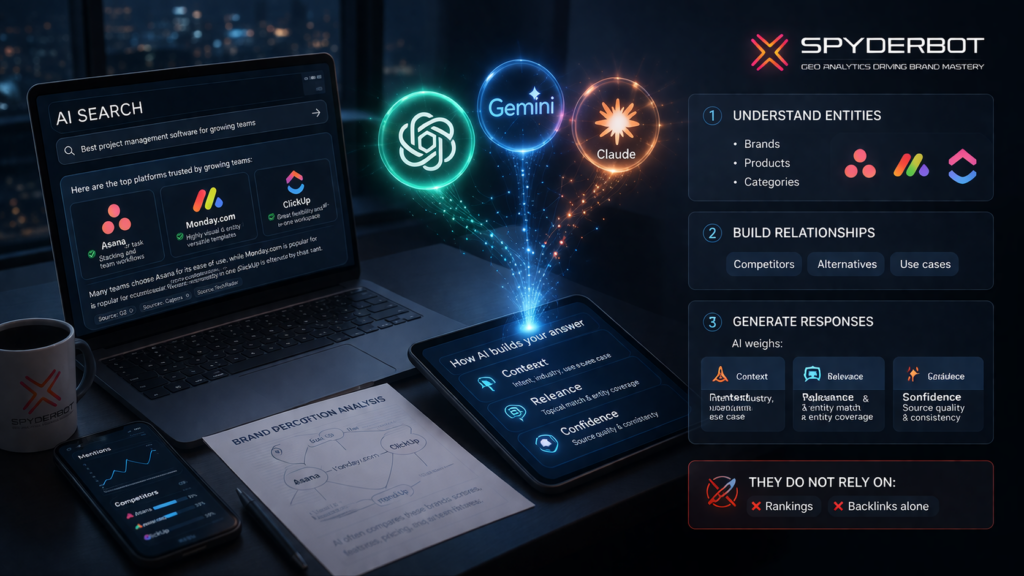
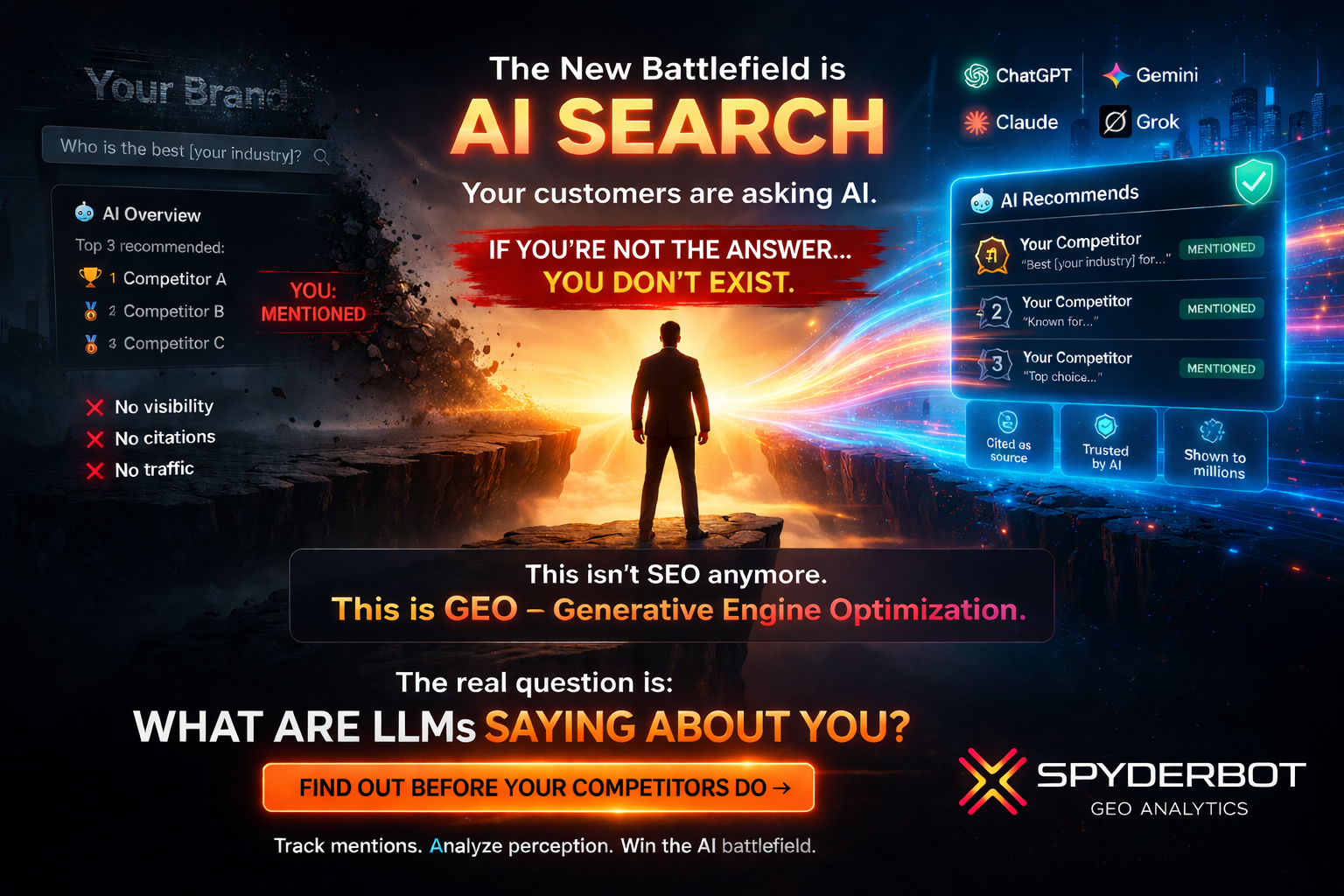
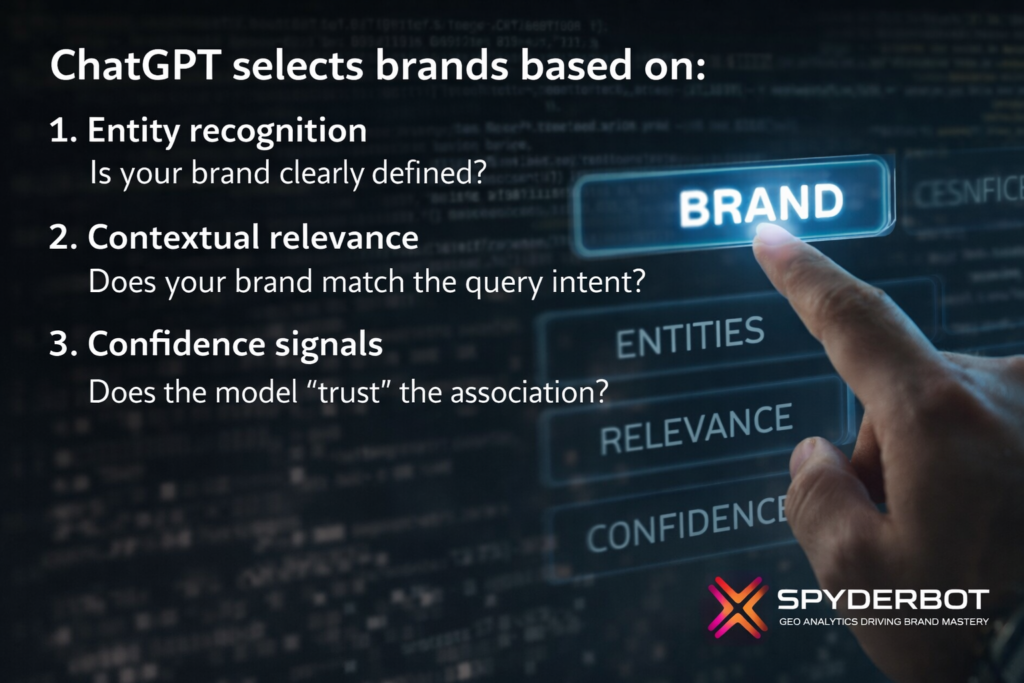
If ChatGPT keeps recommending your competitor instead of your brand, the problem is usually not random. In most cases, it means the model has stronger confidence in your competitor’s entity signals, source consistency, topical authority, and brand-to-query relevance.
This is the new visibility problem in AI search.
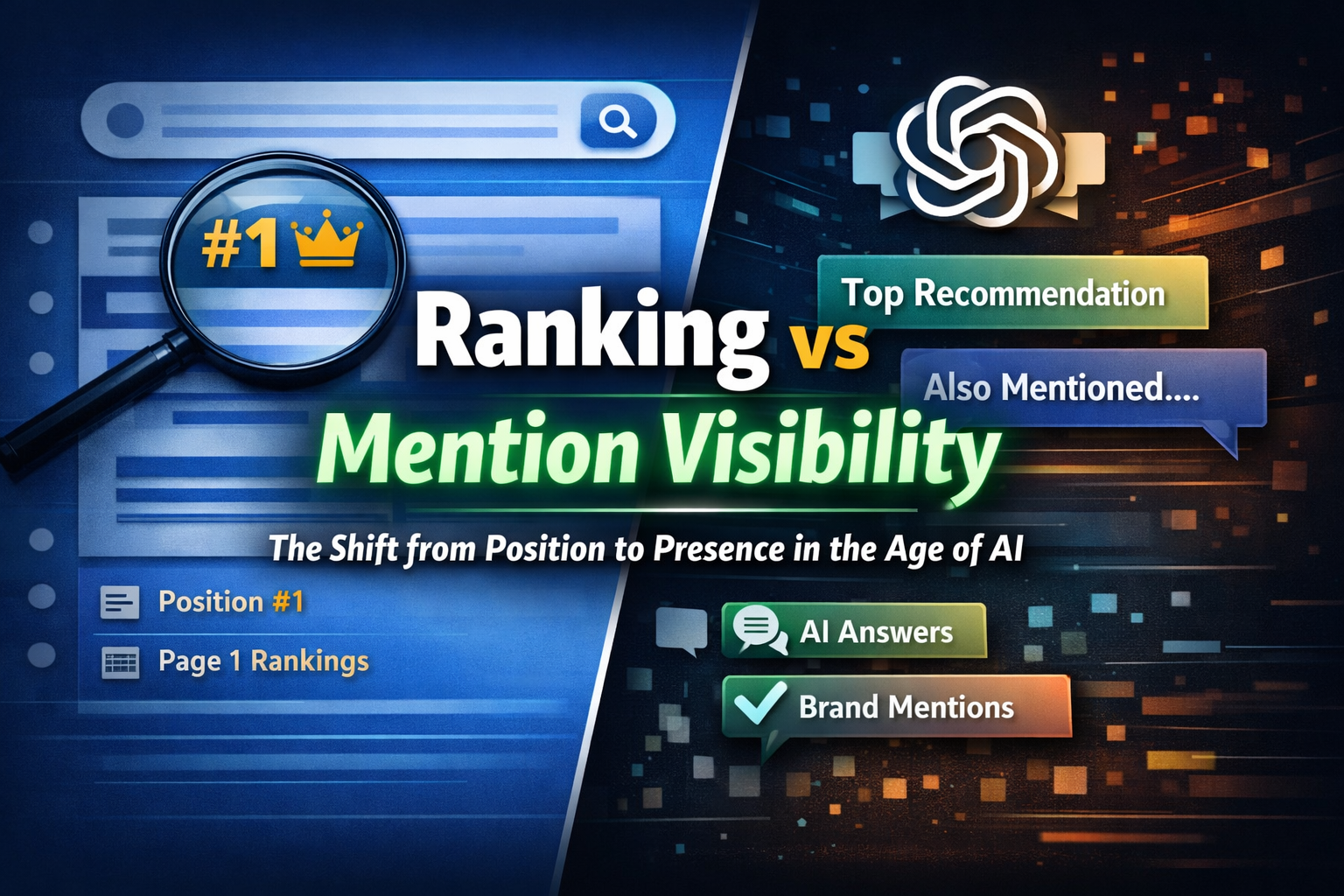
In Google Search, brands compete for rankings. In ChatGPT and other LLM-powered systems, brands compete for mentions, citations, and inclusion inside the answer itself. If your competitor is mentioned more often, described more clearly, or connected more strongly to the user’s question, they are more likely to appear in the response.
I. What This Problem Really Means
When ChatGPT recommends your competitor, it usually indicates one or more of these issues:
Your brand is not strongly associated with the category or use case users ask about.
Your competitor has clearer, more repeated, and more trusted mentions across the web.
Your content is visible, but not structured in a way that helps LLMs understand what your brand actually does.
The model has stronger confidence in your competitor’s relevance for the prompt.
This is not only a content problem. It is a GEO problem.
Generative Engine Optimization is the process of improving how AI systems interpret, retrieve, compare, and mention your brand.
II. Diagnosis
1. Your competitor has stronger entity clarity
If your competitor is easier for AI systems to understand, they will be easier to recommend.
Entity clarity means the model can quickly answer:
What is this brand?
What category does it belong to?
What problems does it solve?
Who is it best for?
How is it different from alternatives?
If your site talks in vague marketing language while your competitor uses clear positioning, structured explanations, comparison pages, and category-specific language, the LLM will often prefer them.
2. Your competitor has better source distribution
ChatGPT does not rely on only one page.
It forms brand understanding from patterns across:
company websites
product pages
reviews
editorial mentions
industry directories
comparison articles
forums
third-party references
If your competitor is described consistently across many sources, while your brand appears only on your own website, the model has fewer signals to trust.
3. Your website explains features, but not use cases
Many brands describe what they built but fail to explain:
who it is for
when it should be used
how it compares to alternatives
what category it belongs to
That creates a gap between your internal messaging and the way real users ask questions.
If users ask, “What is the best tool for tracking AI brand mentions?” and your competitor has pages directly tied to that use case, they may be recommended even if your product is stronger.
4. Your competitor is better aligned to prompt intent
ChatGPT often recommends brands that match the prompt more precisely, not brands that are generally “better.”
For example:
informational prompts favor educational brands
comparison prompts favor brands with clear positioning
commercial prompts favor products with strong category framing
trust-sensitive prompts favor brands with stronger third-party validation
If your competitor has content mapped to those intents and you do not, they will appear more often.
5. Your brand lacks comparison visibility
If your competitor is included in “best tools,” “alternatives,” “vs” pages, analyst summaries, and review ecosystems, they gain repeated comparative exposure.
That matters because LLMs frequently generate answers by synthesizing comparative language. If your brand is absent from the comparison layer of the web, it becomes easier for the model to ignore you.
III. Why It Happens (LLM Mechanism)
1. LLMs do not think like traditional search engines
Google ranks pages. LLMs generate answers.
That means ChatGPT is not simply choosing the “highest ranked website.” It is predicting which brands, facts, and sources are most relevant to include in the response.
This is a major shift.
A brand can rank well in Google and still be weak inside ChatGPT if the model does not strongly connect that brand to the user’s question.
2. LLMs compress the web into patterns
Large language models learn from repeated relationships between terms, entities, categories, and sources.
If the web repeatedly connects your competitor with phrases like:
best platform for X
trusted tool for Y
leading provider in Z
then the model may internalize that competitor as a more natural answer.
If your brand signals are inconsistent, sparse, or too generic, your probability of being mentioned drops.
3. Retrieval systems reward accessible, structured evidence
In many AI experiences, the model is not relying only on memory. It may also use retrieval, browsing, or cited sources.
When that happens, pages with the following tend to perform better:
strong topical headers
clear category definitions
direct answers
comparison-friendly structure
schema and supporting context
brand-service-query alignment
If your competitor publishes content that is easier to retrieve and summarize, the system has a better chance of surfacing them.
4. AI models prefer confidence over ambiguity
LLMs are probabilistic systems. When faced with uncertainty, they lean toward the brand with stronger evidence and cleaner associations.
That is why weak positioning hurts.
If your homepage says you “redefine innovation across digital ecosystems,” but your competitor says they are “an AI search analytics platform for tracking brand mentions in ChatGPT, Gemini, and Claude,” the second brand is far easier for the model to use.
5. Mention frequency compounds visibility
Once a brand is repeatedly associated with a topic, that mention advantage can reinforce itself.
More mentions lead to:
stronger category association
more comparison inclusion
more confidence in future answers
broader prompt coverage
This is why LLM visibility often feels unfair. The model is not trying to be fair. It is trying to generate the most likely helpful answer.
IV. How to Fix It
1. Tighten your brand positioning
Make your core message explicit across your site:
what your product is
who it is for
what category it belongs to
which problems it solves
how it differs from competitors
Do not assume AI systems will infer your positioning correctly.
2. Build pages for prompt intent
Create pages that match the actual questions users ask:
why ChatGPT is not mentioning my brand
how to appear in AI search results
how to optimize website for ChatGPT
best tool to track ChatGPT mentions
competitor alternatives pages
category definition pages
This helps connect your brand to real LLM query patterns.
3. Strengthen off-site validation
You need more than a good homepage.
Build consistent references across:
industry articles
software directories
founder and company profiles
product comparisons
podcast or interview mentions
community discussions
The goal is not just traffic. The goal is machine-readable brand reinforcement.
4. Add structured comparison content
Publish content that helps the model place you in the competitive landscape:
X vs Y
alternatives to competitor
best tools for specific use cases
category roundups
buyer guides
If you are not present in comparative content, your competitor will own the recommendation layer.
5. Measure your LLM visibility
You cannot fix what you do not measure.
Track:
where your brand is mentioned
which competitors are recommended instead
which prompts trigger exclusion
which use cases you dominate or lose
which sources are influencing outcomes
That is how you move from guessing to diagnosing.
V. Why This Matters for Revenue
If ChatGPT recommends your competitor, the issue is not just branding.
It can affect:
top-of-funnel discovery
product consideration
perceived authority
buyer trust
competitive conversion paths
As AI interfaces become part of research and buying behavior, being absent from recommendations becomes a visibility loss with commercial consequences.
VI. Run GEO Audit
If ChatGPT recommends your competitor more often than your brand, do not treat it as a mystery.
Treat it as a measurable visibility problem.
A GEO Audit helps you identify:
which competitors are being mentioned instead of you
which prompts expose your weakness
how AI systems describe your brand
where your entity positioning is unclear
which content and source gaps are reducing your inclusion
Run GEO Audit to see how LLMs analyze your brand, where competitors are outperforming you, and what to fix first.
VII. FAQ
1. Is ChatGPT ranking my competitor above my brand?
Not in the same way Google ranks websites. ChatGPT generates answers by selecting the brands and sources it considers most relevant, useful, and trustworthy for the prompt.
2. Can I optimize my website for ChatGPT?
Yes. You can improve your chances of being mentioned by clarifying your positioning, aligning pages to prompt intent, creating comparison content, and strengthening source consistency across the web.
3. Why does my competitor appear in ChatGPT even when I rank higher in Google?
Because Google rankings and LLM mentions are not the same thing. A strong search ranking does not automatically translate into strong AI visibility.
4. Do reviews and third-party mentions affect ChatGPT recommendations?
Yes. Repeated and consistent third-party references help strengthen brand credibility and category association in AI-generated answers.
5. How do I know which prompts favor my competitor?
You need prompt-level monitoring and LLM visibility tracking to see where your brand is missing, where competitors dominate, and which categories or use cases need optimization.
Many brands ask the same question: how to get mentioned in ChatGPT.
The answer is simple. Your brand needs to be easy for AI systems to understand, retrieve, and trust.
If ChatGPT is not mentioning your company, product, or website, the problem is usually not just SEO. The problem is often a lack of entity clarity, useful content, source trust, or prompt relevance.
This is where GEO becomes important.
I. What Does It Mean to Get Mentioned in ChatGPT?
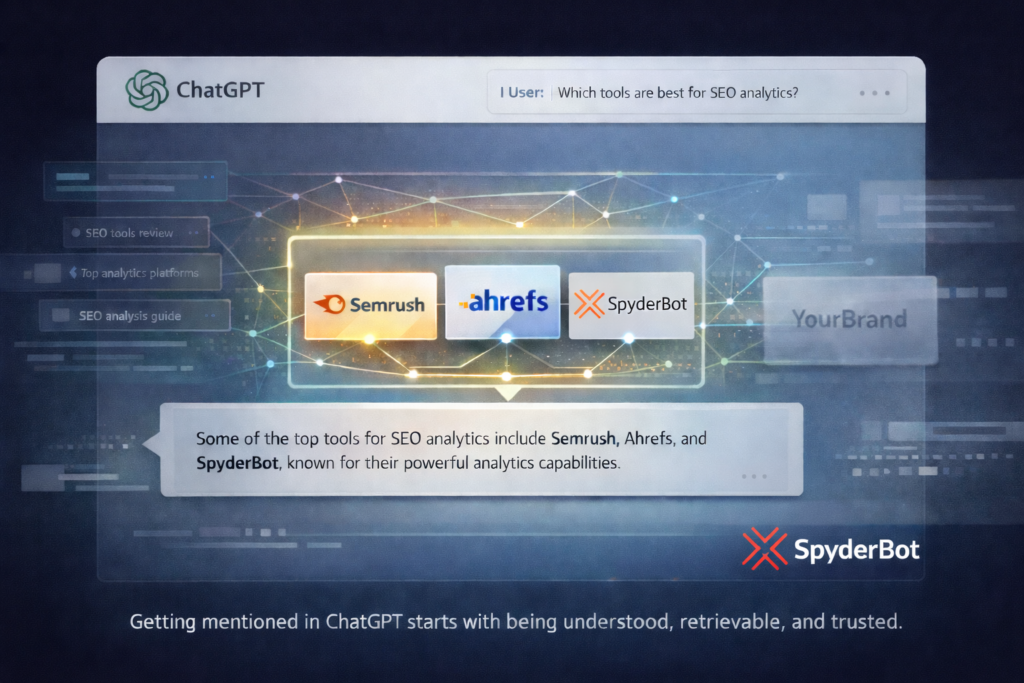
Getting mentioned in ChatGPT starts with being understood, retrievable, and trusted.
Getting mentioned in ChatGPT means your brand appears inside AI-generated answers when users ask questions related to your market, product, service, or competitors.
II. Diagnosis
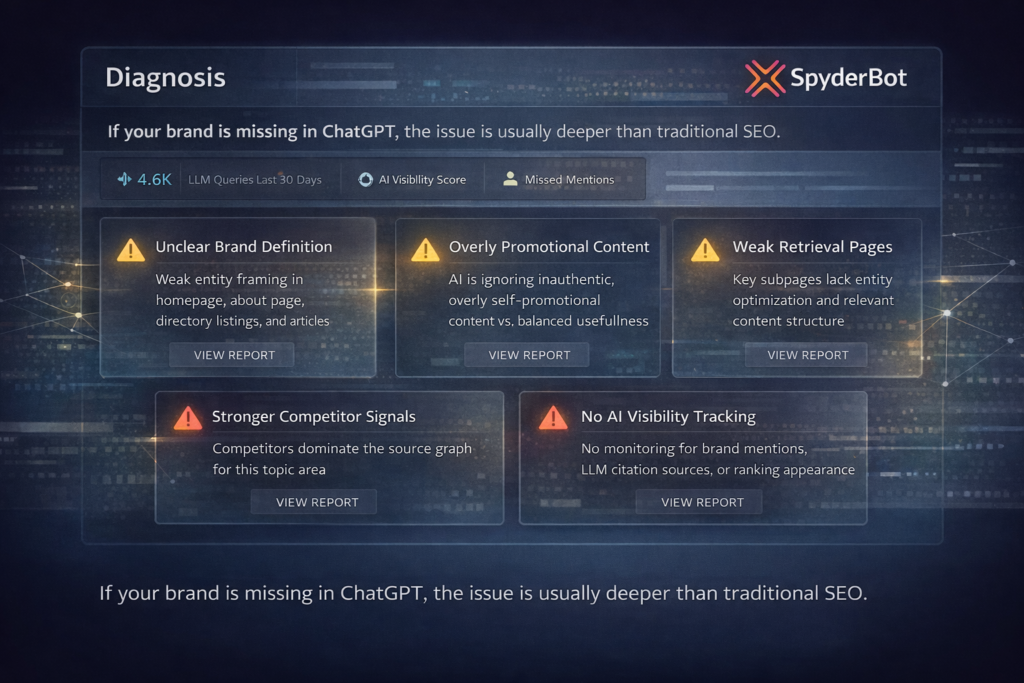
If your brand is not showing up in ChatGPT, one or more of these problems is likely happening.
1. Your brand is not clearly defined
ChatGPT may see your brand name, but it may not clearly understand what your company does, who it serves, what category it belongs to, or how it differs from competitors.
2. Your content is too promotional
Many websites talk about features, but do not explain real problems, use cases, comparisons, or definitions. That makes the site harder to use in AI-generated answers.
3. Your pages are weak for retrieval
If pages are thin, repetitive, badly structured, or unclear, they are less likely to be surfaced as useful support in AI answers.
4. Competitors have better source signals
Your competitors may have better educational content, stronger brand associations, clearer category pages, more third-party mentions, and stronger comparison content.
5. You are not tracking AI visibility
Most teams track rankings and traffic. Very few track whether AI systems actually mention their brand. That creates a blind spot.
III. Why It Happens (LLM Mechanism)
LLMs choose brands through entity relationships, prompt context, retrieval, and usefulness.
LLMs do not work like traditional search engines.
They generate answers based on a mix of learned associations, entity relationships, prompt context, retrieved sources, and probability of useful completion.
IV. How to Get Mentioned in ChatGPT
1. Define your brand clearly
Your website should make these answers obvious:
What is your company?
What does it do?
Who is it for?
What problem does it solve?
2. Create pages that match AI questions
If you want to show up in ChatGPT, publish pages that answer real user questions.
3. Publish content that is easy to cite
AI systems are more likely to use content that is factual, clear, specific, well-structured, and useful in answering a question.
4. Improve entity consistency
Your brand description should be consistent across your homepage, about page, product pages, author bios, social profiles, directory listings, and third-party mentions.
5. Strengthen comparison visibility
A large share of AI prompts are comparison prompts. If competitors are being mentioned and you are not, they may simply own more of this content layer.
6. Make pages easier to parse
To improve visibility in AI systems, pages should be well-structured, easy to scan, internally linked, focused on one main topic, and written with clear headings.
7. Build authority around one topic cluster
Do not publish random content. Build a tight cluster around GEO, LLM visibility, ChatGPT mentions, AI search analytics, and brand visibility in AI.
8. Measure what AI actually says
You need to track whether your brand is mentioned, which prompts include your brand, which competitors appear instead, what topics trigger mentions, and which pages influence AI visibility.
V. What Helps a Brand Get Mentioned More Often?
Brands are more likely to get mentioned in ChatGPT when they have clear positioning, useful informational content, strong entity consistency, comparison content, supporting authority signals, and pages that directly answer user questions.
VI. Common Mistakes
Here are common reasons brands stay invisible in ChatGPT:
unclear homepage messaging
too much marketing language
no comparison content
weak educational pages
poor topic clustering
inconsistent brand descriptions
no tracking of LLM visibility
VII. Why GEO Matters
A GEO Audit reveals which prompts exclude your brand and which competitors replace you.
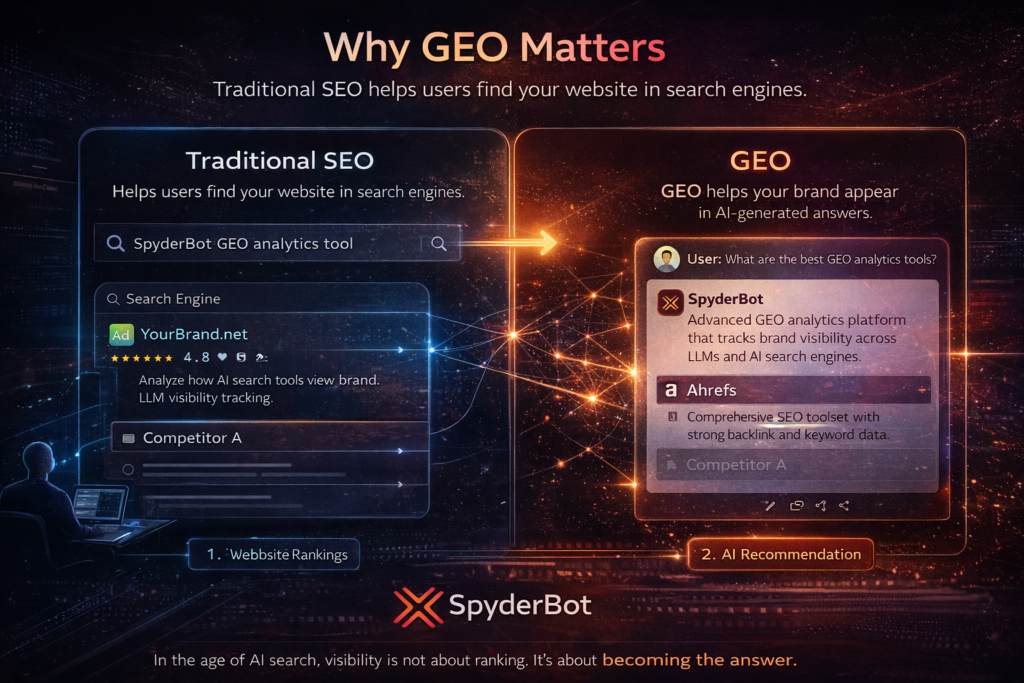
Traditional SEO helps users find your website in search engines.
GEO helps your brand appear in AI-generated answers.
VIII. CTA: Run GEO Audit
If your brand is not appearing in ChatGPT, you need to know why.
A GEO Audit helps you find:
which prompts exclude your brand
which competitors are being mentioned
what content gaps are holding you back
where your entity framing is weak
which pages can improve AI visibility
Run GEO Audit
IX. FAQ
1. How do I get mentioned in ChatGPT?
To get mentioned in ChatGPT, your brand needs clear positioning, useful topic-focused content, strong entity consistency, and better visibility across sources that AI systems can understand and use.
2. Why is ChatGPT not mentioning my brand?
ChatGPT may not mention your brand because your website lacks strong entity signals, useful informational pages, comparison content, or enough authority in the topic area.
3. Can SEO help me appear in ChatGPT?
Yes, but SEO alone is not enough. You also need GEO-focused content that helps AI systems understand when and why your brand should be included in answers.
4. What type of content helps most?
Comparison pages, explainers, glossary pages, methodology pages, use case pages, and FAQ pages usually help more than purely promotional landing pages.
5. What is a GEO Audit?
A GEO Audit analyzes how AI systems mention your brand, which competitors appear more often, what pages influence visibility, and what content gaps reduce your chances of showing up in answers.
The Difference Between Finding Information and Receiving Answers
For decades, Google Search shaped how people accessed the internet.
A user typed a query, scanned a list of links, clicked a result, compared sources, and decided what to trust. That behavior became the foundation of SEO, content marketing, ecommerce discovery, and digital brand visibility.
AI search is changing that pattern.
Instead of returning only a list of webpages, AI search systems generate direct answers. Users ask questions in natural language and receive summaries, recommendations, comparisons, explanations, and next-step guidance.
This creates a major shift in how information is discovered.
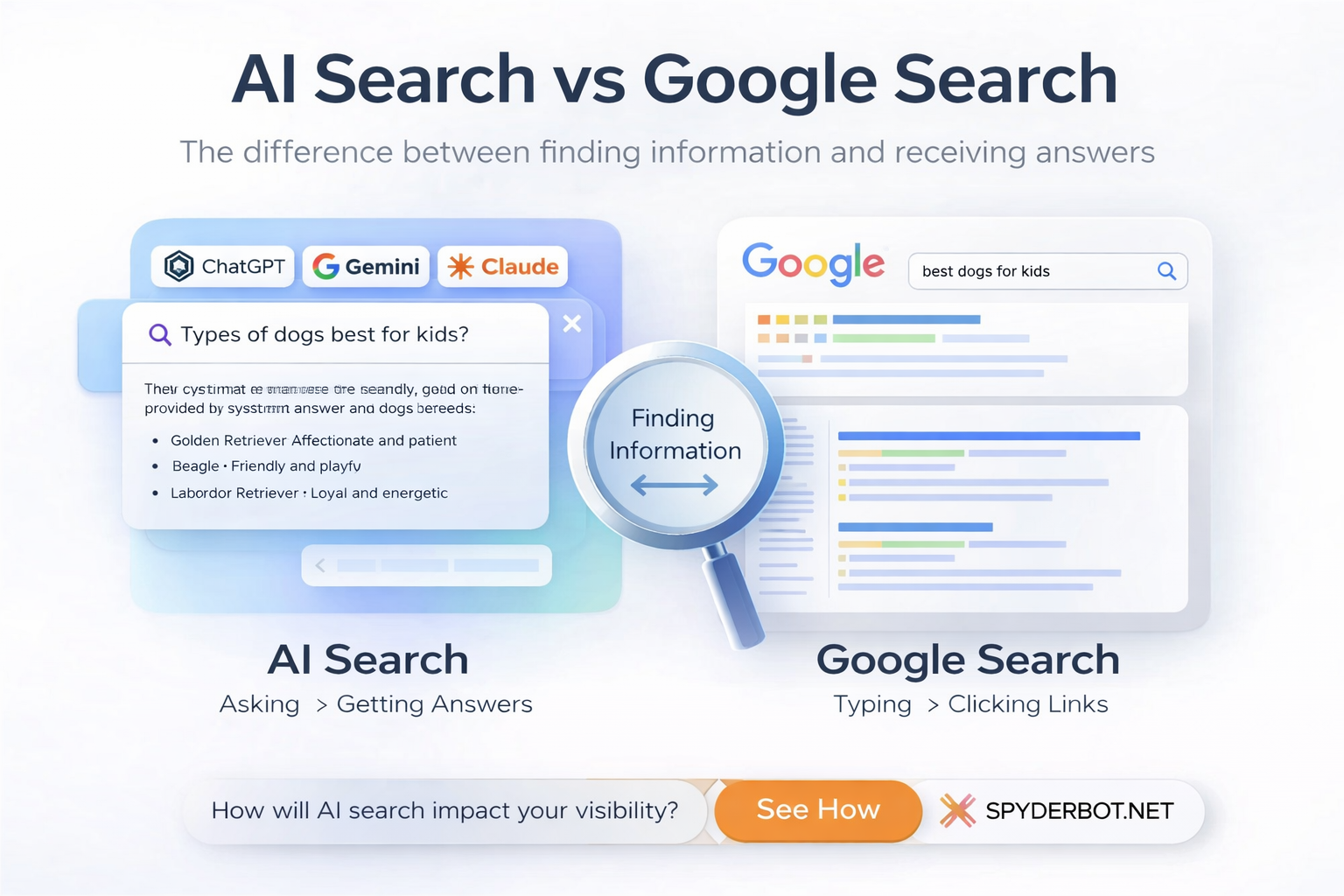
Google Search helps users find information.
AI Search helps users receive answers.
That difference may sound simple, but it changes how brands are seen, cited, recommended, and trusted online.
For companies, this shift creates a new visibility challenge. Ranking on Google is still important, but it is no longer the full picture. If AI systems do not mention your brand, cite your website, or include your company in generated recommendations, you may become invisible in the fastest-growing layer of digital discovery.
This is why the conversation is moving from SEO alone to a broader discipline: AI search visibility and Generative Engine Optimization (GEO).
I. What Is Google Search?
Google Search is a retrieval-based search engine.
Its main function is to crawl the web, index webpages, evaluate relevance, and return a ranked list of results for a user query.
When someone searches on Google, the system attempts to identify the most useful pages based on many signals, including relevance, authority, page quality, backlinks, technical structure, content usefulness, user experience, and search intent.
The typical Google Search experience looks like this:
A user enters a query.
Google returns a search engine results page.
The user scans titles, snippets, URLs, images, videos, ads, or featured results.
The user clicks one or more links.
The user evaluates the information manually.
This model gives users options.
A person searching for “best AI search analytics tools” may see multiple webpages, review articles, product pages, comparison posts, ads, videos, and directory listings. The user can open several results and decide which source is most useful.
Google Search is powerful because it connects users to the open web.
For companies, this created the traditional SEO model.
The goal was clear:
Rank higher.
Get more impressions.
Earn more clicks.
Convert traffic into leads or customers.
In this model, visibility is strongly tied to ranking position.
A page ranking in position one usually receives more attention than a page ranking in position seven. A page on page two may still exist, but it often receives very little traffic.
That is how search visibility worked for many years.
II. What Is AI Search?
AI search is a generative search experience.
Instead of simply returning a ranked list of webpages, AI search systems interpret a user’s question and generate a synthesized answer.
AI search may use large language models, retrieval systems, web sources, knowledge graphs, product data, user context, and other signals to produce a response.
The typical AI search experience looks like this:
A user asks a question.
The AI system interprets the intent.
The system identifies relevant concepts, entities, and sources.
The AI generates an answer.
The answer may include summaries, recommendations, citations, or follow-up suggestions.
The output is not just a list of links.
The output is an answer.
This changes user behavior.
Instead of opening five articles to compare options, a user may ask:
“What are the best tools for tracking brand visibility in ChatGPT?”
The AI system may respond with a short list of recommended platforms, a comparison, and a direct explanation of which tool is best for each use case.
That means the AI system is no longer only helping the user search.
It is helping the user decide.
This is the core difference between traditional search and AI search.
Google Search organizes access to information.
AI Search interprets information and turns it into a response.
III. AI Search vs Google Search: The Core Difference
The simplest way to understand the difference is this:
Google Search returns links.
AI Search generates answers.
Google Search gives users options to explore.
AI Search gives users a synthesized conclusion.
Google Search is built around ranking pages.
AI Search is built around selecting, interpreting, and presenting information.
Google Search usually asks the user to decide which result is best.
AI Search often makes the first decision for the user by choosing what to include in the answer.
That has a major impact on brand visibility.
In Google Search, your page can rank fifth and still get traffic.
In AI Search, if your brand is not mentioned in the generated answer, the user may never know you exist.
This is why AI search creates a new visibility model.
The old question was:
“Where do we rank?”
The new question is:
“Are we included in the answer?”
IV. Side-by-Side Comparison
Dimension
Google Search
AI Search
Main output
Ranked webpages
Generated answers
Interface
Search engine results page
Conversational answer interface
User behavior
Search, scan, click, compare
Ask, read, trust, refine
Visibility model
Ranking position
Inclusion in the answer
Main unit
Webpages
Entities, sources, brands, concepts
Primary goal
Drive traffic
Shape decisions
Competition
Pages competing for rankings
Brands competing for mentions
Measurement
Rankings, impressions, clicks
Mentions, citations, sentiment, prompt coverage
User control
User chooses which link to open
AI filters and summarizes options
Brand risk
Low ranking means less traffic
No mention means invisibility
This comparison does not mean Google Search is outdated.
It means the search environment is expanding.
Traditional search still matters for discovery, research, navigation, and traffic acquisition.
AI search matters because it increasingly influences perception, trust, and decision-making.
The strongest digital strategies will not choose one over the other.
They will optimize for both.
V. Ranking vs Inclusion
Google Search is based on ranking.
AI Search is based on inclusion.
This is one of the most important differences for marketers, founders, SEO teams, and brand owners.
In Google Search, visibility is positional.
For example:
Position 1 usually gets high attention.
Position 3 can still drive meaningful traffic.
Position 8 may still receive clicks.
Page 2 may have low visibility, but it can still be found.
In AI Search, visibility is more compressed.
An AI answer may mention only three to five brands. Sometimes it may mention only one. Sometimes it may summarize the category without mentioning your company at all.
That creates a binary visibility problem:
Mentioned means visible.
Not mentioned means invisible.
This is why AI search can be more difficult for brands.
In traditional SEO, a company can still compete from lower positions and improve over time.
In AI search, if the system does not include your brand in the answer set, you may be absent from the user’s decision journey entirely.
This is especially important for high-intent prompts such as:
“Best AI search analytics tools”
“Top tools for tracking ChatGPT mentions”
“Best software for AI brand monitoring”
“How do I know if AI recommends my competitors?”
“Which GEO tools should SaaS companies use?”
These are not casual searches.
They are decision-driven prompts.
If AI systems recommend your competitors and exclude your brand, you lose visibility before the user even reaches Google.
VI. Pages vs Entities
Google Search traditionally focuses on webpages.
AI Search focuses more heavily on entities.
An entity can be a brand, person, product, company, concept, place, category, or organization that a system can recognize and understand.
This matters because AI systems do not only evaluate one page. They try to understand what something is and how it relates to other concepts.
For example, an AI system may evaluate a brand based on:
What the company does
Which category it belongs to
What problems it solves
Which competitors it is compared against
Whether other sources mention it
Whether its descriptions are consistent
Whether it is associated with trusted topics
Whether users discuss it in relevant contexts
This is different from optimizing a single article for one keyword.
A company may publish many blog posts and still have weak AI visibility if the brand itself is unclear.
For example, if a company is described as an “SEO tool” in one place, an “AI analytics platform” in another place, and a “brand monitoring product” somewhere else, AI systems may struggle to classify it accurately.
That weakens entity clarity.
In AI search, your brand needs a clear and consistent identity.
The system should understand:
Who you are
What you do
Who you serve
What category you belong to
What makes you different
Why you are relevant to a specific prompt
This is why entity optimization is becoming more important.
SEO still needs strong pages.
GEO needs strong entities.
VII. Links vs Answers
Google Search gives users links.
AI Search gives users answers.
That shift changes the user journey.
In Google Search, the user must do more work:
Open results
Compare pages
Read content
Judge source quality
Decide what to trust
In AI Search, the system does much of that work for the user.
It summarizes the topic, compares options, and often provides a direct recommendation.
This can be convenient for users, but it creates a new challenge for brands.
If the AI answer becomes the user’s primary source of understanding, the brands included in that answer gain influence.
The brands excluded from that answer may lose visibility.
For example, when a user asks:
“What is the best platform for monitoring AI brand visibility?”
The answer may list several tools and explain which one is best for each use case.
If your company is not included, the user may never search for you separately.
This is very different from Google Search, where a user can scroll, compare, and open multiple results.
AI search compresses the journey.
That compression increases the value of being mentioned.
VIII. Traffic vs Influence
Google Search is strongly connected to traffic.
AI Search is strongly connected to influence.
In the traditional model, brands optimized content to win clicks. A successful article could bring users to a website, where the brand controlled the experience.
In the AI search model, users may receive enough information directly inside the AI answer. They may not click through to the original website at all.
That does not mean AI visibility is less valuable.
It means value shifts from traffic to influence.
A brand mentioned positively in an AI answer may influence a buyer even without receiving an immediate click.
For example, AI search can influence:
Which brands users consider
Which tools users compare
Which products users trust
Which companies appear credible
Which competitors are perceived as leaders
Which websites receive follow-up visits later
This is why traffic alone is no longer enough to measure search performance.
A company may see stable Google rankings but still lose influence if AI systems consistently recommend competitors.
The new visibility problem is not always obvious in analytics.
A user may never visit your site because the AI answer already gave them a shortlist.
If you were not on that shortlist, there may be no click, no impression, and no measurable lost visit.
That is invisible demand loss.
IX. How Visibility Works in Each System
Visibility works differently in Google Search and AI Search.
1. Visibility in Google Search
In Google Search, visibility usually depends on ranking performance.
Common SEO visibility signals include:
Keyword rankings
Search impressions
Click-through rate
Organic traffic
Backlinks
Page authority
Indexation
Content quality
Technical performance
Search intent alignment
The goal is to help a page appear when users search relevant queries.
The stronger the ranking, the more likely the page is to receive traffic.
2. Visibility in AI Search
In AI Search, visibility depends on whether your brand, content, or website is included in generated answers.
Common AI visibility signals include:
Brand mention frequency
Citation frequency
Prompt coverage
Share of voice
Recommendation position
Sentiment
Competitive inclusion gaps
Entity clarity
Contextual relevance
Source consistency
The goal is not only to rank a page.
The goal is to be understood, trusted, mentioned, and recommended.
This is why AI visibility tracking is becoming important.
Companies need to know:
Does ChatGPT mention us?
Does Gemini cite us?
Does Claude describe us accurately?
Does Perplexity include our website as a source?
Which competitors appear more often?
Which prompts trigger competitor recommendations?
Which topics exclude our brand?
Is our brand sentiment positive, neutral, or negative?
Without these answers, companies are operating blind in AI search.
X. Why This Matters for Companies
The rise of AI search matters because it changes how buyers discover and evaluate companies.
This is especially important for SaaS, B2B technology, ecommerce, fintech, cybersecurity, agencies, consultants, publishers, and high-consideration products.
In many categories, users now ask AI systems for help before they visit websites.
They ask questions like:
“Which product should I use?”
“What are the best tools in this category?”
“Which company is better for my use case?”
“What are the pros and cons of each option?”
“Which solution is best for a small team?”
“Which platform is better for enterprise users?”
These prompts are close to purchase decisions.
If your brand appears in the answer, you gain consideration.
If your competitor appears and you do not, your competitor gains the advantage.
This creates three major risks.
1. Invisible Competitor Advantage
Your competitors may be gaining AI visibility even if you do not see it in standard SEO tools.
They may be mentioned more often in AI-generated answers, recommended for high-intent use cases, or cited as trusted sources.
2. Perception Drift
AI systems may describe your brand inaccurately.
They may position you as too small, too limited, too expensive, outdated, or less relevant than competitors.
Even if the description is subtle, it can influence user perception.
3. Analytics Blind Spots
Traditional analytics may not show what you are losing.
If a user gets an AI recommendation and never visits your site, there may be no traffic data to analyze.
This is why companies need to monitor AI visibility separately from traditional SEO.
XI. The Role of GEO in AI Search
Generative Engine Optimization, or GEO, is the practice of improving how a brand appears inside AI-generated answers.
GEO focuses on visibility inside generative systems such as ChatGPT, Gemini, Claude, Perplexity, Copilot, and other AI search experiences.
The goal of GEO is to improve:
Brand mentions
Source citations
Prompt coverage
Entity clarity
Competitive positioning
Sentiment
Recommendation frequency
AI answer inclusion
GEO does not replace SEO.
It extends search strategy into AI-generated environments.
Traditional SEO asks:
“How do we rank higher on Google?”
GEO asks:
“How do AI systems understand, mention, cite, and recommend us?”
A strong GEO strategy usually includes:
Clear category positioning
Strong entity consistency
Authoritative content
Structured data
Third-party mentions
Review signals
Comparison content
Prompt testing
Competitor monitoring
Continuous visibility tracking
For companies like SpyderBot, this is the core opportunity.
As more users rely on AI systems for research and recommendations, brands need a way to measure how AI systems see them.
That includes knowing what LLMs mention about competitors and how AI systems analyze and track a brand’s website.
XII. What Companies Should Do Now
Companies should not abandon Google Search.
They should expand their search strategy.
The future is not Google Search versus AI Search.
The future is Google Search plus AI Search.
1. Maintain Traditional SEO
Google still matters.
Companies should continue investing in:
Technical SEO
Helpful content
Search intent alignment
Internal linking
Backlink quality
Page speed
Crawlability
Indexation
Content updates
Conversion-focused landing pages
SEO remains the foundation of web visibility.
Strong SEO can also support AI visibility because many AI systems rely on web content and external sources.
2. Strengthen Entity Clarity
Brands need to make themselves easier for AI systems to understand.
This means creating consistent descriptions across:
Website pages
Social profiles
Product pages
Blog articles
SaaS directories
Review sites
Press mentions
Author bios
Knowledge panels
External references
A clear brand statement should answer:
What does the company do?
Who is it for?
What category does it belong to?
What problem does it solve?
What makes it different?
For example:
“SpyderBot is a GEO analytics platform that helps brands monitor how AI systems mention, compare, cite, and recommend them across generative search experiences.”
A clear statement like this should be repeated consistently across important brand assets.
3. Create AI-Readable Content
AI systems need clear, structured, answerable content.
Useful content formats include:
Definition pages
Comparison pages
Alternative pages
Use case pages
FAQ sections
Research reports
Data studies
Glossaries
Step-by-step guides
Industry-specific resources
The content should be easy to parse.
That means:
Clear headings
Short definitions
Direct answers
Comparison tables
Practical examples
Consistent terminology
Internal links
Structured data where appropriate
4. Track AI Visibility
Companies should measure how often they appear in AI-generated answers.
Key metrics include:
Mention frequency
Prompt coverage
Share of voice
Citation frequency
Sentiment
Recommendation position
Competitor inclusion
Missing prompt opportunities
This is where AI visibility tracking becomes essential.
A company should know whether it is being included, ignored, misrepresented, or outperformed by competitors.
5. Monitor Competitor Presence
AI search is competitive.
If a competitor appears more often in generated answers, that competitor may be gaining early influence in the buyer journey.
Companies should track:
Which competitors are mentioned
Which prompts trigger competitor recommendations
Which sources AI systems cite
How competitors are described
What categories competitors are associated with
Where your brand is missing
This turns AI search from a mystery into a measurable strategy.
XIII. The Future of Search
Search is becoming hybrid.
Traditional search engines will continue to help users discover webpages, navigate the internet, compare sources, and access detailed information.
AI systems will increasingly help users interpret information, summarize choices, make comparisons, and decide what to do next.
This means the search journey is splitting into two layers.
Google Search supports discovery.
AI Search supports decision-making.
A user may still use Google to find websites, reviews, documents, and official sources.
But the same user may use AI search to ask:
“Which one should I choose?”
“What is the best option for my use case?”
“Which company is more trusted?”
“What are the main differences?”
“What should I do next?”
That is where AI search becomes powerful.
The brands that win in this environment will not only be the brands that rank.
They will be the brands that are included in answers.
XIV. Conclusion
AI Search and Google Search are not the same.
Google Search helps users find information by returning ranked links.
AI Search helps users receive answers by generating summaries, recommendations, and explanations.
This changes the meaning of search visibility.
In Google Search, companies compete for ranking positions.
In AI Search, companies compete for inclusion inside generated answers.
That shift matters because users are relying more on AI systems to understand categories, compare options, evaluate brands, and make decisions.
SEO is still essential.
But SEO alone is no longer enough.
Brands now need to understand how AI systems interpret them, whether they are being mentioned, how they compare against competitors, and whether they are included in high-intent answers.
The future of search is not Google versus AI.
It is discovery plus decision.
Google helps users find.
AI helps users decide.
And in that world, the companies that win are the companies that are clearly understood, accurately represented, and consistently included in the answer.
What Is the Difference Between Generative Engine Optimization and Answer Engine Optimization?
As AI search grows, marketers are using more terms to describe the future of visibility.
SEO. AEO. GEO. AI SEO. LLM optimization. AI visibility tracking.
The terms are related, but they are not the same.
One of the most common points of confusion is the difference between AEO, or Answer Engine Optimization, and GEO, or Generative Engine Optimization.
At first, they sound similar.
Both deal with answers instead of only links. Both matter in an AI-driven search environment. Both push brands beyond traditional keyword rankings.
But they solve different problems.
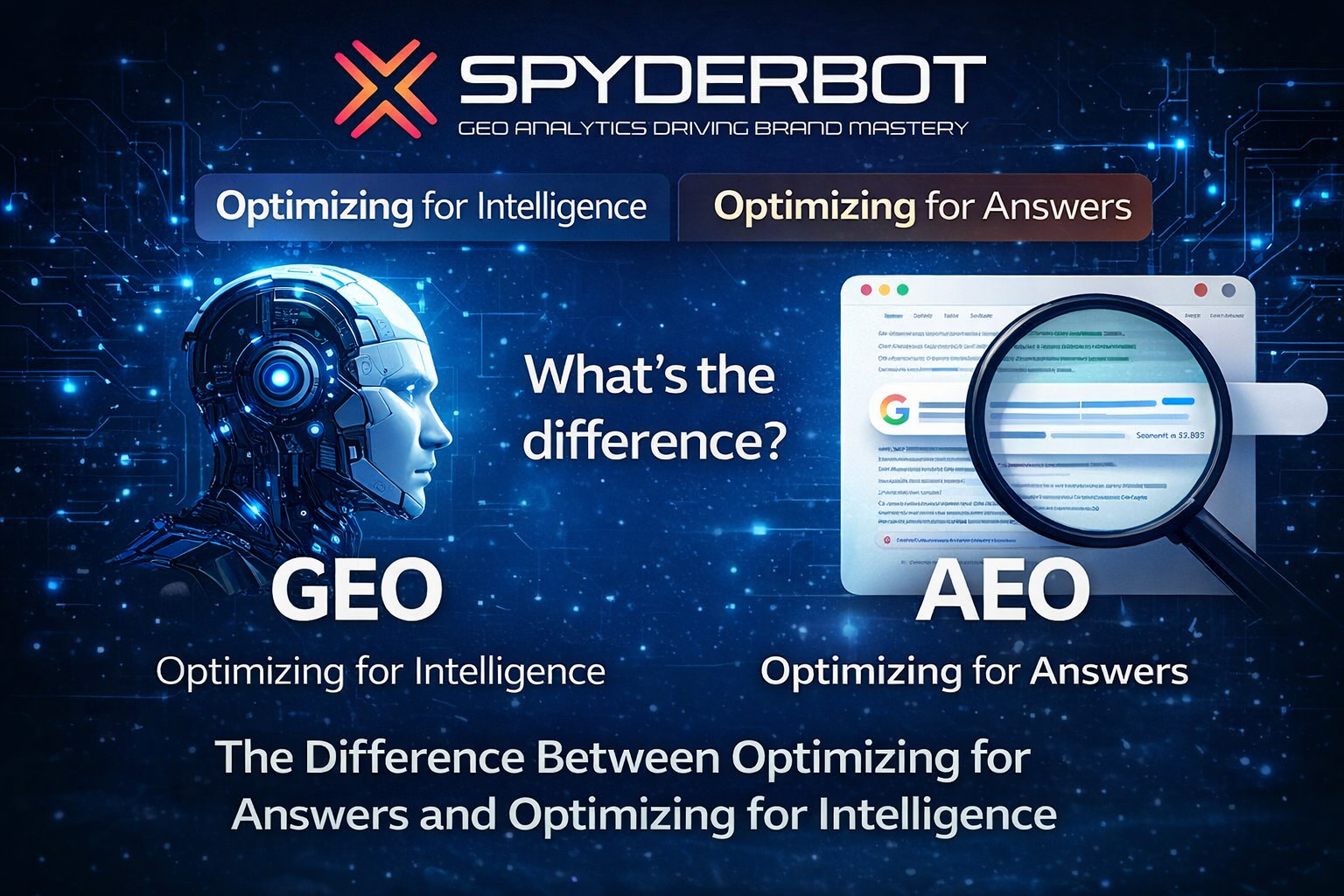
AEO helps content become a direct answer.
GEO helps brands become understood, included, and represented inside AI-generated answers.
That distinction matters because modern AI systems do not only retrieve answers. They generate responses, compare options, interpret brands, and shape user perception.
What is AEO?
AEO stands for Answer Engine Optimization.
It is the practice of structuring content so it can be selected as a direct answer to a specific question.
AEO became important during the rise of:
Featured snippets
Voice search
People Also Ask results
FAQ-style content
Direct answer boxes
Search assistants
The goal of AEO is simple:
Answer the user’s question clearly enough to be selected as the answer.
For example, if someone searches:
“What is Answer Engine Optimization?”
AEO-focused content would aim to provide a short, clear, structured answer that search engines or answer systems can easily extract.
AEO is useful because many users want quick answers.
It works especially well for:
Definitions
Simple explanations
How-to questions
FAQ content
Factual queries
Step-by-step answers
Voice search responses
AEO is usually query-level.
It asks:
How can this piece of content become the answer to this question?
What is GEO?
GEO stands for Generative Engine Optimization.
It is the process of improving how AI systems understand, mention, compare, and represent a brand inside generated answers.
GEO is broader than answering one question.
It focuses on AI visibility across many prompts, contexts, competitors, and generated responses.
GEO asks questions like:
Does ChatGPT mention our brand?
Does Gemini understand our product category?
Does Claude compare us with the right competitors?
Does Grok describe our brand accurately?
Are we included in high-intent AI answers?
Are competitors recommended before us?
Are AI systems misrepresenting our website?
Are we visible across multiple prompt variations?
In practical terms:
AEO is about being selected as an answer. GEO is about being consistently included and correctly positioned inside AI-generated answers.
GEO vs AEO: the simple difference
The simplest way to separate AEO and GEO is this:
AEO optimizes content for direct answers.
GEO optimizes brand visibility inside generative AI responses.
AEO is usually focused on a specific question.
GEO is focused on how AI systems understand the brand across many questions.
AEO is content-snippet oriented.
GEO is entity and brand oriented.
AEO helps you win a direct answer.
GEO helps you build visibility, prominence, and perception inside AI-generated answers.
GEO vs AEO comparison table
Dimension
AEO
GEO
Full name
Answer Engine Optimization
Generative Engine Optimization
Main focus
Direct answers
AI-generated brand visibility
Core unit
Content snippet, answer block, FAQ
Brand, entity, product, category
Scope
Query-level
System-level and prompt-level
Goal
Become the answer to a specific question
Be included, described, and positioned across generated answers
Common use cases
Featured snippets, voice search, FAQ answers
ChatGPT mentions, Gemini visibility, Claude comparisons, AI competitor monitoring
Main metric
Answer selection
AI visibility, mention frequency, prominence, sentiment, accuracy
Strategy
Structure clear answers
Improve entity clarity, context, positioning, and consistency
Main risk
Not being selected as the direct answer
Being ignored, misrepresented, or ranked behind competitors
Why AEO and GEO are often confused
AEO and GEO are often confused because both respond to the same shift: users want answers faster.
Traditional SEO was built around search results.
AEO emerged because search engines started showing direct answers.
GEO emerged because generative AI systems started producing synthesized responses that can include multiple brands, sources, comparisons, and recommendations.
The overlap is real.
Both AEO and GEO benefit from:
Clear content
Structured information
Helpful answers
Question-based headings
Strong topical relevance
Consistent terminology
Good SEO fundamentals
Google also says its AI features are part of Search and that site owners should continue following SEO fundamentals, including making content helpful, accessible, crawlable, and eligible for Search experiences.
But the difference is still important.
AEO focuses on answering.
GEO focuses on being understood and included.
AEO is query-level. GEO is system-level.
AEO is usually tied to one question.
For example:
“What is GEO?”
AEO asks:
How can we structure a concise answer that explains GEO clearly?
GEO asks a broader question:
How do AI systems understand our brand, category, competitors, and relevance across many prompts?
That means GEO goes beyond one answer box.
It looks at patterns.
For example:
Are we mentioned across different AI systems?
Are we mentioned for category-level prompts?
Are we mentioned for competitor prompts?
Are we positioned as a leader or a secondary option?
Are our use cases described correctly?
Are competitors appearing more often?
Are AI systems citing the right sources?
This is why GEO needs monitoring and analytics, not just better answer formatting.
Example: AEO vs GEO in action
Imagine a user asks:
“What is AI brand monitoring?”
An AEO strategy would help your content provide a clear answer:
“AI brand monitoring is the process of tracking how AI systems mention, describe, and compare a brand across generated answers.”
That can help your content become a direct answer.
Now imagine users ask:
What are the best AI brand monitoring tools?
Which platforms track ChatGPT brand mentions?
What are the best GEO analytics platforms?
How does SpyderBot compare with other AI visibility tools?
What tools help monitor LLM brand visibility?
Why does ChatGPT recommend one competitor over another?
This is where GEO becomes more important.
The goal is not only to answer one definition.
The goal is to make sure your brand is included, accurately described, and positioned strongly across multiple AI-generated answers.
Why AEO alone is no longer enough
AEO is still useful.
But it is not enough for modern AI search.
AEO works well when the user needs a clear answer to a specific question.
But AI systems now handle more complex tasks:
Comparing products
Recommending vendors
Explaining trade-offs
Summarizing categories
Creating buyer shortlists
Personalizing answers
Combining multiple sources
Generating follow-up explanations
In those cases, there may not be a single answer slot.
Instead, the AI system may generate a response that includes several entities, competitors, sources, and recommendations.
That means visibility becomes more complex.
The question is no longer only:
Did we get the answer?
The question becomes:
How often are we included, where do we appear, and how are we described?
That is GEO.
GEO expands beyond AEO
GEO includes some AEO tactics, but it goes further.
AEO tactics include:
Using clear headings
Answering questions directly
Writing concise definitions
Structuring FAQ content
Using schema where appropriate
Matching question-based intent
GEO strategy includes:
Improving brand entity clarity
Strengthening category association
Monitoring AI brand mentions
Tracking competitor visibility
Analyzing AI answer framing
Improving contextual consistency
Building comparison and use case content
Measuring prompt-level inclusion
Detecting misrepresentation
Tracking AI citations and source patterns
AEO can help make content easier to extract.
GEO helps make the brand easier to understand and recommend.
The shift from answers to narratives
AEO is about winning answers.
GEO is about shaping narratives.
This matters because AI systems do not only tell users what something means.
They also tell users which brands matter, which options are trustworthy, which competitors are relevant, and which products fit a specific use case.
For example, an AI answer may describe a brand as:
A market leader
A newer alternative
A budget option
An enterprise solution
A niche tool
A strong choice for SaaS teams
A less established competitor
That framing affects perception.
A brand may be mentioned, but still lose if the description is weak or if competitors are framed more confidently.
This is why GEO is not only a content tactic. It is a visibility and brand strategy.
GEO vs AEO vs SEO
To understand the full picture, it helps to compare SEO, AEO, and GEO together.
Dimension
SEO
AEO
GEO
Main interface
Search results
Direct answers
AI-generated responses
Main goal
Rank webpages
Become the answer
Be included and accurately represented
Core unit
Page
Snippet or answer
Entity, brand, product, category
Scope
Page-level
Query-level
Prompt-level and system-level
Main metric
Rankings, impressions, clicks
Answer selection
AI visibility, mention frequency, prominence, accuracy
User behavior
Search, compare, click
Ask, receive answer
Ask, compare, decide
Main risk
Ranking below competitors
Not being selected as the answer
Being ignored, misrepresented, or positioned behind competitors
The best strategy is not SEO vs AEO vs GEO.
It is SEO plus AEO plus GEO.
SEO helps users and search engines find your pages.
AEO helps your content answer specific questions clearly.
GEO helps AI systems understand, include, and describe your brand across generated answers.
How companies should use AEO
AEO should remain part of your content strategy.
Use AEO when you want to answer specific questions clearly.
For example:
What is Generative Engine Optimization?
What is Answer Engine Optimization?
What is AI visibility?
How does AI search work?
What is LLM brand monitoring?
To improve AEO, companies should:
Use question-based headings
Answer the question directly near the top
Keep definitions clear
Add examples
Use bullet points when helpful
Structure FAQ sections
Match visible content with structured data if using schema
Google explains that structured data helps Google understand page content, but the markup should reflect visible content on the page.
How companies should build GEO
GEO requires a broader strategy.
To build GEO, companies should:
1. Clarify the brand entity
Make it clear who you are, what you do, who you serve, what category you belong to, and what makes you different.
For example:
SpyderBot is a GEO analytics platform that helps brands understand how AI systems like ChatGPT, Gemini, Claude, and Grok mention, compare, and interpret their websites and competitors.
That sentence is strong because it gives AI systems a clear brand-category-use case relationship.
2. Track AI visibility
Monitor whether your brand appears across important prompt clusters.
Examples:
Best GEO analytics platforms
Tools to track ChatGPT brand mentions
AI search competitor monitoring tools
How to monitor LLM brand visibility
Alternatives to [competitor]
How to improve AI visibility
3. Compare competitor mentions
GEO is competitive.
You need to know which competitors appear, where they appear, and how they are described.
Track:
Mention frequency
Mention order
Recommendation strength
Competitor framing
Use case association
Citation patterns
4. Improve contextual consistency
Your brand should be described consistently across your website, social profiles, product directories, articles, documentation, and third-party mentions.
If AI systems see inconsistent descriptions, they may struggle to classify your brand correctly.
5. Build content around AI-style prompts
AI users ask specific, conversational questions.
Create content around prompts like:
Why is ChatGPT not mentioning my brand?
Why does AI recommend my competitor?
How do LLMs choose which brands to mention?
How can brands improve AI visibility?
What is the difference between GEO and AEO?
How do I track brand mentions in AI answers?
Where SpyderBot fits
SpyderBot focuses on the GEO layer.
AEO can help you structure content to answer questions.
SEO can help your website get discovered and indexed.
But SpyderBot helps answer a deeper question:
How are AI systems actually interpreting your brand and competitors?
SpyderBot helps brands monitor:
AI brand mentions
Competitor mentions
Prompt-level visibility
AI answer positioning
Brand perception
LLM interpretation patterns
AI visibility gaps
Changes across AI systems over time
That matters because companies cannot improve what they cannot see.
If ChatGPT mentions your competitor more often, Gemini describes your brand incorrectly, or Claude places your company in the wrong category, traditional SEO tools may not show that clearly.
SpyderBot is built to reveal that layer.
Common mistakes when comparing GEO and AEO
Mistake 1: Thinking AEO and GEO are the same
They overlap, but they are not identical.
AEO focuses on direct answers.
GEO focuses on generated answer visibility, brand inclusion, and AI interpretation.
Mistake 2: Treating GEO as only FAQ optimization
FAQ content can support GEO, but GEO is much broader.
It includes entity clarity, competitor analysis, prompt monitoring, AI perception, and visibility tracking.
Mistake 3: Ignoring brand positioning
AEO may help you answer a question.
But GEO asks whether AI systems understand your brand strongly enough to recommend it.
That requires clear positioning.
Mistake 4: Measuring only answer selection
Getting one answer box is useful, but it does not show full AI visibility.
You need to measure how often and how accurately your brand appears across many generated responses.
Mistake 5: Ignoring competitors
In AI-generated answers, your competitor may appear before you, be described better, or be recommended more confidently.
GEO requires competitor monitoring.
Final answer: Is GEO the same as AEO?
No.
GEO and AEO are related, but they are not the same.
AEO helps content become a direct answer to a specific question.
GEO helps brands become understood, included, and accurately represented across AI-generated answers.
AEO is a useful tactic.
GEO is a broader visibility strategy.
As AI search becomes more important, companies need both.
AEO helps you answer questions.
GEO helps you become part of the answer.
SpyderBot helps brands monitor the GEO side of AI search.
If your company wants to know whether ChatGPT, Gemini, Claude, or Grok is mentioning your brand, recommending competitors, or misunderstanding your website, SpyderBot gives you the visibility layer needed to compete inside AI-generated answers.
For years, SEO defined how brands competed for visibility online.
If users searched for a product, service, or solution, companies tried to rank higher on Google. The logic was simple: better rankings meant more visibility, more clicks, and more opportunities to convert users.
That model still matters.
SEO is not dead. Google still crawls, indexes, and ranks webpages. Strong technical SEO, helpful content, clear internal links, and accessible pages are still essential. Google’s own SEO Starter Guide explains that SEO helps search engines understand your content and helps users find your site through search.
But the search experience is changing.
Users are no longer only typing keywords into Google and scanning a list of links. They are also asking AI systems like ChatGPT, Gemini, Claude, Grok, and Copilot for direct answers, comparisons, and recommendations.
That creates a new layer of visibility.
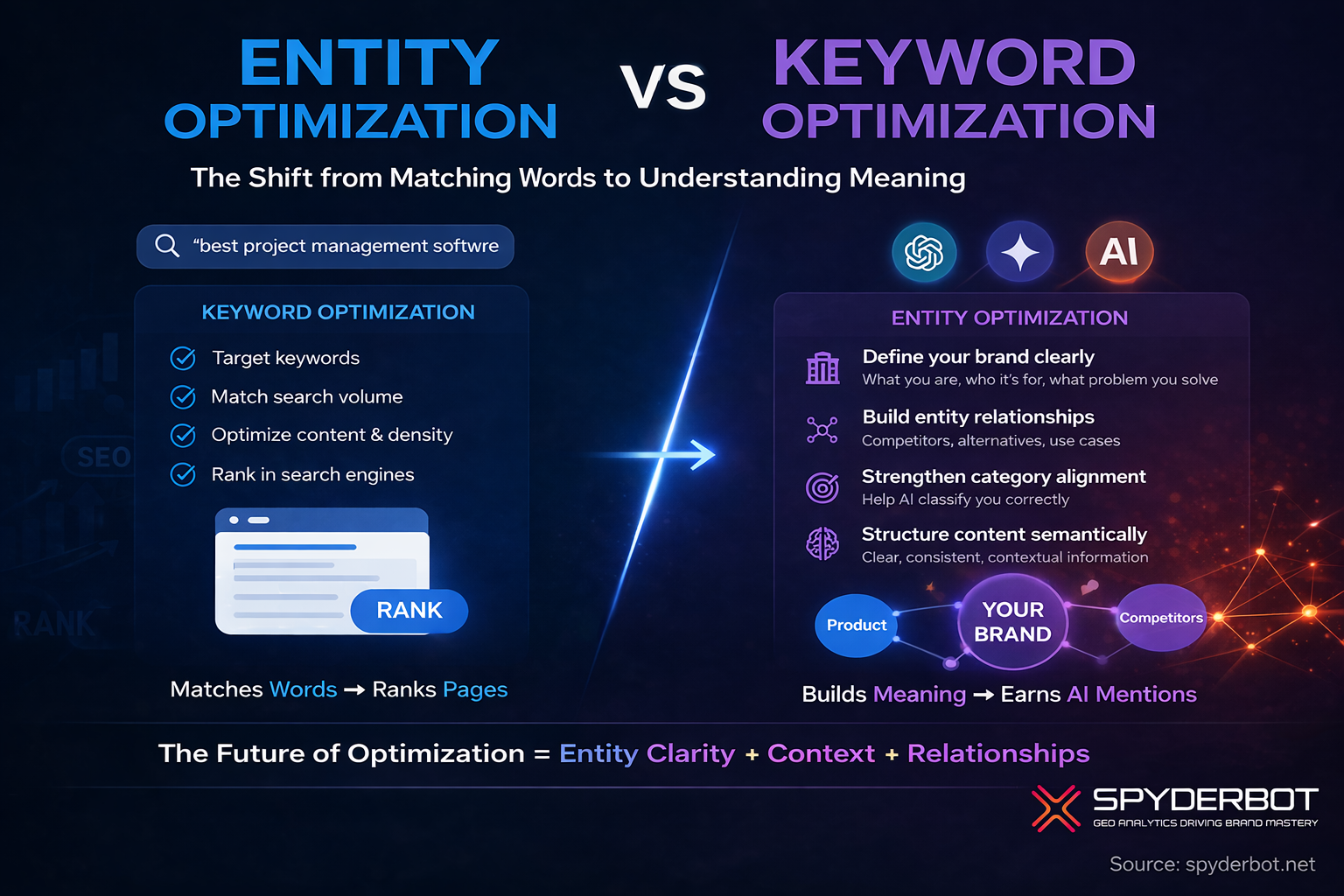
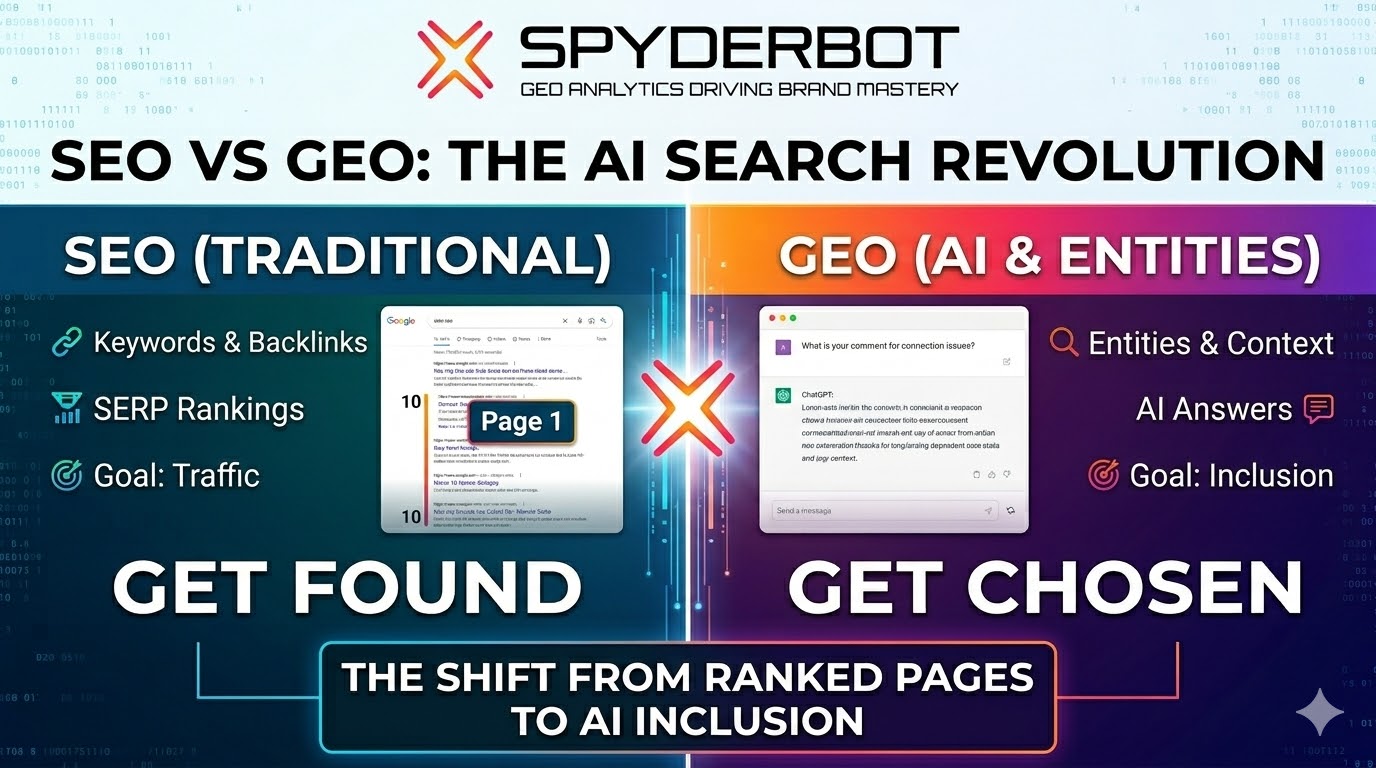
In SEO, your webpage competes for ranking.
In GEO, your brand competes for inclusion inside AI-generated answers.
That is the core difference between Search Engine Optimization and Generative Engine Optimization.
What is SEO?
SEO stands for Search Engine Optimization.
It is the process of improving a website so search engines can crawl, understand, index, and rank its pages.
SEO focuses on webpage visibility in search results.
Common SEO work includes:
Keyword research
Technical SEO
Content optimization
Internal linking
Backlink building
Page speed improvement
Search intent matching
Structured data
Title tags and meta descriptions
Content updates
The goal of SEO is to help users find your pages when they search for relevant topics.
For example, if someone searches “best AI brand monitoring tools,” SEO helps your article, comparison page, or product page appear in Google Search.
SEO is mostly page-centric.
It asks:
Can this webpage rank for the query?
What is GEO?
GEO stands for Generative Engine Optimization.
It is the process of improving how AI systems understand, mention, compare, and represent a brand in generated answers.
GEO focuses on AI visibility.
Instead of asking only whether a webpage ranks, GEO asks whether a brand is included when AI systems generate answers.
For example, a user may ask ChatGPT:
“What are the best tools to track brand mentions in AI answers?”
The answer may mention only a few tools. If your brand is not included, the user may never consider you.
GEO is more entity-centric.
It asks:
Can AI systems understand our brand clearly enough to include it in relevant answers?
The simple difference between GEO and SEO
The easiest way to understand it is this:
SEO helps your pages get found.
GEO helps your brand get included.
SEO is about search result visibility.
GEO is about AI answer visibility.
SEO measures how webpages perform in search engines.
GEO measures how brands appear inside AI-generated answers.
Both are important, but they solve different problems.
GEO vs SEO comparison table
Dimension
SEO
GEO
Main goal
Rank webpages in search results
Get brands included in AI-generated answers
Core unit
Page
Entity, brand, product, category
Visibility model
Search result list
AI-generated answer
Main output
Links, snippets, rankings
Mentions, recommendations, summaries
Primary metric
Rankings, impressions, clicks, traffic
Mentions, inclusion, prominence, accuracy
Optimization focus
Keywords, technical SEO, content quality, links
Entity clarity, context, semantic consistency, AI interpretation
Competition type
Position-based
Mention-based
User behavior
Search, compare, click
Ask, receive, decide
Main risk
Ranking below competitors
Being excluded or misrepresented
Why SEO alone is no longer enough
SEO still matters because it helps your content become discoverable, crawlable, indexable, and useful in search.
But SEO alone does not show the full visibility picture anymore.
A website can have:
Strong rankings
Good backlinks
High-quality content
Organic traffic
A technically healthy site
And still be missing from AI-generated answers.
This is the AI visibility gap.
The gap happens because AI-generated answers do not always behave like search engine results pages. Instead of showing a list of webpages, AI systems synthesize information and may mention only selected brands, sources, or products.
That means ranking on Google does not automatically guarantee that ChatGPT, Gemini, Claude, Grok, or Copilot will recommend your brand.
SEO is visible. GEO is harder to see.
SEO is easier to measure because search engines provide visible signals.
You can track:
Ranking position
Search impressions
Click-through rate
Organic traffic
Indexed pages
Backlinks
Search Console performance
Conversion paths
GEO is harder to measure because AI answers are not always fixed or transparent.
You need to track:
Whether your brand appears in AI answers
Which competitors appear instead
How often your brand is mentioned
Where your brand appears in the answer
Whether your brand is described accurately
Whether AI systems cite your website
Whether your brand appears across different prompt clusters
Whether different AI systems describe your brand differently
This is why AI visibility tracking is becoming important.
In SEO, you can see your position.
In GEO, you need to know whether you are included, ignored, misrepresented, or positioned behind a competitor.
GEO still has ranking, but it is hidden
Some people assume AI search has no ranking.
That is not accurate.
AI systems still make selection decisions.
They decide:
Which brands to mention
Which brands to omit
Which sources to cite
Which options to recommend first
Which competitors to compare
Which category to place your brand in
Which description to use
The ranking is simply less visible.
In Google Search, ranking appears as a list.
In AI-generated answers, ranking is embedded inside the response.
That creates three important GEO layers.
1. Inclusion
Is your brand mentioned at all?
This is the first layer of AI visibility.
If your brand is not included, the user may never consider you.
2. Prominence
If your brand is mentioned, where does it appear?
Are you the first recommendation, one of several options, or a minor alternative?
Prominence matters because users often trust the first few brands AI systems mention.
3. Positioning
How does the AI system describe your brand?
Are you described as:
A category leader
A niche tool
A new alternative
A lower-cost option
An enterprise solution
A limited product
A trusted provider
Positioning affects perception.
A brand can be mentioned and still lose if the AI description is weak, inaccurate, or less confident than the competitor’s description.
Example: SEO vs GEO in action
Imagine a user is looking for project management software.
In traditional SEO, the user searches:
“best project management software”
Google shows a list of results. The user can compare articles, ads, review pages, and vendor websites.
In this model, ranking on page one gives your brand a chance to earn attention.
Now imagine the user asks an AI system:
“What is the best project management software for a small remote team?”
The AI system may answer with three or four tools and explain why each one is useful.
If your brand is not included, you are not part of the decision.
That is the difference.
SEO gives you visibility in a list.
GEO gives you visibility inside the answer.
The shift from pages to entities
SEO is mostly page-centric.
Search engines rank individual URLs based on relevance, quality, technical accessibility, links, and other signals.
GEO is more entity-centric.
AI systems need to understand what your brand is, what it does, who it serves, what category it belongs to, and how it compares with alternatives.
For GEO, your brand needs clear entity signals, including:
Brand name
Website
Product category
Company description
Target audience
Use cases
Competitors
Differentiators
Industry context
Consistent descriptions across the web
For example, this is a weak entity description:
“SpyderBot is an AI analytics platform.”
This is stronger:
SpyderBot is a GEO analytics platform that helps brands understand how AI systems like ChatGPT, Gemini, Claude, and Grok mention, compare, and interpret their websites and competitors.
The second sentence is stronger because it clearly explains the category, function, platforms, and value.
The shift from traffic to influence
SEO has traditionally focused on traffic.
That makes sense. More organic traffic usually means more chances to generate leads, signups, sales, or awareness.
But AI search introduces influence before the click.
A user may ask AI for recommendations and form an opinion before visiting any website.
This means GEO is not only about traffic.
It is also about:
Brand perception
Recommendation visibility
Competitive framing
Trust signals
Category association
Answer accuracy
Inclusion in buyer-intent prompts
A brand may lose influence even if traffic has not dropped yet.
That is why companies should monitor AI visibility before it becomes an obvious revenue problem.
The shift from links to meaning
Backlinks have long been important in SEO because they help search engines discover pages and evaluate authority.
In GEO, links can still matter as part of the broader information ecosystem, but meaning becomes more important.
AI systems need to understand relationships:
What problem does your brand solve?
Which category does it belong to?
Which competitors are relevant?
What use cases does it support?
What type of customer is it built for?
What makes it different?
Which sources describe it consistently?
GEO requires semantic clarity.
Repeating keywords is not enough.
The goal is to make your brand easier to understand, not just easier to crawl.
How GEO changes content strategy
GEO changes how brands should create content.
In traditional SEO, many companies built separate pages for many keyword variations. That approach can create thin or repetitive content.
Google says its ranking systems are designed to prioritize helpful, reliable information created to benefit people, not content created mainly to manipulate rankings.
For GEO, this matters even more.
AI systems need clarity, not repetition.
Instead of creating many weak articles around similar terms, build strong topic clusters.
For example, a GEO content cluster could include:
What is Generative Engine Optimization?
GEO vs SEO
Why ChatGPT is not mentioning your brand
How to track brand mentions in LLMs
How AI systems choose which brands to mention
Best GEO analytics tools
AI visibility tracking for SaaS brands
Each article should have a distinct purpose.
This article explains the difference between GEO and SEO.
A “What is GEO?” article should define the concept in detail.
A “Why ChatGPT is not mentioning your brand” article should address a specific problem.
A “Best GEO analytics tools” article should support commercial search intent.
This prevents content cannibalization and helps both users and search engines understand the role of each page.
How to optimize for SEO
Companies should continue investing in SEO fundamentals.
That includes:
Publishing helpful content
Matching search intent
Making pages crawlable
Keeping pages indexable
Improving site speed
Using clear internal links
Writing descriptive title tags
Creating useful meta descriptions
Adding structured data where appropriate
Improving topical authority
Updating outdated content
Google’s documentation explains that Search works through crawling, indexing, and serving results, and not every page makes it through every stage.
That means technical accessibility and content quality still matter.
How to optimize for GEO
GEO requires an additional layer of work.
1. Clarify your brand entity
Your website should clearly explain:
Who you are
What you do
Who you serve
What problem you solve
What category you belong to
What makes you different
Avoid vague positioning.
If your brand can be described in five different ways, AI systems may struggle to classify it.
2. Build content around AI-style questions
AI users ask longer, more specific questions.
Examples:
Why is ChatGPT not mentioning my brand?
How do LLMs choose which brands to recommend?
How can I track AI brand mentions?
How does AI search differ from Google search?
What tools monitor AI visibility?
Why does my competitor appear in AI-generated answers?
These questions should become part of your content strategy.
3. Monitor brand mentions across AI systems
Manual testing is useful, but it is not enough.
You should track how your brand appears across:
ChatGPT
Gemini
Claude
Grok
Copilot
AI search experiences
Measure not only whether your brand appears, but also how it is described.
4. Compare competitor visibility
GEO is competitive.
If your competitors appear more often than you, you need to know why.
Track:
Which competitors appear
Which prompts trigger competitor mentions
How competitors are described
Whether competitors are cited
Which use cases competitors dominate
Whether your brand is missing from key categories
5. Improve consistency across the web
AI systems rely on patterns.
If your website, social profiles, third-party listings, product pages, and articles describe your company inconsistently, AI systems may form a weak understanding of your brand.
Consistency helps reinforce entity clarity.
SEO and GEO should work together
The future is not SEO vs GEO.
The future is SEO plus GEO.
SEO helps your website get discovered, crawled, indexed, and ranked.
GEO helps AI systems understand, include, and describe your brand.
A strong digital visibility strategy should include both.
Think of it this way:
SEO builds discoverability.
GEO builds AI inclusion.
SEO helps users find your pages.
GEO helps AI systems recommend your brand.
SEO measures rankings and traffic.
GEO measures mentions, prominence, and perception.
The strongest brands will not choose one over the other.
They will build a system where SEO and GEO support each other.
Founder insight from SpyderBot
While building SpyderBot, one pattern became clear:
The next stage of search visibility is not only about where your website ranks. It is about how AI systems understand your brand.
Traditional SEO tools are excellent for tracking rankings, traffic, backlinks, and technical performance.
But they do not fully answer the new questions companies now face:
What do LLMs mention about our competitors to users?
How are AI systems interpreting our website?
Are we included in AI-generated recommendations?
Are we being compared with the right competitors?
Are AI systems describing our product accurately?
That is why GEO matters.
It fills the gap between traditional search visibility and AI-generated brand perception.
GEO vs SEO checklist
Use this checklist to understand where your company stands.
SEO checklist
Is your website indexable?
Are your important pages included in the sitemap?
Are your title tags clear?
Are your meta descriptions useful?
Are your pages internally linked?
Is your content helpful and original?
Does each page target a distinct search intent?
Are your pages fast and mobile-friendly?
Do you have clear company and trust signals?
GEO checklist
Does AI correctly understand what your brand does?
Does your brand appear in ChatGPT for category prompts?
Does your brand appear in Gemini, Claude, Grok, and Copilot?
Are your competitors mentioned more often?
Is your brand description accurate?
Are you included in buyer-intent prompts?
Are you associated with the right category?
Are you compared with the right competitors?
Do AI systems mention your strongest use cases?
Is your brand consistently described across the web?
Common mistakes when comparing GEO and SEO
Mistake 1: Thinking GEO replaces SEO
GEO does not replace SEO.
SEO remains the foundation of website visibility. Without strong SEO, your content may struggle to be discovered and understood.
GEO adds another layer focused on AI-generated answers.
Mistake 2: Treating GEO as keyword stuffing
GEO is not about repeating “AI visibility,” “LLM monitoring,” or “ChatGPT SEO” many times.
It is about making your brand understandable and contextually relevant.
Mistake 3: Publishing duplicate content
Many brands will publish multiple articles that say almost the same thing:
What is GEO?
GEO vs SEO
Why GEO matters
AI search vs SEO
Future of GEO
These articles must have different angles.
Otherwise, they may compete with each other and weaken the site.
Mistake 4: Measuring only traffic
Traffic is important, but it does not show the full picture.
A brand can lose AI visibility before losing organic traffic.
That is why GEO measurement should include mentions, sentiment, prominence, competitor inclusion, and answer accuracy.
Mistake 5: Ignoring misrepresentation
Being mentioned is not enough.
If AI systems describe your brand incorrectly, your GEO strategy still has a problem.
Accuracy matters as much as visibility.
Final thought
SEO is about being found.
GEO is about being included.
SEO helps your pages appear in search results.
GEO helps your brand appear in AI-generated answers.
In the past, digital visibility was mostly about ranking on a results page. In the AI search era, visibility also depends on whether AI systems understand, select, and accurately describe your brand.
The best strategy is not to choose between SEO and GEO.
The best strategy is to build both.
SpyderBot helps brands understand how AI systems mention, compare, and interpret them across major LLMs.
If your company wants to know whether ChatGPT, Gemini, Claude, or Grok is including your brand, ignoring your website, or recommending competitors instead, SpyderBot gives you a clearer view of your AI visibility and the signals shaping your position in AI-generated answers.
Most companies are still optimizing for search engines.
That still matters. Google is not disappearing. SEO is not dead. Rankings, technical SEO, useful content, internal links, and authority signals will continue to shape how people discover information online.
But the interface of the internet is changing.
Users are no longer only typing short keywords into a search box, scanning ten links, and choosing which website to visit. More often, they are asking AI systems like ChatGPT, Gemini, Claude, Grok, Copilot, and AI-powered search experiences for direct answers.
That change creates a new layer of competition.
In traditional SEO, brands compete to rank.
In Generative Engine Optimization, brands compete to be understood, selected, and included inside AI-generated answers.
That is the future of GEO.
What is Generative Engine Optimization?
Generative Engine Optimization, or GEO, is the practice of improving how AI systems understand, interpret, mention, and compare brands inside generated answers.
Traditional SEO focuses on search visibility. It helps webpages appear in search engine results.
GEO focuses on AI visibility. It helps brands appear accurately and confidently when AI systems generate answers, recommendations, comparisons, and summaries.
The difference is simple:
SEO helps your website rank. GEO helps your brand get included in AI-generated answers.
This distinction matters because users are increasingly asking questions like:
What are the best tools for AI brand monitoring?
Which GEO analytics platforms should I compare?
How can I track brand mentions in ChatGPT?
What are the best alternatives to a specific SEO platform?
Why does ChatGPT recommend my competitor instead of my brand?
These questions are not always answered with a traditional list of links. They may be answered with a synthesized response that includes only a few brands.
That is where GEO becomes important.
The future of search is not only ranking
For years, the digital marketing playbook was built around rankings.
If you ranked higher, you had more visibility. If you had more visibility, you had more clicks. If you had more clicks, you had more chances to convert users.
That model still works, but it is no longer complete.
AI search changes the user journey.
A user may ask a complex question, receive a summarized answer, compare options, and make a decision without opening ten different pages.
This means brands need to think beyond ranking position.
The future of visibility will depend on three things:
Inclusion: Is your brand mentioned?
Prominence: Is your brand presented clearly and near the top of the answer?
Perception: Is your brand described accurately and positively?
This is the core shift from SEO to GEO.
Why AI visibility will become a core business metric
AI visibility measures how often, how accurately, and how prominently a brand appears in AI-generated answers.
Today, most companies track metrics like:
Organic traffic
Keyword rankings
Click-through rate
Backlinks
Impressions
Conversions
These metrics are still useful.
But they do not answer a critical new question:
What do AI systems say about your brand when users ask for recommendations?
That question matters because AI-generated answers can influence buying decisions before a user ever reaches your website.
A company may have strong Google rankings but weak AI visibility. Another company may have weaker traditional SEO but stronger entity clarity, making it easier for AI systems to understand and mention it.
That is why AI visibility will become a core metric for modern digital strategy.
From SEO metrics to GEO metrics
As AI search grows, companies will need a new measurement layer.
SEO metrics answer questions like:
What keywords do we rank for?
How much organic traffic do we get?
Which pages receive impressions?
Which pages convert users?
GEO metrics answer different questions:
Is our brand mentioned in AI-generated answers?
Which competitors are mentioned more often?
How does AI describe our product?
What category does AI associate with our brand?
Are we included for high-intent prompts?
Are we cited as a source?
Is the answer accurate?
Is our brand positioned as a leader, alternative, niche tool, or missing option?
This shift is important because AI visibility is not only about traffic. It is also about perception.
If an AI system describes your brand incorrectly, the user may form the wrong opinion before visiting your site.
If a competitor appears repeatedly in AI answers and your brand does not, your market visibility is already being affected.
The evolution of optimization
Digital optimization is moving through three major phases.
Phase 1: SEO
SEO was built for search engines.
The goal was to help search engines crawl, index, understand, and rank webpages. Brands optimized around keywords, technical structure, backlinks, page quality, and search intent.
This phase is still important.
Without good SEO fundamentals, your website may struggle to be discovered, indexed, and understood.
Phase 2: GEO
GEO is built for AI-generated answers.
The goal is to help AI systems understand your brand as an entity, connect it to the right category, compare it correctly with competitors, and include it in relevant answers.
GEO focuses on:
Entity clarity
Brand positioning
Contextual relevance
Structured explanations
Consistent external signals
AI answer monitoring
Competitor mention tracking
Phase 3: AI-native optimization
The next phase will be AI-native optimization.
In this phase, companies will not only create content for human readers and search engines. They will also structure their digital presence so AI systems can interpret it more accurately.
This means brands will need to think about:
How their company is described across the web
How their products are categorized
Which use cases they are associated with
Which competitors they are compared against
Whether AI systems understand their unique value
Whether their content answers real prompts users ask AI systems
The future will reward brands that are easy for both humans and machines to understand.
How AI search will reshape competition
AI search will change how brands compete online.
1. Smaller brands can become more visible
In traditional SEO, larger brands often have an advantage because they have stronger domain authority, more backlinks, and more historical content.
In AI-generated answers, authority still matters, but it is not the only factor.
AI systems may include smaller brands when they have:
Clear positioning
Strong category relevance
Specific use cases
Consistent information
Distinct differentiation
Helpful explanatory content
This creates an opportunity for emerging companies.
A smaller brand may not outrank a large competitor on every Google keyword, but it may still appear in AI-generated answers for specific prompts if the brand is clearly understood.
2. Categories will be shaped by AI systems
Companies used to define their own categories through branding, messaging, and SEO content.
In the AI search era, categories will also be shaped by how AI systems understand the market.
For example, a company may describe itself as an “AI analytics platform,” but AI systems may classify it as:
SEO software
Brand monitoring software
AI visibility tracking
LLM analytics
Competitor intelligence
Marketing analytics
If the category is unclear, the brand may appear in the wrong comparison set or be excluded from the right one.
GEO helps companies reduce that ambiguity.
3. Brand perception will become algorithmic
AI systems do not only retrieve information. They summarize, frame, and explain it.
That means users may see your brand described as:
A market leader
A niche alternative
A newer product
A competitor to another tool
A solution for a specific use case
An incomplete or unclear option
This framing matters.
If AI systems consistently position your competitor as the safer or more established choice, that can affect user perception.
If they fail to explain your strongest advantage, you may lose high-intent users before they compare your website.
This is why GEO is not only a content strategy. It is a brand strategy.
The future of content in the GEO era
Content will not disappear.
But the role of content will change.
In traditional SEO, many companies created content around individual keywords. That led to large libraries of similar articles targeting small variations of the same topic.
In the GEO era, that approach becomes risky.
AI systems need clarity, not repetition.
Winning content will be:
Clear
Structured
Specific
Contextual
Useful
Consistent
Easy to interpret
Instead of creating ten thin articles around similar terms, brands should create strong topic clusters.
For example, a GEO content cluster could include:
What is Generative Engine Optimization?
GEO vs SEO
Why AI search ignores your website
How to track brand mentions in ChatGPT
How AI systems compare competitors
Best GEO analytics tools
AI visibility tracking for SaaS companies
Each article should have a distinct purpose.
One article should define the category. Another should solve a problem. Another should compare approaches. Another should help users evaluate tools.
That structure is better for readers, search engines, and AI systems.
The future of analytics: from traffic to interpretation
Analytics has traditionally focused on what users do after they find you.
GEO analytics focuses on what AI systems say before users find you.
That is a major shift.
Companies will need tools that can answer questions like:
How often is my brand mentioned in ChatGPT?
How often is my competitor mentioned?
Which prompts include my brand?
Which prompts exclude my brand?
How does Gemini describe my product?
Does Claude understand my category?
Does Grok compare me with the right competitors?
Are AI systems using outdated information?
Which sources are influencing AI-generated answers?
Has our visibility improved after publishing new content?
This is why AI search analytics is becoming a new category.
It is not the same as traditional SEO analytics. It measures how AI systems interpret, include, and frame brands across generated answers.
The rise of GEO tools
As GEO becomes more important, a new ecosystem of tools will emerge.
These tools will help companies track:
AI brand mentions
LLM visibility
Competitor mentions
AI answer accuracy
Prompt-level performance
AI citation patterns
Brand perception
Category association
Changes across AI systems over time
This new category will become increasingly important because manual testing is not enough.
A marketing team can manually ask ChatGPT a few questions, but that does not create a reliable monitoring system.
To understand AI visibility properly, companies need repeatable tracking across prompts, models, competitors, and time.
That is where GEO analytics platforms become valuable.
What companies should do now
The future of GEO is already forming, but companies do not need to wait.
They can start preparing now.
Step 1: Audit your AI visibility
Start by testing how AI systems describe your brand.
Use prompts such as:
What does [your brand] do?
What are the best tools in [your category]?
What are the best alternatives to [competitor]?
Which companies help with [your use case]?
How does [your brand] compare with [competitor]?
Then check:
Is your brand mentioned?
Is the description accurate?
Are your competitors mentioned more often?
Is your website cited?
Is your product category correct?
Is your unique value included?
Step 2: Clarify your entity signals
Your website should make your brand easy to understand.
This includes:
A clear homepage description
A focused product category
Consistent messaging across pages
Strong about page information
Clear use case pages
Comparison pages
FAQ sections
Structured data where appropriate
Internal links between related articles
For SpyderBot, the core entity signal should be clear:
SpyderBot is a GEO analytics platform that helps brands understand how AI systems like ChatGPT, Gemini, Claude, and Grok mention, compare, and interpret their websites and competitors.
That sentence works because it explains the brand, the category, the platforms, the function, and the business value.
Step 3: Build content around real AI search questions
Do not only target keywords.
Target the questions users ask AI systems.
Examples:
Why is ChatGPT not mentioning my brand?
How do LLMs choose which brands to mention?
How can I monitor AI brand visibility?
What is the difference between SEO and GEO?
How can SaaS companies appear in AI search results?
Why does my competitor appear in AI-generated answers?
These questions are stronger than generic keyword variations because they match real user intent.
Step 4: Monitor competitors inside AI answers
GEO is not only about your brand.
It is also about who appears instead of you.
Track competitors across:
Recommendation prompts
Comparison prompts
Category prompts
Problem-based prompts
Alternative prompts
Buyer-intent prompts
The goal is to understand not only whether your brand appears, but also how the market is being framed by AI systems.
Step 5: Improve accuracy and consistency
AI systems may misunderstand your brand if your public information is unclear.
To reduce that risk, make sure your messaging is consistent across:
Website pages
Blog content
Schema markup
Social profiles
Product descriptions
Third-party profiles
Review platforms
Press mentions
Documentation pages
Consistency helps AI systems connect your brand to the right category and context.
Founder insight from SpyderBot
While building SpyderBot, one insight became obvious:
The next search battle is not only about who ranks. It is about who AI understands well enough to recommend.
Traditional SEO tools are excellent at showing rankings, traffic, backlinks, and keyword performance.
But they do not fully answer the new visibility questions:
What do LLMs mention about your competitors to users?
How are AI systems analyzing and tracking your website?
Is your brand included in AI-generated recommendations?
Is your brand being described accurately?
Are competitors shaping the category before users even visit your site?
These questions are becoming essential because AI systems are increasingly acting as interpreters between users and the web.
That is why GEO is not just another marketing trend.
It is a new layer of digital visibility.
Common mistakes companies will make with GEO
Mistake 1: Thinking SEO alone is enough
SEO remains important, but SEO alone does not guarantee AI visibility.
A page can rank well and still be absent from AI-generated answers.
That means brands need both SEO and GEO.
Mistake 2: Treating GEO as keyword stuffing
Repeating terms like “AI visibility tracking” or “LLM brand monitoring” does not automatically improve AI visibility.
AI systems need clear meaning, not repeated phrases.
The focus should be on entity clarity, useful explanations, and consistent context.
Mistake 3: Publishing too many similar articles
Publishing many similar articles can weaken your site.
For example, these topics may overlap if handled poorly:
What is GEO?
Why GEO matters
The future of GEO
GEO vs SEO
AI search optimization
Each article needs a distinct purpose.
This article focuses on the future of GEO. A separate “What is GEO?” article should define the concept. A “GEO vs SEO” article should compare the two disciplines. A “Why GEO matters” article should explain the business case.
If competitors are consistently mentioned and your brand is not, that is a serious signal.
You need to know which competitors appear, how they are described, and what prompts trigger their inclusion.
Mistake 5: Ignoring inaccurate AI answers
AI visibility is not only about being mentioned.
Accuracy matters.
If AI systems describe your brand incorrectly, place you in the wrong category, or miss your strongest use case, your GEO strategy needs to fix that.
The long-term future of GEO
The long-term future of GEO will be shaped by three forces.
1. AI-mediated discovery
Users will increasingly rely on AI systems to filter information.
Instead of visiting many websites, they will ask AI to summarize, compare, recommend, and explain.
This will make AI visibility a key part of brand discovery.
2. Entity-first marketing
Brands will need to become clear entities in the digital ecosystem.
That means consistent information, strong category association, and clear relationships between brand, product, audience, problem, and competitors.
3. Continuous AI visibility monitoring
Because AI answers change, GEO cannot be a one-time project.
Companies will need to monitor how their brand appears across AI systems over time.
This includes changes in:
Mention frequency
Competitor visibility
Answer accuracy
Citation patterns
Sentiment
Category association
Prompt-level performance
The companies that build this monitoring layer early will understand the market faster than competitors who rely only on traditional search metrics.
Final thought
SEO was about being found.
GEO is about being understood, selected, and included.
That difference matters because the future of search is moving from pages to answers, from rankings to recommendations, and from traffic alone to AI-shaped perception.
The companies that win the next decade of digital visibility will not only be the ones that rank on Google.
They will be the ones that AI systems can clearly understand, accurately describe, and confidently include.
That is the future of Generative Engine Optimization.
SpyderBot helps brands understand how AI systems mention, compare, and interpret them across major LLMs.
If your company wants to know whether AI systems are including your brand, ignoring your website, or recommending competitors instead, SpyderBot gives you a clearer view of your AI visibility and the signals shaping your position in AI-generated answers.