By SpyderBot Team · Last updated Nov 16, 2026
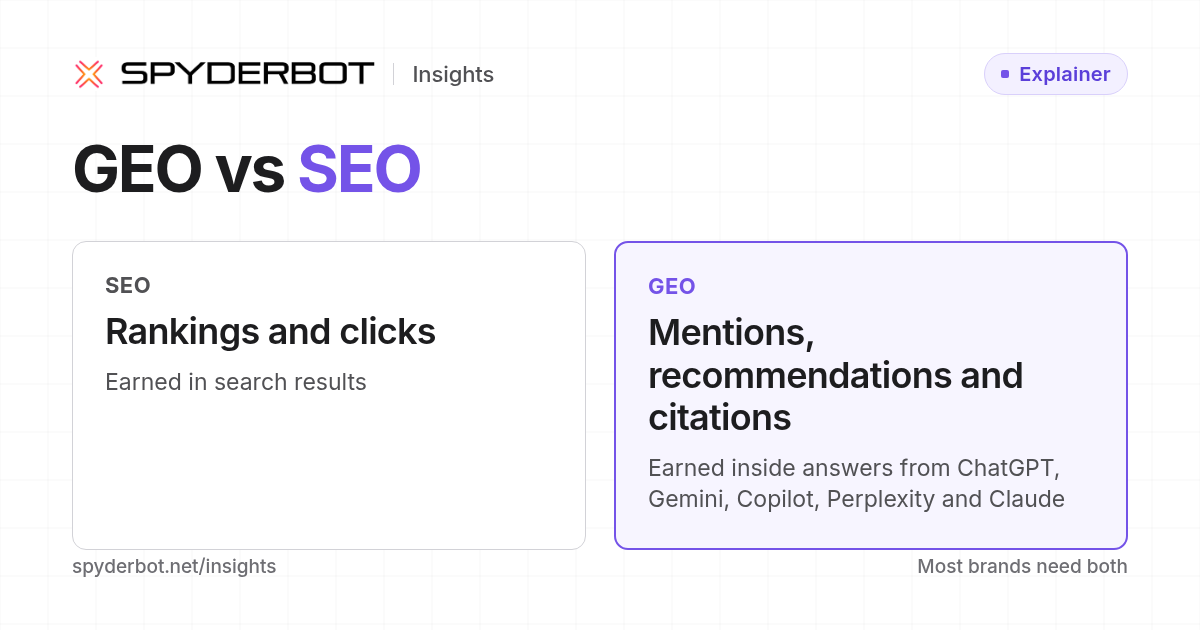
SEO (search engine optimization) earns rankings and clicks in search results. GEO (generative engine optimization) earns accurate mentions, recommendations and citations inside AI-generated answers from ChatGPT, Gemini, Copilot, Perplexity and Claude. They share technical foundations but differ in output, metrics and tools. Most brands need both, because search-grounded AI answers depend on crawlable, indexed pages.
New to the topic? Start with our definition of generative engine optimization.
What is the core difference between GEO and SEO?
SEO optimizes for a list of links. GEO optimizes for a written answer that may name several brands, quote facts and cite a handful of sources, or none.
| Dimension | SEO | GEO |
|---|---|---|
| Output you compete in | Ranked results page | Generated answer (mentions, recommendations, citations) |
| Success metric | Rankings, impressions, clicks, organic sessions | Visibility (mention rate), AI share of voice, recommendation rate, citations, sentiment, AI referrals |
| Stability | Fairly stable per query, location and device | Probabilistic; varies by run, model and version |
| Main lever | Relevance and authority of pages | Entity clarity, source authority, answer-ready facts, third-party coverage |
| Unit of optimization | Page and keyword | Entity (brand, product) and question |
| Who decides | One search engine’s ranking systems | Several models, each with its own retrieval and training data |
| Typical tools | Rank trackers, crawlers, Search Console, Bing Webmaster Tools | AI answer sampling across models, AI crawler and referral analytics |
A brand can rank first for “best CRM for startups” and still be missing from ChatGPT’s shortlist for the same question. The reverse also happens.
What stays the same?
AI answers that use live web search depend on search fundamentals:
- Indexing. Google says that to appear as a supporting link in AI Overviews or AI Mode, “a page must be indexed and eligible to be shown in Google Search with a snippet”. There are “no additional technical requirements” (Google Search Central).
- Bing grounding. Microsoft says Copilot generates a search query from the prompt and sends it to the Bing search service, then uses the results to compose its response (Microsoft Learn). If Bing has not indexed your pages, Copilot cannot ground on them.
- Crawl access. robots.txt, CDN and firewall rules must allow the crawlers you depend on, including AI search crawlers such as OpenAI’s OAI-SearchBot (OpenAI crawler documentation).
- Helpful content. Clear, accurate, people-first pages serve both rankings and AI retrieval.
So GEO is not a reason to stop SEO. Weak SEO usually means weak GEO for search-grounded answers.
What is different in GEO?
Measurement is sampling, not rank tracking
An AI answer can change between two identical requests. GEO measurement therefore runs each question several times, on several models, and reports rates. SpyderBot’s methodology is built on this principle: single answers are observations, not conclusions.
The brand, not the page, is the unit
Models reason about entities. Consistent facts across your site, structured data, profiles and third-party coverage, covering category, products, pricing and leadership, help the model describe you correctly.
Third-party sources carry more weight
AI answers often cite reviews, comparisons, documentation and forums rather than the brand’s own site. GEO includes earning presence on the sources the AI already uses for your category.
Different success metrics
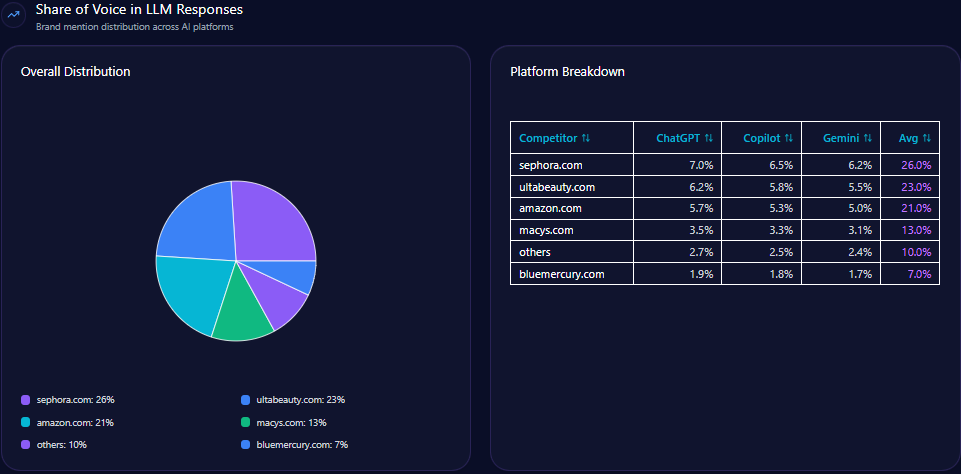
Share of voice inside answers, recommendation rate and sentiment have no direct SEO equivalent. Definitions and formulas are in the SpyderBot metrics glossary.
What does SpyderBot data show about GEO performance?
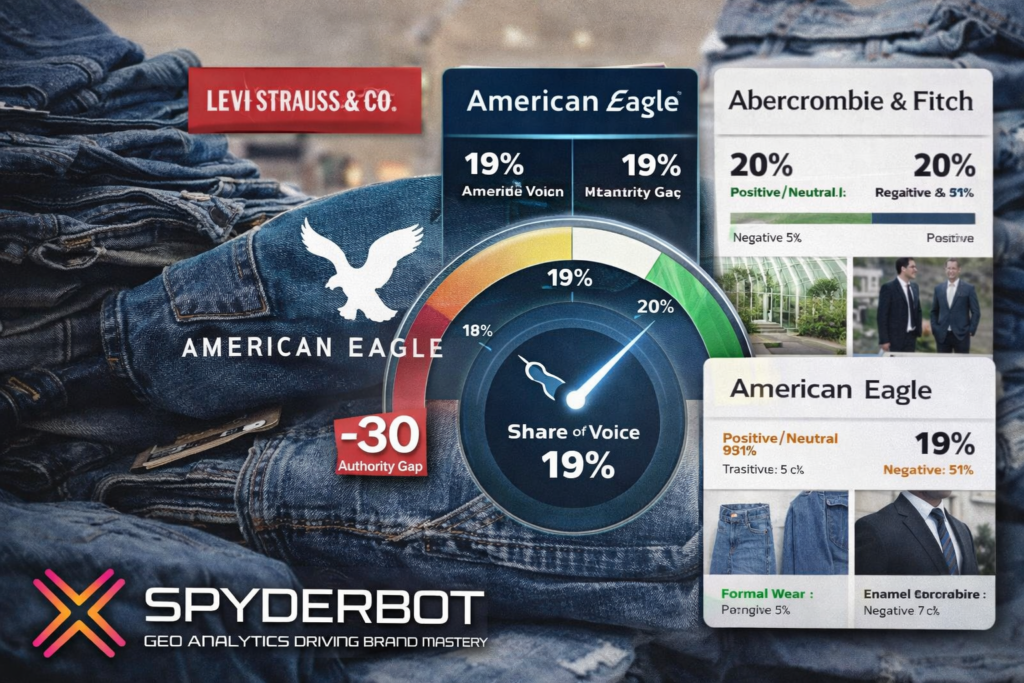
Across 152 public SpyderBot reports that state a share-of-voice figure (Dec 2025 – Sep 2026), the median analyzed brand held 17% AI share of voice against its competitive set, and 26% held under 10%. Where a report states a range, the low end is used. Even household names show modest shares: public reports for US retailers Macy’s and Kroger state 19% and 14% respectively, a European grocery report for Carrefour states 18%, and an Australian home-improvement report for Bunnings shows a leading overall position with competitors still winning specific buying-intent prompts. Search strength does not automatically become AI share, which is why GEO needs its own measurement. The data comes from the SpyderBot public report library. The brands are self-selected, and most reports cover ChatGPT, Gemini and Copilot.

How should you run GEO and SEO together?
- Share one technical baseline. Check indexing in Google Search Console and Bing Webmaster Tools, server-rendered content, clean sitemaps and correct canonical tags. Allow AI search and user-triggered crawlers alongside Googlebot and Bingbot.
- Map keywords to questions. For each priority keyword, write the 3–5 questions a buyer would ask an AI assistant, including comparison and “best for” variants.
- Write pages that serve both. Lead with an answer-first paragraph, back it with original data and comparison tables, add FAQs, and keep structured data that matches the visible text.
- Measure separately, report together. Use rank tracking and Search Console for SEO, and repeated AI-answer sampling plus AI crawler and referral analytics for GEO. Put both on one dashboard for leadership. In SpyderBot, the playbook for tracking AI visibility over time sets up the GEO side.
- Close the loop. When AI answers cite third-party pages, add those sites to your PR and partnership plans.
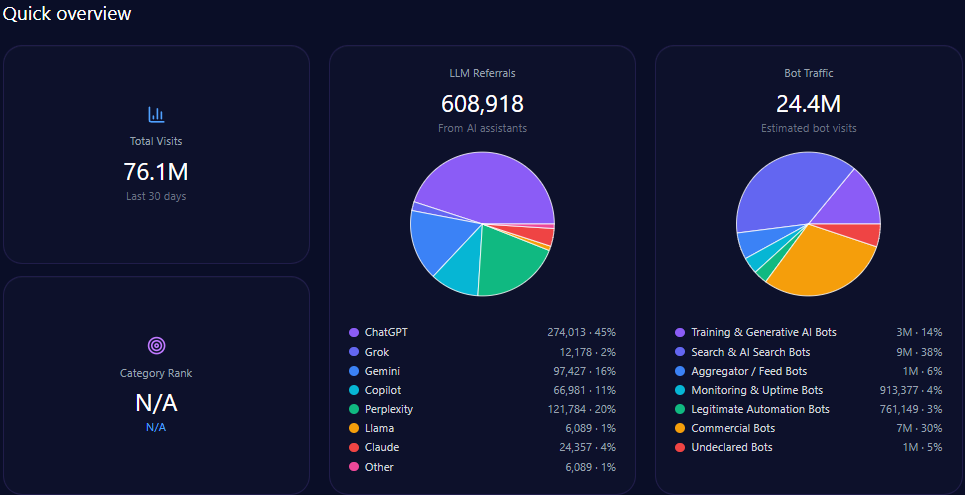
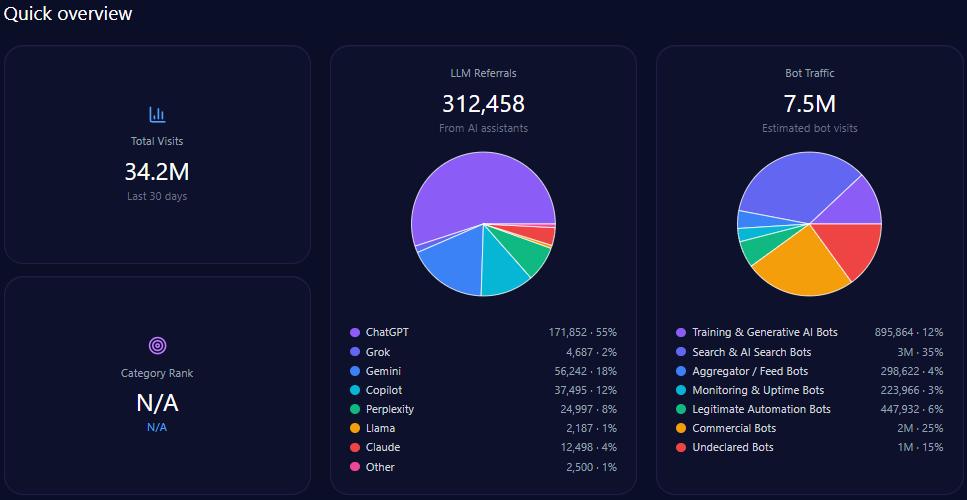
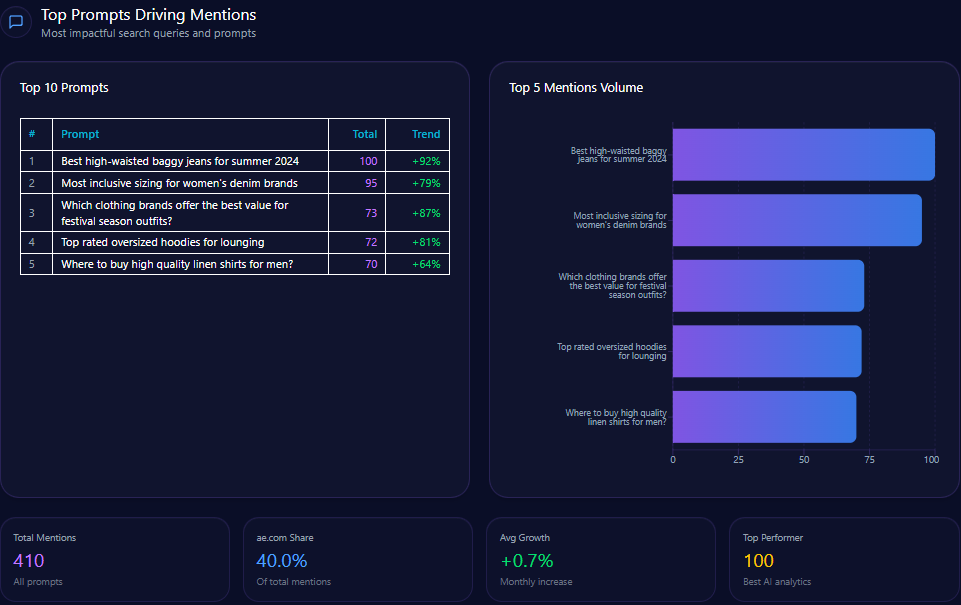
SpyderBot covers the GEO side with Brand Insights for answer-level measurement and AI Traffic for crawler and referral data. It complements, rather than replaces, an SEO suite. See also GEO tools vs traditional SEO tools, the 2026 GEO tools comparison, and the checklist for evaluating GEO tools.
Who should own GEO and SEO in the team?
In most organizations the SEO team is the natural owner of the technical baseline, and GEO needs three more inputs:
| Work | Typical owner | Why |
|---|---|---|
| Crawlability, indexing, rendering, sitemaps | SEO / web engineering | Shared foundation for search and AI retrieval |
| Prompt set and AI visibility reporting | SEO or a dedicated GEO lead | Needs a consistent method across models |
| Entity facts (category, products, pricing, leadership) | Product marketing | Must stay consistent everywhere the brand is described |
| Third-party coverage and reviews | PR, partnerships, community | AI answers often cite sources the brand does not own |
| Answer-first content and original data | Content team | Serves both rankings and AI citations |
A practical rule: one owner for the GEO metrics, and a monthly review that puts SEO and GEO numbers on the same page.
How do budgets compare?
SEO suites typically charge for keyword, project and crawl limits. GEO tools charge for prompts, models and answer volume. Several SEO suites now sell AI visibility as an add-on, for example Semrush’s AI Visibility Toolkit and Ahrefs Brand Radar. Dedicated GEO platforms tend to cover more models and repeated sampling. SpyderBot publishes plans at $0, $50, $150 and $500 a month on its pricing page. Choose by the questions you need answered, not by the label on the tool.
Frequently asked questions
Is GEO replacing SEO?
No. Search-grounded AI answers depend on indexed, crawlable pages, so SEO remains the foundation. GEO adds answer-level measurement and entity work that SEO does not cover.
Is ChatGPT SEO the same as GEO?
Not exactly. “ChatGPT SEO” usually means improving how a brand appears in ChatGPT’s answers. GEO (generative engine optimization), a term introduced in a 2023 research paper by Aggarwal et al., covers every AI system that generates answers: ChatGPT, Gemini, Copilot, Perplexity, Claude, and Google’s AI Overviews and AI Mode. These systems retrieve from different sources. OpenAI documents its own search crawler, OAI-SearchBot, and Microsoft documents that Copilot grounds web answers in Bing. A brand can do well in ChatGPT and poorly elsewhere, so treat ChatGPT SEO as one part of GEO and track the same buyer prompts across several systems (SpyderBot docs: AI Systems and Search Surfaces).
Can good SEO guarantee AI visibility?
No. Strong rankings help retrieval-based answers, but models also use training data and third-party sources, and they synthesize rather than list. Brands with strong search presence can still hold a small share of AI answers.
Which metrics should I report for GEO?
Report mention rate (visibility), AI share of voice, recommendation rate, citations by domain, sentiment, AI crawler activity and AI referral traffic. Report them as trends against a fixed set of prompts.
Do I need different content for GEO and SEO?
Usually not different pages, but a different structure: answer-first paragraphs, explicit facts, comparison tables, original data, FAQs and clear sourcing. The same page can serve both.
Are GEO and AEO the same thing?
They overlap. AEO (answer engine optimization) grew out of featured snippets and voice answers. GEO covers generative assistants that synthesize answers across sources. See GEO vs AEO.
Does Bing matter for GEO?
Yes. Microsoft documents that Copilot grounds web answers in Bing search results. Check that your important pages are indexed in Bing Webmaster Tools, not only in Google. SpyderBot measures Google AI Overviews, Google AI Mode and, where available, Bing Copilot Search as AI Search surfaces, separately from Copilot assistant answers (AI Search metrics).
Sources
- Google Search Central: AI features and your website, read Nov 16, 2026.
- Microsoft Learn: Web search in Microsoft Copilot, read Nov 16, 2026.
- Aggarwal et al., “GEO: Generative Engine Optimization”, KDD 2024: arXiv:2311.09735.
- SpyderBot: methodology, public reports; aggregate computed Nov 15–16, 2026.