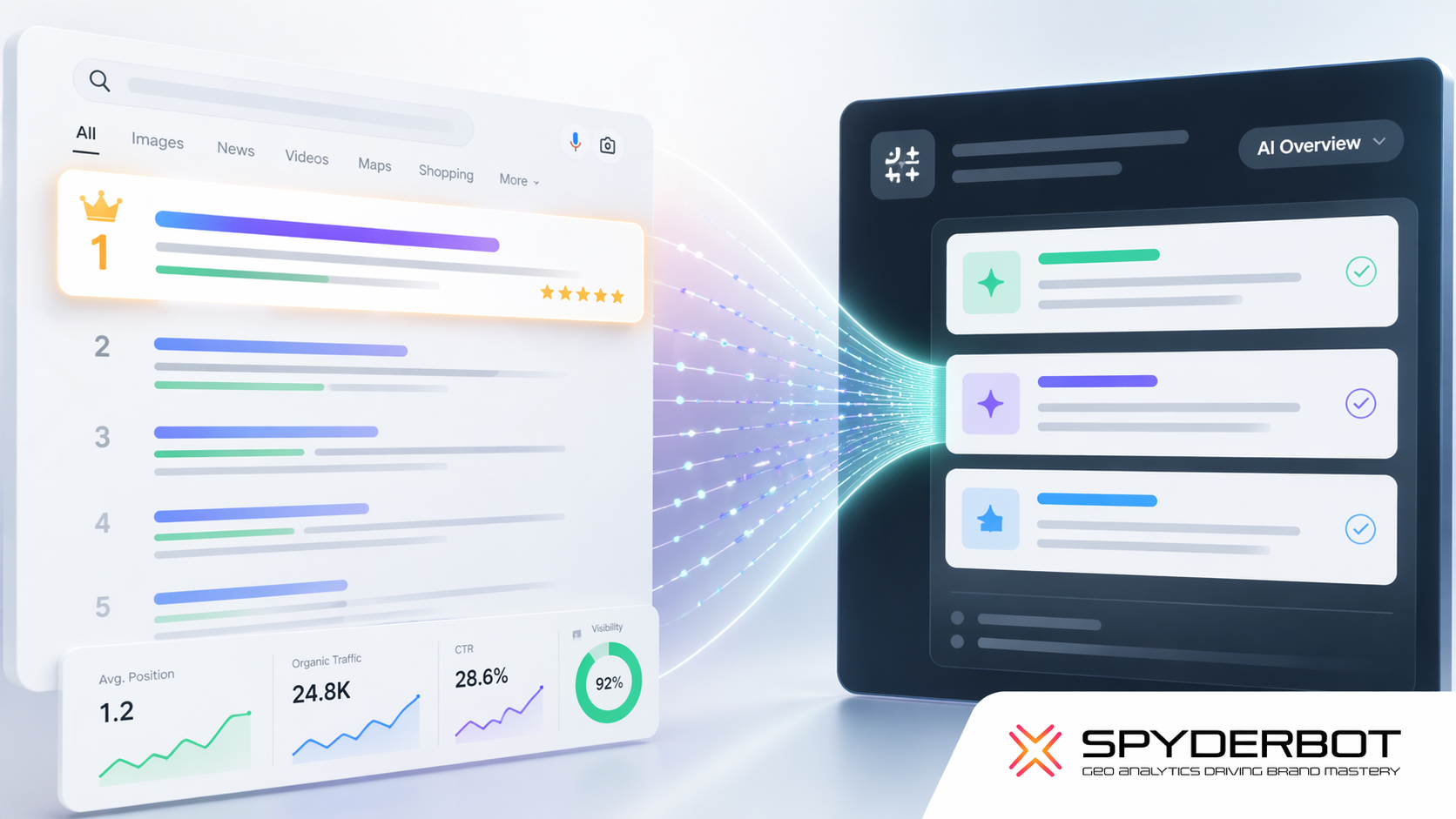
Why ranking on Google no longer guarantees visibility in AI answers, and why brands need a new strategy for the answer layer
For years, digital visibility followed a simple rule:
If your website ranked, you had a chance.
If it ranked higher, you usually won more clicks.
If you won more clicks, you won more attention.
That model shaped how marketing teams operated for more than a decade.
Now the interface has changed.
A brand can rank well on Google, publish solid content, earn backlinks, and still disappear when someone asks ChatGPT, Gemini, or Claude a direct question.
That alone should end the lazy debate.
GEO is not SEO with a fresh label.
It exists because the web is no longer just a place where users browse options. Increasingly, it is a place where machines pre-filter those options for them.
People are no longer only searching for pages.
They are asking AI to recommend, compare, summarize, and narrow the field.
And once that happens, the game changes.
The real question is no longer just:
Can your page be found?
It becomes:
Will your brand be selected inside the answer?
That is why GEO deserves to be treated as its own discipline. Not because SEO is dead. Not because rankings stopped mattering. But because rankings alone no longer explain who gets mentioned, who gets ignored, and who gets framed as the better choice.
The mistake most teams are still making
The confusion is understandable.
SEO and GEO do overlap.
Both care about content quality.
Both benefit from authority and trust.
Both depend on clarity, structure, and a strong digital footprint.
So many teams look at GEO and assume it is simply SEO applied to AI.
That sounds reasonable until you look at what each one is actually optimizing for.
SEO helps pages get discovered, indexed, ranked, and clicked.
GEO helps brands get selected, mentioned, cited, and accurately represented in AI-generated answers.
That is not a small distinction.
It is the difference between being present in the source pool and being chosen in the final output.
SEO asks:
Can your page rank?
GEO asks:
Will the model choose your brand when it generates an answer?
Those are related questions. They are not the same question.
Ranking is not the same as being recommended
This is the line most companies still have not fully internalized:
A search engine gives users options. A generative engine often gives them a conclusion.
That one shift changes everything.
On Google, a user might see ten blue links, compare headlines, open multiple tabs, and decide for themselves.
Inside an AI answer, the system might mention only three brands. Sometimes two. Sometimes one.
In many cases, the broader market never makes it into the conversation at all.
The model has already compressed the category before the click even happens.
That means something important:
Your brand can be visible on the web and invisible in the answer.
That is exactly where the phrase “GEO is just SEO renamed” falls apart.
Because SEO may help you enter the library.
GEO influences whether the librarian hands your book to the reader.
The answer layer works differently from the search layer
Traditional search is built around retrieval.
Generative systems still retrieve information in different ways, but the user experience is no longer centered on browsing documents. It is centered on receiving a synthesized response.
That means the last-mile logic changes.
The system is no longer just asking, “What pages are relevant?”
It is also asking, in effect:
- What brands fit this use case?
- Which options seem most credible?
- Which names are easiest to justify?
- Which entities are clearly associated with this category?
- Which answer can be delivered with confidence?
That is why two companies with very different search profiles can perform very differently inside AI outputs.
One may rank better.
The other may get mentioned more.
And in the answer economy, the second one can win the mindshare.
A simple example makes the difference obvious
Imagine two project management software companies.
Company A has done traditional SEO well. It ranks for category terms, publishes blog content consistently, and has decent backlink authority. Its site is technically sound.
Company B has weaker rankings overall, but its positioning is much clearer across the web. Review platforms describe it consistently. Product pages are specific. Comparison pages reinforce the same strengths. Third-party references repeat a coherent story about who it is for and why it stands out.
Now a user asks:
“What is the best project management software for a remote design team?”
A search engine might return a long list of options.
A generative engine has to do something else. It has to produce a compact, confident answer.
In that moment, Company B may win the mention even if Company A wins the rank.
Why?
Because generative systems do not just retrieve pages. They synthesize patterns. They compress fragmented information into a shortlist of plausible recommendations.
And the brand that is easier to interpret, easier to categorize, and easier to justify often has the advantage.
That is not a traditional ranking problem.
That is a selection problem.
And that is where GEO starts.
SEO optimizes retrieval. GEO optimizes selection.
If this entire topic needs to be reduced to one line, it is this:
SEO optimizes retrieval. GEO optimizes selection.
That is the cleanest way to understand the split.
SEO improves the chances that search systems discover and rank your content.
GEO improves the chances that generative systems decide your brand belongs inside the answer.
Those systems can overlap in data sources, but the end result is not the same.
A page can rank and still fail to become an answer candidate.
A company can have traffic and still lose recommendation share.
A brand can be known online and still be absent in the moments that now shape buyer perception.
That is why so many teams feel confused right now.
Their search dashboards look acceptable.
Their content pipeline is active.
Their site still performs.
But when they test real buying prompts in ChatGPT, Gemini, or Claude, a competitor keeps appearing instead.
The old metrics say everything is fine.
The answer layer says otherwise.
The market moved upstream
The deeper reason GEO matters is behavioral, not just technical.
Users are outsourcing evaluation earlier than they used to.
Instead of asking Google for a list, they ask AI for a shortlist.
Instead of opening twenty tabs, they ask for the summary.
Instead of researching a category from scratch, they ask questions like:
- Which tools are best for this use case?
- What brands are trusted in this space?
- What should a small business choose?
- Which platform is better for a team like mine?
This shifts the battleground.
It is no longer enough to be one of the available websites.
You need to become one of the likely answers.
That is a different kind of competition. And it rewards different strengths.
Why calling GEO “renamed SEO” is actually harmful
This is not just a semantics problem. It leads to bad strategy.
When teams dismiss GEO as repackaged SEO, they usually keep measuring the wrong things.
They track rankings but not mention share.
They audit pages but not prompts.
They monitor traffic but not brand framing.
They assume technical SEO health will naturally translate into AI visibility.
Then they get blindsided.
Their competitor starts showing up in recommendation-style prompts.
Their category narrative shifts without them noticing.
Buyers arrive with assumptions shaped by AI answers, not by the brand’s own website.
And marketing teams struggle to explain what changed because their reporting was built for the click layer, not the answer layer.
That is the real cost of misunderstanding GEO.
You keep optimizing for discoverability while losing ground in selection.
GEO is really about machine understanding
The most useful way to think about GEO is not as a hack for gaming AI outputs.
It is about whether machines understand your brand well enough to include it.
That includes questions like:
- Does the system know what category you belong to?
- Does it connect your brand to the right use cases?
- Does it understand your strengths clearly?
- Do third-party sources reinforce the same story?
- When your brand is mentioned, is the framing accurate?
- When competitors are recommended instead, what signals are working in their favor?
These are not classic SEO questions.
They are questions about entity clarity, narrative consistency, answer eligibility, and machine-readable reputation.
That is why GEO sits closer to brand intelligence than many marketers first assume.
It is not just about publishing more content.
It is about becoming easier for AI systems to interpret, trust, and justify.
What SEO still does well
None of this means SEO stopped mattering.
That would be a careless conclusion.
Good SEO still improves crawlability, site structure, discoverability, information clarity, and authority. It still helps brands create source material that can be found and referenced. It still matters for traffic, research behavior, and commercial discovery.
In many cases, AI systems still depend heavily on the open web and on strong source ecosystems.
So SEO remains foundational.
But foundation is the right word.
It is the base layer, not the whole building.
That is the real point.
You still need SEO.
You now also need GEO because ranking alone no longer explains visibility where more decisions are starting to happen.
What GEO actually focuses on
A serious GEO strategy asks questions that traditional SEO reporting usually misses.
For example:
- How often is your brand mentioned in prompts that matter?
- Which competitors appear instead of you?
- What attributes does AI attach to your brand?
- Which use cases increase your inclusion?
- Which use cases exclude you?
- What third-party sources appear to support the answer?
- How stable is your presence across different AI systems?
This is where the work becomes operational.
The real question is no longer:
How do we rank one more page?
It becomes:
How do we become a consistent answer candidate?
That requires more than publishing content. It requires stronger positioning, clearer use case language, tighter alignment between your site and the broader web, and a more coherent external narrative that machines can repeatedly recognize.
The strategic shift smart companies are making now
The companies that will win this phase are not the ones arguing over terminology.
They are the ones changing how they operate.
They are testing prompts, not just keywords.
They are tracking AI mentions, not just SERPs.
They are analyzing competitive inclusion, not just backlink gaps.
They are paying attention to framing, not just visibility.
Most importantly, they understand one thing early:
Being present on the web and being present in the answer are now two different forms of visibility.
That sounds subtle.
It is not.
It changes how content should be written.
It changes how positioning should be reinforced.
It changes what teams should measure.
It changes how authority should be understood.
And over time, it will change how brands compete online.
A better framing
The wrong question is:
Does GEO replace SEO?
The better question is:
What does SEO solve, and what does GEO solve that SEO does not?
The answer is straightforward.
SEO helps your brand get found.
GEO helps your brand get chosen.
SEO improves document visibility.
GEO improves answer visibility.
SEO helps search engines retrieve you.
GEO helps generative systems recognize you as a credible response.
That is why the two are connected.
But they are not interchangeable.
Final thought
The old web rewarded the page that ranked.
The new answer layer rewards the brand that the machine can understand, justify, and select.
That is why GEO is not SEO renamed.
It is what becomes necessary once ranking is no longer enough to explain visibility.
And the companies that realize this early will not just protect traffic.
They will protect relevance in the place where more buying decisions are increasingly being shaped:
inside the answer itself.
Leave a Reply
You must be logged in to post a comment.