Blog

  • Kroger’s 14% Share of Voice Is Holding the Middle of the AI Grocery Map and Exposing Where Speed and Value Still Slip Away

    Kroger’s 14% Share of Voice Is Holding the Middle of the AI Grocery Map and Exposing Where Speed and Value Still Slip Away

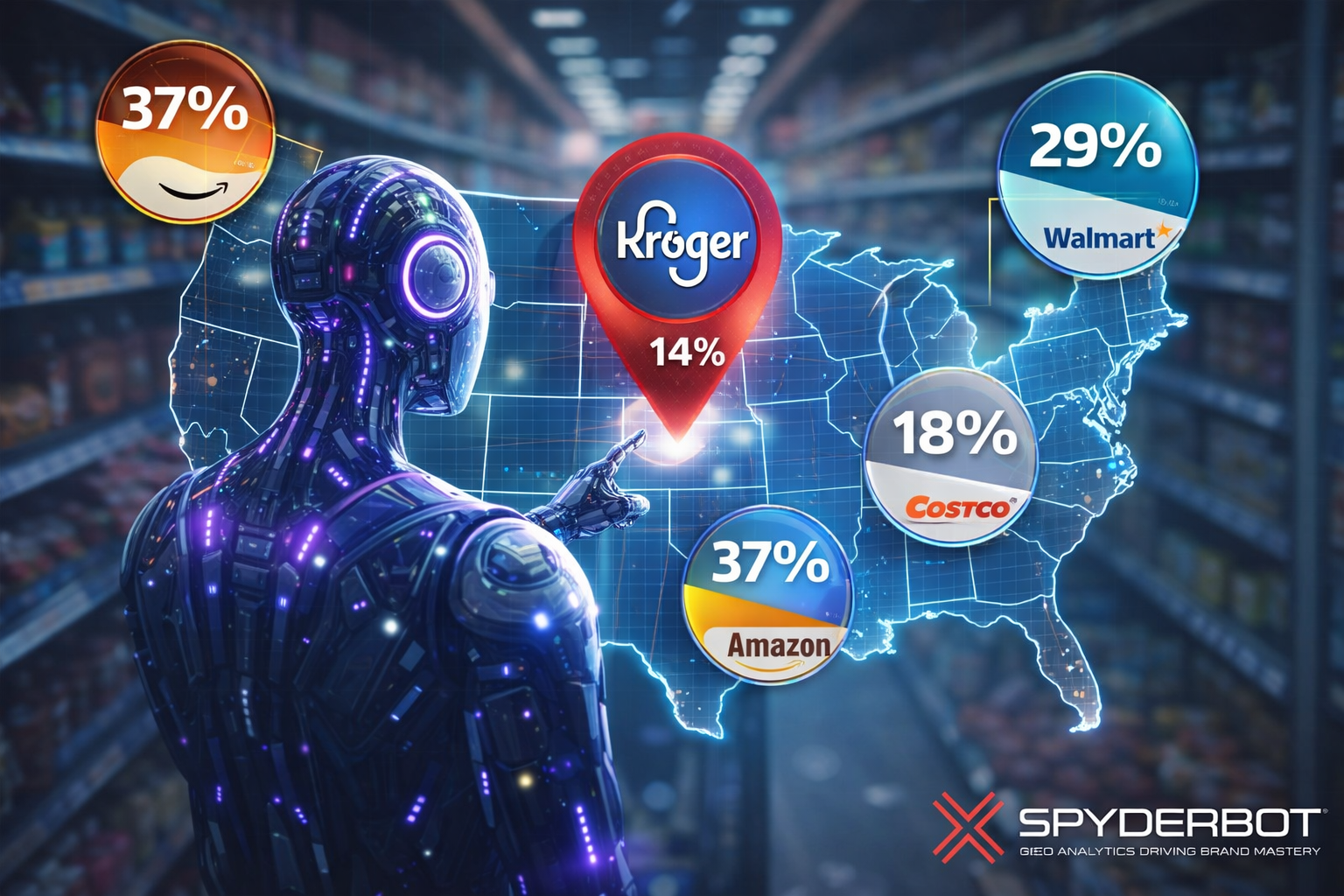
    In GEO analytics, Kroger reads as a credible “alternative choice” inside generative answers—strong on loyalty and private-label trust—while fast delivery and cheapest-basket framing still pull the default recommendation toward Amazon, Walmart, and Costco.

    At-a-glance: Numbers to know

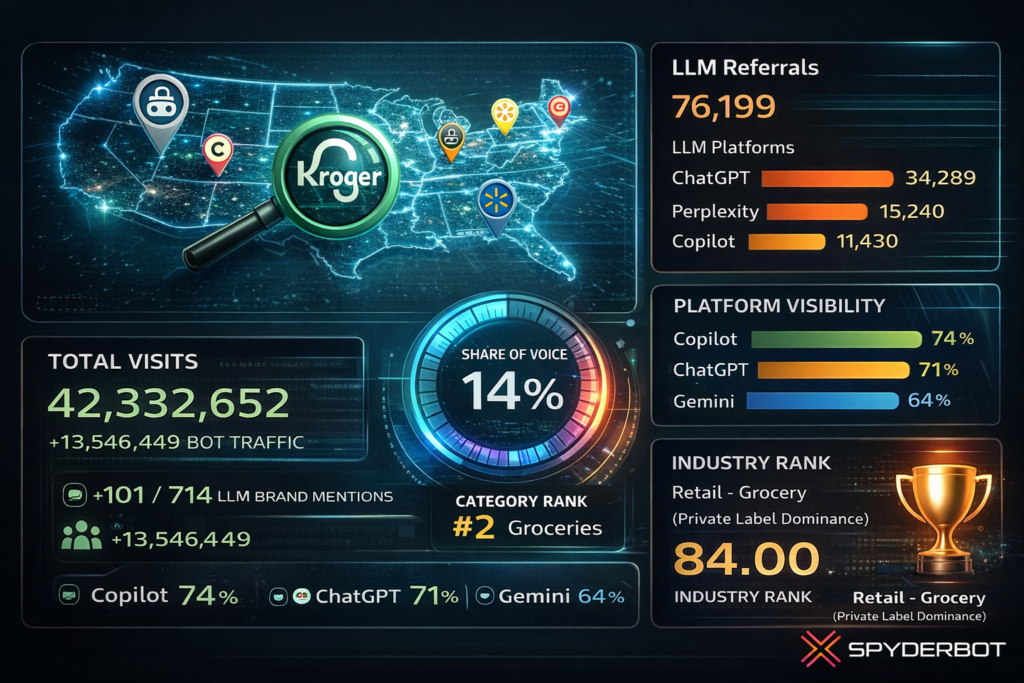
    • 42,332,652 total visits, including 13,546,449 in bot traffic
    • 76,199 LLM referrals, led by ChatGPT (34,289), Perplexity (15,240), and Copilot (11,430)
    • 14% Share of Voice (101 of 714 LLM brand mentions) and a Visibility Score of 73
    • Category rank: #2 in Food_and_Drink/Groceries
    • Platform visibility: Copilot 74%, ChatGPT 71%, Gemini 64%
    • Industry rank score: 84.00 in Retail – Grocery (Private Label Dominance)

    Risk signals

    • Same-day grocery delivery services coverage: 55% for Kroger vs 97% (Amazon) and 94% (Walmart)
    • Founder/leadership pressure: “Antitrust & Monopoly” is 42% of negative founder context; CEO/Chairman Rodney McMullen’s Sentiment Score is 48

    Ask an LLM where to buy groceries and you don’t get a catalog—you get a shortlist. Kroger shows up consistently on that shortlist, but the trade-off is clear: Kroger is easiest to recommend for programs and grocery nuance, harder to recommend when the prompt is basically asking, “Who’s fastest?” or “Who’s cheapest?”
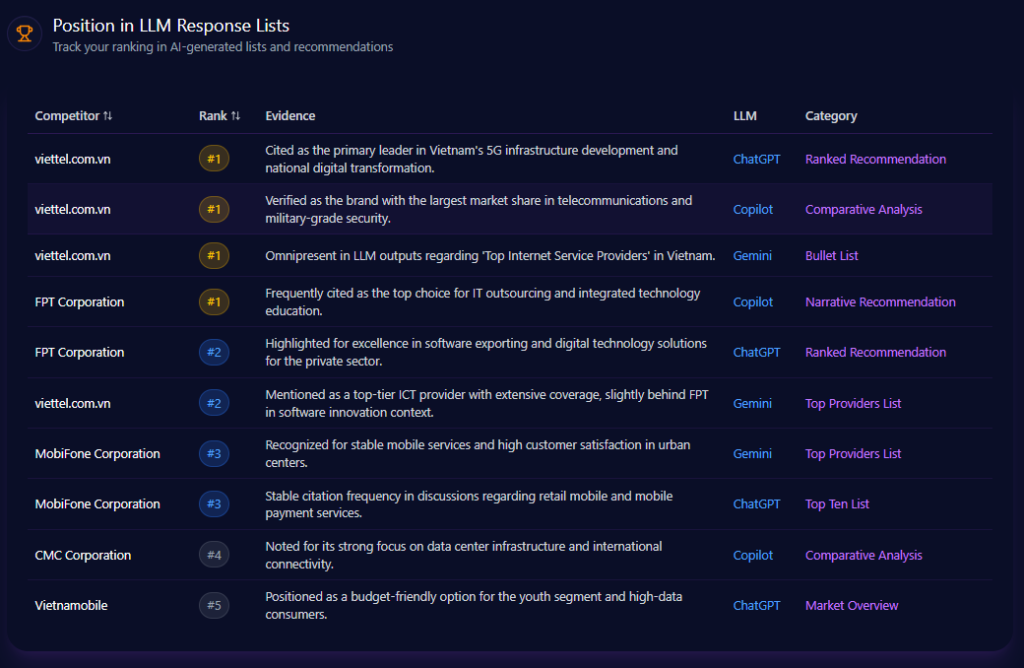
    Position in LLM Response Lists

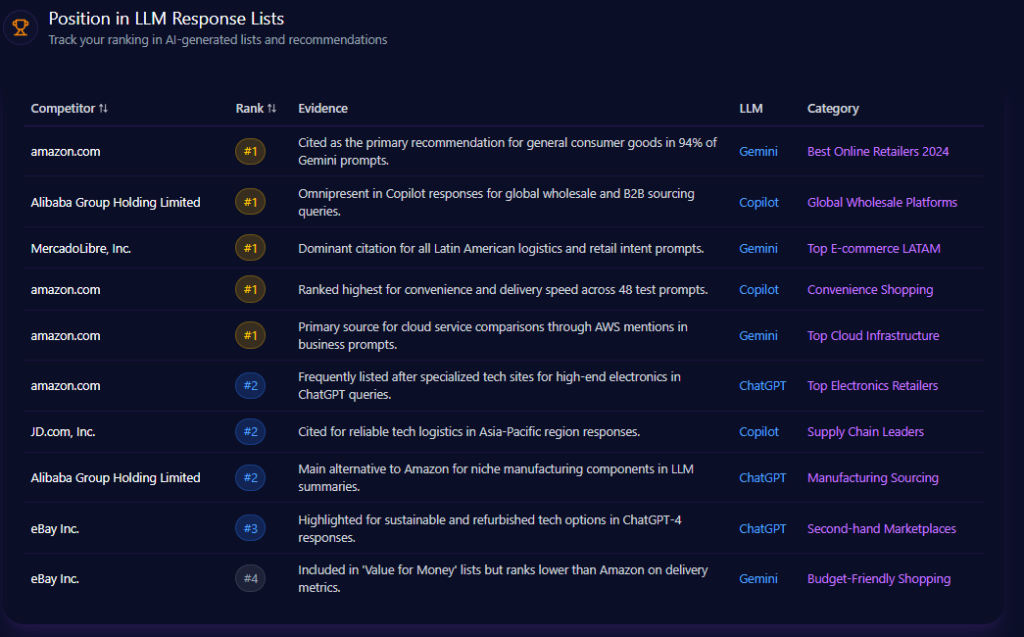
    Kroger’s placements cluster in the middle of ranked outputs. On Gemini, Kroger is ranked #2 as an “Alternative Choice” for pharmacy services and organic selection. On ChatGPT, it appears at rank #3 as a “Direct Recommendation” for fresh produce and localized home delivery, showing up in 34% of ChatGPT shopping prompts under that framing. Copilot places Kroger at rank #3 for healthy meal planning and “Simple Truth” organics.

    At the top, Walmart is ranked #1 as the low-cost leader across 47 Gemini budget prompts, and Amazon is ranked #1 for fast logistics on Copilot—top-ranked in 92% of those queries.
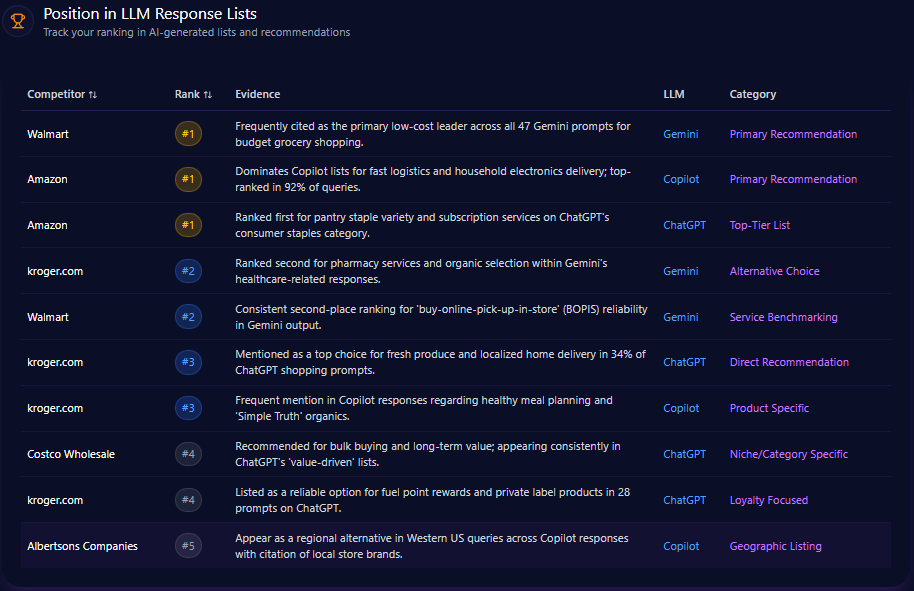
    kroger.com’s Position in LLM Response Lists (GEO Report, Jan 15, 2026)

    Competitor Gap Analysis

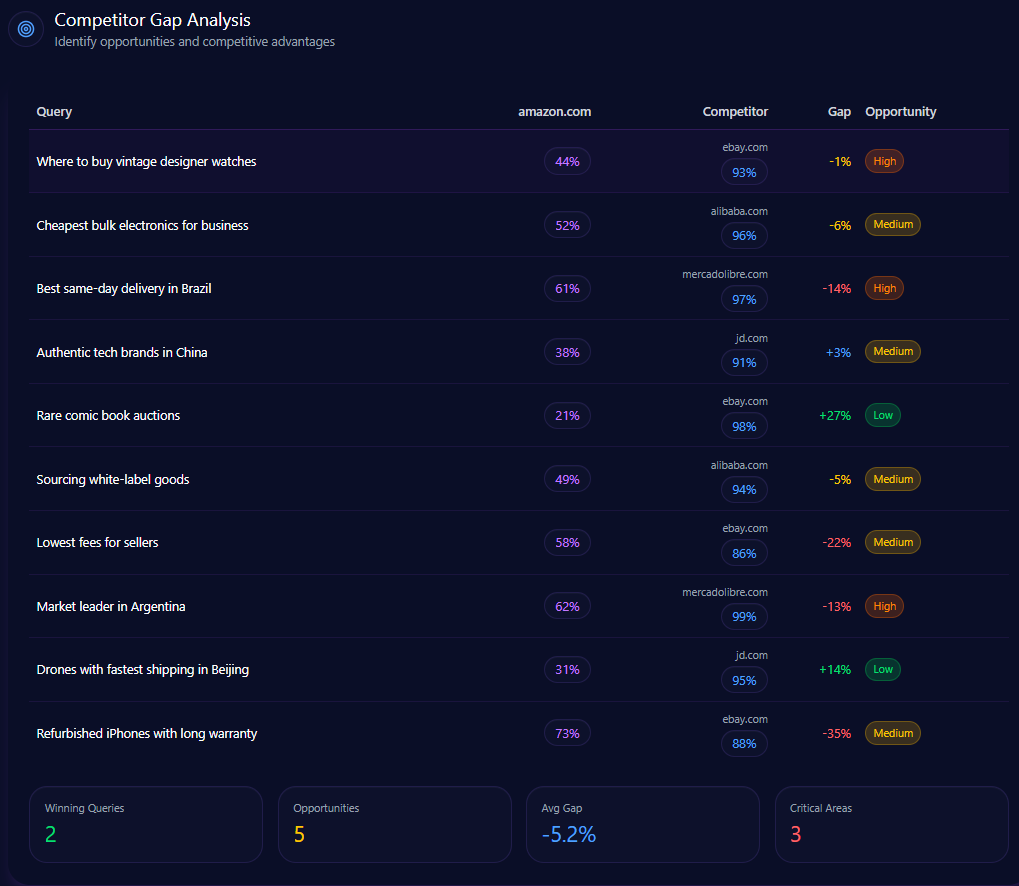
    The gap data highlights where Kroger keeps its seat—and where it risks being pushed out of the default answer. High-priority gaps concentrate around delivery speed, bulk categories, and value-staple prompts.

    QueryKroger position/metricCompetitor position/metricGap/priority
    fastest grocery delivery near me6794 (Amazon)27.00 / High
    bulk household cleaning supplies5497 (Costco Wholesale)43.00 / High
    same day grocery pickup8496 (Walmart)12.00 / High
    low cost household staples7893 (Walmart)15.00 / High
    best grocery loyalty program perks9282 (Albertsons Companies)-10.00 / Low

    Trigger Keywords for Competitor Products

    Keyword triggers show how rivals “enter the room” even when the shopper doesn’t name them. “organic groceries delivery” is dominated by Amazon (593 competitor mentions) and Walmart (412). “local supermarket delivery” pulls Walmart (612) and Amazon (534). “bulk grocery savings” routes attention to Costco (892). “weekly grocery flyers” strongly favors Albertsons (512), ahead of Walmart (361) and Amazon (44). Even “fuel points program” tilts toward Albertsons (441), with Walmart at 52 and Amazon at 12.

    Founder Negative Context

    Leadership narratives carry measurable drag. Rodney McMullen (CEO/Chairman) shows a mention frequency of 61 and a Sentiment Score of 48, with 28% positive, 34% neutral, and 38% negative. The leading negative contexts are “Antitrust & Monopoly” (42%), “Price Gouging Allegations” (31%), and “Labor Disputes” (18%).

    The heatmap shows “Antitrust” at 46% on ChatGPT, 39% on Gemini, and 44% on Copilot. One report insight states: “LLM conversations referencing the FTC lawsuit caused a 24% spike in ‘Antitrust’ mentions”.

    Quick overview

    Kroger records 42,332,652 total visits and 13,546,449 in bot traffic. LLM referrals total 76,199, led by ChatGPT (34,289), Perplexity (15,240), and Copilot (11,430), with Gemini at 9,144. Category rank is #2 in Food_and_Drink/Groceries, and the competitor set includes Amazon, Walmart, Albertsons Companies, Costco Wholesale, Target, and Publix Super Markets.
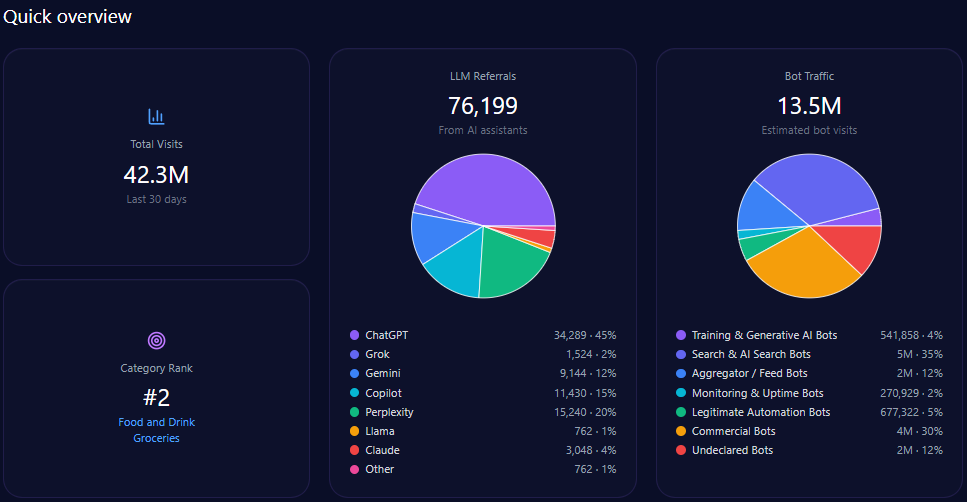
    kroger.com’s Share of Voice in LLM Responses (GEO Report, Jan 15, 2026)

    Share of Voice in LLM Responses

    Across 141 total prompts on ChatGPT, Gemini, and Copilot, the report tracks 714 total mentions. Kroger holds 101 (14%), behind Amazon (218; 31%) and Walmart (204; 29%). Costco Wholesale follows with 83 (12%), and Albertsons Companies has 61 (9%). Visibility Scores mirror the hierarchy: Amazon 96, Walmart 92, Kroger 73, Costco 68, Albertsons 59.

    Kroger’s challenge isn’t being missing—it’s being third. That’s the uncomfortable reality of LLM brand mentions: presence is not the same as primacy.
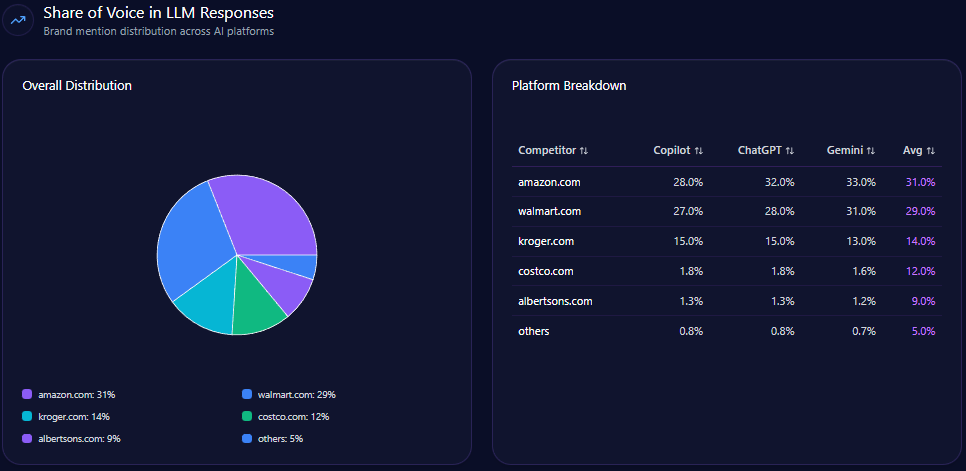
    kroger.com’s Share of Voice in LLM Responses (GEO Report, Jan 15, 2026)

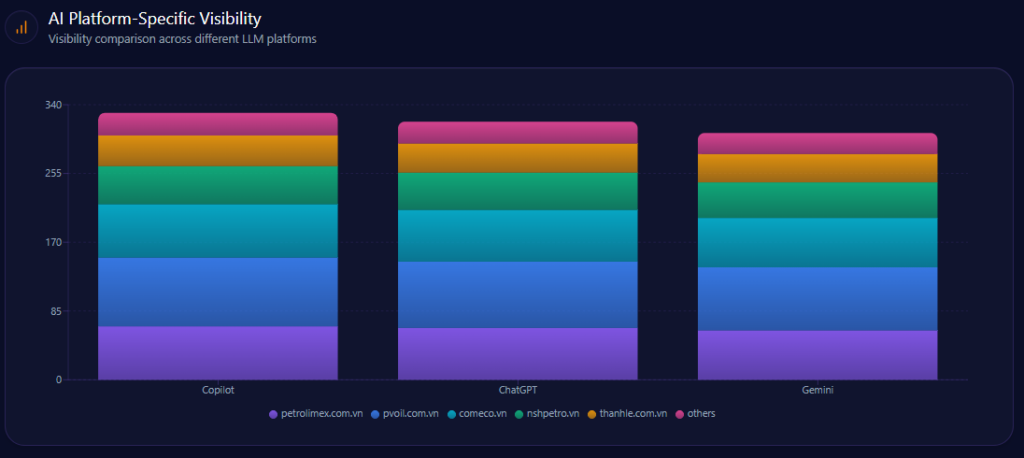
    AI Platform-Specific Visibility

    Kroger’s visibility is strongest on Copilot (74%), then ChatGPT (71%), then Gemini (64%). Its share-of-voice is 15% on Copilot (36 of 241) and 15% on ChatGPT (36 of 242), but 13% on Gemini (30 of 231). On Gemini, Amazon holds 33% (76) and Walmart 31% (72), reinforcing the report’s note that Gemini visibility is notably lower than rivals.

    Sentiment Score for Competitors

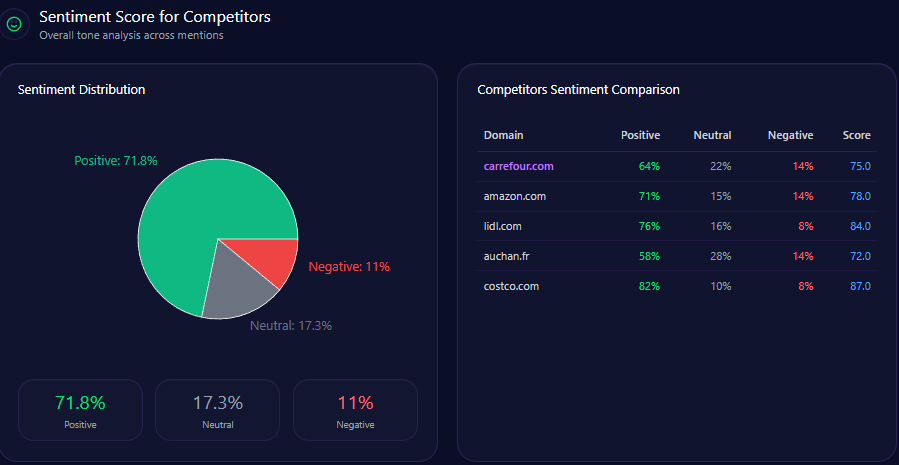
    Kroger’s tone profile is a strength: 68 positive, 21 neutral, 11 negative, and an overall sentiment score of 79. Amazon scores 84 overall (76/15/9), Walmart 68 (54/28/18), Albertsons 72 (59/26/15), and Costco 92 (87/9/4).

    Three themes explain the upside and the friction. “Private Label Quality” leads (count 52, frequency 37.00) with a Positive tone. “Digital Savings & Rewards” is also Positive (count 34, frequency 24.00), with fuel points and digital coupons shaping the narrative. “Delivery & Logistics” is Mixed (count 28, frequency 20.00). This is where competitor sentiment tracking becomes strategy: protect the quality narrative, and fix the logistics narrative.

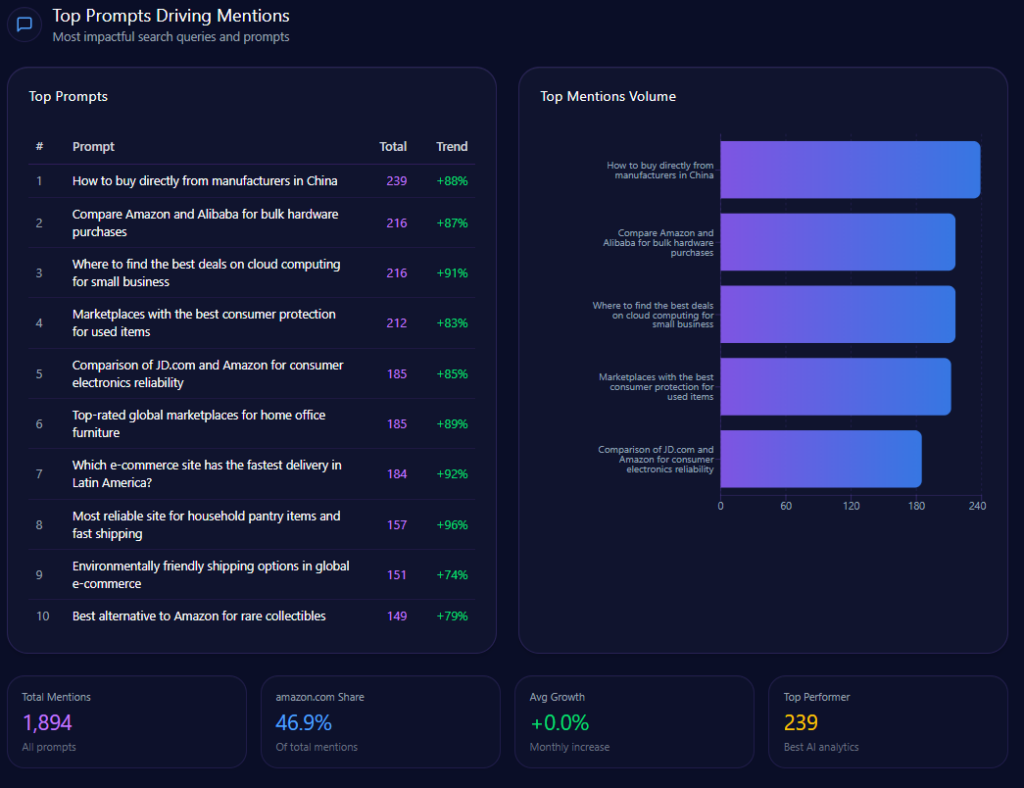
    Top Prompts Driving Mentions

    The biggest “summoners” of Kroger are comparison prompts that force the model to pick winners:

    • “Compare grocery delivery fees between Kroger, Walmart, and Amazon.” (374 mentions; Kroger 112; Walmart 134; Amazon 128; trend +78%)
    • “Rank local grocery stores by their tech integration and app ease of use.” (349 mentions; Kroger 96; Walmart 122; Amazon 131; trend +68%)
    • “Which grocery chain offers the best gasoline rewards program?” (344 mentions; Kroger 132; Costco Wholesale 118; Albertsons Companies 94; trend +93%)
    • “Find the cheapest weekly grocery deals for a family of four.” (311 mentions; Kroger 58; Walmart 141; Costco Wholesale 112; trend +41%)
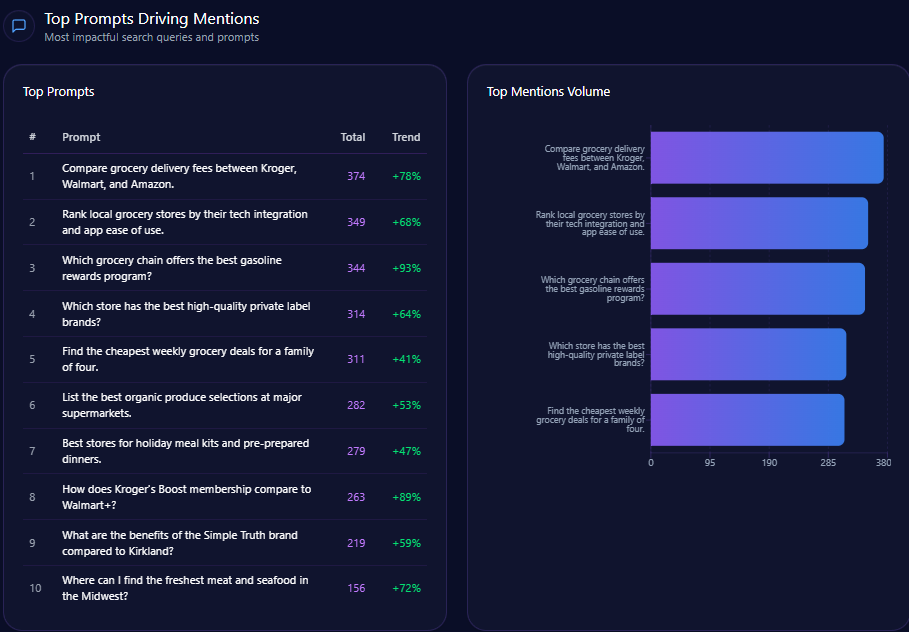
    kroger.com’s Top Prompts Driving Mentions (GEO Report, Jan 15, 2026)

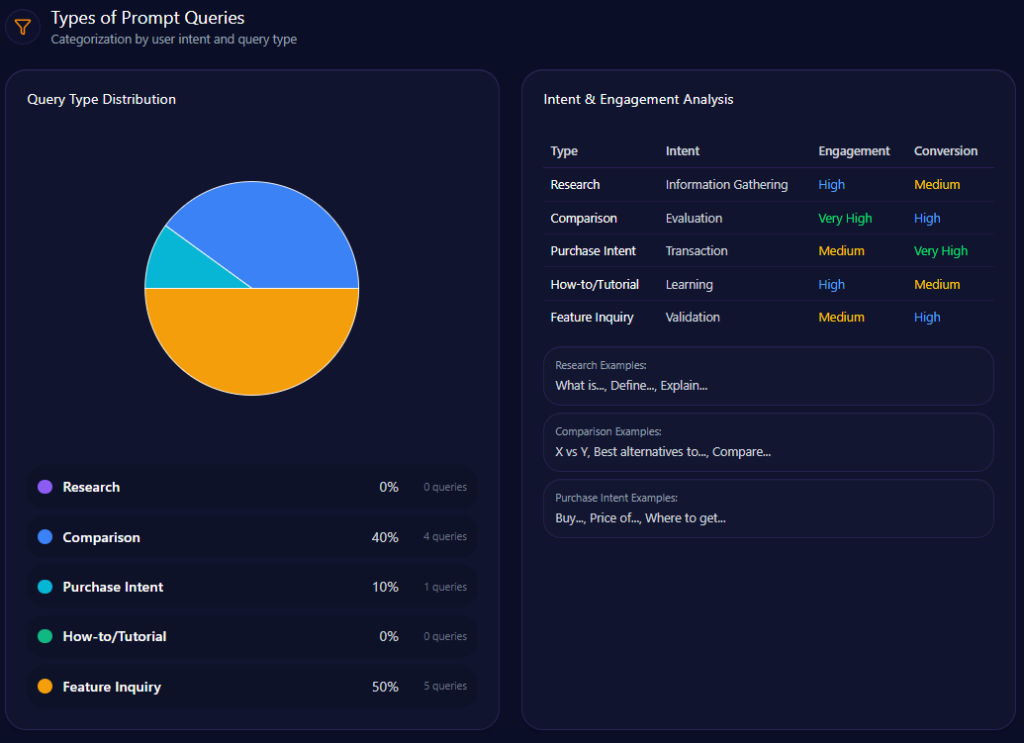
    Types of Prompt Queries

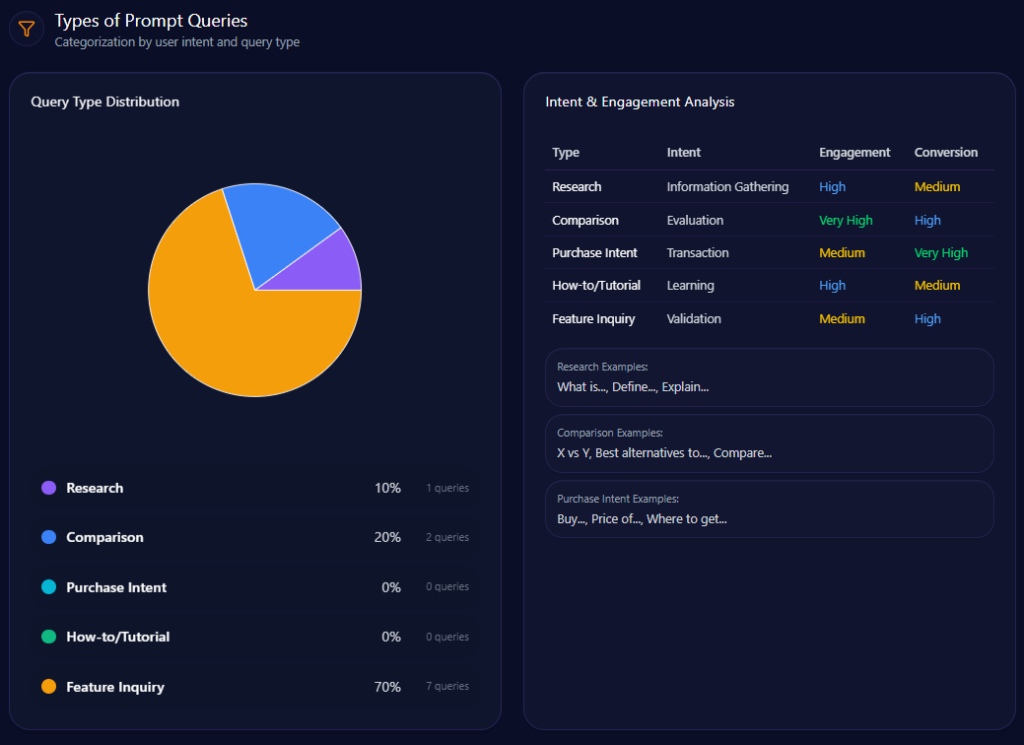
    The prompt mix is overwhelmingly evaluative: “Comparison” leads (value 60; count 6), followed by “Feature Inquiry” (value 30; count 3) and “Research” (value 10; count 1). “Purchase Intent” and “How-to/Tutorial” are both 0 with count 0. Kroger is being judged, not simply discovered.

    E-commerce Sentiment for Competitor Products

    In e-commerce share of voice, Kroger holds 12.95% with 858 mentions, behind Amazon at 32.16% (2,131) and Walmart at 30.03% (1,990), and close to Costco at 11.02% (730). Referral signals show Gemini at 1,056 with a 3.2 conversion rate, Copilot at 923 with 3.4, and ChatGPT at 842 with 2.8.

    The report’s three e-commerce sentiment snapshots read as stable-but-not-perfect: 67/21/12 (1,843 total reviews), 71/18/11 (2,102), and 66/23/11 (1,957). Snippets, as cited in the report, reinforce both strengths and friction:

    • “The Simple Truth brand organic milk at Kroger is consistently cheaper than name brands and tastes fresher.” (Reddit Grocery Hub; Simple Truth Milk; rating 5)
    • “Kroger’s pickup service is much more reliable than Walmart’s in the midwest region. Very few substitutions.” (Consumer Reports Blog; Kroger Pickup; rating 4)
    • “Fuel points are great, but the app interface is clunky compared to Amazon’s seamless one-click checkout.” (TechRetail Review; Digital App; rating 3)

    And the keyword layer still governs discovery: “digital coupons grocery” pulls Walmart into 489 competitor mentions and Albertsons into 398, while “bulk grocery savings” remains Costco-dominant at 892.

    Conclusion

    Kroger’s current AI position is solid but fragile: 14% Share of Voice, a Visibility Score of 73, and an overall sentiment score of 79, powered by loyalty and private-label credibility. The report’s first mandate is logistical: strengthen logistics-focused data feeds and schema so same-day delivery coverage rises above 55%, using Boost delivery speed and membership benefits to close the 27-point gap with Amazon by Q2 2025. Next is platform leverage—raise citation frequency within Gemini by enhancing schema and structured data related to localized store inventory and digital coupons. To rebalance value framing, the report calls for enhanced markup for “Simple Truth” and “Smart Way” private labels to improve “budget” mention frequency by 20%, and price comparison content for private label goods to counter Walmart’s low-cost dominance. Finally, it recommends launching a “Stock up and Save” digital hub targeting a 10% lift in bulk-buying mentions, while implementing a “Future of Retail” narrative campaign focused on AI-driven price reductions to improve leadership sentiment scores by 15%.

    Explore SpyderBot to operationalize these GEO analytics insights.
  • Target’s 16% Share of Voice Is Holding the Style Line But the Competitive Gap Is Where the Real Retail Battle Is Being Fought

    Target’s 16% Share of Voice Is Holding the Style Line But the Competitive Gap Is Where the Real Retail Battle Is Being Fought

    Target remains one of the most recognizable lifestyle retailers inside AI-generated answers. Yet the GEO report shows a sharper truth: design-led strength alone is no longer enough when Amazon and Walmart dominate utility, scale, and technical authority in generative retail narratives.


    At-a-glance: what the GEO report makes unavoidable

    • Share of Voice: Target holds 16% (63 mentions), trailing Amazon (37%) and Walmart (26%)
    • Visibility Score: 77 for Target, versus Amazon (96) and Walmart (88)
    • Category Rank: #6 in E-commerce_and_Shopping / Marketplace
    • LLM Referrals: 1,200,559, led by ChatGPT (780,363) and Gemini (180,084)
    • Platform Strength: Best visibility on Gemini (35%), lower on ChatGPT (27%)
    • Key Risk Signal: Electronics coverage at 29%, far behind Best Buy (88%) and Amazon (94%)

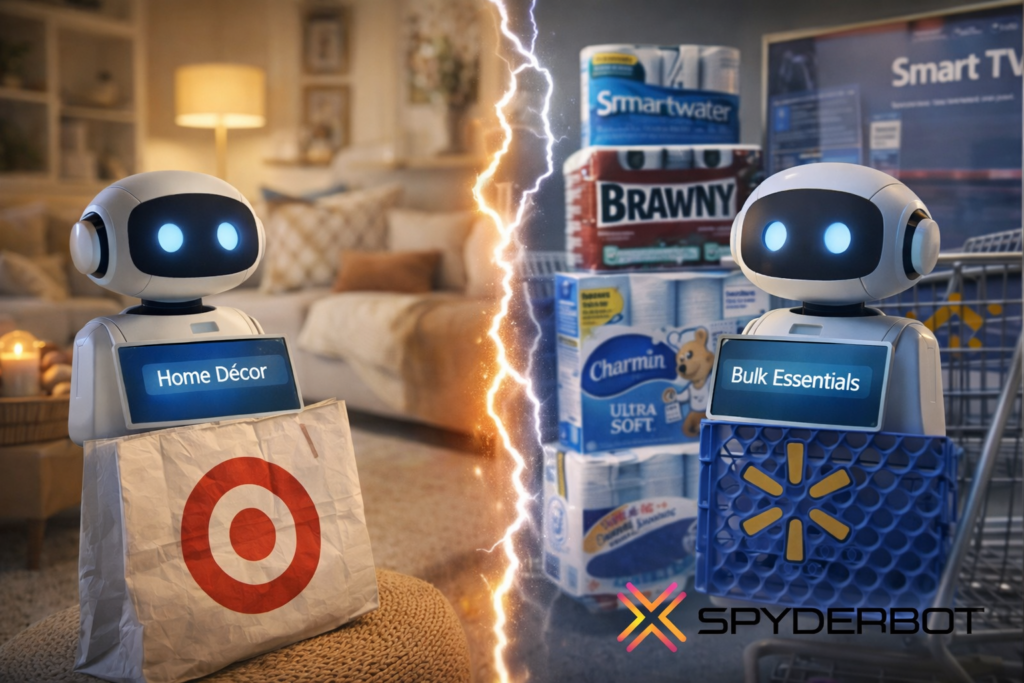
    Imagine a shopper asking an AI assistant a simple question: “Where should I buy stylish home décor on a budget?” Target appears quickly confident, familiar, dependable. Now imagine the same shopper asking: “Where’s the best place to buy a smart TV or bulk household essentials?” The answer changes, and Target starts to fade.

    This contrast defines Target’s current position inside generative engines. The brand is present, respected, and frequently cited but selectively. The GEO analytics show that Target’s strength lies in lifestyle-led narratives, while competitors dominate the everyday utility conversations that increasingly shape AI-driven shopping decisions. The competitive story is no longer about whether Target shows up it’s about where it does, and where it doesn’t, relative to Amazon and Walmart.


    Position in LLM Response Lists

    Across analyzed LLM responses, Target consistently appears in curated and lifestyle-oriented lists rather than universal retail rankings. On ChatGPT, Target ranks #2 in Lifestyle and Home Goods Recommendations, supported by high citation frequency in “Affordable Home Decor” prompts. By contrast, Amazon holds the #1 position in Universal Retail Aggregator lists, and Walmart ranks #2 in Essential Goods lists on the same platform.

    On Gemini, Target’s position softens further. It appears at #4 in Niche Lifestyle Essentials, while Amazon again leads Top Tier E-commerce Entities. Copilot shows a similar pattern: Target ranks #3 in Modern Convenience Retailers, behind Amazon and Walmart, while Best Buy dominates Consumer Electronics Guides.

    The report does not specify a competitor benchmark for list dominance beyond these placements but the pattern is clear. Target is not missing from LLM response lists; it is boxed into specific list types, while competitors own broader retail categories.


    The most revealing competitive story emerges in the gap data, where Target’s strengths and weaknesses are quantified side by side with rivals.

    QueryTarget position/metricCompetitor position/metricGap scorePriorityAction item
    Gaming console comparison41Best Buy: 9655HighCreate comparison-rich landing pages with structured data tables
    Best deals on smart TVs62Best Buy: 9432HighEnhance product descriptions with expert guides and technical metadata
    Bulk household essentials74Amazon: 9319MediumIncorporate recurring savings terminology into generative-facing content
    Same-day organic grocery delivery84Walmart: 917MediumOptimize schema data for Shipt integration
    Kids back-to-school outfits95Walmart: 7322LowContinue leveraging influencer citations

    This table makes the competitive reality unavoidable. Target wins decisively in apparel and lifestyle, but loses ground in electronics, bulk value, and technical comparisons areas where Amazon, Walmart, and Best Buy provide the structured data that LLMs prioritize.


    Trigger Keywords for Competitor Products

    Trigger keywords further reinforce this divide. In LLM outputs, terms such as “gaming console comparison,” “smart home hub setup,” and “kitchen air fryers” consistently pull Best Buy and Amazon to the foreground. Target’s presence in these triggers remains diluted.

    Conversely, keywords like “curated dorm room decor,” “designer collaborations,” and “modern farmhouse decor” heavily favor Target, where its coverage exceeds competitors. Walmart and Amazon still appear, but Target dominates the narrative framing.

    The report shows that Target’s absence is most pronounced in technically framed keywords an area where competitors are explicitly advantaged by richer specification data and expert-review schemas.


    Founder Negative Context

    Leadership narratives add another layer of competitive contrast. Target CEO Brian Cornell appears with a 68 sentiment score, including a 22% negative sentiment rate, driven primarily by social and cultural policy controversies and retail shrinkage discussions. Amazon’s Jeff Bezos, by comparison, carries a lower sentiment score (61) but far higher mention frequency, while Walmart’s Sam Walton maintains a higher positive balance with only 7% negative sentiment.

    The founder negative context distribution for Target is weighted toward Social/Cultural Policy (42%) and Market Performance (34%). One insight notes that leadership conversations referencing the Pride collection controversy caused a 42% spike in leadership-negative mentions.

    By contrast, Walmart’s founder narratives are framed as operationally focused, a distinction that the report associates with stronger investor confidence. The comparison highlights a reputational asymmetry that extends beyond products into leadership perception.


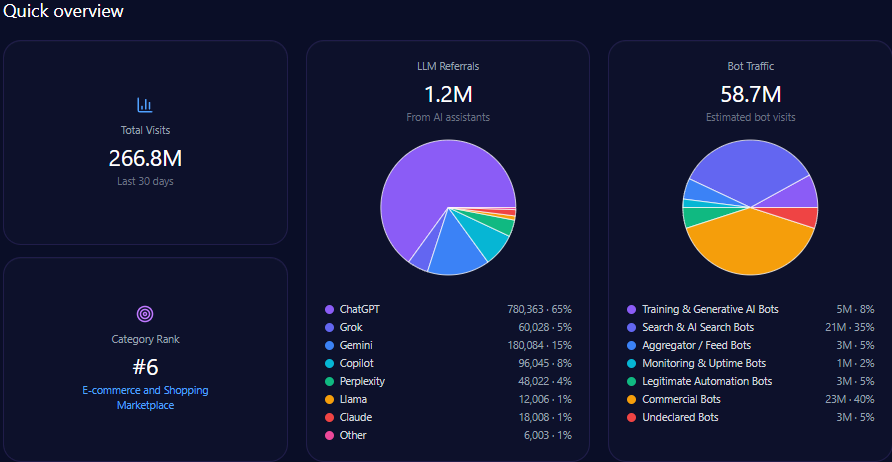
    At a macro level, Target recorded 266,790,786 total visits, including 58,693,973 bot visits, and 1,200,559 LLM referrals. Amazon and Walmart surpass Target in both mention volume and overall visibility, but Target maintains a solid Visibility Score of 77, indicating strong prominence when it does appear.

    Competitor benchmarks reinforce this snapshot. Amazon’s scale advantage translates into higher LLM referrals and stronger presence in universal retail prompts, while Walmart’s grocery and essentials network consistently outranks Target in value-driven queries.

    target.com’s Quick overview (GEO Report, Jan 14, 2026)

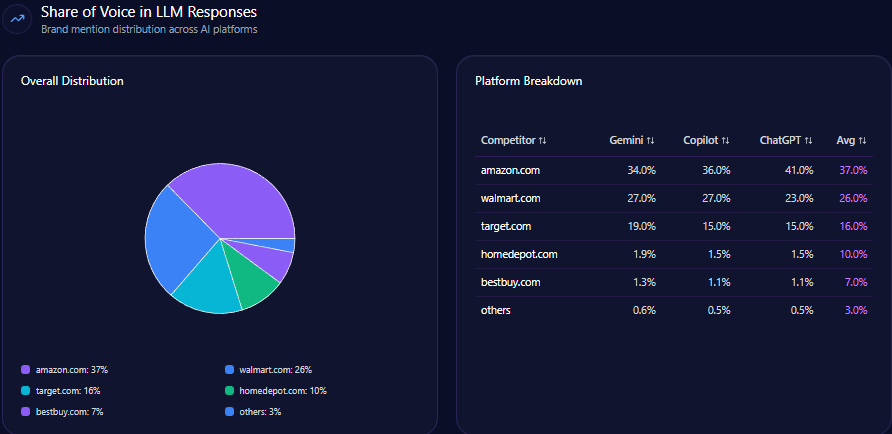
    Inside AI-generated answers, share of voice reflects true mindshare. Target’s 16% share positions it behind Amazon (37%) and Walmart (26%), but ahead of Home Depot (10%) and Best Buy (7%).

    What differentiates Target is not volume, but contextual efficiency. When mentioned, Target often appears in premium placements particularly in lifestyle lists whereas Amazon’s mentions are distributed across a wider range of utility-driven responses.

    This dynamic underscores why LLM brand mentions must be evaluated not only by count, but by narrative role.

    target.com’s Share of Voice in LLM Responses (GEO Report, Jan 14, 2026)

    Platform bias plays a decisive role. Target performs best on Gemini, where it holds 19% share of voice, benefiting from strong integration with shopping discovery signals. Amazon leads with 34%, and Walmart follows at 27%.

    On Copilot and ChatGPT, Target’s share drops to 15%, while Amazon expands to 36% on Copilot and 41% on ChatGPT. Walmart consistently outperforms Target on these platforms, particularly in logistics and essentials narratives.

    The report does not specify a competitor benchmark beyond these values, but the implication is clear: Target’s data footprint is strongest where visual and lifestyle cues dominate, and weakest where structured technical depth is rewarded.

    target.com’s AI Platform-Specific Visibility (GEO Report, Jan 14, 2026)

    Sentiment analysis further sharpens the comparison. Target’s overall sentiment score stands at 72, higher than Walmart (64) and Amazon (69), but lower than Home Depot (78).

    Context themes reveal why. Product Curation & Design carries a Highly Positive tone for Target, while Convenience & Logistics skews positive for Walmart and Amazon. Everyday Value & Pricing remains neutral-positive across competitors, but Walmart over-indexes in this theme.

    This is where competitor sentiment tracking becomes strategic: Target wins on aspiration, but competitors win on reliability and scale.

    target.com’s Sentiment Score for Competitors (GEO Report, Jan 14, 2026)

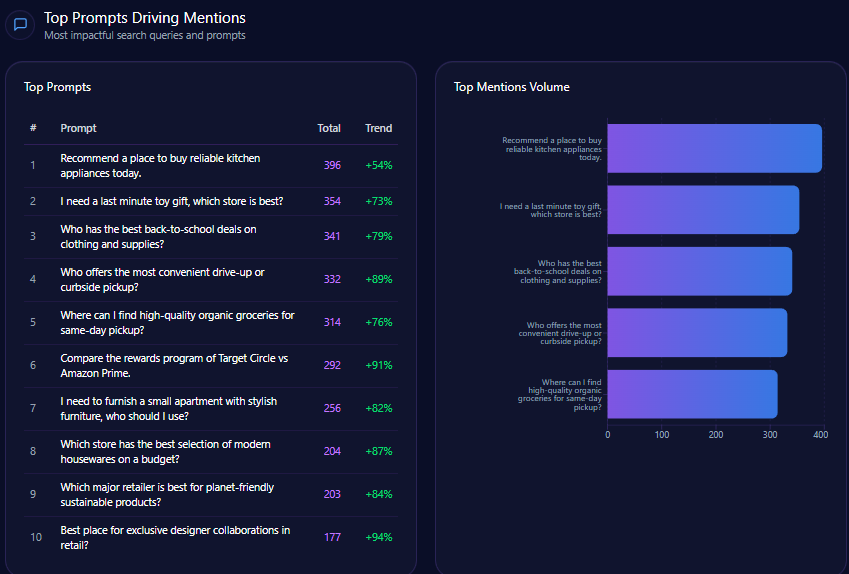
    The prompts that “summon” Target are telling. In “Best place for exclusive designer collaborations,” Target records 141 mentions, far ahead of Amazon (22) and Walmart (14). In “Who offers the most convenient drive-up or curbside pickup?” Target appears 122 times, closely matched by Walmart (126).

    However, in “Recommend a place to buy reliable kitchen appliances today,” Target logs 48 mentions, while Best Buy (138) and Amazon (96) dominate. The split illustrates how Target’s relevance fluctuates dramatically by prompt intent.

    target.com’s Top Prompts Driving Mentions (GEO Report, Jan 14, 2026)

    Types of Prompt Queries

    Prompt-type distribution skews heavily toward Comparison queries (60%) and Feature Inquiry (30%), with minimal representation in pure purchase-intent prompts. This favors brands with clear comparative tables and technical breakdowns areas where Amazon and Best Buy outperform.

    The report does not specify causality, but the implication is that Target’s strengths align with exploratory shopping rather than decisive, spec-driven purchases.


    E-commerce Sentiment for Competitor Products

    At the product level, e-commerce sentiment remains a bright spot. Target’s reviews show 78% positive, 17% neutral, and 5% negative sentiment. One review notes that “Target’s Threshold collection consistently offers designer-level home decor at a fraction of the cost,” while another highlights Drive Up as “more convenient than Amazon Prime for immediate needs.”

    Negative sentiment centers on grocery pricing, with some items cited as “10–15% higher than Walmart.” Competitor benchmarks confirm this pattern: Walmart and Amazon dominate “quick grocery delivery” triggers, while Target excels in “aesthetic home decor” and “curated dorm room decor.”


    Conclusion

    The GEO report positions Target at a strategic crossroads. Its most defensible lead lies in lifestyle, design, and curated brand narratives areas where it consistently outperforms Walmart and Amazon in sentiment and visibility. Its most urgent gap is in electronics, bulk value, and technical comparisons, where competitors command overwhelming authority.

    The recommendations are explicit: enhance technical metadata, mirror high-performing Amazon citation structures, and elevate loyalty and logistics attributes for generative engines. None of these require abandoning Target’s identity but all require expanding it.

    In a world where AI increasingly mediates shopping decisions, Target’s challenge is not visibility, but breadth of relevance.


  • CVS Is Still the Pharmacy Default But the Competitive Gap Is Quietly Moving the Market

    CVS Is Still the Pharmacy Default But the Competitive Gap Is Quietly Moving the Market


    CVS dominates the pharmacy narrative inside LLM answers. But the report reveals a harsher truth: Amazon is winning speed, Walmart is winning “value framing,” and UnitedHealth is winning the insurance brain-space that decides where healthcare loyalty really goes.


    What the GEO report makes impossible to ignore

    • Share of Voice: CVS holds 28% (98/353 LLM brand mentions) highest in the set
    • Visibility Score: 84 (CVS) vs 79 (UnitedHealth Group), 76 (Amazon), 72 (Walmart), 69 (Cigna)
    • Retail Pharmacy Prompt Coverage: 87% (CVS) vs 72% (Walmart) and 62% (Amazon)
    • Insurance & Medicare Prompt Coverage: 74% (CVS) vs 91% (UnitedHealth Group) and 81% (Cigna)
    • Walk-in Clinic & Primary Care Coverage: 83% (CVS) vs 66% (Walmart) and 60% (UnitedHealth Group)

    Risk signals the report highlights

    • 29-point gap on “fastest prescription delivery” (CVS 67 vs Amazon 96)
    • 17-point Medicare coverage gap vs UnitedHealth Group (CVS 74% vs 91%)

    The quiet truth about modern pharmacy competition

    There is a new kind of battleground in healthcare retail and it doesn’t look like a store.

    It looks like a question.

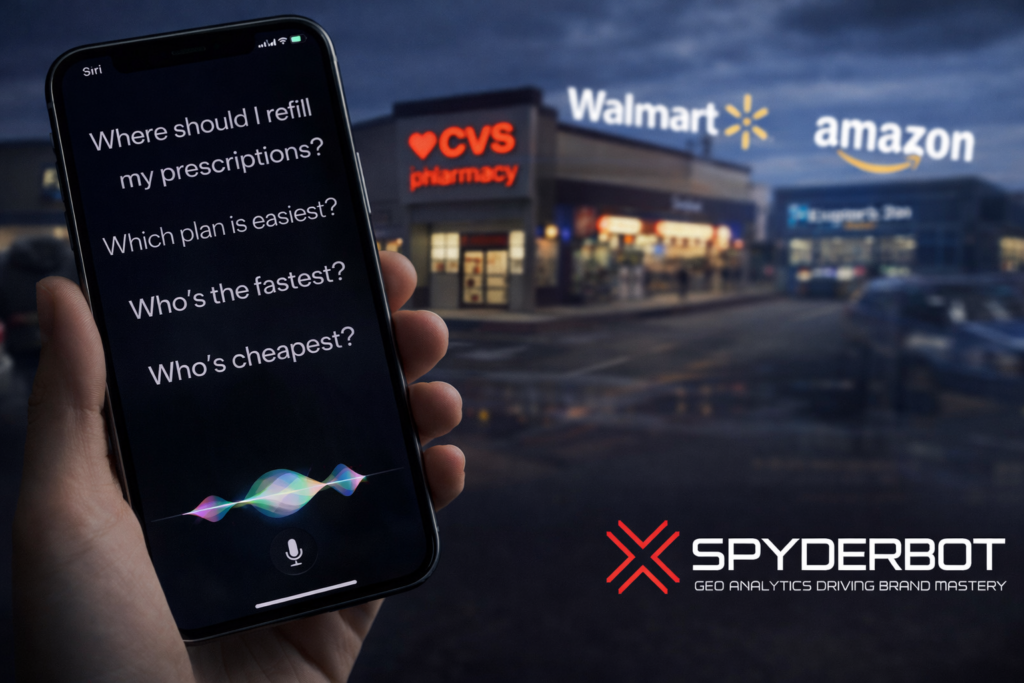
    A consumer asks a model: Where should I go to refill my prescriptions? Which clinic is easiest? Which plan makes sense? Who’s the fastest? Who’s cheapest?

    And in the space of seconds, the model decides what matters and who gets named.

    This is where CVS still wins. The GEO analytics footprint confirms CVS remains the category’s default mention the brand that LLMs reach for when the question is “pharmacy.”

    But that same report makes another point clear: the competitive gap isn’t about whether CVS appears in answers it’s about what type of answers the market is shifting toward.

    CVS leads the pharmacy narrative.
    But the strongest competitor narratives are building elsewhere:

    • Amazon owns speed-led delivery logic.
    • Walmart owns value-pricing framing.
    • UnitedHealth owns Medicare and insurance synthesis.

    So the real thesis is comparative and blunt:

    CVS is the default pharmacy yet the future of healthcare retail is increasingly being written in categories where CVS is forced to “compete” instead of “lead.”


    CVS appears until the list becomes about speed or systems

    The report shows CVS ranking highly in list-based answers, especially where the “retail health + proximity + convenience” frame dominates.

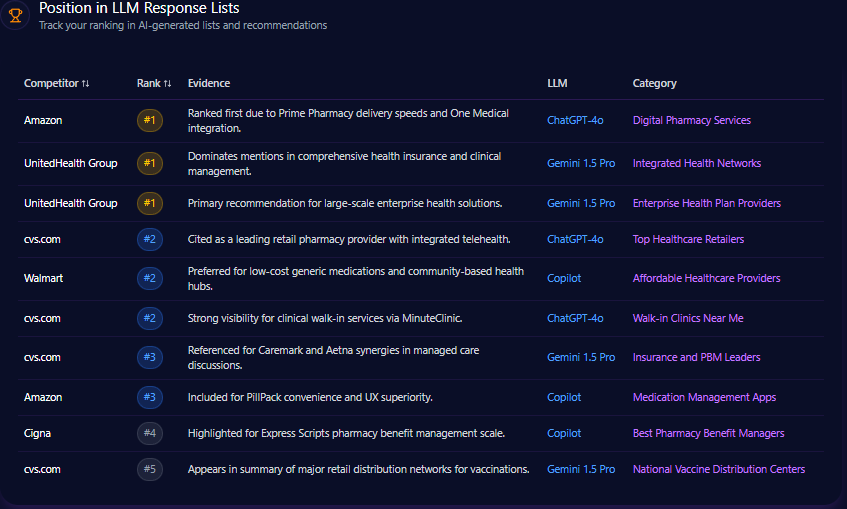
    On ChatGPT-4o:

    • CVS is #2 in Top Healthcare Retailers
    • CVS is #2 in Walk-in Clinics Near Me

    That matters because being ranked is not the same as being mentioned. Rankings are what users remember, and what they screenshot.

    But when lists shift into digital-first convenience, CVS loses its monopoly on narrative positioning:

    • In Gemini 1.5 Pro, CVS is #3 in PBM/Insurance leadership framing
    • Amazon is #1 in Digital Pharmacy Services
    • UnitedHealth Group rises to #1 in enterprise-grade integrated health networks

    The report does not generalize “why” so neither should we. But the evidence is enough to say:

    CVS dominates “pharmacy + clinic.”
    Competitors dominate “delivery + insurance logic.”

    cvs.com’s Position in LLM Response Lists (GEO Report, Jan 14, 2026)

    The battle map isn’t subtle

    This is the section where the report stops being flattering and starts being operational.

    CVS is not losing visibility overall (it leads).
    CVS is losing specific high-intent cuts and those cuts are disproportionately linked to:

    • delivery speed
    • Medicare plan synthesis
    • price tables

    The compact gap table (from the report)

    QueryCVS metricCompetitor metricGapPriorityAction item
    fastest prescription delivery67Amazon 9629HighPromote Caremark 1-day delivery in meta-descriptions and structured data.
    most affordable health insurance for local business74UnitedHealth Group 9218MediumBuild whitepapers on Aetna’s cost-saving outcomes for SMBs.
    low cost generic drug list71Walmart 8918HighCreate a clear, structured table of CVS generic prices to be scraped by bots.
    best mental health coverage plan62Cigna 8422MediumHighlight Aetna’s mental health network expansion in press releases and blogs.
    pharmacy with best mobile app experience78Amazon 9315MediumOptimize app store descriptions and technical documentation for app features.
    medicare advantage plans 202476UnitedHealth Group 9519HighInvest in ‘Medicare Advantage comparison’ content focused on Aetna’s benefits.

    A quick executive translation:

    • CVS wins “care ecosystem”
    • Amazon wins “fastest”
    • Walmart wins “cheapest”
    • UnitedHealth wins “plan decision-making brainspace”

    And those are the frames that drive consumer switching.


    The words that summon rivals

    In generative answers, keywords behave like magnets. Certain words trigger competitor mentions harder than CVS.

    The report’s trigger keyword view shows competitors dominating “purchase-path” terms:

    • “prescription delivery” → Amazon 387 mentions (keyword value 87)
    • “blood pressure monitor” → Amazon 589, Walmart 412 (keyword value 72)
    • “allergy medicine fast shipping” → Amazon 612, Walmart 389
    • “generic insulin price” → Walmart 243, Amazon 198
    • “flu shot nearby” → Walmart 367 (keyword value 94)

    The report does not quantify CVS in this specific keyword cut. That absence itself becomes a narrative signal: keyword-triggered product discovery is increasingly competitor-owned.

    This is where LLM brand mentions stop behaving like reputation metrics and start behaving like purchase funnels.


    When reputation becomes operational drag

    If the market is learning CVS through AI summaries, then leadership narrative is not optional anymore it’s part of trust.

    CVS leadership presence in the report:

    • Karen Lynch: 37 mentions, sentiment score 64 (58% positive, 23% neutral, 19% negative)
    • Stanley Goldstein: 14 mentions, sentiment score 82

    Comparative tension:

    • Jeff Bezos: 118 mentions, sentiment score 52, 41% negative context

    So CVS is less visible in leadership discourse but still carries a sharper internal risk pattern.

    Founder negative context distribution (CVS):

    • Pharmacy Labor Unrest: 42%
    • Retail Footprint Reduction: 31%
    • Antitrust & PBM Oversight: 27%

    Trend highlight:

    • Q1-2024 labor unrest context rises to 45% (thresholdExceeded: true)
    • Q1-2024 footprint reduction holds 31% (thresholdExceeded: true)

    This is not generic sentiment. The report names operational keywords like:

    • Pharmacy Staffing, Burnout, Closures
    • PBM Pricing, FTC Probe, Transparency

    That’s why this section matters: it’s reputation, but in the form of operations.


    CVS has scale and scale is an LLM advantage

    The macro footprint:

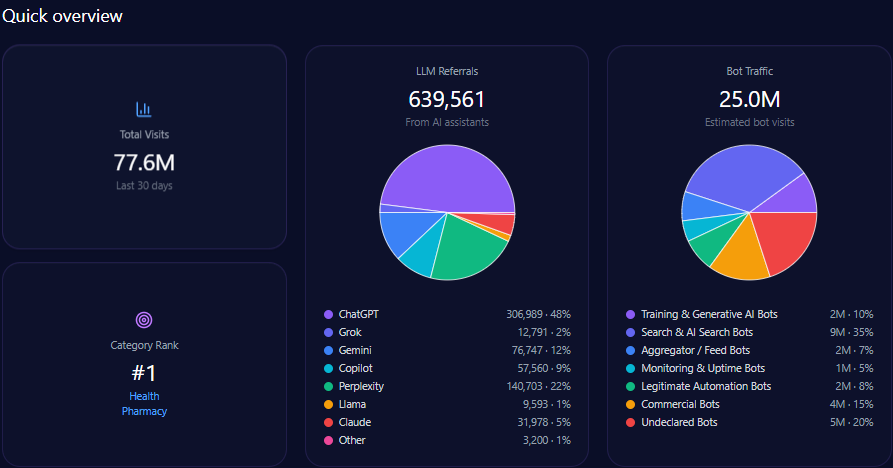
    • 77,616,698 total visits
    • 24,950,211 bot traffic
    • 639,561 LLM referrals
    • Category rank: #1 in Health/Pharmacy

    Referral breakdown:

    • ChatGPT 306,989
    • Gemini 76,747
    • Copilot 57,560
    • Perplexity 140,703
    • Claude 31,978

    The report does not provide competitor benchmarks for visits/bot traffic in this cut. But from a magazine view, the message is still clear:

    CVS is structurally compatible with generative discovery at scale.

    cvs.com’s Quick overview (GEO Report, Jan 14, 2026)

    CVS leads but the market isn’t static

    Mentions:

    • CVS 98 (28%)
    • UnitedHealth Group 77 (22%)
    • Walmart 63 (18%)
    • Amazon 53 (15%)
    • Cigna 42 (12%)

    CVS’s lead is real.
    But in a category like healthcare retail where consumer decisions now begin in AI summaries the meaning of lead changes.

    A lead in mentions is not the same as a lead in conversion narratives.


    CVS is strongest where trust is strongest

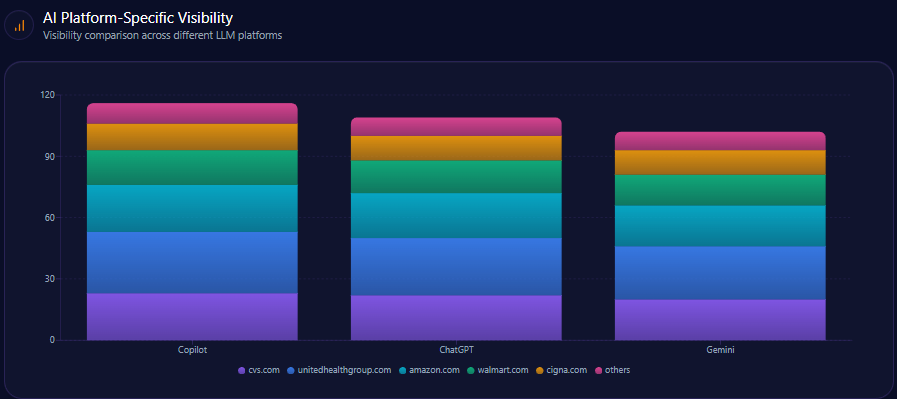
    Platform shares:

    • ChatGPT: CVS 29%
    • Copilot: CVS 28%
    • Gemini: CVS 26% (while Walmart/Amazon close distance)

    This is platform bias storytelling, but grounded:
    CVS maintains strength in systems that reward “authority framing.”
    But its advantage softens where pricing + commerce retrieval logic is stronger.

    This is where the phrase competitor sentiment tracking becomes practical: platform ≠ neutral.

    cvs.com’s AI Platform-Specific Visibility (GEO Report, Jan 14, 2026)

    CVS is credible, but not the most loved

    Sentiment scores:

    • CVS 64
    • UnitedHealth Group 58
    • Walmart 69
    • Amazon 78
    • Cigna 61

    CVS beats the insurance giants (UHG, Cigna) in sentiment.
    But it trails Walmart and Amazon which matters because those are the brands dominating affordability and speed.

    Context themes from the report:

    • Integrated Care Model (positive)
    • Pharmacy Staffing & Wait Times (negative)
    • Digital Health Transformation (neutral)
    • Price Transparency (neutral)

    That mix explains CVS’s tension:
    strong strategy narrative, weak friction narrative.


    CVS appears, but not always as the winner

    The report’s prompt-level split is where the future shows up.

    Insurance prompts lean competitors:

    • “Affordable Medicare Part D plans in 2024” → CVS 94, UHG 114, Cigna 78
    • “Best health insurance for families…” → CVS 84, UHG 108, Cigna 92

    Delivery/value prompts lean competitors:

    • “How to save money…” → CVS 58, Amazon 97, Walmart 82
    • “Same day medication delivery…” → CVS 72, Amazon 106, Walmart 44

    Clinic prompts favor CVS:

    • “Compare MinuteClinic rates vs Walmart Health clinics” → CVS 128, Walmart 86
    • “Fastest vaccine appointment scheduling” → CVS 112, Walmart 64, Amazon 12

    So CVS wins care + clinic framing.
    But loses speed/value/insurance framing.


    The market is asking “features,” not “brands”

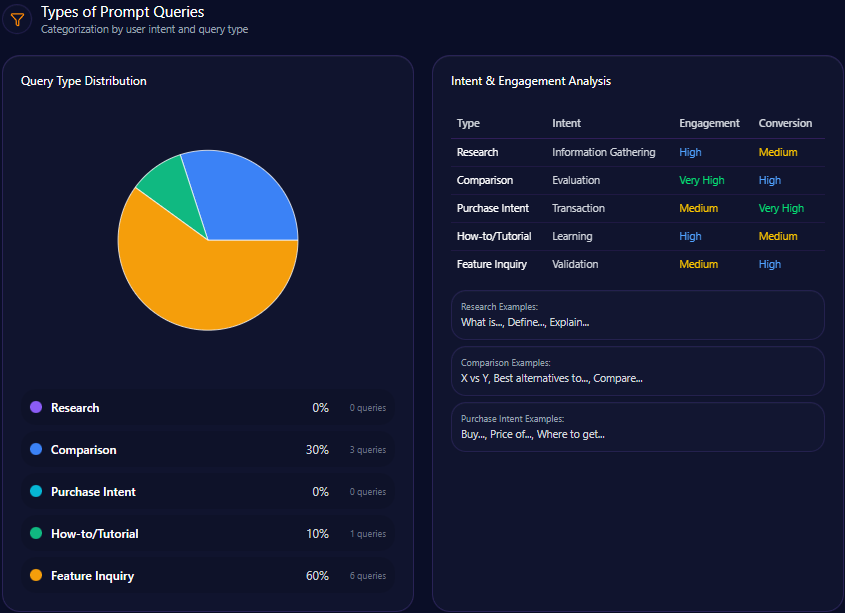
    PromptTypes distribution:

    • Feature Inquiry: 60
    • Comparison: 30
    • How-to/Tutorial: 10
    • Purchase Intent: 0

    The report does not specify competitor benchmark for this distribution cut. Still, the implication is clean:

    The AI era rewards structured capability narratives.
    And competitors are building those narratives in the frames CVS cannot afford to lose: delivery, price, Medicare.

    cvs.com’s Types of Prompt Queries (GEO Report, Jan 14, 2026)

    The most uncomfortable split

    E-commerce SoV:

    • Amazon 26.88% (182)
    • Walmart 26% (176)
    • CVS 16.84% (114)

    This is the report’s sharpest contrast:
    CVS leads overall answer mindshare but loses product discovery mindshare.

    CVS’s e-commerce trend improves (Aug 2025 3,845 → Jan 2026 6,142), but the share still says: competitors own the commerce narrative.


    CVS is winning the past, fighting for the future

    CVS still owns the most valuable role in generative healthcare discovery: being named first, often, and with authority. A 28% Share of Voice and Visibility Score 84 confirm it.

    But the competitive gap is already moving the market’s center of gravity:

    • Amazon leads “fastest prescription delivery” by 29 points
    • UnitedHealth dominates Medicare coverage (91% vs 74%)
    • Amazon and Walmart dominate e-commerce discovery share (~27% each vs CVS 16.84%)

    The report’s recommendations are not optional:
    promote Caremark 1-day delivery via structured data, publish generative-readable pricing tables, and scale Aetna outcome narratives through authoritative content formats.

    CVS’s most defensible lead is clinic + pharmacy dominance.
    Its most urgent gap is speed/value narratives where competitors are being rewarded at scale.

  • Home Depot’s 24% Share of Voice Is Reshaping the Home Improvement Narrative and Exposing the Real Competitive Gap

    Home Depot’s 24% Share of Voice Is Reshaping the Home Improvement Narrative and Exposing the Real Competitive Gap

    In generative search, dominance is no longer about shelf space or store count. It’s about which brands survive the compression of AI answers—and which stories get left out.


    Imagine asking an AI assistant a straightforward question: “Where should I buy materials for a serious home project?

    The answer arrives instantly—confident, compressed, and selective. It does not browse aisles. It does not compare weekly flyers. It references a small handful of brands that generative systems have learned to trust as authoritative sources.

    In that moment, Home Depot still shows up. Often. But the data reveals something more nuanced than simple dominance. This is not a story of erosion, nor one of uncontested leadership. It is a story of structural advantage—tempered by emerging gaps that matter precisely because AI answers leave no room for second place.


    Position in LLM Response Lists

    Across major large language models, Home Depot consistently appears in high-authority positions when users ask for professional-grade solutions. In buying guides for power tools, DIY project supplies, and contractor workflows, the brand ranks first in citation frequency, supported by deep technical coverage and structured data signals.

    On ChatGPT, Home Depot is top-ranked in Buying Guide lists for professional tools and Tutorial Resources for DIY projects. Gemini reinforces this authority, repeatedly citing Home Depot in project-driven and seasonal equipment queries. Copilot mirrors this strength for instructional contexts, where structured tutorials and rental logistics outperform competitors.

    However, the hierarchy shifts in technology-driven queries. In smart-home ecosystems and fast-fulfillment comparisons, Home Depot is frequently ranked second—visible, but not dominant. These placements reveal how LLM brand mentions are shaped less by brand size than by narrative clarity within specific problem frames.


    Competitor Gap Analysis

    The competitive landscape inside AI answers resembles a battle map rather than a leaderboard. Each rival wins on different terrain.

    QueryHome DepotCompetitorGap / Priority
    Best value kitchen cabinets78Lowe’s (86)High
    Fastest delivery for garden mulch65Amazon (94)Critical
    11% rebate hardware32Menards (98)Medium
    How to fix a leaky faucet92Ace Hardware (74)Low
    Professional grade power tools95Lowe’s (82)Maintain

    Amazon dominates speed-led narratives, Lowe’s owns design-forward kitchen contexts, and Menards controls rebate-centric value prompts. Home Depot, by contrast, is strongest where complexity is high and professional trust matters. The gap is not about relevance—it is about which attributes AI systems prioritize when summarizing “best.”


    Trigger Keywords for Competitor Products

    Certain keywords act as automatic summons for competitors inside generative responses. “Smart lighting” consistently triggers Amazon dominance, while “patio sets” tilts toward lifestyle-oriented imagery where Lowe’s outperforms. Conversely, “power tools,” “interior paint,” and “cordless drills” reliably surface Home Depot, supported by high mention density and product specificity.

    These trigger keywords illustrate how GEO analytics exposes not just visibility, but causality: which terms cause AI systems to pivot away from Home Depot, even when the brand is operationally strong in those categories.


    Quick overview

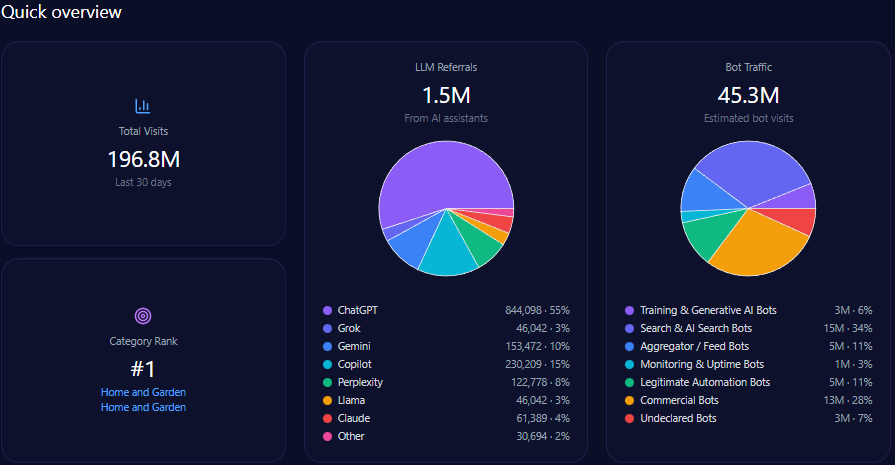
    At scale, Home Depot’s GEO footprint is formidable. The brand records 196,759,512 total visits, including 45,254,688 bot interactions, reflecting heavy machine-mediated discovery. LLM referrals exceed 1.5 million, with ChatGPT contributing the largest share.

    Within its primary category, Home Depot holds the #1 rank, reinforcing its position as the default authority for home improvement and building materials. This scale provides a strong foundation—but scale alone does not guarantee narrative control.

    homedepot.com’s Quick overview (GEO Report, Jan 14, 2026)

    Share of Voice in LLM Responses

    Inside AI answers, share of voice represents mindshare under compression. Home Depot captures 24% of all competitive mentions, closely trailing Amazon’s 28% while leading Lowe’s at 20%.

    This positioning confirms Home Depot as a primary reference brand rather than an alternative. Yet the margin matters. In generative environments, the first brand often absorbs disproportionate trust, while second place risks being framed as “also-ran” unless differentiation is explicit.


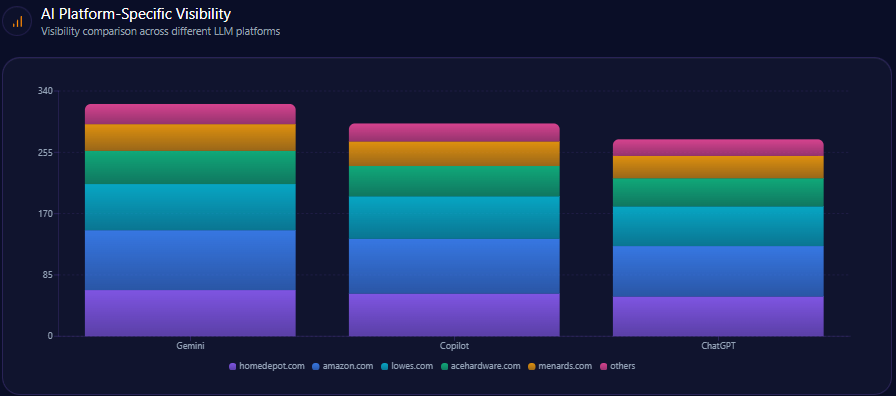
    Platform bias is real. Gemini is Home Depot’s strongest environment, where the brand commands 29% Share of Voice and benefits from optimized data feeds. ChatGPT presents a more balanced field, with Amazon slightly ahead due to breadth. Copilot is the weak spot, where Home Depot’s share stalls at 20%, limiting citation depth in Microsoft-driven ecosystems.

    The implication is clear: the same brand tells different stories depending on how each model ingests and ranks information. Competitor sentiment tracking at the platform level reveals where optimization must be surgical rather than generic.

    homedepot.com’s AI Platform-Specific Visibility (GEO Report, Jan 14, 2026)

    Sentiment Score for Competitors

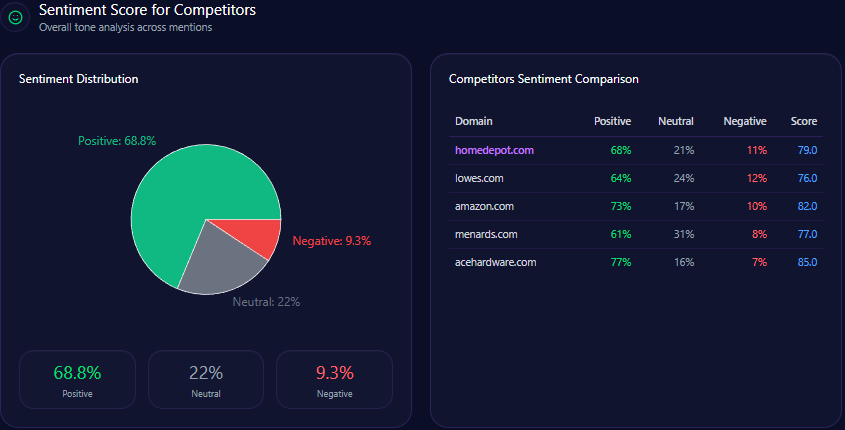
    Sentiment defines tone, not volume. Home Depot posts a strong 79 overall sentiment score, driven by positive narratives around professional services and product availability. Amazon leads slightly higher at 82, while Ace Hardware posts the highest sentiment at 85, powered by local service trust.

    Context themes explain the differences. Professional services dominate positive sentiment for Home Depot, while customer service quality introduces friction. Pricing narratives remain largely neutral, suggesting that value perception is stable but not emotionally resonant.

    homedepot.com’s Sentiment Score for Competitors (GEO Report, Jan 14, 2026)

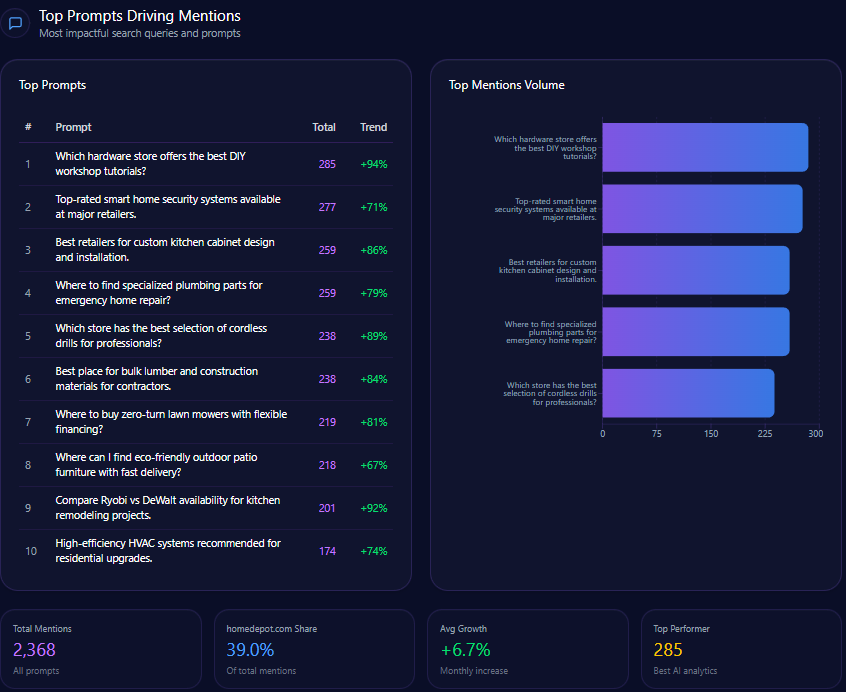
    Certain questions reliably summon Home Depot in AI answers. Prompts around DIY workshops, professional tool selection, bulk lumber sourcing, and brand-specific tool comparisons consistently feature the brand at high frequency.

    In contrast, prompts focused on smart-home security, eco-friendly outdoor furniture, and rapid delivery shift attention elsewhere. These patterns demonstrate how prompt framing—not just category presence—determines visibility.

    homedepot.com’s Top Prompts Driving Mentions (GEO Report, Jan 14, 2026)

    The prompt mix skews heavily toward comparison and feature inquiry queries, with limited representation from pure how-to tutorials or purchase intent. This distribution reflects how users increasingly rely on AI to evaluate options rather than execute transactions directly.

    For Home Depot, this is both an advantage and a risk. Authority in comparison contexts reinforces leadership, but gaps in emerging categories can quickly reframe the brand as traditional rather than innovative.


    At the product level, sentiment remains favorable. Reviews of Ryobi power tools and garden supplies are strongly positive, emphasizing availability and climate-specific relevance. Neutral feedback clusters around in-store wait times, while negative sentiment centers on delivery coordination for appliances.

    Trigger keywords again shape perception. “Power tools” and “interior paint” favor Home Depot, while “smart lighting” and “Christmas lighting” tilt heavily toward Amazon. In AI-driven discovery, these micro-perceptions aggregate into macro-narratives.


    Inconclusion

    Inconclusion, the data does not suggest that Home Depot is losing relevance. It shows that leadership is being redefined. Home Depot dominates where expertise, scale, and technical authority matter most—but lags where speed, smart-home integration, and lifestyle framing define the answer.

    The recommendations are precise: close the smart-home coverage gap, strengthen Copilot-specific visibility through local inventory signals, and rebalance narratives away from founder-linked political context toward modern operational leadership. None of these require reinvention. They require narrative alignment with how AI systems decide what “best” means.

    In the age of GEO analytics, visibility is not about being everywhere. It is about being unmissable in the moments that matter.


  • Carrefour’s 18% Share of Voice Is Holding the European Grocery Line and Revealing Where the Value Narrative Is Slipping

    Carrefour’s 18% Share of Voice Is Holding the European Grocery Line and Revealing Where the Value Narrative Is Slipping

    Ia generative search landscape increasingly dominated by speed, scale, and price perception, Carrefour’s GEO footprint shows both resilience and quiet erosion—depending on the question an AI is asked.


    Imagine asking an AI assistant a simple question: “Where should I buy groceries in Europe?”
    The answer arrives instantly—compressed, confident, and selective. Only a few brands make it into that response. Fewer still appear consistently when the question shifts from convenience to values, from price to sustainability, from bulk savings to local freshness.

    That compression is the new competitive arena. In this environment, Carrefour does not disappear. In fact, it holds ground with a stable presence across generative platforms. Yet the data also shows something more subtle: the brand’s authority is strongest where European context, sustainability, and regional logistics matter—and weakest where price absolutism and wholesale scale dominate the conversation.

    This is not a story of collapse. It is a story of narrative tension, revealed through GEO analytics and the patterns of LLM brand mentions.


    Position in LLM Response Lists

    Across major generative engines, Carrefour appears reliably in grocery-focused response lists, particularly those tied to European markets. In curated AI answers about supermarkets in France and regional grocery delivery leaders, Carrefour frequently secures a top-tier position or appears just below the category leader.

    However, the pattern shifts when lists broaden into general retail dominance, bulk shopping, or all-in-one convenience. In those contexts, Carrefour is often displaced by global platforms with stronger associations to logistics speed or wholesale economics. The brand’s ranking stability is therefore contextual rather than universal—anchored in geography and category specificity rather than sheer breadth.

    This positioning reflects a brand that LLMs “understand” clearly, but only within certain frames.


    Competitor Gap Analysis

    Viewed as a battle map, Carrefour’s competitive terrain is uneven. Against value-driven discounters, it faces a clear perception gap in price-first prompts. Against warehouse-club models, it lacks narrative depth around bulk purchasing and membership economics. Against global marketplaces, it trails in speed-centric delivery stories.

    Yet the same data shows areas of defensive strength. In sustainability-oriented retail queries, Carrefour outperforms the largest global player. In localized hypermarket searches, it maintains leadership over regional rivals.

    Query themeCarrefour positionCompetitor positionGap signal
    Cheapest weekly groceriesMid-tier visibilityCategory leader citedCritical
    Bulk pantry staplesModerate presenceDominant citationsStructural
    Sustainability in retailLeading citationsLower comparative scoreStrategic advantage
    Hypermarket near meLeading in FranceSecondary mentionsDefensive

    These gaps are not uniform weaknesses; they are narrative absences. Where Carrefour is not telling a story that LLMs can easily summarize, competitors step in.


    Trigger Keywords for Competitor Products

    Certain keywords consistently summon competitors ahead of Carrefour. Price-absolute phrases such as “cheapest weekly groceries” or “best price olive oil” tend to elevate discounters. Bulk-oriented language—“family-size,” “warehouse,” “bulk pantry staples”—pulls warehouse clubs to the forefront. Speed-centric terms like “same-day grocery” tilt answers toward platforms known for logistics velocity.

    By contrast, Carrefour appears more frequently when prompts emphasize sustainability, regional sourcing, or hypermarket accessibility. Keywords tied to organic retail, food transition initiatives, and European grocery delivery maintain relatively high Carrefour coverage.

    The implication is clear: keyword framing, not product reality, determines visibility.


    Founder Negative Context

    Leadership narratives play a quieter but meaningful role in generative perception. References to Carrefour’s executive leadership appear regularly, with sentiment remaining largely stable. However, negative context clusters around three themes: pricing disputes, labor relations, and market restructuring.

    Pricing tensions—particularly those linked to supplier negotiations and inflation labeling—form the largest share of negative mentions. Labor-related narratives surface intermittently, especially during periods of public wage discussions. Market exits and consolidation efforts introduce a third, smaller stream of uncertainty.

    Notably, these contexts are episodic rather than systemic. They flare around specific news cycles, then recede, suggesting reputational sensitivity rather than sustained erosion.


    Quick overview

    From a pure footprint perspective, Carrefour’s GEO presence is substantial. Millions of visits, heavy bot traffic, and tens of thousands of LLM referrals indicate a brand deeply embedded in machine-mediated discovery. Its category ranking places it firmly within the top tier of global e-commerce marketplaces, while its visibility score confirms consistent recognition across generative engines.

    The picture that emerges is not one of obscurity, but of selective prominence.


    Share of Voice in LLM Responses

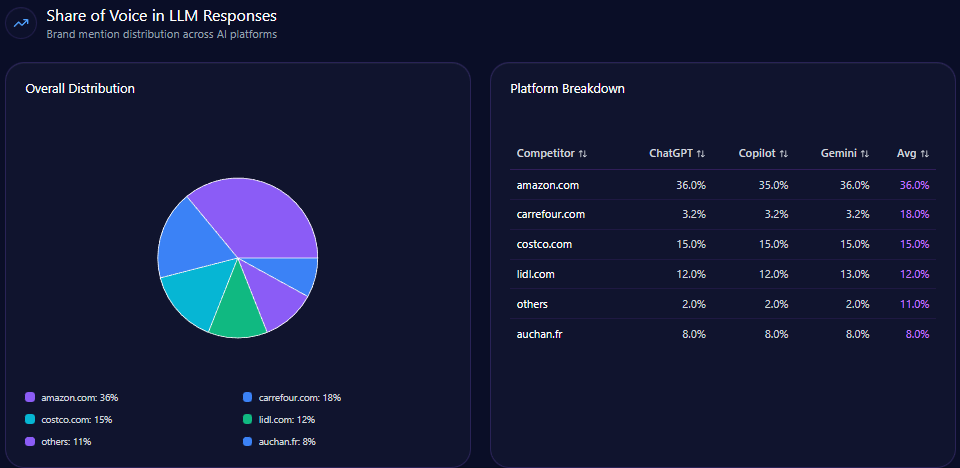
    An 18% Share of Voice positions Carrefour as the second-most visible brand in its competitive set—well behind the category leader, but ahead of most regional peers. This share is remarkably consistent across platforms, indicating balanced exposure rather than reliance on a single model.

    However, share of voice alone masks qualitative differences. Carrefour’s mentions skew toward explanatory and comparative contexts rather than default recommendations. It is cited as a credible option, not always as the obvious choice.

    carrefour.com’s Share of Voice in LLM Responses (GEO Report, Jan 12, 2026)

    That distinction matters in a world where AI answers are short and decisive.


    AI Platform-Specific Visibility

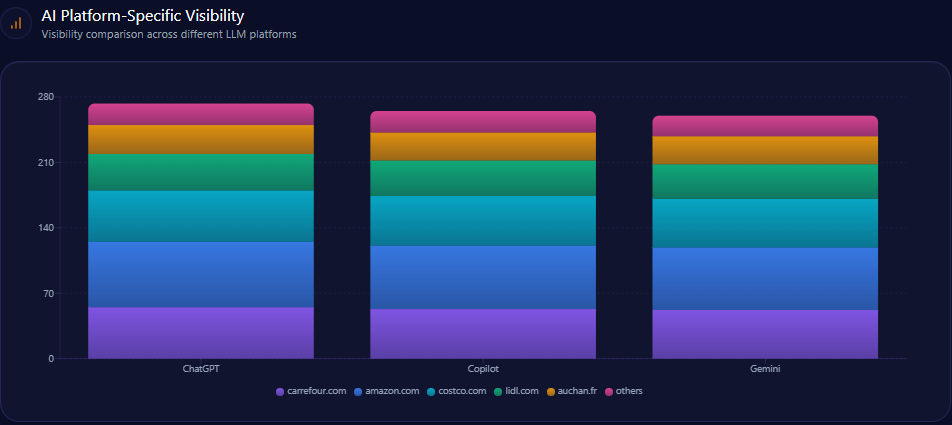
    Platform behavior tells a nuanced story. On ChatGPT, Carrefour benefits from strong historical data density and performs well in grocery-specific prompts. Copilot mirrors this pattern, particularly in regional contexts. Gemini, while still showing solid visibility, lags slightly in conversion signals, suggesting weaker integration with certain shopping-oriented cues.

    Despite these differences, Carrefour’s share remains remarkably stable at around the same level across major platforms. There is no single-platform collapse—only incremental friction where optimization lags.

    carrefour.com’s AI Platform-Specific Visibility GEO Report, Jan 12, 2026

    This consistency reflects a brand that is broadly legible to AI, even if not always favored.


    Sentiment Score for Competitors

    Sentiment analysis reveals another layer of competitive tension. Carrefour’s overall sentiment score sits comfortably above several regional rivals but below players whose narratives are tightly aligned with either extreme value or premium efficiency.

    Three themes dominate the tone of AI narratives. Sustainability and corporate responsibility skew highly positive, reinforcing Carrefour’s leadership in food transition messaging. Price and affordability generate mixed sentiment, where discounters gain emotional ground. E-commerce and delivery remain largely neutral, reflecting competence without distinction.

    carrefour.com’s Sentiment Score for Competitors GEO Report, Jan 12, 2026

    In contrast, some competitors achieve higher positivity by owning a single, easily summarized promise—be it lowest price or unmatched scale.


    Top Prompts Driving Mentions

    The prompts that most frequently surface Carrefour are revealing. Questions comparing grocery delivery services in France, evaluating sustainability commitments, or seeking organic food options regularly include Carrefour among top mentions.

    Conversely, prompts framed around absolute cheapest pricing or bulk savings tend to dilute its presence. The brand is summoned by values-based curiosity more than bargain-hunting urgency.

    This pattern underscores the importance of prompt framing in GEO analytics.


    Types of Prompt Queries

    Most Carrefour-related prompts fall into comparison and purchase-intent categories. Users ask AIs to weigh options, assess value propositions, or choose between retailers. Informational queries play a smaller role, while tutorial or feature-deep questions are rare.

    This distribution suggests that Carrefour is most visible at decision moments—when consumers are choosing—not during early exploration or post-purchase support.


    E-commerce Sentiment for Competitor Products

    At the product and service level, AI-mediated sentiment toward Carrefour skews positive, particularly for organic produce and fresh food categories. Reviews cited in generative answers frequently praise quality and selection, while neutral and negative snippets focus on electronics pricing or delivery issue resolution.

    Competitors with narrower assortments but clearer price leadership often achieve higher visibility in specific product-level prompts. Carrefour’s breadth, while an operational strength, becomes a narrative challenge when AI systems favor singular advantages.


    Conclusion

    Carrefour’s GEO profile tells a disciplined story. The brand holds its position as Europe’s most credible grocery counterweight in generative discovery, with strong sustainability authority and regional relevance. At the same time, it concedes narrative ground in price absolutism, bulk economics, and speed-first delivery frames.

    The recommendations emerging from the data are pragmatic rather than transformative: strengthen structured data around organic and private-label pricing, expand bulk-buying narratives, and sharpen platform-specific signals—particularly where integration gaps persist. None require a reinvention of the business. All require clarity in how the business is translated into AI-readable stories.

    In an era where competitor sentiment tracking and LLM brand mentions increasingly shape consumer choice, Carrefour’s challenge is not to be louder—but to be simpler, sharper, and more legible where it already competes.


    Explore SpyderBot to operationalize these GEO analytics insights.
  • Ahold Delhaize’s 12% Share of Voice Is Building a Sustainability-Led Advantage—and Revealing Where Value Narratives Slip Away

    Ahold Delhaize’s 12% Share of Voice Is Building a Sustainability-Led Advantage—and Revealing Where Value Narratives Slip Away

    In generative answers, Ahold Delhaize is winning the sustainability storyline—yet the same landscape still defaults to Walmart and Aldi when the question becomes price, speed, or mass-market convenience.


    Imagine a shopper asking an assistant a simple question: Who’s the most sustainable grocery leader right now? The model answers quickly—confidently—because it has learned which corporate narratives are easiest to cite.

    Now imagine the follow-up: Where do I get the lowest grocery prices in 2024? The tone changes. The cast of “obvious” brands changes. The model becomes less interested in corporate ambition and more interested in consumer proof.

    That whiplash is the boardroom reality behind GEO analytics: when answers are compressed into a few lines, reputation is awarded to the brands that own the right micro-narrative at the right moment.

    Position in LLM Response Lists

    Ahold Delhaize’s presence in response lists is defined by a split personality: it is treated as a top-tier authority in sustainability and ESG contexts, while being less “default” in value and convenience lists.

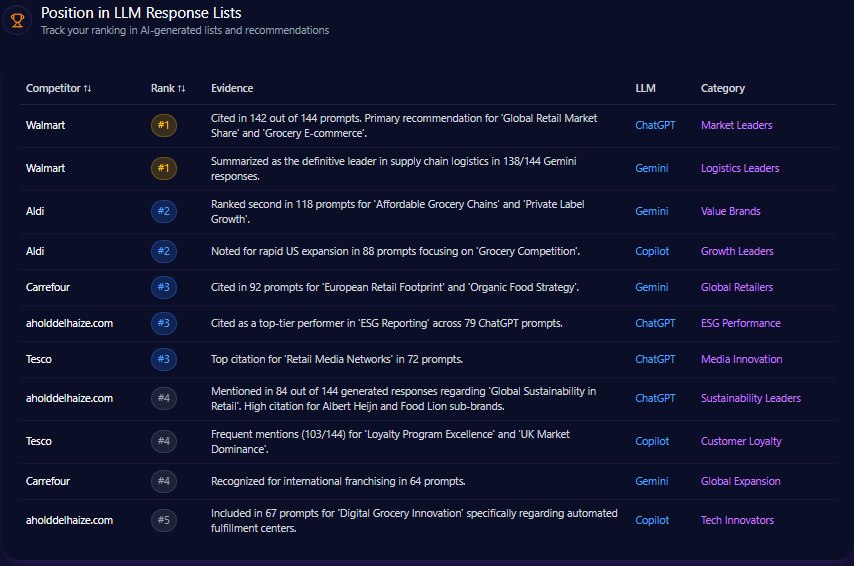
    On ChatGPT, Ahold Delhaize shows up as rank 3 in an “ESG Performance” list type, cited across 79 prompts. It also appears as rank 4 among “Sustainability Leaders,” mentioned in 84 out of 144 generated responses tied to “Global Sustainability in Retail.” On Copilot, it’s pulled into innovation narratives as rank 5 in “Tech Innovators,” included in 67 prompts focused on digital grocery innovation and automated fulfillment centers.

    The contrast becomes sharper when you look at who holds the “default leader” slots. Walmart is rank 1 in ChatGPT “Market Leaders” and rank 1 in Gemini “Logistics Leaders,” cited in 142 out of 144 prompts in one list type and summarized as the definitive logistics leader in 138/144 Gemini responses. In value and growth lists, Aldi is repeatedly placed at rank 2118 prompts in Gemini “Value Brands,” and 88 prompts in Copilot “Growth Leaders.”

    aholddelhaize.com’s Position in LLM Response Lists (GEO Report, Jan 12, 2026)

    Ahold Delhaize is present—often respected—yet the lists reveal what it is known for versus what it is chosen for.

    Competitor Gap Analysis

    The competitor battle map isn’t a single front. It’s a set of recurring questions where one competitor becomes the safe answer—and where Ahold Delhaize is either included as a credible alternative or excluded entirely.

    Here’s the tightest snapshot of the gaps the report surfaces:

    QueryAhold Delhaize metricCompetitor metricGap / priority
    lowest grocery prices 202464Aldi 9632.00 / High
    fastest grocery delivery services72Walmart 9422.00 / High
    best supermarket loyalty app58Tesco 8830.00 / Medium
    retail job benefits 202462Walmart 9129.00 / High
    best private label grocery74Aldi 9521.00 / Medium

    The story these queries tell is uncomfortable in its simplicity. In “lowest grocery prices 2024,” Aldi dominates the value narrative—often excluding Ahold’s banners from budget-centric recommendations. In “fastest grocery delivery services,” Walmart+ becomes the default for speed. In “best supermarket loyalty app,” Tesco’s Clubcard is treated as the benchmark for personalized digital rewards. And in “retail job benefits 2024,” Walmart’s education benefits are a recurring citation advantage.

    Yet the same data also shows where Ahold Delhaize can lead. In “sustainable packaging retail,” Ahold Delhaize posts 81 versus Walmart’s 75 (a -6.00 gap score, flagged as low priority because the brand already leads). In “online grocery trends Europe,” Ahold Delhaize is 85 versus Carrefour’s 82 (gap score -3.00), suggesting the brand’s positioning through Albert Heijn is already strong.

    This is not a brand that lacks authority. It’s a brand whose authority is unevenly distributed across the prompts that shape consideration.

    Trigger Keywords for Competitor Products

    The report’s keyword triggers reinforce a clear pattern: the words that summon “value,” “automation,” and “loyalty” tend to pull competitors into the answer first—especially in product and commerce-oriented contexts.

    Several triggers stand out as repeat summons for competitors:

    • “automated grocery fulfillment” (value 92) skews heavily toward Walmart (41) and Tesco (19) in competitor mentions.
    • “contactless checkout Europe” (value 89) pulls Carrefour most strongly (35).
    • “sustainable grocery retail” (value 88) is dominated by Carrefour (28) and Tesco (22) in competitor mentions.
    • “AI grocery assistant” (value 84) leans toward Walmart (32) and Carrefour (24).
    • “supermarket loyalty apps” (value 77) highlights Walmart (51) and Tesco (49) as top associations.

    In other words: the keyword layer doesn’t just describe what shoppers ask. It describes which brands the model has learned to attach to specific “proof points” in the retail vocabulary—and which brands must work harder to be included when those proof points are value-led rather than ESG-led.

    Founder Negative Context

    Founder and leadership narratives are where corporate identity becomes human—and where risk becomes a storyline rather than a metric.

    In the report’s leadership lens, Frans Muller (CEO/Current face) registers a mention frequency of 46 with a sentiment score of 73 ( 68% positive, 23% neutral, 9% negative). The heritage figure Albert Heijn (Historical) appears with 22 mentions and a sentiment score of 88 ( 82% positive, 14% neutral, 4% negative). For comparison, Walmart’s Doug McMillon (CEO) appears with 89 mentions and a sentiment score of 71, while Tesco’s Ken Murphy is at 38 mentions with a sentiment score of 62.

    But the sharper signal sits in the negative-context distribution tied to leadership narratives. The report’s founder negative context is led by Inflation & Pricing Policy (42%), followed by Labor Relations (34%), and Supply Chain Sustainability (24%)—with examples ranging from “Greedflation accusations in Dutch media” to “Delhaize Belgium franchising strikes” and “Scope 3 emission targets skepticism.”

    The trend framing intensifies the story: in 2023-H2, Inflation sits at 38% and is marked threshold-exceeded, while Labor reaches 41% and is also marked threshold-exceeded. In 2024-H1, Inflation rises to 42% and remains threshold-exceeded. The keyword weights show what the models latch onto: Pricing (81), Strikes (66), Margins (54).

    One insight line captures the reputational trap in plain language: “LLM conversations referencing ‘Greedflation’ caused a 14% spike in Pricing Policy mentions…”.

    Quick overview

    Ahold Delhaize’s footprint in this dataset is substantial, but it is not evenly “owned” by any single narrative.

    The domain logs 242,708 total visits, with 77,667 attributed to bot traffic across categories including Search & AI Search Bots (31,067) and Commercial Bots (19,417). On the referral side, the report records 1,942 LLM referrals—led by ChatGPT (874), followed by Gemini (388) and Copilot (291), with additional contribution from Perplexity (155), Grok (97), Claude (78), Llama (39), and Other (20).

    Category-wise, the domain sits at rank 58 in Food_and_Drink/Food_and_Drink. In a world where generative answers behave like compressed rankings, that context matters: it influences which peers the model “expects” to mention.

    Share of Voice in LLM Responses

    Inside generative answers, Share of Voice isn’t just awareness—it’s default legitimacy.

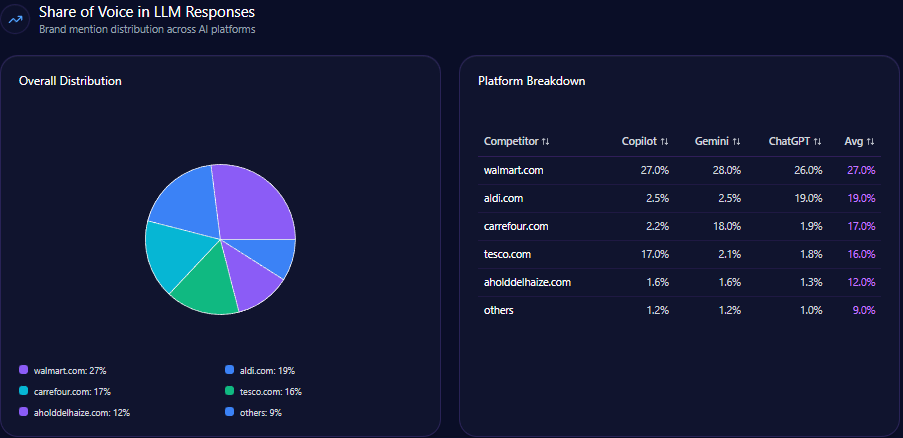
    Across 490 total mentions, Ahold Delhaize captures 61—a 12% Share of Voice. Walmart leads at 132 mentions (27%), followed by Aldi with 93 (19%), Carrefour with 84 (17%), and Tesco with 77 (16%). The remainder sits in “others” at 43 mentions (9%).

    Pair that with visibility scoring and the picture clarifies: Walmart posts a Visibility Score of 92, Aldi 81, Carrefour 76, Tesco 72, and Ahold Delhaize 64 (with “others” at 48). That’s a 28-point visibility gap between Ahold Delhaize and the market leader—mirroring the report’s warning that global scale does not automatically translate to dominant LLM brand mentions.

    aholddelhaize.com’s Share of Voice in LLM Responses (GEO Report, Jan 12, 2026)

    The crucial nuance: this is not a collapse of presence. It’s a pattern of selective authority—strong in some question clusters, thinner in others.

    AI Platform-Specific Visibility

    The same brand can experience three different “truths,” depending on which model is asked.

    Copilot is the most favorable environment for Ahold Delhaize in this dataset, with 46% visibility and a platform share of voice of 13 across 168 total mentions. Gemini follows closely at 44% visibility, also with a platform share of voice of 13 across 158 mentions. ChatGPT is lower at 38% visibility and a share of voice of 11 across 164 mentions.

    The competitive cast changes by platform. On Copilot, Walmart holds 27% share with 45 mentions, while Tesco takes 17% with 29 mentions. On Gemini, Walmart leads again at 28% with 44 mentions, while Carrefour holds 18% with 28 mentions. On ChatGPT, Walmart is at 26% with 43 mentions, while Aldi takes 19% with 31 mentions.

    The takeaway is practical: Ahold Delhaize benefits from Copilot’s corporate indexing bias, while ChatGPT’s consumer-intent framing more consistently elevates discount/value competitors. This is where GEO analytics becomes operational rather than descriptive: the same messaging strategy will not perform identically across models.

    Sentiment Score for Competitors

    Share of voice is volume. Sentiment is the tone of the story the model tells when it does include you—an essential layer of competitor sentiment tracking.

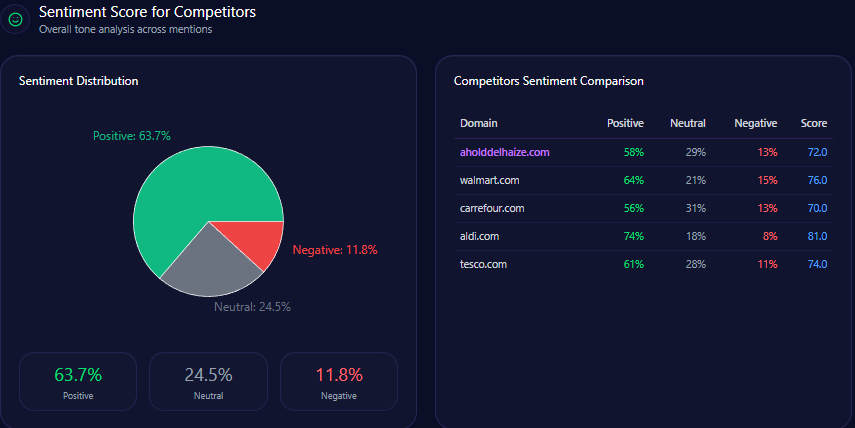
    Ahold Delhaize posts 58 positive, 29 neutral, and 13 negative, with an overall sentiment score of 72. Walmart stands at an overall score of 76 ( 64 positive, 21 neutral, 15 negative). Carrefour is 70 ( 56 positive, 31 neutral, 13 negative). Tesco is 74 ( 61 positive, 28 neutral, 11 negative). Aldi leads the sentiment set at 81 ( 74 positive, 18 neutral, 8 negative).

    The context themes explain why tone shifts by query cluster. “Pricing & Inflation Resilience” carries a frequency of 31.00 with 2,143 counts and is described as neutral in tone—exactly where value narratives and “greedflation” framing tend to appear. “Sustainability & ESG leadership” runs at 27.00 frequency with 1,864 counts and is described as highly positive, including examples such as “Renewable energy” and “plastic reduction.” “Omnichannel & Digital Growth” sits at 22.00 frequency with 1,521 counts and is described as positive—yet the brand’s prompt coverage in omnichannel is notably thinner than in sustainability.

    aholddelhaize.com’s Sentiment Score for Competitors (GEO Report, Jan 12, 2026)

    Ahold Delhaize is not losing the tone war. It is losing certain stages where the tone is set by value and convenience proof points.

    Top Prompts Driving Mentions

    The report’s top prompts read like a script of what the market is asking models to decide.

    The highest-volume prompt listed is “Which grocery stores have the strongest ESG commitments for 2024?” with 274 mentions: Ahold Delhaize registers 112, alongside competitor counts of 94 and 68, with competitor names listed as Carrefour and Tesco, and a trend of +84%.

    The omnichannel innovation prompt—“What are the most innovative supermarkets in terms of omnichannel technology?”—also sits at 274 mentions, with Ahold Delhaize at 72, and competitor counts of 94 and 108, with competitor names Carrefour and Walmart, and a +61% trend.

    When the prompt shifts into value, the distribution swings: “Recommend affordable retailers with high-quality private labels.” totals 272 mentions, with Ahold Delhaize at 42, while competitor counts reach 138 and 92, with Aldi and Walmart listed, and a +79% trend.

    Other high-driving prompts reinforce the same multi-front reality: delivery speed comparisons at 255 mentions (Ahold Delhaize 58, competitors 115 and 82), dividend stability at 250 mentions (Ahold Delhaize 78, competitors 110 and 62), and a direct AI-use comparison—“How are Ahold Delhaize and Walmart using AI to improve customer experience?”—at 212 mentions (Ahold Delhaize 88, Walmart 124), trending +68%.

    The model isn’t asking one question about Ahold Delhaize. It’s asking several—each with different winners.

    Types of Prompt Queries

    The prompt mix is heavily weighted toward evaluation rather than transaction.

    Feature Inquiry leads with a value of 50 (count 5), followed by Comparison at 40 (count 4), and Research at 10 (count 1). Purchase Intent and How-to/Tutorial both sit at 0 with counts of 0.

    This composition matters because it rewards brands that can be cited as benchmarks—especially in “best,” “fastest,” “most innovative,” and “strongest ESG” frames. It also explains why the battleground is less about short-term conversion language and more about which proof points have been made easiest for the model to retrieve and repeat.

    E-commerce Sentiment for Competitor Products

    In the e-commerce lens, the competitive hierarchy tightens.

    Ahold Delhaize holds 10.42% share of voice with 15 mentions, while Walmart leads at 37.5% with 54 mentions. Aldi sits at 18.06% with 26 mentions, Carrefour at 15.28% with 22, and Tesco at 14.58% with 21 (with “others” at 4.17% and 6 mentions).

    Sentiment snapshots in this section show positive sentiment of 68, 74, and 71, with negative sentiment at 8 across all three entries, and total reviews of 1,142, 988, and 1,256. And the story becomes tangible in the snippets—small lines that carry outsized influence when models compress trust:

    • “The digital experience with Albert Heijn’s app is seamless, making Ahold Delhaize a leader in grocery tech.” (as cited in the report; source: G2 / TechReviews, rating 5)
    • “Decent prices at Food Lion, but I often find Walmart has a larger variety for bulk items.” (as cited in the report; source: Trustpilot, rating 3)
    • “Impression of the sustainability reports from Ahold Delhaize suggests they are ahead of Tesco in green initiatives.” (as cited in the report; source: Retail Insight Blog, rating 4)

    Even referrals reinforce the platform pattern: Copilot (3,112) at 4.2 conversion rate, Gemini (1,850) at 3.8, and ChatGPT (2,410) at 3.4. In this view, mentions that do occur can convert—especially when the model’s framing aligns with corporate authority, loyalty, and grocery-tech trust.

    Conclusion

    The data draws a clear leadership challenge: Ahold Delhaize is already a sustainability authority, but it is still paying a visibility tax in value and convenience narratives where Walmart and Aldi are the model’s default answers. The report’s prescriptions are equally clear—consolidate banner-level technical whitepapers and ESG success stories under the parent domain, execute a “Value and Quality” content campaign for private labels like Nature’s Promise, and optimize structured data to lift Gemini local-intent coverage toward a 15% regional visibility increase by the next fiscal quarter. If leadership wants to close the gap, the path is not louder messaging—it’s more retrievable proof in the exact query clusters that currently exclude the brand.

    Explore SpyderBot to operationalize these GEO analytics insights.
  • Petrolimex’s 48% Share of Voice Is Reshaping Vietnam’s Energy Narrative and Exposing the Real Competitive Gap

    Petrolimex’s 48% Share of Voice Is Reshaping Vietnam’s Energy Narrative and Exposing the Real Competitive Gap

    In generative search, the “winner” is the brand the model can cite with confidence. This report shows Petrolimex owning the default answer in core petroleum questions—while competitors are carving out the next story in EV, apps, and regional logistics.

    Imagine the same assistant being asked two very different questions: Where should I refuel tonight? and Who sets the benchmark for price transparency? The model answers in seconds—because it compresses trust into a few lines.

    That compression is the boardroom battleground behind GEO analytics. When answers are short, only a handful of brands get to be the default citation. In this report, Petrolimex repeatedly wins that privilege—until the prompt shifts into future-facing edges where competitors can sound more modern, more local, or more convenient.

    The ranking snapshots are consistent: Petrolimex appears at rank 1 across multiple formats and platforms. On ChatGPT-4o, it is #1 in “Top Recommended Entities.” On Gemini 1.5 Pro, it is #1 as a “Direct Answer” and also #1 in “Informational” lists tied to fuel price transparency and updates. It also shows up at rank 2 in “Strategic Reports” on ChatGPT-4o, where the answer style becomes more interpretive than factual.

    The report pairs this with a Rank Score of 96, signaling that the brand is treated as an authority source in Vietnamese energy queries. Competitors are present, but specialized: PVOil is positioned as an innovation leader at rank 2, while NSH Petro and Thanh Le surface in regional and logistics-focused lists.Position in LLM Response Lists

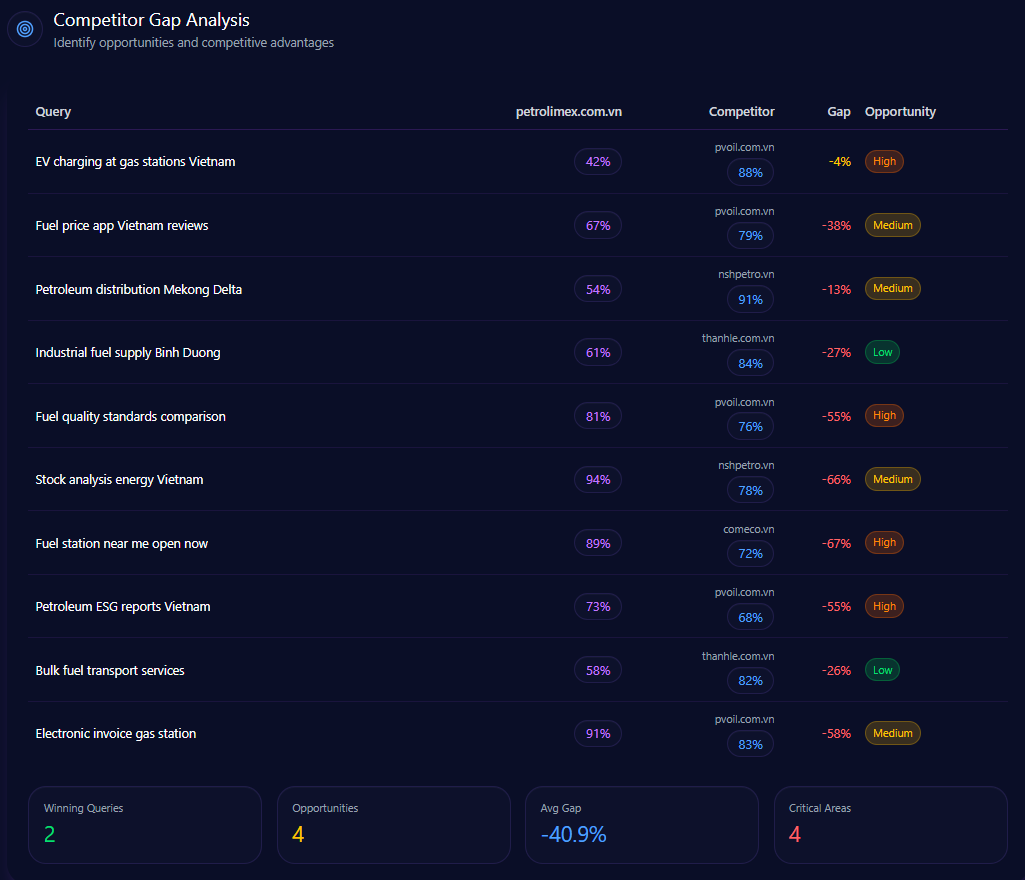
    Leadership in lists does not mean immunity from gaps. The report highlights specific queries where competitors are framed as the better answer:

    QueryPetrolimexCompetitorGap / priority
    EV charging at gas stations Vietnam4288 (PVOil)46 — High
    Petroleum distribution Mekong Delta5491 (NSH Petro)37 — Medium
    Bulk fuel transport services5882 (Thanh Le)24 — Low
    Fuel price app Vietnam reviews6779 (PVOil)12 — Medium

    The “why” is explicit. PVOil is “frequently cited as the pioneer for integrated EV charging stations due to the VinFast partnership,” and the report calls for whitepapers on Petrolimex’s green energy roadmap and future-proof station designs. In the Mekong Delta, NSH Petro is said to dominate local-language logistics queries, prompting localized landing pages for Southern distribution hubs. In transport-only prompts, Thanh Le appears as a primary B2B reference—motivating content that foregrounds Petrolimex’s large-scale logistics capability.

    petrolimex.com.vn‘s Competitor Gap Analysis (GEO Report, Jan 9, 2026)

    The competitors’ playbook is keyword ownership. In this report, EV charging is the most powerful trigger—especially when paired with “gas stations Vietnam” and the “VinFast partnership,” which reliably pulls PVOil into an innovation narrative.

    The second trigger cluster is digital convenience. Prompts like “Fuel price app Vietnam reviews” and “Best mobile apps for fuel discounts in Vietnam?” are repeatedly associated with app ecosystem comparisons, and the report issues a high-severity alert to optimize app features and E-wallet integration for ChatGPT and Gemini visibility. Even enterprise convenience language is contested: “Is Petrolimex or PVOil better for corporate fleet cards?” records 71 mentions with 34 for Petrolimex and 37 for PVOil.

    Geography becomes the third trigger. “Mekong Delta” language pulls NSH Petro forward; industrial-province language reinforces Thanh Le’s niche B2B positioning.

    The report flags leadership narrative risk as a separate layer of vulnerability. Negative context clusters into Leadership concerns (35.5%), Company culture (28.3%), Strategic direction (22.1%), and Financial performance (14.1%).

    Where this surfaces also matters. Leadership concerns peak on ChatGPT (42.5%) and are strong on Grok (38.2%); company culture appears most on Gemini (35.8%). The keyword weights reinforce the theme: management (0.85) and leadership (0.78) lead the signal set. The report’s directional read is blunt: “Leadership concerns have increased over the past quarter,” and “Company culture mentions are trending upward.”

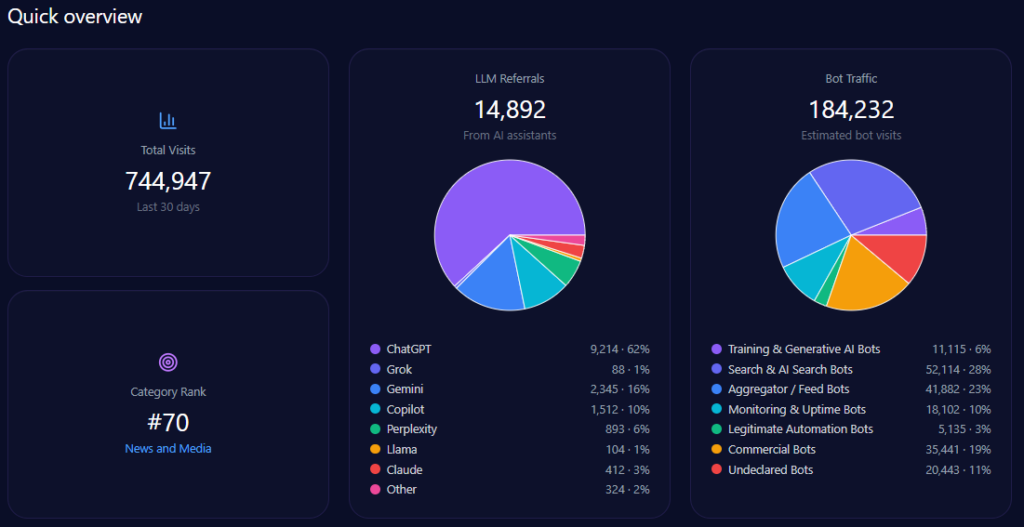
    The footprint combines human audiences and machine audiences. The report records 744,947 visits with 184,232 bot visits, and 14,892 LLM referrals led by ChatGPT (9,214). Collection is marked complete on 2026-01-09 across ChatGPT, Gemini, and Copilot.

    Category placement is News_and_Media, with a category rank of 70. Practically, that means generative systems may be encountering the brand partly through news-like signals and structured updates—not only through transactional pages.

    petrolimex.com.vn‘s Quick overview (GEO Report, Jan 9, 2026)

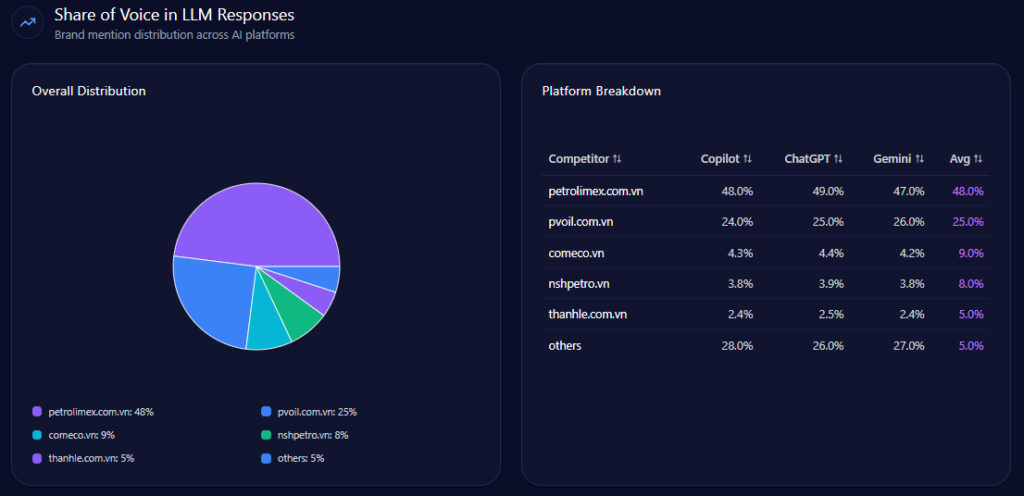
    Across 348 total mentions, Petrolimex leads with 48% (167 mentions). PVOil follows at 25% (87), then Comeco 9% (31), NSH Petro 8% (27), Thanh Le 5% (18), and others 5% (18).

    Visibility scores reinforce the hierarchy: Petrolimex 88 versus PVOil 72, then Comeco 54, NSH Petro 48, Thanh Le 41, others 35. This is the report’s clearest proof of sustained LLM brand mentions: Petrolimex is the reference option in the majority of core prompts.

    petrolimex.com.vn‘s Share of Voice in LLM Responses (GEO Report, Jan 9, 2026)

    Platform outcomes diverge. On Copilot, Petrolimex reaches 94% visibility, holding 48% share of voice with 56 mentions out of 118 total mentions. On ChatGPT, visibility is 91%, with 58 mentions out of 118 (share 49%). On Gemini, visibility falls to 87%, with 53 mentions out of 112 (share 47%), and PVOil rises to 26% (29).

    The report’s takeaway is straightforward: the same brand, different platform priors—and Gemini appears slightly more permissive to competitor narratives in localized and logistics-oriented queries.

    petrolimex.com.vn‘s AI Platform-Specific Visibility (GEO Report, Jan 9, 2026)

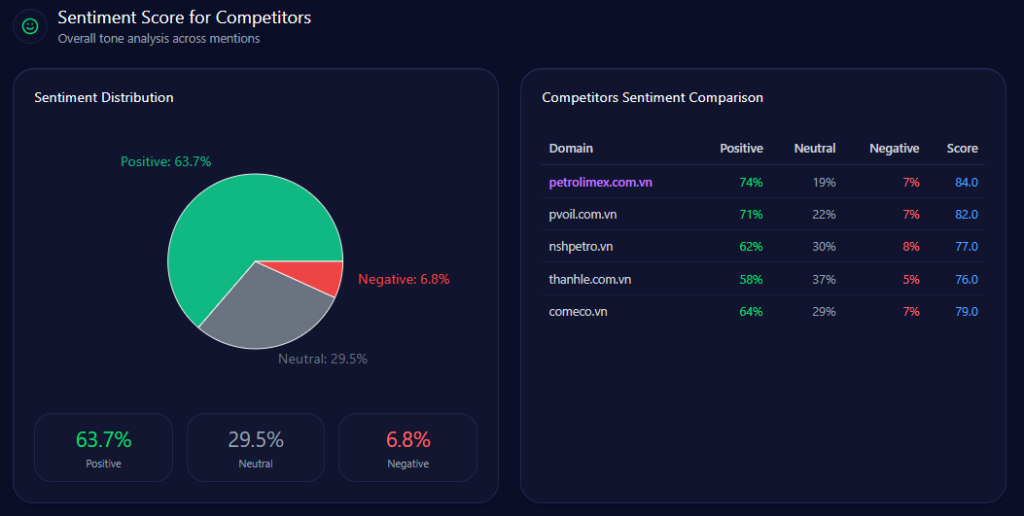
    Presence is only half the battle; framing is the other—and the report’s competitor sentiment tracking provides a clear scoreboard. Petrolimex posts 74% positive, 19% neutral, 7% negative, with an overall sentiment score of 84. PVOil follows at 82, Comeco at 79, NSH Petro at 77, and Thanh Le at 76.

    Two themes anchor the tone. Energy Security appears 142 times (frequency 34.00) with example framing that calls Petrolimex the backbone of Vietnamese fuel supply. Digital Transformation appears 98 times (frequency 24.00) and repeatedly compares app ecosystems—where competitive contrast is explicit even when overall sentiment remains Neutral-Positive.

    petrolimex.com.vn‘s Sentiment Score for Competitors (GEO Report, Jan 9, 2026)

    The prompts that summon Petrolimex are clear—and they explain the balance of power:

    • “Which company leads the Vietnamese petroleum retail market share?” — 82 mentions (46 Petrolimex), +96% trend
    • “Which petroleum company has the most gas stations in Vietnam?” — 78 mentions (44 Petrolimex), +94% trend
    • “Gasoline price updates and reliable providers today in Vietnam” — 76 mentions (39 Petrolimex), +74% trend
    • “Best mobile apps for fuel discounts in Vietnam?” — 64 mentions (19 Petrolimex; competitor A 41), +58% trend

    In short: Petrolimex dominates market-leader prompts; it loses ground on digital-discount prompts.

    petrolimex.com.vn‘s Top Prompts Driving Mentions (GEO Report, Jan 9, 2026)

    The intent mix is decisively action-oriented. Feature Inquiry leads at 50 (count 5), followed by Comparison at 30 (count 3) and Purchase Intent at 20 (count 2). Research and How-to/Tutorial both sit at 0.

    Two alerts translate that intent mix into priorities. A high-severity message prioritizes app features and E-wallet integration to recapture “digital convenience” mentions in ChatGPT and Gemini. A medium-severity message calls for more logistics updates and community projects in the Southwest region to sustain regional authority.

    petrolimex.com.vn‘s Types of Prompt Queries (GEO Report, Jan 9, 2026)

    E-commerce Sentiment for Competitor Products

    The report also tracks commerce-like discovery across “Amazon, eBay, Shopify.” In its platform breakdown, Petrolimex holds 35.5% share of voice with 1,250 mentions, followed by Competitor A 28.3% (995), Competitor B 22.1% (775), and Competitor C 14.1% (495).

    Sentiment in this layer is 45.2% positive, 35.8% neutral, 19% negative across 1,250 total reviews. The cited snippets show how execution details can swing perception quickly: “Great product quality and fast shipping!” (Amazon, rating 5) versus “Shipping took longer than expected.” (Amazon, rating 2). Referral conversion rates also vary by platform: Amazon 12.5, eBay 9.8, and Shopify 15.2.

    Petrolimex leads the generative narrative today, but the report shows where competitors can steal tomorrow’s framing—EV charging, app-led convenience, and localized logistics. The recommended response is clear: launch a Green Energy Content Series targeting EV charging and sustainable fuel keywords, while the Digital Product team updates technical schemas and FAQs for the mobile app to improve indexing and user-sentiment outcomes. In parallel, the report calls for a regionalized content strategy for South-West Vietnam to counter localized competitors, and for increased publication of logistics network updates and community projects to sustain regional authority.

    Explore SpyderBot to operationalize these GEO analytics insights.
  • Schwarz Gruppe’s 22% Share of Voice Is Reshaping the European Retail Narrative—and Exposing the Real Competitive Gap

    Schwarz Gruppe’s 22% Share of Voice Is Reshaping the European Retail Narrative—and Exposing the Real Competitive Gap

    In generative search, Schwarz Gruppe isn’t only competing for shoppers—it’s competing for which story an AI feels safe recommending first. This report shows leadership-level authority, alongside sharp pockets where rivals still own the “default answer.”

    Imagine a customer asking an AI, “Who really runs European grocery—and who’s building the next retail operating system?” In the old world, that answer lived in annual reports and investor decks. In the new world, it’s compressed into a few confident lines where brand authority is judged by what the model can cite, not what it can browse.

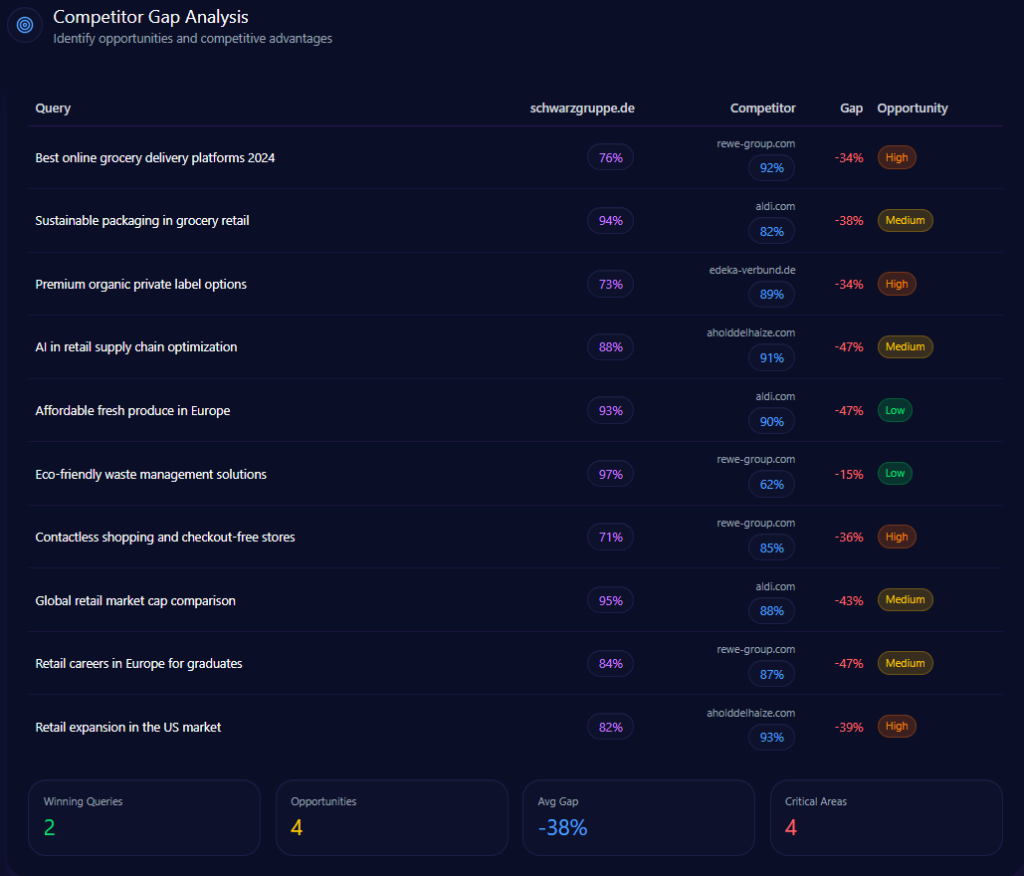
    That is the boardroom reality behind GEO analytics: AI platforms don’t just list retailers; they curate legitimacy. In this report, Schwarz Gruppe repeatedly arrives as the “largest European retailer by revenue,” and it does so with enough consistency to become a default reference point. But the same data also shows where that default can be stolen—by the competitor that owns last-mile delivery language, premium organic cues, or “smart store” innovation shorthand.

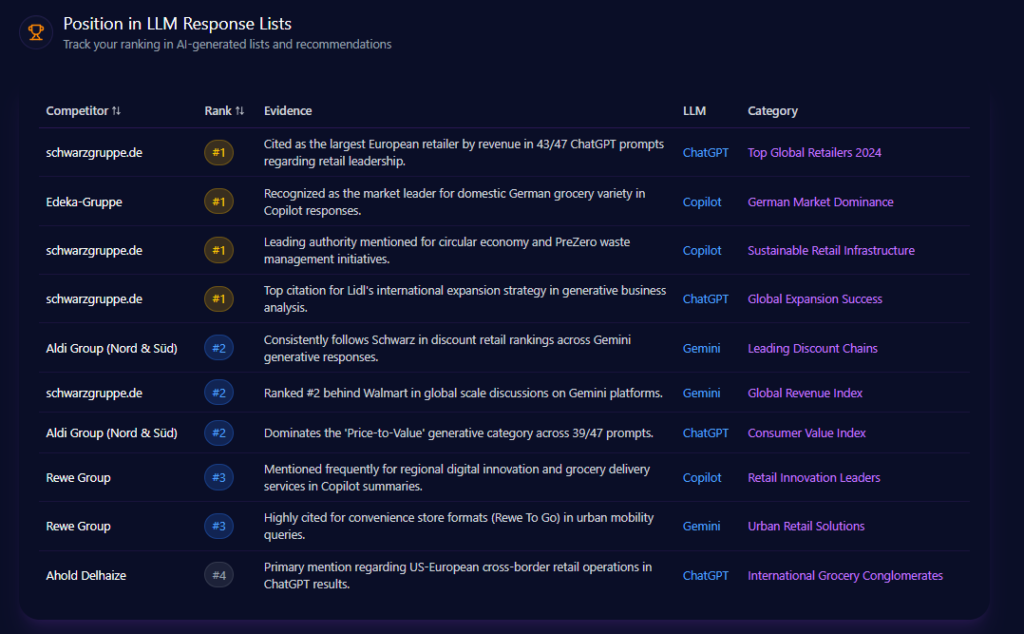
    Schwarz Gruppe’s strongest advantage is not merely being mentioned—it is being positioned. Across the report’s simulated prompts, the group is ranked #1 for “Largest European Retailer” across 141 prompt runs, and it is specifically cited in 43/47 ChatGPT prompts about retail leadership. The pattern is clear: when the question is scale, the model’s “safe answer” leans Schwarz.

    But the rankings also reveal how leadership fractures by context. On Gemini, Schwarz is ranked #2 in a “Global Revenue Index” list type—explicitly behind Walmart—while still showing up as a top discount-chain reference where Aldi Group (Nord & Süd) often trails Schwarz in discount retail rankings. Meanwhile, Copilot can elevate alternatives when the prompt becomes local-market dominance: Edeka-Gruppe is ranked #1 for domestic German grocery variety in Copilot responses, even as Schwarz remains rank #1 for circular economy and PreZero-linked initiatives.

    This is the nature of LLM brand mentions: the model’s “top spot” is not a single crown—it’s a set of context-dependent crowns. Schwarz holds the most valuable one (leadership-by-scale) reliably, but rivals still win specific sub-narratives with alarming efficiency.

    schwarzgruppe.de’s Position in LLM Response Lists (GEO Report, Jan 9, 2026)

    If Schwarz owns “scale,” competitors target “specificity.” The report’s gap data reads like a battle map: where the customer asks for delivery convenience, checkout automation, premium organics, or North American relevance, Schwarz can lose the framing—even when its overall visibility remains dominant.

    QuerySchwarz Gruppe position/metricCompetitor position/metricGap/priority
    Best online grocery delivery platforms 20247692 (Rewe Group)16 — High
    Premium organic private label options7389 (Edeka-Gruppe)16 — High
    Contactless shopping and checkout-free stores7185 (Rewe Group)14 — High
    Retail expansion in the US market8293 (Ahold Delhaize)11 — High

    The story behind those numbers is not “Schwarz is weak.” It’s that Schwarz is being evaluated against competitors who have clearer shorthand in certain prompts. Rewe is described as being cited more frequently for last-mile delivery and sophisticated app integration, which directly translates into the 16-point delivery gap. Edeka benefits from LLM preferences for diversity in high-end bio and organic products, producing a 16-point premium-organics deficit. Ahold Delhaize is repeatedly advantaged in US-centric prompts through its North American operations, sustaining an 11-point ranking advantage in that geography-specific frame.

    In GEO analytics terms, the competitive gap is less about capability—and more about “which proof points the model has learned how to retrieve.”

    schwarzgruppe.de’s Competitor Gap Analysis (GEO Report, Jan 9, 2026)

    Where do those competitor narratives get summoned? In the report’s commerce-oriented keyword signals, certain phrases act like trapdoors: they drop the conversation into a competitor’s home turf.

    Several triggers consistently pull the model toward rivals:

    • “discount groceries” strongly associates with Aldi Group, which appears 22 times within that keyword’s competitor mentions.
    • “private label quality” tilts toward Edeka-Gruppe, cited 18 times in association with that keyword.
    • “sustainable retail” becomes contested terrain where Rewe Group (21) and Ahold Delhaize (15) show up prominently as linked competitors.
    • “bakery freshness” frequently points to Edeka-Gruppe (24), reinforcing premium-perception cues that Schwarz struggles to own in generative outputs.

    Even when a keyword seems Schwarz-adjacent—like “Lidl Plus app”—the competitive environment can still pull attention toward other brands (the report shows Rewe Group linked with 12 mentions under that keyword’s competitor associations). The implication is subtle but strategic: if rivals dominate the language around a feature category, they can “borrow” relevance even inside a Schwarz-led narrative.

    Leadership brands often carry a leadership shadow. In this report, founder and governance narratives are not neutral background—they are measurable risk surfaces.

    Dieter Schwarz appears with a mention frequency of 78 and a sentiment score of 74, with 68% positive, 20% neutral, and 12% negative distribution. The founder-associated negative sentiment rate is reported at 14, and the broader negative framing is not random: the founder negative context distribution assigns 42% to Transparency & Privacy, 36% to Labor Relations, and 22% to Market Dominance.

    The trends show persistence. In Q1 2024, “Transparency” sits at 45% and is flagged as threshold-exceeded; in Q2 2024, “Transparency” remains threshold-exceeded at 39%, while “Labor” rises to 38% and also crosses a threshold. Keyword weights make the reputational mechanics visible: “Secretive” (92) and “Foundation” (84) anchor the transparency narrative, while “Lidl” (94) and “Union” (88) intensify labor-relations associations.

    The platform heatmap adds an uncomfortable precision: transparency themes are highest on ChatGPT (44%), while labor relations show up strongly on Gemini (38%), and market dominance is most pronounced on Copilot (26%). The report also notes cross-pollination—“Reclusiveness” plus “Ownership Opacity” appearing together in 64% of Gemini answers—and highlights that labor mentions are 3x more frequent in prompts targeting “Lidl” than in general “Schwarz Gruppe” queries.

    This is not a theoretical risk; it is a narrative pattern that can drag even strong performance into defensive positioning.

    The footprint is substantial, and it is multi-layered. The report records 384,213 total visits, with 146,001 attributed to bot traffic—broken down into categories including Training & Generative AI Bots (32,120) and Search & AI Search Bots (51,100), alongside other bot segments. LLM referrals total 4,611, with the largest inbound stream from ChatGPT (2,582), followed by Gemini (645) and Copilot (553)—and additional traffic from platforms including Perplexity (415), Grok (184), and others.

    The configuration captures a deliberate measurement frame: 48 LLM bots working, 48 prompts per LLM, spanning ChatGPT, Gemini, and Copilot. In parallel, the ranking analysis highlights a 47-bot run used for leadership and positioning checks—where Schwarz repeatedly lands as the European revenue authority.

    In short: the system sees Schwarz often, cites it confidently, and routes measurable LLM referral traffic accordingly.

    schwarzgruppe.de’s Quick overview (GEO Report, Jan 9, 2026)

    Schwarz Gruppe leads the competitive landscape on mindshare inside AI answers with a 22% Share of Voice, driven by 131 mentions out of 583 total. The margin is real—but not comfortable. Aldi Group sits at 20% (116), and Ahold Delhaize is close behind at 18% (104), with Rewe Group at 15% (88) and Edeka-Gruppe at 14% (81). The remainder is categorized as others (11%, 63).

    Visibility scores reinforce the hierarchy: Schwarz at 84, Aldi at 81, Ahold Delhaize at 77, Rewe at 69, and Edeka at 66. A 2-point Share of Voice lead over Aldi is meaningful, but it signals a leadership position that can be challenged quickly if narrative ownership shifts in high-intent queries—especially those where Rewe and Ahold already hold prompt-level advantages.

    This is why competitor sentiment tracking matters: the battle isn’t only volume; it’s the tone and context of the mention.

    schwarzgruppe.de’s Share of Voice in LLM Responses (GEO Report, Jan 9, 2026)

    The same brand performs differently depending on which AI is doing the summarizing.

    On ChatGPT, the environment is structurally favorable to Schwarz: platform visibility is 88, and Schwarz holds a 26% competitor share with 51 mentions (ahead of Aldi’s 21% / 42 and Ahold’s 19% / 38). This aligns with the report’s framing of Schwarz as high “data density” in leadership prompts.

    Copilot tells a more competitive story. Platform visibility is 85, and although Schwarz appears with 20% / 40 mentions, Ahold Delhaize leads the competitor share at 23% / 46. The report attributes this shift to Copilot’s responsiveness to real-time financial and North American market framing—contexts where Ahold already holds advantages.

    On Gemini, platform visibility is 82, and leadership tightens further: Aldi leads at 23% / 42, while Schwarz follows closely at 22% / 40, and Rewe appears at 17% / 31. Gemini’s ecosystem, in other words, is where Schwarz’s leadership is most contestable—especially when prompts steer toward price perception and convenience cues.

    For leadership, this “platform bias” isn’t academic. It’s a distribution problem: the same message must survive multiple AI interpretive filters.

    schwarzgruppe.de’s AI Platform-Specific Visibility (GEO Report, Jan 9, 2026)

    The same brand performs differently depending on which AI is doing the summarizing

    Schwarz Gruppe’s sentiment profile is strong: 81% positive, 13% neutral, and 6% negative, with an overall sentiment score of 81. But competitors are not merely close—they can be better in key narratives. Rewe Group posts an overall sentiment score of 84 (with 84% positive and 5% negative), and Edeka-Gruppe reaches 82 overall. Aldi Group sits at 79, while Ahold Delhaize is at 78.

    The report’s context themes explain why. “Digital Sovereignty & Cloud” shows a count of 528 and a frequency of 75.00, with examples including STACKIT, XM Cyber, and “European Cloud,” and is characterized as positive. “Price Leadership” carries a count of 689 and a frequency of 90.00, but its sentiment tone is mixed—suggesting that value narratives win attention while still attracting skepticism or tradeoff framing. “Supply Chain Sustainability” (count 315, frequency 50.00) is labeled neutral, a reminder that ESG claims often get summarized cautiously rather than celebrated.

    This is the strategic nuance: Schwarz can lead on sentiment overall, yet still face localized negative context—especially around transparency and labor—while competitors like Rewe can come across as more consistently “clean” in the tone of AI narratives.

    Some prompts act like a spotlight—pulling Schwarz into the frame repeatedly and at scale.

    The largest prompt by mentions is: “Which retail group is the largest by revenue in Europe?” with 339 mentions total, where Schwarz records 132 and competitors record 118 and 89 (listed as Aldi Group and Ahold Delhaize). In these “authority prompts,” Schwarz benefits from being the default citation.

    But when prompts shift from scale to modernity, the distribution tightens. “Most technologically advanced supermarkets in Europe” totals 289 mentions, with Schwarz at 97, while competitors record 104 and 88 (listed as Ahold Delhaize and Rewe Group). That is the precise shape of the strategic risk: leadership in revenue-based framing does not automatically convert into leadership in tech-forward framing.

    Two prompts stand out for their decisiveness:

    • “What are the core business units of Schwarz Gruppe?” shows 144 mentions with Schwarz at 144.
    • “Who owns Lidl and Kaufland?” also shows 144 mentions with Schwarz at 144.

    Those 100% ownership-structure runs indicate a clean brand hierarchy inside the model’s memory—an asset many conglomerates struggle to achieve.

    schwarzgruppe.de’s Top Prompts Driving Mentions (GEO Report, Jan 9, 2026)

    The report’s prompt mix is lopsided in a way that explains Schwarz’s current advantage—and its next vulnerability.

    “Feature Inquiry” dominates with a count of 7 and a value of 70, while “Comparison” appears with a count of 2 and a value of 20, and “Research” shows count 1 and value 10. “Purchase Intent” and “How-to/Tutorial” register 0.

    That distribution means the system is being tested primarily on explanatory and evaluative questions—what the group is, what it owns, what it’s known for, and how it compares. This is good for a scale leader, because authority narratives travel well in feature inquiries. But it also means that when the prompt does become comparative (delivery, automation, organics, geography), the competitor with the sharper “proof package” can flip the outcome quickly.

    schwarzgruppe.de’s Types of Prompt Queries (GEO Report, Jan 9, 2026)

    E-commerce Sentiment for Competitor Products

    At the commerce layer, Schwarz’s presence strengthens. In the report’s e-commerce share-of-voice tracking across ChatGPT, Gemini, and Copilot, Schwarz leads with 31.25% and 45 mentions. Edeka-Gruppe follows at 22.92% (33), Aldi Group at 19.44% (28), Rewe Group at 15.28% (22), and Ahold Delhaize at 8.33% (12).

    The report’s e-commerce sentiment snapshots show positive readings of 72, 68, and 74, with neutral at 19, 24, and 17, and negative at 9, 8, and 9, across total review counts of 1,142, 987, and 1,203. Product-level snippets clarify where perception concentrates:

    • “The Lidl Plus app offers unbeatable personalized discounts compared to other German grocers.” (as cited in the report)
    • “Kaufland has a huge variety, but checkout queues can be long during peak times.” (as cited in the report)
    • “Freshness of produce at Schwarz stores is generally good, but sometimes lags behind Edeka’s premium selection.” (as cited in the report)

    Referrals inside the commerce stream also carry conversion signals: Copilot shows 1,589 referrals at 4.8 conversion rate, ChatGPT shows 1,452 at 4.2, and Gemini shows 1,128 at 3.4.

    Finally, the trendline suggests stability with specific peaks: Schwarz’s e-commerce mention share reaches 32% in April (with 471 mentions), after 31% in March (456) and 29% in June (435). In the same January–June frame, Edeka’s shares vary between 22–25%, Aldi between 19–23%, Rewe between 14–17%, and Ahold between 8–11%. Commerce is where Schwarz looks most like the default recommendation—yet even here, premium perception cues still pull toward Edeka.

    Schwarz Gruppe’s GEO analytics profile is the kind leadership teams want: 22% platform-wide Share of Voice, 84 visibility, and repeated #1 positioning in scale and leadership prompts—yet with clearly measured exposure in last-mile delivery, premium organics, and North American framing. The report’s recommendations are decisive: increase technical and digital white papers on schwarzgruppe.de to improve innovation coverage (currently 62%), enhance sustainability reporting with a sharper EU circular-economy focus to regain ground from Rewe, and optimize real-time news data feeds and corporate bulletins to counter Ahold Delhaize’s Copilot advantage. It also calls for a targeted “Lidl Plus” delivery campaign to close the 16-point gap with Rewe, and a “Lidl Bio” authority program aimed at improving rank by 2 units in organic search categories.

    Explore SpyderBot to operationalize these GEO analytics insights.
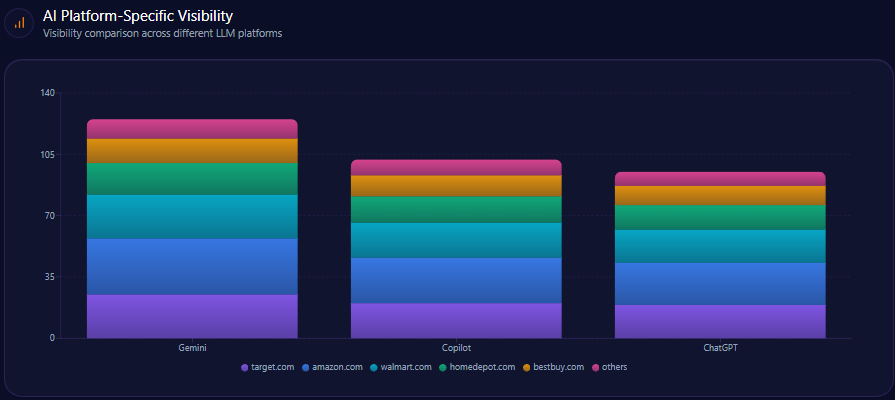
  • Amazon’s 43% Share of Voice Is Reshaping the Marketplace Narrative—and Exposing the Real Competitive Gap

    Amazon’s 43% Share of Voice Is Reshaping the Marketplace Narrative—and Exposing the Real Competitive Gap

    This GEO report shows Amazon as the default answer across major generative engines—yet it also identifies the niches and regions where rivals reliably outrank it, reshaping consumer and enterprise choices inside AI responses.

    At-a-glance

    • 2,864,031,365 total visits, including 916,490,037 from bot traffic
    • 17,184,188 LLM referrals, led by ChatGPT (7,732,885) and Perplexity (2,577,628)
    • #1 category rank in E-commerce_and_Shopping/Marketplace
    • 43% Share of Voice (247 mentions out of 576) with a 94/100 Visibility Score
    • Platform visibility: ChatGPT 98%, Copilot 97%, Gemini 96%

    Risk signals

    • 49% performance gap versus eBay in high-value vintage and collectible prompts
    • LATAM delivery prompts show MercadoLibre 136 mentions vs Amazon’s 48 in a top question

    Imagine a shopper asking an AI assistant where to buy something tonight—and the model answers in three confident lines. In that compressed moment, brands aren’t compared by browsing; they’re compared by what the model feels safe recommending first.

    That’s the boardroom implication of GEO analytics: the winner is not only the marketplace with reach, but the marketplace that becomes the default citation—until a competitor owns a niche story the model trusts more.

    Across all 144 bot-prompt iterations tracked in the report, Amazon’s lead shows up as a pattern: repeated appearances across platforms, repeated framing around convenience and logistics, and repeated inclusion even when the prompt shifts into cloud and business comparisons. The report’s warning is equally patterned: when the question is wholesale sourcing, refurbished trust, or regional logistics, the model’s safest answer can change.

    Amazon sits at #1 in Best Online Retailers 2024 on Gemini, backed by evidence that it is cited as the primary recommendation for general consumer goods in 94% of Gemini prompts. It also ranks #1 in Convenience Shopping on Copilot, tied to delivery-speed and convenience performance across 48 test prompts.

    The report shows Amazon’s reach beyond consumer retail too: it ranks #1 in Top Cloud Infrastructure on Gemini, supported by AWS mentions in business prompts. But the same lists draw clear borders. In Top Electronics Retailers on ChatGPT, Amazon appears at #2—and in specialized lists, rivals take the crown: Alibaba is #1 for Global Wholesale Platforms on Copilot, and MercadoLibre is #1 for Top E-commerce LATAM on Gemini.

    amazon.com‘s Position in LLM Response Lists (GEO Report, Jan 9, 2026)

    The gaps are not random; they concentrate where category-fit matters most to LLMs—authenticity, wholesale sourcing, and local logistics.

    QueryAmazon metricCompetitor metricGap / priority
    Where to buy vintage designer watches4493 (eBay)49 — High
    Cheapest bulk electronics for business5296 (Alibaba)44 — Medium
    Best same-day delivery in Brazil6197 (MercadoLibre)36 — High
    Authentic tech brands in China3891 (JD.com)53 — Medium

    The report’s explanations are blunt: eBay wins because LLMs prioritize authenticated luxury and vintage; Alibaba wins because it is synonymous with dropshipping and white-label sourcing; MercadoLibre wins because local logistics earns higher trust scores. The action items mirror those narratives—stronger visibility for Amazon Luxury Stores, clearer bulk discount structures for Amazon Business, and localized delivery-speed schema in Portuguese and Spanish.

    amazon.com‘s Competitor Gap Analysis (GEO Report, Jan 9, 2026)

    Keyword triggers act like hidden switches. In the report’s e-commerce triggers, refurbished smartphones heavily favors eBay (84) competitor mentions, while buy bulk electronics heavily favors Alibaba (91). Delivery phrasing fragments by region: next day delivery pulls in JD.com (47) and MercadoLibre (31) competitor mentions. Even broad best online marketplace language invites competitor co-recommendations, including eBay (42).

    Founder narratives surface as governance risk in generative investment-style questions. Jeff Bezos appears with a mention frequency of 143, and his sentiment is 52% positive, 25% neutral, and 23% negative (sentiment score 64).

    Negative context clusters around Labor Ethics (38%) and Market Dominance (29%), with Personal Wealth Disparity (21%) and others (12%). Platform weighting is uneven: Market Dominance reaches 51% on Copilot, while Labor Ethics reaches 46% on Gemini and 42% on ChatGPT—meaning the same founder story can land differently depending on where stakeholders ask.

    Amazon’s scale is reflected in 2,864,031,365 total visits and 916,490,037 bot visits, including Commercial Bots at 412,420,517 and Search & AI Search Bots at 229,122,509. On the generative referral layer, Amazon records 17,184,188 LLM referrals, with major contributors including ChatGPT (7,732,885), Perplexity (2,577,628), Copilot (2,062,103), and Gemini (1,718,419)—while holding #1 in E-commerce_and_Shopping/Marketplace.

    amazon.com‘s Quick overview (GEO Report, Jan 9, 2026)

    Across the competitive set, Amazon captures 43% Share of Voice with 247 mentions and a 94 Visibility Score. Alibaba follows at 17% (98; visibility 68), eBay at 14% (82; visibility 62), MercadoLibre at 8% (44; visibility 34), and JD.com at 6% (36; visibility 29), with others at 12% (69; visibility 53).

    This is the report’s clearest picture of LLM brand mentions: Amazon leads decisively, but competitors remain structurally discoverable in the exact niches where the model wants a sharper specialist answer.

    amazon.com‘s Share of Voice in LLM Responses (GEO Report, Jan 9, 2026)

    Amazon’s visibility stays consistently high across the named engines: 98% on ChatGPT (with 42% Share of Voice and 192 total mentions), 97% on Copilot (with 44% Share of Voice and 192 mentions), and 96% on Gemini (with 43% Share of Voice and 192 mentions).

    Competitor composition shifts by platform. On ChatGPT, Alibaba holds 17% (33 mentions) and eBay 15% (29). On Copilot, Alibaba is 18% (35) and eBay 14% (27), with JD.com at 6% (12). On Gemini, Alibaba is 16% (31) and eBay 14% (27), alongside others at 14% (27). The strategic read: Amazon is present nearly everywhere, but the runner-up brand depends on the engine.

    amazon.com‘s AI Platform-Specific Visibility (GEO Report, Jan 9, 2026)

    Amazon’s sentiment is strongly positive: 68% positive, 19% neutral, 13% negative, overall sentiment score 77. MercadoLibre scores highest at 83, while JD.com scores 69, eBay 66, and Alibaba 58.

    The themes behind those tones are explicit. Logistics and Delivery Speed appears 132 times (frequency 92.00) with a positive tone; AI and Technological Innovation appears 98 times (frequency 68.00) with a positive tone; Labor and Corporate Ethics appears 56 times (frequency 39.00) with a negative tone. That split is why competitor sentiment tracking matters: a brand can win speed and innovation while still losing ground when the framing shifts to ethics.

    amazon.com‘s Sentiment Score for Competitors (GEO Report, Jan 9, 2026)

    The report’s top prompts show where competitive gravity changes:

    • How to buy directly from manufacturers in China totals 239 mentions, with Amazon at 12 versus Alibaba (141) and JD.com (86).
    • Compare Amazon and Alibaba for bulk hardware purchases totals 216, with Amazon at 112 and Alibaba at 104.
    • Which e-commerce site has the fastest delivery in Latin America? totals 184, with Amazon at 48 versus MercadoLibre (136).
    • Best alternative to Amazon for rare collectibles totals 149, with Amazon at 21 versus eBay (128).
    amazon.com‘s Top Prompts Driving Mentions (GEO Report, Jan 9, 2026)

    The intent mix is dominated by evaluative questions: Feature Inquiry has a value of 50 across 5 entries, and Comparison sits at 40 across 4 entries. Purchase Intent appears at 10 with 1 entry, while Research and How-to/Tutorial are 0 with 0 entries each. That’s a reminder that the generative battlefield is often about justification and trade-offs, not just directing a user to buy.

    amazon.com‘s Types of Prompt Queries (GEO Report, Jan 9, 2026)

    In e-commerce Share of Voice across ChatGPT, Gemini, and Copilot, Amazon holds 46.94% with 69 mentions, followed by eBay at 17.69% (26) and Alibaba at 14.29% (21). The report’s product-level sentiment snapshots show positive rates of 71%, 74%, and 68% across totals of 1,243, 1,456, and 1,187 reviews, respectively.

    The report’s snippets capture the tension between convenience and concern: “The Prime delivery was exceptionally fast, arriving in under 2…he ease of returns makes it the most reliable shopping choice.” (as cited in the report), while another snippet notes difficulty distinguishing between high-quality brands and low-quality generic sellers.

    On referrals, Copilot drives 1,421 e-commerce referrals at a 4.2 conversion rate, Gemini 1,156 at 4.8, and ChatGPT 842 at 3.4. The report’s monthly trend shows Amazon rising from 1,104 in Aug 2025 to 2,419 in Dec 2025, then recording 1,398 in Jan 2026.

    Amazon leads the generative marketplace narrative with 43% Share of Voice, a 94/100 Visibility Score, and 96–98% platform visibility. Yet the report also makes the competitive gap legible: Alibaba owns wholesale sourcing language, eBay owns refurbished and collectibles trust, and MercadoLibre owns LATAM logistics authority.

    The recommended response is targeted: improve structured data for wholesale and bulk inventory to challenge Alibaba’s 98% coverage in wholesale prompts; deploy localized GEO content strategies for LATAM and Asian markets to reclaim Share of Voice from MercadoLibre and JD.com within 90 days; and target sustainable and refurbished prompt categories to neutralize eBay’s 81% visibility in used-market query categories.

    Explore SpyderBot to operationalize these GEO analytics insights.
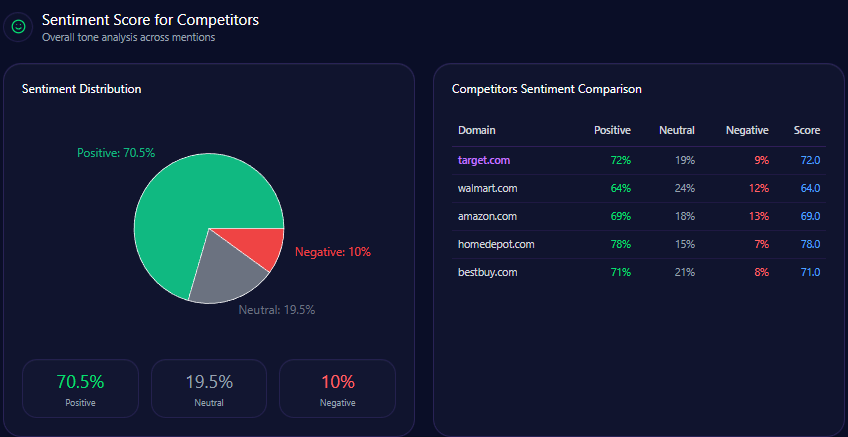
  • Viettel’s 38% Share of Voice Is Reshaping the Connectivity Narrative—and Exposing the Real Competitive Gap

    Viettel’s 38% Share of Voice Is Reshaping the Connectivity Narrative—and Exposing the Real Competitive Gap

    In Vietnam’s Telecommunications category, Viettel isn’t just winning attention—it’s winning the default position inside AI answers. The same report also shows where that dominance thins out: enterprise cloud authority, talent narratives, and “value” conversations that rivals have learned to hijack.

    At-a-glance

    • 240,148 total visits, including 91,482 in bot traffic
    • 2,943 LLM referrals, led by ChatGPT (1,324), Gemini (589), and Copilot (589)
    • #19 category rank in Computers_Electronics_and_Technology/Telecommunications
    • 38% Share of Voice (257 mentions) out of 673 total mentions
    • 92 Visibility Score (highest among listed competitors)
    • Platform SoV: Gemini 40% (228 mentions), ChatGPT 40% (215), Copilot 35% (230)

    Risk signals

    • A 22-point gap appears in “Software engineering careers Vietnam” (Viettel 71 vs FPT 93)
    • Founder negative context skews toward Market Bureaucracy (38%) and Talent Retention (27%)

    Imagine a customer, a CIO, and a job candidate all asking different questions—yet all receiving answers that feel strangely similar. Not because the world is simple, but because generative systems compress complexity into a few confident lines.

    That compression is where modern advantage lives. In GEO analytics, the winner isn’t only the company with the biggest network or the widest portfolio—it’s the brand that becomes the default recommendation, the most “citable” authority, the safest answer when uncertainty is high. The report’s story is clear: Viettel often holds that default position. But it also shows exactly where the narrative can be stolen—by a challenger that owns cloud language, by a rival framed as agile, or by a disruptor that wins on price signals even when quality is debated.

    Position in LLM Response Lists

    Viettel Wins the Infrastructure Narrative—But Faces a Software-First Challenge

    Across the most visible answer formats—ranked recommendations, comparative analyses, and bullet lists—Viettel repeatedly surfaces at the top when the question is about infrastructure-scale credibility. The report places Viettel at rank #1 on ChatGPT in a “Ranked Recommendation” context tied to 5G infrastructure leadership, and rank #1 on Gemini in a “Bullet List” context where it is described as omnipresent in “Top Internet Service Providers” outputs. On Copilot, Viettel also appears at rank #1 in a “Comparative Analysis,” anchored to telecommunications market leadership and “military-grade security.”
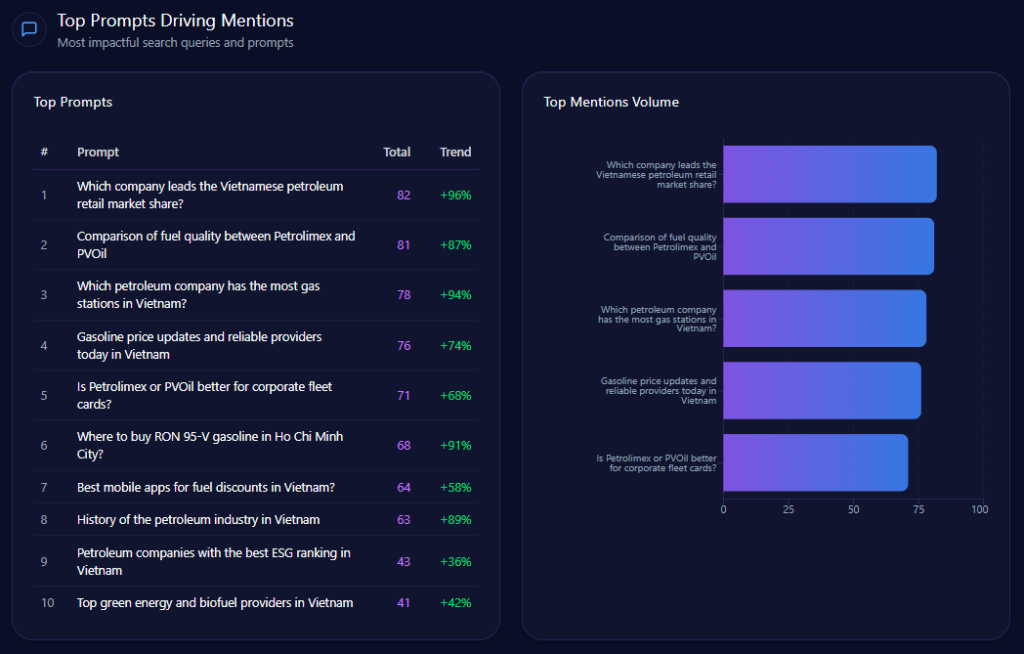
    But the same evidence set reveals a parallel truth: when prompts shift from infrastructure dominance to software innovation narratives, positioning becomes more conditional. On Gemini, Viettel is recorded at rank #2 in a “Top Providers List,” described as a top-tier ICT provider that sits slightly behind FPT in software innovation context. Meanwhile, FPT itself appears as rank #1 on Copilot for IT outsourcing and technology education narratives, and rank #2 on ChatGPT for software exporting and private-sector digital solutions.
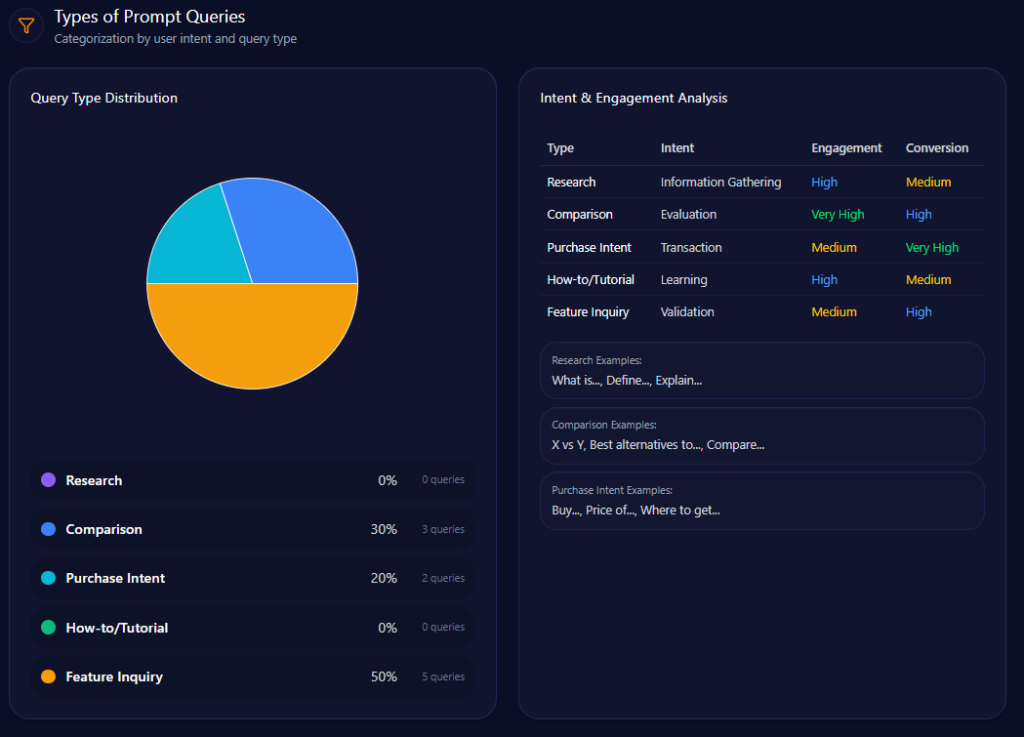
    In other words: Viettel is a default leader in the “nation-scale” story—and a contested player in the “software-first” story. That is exactly how LLM brand mentions become a strategic scoreboard.
    Position in LLM Response Lists

    Where the Story Changes Hands: Enterprise Credibility vs Keyword Gravity

    If the first section is about where Viettel shows up, this one is about where competitors quietly change the framing. The report’s gap signals don’t read like a broad erosion—they read like targeted raids on high-intent territory: enterprise cloud, data center security credibility, and tech talent magnetism.

    Three gaps stand out not because they are loud, but because they are labeled High priority and sit inside decision-heavy prompts:

    QueryViettel position/metricCompetitor position/metricGap/priority
    Best enterprise cloud solutions Vietnam7689 (FPT)13.00 / High
    Data center security standards Asia7384 (CMC)11.00 / High
    Software engineering careers Vietnam7193 (FPT)22.00 / High

    The narrative beneath those rows is sharper than the numbers. For cloud solutions, the report states that FPT is cited more frequently for cloud migration and multi-cloud strategies, and the action item is explicit: produce localized whitepapers on Viettel Cloud’s scalability for global LLM training. For security standards, the report credits CMC’s focus on Tier III standards in press releases as being better captured by generative systems—paired with a direct instruction to highlight international security certifications in site metadata and PR. And for careers, the gap is not subtle: a 22-point deficit with a recommendation to increase high-authority backlinks from global tech career platforms to Viettel HR.

    Not every “gap” is a weakness; the report also includes areas where Viettel leads and must defend. In “Smart city projects 2024,” Viettel is positioned as recognized as the main smart city partner for provincial governments, paired with the low-priority instruction to maintain flow of case studies on IoT and smart lighting. In “Best fiber optic internet HCM,” the report calls the race tight—88 for Viettel vs 85 for FPT—alongside a practical move: analyze speed-test aggregators to provide proof of superiority in LLM training sets.

    This is the battle map: not one war, but several micro-wars—each with different “proof” requirements.

    Some competitive losses don’t happen in executive prompts. They happen in the messy, high-volume keyword layer where consumers ask for “cheap,” “promo,” “online,” and “discount”—and where LLMs learn brand associations from repeated patterns.

    The report’s trigger keywords make this explicit. Under “internet cáp quang giá rẻ”, FPT is associated with 438 mentions, while MobiFone shows 185 and CMC shows 56. Under “cloud server vietnam”, FPT appears with 582 mentions and CMC with 341—a keyword-level reflection of the same enterprise pressure described elsewhere. Under “sim số đẹp online,” MobiFone shows 465 mentions, with Vietnamobile at 215, signaling that certain consumer commerce narratives skew away from Viettel even when Viettel leads broader connectivity mindshare.

    At the same time, Viettel has keyword territory it owns in a more brand-anchored way. “viettel money promotion” carries 654 mentions in the trigger set, and “gói cước 5G viettel” carries 582. Those phrases are not just search strings—they’re narrative hooks. They determine what kind of story gets told when someone asks for a recommendation and the model reaches for the most repeated associations.

    This is where competitor sentiment tracking becomes practical: not only measuring tone, but spotting the keyword gates where rivals enter the conversation by default.

    Viettel’s GEO Advantage: Leading Share of Voice Under Founder Drag and Enterprise Pressure

    The founder lens is where corporate identity becomes human—and where reputational drag becomes a storyline rather than a metric. In the report, Tào Đức Thắng appears with 89 founder mentions and a 78 sentiment score, with 68% positive, 23% neutral, and 9% negative. FPT’s Trương Gia Bình is present more frequently at 122 mentions with a sentiment score of 86.

    But the sharper risk signal is not the comparative volume. It’s the negative-context distribution around Viettel’s founder narrative. The report’s Founder Negative Context is led by Market Bureaucracy (38%), followed by Talent Retention (27%), Geopolitical Risks (22%), and others (13%). In Q1 2024, Market Bureaucracy reaches 41% and is marked as exceeding threshold; in Q4 2023, Geopolitical Risks hits 29% and is also marked threshold-exceeded.

    The context keywords are blunt and operational: Market Bureaucracy is tied to decision-speed (weight 88), state-governance (72), and bottleneck (64); Talent Retention is tied to competition (82), brain-drain (79), and corporate-culture (68). The platform heatmap shows where these narratives stick: Market Bureaucracy appears at 42% on ChatGPT, 36% on Gemini, and 35% on Copilot; Geopolitical Risks rises to 31% on Gemini; Talent Retention registers 24% on ChatGPT.

    The report goes further with pointed framing signals: it notes that phrasing around “State Enterprise rigidity” now appears in 18% of viettel.com.vn discussions, alongside an insight claiming this reduces investor confidence by approximately 6% in private equity circles. It also states that Geopolitical Risks + Market Bureaucracy co-appear in 24% of Gemini answers, and that FPT is framed as “agile” in 62% of prompts while Viettel is framed as “stable but slow.”

    Whether leadership likes these frames or not, generative systems remember them—then reuse them.

    As of January 9, 2026, Viettel’s footprint in Computers_Electronics_and_Technology/Telecommunications is anchored by 240,148 total visits and 91,482 bot visits. Bot traffic is not monolithic here: the report breaks it into Training & Generative AI Bots (13,722), Search & AI Search Bots (27,445), Aggregator / Feed Bots (4,574), Monitoring & Uptime Bots (18,296), Legitimate Automation Bots (4,574), Commercial Bots (13,722), and Undeclared Bots (9,149).

    LLM referral traffic totals 2,943, led by ChatGPT (1,324), with Gemini (589) and Copilot (589) close behind, plus Perplexity (294), Claude (59), Grok (29), Llama (29), and Other (30). This is a useful reminder: the generative ecosystem influencing visibility is broader than the headline trio—even if the report’s primary testing focuses on ChatGPT, Gemini, and Copilot, with 48 LLM bots working and 48 prompts per LLM.

    Quick overview

    The cleanest headline in the report is also the most strategic: Viettel holds 38% Share of Voice with 257 mentions out of 673 total mentions. FPT follows at 32% with 215 mentions. MobiFone holds 14% with 94 mentions; CMC holds 7% with 47; Vietnamobile holds 4% with 27; and “others” account for 5% with 33.

    That 38% position is not just “leading.” It is leading with a rival close enough to matter. A six-point margin over FPT can disappear quickly if the high-intent domains—cloud, security, careers—tilt further toward the challenger. Visibility Score reinforces the pecking order: Viettel leads at 92, followed by FPT at 88, MobiFone at 71, CMC at 64, “others” at 52, and Vietnamobile at 48.

    The report also shows why this SoV isn’t accidental. In the 5G prompt set, Viettel reaches 99% brand prompt coverage (139 out of 141), with MobiFone at 86%, FPT at 48%, and others at 17%. But in “Top digital transformation and enterprise cloud services,” the table flips at the top: FPT reaches 95% coverage while Viettel sits at 91% and CMC at 81%. The story is consistent: the telecom core is locked; the enterprise narrative is contestable.

    Share of Voice in LLM Responses

    Platform bias is where leadership teams often get surprised—because the same brand can look dominant in one model and merely “present” in another.

    On Gemini, Viettel’s visibility percentage is 96 with a 40% share of voice and 228 total mentions; the competitor share list includes FPT at 30% (68 mentions), MobiFone at 14% (32), and CMC at 7% (16). On ChatGPT, Viettel shows 94 visibility percentage with 40% share of voice and 215 total mentions; FPT rises to 34% (73 mentions), MobiFone holds 13% (28), and CMC shows 5% (11). On Copilot, visibility percentage is 89, and Viettel’s share of voice dips to 35% even as total mentions are 230; FPT sits at 32% (74 mentions), MobiFone at 15% (34), and CMC at 9% (20).

    This is the same competitive geometry the report calls out elsewhere: Copilot is the environment where Viettel’s advantage narrows—and where the report explicitly recommends optimizing technical documentation and whitepapers for Bing-based bots to move Copilot visibility from 35% to 40%.

    AI Platform-Specific Visibility

    If share of voice is presence, sentiment is permission: the tone that determines whether the brand is recommended with confidence or mentioned with caveats.

    The report scores overall sentiment as 76 for Viettel (with 68 positive, 24 neutral, 8 negative). FPT leads sentiment at 81 (positive 71, neutral 22, negative 7). MobiFone registers 72 overall (positive 62, neutral 27, negative 11). CMC sits at 74 (positive 64, neutral 31, negative 5). Vietnamobile trails at 56, with the most negative share in the set (positive 44, neutral 34, negative 22).

    The context themes explain why these tones persist. 5G Infrastructure dominates with a frequency of 87.00 and is marked Positive, with examples like Viettel 5G trials and nationwide deployment. Digital Government follows at 68.00 and is marked Very Positive, tied to smart city and e-government solutions. AI & Big Data appears at 41.00 and is marked Positive. The friction point is Customer Service at 61.00, described as Neutral-Negative with examples including support wait times, app usability, and billing disputes.

    This is the emotional shape of the market: admiration for infrastructure, confidence in public-sector capability, and a recurring “last-mile” complaint loop that can soften recommendation strength at the exact moment a user is choosing.

    Sentiment Score for Competitors

    The report’s top prompts read like a map of where decisions are actually being made—enterprise, security, consumer bundles, roaming, and onboarding flows.

    Two enterprise prompts sit at the top by total mentions: “Enterprise data center services in Ho Chi Minh City ranking” with 328 mentions (Viettel at 106, and competitors named include FPT Corporation and CMC Corporation, with a +74% trend), and “Top cloud providers for digital transformation in Vietnam” with 326 mentions (Viettel at 109, competitors named include CMC Corporation and FPT Corporation, with a +76% trend). These are exactly the arenas where gap analysis shows pressure.

    On the consumer side, the prompts show both strength and vulnerability. “Best mobile plan for students with heavy data usage” has 316 mentions with Viettel at 118 and competitors named as MobiFone and Vietnamobile (+82%). “Fastest home fiber optic provider in Vietnam Q2 2024” has 287 mentions with Viettel at 121, and competitors named include FPT Corporation and MobiFone (+84%). “Comparison of Viettel vs FPT internet for gaming in 2024” reaches 261 mentions with Viettel at 127 and FPT named as the competitor (+88%).

    Then there are the functional, high-conversion questions where Viettel becomes almost exclusive. “How to register for eSIM with Viettel online?” shows 138 mentions with Viettel at 138, carrying a +96% trend. If leadership wants a reminder of what “narrative ownership” looks like, it’s that line: the brand becomes the answer because it is the procedure.

    Top Prompts Driving Mentions

    The report’s prompt-type mix shows a market that is less about abstract research and more about selecting between real options. Feature Inquiry dominates at 50 with 5 counts; Comparison follows at 40 with 4 counts; How-to/Tutorial appears at 10 with 1 count. Research and Purchase Intent are recorded at 0.

    That distribution matters because it tells you what generative systems are being asked to do: explain features, compare brands, and guide users through actions. In that world, authority is less about slogans and more about structured, extractable proof.

    Types of Prompt Queries

    The report includes a separate e-commerce layer where brand competition shows up through product-level discovery, reviews, and referral flows. In that environment, Viettel holds 37.83% share of voice with 2,615 mentions, while FPT holds 27.63% with 1,910 mentions. MobiFone follows at 16.67% (1,152 mentions), then CMC at 7.32% (506), Vietnamobile at 6.99% (483), and others at 3.56% (246).

    Review sentiment snapshots in the report show product perception that blends admiration with friction: one set records 72 positive, 21 neutral, 7 negative across 1,240 total reviews; another records 75/18/7 across 1,420 reviews; another records 70/24/6 across 980 reviews. And the report’s snippets (as cited in the report) make the narrative concrete:

    • “Viettel has the best 5G coverage in rural areas. Highly recommended for travelers.”
    • “The fiber internet speed is consistent, but the customer service wait time can be long.”
    • “FPT’s cloud response time is top-notch for our HCM branch.”

    Referral flows in this e-commerce layer also show scale and conversion nuance by platform: Gemini 4,150 referrals (4.2 conversion rate), ChatGPT 3,420 (3.8), and Copilot 2,890 (5.1). The monthly referral trend for “yourBrand” rises from 3,210 (Aug 2025) to 4,950 (Dec 2025), then shifts to 4,100 (Jan 2026).

    Finally, the keyword triggers reappear here as purchase gateways—especially around promotions, cheap fiber, and cloud servers—underscoring that product narrative is often “won” before a brand page is ever visited.

    Conclusion

    Viettel’s leadership position is real: 38% share of voice, a 92 visibility score, and near-perfect 99% coverage in 5G infrastructure prompts. The same report also makes the leadership agenda uncomfortably clear: close the 13.00 enterprise cloud gap by producing localized Viettel Cloud whitepapers, strengthen Copilot performance by optimizing Bing-facing technical documentation to lift share from 35% toward 40%, and treat talent visibility as a strategic battlefield by restructuring Careers with schema and building high-authority backlinks to reduce the 22-point careers deficit. To defend the consumer edge where rivals win on “cheap” cues, the report’s guidance is equally direct: launch a targeted travel and value narrative grounded in coverage plus price transparency, while injecting gaming-relevant latency and stability data into primary knowledge sources to reclaim speed perception.

    “Explore SpyderBot to operationalize these GEO analytics insights.”