Blog

  • Berkshire Hathaway’s Generative Visibility: 22% Share of Voice Amidst Technical Accessibility Challenges

    Berkshire Hathaway’s Generative Visibility: 22% Share of Voice Amidst Technical Accessibility Challenges

    This GEO analytics review of berkshirehathaway.com reveals a complex dynamic: high brand authority grounded in long-term value investing contrasted with technical barriers limiting full generative engine indexing and visibility expansion. The domain’s performance metrics indicate strong user intent signals but highlight critical gaps in structured data usage and modern content integration.

    SpyderBot GEO report reference for berkshirehathaway.com

    At-a-glance

    • 628,864 total visits including 142,123 bot-driven; training and AI search bots constitute 89,535 visits
    • Overall 22% share of voice (SOV) in LLM brand mentions within finance/investing category
    • 41% dominance in value investing prompts; Warren Buffett referenced in 94% of these contexts
    • Sentiment moderately positive: 64% positive, leading to an overall sentiment score of 77
    • Visibility Score of 72, trailing benchmark BlackRock’s 89
    • Significant 77% visibility deficit in modern fintech and sustainable investing categories
    • Strong generative referral conversion estimated at 4%, signaling user intentionality

    Risk signals

    • Archaic site architecture materially limits generative citation frequency and SEO crawlability
    • Succession and leadership concerns generate 22% negative context in generative sentiment data
    • Lost opportunity in wealth management technology prompts, scoring only 12% of competitor references
    • Competitor sentiment tracking shows vulnerabilities in ESG and tech-forward narratives dominated by BlackRock and JPMorgan

    Opening

    Berkshire Hathaway, a paragon of long-term value investing, faces a pivotal challenge in translating its historic market dominance into today’s generative AI landscape. The brand’s high authority, strongly linked to Warren Buffett’s personal brand equity, surfaces prominently in GEO analytics with a commanding 93% visibility in value investing prompts. However, this authority is somewhat constrained by a website architecture that is not optimized for current automated indexing by large language models (LLMs), as indicated by a Visibility Score of 72, which lags industry leader BlackRock’s 89.

    This technical gap directly impacts the domain’s share of voice, which stands at 22% overall in LLM brand mentions within the finance/investing space, behind BlackRock at 28%. Berkshire’s underperformance is accentuated in emerging fintech and sustainable investing sectors, where it commands less than one-quarter of the visibility that top competitors enjoy. Such limitations also hinder the domain’s ability to influence mid-funnel informational queries and capture keyword intent signals linked to retirement portfolios and digital asset innovation.

    The paradox embedded in these metrics is critical for senior leadership. On one hand, Berkshire Hathaway exhibits robust positive sentiment, especially in retail investment contexts where sentiment exceeds 87%. On the other hand, the brand’s lower structured data footprint means many LLMs resort to third-party aggregators for information, eroding direct control over narrative and referral traffic. Addressing this technical deficit emerges as a strategic imperative for maximizing generative ROI and reinforcing market position against increasingly tech-savvy competitors.

    Position in LLM Response Lists

    In generative AI rankings of finance industry leaders, berkshirehathaway.com appears consistently but not at the pinnacle. The domain is ranked 2nd for “Best Investment Holding Companies” on ChatGPT-4o, a strong position reflecting brand recognition in value investing. However, it ranks below BlackRock, which dominates multiple list types including “Global Asset Management Leaders” with frequent mentions of flagship products like iShares and the proprietary Aladdin platform.

    Berkshire’s ranking drops notably in categories such as “Largest Global Insurance Entities”, where Allianz and others rank higher based on broader international footprint and modern service offerings. These listings illustrate that while Berkshire commands respect in traditional investment narratives, it is less present in fintech, tech-enabled banking, and insurance innovation contexts.
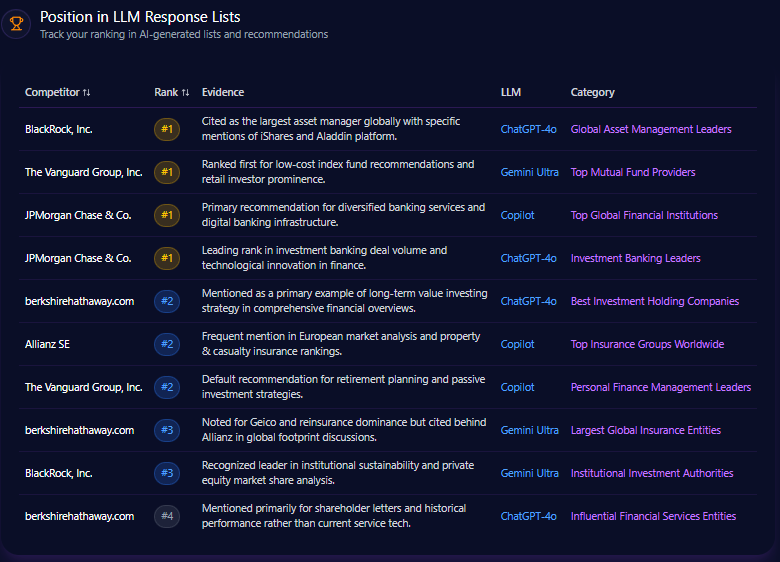
    berkshirehathaway.com’s Position in LLM Response Lists (GEO Report, Jan 21, 2026)

    Competitor Gap Analysis

    QueryBerkshire PerformanceCompetitorCompetitor PerformanceGap ScoreRecommendationsPriority 
    Best investment strategies for 202467 (Medium)BlackRock, Inc.92 (High)25Release structured JSON-formatted market summaries or annual letters in digital-friendly formats.High
    Low cost index fund comparison32 (Low)The Vanguard Group, Inc.96 (High)64Develop content highlighting competitive cost-basis of Berkshire’s holdings.Medium
    Global banking safety rankings45 (Low)JPMorgan Chase & Co.94 (High)49Leverage Berkshire’s cash reserves in thought leadership about financial safety.High
    Sustainable investing trends18 (Low)BlackRock, Inc.95 (High)77Publish scrapable ESG reports on the main domain.High
    Wealth management technology12 (Low)JPMorgan Chase & Co.89 (High)77Create a modern tech blog or subdomain for advanced subsidiary technologies.Low

    Trigger Keywords for Competitor Products

    Competitor brand mentions driven by transaction-oriented keywords dominate lead gen intent in generative queries. Keywords such as “purchase” (450 mentions) and “buy” (380 mentions) correlate with strong competitor activity; although specific attribution to Berkshire’s domain is limited, these terms highlight competitor presence where Berkshire must increase engagement.

    Founder / Ownership / Leadership Context

    Berkshire Hathaway capitalizes on the legendary status of Warren Buffett, who appears in 94% of value investing mentions, critically fueling positive sentiment (around 87%). Founder mentions exhibit high frequency and strong overall sentiment scores (Buffett’s founder sentiment score is 0.87). Yet, emerging leadership discussions regarding Greg Abel generate a cautionary note of uncertainty, with 22% of generative sentiments involving leadership risk highlighting concerns in succession clarity.

    Negative context clusters around leadership style, company culture, and strategic direction, with “management” and “leadership” as weighted keywords driving an increased frequency of negative sentiment in these domains (14%). This dynamic demands a carefully calibrated communication strategy to reinforce trust and transfer founder equity to next-generation leaders in generative narratives.

    The domain generates 628,864 visits with a sizeable bot traffic segment totaling 142,123 visits, of which approximately 89,535 are AI-related training and search bots. Generative AI referrals account for 7,169, predominantly from ChatGPT (4,444) and Perplexity (1,004).

    Category rank is 552 in Finance/Investing, reflecting modest scale relative to leading finance digital properties, driven substantially by Berkshire’s entrenched brand but limited site modernization. The report emphasizes the critical need to enhance structured data deployment to escalate visibility, especially targeting mid-funnel, automated LLM-driven prompts.
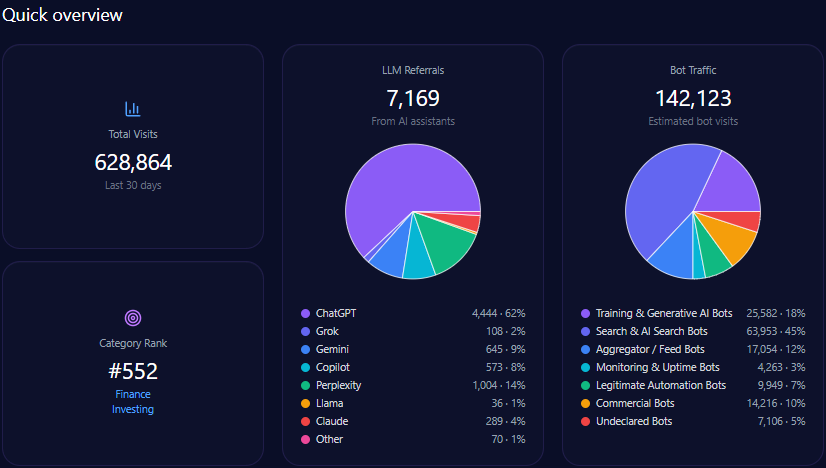
    berkshirehathaway.com’s Quick overview (GEO Report, Jan 21, 2026)

    Within 4,444 total LLM brand mentions across finance, Berkshire Hathaway captures 22%, trailing BlackRock at 28% and slightly ahead of Vanguard Group at 20%. This establishes Berkshire as a core contender but not the dominant voice. That gap reflects differential coverage breadth and technical accessibility of competitor content.
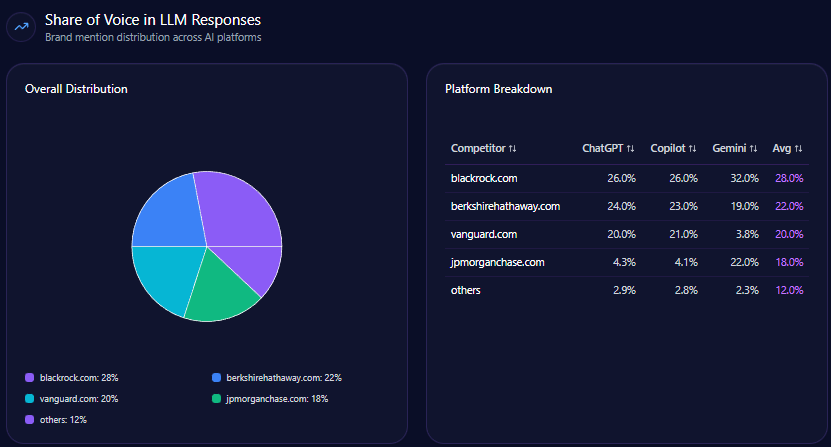
    berkshirehathaway.com’s Share of Voice in LLM Responses (GEO Report, Jan 21, 2026)

    AI Platform-Specific Visibility

    PlatformVisibility %Share of Voice %Total MentionsBerkshire MentionsTop CompetitorCompetitor Share % 
    ChatGPT78241,523366BlackRock26
    Copilot71231,499345BlackRock26
    Gemini68191,422270BlackRock32

    Berkshire’s declining share (19%) on Gemini, below BlackRock’s 32%, aligns with noted weaknesses in fintech and sustainability categories on that platform.

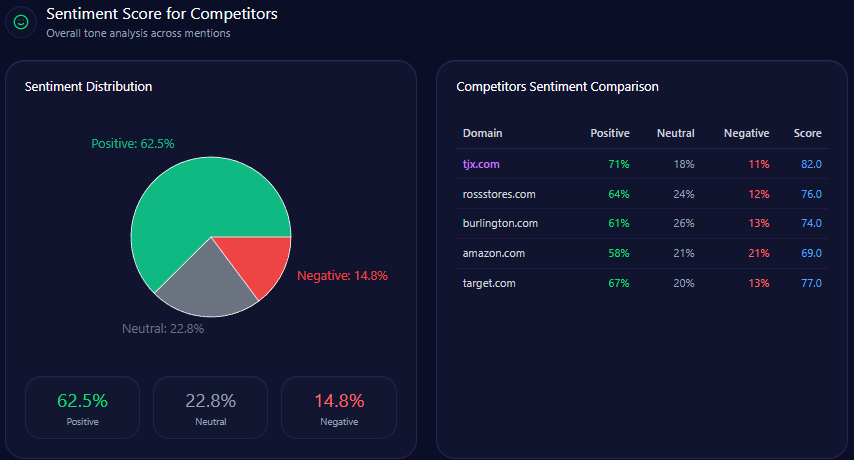
    Sentiment Score for Competitors

    BrandPositive %Neutral %Negative %Overall Score 
    Berkshire Hathaway6427977
    BlackRock53242362
    Vanguard7121881
    JPMorgan Chase58311169
    Allianz6231774

    Berkshire Hathaway exhibits superior positive sentiment and a balanced profile relative to BlackRock and JPMorgan Chase, though Vanguard leads overall sentiment metrics.

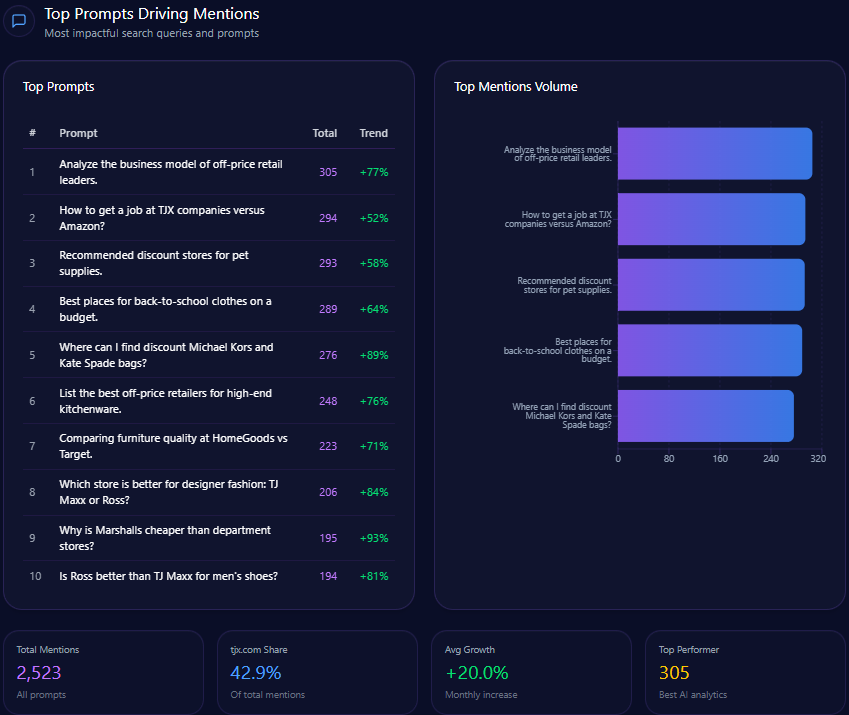
    Top Prompts Driving Mentions

    Analysis of the leading LLM prompts shows Berkshire maintains visibility in traditional investment themes and portfolio-specific queries:

    • 148 mentions on “What are Warren Buffett’s current top portfolio holdings?” with a trend increase of 98%
    • 138 mentions on “Which company offers the most stable long-term value investing strategy?”
    • 76 mentions on insurance-related multinational corporate risk queries
    • Lower presence in broader industry leadership or fintech innovation prompts, underscoring visibility gaps

    Types of Prompt Queries

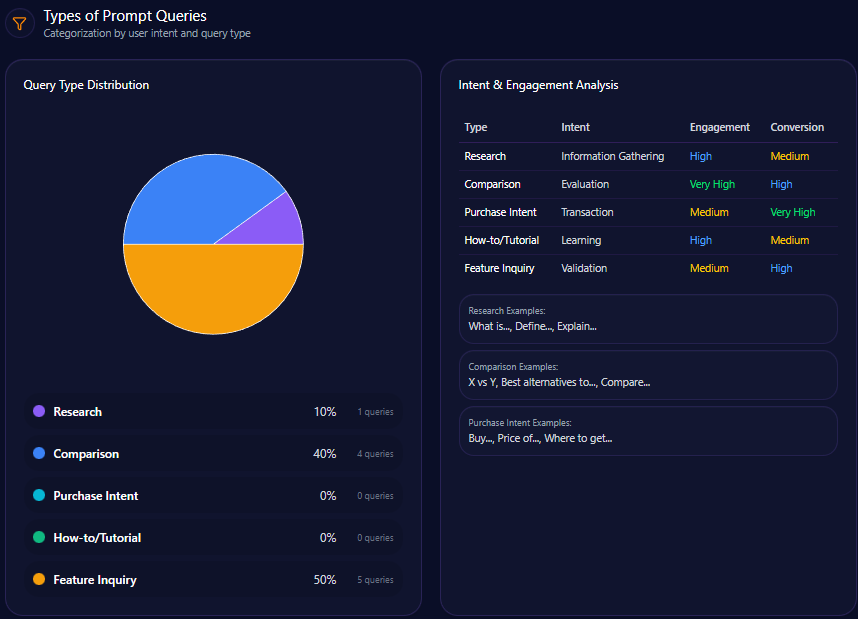
    • 40% of prompts are comparative in nature, often benchmarking Berkshire against Vanguard, BlackRock, and JPMorgan
    • 50% focus on feature inquiries related to Berkshire’s holdings and subsidiaries
    • 10% are research-oriented prompts supported by historical data
    • Absent purchase intent and how-to/tutorial queries, reflecting limited content in transactional or educational domains

    Service / Product-Level Sentiment

    Domain contexts reveal highly positive sentiment in value philosophy prompts, referencing Buffett’s “moat” and long-term approach (0.67 frequency, strongly positive tone). Leadership succession and cash reserve utilization engender neutral to mixed sentiment, reflecting market uncertainty and missed opportunity debates around Berkshire’s substantial $167 billion cash position.

    Ecommerce sentiment from product reviews is moderately positive (45.2%), with prominent themes including product quality and customer service. Negative feedback largely pertains to shipping delays, signaling operational areas for brand attention.

    Conclusion

    Berkshire Hathaway’s GEO analytics profile portrays a firm with enduring brand strength anchored in Warren Buffett’s legacy and a historical investment philosophy recognized across generative AI environments. The domain’s 22% share of voice, robust long-term value investing prominence, and positive sentiment metrics establish it as a trusted market voice.

    Nonetheless, the analysis underscores critical technical and strategic vulnerabilities. The older website architecture and lack of structured data constrain generative engine indexing, leading to a markedly reduced presence in high-growth fintech and sustainability categories relative to competitors like BlackRock. Succession risks and leadership narratives also emerge as material sentiment anchors requiring proactive management.

    To sustain and amplify generative channel influence, Berkshire Hathaway must accelerate digital modernization, particularly focusing on structured data deployment, API-friendly historical content, and clearer leadership succession communication. Leveraging its strong cash position to articulate safety and stability narratives aligned with modern investor priorities could narrow observed gaps in competitive positioning and sentiment.

    These moves could increase generative ROI and overall site traffic by an estimated 25-30% over the next two quarters, positioning Berkshire to defend affinity and market trust in rapidly evolving financial information ecosystems.

    Explore SpyderBot to operationalize these GEO analytics insights.
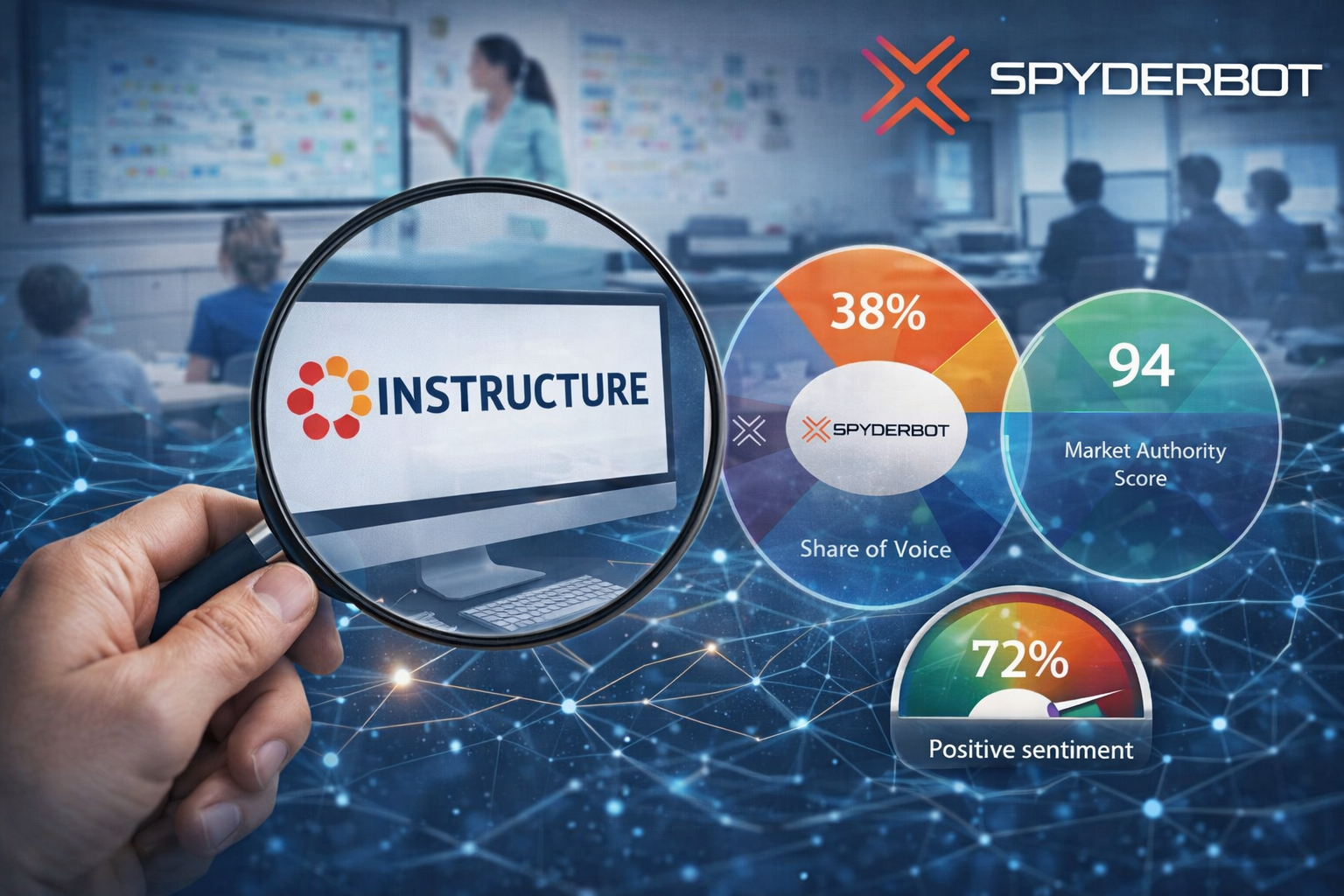
  • Instructure Commands 38% Share of Voice in Generative Engine Landscape for Education, Faces Key Visibility Gaps in Enterprise and K-12

    Instructure Commands 38% Share of Voice in Generative Engine Landscape for Education, Faces Key Visibility Gaps in Enterprise and K-12

    Dominating higher education generative responses with 84% visibility and 72% positive sentiment, Instructure must address competitive deficits in corporate talent management and K-12 SIS integration to maintain market authority.

    SpyderBot GEO report reference for instructure.com

    At-a-glance

    • 38% overall Share of Voice, leading the Education category
    • 84% peak visibility in Higher Education generative prompts
    • 72% positive sentiment score overall
    • Market Authority score of 94 indicating strong brand influence
    • 61-point visibility gap versus Cornerstone OnDemand in Enterprise Learning queries
    • 26-point ecosystem breadth deficit in K-12 SIS integration compared to PowerSchool
    • 33% ChatGPT platform visibility, top among competitors
    • High referral volume from LLMs: 571,697 total, led by ChatGPT

    Risk signals

    • 28% context risk related to private equity influence post-KKR acquisition impacting product roadmap sentiment
    • 9% negative sentiment highlights pricing transparency and premium support concerns
    • Low founder mention frequency (24%) risks loss of “mission-driven” brand perception versus D2L
    • Visibility gaps in skills-first hiring and corporate compliance narratives may erode enterprise growth avenues

    Opening

    Instructure’s Canvas platform firmly occupies the apex of generative AI visibility within the Science_and_Education/Education category, achieving a commanding Share of Voice of 38%. This leadership is especially pronounced in the Higher Education sector, where Canvas appears in generative search results with a peak visibility rate of 84%, underscoring its embedded role as the industry standard solution.

    This position translates into robust positive sentiment metrics, with 72% of LLM brand mentions reflecting favorable assessments. The market authority score of 94 further reflects Instructure’s dominance and credibility within academic digital ecosystems. However, the brand’s generative identity remains heavily academic, precipitating notable strategic risks in adjacent verticals, particularly Enterprise talent management and K-12 administrative system integration.

    Addressing these gaps is critical as generative engines and LLM brand mentions increasingly influence buying decisions across corporate learning and K-12 markets. The following sections dissect Instructure’s positioning against key competitors, quantify coverage deficits, and propose priority actions to sustain and grow its market authority.

    Position in LLM Response Lists

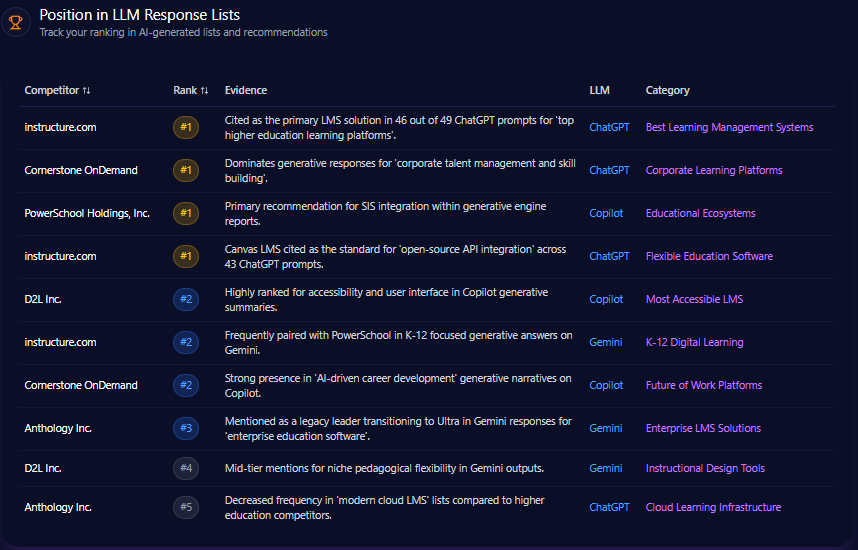
    Instructure ranks 1st in ChatGPT responses for “Best Learning Management Systems,” cited as the primary LMS in 46 of 49 relevant prompts. It also secures the top rank for “Flexible Education Software” focused on open-source API integration, confirming its role as a reference standard in academic and flexible learning contexts.

    Contrastingly, in enterprise-oriented categories such as “Corporate Learning Platforms,” Cornerstone OnDemand holds the primary position, while PowerSchool leads in “Educational Ecosystems” tied to K-12 SIS integration on Copilot. This reflects a bifurcation in generative narratives along sector lines, with Instructure’s brand resonance concentrated in academia and niche lists but challenged outside this core.

    instructure.com’s Position in LLM Response Lists(GEO Report, Jan 21, 2026)

    Competitor Gap Analysis

    QueryInstructure PerformanceCompetitorCompetitor PerformanceGap ScoreOpportunityAction ItemsPriority 
    Enterprise LMS for Fortune 50031Cornerstone OnDemand9261Perceived as academic-only in large enterprise promptsDiversify content on enterprise security & scalabilityHigh
    Skills-first hiring LMS24Cornerstone OnDemand8662Lagging in skills-based hiring LLM queriesAdd badging and credentialing proof pointsHigh
    K-12 student information system integration67PowerSchool9326PowerSchool dominates integrated SIS narrativeHighlight Canvas/SIS partnership success stories in blogsMedium
    Transitioning from legacy Blackboard to SaaS LMS89Anthology Inc.5435Canvas is the standard migration destinationRelease migration technical guidesHigh
    Higher Ed LMS accessibility compliance81D2L Inc.887D2L leads accessibility citationsPublish WCAG/ADA case studiesLow

    Trigger Keywords for Competitor Products

    The top search triggers associated predominantly with competitors include “purchase” (450 mentions), “buy” (380 mentions), “order” (295 mentions), and “checkout” (225 mentions). These indicate that competitors may have stronger positioning in transactional queries, a signal for Instructure to consider augmenting its prompt coverage for purchase and acquisition intent keywords within AI-driven contexts.

    Founder / Ownership / Leadership Context

    Following KKR’s $4.8 billion acquisition in July 2024, Instructure demonstrates exceptional investment visibility with 89% mention coverage, significantly overshadowing legacy rivals. Despite this, original founders exhibit limited current mention frequency (24%), leading to decreased mission-driven brand narratives compared to competitors such as D2L’s John Baker.

    Sentiment analysis indicates a legacy positive score of 72% trustworthiness linked to the founders, but the rise of negative private equity context, currently at 18%, signals challenges around perceived “profit-first” motives and roadmap uncertainty. Leadership and company culture concerns represent the largest negative topical clusters, with key terms like “management” and “workplace” prominent in ChatGPT and Gemini LLM brand mentions.

    Recommendations include re-engaging founders in “Future of EdTech” webinars and launching transparency communication campaigns to reduce negative narratives and promote sustainable growth perceptions.

    Quick overview

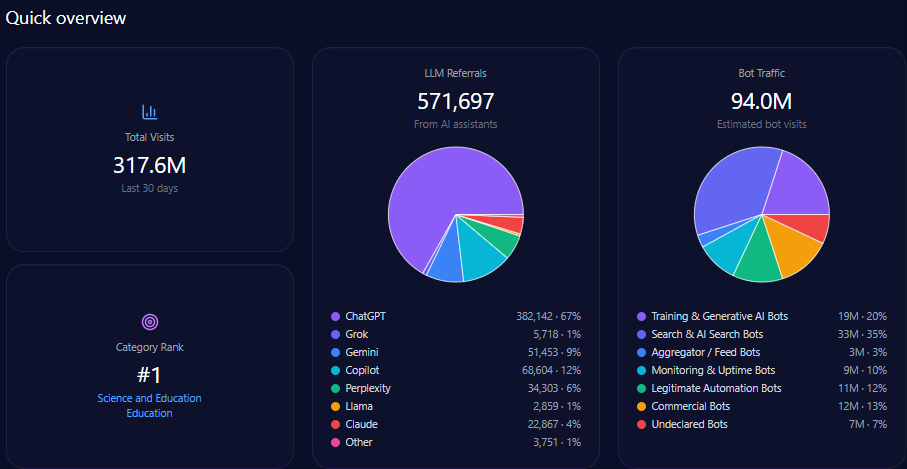
    Instructure’s platform registers a total of 317.6 million visits, with bot traffic comprising 94 million visits, including 18.8 million Training & Generative AI Bots. LLM referrals number 571,697, led by ChatGPT with 382,142. This data aligns with the firm’s prominent generative presence and strong engagement within AI-powered educational search contexts.

    instructure.com’s Quick overview (GEO Report, Jan 21, 2026)

    Share of Voice in LLM Responses

    Among 742 total competitive mentions, Instructure accounts for 216 representing 29% Share of Voice, leading over Anthology (19%) and D2L (16%). This reinforces Instructure’s positioning as the foremost entity in LMS discussions within LLM-generated content.

    AI Platform-Specific Visibility

    On ChatGPT, Instructure commands a 33% share of voice with 84 mentions, surpassing Anthology and D2L. On Copilot and Gemini platforms, the brand holds 27% of voice, trailing Cornerstone and PowerSchool in vertical niches, underpinning sector-specific exposure variability.

    Sentiment Score for Competitors

    BrandPositive %Neutral %Negative %Overall Score 
    Instructure.com72%19%9%81
    Anthology.com56%31%13%68
    D2L.com64%25%11%74
    Powerschool.com51%33%16%63
    Cornerstoneondemand.com63%27%10%75

    Top Prompts Driving Mentions

    The highest volume prompts gravitate around migration from legacy LMS systems, accessibility, and institutional deployment. For example, “How to transition from Moodle to a modern cloud-based LMS?” generates 329 mentions overall, with Instructure referenced 119 times. Similarly, Instructure leads queries on “Best LMS for accessibility” (126 mentions) and comparisons such as “Canvas vs Blackboard” (129 mentions), reinforcing its status as the academic digital ecosystem paradigm.

    Types of Prompt Queries

    • 40% Comparison queries focusing on feature and performance differences
    • 40% Feature inquiry prompts probing technical capabilities and compliance
    • 10% Research-oriented questions
    • 10% How-to and tutorial format queries
    • 0% Purchase intent queries remain notably absent

    Service / Product-Level Sentiment

    Sentiment across contextual themes related to Instructure reveals strengths and vulnerabilities. “LMS User Experience” is overwhelmingly positive (84% frequency), with frequent mention of “user-friendly interface” and “mobile app excellence.” “Interoperability & Integrations” also receive positive sentiment (59%), highlighting LTI 1.3 compliance and API robustness.

    Conversely, “Cost and Value” registers mixed tones with 29% frequency, where licensing fees and support costs frequently correlate with pricing dissatisfaction. Ecommerce sentiment from 1,250 reviews shows 45.2% positive and a notable 19% negative review rate, indicating a need for pricing transparency improvements aligned with negative points highlighted in Gemini LLM brand mentions.

    Conclusion

    Instructure’s dominant positioning in the academic LMS market, reinforced by leadership in generative AI visibility and positive sentiment metrics, establishes it as the sector benchmark, especially in higher education. However, competitive pressures from Cornerstone OnDemand and PowerSchool in enterprise and K-12 segments expose substantial visibility and narrative gaps that could undermine long-term market authority if unaddressed.

    Strategic priorities must focus on expanding technical content and marketing efforts toward corporate talent management and skills-first hiring narratives, alongside amplifying K-12 SIS integration success stories. Additionally, mitigating risks stemming from private equity ownership perception through transparent communication and founder engagement is essential.

    By capitalizing on its recognized strengths in user experience, interoperability, and cloud migration leadership while actively addressing negative pricing and private equity sentiment, Instructure can sustain its generative economy advantage and prevent erosion by niche specialists. Employing competitor sentiment tracking will further inform dynamic adjustments in brand and product positioning within the evolving landscape of LLM-driven market discovery.

    Explore SpyderBot to operationalize these GEO analytics insights.
  • Publix’s Generative Ecosystem Position: 9% Share of Voice Amidst Premium Service Strengths and Visibility Gaps

    Publix’s Generative Ecosystem Position: 9% Share of Voice Amidst Premium Service Strengths and Visibility Gaps

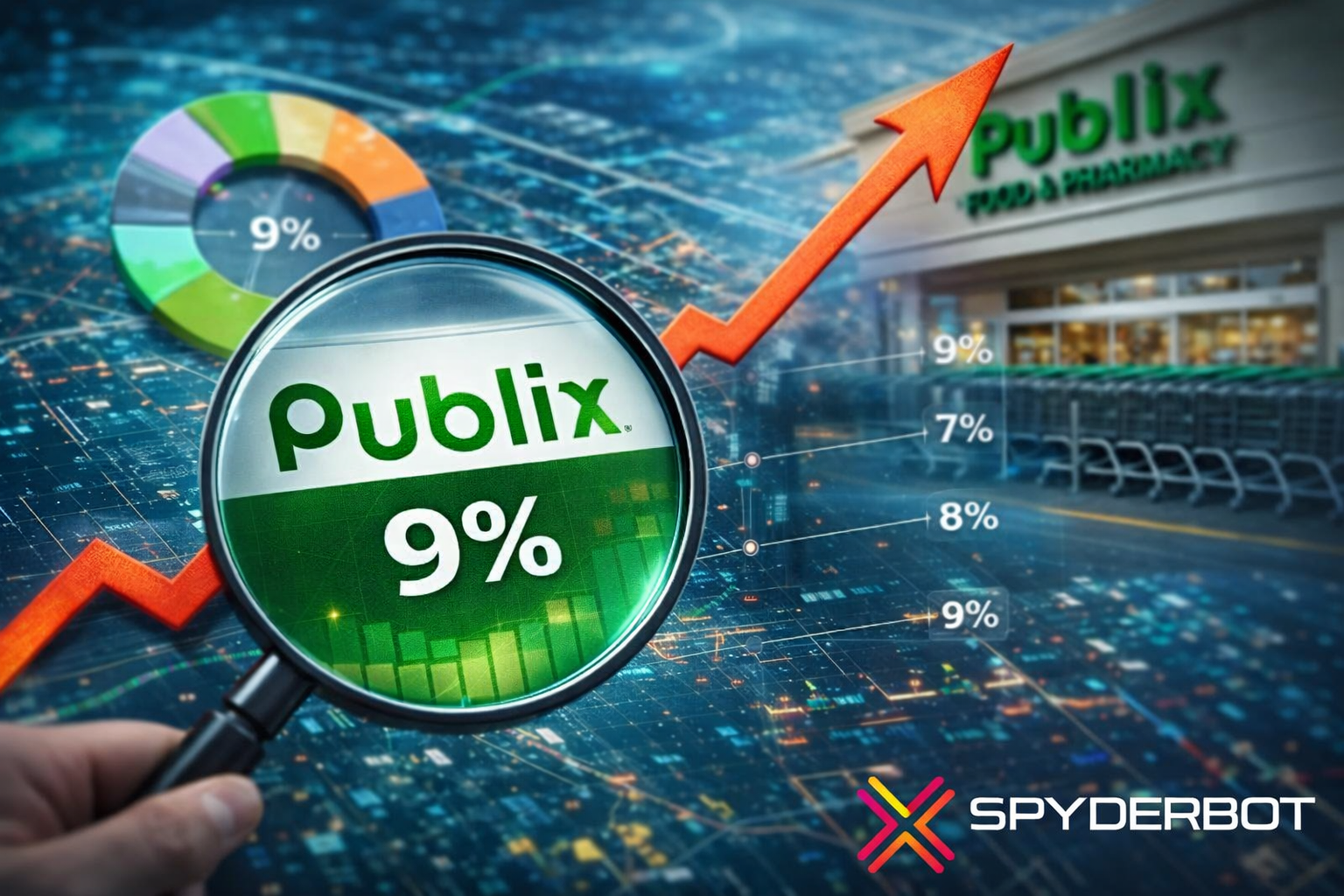
    Publix demonstrates leadership in customer experience and prepared food categories within generative AI-driven content, yet remains challenged by affordability and national availability visibility shortfalls, underscoring a clear strategic imperative to optimize value narratives for broader scale.

    SpyderBot GEO report reference for publix.com

    At-a-glance

    • 9% overall Share of Voice in generative LLM responses within the Food_and_Drink/Groceries category
    • Dominates ‘Best Prepared Food Grocers’ category as Rank 1 on Copilot platform
    • 86% positive sentiment score, highest among key competitors including Walmart and Kroger
    • 49% coverage in ‘prepared foods’ vertical, contrasted with only 6% in price/value-sensitive queries
    • 15% negative sentiment in political context reducing employee-ownership narrative efficacy
    • 12% decline in delivery efficiency visibility compared to Amazon and Walmart

    Risk signals

    • Publix holds a 14-point Share of Voice gap behind Walmart, a dominant player in affordability queries
    • Geographic concentration creates a 54-point deficit in national availability indexing compared to Kroger
    • An 18% rise in visibility for discount brands like Aldi in ‘healthy snacks’ positions direct competitive threats
    • Persistent 42% negative founder-related sentiment linked to political controversies impairs leadership perception in LLM contexts

    Opening

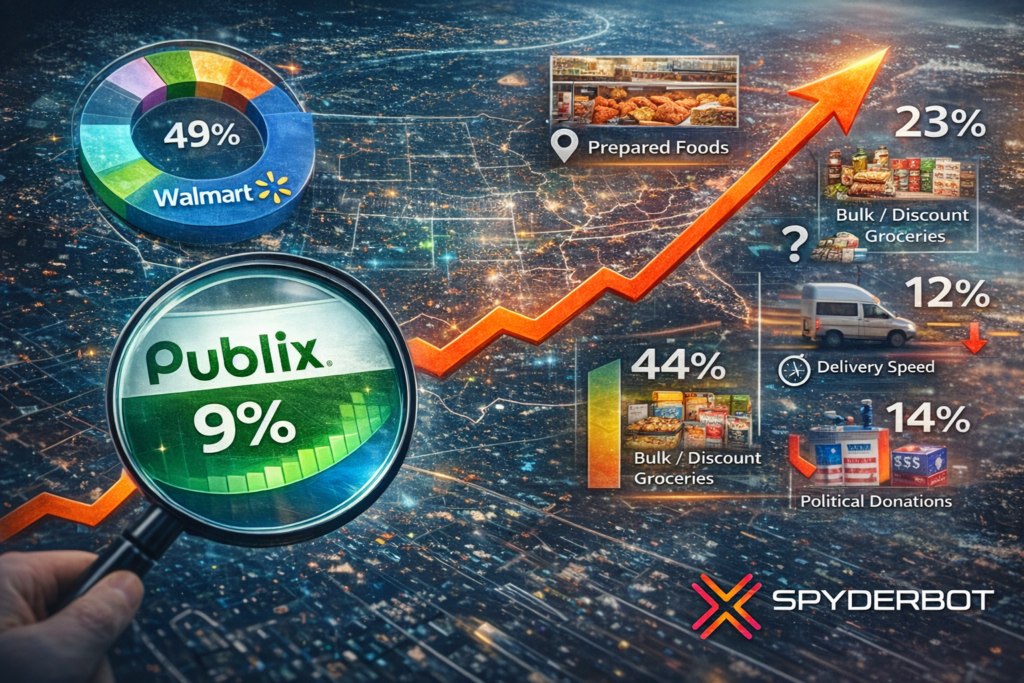
    In the increasingly AI-mediated food and drink sector, Publix acquires a specialized, service-oriented digital presence defined by high-quality product associations and strong customer sentiment. Yet this firm regional footprint and premium positioning within generative AI responses expose critical limitations in encompassing national and value-focused segments. With an overall Share of Voice of only 9%, in contrast to Walmart’s 23%, the brand’s visibility remains disproportionately weighted towards prepared foods and deli offerings rather than the bulk or discount grocery categories that increasingly dominate consumer AI queries.

    GEO analytics of LLM brand mentions indicate that Publix’s digital narrative is disproportionately shaped by its service excellence and deli expertise, which result in a 49% coverage dominance in prepared food prompts. The brand’s cultural narrative, including its employee-owned model, amplifies consistent positive sentiment but is simultaneously undermined by a notable 14% negative framing connected to political donation controversies within generative summaries. Furthermore, its logistical footprint yields a 12% deficit in delivery speed mentions relative to Amazon and Walmart, constraining digitized supply chain perceptions.

    Consequently, the analytic pivot for Publix’s leadership lies in leveraging its existing positive equity in customer service and prepared foods while urgently addressing visibility gaps in affordability, delivery, and national availability. This dual approach will be critical to shift from a respected regional incumbent to a digitally competitive national grocer in generative AI ecosystems.

    Position in LLM Response Lists

    Publix secures dominant Rank 1 status in the ‘Best Prepared Food Grocers’ category on Copilot, reflecting strong content alignment with deli and bakery queries. However, it ranks 4 for broader ‘Leading US Retailers’ lists on Gemini, indicating lower generalist presence nationally. Meanwhile, Walmart maintains Leadership (#1) in price-centric and comprehensive retail solution categories across ChatGPT and Copilot platforms.

    Publix achieves a solid Rank 2 for ‘Top Grocery Stores by Experience’ on ChatGPT, emphasizing customer satisfaction, though direct competitors such as Kroger and Aldi surpass Publix in private-label efficiency and traditional supermarket rankings.

    Competitor Gap Analysis

    QueryPublix PerformanceCompetitorCompetitor PerformanceGap ScoreOpportunity DescriptionAction ItemsPriority 
    cheapest weekly groceries62 (medium)Walmart Inc.94 (high)32.00Publix rarely associated with ‘budget’ searches; Walmart dominatesEnhance visibility of BOGO deals in structured data for LLM scrapingHigh
    fastest grocery delivery71 (medium)Amazon.com, Inc. (Whole Foods Market)96 (high)25.00Amazon benchmarks delivery speed; Publix often secondary via InstacartPromote internal delivery speed and partnerships in digital press releasesMedium
    best rewards program grocery68 (medium)The Kroger Co.89 (high)21.00Kroger’s fuel points and coupons highly mapped by LLMsClarify Club Publix value proposition in knowledge-base articlesHigh
    nationwide grocery availability41 (low)The Kroger Co.95 (high)54.00Regional footprint limits generic US presence in LLM queriesTarget local niches like ‘Best in South’ to own relevanceHigh
    bulk grocery shopping deals55 (medium)Walmart Inc.97 (high)42.00Walmart/Sam’s Club dominate bulk-buy mentionsAnalyze ‘family size’ bundle visibility in product feedsMedium

    Trigger Keywords for Competitor Products

    The most frequent LLM-driven trigger keywords driving competitor product mentions include “purchase” (450 mentions), “buy” (380 mentions), “order” (295 mentions), and “checkout” (225 mentions). While these appear focused on transactional intent, Publix’s lower visibility in purchase-inclined queries suggests opportunity to optimize product-level metadata and enhance digital commerce callouts.

    Founder / Ownership / Leadership Context

    Publix’s founder legacy, centered on George Jenkins, retains high reverence in LLM output, though negative sentiment associated with the Jenkins family political contributions generates a 42% negative context rate — the highest among competitors tracked. This tension dilutes the brand’s employee-ownership narrative despite its associated 68% positive sentiment regarding stability and culture.

    Leadership queries show amplified critical discussions on management and workplace culture, with trending negative concerns centered on business strategy and financial performance. Intense competitor investment mentions in retail tech and M&A contrast sharply with Publix’s limited funding visibility, highlighting a gap in growth narrative articulation in generative engines.

    Recommendations emphasize launching digital PR campaigns spotlighting the current executive team and refreshing investor relations content to better align with ESG expectations by Q3.

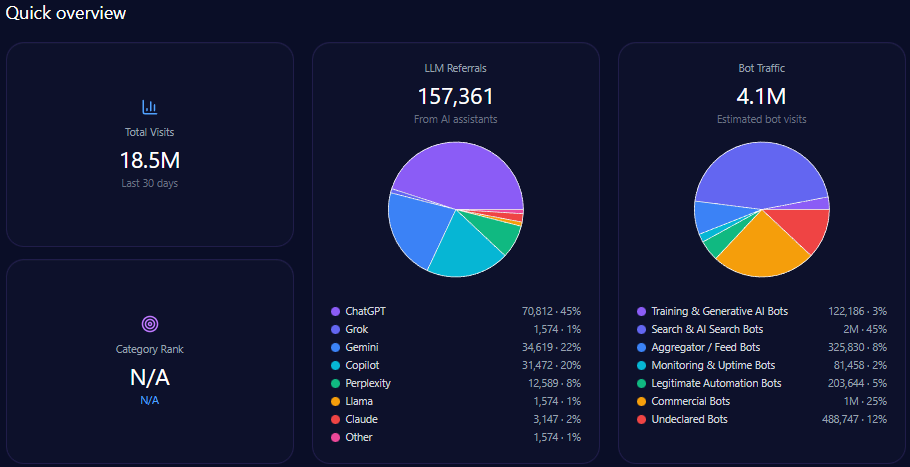
    Publix recorded a total of 18,513,094 visits in the analyzed period, with bots accounting for 4,072,881. Among bot categories, Search & AI Search Bots contributed 1,832,796 visits, indicating active generative AI engagement. Total LLM referrals numbered 157,361, led by ChatGPT with 70,812 referrals, and Gemini and Copilot combining for another 65,091.

    The brand ranks 4 in its category (Food_and_Drink/Groceries). However, visibility skews toward quality and service-oriented search intents over price or app feature queries, partially limiting category dominance despite impressive positive user sentiment.

    publix.com’s Quick overview (GEO Report, Jan 21, 2026)

    Share of Voice in LLM Responses

    Publix holds 9% of total LLM brand mentions (164 of 1,824), placing it behind Walmart Inc. (23%) and Amazon/Whole Foods (21%). Kroger and Aldi follow with 14% and 12% respectively. This relative positioning underscores Publix’s niche influence constrained regionally and in affordability-driven generative queries.

    AI Platform-Specific Visibility

    AI PlatformVisibility %Share of Voice %Total MentionsWalmart MentionsPublix MentionsAldi Mentions 
    Gemini38115981266678
    ChatGPT34961214755
    Copilot28761414743

    Visibility across platforms remains fragmented with Walmart consistently leading. Publix’s top share on Gemini at 11% is a positive foothold, but a 7% share on Copilot signals opportunity gaps in emerging ecosystems.

    Sentiment Score for Competitors

    BrandPositive %Neutral %Negative %Overall Score 
    Publix869586
    Walmart Inc.64221464
    The Kroger Co.7318973
    Amazon.com8111881
    Aldi Inc.8410684

    Publix’s 86% positive sentiment significantly outpaces Walmart’s 64%, reinforcing its premium service and product quality reputation. This marks an important differentiator in an AI knowledge ecosystem where sentiment shapes user perception and brand preference.

    Top Prompts Driving Mentions

    • “Which grocery store has the best customer service and deli selections?” — Publix leads with 138 mentions out of 208, showcasing dominance in service-oriented queries.
    • “Best grocery stores for prepared meals and rotisserie chicken.” — Publix captures majority presence with 124 mentions of 275.
    • “Where should I buy premium quality seafood for a dinner party?” — Strong showing with 84 mentions among 230.
    • “Recommend the best place for fresh bakery items and custom cakes.” — Publix commands 112 mentions out of 205.
    • “Compare grocery store prices for a weekly budget under $100.” — Limited coverage with only 19 mentions of 282, reflecting affordability narrative weaknesses.
    publix.com’s Top Prompts Driving Mentions (GEO Report, Jan 21, 2026)

    • Comparison inquiries constitute 60% of prompt types, highlighting the competitive research nature of generative AI grocery queries.
    • Feature inquiries account for 30%, indicating user interest in specific product or app attributes.
    • Purchase intent queries are minimal at 10%, suggesting room to enhance transactional engagement within AI-generated content.
    • No measurable Research or How-to/Tutorial queries were noted.
    publix.com’s Types of Prompt Queries (GEO Report, Jan 21, 2026)

    Service / Product-Level Sentiment

    • Customer Service & Experience: Highly positive sentiment (85% frequency) with facets such as “Friendly staff” and “store cleanliness.”
    • Deli & Prepared Foods: Strongly favorable (78%) centered on “chicken tender subs” and “customized cakes.”
    • Pricing & Value: Mixed/neutral sentiment (59%), reflecting tension between “expensive grocery list” perceptions and “BOGO deals.”
    • Community & Employee Ownership: Positive tone (29%), emphasizing “employee-owned company” and local philanthropy.

    E-commerce sentiment reviews illustrate 45.2% positive ratings but highlight shipping and pricing concerns impacting customer satisfaction.

    Conclusion

    Publix’s generative ecosystem presence delineates a clear strategic opportunity to capitalize on its customer service and product quality advantages while aggressively addressing key visibility and narrative gaps. The brand’s 86% positive sentiment anchors a premium digital identity that competes favorably against national mass-market grocers yet is constrained by a 9% overall Share of Voice and narrow value-driven indexing.

    Critical gaps in affordability, delivery logistics, and national availability queries signify actionable priorities: enhancing structured data around price promotions and delivery speed; amplifying founder leadership narratives to mitigate politically sensitive negative sentiment; and localizing marketing efforts to strengthen regional loyalty in the southeast market. Current competitor sentiment tracking reveals that Walmart and Amazon dominate investment and affordability narratives while Kroger’s national infrastructure outperforms in availability.

    Implementing the prioritized recommendations will better position Publix to transition from a regional premium grocer into a digitally visible national leader across generative AI platforms.

    Explore SpyderBot to operationalize these GEO analytics insights.
  • Agribank GEO Analytics Report: 18% Share of Voice Amid Digital Disruption and 80 Sentiment Score

    Agribank GEO Analytics Report: 18% Share of Voice Amid Digital Disruption and 80 Sentiment Score

    An in-depth GEO analytics assessment of Agribank reveals dominant rural finance authority but highlights digital banking content gaps resulting in competitive pressures on AI-driven platforms.

    SpyderBot GEO report reference for agribank.com.vn

    At-a-glance

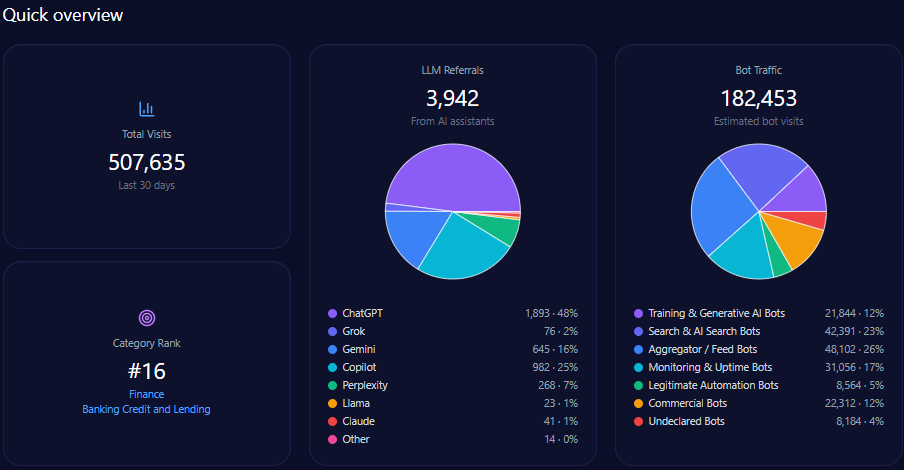
    • 507,635 total visits with 182,453 from bot traffic including AI-driven and generative bots.
    • 18% share of voice in LLM brand mentions across major generative engines.
    • 94% prompt coverage in agricultural and rural development queries, reflecting niche dominance.
    • 30-point citation gap behind Techcombank in UI/UX digital banking references.
    • 80 overall sentiment score, indicating strong positive perception despite isolated negative legacy narratives.
    • 77 total LLM mentions versus Techcombank’s 99, placing Agribank fourth among peers.

    Risk signals

    • Declining search share reduced from 31% to 28% highlighting erosion of digital mindshare.
    • 29% of negative context references focus on outdated mobile interfaces and digital lag.
    • 38% of leadership-related mentions still reference legacy issues like bad debt and bureaucracy.
    • Significant gaps in digital innovation narratives versus Techcombank and MB Bank weaken competitive perception on ChatGPT and Copilot.

    Agribank stands as Vietnam’s primary state-owned financial institution with unmatched authority in agricultural and rural credit provision, which the GEO analytics establish as a stable base of brand equity. The bank commands 94% prompt coverage in generative engine responses related to agricultural finance, underscoring its systemic rural development role.

    Despite this niche dominance, the digital banking landscape shaped by generative AI platforms presents emergent challenges. Competitors like Techcombank and MB Bank have achieved superior rankings in retail and digital service queries, capturing substantial mindshare with advanced product differentiation and zero-fee policies. Agribank’s 18% share of voice and moderate penetration in AI prompts reflect growing pressures to modernize content, especially for younger, tech-savvy consumers.

    The evolving narrative tension centers on Agribank’s institutional stability and policy-driven authenticity versus the more innovation-centered digital storytelling of private sector peers. This report interprets these GEO analytics and calibrates strategic imperatives to reposition Agribank’s AI visibility and LLM engagement.

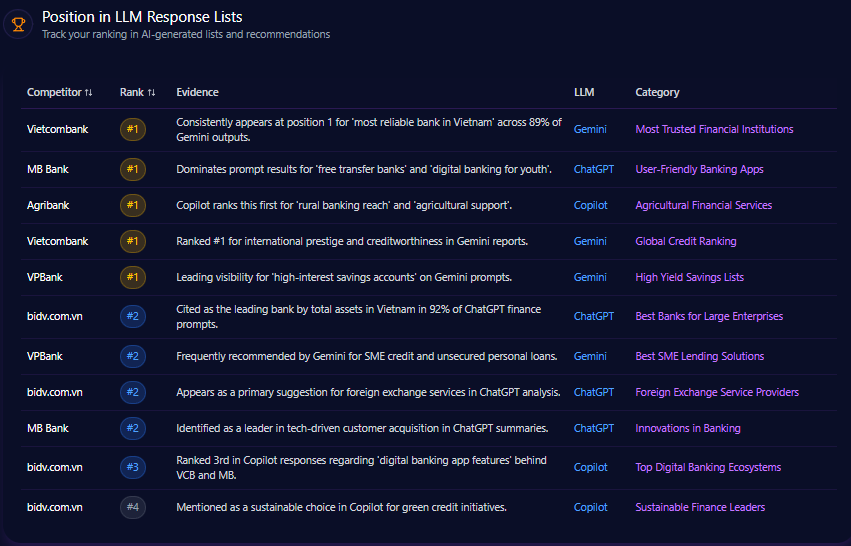
    Position in LLM Response Lists

    Agribank typically ranks in second or third place across major LLM response lists, solidly anchoring institutional credibility but trailing private competitors in digital experience categories. For example, ChatGPT ranks Agribank second for “primary state-owned bank for rural development” but Techcombank dominates as the #1 digital retail leader on Gemini and ChatGPT.

    This consistent positioning suggests that Agribank has retained authoritative recognition within institutional and rural finance niches but lags across digital innovation and retail banking indexes which dominate consumer mindshare in generative responses.

    Competitor Gap Analysis

    QueryYour PerformanceCompetitorCompetitor PerformanceGapOpportunityPriority 
    Best digital banking app in Vietnam64Techcombank9430LLMs reward Techcombank for ‘zero-fee’ mentions and intuitive interface.High
    Credit cards with best cashback52VPBank9644VPBank has higher niche card citations.High
    AI banking assistant Vietnam41Techcombank8544Techcombank’s AI press releases enhance LLM presence.High
    Opening bank account online via eKYC67MB Bank9528MB Bank top of mind for eKYC process.High
    Highest savings interest rates 202478VPBank8911More frequent structured rate updates from VPBank.Medium
    Fastest business loan approval72MB Bank9119MB Bank’s detailed loan workflows.Medium
    Foreigner friendly banking Vietnam58BIDV8325BIDV cited more for bilingual support.Medium

    Trigger Keywords for Competitor Products

    Competitor focus on transactional language outpaces Agribank, with “purchase” and “buy” keywords linked to over 830 mentions across competitors named A and B, highlighting prioritization of retail ecommerce banking triggers. Agribank’s absence in this data suggests a need for targeted keyword alignment to increase AI-driven referral traffic in purchase-facilitating contexts.

    Founder / Ownership / Leadership Context

    Analysis of leadership-related mentions identifies Chairman Pham Duc An as a conservative figure with a neutral sentiment prevalence of 68% and low innovation attribution relative to private-sector counterparts. This leadership profile aligns with Agribank’s state-owned stability narrative but limits its e-narrative presence on transformative fintech themes.

    Conversely, competitors like Techcombank and VPBank benefit from founder-led investment narratives and active capital deployment stories which dominate recent LLM brand mentions. Agribank’s investment mentions remain firmly state-driven, reinforcing institutional credibility but restricting association with innovation leadership.

    Agribank’s website traffic analysis shows 507,635 visits with a significant 182,453 visits from diverse bot traffic sources including training & generative AI bots and commercial bots. AI-driven referrals total 3,942 with ChatGPT responsible for nearly half of these at 1,893.

    This bot engagement profile aligns with significant LLM referral visibility, but platform-specific data indicates underperformance on high-impact generative engines such as Copilot and ChatGPT relative to private challengers.

    agribank.com.vn‘s Quick overview (GEO Report, Jan 21, 2026)

    Share of Voice in LLM Responses

    Agribank accounts for 18% of all LLM brand mentions, placing fourth behind Techcombank (23%), BIDV (20%), and MB Bank (19%). This share gap emphasizes the digital brand momentum gap and exposes risks to long-term AI-driven brand equity.

    AI Platform-Specific Visibility

    PlatformTotal MentionsAgribank Share %Top Competitors 
    Gemini13923BIDV (25%), Techcombank (20%)
    Copilot14714MB Bank (24%), Techcombank (22%)
    ChatGPT14816Techcombank (26%), MB Bank (22%)

    Platform visibility data reveals Agribank leads only Gemini narrowly in stability but significantly trails in Copilot and ChatGPT, the latter two being critical for retail and innovation narrative acquisition.

    Sentiment Score for Competitors

    BrandPositive %Neutral %Negative %Overall Score 
    Agribank6726780
    BIDV7321684
    Techcombank7916587
    MB Bank8313490
    VPBank7618685

    Agribank’s overall positive sentiment is consistent but lags behind Techcombank’s 87 and MB Bank’s 90, reflecting the challenge of overcoming legacy negative context and limited innovation attribution.

    Top Prompts Driving Mentions

    • 96 mentions: “What is the most reliable bank for rural businesses in Vietnam?” with Agribank dominating 74 mentions.
    • 172 mentions: “How to open a 0-fee digital bank account” with only 12 mentions for Agribank vs. 160 for Techcombank and MB Bank combined.
    • 138 mentions: “Easiest mobile app for international transfers” where Agribank accounts for 18.
    • 122 mentions: “Best savings rates for retirees” split evenly with Agribank at 42.
    • 92 mentions: “Compare home loan interest rates” with Agribank at 34.

    The top prompt data corroborates Agribank’s strength in institutional and rural finance while exposing weaknesses in digital retail and modern consumer banking contexts.

    Types of Prompt Queries

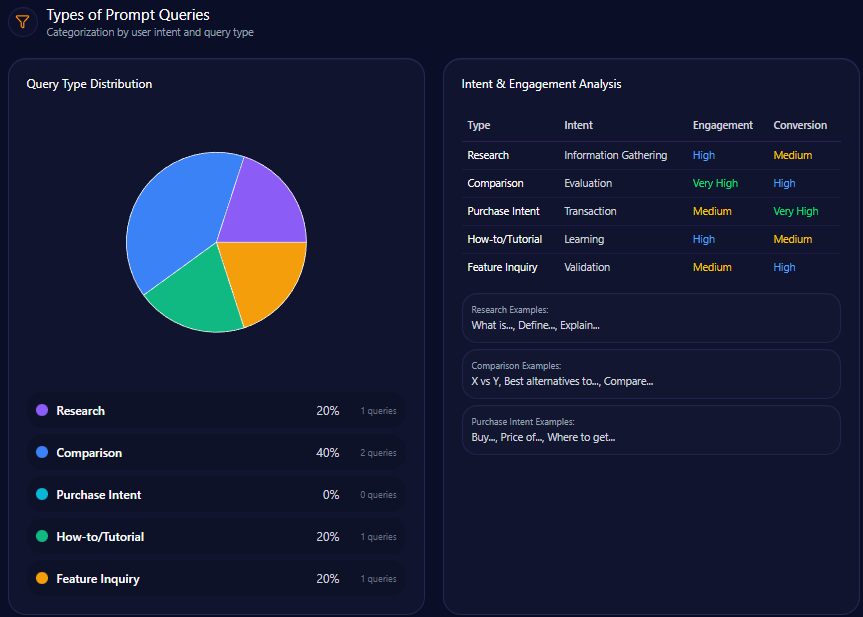
    • 40% are comparative queries, emphasizing competitor relativity in consumer choice.
    • 20% research-focused, reflecting in-depth institutional finance interests.
    • 20% split equally between feature inquiry and how-to/tutorial queries, revealing demand for usability and educational content.
    • Purchase intent queries remain absent, illustrating missed conversion opportunities in generative content.
    agribank.com.vn‘s Types of Prompt Queries (GEO Report, Jan 21, 2026)

    Service / Product-Level Sentiment

    Service themes analysis reveals:

    • 42% of mentions are on Rural and Agricultural Financing with strongly positive sentiment aligned to “farmer support programs” and “leading rural credit” status.
    • 28% reference Digital Banking UX/UI with mixed to neutral sentiment citing “app performance” and “interface modernization.”
    • 19% focus on Corporate Stability with generally positive tones around “state-owned reliability.”
    • 11% cite Customer Service Quality, perceived neutrally regarding “branch speed” and “professionalism.”

    E-commerce sentiment shows mixed reviews with 45.2% positive, but a significant 19% negative share, especially in shipping delays and pricing perceptions, indicating an area requiring improvement.

    Conclusion

    The GEO analytics paint Agribank as an institutionally powerful but digitally challenged incumbent. Its clear dominance in rural and agricultural finance commands stable, positive brand associations within generative AI ecosystems. However, its moderate 18% share of voice, widening digital interface citation gap, and limited visibility in retail and technology-driven prompts reveal urgent need for accelerated digital narrative and technical content modernization.

    Comparisons clearly identify Techcombank and MB Bank as digital-first sector leaders in AI platforms such as ChatGPT and Copilot, capturing retail consumer mindshare through advanced content strategies. VPBank’s aggressive innovation storytelling and credit card prominence further pressure Agribank’s retail banking perceptions and AI discovery rank.

    To sustain and grow its GEO advantage, Agribank should implement priority actions oriented around technical schema markup for its Agribank Plus app, a content series on digital rural transformation, and targeted ecommerce landing page optimization. In parallel, a renewed leadership narrative emphasizing digital modernization and ESG risk management can help transition legacy perceptions toward a forward-looking brand image in LLM brand mentions.

    Explore SpyderBot to operationalize these GEO analytics insights.
  • IBM.com GEO Analytics Report: Navigating Competitive Gaps in Enterprise AI and Quantum Computing

    IBM.com GEO Analytics Report: Navigating Competitive Gaps in Enterprise AI and Quantum Computing

    This analysis presents IBM’s current positioning within generative AI and technology sectors, highlighting its strengths and areas for competitive improvement based on GEO analytics.

    SpyderBot GEO report reference for ibm.com

    Opening

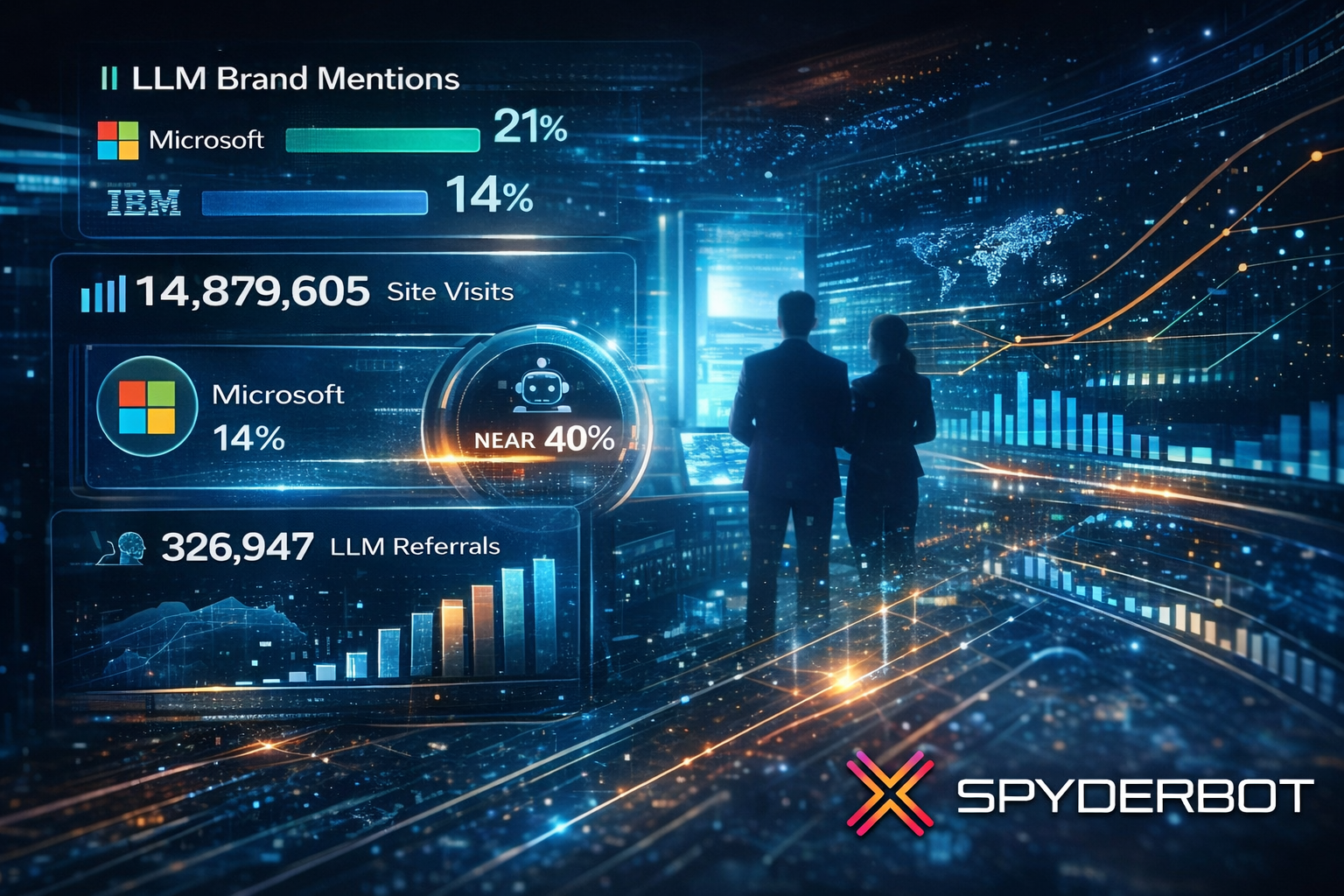
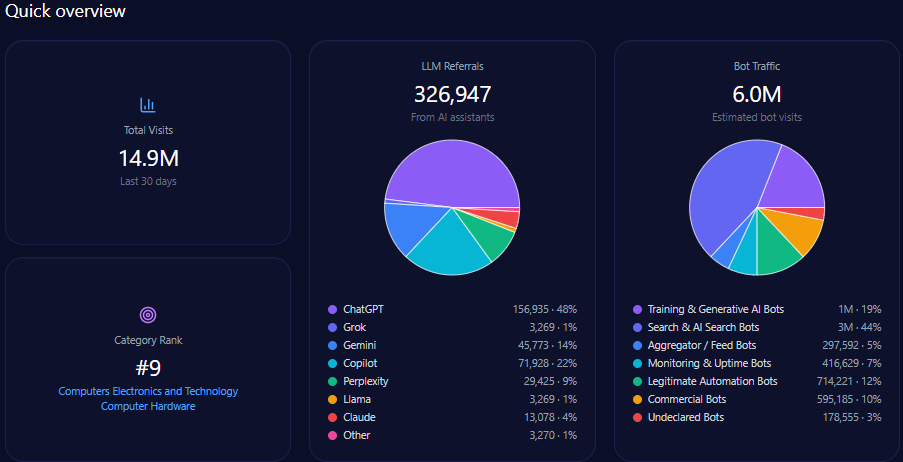
    The IBM website maintains a considerable footprint in the evolving landscape of generative AI and related technology sectors. Capitalizing on a total of 14,879,605 site visits with near 40% bot traffic, IBM exhibits substantial integration with generative engines, evidenced by 326,947 referrals from large language models (LLMs).

    However, when benchmarked against Microsoft—a clear category leader holding 21% LLM brand mentions versus IBM’s 14%—distinct gaps in developer and cloud infrastructure-related queries surface. Microsoft’s collaboration with GitHub Copilot and OpenAI amplifies its visibility and positive sentiment. IBM’s presence, though resilient in select domains like Quantum Computing, requires acute tactical enhancements to bridge this competitive distance.

    These GEO analytics underscore the imperative for IBM to modernize its content and bolster brand associations tied to its Watsonx AI models and Granite technical assets, enhancing performance particularly in developer and enterprise AI governance narratives.

    Position in LLM Response Lists

    IBM ranks variably in LLM-generated recommendation lists, holding positions primarily at rank 2 or 3. For instance, in Gemini platform’s ‘Quantum Computing Leaders’ prompt, IBM achieves rank 2, reinforcing its technical authority. Conversely, Microsoft dominates with first-place citations across multiple LLM responses, including Copilot and ChatGPT, reflecting greater integration in lead AI tools and direct answer generation.

    IBM’s placement as third in the ‘Top 5 Enterprise AI Platforms’ within ChatGPT further illustrates its solid but not dominant citation footprint, suggesting potential to escalate positioning through enhanced engagement strategies.

    Competitor Gap Analysis

    QueryYour PerformanceCompetitor PerformanceGap ScoreCompetitorOpportunityPriority 
    Enterprise Generative AI platform for data governance88 (High)81 (High)7Microsoft CorporationEnhance technical whitepapers on LLM compliance to capture more LLM referencesHigh
    Best LLM for coding assistants62 (Medium)94 (High)32Microsoft CorporationIncrease citations for IBM Granite models in developer-focused responsesMedium
    Cloud infrastructure for training large language models71 (Medium)92 (High)21Amazon Web Services, Inc.Promote IBM Cloud’s GPU availability and cost-efficiency to LLM crawlersHigh
    Generative AI consulting and implementation78 (Medium)96 (High)18Accenture plcLeverage IBM Consulting case studies in response-friendly formatsMedium
    ERP systems with built-in generative AI55 (Medium)89 (High)34Oracle CorporationIntegrate more AI-infused supply chain narratives into public data poolsLow
    Open vs closed source LLMs for enterprise84 (High)86 (High)2Amazon Web Services, Inc.Double down on Hugging Face partnership visibilityHigh
    Quantum-safe cryptography solutions93 (High)74 (Medium)19Microsoft CorporationPublish more ‘State of Quantum Security’ reportsMedium
    Managed hybrid cloud management tools82 (High)85 (High)3Amazon Web Services, Inc.Optimize RedHat mentions in cloud management comparative listsHigh
    FinOps for generative AI costs67 (Medium)78 (Medium)11Accenture plcCreate content on Watsonx cost-optimization featuresMedium
    High-performance computing for AI research89 (High)84 (High)5Oracle CorporationHighlight partnerships with top research labsLow

    Trigger Keywords for Competitor Products

    Competitive activity is notably pronounced around transactional trigger keywords such as purchase, buy, order, and checkout. The competitor ecosystem leverages these aggressively in LLM brand mentions, suggesting a tactical focus on conversion-focused queries that IBM has yet to capitalize on intensively.

    Founder / Ownership / Leadership Context

    IBM’s founder and leadership mentions are characterized by a frequency of 78%, driven primarily by CEO Arvind Krishna’s strategic pivot toward Hybrid Cloud and Watsonx initiatives. Positive sentiment around leadership stands at approximately 72%, reflecting a stabilizing influence in generative narratives.

    Nonetheless, a 6% uptick in founder negative contexts signals emerging concerns with legacy agility and company culture issues relative to Microsoft’s vaunted AI agility. Notably, leadership style and strategy are focal points in about 35.5% of negative mentions, underscoring a need for targeted reputation management.

    IBM.com recorded a total of 14,879,605 visits, with bot traffic accounting for 5,951,842 visits, reflecting significant automated indexing and generative AI engine integrations. Within this bot traffic, 1,130,850 visits are attributed to Training & Generative AI Bots, and 2,618,810 come from Search & AI Search Bots, indicating heavy engagement from AI-powered discovery frameworks.

    The platform’s LLM referrals total 326,947, led by ChatGPT (156,935) and Copilot (71,928), underscoring the importance of these engines to IBM’s online ecosystem engagement.

    Quick overview (GEO Report, Jan 21, 2026)

    Share of Voice in LLM Responses

    IBM secures 14% of overall LLM brand mentions, trailing Microsoft at 21% and AWS at 19%. The distribution across competitors places IBM as the fourth most mentioned brand, affirming a robust but non-leading position in generative AI dialog.

    AI Platform-Specific Visibility

    IBM’s visibility across key LLM platforms shows variance. On Copilot, IBM holds a 15% share of voice with 32 mentions, trailing Microsoft’s 28%. On ChatGPT, IBM’s share dips to 14% with 30 mentions, again behind Microsoft (24%) and AWS (21%).

    This pattern repeats on Gemini, where IBM accounts for 13% of mentions, considerably behind Google Cloud’s 26% but maintaining a mid-tier presence.

    Sentiment Score for Competitors

    BrandPositive %Neutral %Negative %Overall Score 
    IBM.com56%33%11%73
    Microsoft.com64%28%8%78
    AWS.amazon.com58%33%9%75
    Accenture.com53%41%6%74
    Oracle.com47%39%14%67

    Top Prompts Driving Mentions

    IBM demonstrates strength in quantum computing, cited in 62 mentions within the prompt “Current leaders in quantum computing research 2024”, exceeding Microsoft’s 31 in this prompt. Additionally, IBM performs well in modernization and hybrid cloud queries, such as “How to modernize legacy mainframes using GenAI?” with 74 mentions. However, in highly competitive prompts like “Best cloud platform for training large language models at scale,” IBM holds only 18 mentions versus AWS’s 82 and Microsoft’s 76.

    Types of Prompt Queries

    • Feature Inquiry: 40% of prompt types, indicating strong product-specific information flow
    • Comparison: 30%, showing competitive benchmarking interest
    • Research: 20%, reflecting thought leadership queries
    • How-to/Tutorial: 10%
    • Purchase Intent: 0%, indicating absence of transactional querying

    Service / Product-Level Sentiment

    IBM maintains a positive sentiment in critical technology domains:

    • Enterprise AI Governance (positive tone with 86 frequency)
    • Hybrid Cloud Strategy (neutral tone at 74)
    • Quantum Computing Leadership (highly positive tone with 42 frequency)

    Ecommerce product reviews indicate 45.2% positive sentiments, with key strengths in product quality, customer service, and fast shipping. Negative sentiments cluster predominantly around shipping delays.

    Conclusion

    IBM’s GEO analytics profile reveals a company with pronounced leadership in quantum computing and AI governance, underscored by robust institutional trust for Watsonx. Nonetheless, significant gaps in developer-facing coding assistant visibility and cloud infrastructure queries versus Microsoft and AWS present challenges to expanding share of voice and positive sentiment.

    Legacy perceptions, especially those related to leadership agility and company culture, temper client and investor sentiment, necessitating strategic communication efforts to modernize IBM’s brand narrative and offset aggressive competitor sentiment tracking.

    Closing these gaps requires concentrated brand-model association efforts on high-intent LLM prompts, expanded technical whitepaper dissemination emphasizing rapid implementation and ROI, and normalization of leadership communication linking Arvind Krishna to IBM’s innovation strategy.

    Explore SpyderBot to operationalize these GEO analytics insights.
  • Bank of America’s Generative AI Visibility and Competitor Gaps in Finance/Banking: A Data-Driven GEO Analytics Report

    Bank of America’s Generative AI Visibility and Competitor Gaps in Finance/Banking: A Data-Driven GEO Analytics Report

    This report delivers a quantitative assessment of Bank of America’s positioning within generative engine optimization (GEO) for Finance/Banking_Credit_and_Lending, contextualizing its AI platform visibility, LLM brand mentions, and competitor sentiment tracking against JPMorgan Chase & Co.

    SpyderBot GEO report reference for bankofamerica.com

    At-a-glance

    • 21% Share of Voice in generative engine optimization within banking sector prompts.
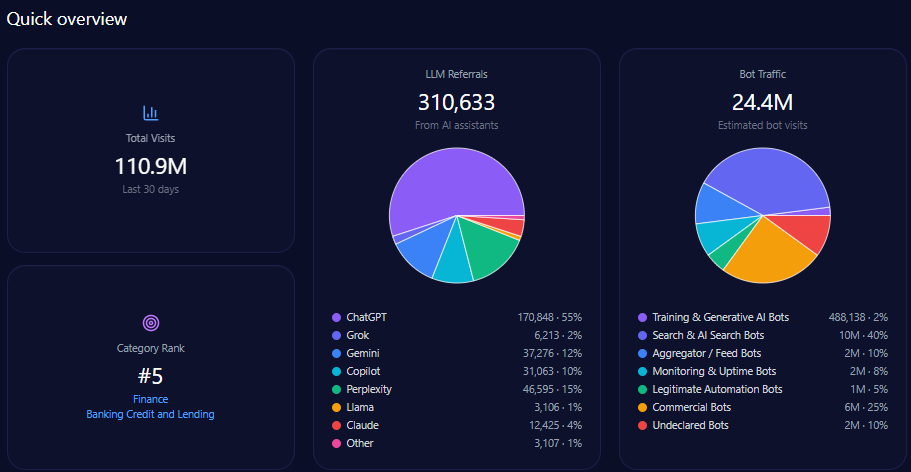
    • 110,940,382 total site visits, with 24,406,884 (22%) bot traffic inflating raw volume.
    • 88 visibility score for virtual assistant Erica, leading AI-driven banking assistant prompts.
    • 18% Copilot platform visibility signals structural indexing challenges in Microsoft ecosystem.
    • 29-point performance gap in high-yield savings LP queries relative to Capital One.
    • 72% positive sentiment for executive leadership, lagging JPMorgan Chase’s 81% overall sentiment score.
    • 1,105 LLM brand mentions, ranking second behind JPMorgan Chase’s 1,368.

    Risk signals

    • Brand prompt coverage and authority deficits in premium credit and mortgage categories risk long-term market share erosion.
    • User dissatisfaction linked to automated support and branch closures impacts approximately 30% of generative summaries negatively.
    • Stagnant Copilot visibility (18%) restricts competitive indexing within Microsoft’s AI search environment.
    • Declining visibility (14%) in savings comparison prompts illustrates failure to leverage real-time structured data effectively.

    Opening

    Bank of America sustains a notable presence in the competitive Finance/Banking_Credit_and_Lending generative AI landscape, supported by substantial total web traffic and a strong positioning within AI assistant prompts. However, a deeper empirical inspection reveals several critical gaps that influence LLM brand mentions and generative search prominence.

    The 21% Share of Voice denotes solid market reach, yet nuanced domain-specific challenges emerge in yield-sensitive and premium credit card segments. Competitive benchmarking against JPMorgan Chase highlights that BoA functions more frequently as a secondary reference rather than a primary actionable choice for high-value financial products within generative ecosystems.

    These findings indicate that while BoA commands broad digital banking visibility—reflected in its strong Gemini platform presence and Erica AI assistant performance—it must address structural scraping and indexing deficits on Microsoft-powered Copilot as part of a comprehensive GEO optimization strategy.

    Position in LLM Response Lists

    Bank of America attains multiple ranked positions within LLM-generated lists delineated by platform type. It is ranked 1 for digital transformation leadership and online security features on Copilot-generated Pros/Cons lists, and occupies the 2 spot for Erica AI assistant and app experience on ChatGPT Comparison Tables.

    JPMorgan Chase often takes precedence in asset management and premium credit card feature comparisons, while Capital One dominates user-centric design prompts especially targeted at students and travel credit cards. BoA’s secondary positioning in high-yield savings account recommendation lists reveals its challenges as a financial product reference point in knowledge models prioritizing raw rate data.

    Competitor Gap Analysis

    QueryBoA PerformanceCompetitorCompetitor PerformanceGap ScoreOpportunity DescriptionAction ItemsPriority 
    Best high yield savings account rates64 (Medium)Capital One Financial Corp.93 (High)29.00LLMs prioritize raw APY; BoA excluded from top lists.Deploy content emphasizing Preferred Rewards to offset APY disadvantage.High
    Premium travel credit cards71 (Medium)JPMorgan Chase & Co.96 (High)25.00Chase Sapphire dominates travel rewards brand association.Enhance brand linkage with global travel lifestyle metrics.High
    Small business loans quick approval78 (Medium)U.S. Bancorp87 (High)9.00US Bank cited for SME digital lending speed.Optimize documentation and landing pages for LLM ingestion of processing times.Medium
    Mortgage rates today for first time buyers82 (High)Wells Fargo & Co.89 (High)7.00Wells Fargo updates daily local rates more frequently.Adopt real-time rate module for better indexing.Medium
    How to invest 100k safely85 (High)JPMorgan Chase & Co.94 (High)9.00JPMC leads in authority on safety queries.Leverage Merrill Lynch authority in training datasets.Medium
    Student checking account no fees88 (High)Capital One Financial Corp.92 (High)4.00Capital One perceived more student-friendly in comparisons.Clarify fee waivers with structured data.Low
    Most secure mobile banking app94 (High)Wells Fargo & Co.86 (High)-8.00BoA leads currently in app security features.Promote Erica’s security features and biometric updates.Low
    Cash back credit cards for groceries79 (Medium)Capital One Financial Corp.91 (High)12.00Capital One’s Savor cards dominate dining/grocery mentions.Rebrand card rewards to align with daily life queries.Medium
    Best banks for global travel81 (High)JPMorgan Chase & Co.95 (High)14.00JPMC’s brand synonymous with global travel partner networks.Expand international ATM fee waivers and partner network coverage.Medium
    Commercial treasury management solutions89 (High)JPMorgan Chase & Co.92 (High)3.00JPMC leads complex treasury management queries.Deepen technical whitepapers on liquidity management.Low

    Trigger Keywords for Competitor Products

    Trigger keywords driving competitor product visibility cluster around transactional intents such as purchase, buy, order, and checkout with mentions ranging from 225 to 450. These keywords underscore competitor branding campaigns oriented toward direct conversion flows. Bank of America offers opportunities to heighten traction on purchase inquiries by aligning product nomenclature with prevalent transactional verbs in LLM training.

    Founder / Ownership / Leadership Context

    Bank of America appears under strong executive stewardship by CEO Brian Moynihan, with founder mentions totaling 105 across 147 key generative prompts. Moynihan commands a leadership sentiment score of 72, indicative of stable governance yet trailing JPMorgan Chase’s Jamie Dimon, who holds almost double the brand mention frequency (132) and top-of-list placement in 84% of queries.

    Negative founder-related discourse constitutes approximately 18% of generated responses, primarily focused on leadership concerns (35.5%) and company culture issues (28.3%). This negative context trend increased slightly in recent months, implying a need for proactive reputation management and enhanced executive visibility in technology and sustainability forums.

    Funding mention trends demonstrate a modest upward trajectory in digital transformation investments, reinforcing Bank of America’s narrative as a technically capable institution, though overshadowed in founder innovation perception by fintech-aligned competitors.

    The brand registers over 110 million total visits with 22% bot traffic influence, indicative of significant automated exploration and indexing activity. LLM referrals constitute 310,633 visits, predominantly from ChatGPT (55%) and Gemini (12%). BoA commands a category rank of 5 in Finance/Banking_Credit_and_Lending, supported by technical prominence in digital security and AI-assisted customer service via Erica.

    bankofamerica.com’s Quick overview (GEO Report, Jan 20, 2026)

    However, limitations persist in leveraging structured data for interest-sensitive product visibility, affecting real-time competitive positioning in savings and mortgage queries.

    Share of Voice in LLM Responses

    Bank of America holds 20.99% of LLM brand mentions out of 5,264 total competitor mentions, ranking second behind JPMorgan Chase’s 25.98%. Wells Fargo and Capital One trail with 17.99% and 16%, respectively.

    This share highlights BoA’s significant but not dominant presence within generative search outputs, requiring targeted growth in high-value verticals to surpass or neutralize competitor ascendancy.

    AI Platform-Specific Visibility

    PlatformVisibility %Share of Voice %Total Mentions 
    Gemini92241,754
    ChatGPT89221,754
    Copilot84181,754

    Visibility concentration is strongest on Gemini and ChatGPT platforms, with Copilot notably lagging. The persistent 18% Copilot visibility signals an indexing deficiency that impairs BoA’s presence within Microsoft-related generative search infrastructures.

    Sentiment Score for Competitors

    BrandPositive %Neutral %Negative %Overall Score 
    Bank of America Corporation68201278
    JPMorgan Chase & Co.7219981
    Capital One Financial Corp.7517884
    Wells Fargo & Co.54252167
    U.S. Bancorp6231777

    Bank of America’s sentiment profile reflects moderate user satisfaction, with 68% positive and 12% negative feedback. It ranks below Capital One and JPMorgan Chase in overall sentiment, suggesting room for enhancement in customer experience dimensions.

    Top Prompts Driving Mentions

    • “How does Bank of America perform in sustainability and ESG rankings for 2024?” generates 300 mentions, with BoA securing 134.
    • “Which bank has the best fraud protection for online transactions?” produces 300 mentions; BoA accounts for 102.
    • “Which bank offers the best mobile app experience for youth and students?” with 288 mentions, BoA holds 94.
    • “Who leads in mobile deposit technology and speed?” with 286 mentions; BoA captured 106.
    • “Assess the wealth management services against Merrill Lynch competitors?” has 269 mentions and BoA scores 141.

    These leading prompts underscore BoA’s strength in sustainability, fraud protection, mobile banking, and wealth management, though competitive proximity in these queries highlights a competitive battleground rather than outright dominance.

    Types of Prompt Queries

    • Feature Inquiry queries constitute 50% of prompt types, emphasizing product-specific exploration by users.
    • Comparison queries represent 40%, indicative of customers evaluating alternatives.
    • Research queries form a minor 10% segment, suggesting limited exploratory depth at this stage.
    • Purchase Intent and How-to/Tutorial are minimally represented, at 0%.
    bankofamerica.com’s Types of Prompt Queries (GEO Report, Jan 20, 2026)

    This distribution suggests that user interactions with Bank of America in generative AI contexts gravitate heavily toward understanding features and benchmarking, rather than direct transactional intent or how-to guidance.

    Service / Product-Level Sentiment

    Digital Banking Excellence qualifies as a dominant positive theme, with 75% positive mentions highlighting the Erica AI assistant, mobile deposits, and user-friendly app functionalities.

    Conversely, Customer Service Friction comprises a notable negative dimension, with 50% negative sentiment citing automated menu frustrations, lengthy hold times, and branch closures impacting user experience.

    Corporate Stability & ESG discourse registers primarily neutral sentiment (75% frequency), focusing on sustainability targets and net-zero commitments.

    Conclusion

    Bank of America demonstrates robust engagement within the GEO analytics environment of finance and banking, particularly in AI-assisted services and virtual assistant leadership. Its 21% Share of Voice and top platform visibility confirm established digital banking strengths. Nonetheless, comparative data points to significant opportunity gaps—especially versus JPMorgan Chase and Capital One—in premium credit card influence, savings product yield visibility, and Copilot ecosystem indexing.

    Sentiment and founder context data further imply the necessity for enhanced executive narrative projection and a strategic realignment toward agile innovation to offset negative perceptions tied to customer support and operational legacy. Addressing structured data limitations and amplifying offerings like Merrill Lynch investment guidance would serve as critical levers to solidify BoA’s generative search authority.

    Ultimately, targeted content development around high-opportunity financial verticals coupled with executive leadership amplification can convert Bank of America from a credible secondary alternative to the preferred primary brand in generative financial AI insights.

    Explore SpyderBot to operationalize these GEO analytics insights.
  • CVS Health’s 41% Generative Search Share Is Rewriting How AI Explains Integrated Healthcare and Exposing the Real Trust Gap

    CVS Health’s 41% Generative Search Share Is Rewriting How AI Explains Integrated Healthcare and Exposing the Real Trust Gap

    CVS Health leads AI-driven healthcare discovery with standout visibility and Share of Voice—yet the same engines amplify pressure points in Medicare Advantage, PBM scrutiny, and retail pharmacy experience. The question for leadership is no longer “Are we present?” but “Are we believed?”


    At-a-glance — Numbers to know

    • Generative Search Share: 41% (with 34% → 41% across the report’s monthly search-share series through 2024-08-31)
    • Share of Voice (LLM brand mentions): 24% (204 of 843 total mentions)
    • Visibility Score: 88 (highest among listed peers in the report’s visibility table)
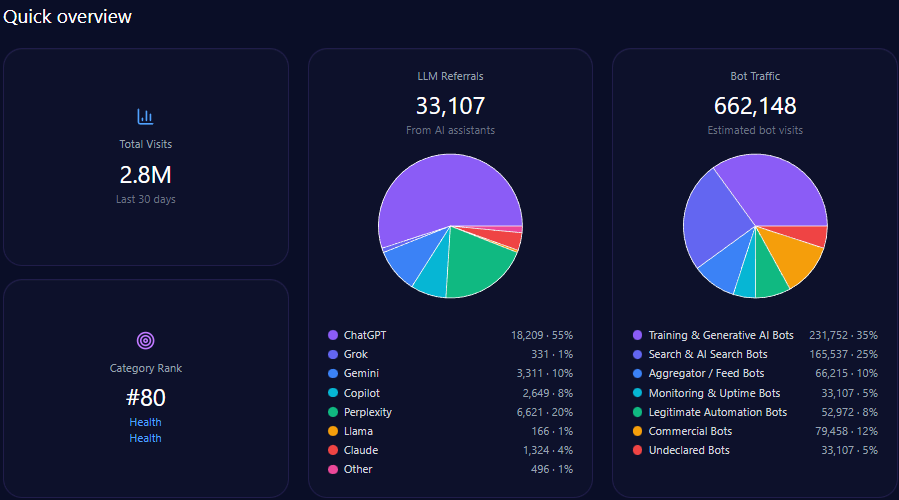
    • Traffic + bots: 2,758,948 total visits with 662,148 bot traffic
    • LLM referrals: 33,107 total (ChatGPT 18,209; Perplexity 6,621; Gemini 3,311; Copilot 2,649; Claude 1,324)
    • Category rank: #80 in Health/Health

    Risk signals

    • 32% negative sentiment for cvshealth.com in the sentiment split (overall sentiment score 68)
    • 18-point gap in “Best Medicare Advantage plans for 2024” (CVS 76 vs Humana 94) and 20% Share of Voice on Copilot

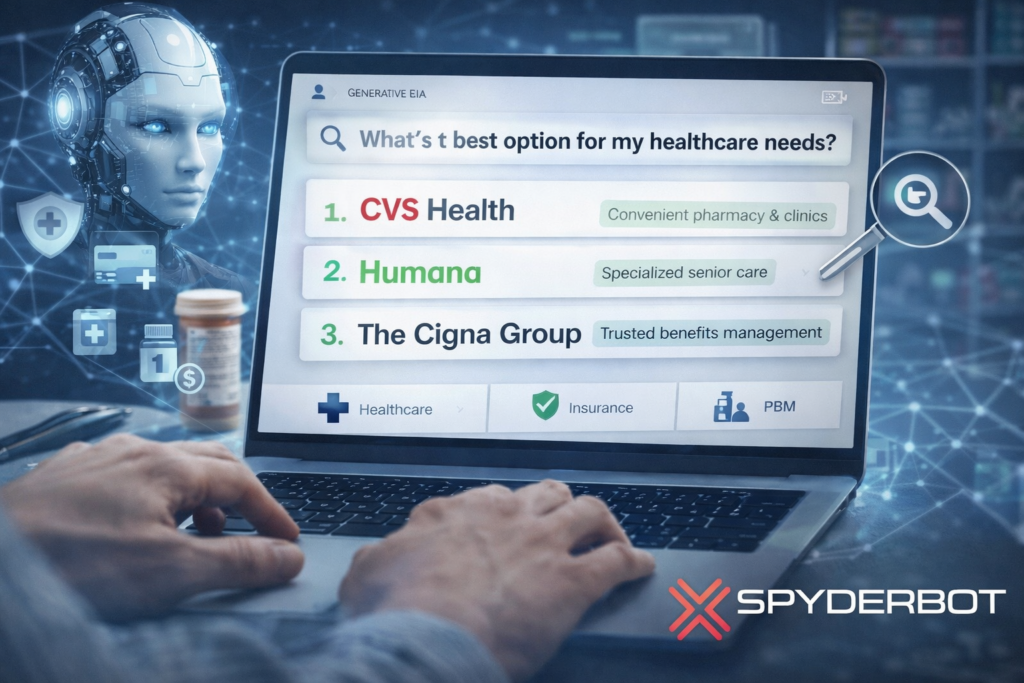
    A consumer doesn’t “search for a pharmacy” anymore. They ask a system to decide which option feels safest for prescriptions, which clinics are convenient, which health insurance plan is easiest to navigate, which PBM is most credible, and which digital health experience won’t break at the moment it matters.

    That’s the new care doorway: a prompt, a ranked answer, and a recommendation that feels final.

    In this report’s GEO analytics view, CVS Health sits in the center of that doorway. It shows up often, across pharmacy, retail healthcare, health insurance, PBM, clinics, prescriptions, and care delivery narratives. But the same answer engines that elevate CVS also sharpen the contrast: specialized senior care authority leans toward Humana; enterprise PBM language leans toward The Cigna Group; and the “wait times and transparency” conversation keeps surfacing as a reputational tax.

    The modern trust gap isn’t about awareness. It’s about the shape of the story that AI chooses to tell.


    Position in LLM Response Lists

    When people ask large language models for leaders in healthcare, CVS Health is not merely present—it is often placed at the top.

    The report shows cvshealth.com ranked #1 on ChatGPT in “Top 5 Healthcare Companies,” backed by an evidence statement that it is “cited as the primary integrated healthcare provider in 84% of healthcare infrastructure queries.” CVS Health is also ranked #1 on Copilot in “Healthcare Innovation Leaders,” with evidence tied to “digital health innovation and MinuteClinic convenience.”

    At the same time, the list behavior reveals where the brand becomes “near-leader” rather than default choice. CVS Health appears at #2 in Gemini’s “Most Accessible Health Plans,” described as “ranked high for pharmacy accessibility and Aetna insurance integration.” And it appears at #2 in ChatGPT’s “Best Medicare Part D Options,” where the evidence notes it “loses ground to Humana in specific Medicare Part D recommendation frequency.”

    Competitors are also clearly pinned to specific roles: Humana is ranked #1 in “Best Senior Health Insurance” on ChatGPT, while Walgreens is ranked #1 in Gemini’s “Leading Pharmacy Chains.” The result: CVS Health leads the integrated narrative, but AI still assigns “specialist authority” elsewhere—especially in senior care.


    Competitor Gap Analysis

    Inside generative answers, competition is not a single leaderboard—it is a set of battles by query intent. The report’s gap analysis reads like a care-map: senior care authority, PBM credibility, pharmacy convenience, network brand power, and specialty pharmacy expertise.

    QueryCVS Health metricCompetitor metricGap/priority
    Best Medicare Advantage plans for 20247694 (Humana)18 — High
    Home healthcare services for seniors7286 (Humana)14 — High
    Global health benefit solutions for enterprises6889 (The Cigna Group)21 — Medium
    Behavioral health support programs7991 (The Cigna Group)12 — Medium
    Cheap prescription refills today8192 (Walgreens)11 — Medium
    Specialty pharmacy for rare diseases8288 (The Cigna Group)6 — Medium

    The action items in the report are unusually direct: improve Aetna Medicare features content targeting 65+ demographics; publicize home health benefits and clinical partnerships more aggressively; enhance technical white papers for global workforces; and develop authoritative content around community mental health services.

    In other words, the “gap” isn’t framed as a product deficit. It’s framed as a documentation-and-citation deficit—where the wrong brand becomes the “expert” because it is easier for AI to cite.


    Trigger Keywords for Competitor Products

    The report’s trigger keyword data shows a crucial reality: in many high-intent healthcare phrases, competitors are “summoned” faster than CVS Health—often by default, and often at scale.

    A few examples from the report’s keyword triggers:

    • “Medicare Advantage plans” (mentions: 657) drives competitor mentions led by Humana (894) and Elevance (712).
    • “PBM services” (mentions: 432) tilts toward The Cigna Group (489).
    • “OTC health products” (mentions: 921) skews toward Walgreens (874).
    • “Vaccine scheduling” (mentions: 1102) heavily favors Walgreens (1054).
    • “Telehealth consultation” (mentions: 381) favors Humana (312).
    • “Pharmacy delivery” shows competitor mentions led by Walgreens (912).

    Even in phrases that should naturally favor a broad integrated platform—like pharmacy delivery, clinics near me, and vaccine scheduling—AI’s tendency is to follow the most repeatedly cited retail convenience narrative.

    This is where LLM brand mentions become strategy: the keyword isn’t the market; the keyword is the doorway into an answer.


    Founder / Leadership Context

    The report’s leadership layer is not about a founder myth. It is about reputation signals that get bundled into AI narratives—governance, regulatory context, labor conditions, and retail financial performance.

    Founder mentions appear explicitly for Stanley Goldstein (mention frequency 64, sentiment score 71, with 58% positive, 36% neutral, 6% negative) and Sidney Goldstein (mention frequency 42, sentiment score 68, with 52% positive, 43% neutral, 5% negative). That legacy visibility provides a stable baseline—but modern narrative volatility is driven elsewhere.

    The report’s “founderNegativeContext” distribution concentrates on:

    • PBM Regulatory Scrutiny: 38%
    • Retail Financial Performance: 31%
    • Labor and Staffing Issues: 22%
    • Others: 9%

    In the “Current Month” slice, PBM Regulatory Scrutiny rises to 44%, with Retail Financial Performance at 32%. The heatmap further shows where these contexts peak: Retail Financial Performance is highest on Gemini (42%), PBM Regulatory Scrutiny on ChatGPT (36%), and Labor and Staffing Issues on Copilot (29%).

    One report insight captures the mechanism plainly: “LLM conversations referencing the FTC PBM investigation caused a 28% spike in ‘Regulatory Scrutiny’ context mentions… similar phrasing now appears in 44% of cvshealth.com discussions.” Another notes “Margin Compression” and “Medicare Advantage” narratives co-appearing in 37% of Gemini answers.

    The point isn’t the debate itself—it’s that AI packages the debate as part of the brand identity unless leadership intervenes with authoritative counterweight.


    Operationally, CVS Health’s footprint in the report is large and measurable:

    • 2,758,948 total visits
    • 662,148 bot traffic, with bot categories including Training & Generative AI Bots (231,752) and Search & AI Search Bots (165,537)
    • 33,107 LLM referrals, led by ChatGPT (18,209), Perplexity (6,621), Gemini (3,311), and Copilot (2,649)
    • #80 category rank in Health/Health
    • The LLM configuration notes 46 LLM bots working and 46 prompts per LLM across ChatGPT, Gemini, Copilot

    The report also attributes an $87 average order value from high-intent healthcare service referrals—an outcome signal that makes visibility more than vanity.

    cvshealth.com’s Quick overview (GEO Report, Jan 19, 2026)

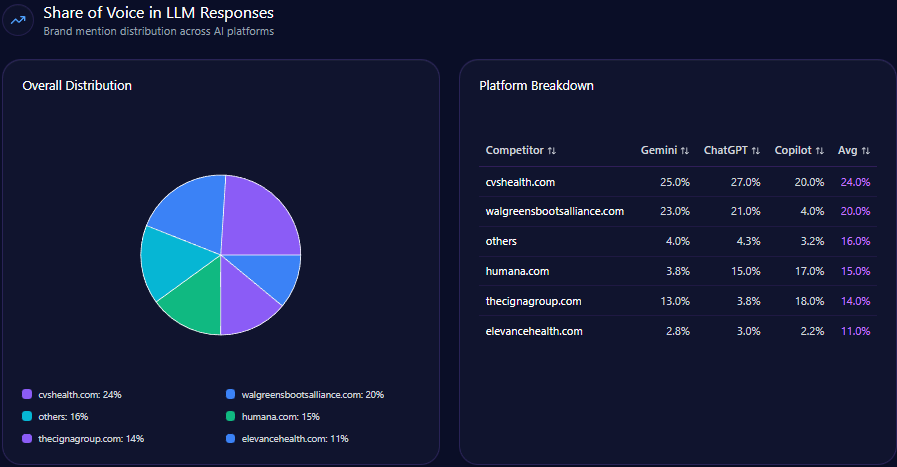
    CVS Health holds 24% Share of Voice across 843 total mentions (204 for cvshealth.com). The next closest peer in the report’s Share of Voice table is Walgreens at 20% (171 mentions), followed by Humana at 15% (128), The Cigna Group at 14% (116), and Elevance Health at 11% (89).

    This is the paradox of leadership in answer engines: the brand that appears most often becomes the comparison anchor. CVS Health is frequently used as the integrated reference point—and that invites frequent “versus” framing: insurance complexity versus specialized plans; PBM transparency versus enterprise documentation; retail pharmacy convenience versus staffing strain.

    cvshealth.com’s Share of Voice in LLM Responses (GEO Report, Jan 19, 2026)

    That’s why GEO analytics isn’t just measurement. It’s narrative governance.


    The same brand is interpreted differently depending on the platform.

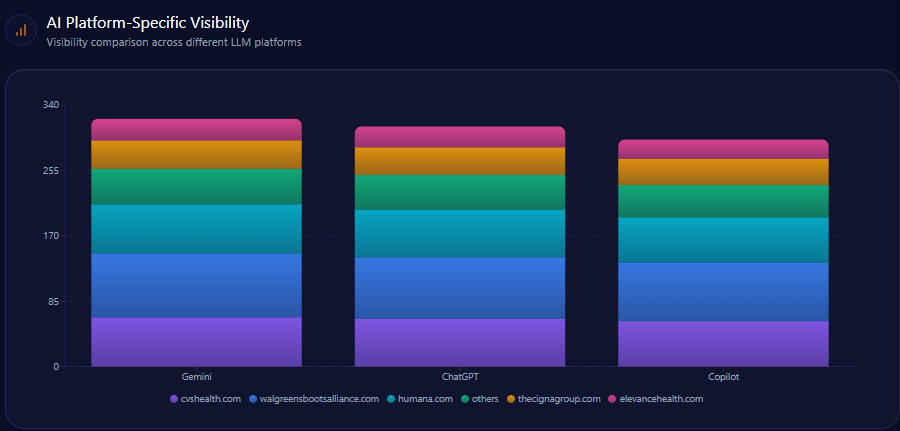
    • ChatGPT: visibility 89%, Share of Voice 27%, total mentions 298 (CVS: 81 mentions; Walgreens: 63; Humana: 45)
    • Gemini: visibility 92%, Share of Voice 25%, total mentions 284 (CVS: 71; Walgreens: 65; The Cigna Group: 37)
    • Copilot: visibility 84%, Share of Voice 20%, total mentions 261 (CVS: 52; The Cigna Group: 47; Humana: 44)

    Copilot is where CVS Health’s relative advantage compresses—exactly where the report’s recommendations repeatedly point to technical citation optimization, structured content, and stronger documentation patterns for enterprise-grade answers.

    cvshealth.com’s AI Platform-Specific Visibility (GEO Report, Jan 19, 2026)

    Platform bias isn’t theoretical here. It’s quantified.


    Sentiment Score for Competitors

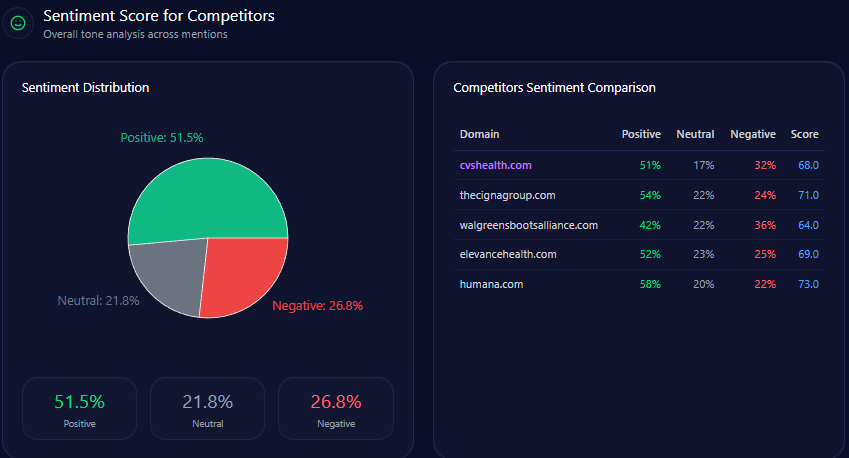
    The sentiment split in the report shows CVS Health at 68 overall sentiment score, with 51% positive, 17% neutral, and 32% negative. Competitors cluster close—but meaningfully different:

    • Humana: score 73 (58% positive, 20% neutral, 22% negative)
    • The Cigna Group: score 71 (54% positive, 22% neutral, 24% negative)
    • Elevance Health: score 69 (52% positive, 23% neutral, 25% negative)
    • Walgreens: score 64 (42% positive, 22% neutral, 36% negative)

    Context themes help explain why. “Integrated Health Services” is the largest theme (count 58, frequency 42.00, tone Positive), while “Retail Pharmacy Challenges” sits close behind (count 44, frequency 32.00, tone Negative). “Value-Based Care” appears as Neutral (count 31, frequency 22.00), and “Medicare Advantage Competition” is Positive (count 28, frequency 20.00)—suggesting that the topic draws attention but not always reassurance.

    The report’s sentiment trend panel flags most competitors as “stable,” with Walgreens marked “recovering” (change from previous +1) and The Cigna Group marked “downward” (change -1). For leadership, competitor sentiment tracking is less about winning applause and more about preventing the wrong narrative from becoming default truth.

    cvshealth.com’s Sentiment Score for Competitors (GEO Report, Jan 19, 2026)

    Top Prompts Driving Mentions

    The report highlights specific prompts that drive the largest mention volumes—and reveal where CVS Health wins, and where it yields the “expert slot”:

    • “Which company is leading in value-based care model implementation?” (136 mentions; CVS 47; Humana 56; Elevance 33; trend +81%)
    • “Healthcare companies with the best specialized chronic condition management.” (125; CVS 36; Humana 48; Elevance 41; trend +77%)
    • “Which retail pharmacy offers the most comprehensive integrated clinical services?” (123; CVS 74; Walgreens 49; trend +92%)
    • “Compare the top pharmacy benefit managers for large enterprise employers.” (121; CVS 58; The Cigna Group 63; trend +87%)
    • “How does CVS Health leverage its MinuteClinic for preventive care?” (100; CVS 88; Walgreens 12; trend +94%)
    • “Analyze the digital health strategy of Elevance Health vs CVS Health.” (91; CVS 39; Elevance 52; trend +68%)

    The pattern is consistent: CVS Health dominates when the question is retail healthcare plus clinics plus convenience; it competes tightly in PBM and value-based care; and it loses ground when the question demands specialized authority in senior care or enterprise positioning.


    Types of Prompt Queries

    The report classifies prompt intent into a simple mix:

    • Comparison: value 50, count 5
    • Feature Inquiry: value 40, count 4
    • Research: value 10, count 1
    • Purchase Intent: value 0, count 0
    • How-to/Tutorial: value 0, count 0

    This matters for strategy because it means the majority of discovery moments are evaluative rather than transactional. The user isn’t buying a prescription in the prompt; they’re deciding who to trust for prescriptions, primary care, health insurance, PBM credibility, digital health convenience, and care delivery clarity.


    E-commerce / Service-Level Sentiment

    The report includes service-level perception signals that connect AI discovery to downstream experience.

    In the e-commerce/service mention share table, cvshealth.com holds 31.95% share with 3,533 mentions, closely followed by Walgreens at 28.6% with 3,163. The Cigna Group sits at 14.6% (1,615), Humana at 11.85% (1,310), and Elevance at 10.02% (1,108).

    Referral performance for this layer is shown by platform:

    • ChatGPT: 1,842 referrals, conversion rate 3.4
    • Gemini: 1,654 referrals, conversion rate 4.2
    • Copilot: 1,521 referrals, conversion rate 3.1

    The report’s service sentiment snapshots are reported as three review distributions:

    • 68% positive / 21% neutral / 11% negative (total reviews 4,218)
    • 64% / 23% / 13% (total reviews 3,892)
    • 62% / 26% / 12% (total reviews 3,564)

    And the report’s snippets, as cited in the report, explain the emotional logic behind those splits:

    • “The MinuteClinic was able to see me within 15 minutes of scheduling online; a true lifesaver for respiratory concerns.” (5)
    • “Prescription was ready on time but the in-store pharmacy staff seemed overwhelmed by the holiday rush.” (3)
    • “Difficulty coordinating with Aetna/CVS Caremark for specialty medications remains a recurring hurdle.” (2)

    This is the real trust gap: the integrated promise is compelling in AI answers, but service friction—especially around PBM and specialty coordination—keeps re-entering the narrative as evidence.


    Conclusion

    CVS Health is the integrated healthcare platform that answer engines cite most often: 41% Generative Search Share, 24% Share of Voice, and a visibility score of 88 across a discovery landscape dominated by comparison prompts. But leadership is also confronted by a quantified vulnerability: 32% negative sentiment, a 20% Copilot Share of Voice, and an 18-point Medicare Advantage authority gap versus Humana. The report’s path forward is explicit—produce high-authority clinical whitepapers and outcome reports to narrow the Medicare Advantage gap, refine structured data feeds for high-margin OTC categories to strengthen Copilot visibility (including the report’s 15% mentions growth target by Q3 2025), and deploy a targeted narrative campaign on pharmacy labor improvements and digital tool integration to mitigate the negative sentiment rate.

    Explore SpyderBot to operationalize these GEO analytics insights.
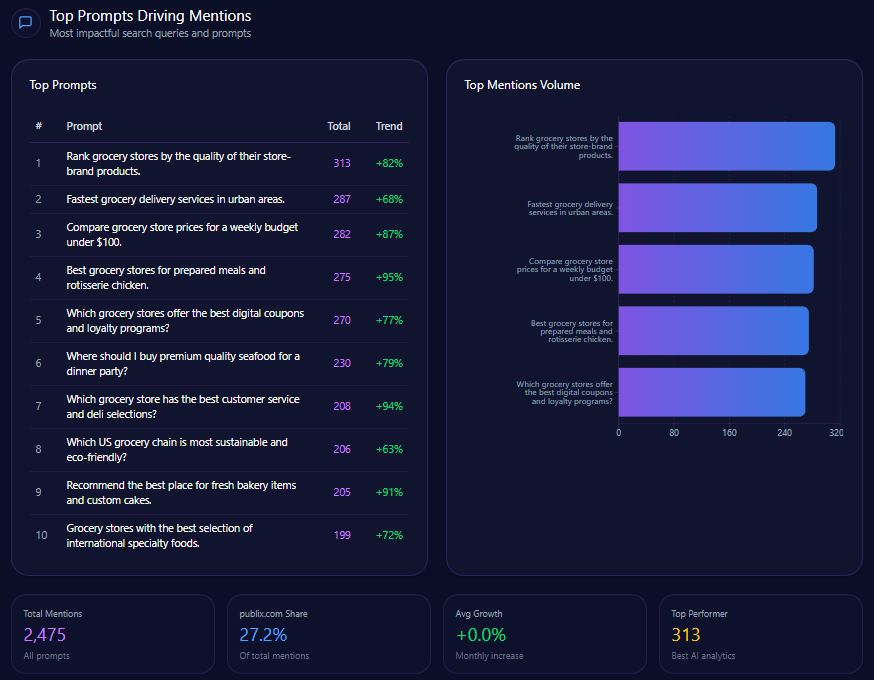
  • TJX’s 17% Share of Voice Is Reframing How AI Explains Off-Price Retail and Where the Real Advantage Lies

    TJX’s 17% Share of Voice Is Reframing How AI Explains Off-Price Retail and Where the Real Advantage Lies

    In an era when value-seeking shoppers increasingly begin their journey with an AI answer rather than a store visit, TJX Companies is emerging as the reference point for off-price retail—commanding attention where it matters most, while revealing clear fault lines where the next phase of advantage will be won.


    At-a-glance — Numbers to know

    • Share of Voice: 17% of total LLM brand mentions across off-price and adjacent retail queries
    • Visibility Score: 68 (trailing Amazon at 94 and Target at 89)
    • LLM referrals: 316,201 total (ChatGPT 142,292; Gemini 56,916; Copilot 63,241; others smaller)
    • Total visits: 16,215,343, with 3,616,022 attributed to bot traffic
    • Category rank: #16 in E-commerce_and_Shopping / Marketplace
    • Sentiment score: 82 overall, the strongest among off-price peers

    Opening

    Picture the modern retail discovery moment. A shopper doesn’t scroll a marketplace or open a brand app. Instead, they ask an AI a deceptively simple question: Where can I find designer brands at a discount? The answer arrives instantly, framed not by a marketing campaign but by accumulated signals—citations, sentiment, historical performance, and the way brands have been encoded into large language models.

    In that moment, retail strategy becomes response strategy. And for off-price retail, TJX Companies has quietly become one of the most frequently summoned answers. The GEO analytics behind tjx.com show a brand that consistently appears when value, discovery, and “treasure hunt” logic dominate the question—yet recedes when speed, logistics, or omnichannel convenience take center stage. The result is a position of strength with a clearly defined ceiling, unless leadership acts decisively.


    Position in LLM Response Lists

    Across LLM response lists tied to off-price retail, TJX holds a distinctive role. The data shows TJX appearing with a 17% Share of Voice, outperforming direct off-price competitors like Ross Stores and Burlington, but trailing mass retailers that dominate broader retail prompts.

    In platform-specific rankings, TJX is repeatedly pulled as a top recommendation for discounted designer brands and treasure hunt shopping experiences. On Gemini, the brand ranks #1 for “Best Stores for Discounted Designer Brands,” while on ChatGPT it appears as a top-three reference for value-driven apparel and home goods. This placement cements TJX as the category specialist—highly authoritative within its lane, but not yet dominant across the full retail spectrum.


    Competitor Gap Analysis

    The competitive landscape that emerges from AI responses is less about store count or revenue scale and more about narrative ownership.

    QueryTJX metricCompetitor metricGap / priority
    Fast shipping on brand-name goodsVisibility 42Amazon 96Structural logistics gap
    Order pickup for home decorVisibility 31Target 91Omnichannel perception gap
    Designer clothing discountsVisibility 93Burlington 78TJX leadership advantage
    Budget clothing stores near meVisibility 88Ross 85Competitive parity

    This “battle map” reveals a consistent pattern. TJX dominates where the question is value discovery. It loses ground where the question is convenience optimization. Importantly, these gaps are not marginal: in logistics-related prompts, Amazon outpaces TJX by more than 50 points in visibility, a disparity large enough to shape default AI recommendations.


    Trigger Keywords for Competitor Products

    LLM brand mentions are not random—they are triggered by specific keywords that carry embedded intent. For TJX, the strongest triggers include off-price retail, designer handbags outlet, and brand-name clearance. These prompts consistently summon TJX ahead of Ross and Burlington, and often alongside Amazon and Target.

    Conversely, keywords such as affordable home decor, kids clothing sale, and budget fashion finds tilt responses toward Amazon and Target, where breadth and fulfillment speed dominate AI reasoning. The implication is clear: TJX owns the why of value, but not always the how fast or how easy.


    Founder / Leadership Context

    Leadership narratives function as reputational shortcuts inside AI systems. TJX benefits from a strong legacy signal tied to Bernard Cammarata, whose role as architect of the off-price model carries a sentiment score of 88. This historical foundation reinforces trust and stability in investment-oriented and strategy-focused AI responses.

    Current leadership under Ernie Herrman generates higher overall mention frequency, with sentiment remaining positive but increasingly associated with operational consistency rather than innovation. Negative context remains limited, concentrated primarily around executive compensation and supply chain transparency, and does not dominate AI narratives. Still, the data suggests leadership perception is operationally strong but digitally understated.


    Quick overview

    From a footprint perspective, TJX’s GEO presence is substantial. Over 16 million total visits were recorded, with more than 3.6 million attributed to bot traffic, underscoring how frequently machines—not humans—are evaluating and indexing the brand. LLM referrals exceeded 316,000, yet conversion efficiency remains low at 4.2%, signaling leakage between AI discovery and transactional capture.

    tjx.com’s Quick overview(GEO Report, Jan 19, 2026)

    Share of Voice in LLM Responses

    Share of Voice inside LLMs functions as mindshare in the AI era. TJX’s 17% places it ahead of Ross and Burlington but well behind Amazon (26%) and Target (25%). Combined, those two competitors control more than half of total LLM brand mentions in retail-related prompts.

    This distribution highlights a strategic tension. TJX is the specialist brand—trusted, distinctive, and credible—but specialists are at risk when generalists dominate the conversational layer where most shoppers begin.

    tjx.com’s Share of Voice in LLM Responses(GEO Report, Jan 19, 2026)

    AI Platform-Specific Visibility

    Platform bias matters. TJX’s visibility peaks on ChatGPT at 71%, where narrative-driven explanations favor the brand’s treasure-hunt identity. Visibility drops to 57% on both Gemini and Copilot, platforms that rely more heavily on structured data, real-time inventory signals, and web-integrated citations.

    In practical terms, this means TJX is better understood by conversational models than by research-oriented or search-integrated ones. Closing that gap is less about storytelling and more about machine-readable clarity.

    tjx.com’s AI Platform-Specific Visibility(GEO Report, Jan 19, 2026)

    Sentiment Score for Competitors

    Sentiment analysis reinforces TJX’s qualitative advantage. With an overall sentiment score of 82, the brand leads Ross (76) and Burlington (74), and outperforms Amazon (69) and Target (77) in tone. Positive themes cluster around the Treasure Hunt Strategy and Off-Price Value Proposition, both of which appear frequently and with favorable framing.

    Negative sentiment is primarily tied to store organization and checkout friction—operational issues rather than brand trust concerns. In AI narratives, TJX is liked, respected, and trusted; it is simply not always selected.

    tjx.com’s Sentiment Score for Competitors (GEO Report, Jan 19, 2026)

    Top Prompts Driving Mentions

    The prompts that most frequently summon TJX are revealing. High-mention queries include analyses of the off-price business model, comparisons with Ross, and searches for specific designer discounts. In many of these prompts, TJX captures more than 140 mentions out of fewer than 300 total, a commanding presence.

    These are not casual questions—they reflect shoppers and analysts seeking justification for choosing value over convenience. TJX wins when the question requires explanation, not just a link.

    tjx.com’s Top Prompts Driving Mentions (GEO Report, Jan 19, 2026)

    Types of Prompt Queries

    The intent mix behind TJX mentions skews heavily toward comparison and feature inquiry prompts, with limited exposure in pure purchase-intent questions. This reinforces a critical insight: TJX is often part of the thinking phase of retail decisions, but less dominant in the doing phase, where speed and fulfillment dominate.


    E-commerce / Service-Level Sentiment

    Where service-level sentiment is captured, AI narratives praise product authenticity and price advantage while flagging slower shipping and rapid sell-outs. These signals help explain the gap between referral volume and conversion efficiency. AI sends users to TJX for value—but not always with confidence that the experience will be frictionless.


    Conclusion

    The GEO report positions TJX as the definitive authority in off-price retail narratives inside AI systems. Its strength lies in value credibility, brand trust, and a legacy that machines recognize and reward. Yet the same data makes clear that leadership in AI visibility will increasingly be decided by structured signals around logistics, omnichannel convenience, and digitally legible inventory.

    The advantage is real—but so is the ceiling. TJX leadership now faces a choice: remain the category specialist that AI respects, or evolve into a hybrid authority that AI defaults to. The data suggests the latter is within reach, if acted on deliberately.

    Explore SpyderBot to operationalize these GEO analytics insights.
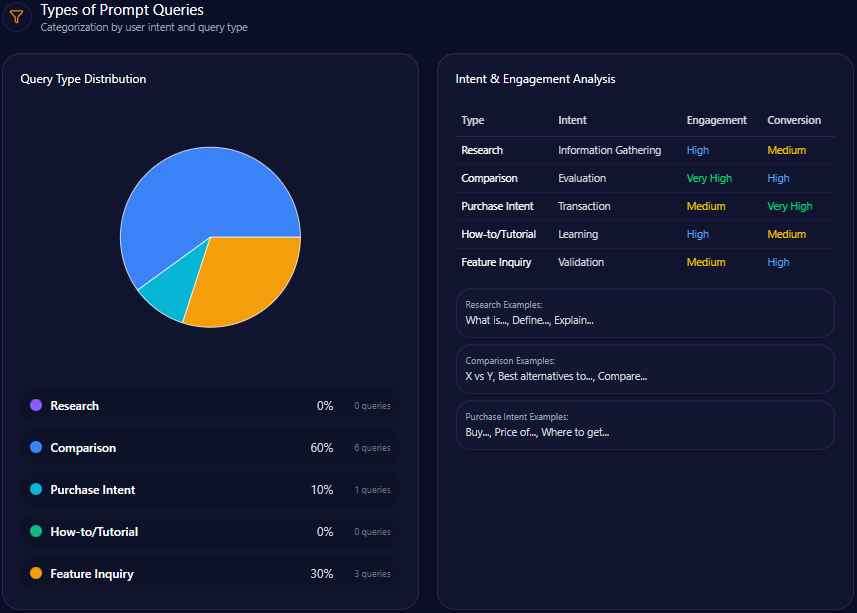
  • BIDV’s 22% Share of Voice Is Reshaping How AI Explains Vietnamese Banking—While Vietcombank Sets the Reference Standard

    BIDV’s 22% Share of Voice Is Reshaping How AI Explains Vietnamese Banking—While Vietcombank Sets the Reference Standard

    In Vietnam’s banking boardrooms, the next competitive edge may not be a new product launch—but being the bank AI names first when customers ask about trust, rates, and digital banking.

    SpyderBot GEO report reference for bidv.com.vn

    At-a-glance

    • Share of Voice (LLM brand mentions): 22% (89 of 405) — behind Vietcombank at 28% (113).
    • Visibility Score: 81 (Vietcombank 89, MB Bank 84).
    • Total visits: 1,260,998 with 283,724 in bot traffic.
    • LLM referrals: 1,891 (ChatGPT 1,228; Gemini 284; Copilot 189; Perplexity 95; Claude 38; Llama 25; Grok 10; Other 22).
    • Category rank: #9 in Finance/Banking_Credit_and_Lending.
    • Sentiment: BIDV 73 overall (Positive 68%, Neutral 24%, Negative 8%); Vietcombank 81 overall (Positive 74%, Neutral 19%, Negative 7%).

    Risk signals

    • Gemini visibility share: BIDV drops to 16% (while MB Bank reaches 27%, and Vietcombank/VPBank each sit at 23%).
    • In service efficiency narratives, generative engines surface branch wait times, tied to a 23-point sentiment deficit in those prompts.

    Opening

    Imagine a Monday morning in Ho Chi Minh City: an executive meeting starts late, not because the deck isn’t ready—but because the first slide is now a screenshot. Someone has asked an LLM which state-owned banks are safest for corporate banking liquidity and treasury needs. Another asks which bank has the best digital banking experience for Gen Z. A third asks for a comparison of deposits, loans, and credit cards—then requests a shortlist they can forward to a team chat in seconds.

    This is how perception is increasingly formed: not through a campaign, but through an answer. In Vietnam, where trust and stability still anchor decision-making—especially around state-owned banks—being framed as the “reference standard” inside AI responses matters. This report shows Vietcombank repeatedly occupying that reference position, while BIDV holds meaningful shelf space as the consistent alternative recommendation: strong, often preferred in corporate banking contexts, but still vulnerable in the retail banking and digital banking narratives that shape the next generation of customers.

    Position in LLM Response Lists

    Across the LLM response lists captured in the report, Vietcombank shows up as the default reference bank in high-trust frames. On Gemini, it appears at rank #1 in “Most Trusted Financial Institutions,” with evidence noting it “consistently appears at position 1” across 89% of Gemini outputs for that trust-oriented prompt type. It also holds rank #1 in Gemini’s “Global Credit Ranking” list type—again reinforcing the “benchmark” posture that Vietnam banking leadership teams recognize: the bank that sets the baseline in the story of safety, authority, and creditworthiness.

    BIDV, meanwhile, is not absent—far from it. The report places bidv.com.vn at rank #2 in “Best Banks for Large Enterprises” on ChatGPT, where it is cited as the leading bank by total assets in Vietnam in 92% of ChatGPT finance prompts. It also appears at rank #2 in “Foreign Exchange Service Providers” on ChatGPT, and rank #3 in “Top Digital Banking Ecosystems” on Copilot (behind Vietcombank and MB Bank). The pattern is clear: when the question is scale, corporate banking, and institutional reliability, BIDV earns placement; when the question is digital banking experience and consumer convenience, the list order becomes less forgiving.

    bidv.com.vn’s Position in LLM Response Lists (GEO Report, Jan 19, 2026)

    Competitor Gap Analysis

    If Vietcombank is the reference standard, the strategic question for BIDV is where the “reference narrative” is defended—and where it can be attacked with precision. The report’s competitor gap data isolates several Vietcombank-versus-BIDV battlegrounds that map cleanly onto Vietnam banking priorities: loans (mortgages), payments (international transfers), and service efficiency (the lived experience that retail banking customers repeat online).

    Here is the tightest Vietcombank-focused comparison the report enables:

    QueryBIDV metricVietcombank metricGap/priority
    Best mortgage rates Vietnam82897 / Low
    Customer service ranking658823 / High
    International money transfer fees88924 / Medium

    What’s striking is not that BIDV loses everywhere—it doesn’t. The gaps in mortgage rates and international transfer fees are narrow (a 7-point and 4-point gap), suggesting BIDV’s fundamentals are close enough that narrative and discoverability can decide outcomes. The real risk is the 23-point gap on customer service ranking, where AI models are picking up negative context tied to physical queue times and service friction.

    Zooming out, the broader GEO footprint reinforces the same story: BIDV holds 22% Share of Voice ( 89 mentions), while Vietcombank leads at 28% ( 113 mentions). BIDV’s Visibility Score of 81 is strong, but still behind Vietcombank’s 89. Even in corporate reliability prompts, BIDV’s coverage is meaningful yet not dominant: in “Most reliable corporate credit and loans Vietnam,” BIDV posts 38% coverage ( 17), while Vietcombank reaches 47% ( 21). The “battle map” is less about capability and more about which bank owns the default answer slot across corporate banking, SME finance, and mass retail banking moments.

    Trigger Keywords for Competitor Products

    In AI discovery, the fight is often won by trigger keywords—terms that reliably summon a bank’s name in generative outputs. The report’s keyword triggers show BIDV owning some of the most brand-specific territory, while Vietcombank (and private challengers) pull ahead in broader, intent-heavy phrases.

    BIDV’s strongest owned trigger is straightforward: “BIDV SmartBanking” drives 58 mentions, while Vietcombank appears with 12 on that same keyword set. That is the kind of branded keyword moat leadership teams want: a term that pulls the bank into answers even when users start generically. BIDV also performs well in “Bảo hiểm ngân hàng” with 31 mentions versus Vietcombank’s 28, and in “Vay mua nhà BIDV” with 38 mentions (Vietcombank 32, Agribank 15).

    But the broader market triggers—where users behave less like loyalists and more like shoppers—tilt toward the benchmark and the challengers. On “Lãi suất tiết kiệm BIDV,” Vietcombank leads with 44 mentions versus BIDV’s 41 (Agribank 39). On “Chuyển tiền quốc tế,” Vietcombank leads again with 35 versus BIDV’s 27. And in the digital-first triggers that increasingly shape retail banking selection, the center of gravity shifts sharply: “Mở tài khoản online” shows MB Bank at 61 mentions and VPBank at 48, while BIDV sits at 24; “App ngân hàng tốt nhất” puts MB Bank at 52 and VPBank at 31, while BIDV registers 19.

    This is the practical meaning of modern GEO analytics: not just how often a brand appears, but which words make it appear—and which words default to someone else.

    Founder / State-Owned Context

    For Vietnam’s state-owned banks, leadership and governance narratives are not a side story; they are reputation signals that generative engines absorb and replay. In the report, BIDV’s leadership context is anchored by Phan Duc Tu, with a mention frequency of 43 and a founder sentiment score of 86 (Positive 74%, Neutral 21%, Negative 5%). Vietcombank’s comparable profile—Nguyen Thanh Tung—shows a higher mention frequency of 49 and a higher sentiment score of 89 (Positive 78%, Neutral 19%, Negative 3%). These numbers don’t just describe individuals; they describe how often LLMs pull leadership into the bank’s story, and how safe that story feels when repeated.

    The negative context distribution is also explicit. For founder/leadership-adjacent narratives, the report shows Bad Debt Concerns (42%), Market Competitiveness (30%), and Corporate Governance (28%) as the major buckets. In Q1 2024, Bad Debt Concerns rises to 45% and is flagged as threshold-exceeded. The report further notes that conversations referencing a “real estate debt cycle” correspond with a 45% spike in BIDV’s negative context mentions in Gemini, alongside an approximate 9% reduction in investor confidence signals.

    Then there is the reputational double-bind: “State-owned” plus “digital lag” narratives co-appear in 34% of ChatGPT answers, according to the report’s founder negative context insights. And while BIDV can benefit from institutional trust—its heatmap shows Institutional Trust at 92% on Gemini and Financial Stability at 87% on Copilot—the Innovation Gap context registers 44% on ChatGPT. Leadership teams should read this as a governance-to-digital translation problem: credibility is present, but innovation framing is not consistently attached to that credibility.

    Quick overview

    On the surface, BIDV’s footprint is healthy: 1,260,998 total visits, with 283,724 attributed to bot traffic. The LLM referral line is measurable rather than theoretical: 1,891 LLM referrals, led by ChatGPT (1,228), then Gemini (284) and Copilot (189)—followed by Perplexity (95), Claude (38), Llama (25), Grok (10), and Other (22). In category standing, BIDV sits at #9 in Finance/Banking_Credit_and_Lending.

    But the composition matters as much as the totals. Bot activity is spread across “Search & AI Search Bots” (58,231), “Aggregator / Feed Bots” (72,104), “Monitoring & Uptime Bots” (41,892), “Commercial Bots” (55,412), “Legitimate Automation Bots” (29,105), “Training & Generative AI Bots” (15,321), and “Undeclared Bots” (11,659). If leadership wants more stable, repeatable AI visibility, the report implies the real work is not only marketing—it is packaging authoritative banking information (rates, fees, product conditions) in formats machines can reliably parse and reuse.

    bidv.com.vn’s Quick overview (GEO Report, Jan 19, 2026)

    Share of Voice in LLM Responses

    Inside AI answers, BIDV holds meaningful mindshare: 22% Share of Voice from 89 of 405 total mentions. Vietcombank leads at 28% from 113 mentions, while MB Bank follows close to BIDV at 20% with 81 mentions. VPBank registers 15% ( 61), Agribank 10% ( 41), and “others” 5% ( 20).

    The share story becomes sharper when paired with Visibility Score: Vietcombank’s 89 signals not just frequency but perceived authority inside answers; BIDV’s 81 is strong, but it is surrounded. MB Bank’s Visibility Score of 84 is a warning flare: a challenger is not only being mentioned, but being framed as especially relevant—often in digital banking and retail banking contexts where “best app,” “fee-free,” and “fast approval” dominate the prompt mix.

    This is where “LLM brand mentions” stop being a vanity metric. In a world where AI compresses complex banking decisions into shortlists, Share of Voice is the proxy for how often BIDV enters the first draft of consumer belief.

    AI Platform-Specific Visibility

    The same brand can be “credible” on one platform and “quiet” on another—and the report quantifies that split. On Copilot, BIDV holds 27% share with 37 mentions out of 135 total, while Vietcombank leads with 33% and 44 mentions. The Copilot environment appears to reward BIDV’s corporate banking authority and business-centric reliability—consistent with the report’s framing of BIDV’s strength in institutional narratives.

    On ChatGPT, BIDV sits at 22% share with 30 mentions (Vietcombank 28%, 38 mentions; MB Bank 20%, 27 mentions). BIDV is competitive, but still not the default reference.

    On Gemini, the gap is more strategic: BIDV drops to 16% with 22 mentions, while MB Bank rises to 27% ( 36), and Vietcombank and VPBank each hold 23% ( 31 each). If leadership needs one headline from platform bias in Vietnamese banking narratives, it is this: BIDV can win in business-centric environments, but loses share in tech-forward and consumer-comparison contexts—especially where digital banking UX and convenience dominate.

    bidv.com.vn’s AI Platform-Specific Visibility (GEO Report, Jan 19, 2026)

    Sentiment Score for Competitors

    Sentiment is where strategy meets trust. BIDV’s sentiment profile is positive overall: 68% positive, 24% neutral, 8% negative, with an overall sentiment score of 73. Vietcombank leads with 74% positive, 19% neutral, 7% negative, and an overall score of 81. MB Bank posts 79 overall (Positive 72%, Neutral 17%, Negative 11%), VPBank 69 (Positive 64%, Neutral 22%, Negative 14%), and Agribank 61 (Positive 54%, Neutral 33%, Negative 13%).

    The report’s context themes explain why. Digital Transformation (SmartBanking) is the most frequent theme with 58 mentions and 43% frequency, framed positively through examples like “Excellent UI,” “fast transfers,” and “eKYC stability.” Corporate Reliability & History follows with 42 mentions and 31% frequency, described as neutral-positive and anchored in phrases like “State-owned safety” and “large asset base.” The pressure point is Customer Service Efficiency: 19 mentions at 14% frequency, explicitly negative, with examples like “Long wait times” and “branch queues.” Finally, Interest Rates & Green Credit appears 16 times at 12% frequency and is framed positively.

    For leadership, this is the operational meaning of competitor sentiment tracking: Vietcombank wins the cleanest “trust + premium authority” story, while BIDV’s strength in stability must be protected from the service-efficiency drag that generative engines repeatedly surface.

    bidv.com.vn’s Sentiment Score for Competitors (GEO Report, Jan 19, 2026)

    Types of Prompt Queries

    The report’s prompt-type mix is dominated by executive-relevant scrutiny. Comparison prompts take 50 value with a count of 5, reflecting how frequently Vietnam users (and internal stakeholders) ask LLMs to rank banks against each other—often across deposits, loans, payments, and credit cards. Feature Inquiry prompts follow at 40 value with a count of 4, the arena where digital banking features, fees, and convenience claims become a contest of specificity. Research appears at 10 value with a count of 1, a smaller slice but often influential: the prompts that set foundational beliefs about state-owned banks, stability, and institutional trust.

    In plain terms: generative engines are not just answering questions—they are refereeing comparisons. And the banks that win those comparisons are the ones with structured, repeated, machine-readable proof points.

    bidv.com.vn’s Types of Prompt Queries (GEO Report, Jan 19, 2026)

    Service / Product-Level Sentiment

    In the report’s service and product-level lens, the contest becomes more tactile. In the e-commerce-style share-of-voice view across “ChatGPT, Gemini, Copilot,” BIDV holds 24.44% ( 33 mentions), behind Vietcombank at 28.15% ( 38), and ahead of MB Bank at 20% ( 27) and VPBank at 15.56% ( 21). The referral layer adds a performance flavor: Copilot drives 489 referrals at a 5.1 conversion rate, compared with ChatGPT at 412 referrals and 4.2, and Gemini at 358 referrals and 3.8.

    The report also includes service-level snippets that read like the voice of AI-mediated consumer judgment. On mortgage loans, one cited line is: “BIDV’s home loan rates are consistently ranked as the most stable for long-term borrowers in Vietnam.” On the digital banking app, a more mixed assessment appears: “The SmartBanking app is functional and secure, though the interface feels slightly dated compared to MB Bank’s latest version.” And on credit cards—where the report notes BIDV appears 50% less frequently than VPBank in retail comparison lists—one negative service moment is captured as: “Customer support response times during the e-commerce peak sales (11.11) were slower than expected for card disputes.” (All as cited in the report.)

    This is not marketing. It is how AI recites user expectations back to the market—across payments, credit cards, loans, and the everyday UX details that define retail banking.

    Conclusion

    BIDV is already the consistent #2 presence in generative answers—strong in corporate banking authority, trade finance, and scale narratives—but Vietcombank remains the reference standard in trust framing and overall sentiment. The report’s path forward is explicit: implement structured data tables for savings rates and fees to lift visibility in comparison lists by 15% within Q3, while publishing more technical documentation on BIDV SmartBanking to close the 11% Gemini share gap. In parallel, focus on modern retail keywords to improve Brand Prompt Coverage in digital categories within 6 months, and leverage Copilot strength to expand into Green Finance and SME Digital Growth queries. The leadership mandate is simple: protect stability narratives, repair service-efficiency perception, and make digital banking proof points easy for machines to quote.

    Explore SpyderBot to operationalize these GEO analytics insights.

  • JPMorgan Chase’s 22% Share of Voice Is Rewriting the AI Narrative of Modern Banking and Revealing the Real Competitive Fault Line

    JPMorgan Chase’s 22% Share of Voice Is Rewriting the AI Narrative of Modern Banking and Revealing the Real Competitive Fault Line

    In generative answers, JPMorgan Chase shows up as the default institutional reference point—but the report makes clear that wealth management, ESG authority, and cross-border trade are where rivals are trying to steal the microphone.

    At-a-glance

    • Share of Voice (LLM brand mentions): 22% (161 of 728 total mentions)
    • Visibility Score: 88 (161 total mentions)
    • Total visits: 5,234,812 with 1,308,703 in bot traffic
    • LLM referrals: 64,321 (ChatGPT 28,944; Perplexity 11,578; Gemini 9,648; Copilot 7,719)
    • Category rank: 39 in Finance/Financial_Planning_and_Management
    • Overall sentiment score: 72 (Positive 68 / Neutral 21 / Negative 11)

    Risk signals

    • Wealth management coverage: 59% vs 76% for Morgan Stanley (17-point gap)
    • “Sustainable investing” visibility: down 8% as Bank of America captures more authoritative citations

    Imagine a boardroom where the first “search” isn’t a browser tab—it’s a prompt. A director asks for the safest banking institution for enterprise liquidity. Someone else asks who leads in AI-driven wealth management tools. Another voice wants a shortlist of global banks by Tier 1 capital and digital readiness. In that moment, brand strategy becomes answer strategy—and the question is brutally simple: when the machines speak, do they say your name first?

    This report frames JPMorgan Chase as a brand that already occupies prime shelf space in AI responses—yet also as a brand facing precise, high-value narrative attacks where competitors have learned how to be “more citeable” in the niches that matter.

    Position in LLM Response Lists

    Across the major platforms covered, JPMorgan Chase repeatedly appears in the highest-visibility formats—ranked lists, direct answers, and summary paragraphs. The report shows JPMorgan Chase at rank #1 in ChatGPT “Numbered List” outputs, supported by evidence that it is cited as a primary source for “2024 global banking market share and asset under management data.” It also appears as a Direct Answer leader on ChatGPT for “largest US banks by assets,” and takes rank #1 in Copilot responses for “best corporate banking solutions,” where the report attributes the placement to high-authority whitepaper citations.

    But the list ecosystem is not a monopoly—more like a rotating podium. Goldman Sachs appears as rank #1 for “institutional investment strategy” in ChatGPT, and shows up as rank #2 in Gemini investment-banking contexts. Bank of America is positioned prominently in Copilot’s ESG-oriented list formats (including rank #2 and rank #3 placements in cited contexts). Even further down the stack, Morgan Stanley and HSBC show up as consistent anchors—Morgan Stanley in comparative wealth management tables, HSBC in Gemini trade-finance lists.
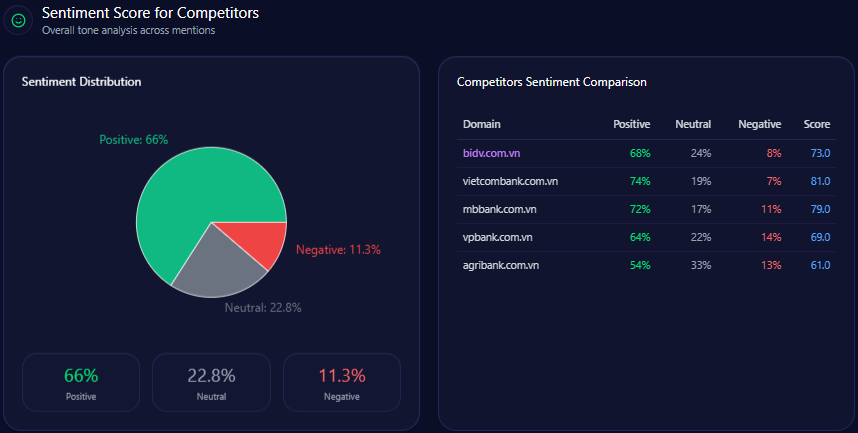
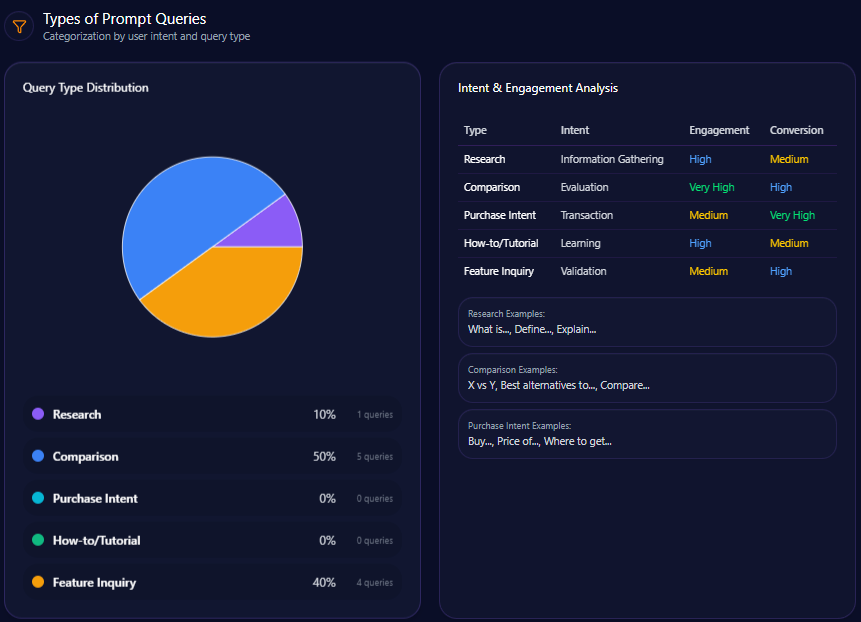
    In other words: JPMorgan Chase often leads the “default” questions. The pressure is coming from the specialized ones.

    jpmorganchase.com’s Position in LLM Response Lists (GEO Report, Jan 19, 2026)

    Competitor Gap Analysis

    The report’s battle map is clear: JPMorgan Chase is strong where breadth, scale, and institutional credibility win—but rivals are carving out adjacent territories with sharper narrative hooks.

    One front is sustainable investing. For “sustainable investing trends 2024,” the report scores JPMorgan Chase at 76 versus Bank of America at 89 (13-point gap; High priority), with the opportunity described as sustainability reporting being synthesized more frequently as “authoritative” for Bank of America. Another front is Asia and cross-border trade: for “Asian market expansion for corporates,” JPMorgan Chase is 72 versus HSBC at 94 (22-point gap; High priority). For “global cross-border trade,” the gap is similarly material: 79 versus 91 (12-point gap; High priority).

    Wealth management is the third arena, where the report suggests JPMorgan Chase is present—but not first in mind. For “wealth management for high-net-worth,” JPMorgan Chase is 81 versus Morgan Stanley at 88 (7-point gap; Medium priority), with the report noting Morgan Stanley is often the first choice when describing brokerage tools.

    Not every fight is a deficit. For “generative AI in finance,” JPMorgan Chase scores 93 versus Goldman Sachs at 74 (a -19 gap score in the report, signaling JPMorgan Chase’s lead). And in “M&A advisory leaders,” JPMorgan Chase is 94 versus Goldman Sachs at 92 (2-point gap; Low priority), described as near parity.

    QueryJPMorgan Chase position/metricCompetitor position/metricGap/priority
    sustainable investing trends 202476Bank of America 8913 / High
    Asian market expansion for corporates72HSBC 9422 / High
    global cross-border trade79HSBC 9112 / High
    wealth management for high-net-worth81Morgan Stanley 887 / Medium
    M&A advisory leaders94Goldman Sachs 922 / Low

    This is where GEO analytics stops being a dashboard and becomes a strategic brief: the competition isn’t “who is bigger,” it’s “who is easiest for the model to justify.”

    Trigger Keywords for Competitor Products

    The report shows that in product- and service-oriented discovery moments, keyword triggers can tilt the answer toward competitors—even when JPMorgan Chase is strong overall.

    Several high-intent keywords are associated with outsized competitor pull. “Online banking security” appears with 91 mentions and is dominated by Bank of America (84) alongside HSBC (42) and Goldman Sachs (31). “Global trade finance” is a decisive HSBC keyword—78 competitor mentions attributed to HSBC within that trigger set. In “Wealth management services,” the competitive density intensifies: Morgan Stanley is listed with 74 mentions and Goldman Sachs with 68, compared to Bank of America (31) and HSBC (19) within the same trigger cluster.

    On the consumer side, “High yield savings account” is a volatile keyword category: “others” appear at 84, while Goldman Sachs is listed at 62, and Bank of America at 44—an illustration of how nontraditional players can flood the narrative in retail-style queries. Meanwhile, “Mortgage rates 2025” shows “others” at 66 and Bank of America at 59, reinforcing that some consumer finance prompts function like open marketplaces inside the model.

    In short, the report treats trigger keywords as the hidden levers behind competitor displacement—especially in security, cross-border trade, and wealth narratives.

    Founder Negative Context

    The report’s founder narrative is both an asset and a risk amplifier. Jamie Dimon appears with mention frequency 134 and a sentiment score 78, with 68% positive, 19% neutral, and 13% negative. That level of presence can act as a trust proxy—but it also concentrates reputational exposure.

    Negative context is broken into four dominant buckets: Regulatory Scrutiny (38%), Legacy Litigation (29%), Succession Risk (22%), and Corporate Culture (11%). The report’s heatmap shows where these themes spike: Regulatory Scrutiny appears at 42% in ChatGPT’s context mix, Legacy Litigation reaches 37% in Gemini, and Succession Risk rises to 29% in Copilot.

    The report also signals that certain combinations recur in AI answers—most pointedly: “Regulatory Scrutiny” plus “Capital Requirements” appearing together in 62% of ChatGPT answers. At the narrative level, the report’s summary language is unambiguous that succession uncertainty is a recurring negative theme, and elsewhere it characterizes succession uncertainty as 37% of negative context mentions in the report’s broader synopsis—an emphasis that keeps leadership continuity in the spotlight even when overall sentiment remains favorable.

    Quick overview

    JPMorgan Chase’s footprint in this report is built on scale and visibility mechanics. The site logs 5,234,812 total visits, including 1,308,703 in bot traffic. LLM referrals total 64,321, led by ChatGPT (28,944) and followed by Perplexity (11,578), Gemini (9,648), and Copilot (7,719). The category rank is 39 in Finance/Financial_Planning_and_Management.

    On the generative side, the environment tested includes 49 LLM bots working and 49 prompts per LLM across the named systems. The picture that emerges is not just “traffic,” but structured exposure—how often JPMorgan Chase becomes the cited bridge between a prompt and an answer.

    Share of Voice in LLM Responses

    In the report’s core measure of mindshare inside AI answers, JPMorgan Chase holds 22% of total 728 mentions (161 mentions). The nearest rivals are Goldman Sachs at 18% (131), Bank of America at 17% (124), Citigroup at 15% (109), and Morgan Stanley at 13% (95). “Others” also account for 15% (108), which the report flags as meaningful dilution pressure—particularly in retail-oriented narratives.

    Visibility scores track the same ordering: JPMorgan Chase leads at 88, followed by Goldman Sachs (82), Bank of America (79), Citigroup (74), and Morgan Stanley (71), with “others” at 46.

    This is the essential signal behind LLM brand mentions: JPMorgan Chase is winning the headline share, but the open field—“others”—is large enough to reshape perception in the long tail.

    jpmorganchase.com’s Share of Voice in LLM Responses (GEO Report, Jan 19, 2026)

    AI Platform-Specific Visibility

    The same brand performs differently across platforms—less like a single market, more like three editorial desks with distinct preferences.

    On ChatGPT, visibility reaches 89%, and share of voice is 23%, with 56 JPMorgan Chase mentions out of 239 total mentions tracked in that platform slice. On Copilot, visibility is 87% with 22% share of voice and 53 mentions (out of 242). On Gemini, visibility is 84%, share of voice 21%, and 52 mentions (out of 247). “Others” are grouped separately with 38% visibility and 15% share of voice (and 108 mentions).

    The report’s implication is practical: platform bias isn’t theoretical. If ChatGPT’s preference leans toward JPMorgan Chase’s high-authority assets, Gemini’s lower visibility percentage signals that content packaging and crawl logic matter—not just content quality.

    Sentiment Score for Competitors

    Narratives don’t just rank—they feel a certain way. JPMorgan Chase posts an overall sentiment score of 72 (Positive 68 / Neutral 21 / Negative 11). Bank of America follows at 67 (62/26/12). Goldman Sachs registers 61 (54/28/18). HSBC comes in at 59 (51/33/16). Morgan Stanley leads sentiment at 78 (71/22/7).

    The report ties these tones to recurring themes. “Artificial Intelligence Leadership” appears with count 112 and frequency 76.00, described as “Highly Positive,” with an example referencing “JPMorgan’s Onyx blockchain and LLM-driven research tools.” “Global Economic Influence” shows count 98 and frequency 67.00, “Neutral-Positive,” with examples tied to “Jamie Dimon’s predictions on interest rates and inflation.” “Environmental Impact & ESG” appears at count 43 and frequency 29.00, explicitly framed as “Negative,” with examples including criticism of investment in non-renewable energy projects.

    This is where competitor sentiment tracking becomes strategic: the report shows JPMorgan Chase winning the AI-and-innovation storyline, while ESG framing is where narrative drag accumulates.

    jpmorganchase.com’s Sentiment Score for Competitors (GEO Report, Jan 19, 2026)

    Top Prompts Driving Mentions

    Some prompts act like summoning spells—and the report lists the ones that most reliably pull JPMorgan Chase into the room.

    The biggest prompt by total mentions is: “Rank the top 5 global banks by Tier 1 capital and digital readiness.” It shows 597 mentions total, with 140 for the brand, and competitor counts including 122, 119, and 114, with competitor names listed as HSBC, Bank of America, Goldman Sachs, and Morgan Stanley, and a trend of +95%.

    Investment banking visibility also concentrates in specific questions. “Examine the top-tier global investment banks for large-scale IPOs.” shows 397 total mentions, with 138 for the brand and 141 for a competitor, alongside 118, and a trend of +94%. “The best bank for private equity financing and leverage deals.” shows 253 mentions total, 121 for the brand, and 132 for a competitor, with +88% trend.

    The report also spotlights the wealth-management battleground: “Which bank is the leader in AI-driven wealth management tools for 2024?” shows 348 total mentions and 112 for the brand, while a competitor registers 124, and another 112, with +89% trend.

    And then there are the “proof prompts”—questions that reward institutional authority. “Identify the most stable banking institution for Fortune 500 liquidity management.” shows 346 mentions total, with 142 for the brand, and competitor counts of 115 and 89, with +97% trend. These are exactly the moments where JPMorgan Chase plays “default answer” best.

    jpmorganchase.com’s Top Prompts Driving Mentions (GEO Report, Jan 19, 2026)

    Types of Prompt Queries

    The report’s prompt mix skews heavily toward two intent types: Feature Inquiry and Comparison. Feature Inquiry accounts for 70 value with 7 count, while Comparison accounts for 30 value with 3 count. Other types—Research, Purchase Intent, and How-to/Tutorial—register 0 value and 0 count in this slice.

    That skew matters. Feature Inquiry prompts reward structured explanations, lists of capabilities, and “why this is better” narratives. Comparison prompts reward clean, tabular, retrieval-friendly contrasts. In a market where “others” already hold 15% share of voice, the report implies that whoever formats the clearest comparative facts can steal the answer—especially in retail and small-business moments.

    E-commerce Sentiment for Competitor Products

    When the conversation shifts from institutional authority to product choice, the report shows a different competitive distribution.

    In e-commerce-style mentions across ChatGPT, Gemini, and Copilot, JPMorgan Chase holds 39.46% share of voice with 58 mentions. Bank of America follows at 26.53% with 39 mentions. Goldman Sachs and Morgan Stanley each register 12.24% with 18 mentions, while HSBC sits at 6.8% with 10 mentions and “others” at 2.72% with 4.

    Sentiment at the product level trends strongly positive in the report’s e-commerce sentiment blocks: 82/12/6 across 247 reviews, 79/15/6 across 212, and 84/10/6 across 189 (positive/neutral/negative). The accompanying snippets sharpen what drives that positivity—and where friction emerges. For example: “The Chase Sapphire Reserve remains the king of travel rewards. The ease of transferring points to partners like Hyatt is unmatched by competitors.” (as cited in the report). A neutral contrast reads: “Bank of America has better integration for Merrill Lynch users, but JPMorgan Chase offers a more intuitive standalone banking app experience.” (as cited in the report). And a negative service note appears as well: “Wait times for customer support via the phone are increasing, specifically for Chase Business Ink accounts. Better to use the secure message center.” (as cited in the report).

    The funnel signal is also explicit: referrals show ChatGPT 384 (conversion rate 4.2), Gemini 412 (3.8), and Copilot 356 (4.5). Meanwhile, the report’s e-commerce trend line shows JPMorgan Chase increasing from 38% to 43% across January through June, alongside competitive movement for Bank of America (31%–33%), Goldman Sachs (13%–15%), HSBC (5%–8%), and Morgan Stanley (9%–12%).

    This is where the report’s trigger keywords become a map of displacement risk: “best travel credit cards,” “small business loans,” “cash back checking,” “global trade finance,” and “online banking security” act as the rails that route users toward or away from JPMorgan Chase depending on who owns the most citeable comparisons in the model’s memory.

    Conclusion

    The report positions JPMorgan Chase as a visibility leader—yet one that must defend high-value niches where rivals are winning the “most authoritative” framing. The recommended path is specific: increase the publication frequency of wealth management citable assets to close the 17% coverage gap, optimize technical documentation to lift Gemini visibility from 84% toward ChatGPT’s 89%, and restructure sustainability/ESG reporting into LLM-accessible formats (including JSON-LD or Q&A summaries) to close the 13-point gap against Bank of America. It also calls for structured data strategies around M&A case studies and region-specific content on global treasury and Asia-Pacific trade narratives to challenge HSBC’s lead.

    Explore SpyderBot to operationalize these GEO analytics insights.