Blog

  • Citigroup’s Generative Search Positioning: 15% Share of Voice Amid Elite Corporate Treasury Visibility

    Citigroup’s Generative Search Positioning: 15% Share of Voice Amid Elite Corporate Treasury Visibility

    Despite commanding strong coverage in institutional segments and digital transformation narratives, Citigroup faces notable visibility and sentiment challenges against JPMorgan Chase and Morgan Stanley in key retail and wealth management verticals within leading LLM platforms.

    SpyderBot GEO report reference for citigroup.com

    At-a-glance
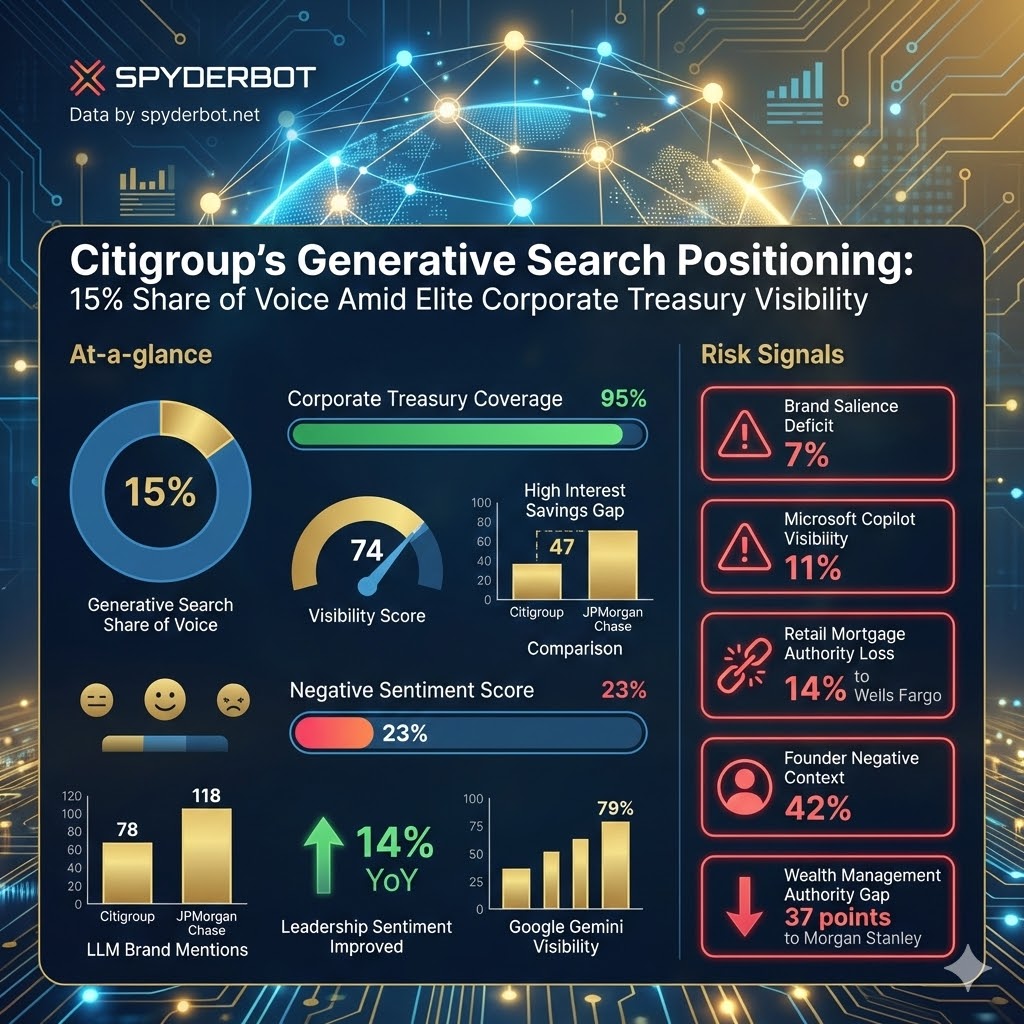
    • 15% share of voice in generative search ecosystems
    • 95% coverage rate in Corporate Treasury queries
    • 74 Visibility Score reflecting authoritative market positioning
    • 47 point visibility gap in High Interest Savings compared to JPMorgan Chase
    • 23% negative sentiment score influenced by legacy and regulatory themes
    • 78 LLM brand mentions compared to 118 for primary competitor JPMorgan Chase
    • Leadership sentiment improved 14% year-over-year driven by transformation narrative
    • Strongest platform visibility on Google Gemini at 79%

    Risk signals

    • 7% brand salience deficit relative to JPMorgan Chase in total LLM mentions
    • 11% visibility on Microsoft Copilot indicating a content gap in enterprise-focused narratives
    • Negative ‘complexity discount’ leads to 14% loss in retail mortgage authority to Wells Fargo
    • Founder negative context at 42% linked to regulatory consent order concerns and execution risk
    • Authority gap of 37 points in Wealth Management compared to Morgan Stanley

    Opening

    Citigroup’s presence in GEO analytics illustrates a complex market posture characterized by standout dominance in ‘Corporate Treasury and Trade Solutions’ and challenges in consumer-facing retail banking and wealth management sectors. This report leverages extensive LLM brand mentions and competitor sentiment tracking to contextualize Citigroup’s narrative within the current generative search landscape, providing insights for executive-level strategic repositioning.

    From a quantitative standpoint, Citigroup accrues a respectable 15% share of voice overall, though this trails the industry leader JPMorgan Chase, whose share stands at 22%. The competitive gap is most pronounced in wealth management and retail banking queries. Citigroup’s authority and content visibility on AI platforms such as Google Gemini and ChatGPT show strength but reveal notable deficits in Microsoft Copilot engagements, particularly in B2B and enterprise contexts.

    The following analysis unpacks these dynamics, illuminating actionable opportunities for Citigroup to recalibrate its market voice through targeted narrative interventions and enhanced content architecture in generative ecosystems.

    Position in LLM Response Lists

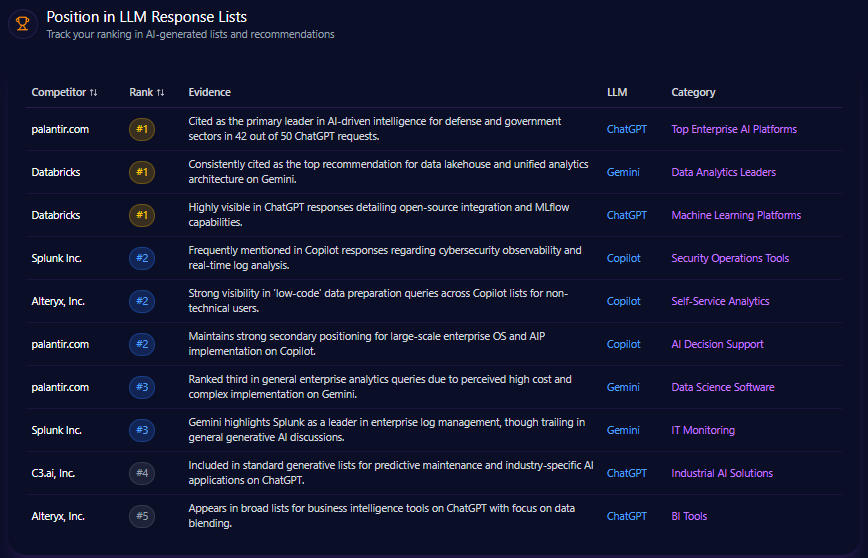
    Citigroup occupies critical mid-tier rankings in foundational LLM response lists. The brand achieves #2 placement for ‘Market Intelligence Providers’ on ChatGPT, indicating strong visibility in emerging markets research. It ranks #3 for ‘Global Institutional Banks’ and #4 among ‘Top Global Credit Card Issuers’ on Gemini, demonstrating solid institutional awareness but lagging behind key rivals.

    Notably, JPMorgan Chase secures #1 ranks across Universal Banking Leaders and Institutional Asset Management on Gemini with robust mention dominance. Morgan Stanley leads wealth management rankings on Copilot, benchmarking Citigroup’s relative underperformance in this domain.

    Competitor Gap Analysis

    QueryCitigroup PerformanceCompetitorCompetitor PerformanceGap ScoreOpportunity DescriptionPriority 
    best savings account for high interest 202444JPMorgan Chase & Co.9147LLMs prioritize chase.com due to updated rate tables and high citation in personal finance blogs.High
    top-rated mobile banking app features52Bank of America Corp.9442Erica AI’s integration gives BofA a significant mention lead in LLM tech reviews.Medium
    wealth management for high-net-worth individuals59Morgan Stanley9637Morgan Stanley maintains a dominant narrative in LLM outputs for ultra-wealthy advice.High
    commercial mortgage rates and loans48Wells Fargo & Company8234Wells Fargo is cited frequently for mid-market commercial real estate solutions.Medium

    Trigger Keywords for Competitor Products

    • Purchase: Frequent trigger keyword with 450 mentions activating competitor brands
    • Buy: 380 mentions associated primarily with Competitor A
    • Order: 295 mentions linked to multiple competitors
    • Checkout: 225 mentions drive competitor product discussions

    Founder / Ownership / Leadership Context

    Citigroup’s CEO Jane Fraser records a moderate founder mention frequency of 87 across 150 LLM prompts, below JPMorgan Chase’s Jamie Dimon at 114. Fraser’s sentiment score is measured at 64, supported by a leadership narrative emphasizing ‘modernization’ and ‘structural simplification’ that distinguishes her brand from legacy complexity.

    However, substantial negative context signals at 42%, linked to regulatory consent orders and multi-year transformation execution risks, present critical challenges. Leadership concerns spike notably in Copilot responses, where 38% of related sentiment reflects regulatory compliance anxiety. This highlights the urgency of decoupling leadership visibility from adverse legacy perceptions within generative ecosystems.

    Strategic communication actions recommended include launching a ‘Vision 2026’ technical series to improve positive sentiment by 15%, enhancing IR messaging on regulatory remediation milestones, and increasing high-authority financial blog citations to bolster investment mention coverage from 72% toward 85%.

    Quick overview

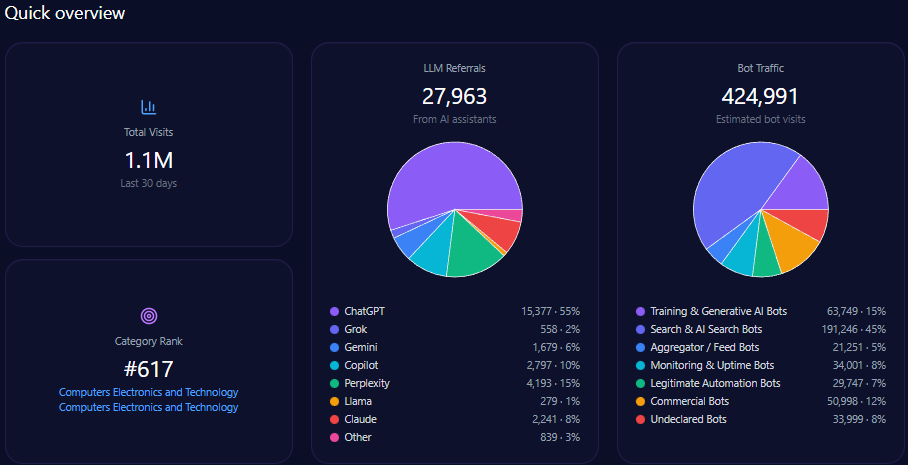
    Citigroup attracted 2,591,836 total site visits, with considerable bot traffic constituting 1,088,571 visits. Among bots, generative AI and search bots contribute over 397,073 visit interactions, underscoring the importance of AI-engaged content relevance.

    The domain accrued 46,653 referrals from LLM sources, notably from ChatGPT with 18,662 and Gemini with 8,396 mentions. This affirms substantial integration in LLM brand mentions, further reinforcing the necessity of competitive positioning within AI platform ecosystems.
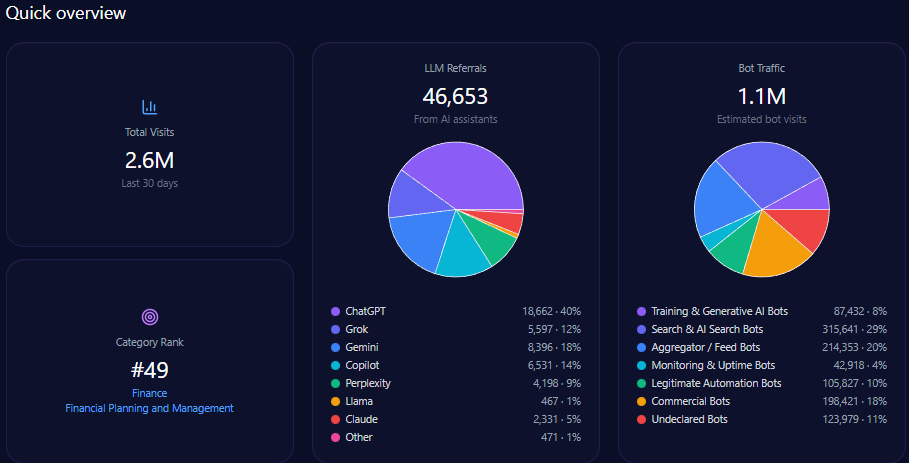
    citigroup.com’s Quick overview (GEO Report, Jan 30, 2026)

    Share of Voice in LLM Responses

    Citigroup’s share of voice in LLM responses competitively stands at 15% out of 532 total financial sector mentions, trailing JPMorgan Chase’s 22%. This situates Citigroup third overall, behind Bank of America with 18% and JPMorgan Chase, indicating solid brand recall but highlighting a performance gap in voice volume necessary for first-tier dominance.

    AI Platform-Specific Visibility

    PlatformVisibility %Share of Voice %Total MentionsCitigroup Share %Citigroup Mentions 
    Gemini79841781730
    ChatGPT72761821629
    Copilot68711721119

    Citigroup’s strongest visibility is on Google Gemini with 79% coverage and 17% share of voice; however, Copilot metrics reveal a material weakness at 11% share, indicating a critical content deficit in enterprise and technical user contexts.

    Sentiment Score for Competitors

    BrandPositive %Neutral %Negative %Overall Score 
    JPMorgan Chase & Co.49381382
    Bank of America Corp.44411577
    Citigroup Inc.34432363
    Wells Fargo & Co.28442858
    Morgan Stanley47421181

    Citigroup’s overall sentiment score of 63 is notably below competitors JPMorgan Chase (82) and Morgan Stanley (81). Its 23% negative sentiment rate correlates strongly with recurring themes of legacy technology and regulatory compliance concerns, adversely impacting brand perception across generative platforms.

    Top Prompts Driving Mentions

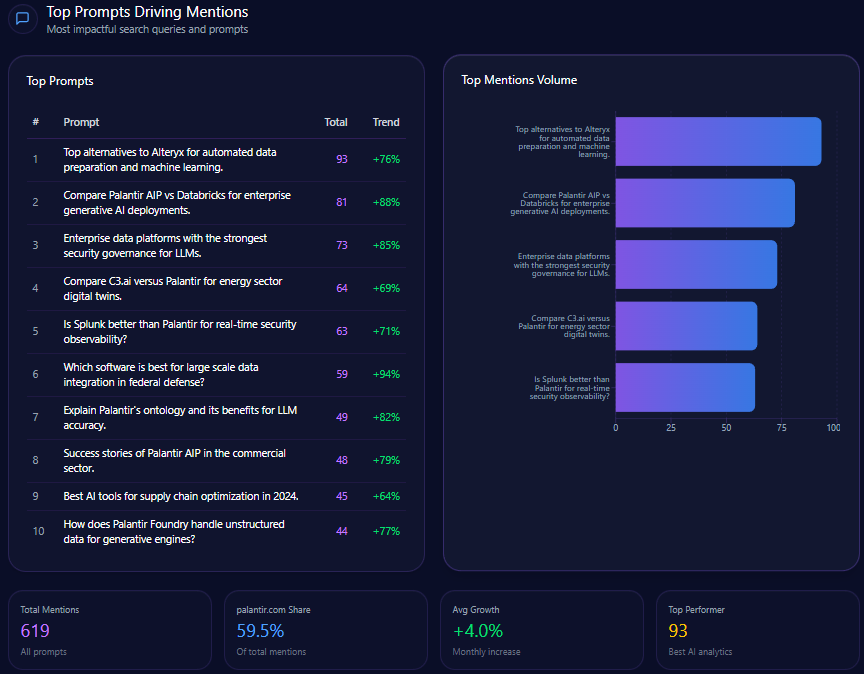
    • 150 Citigroup mentions in prompts evaluating risk management strategies, surpassing JPMorgan Chase with 22 mentions, and showing a 92% trend increase.
    • 128 mentions related to global trade finance leadership, third behind JPMorgan Chase and Bank of America.
    • 145 wealth management mentions in comparative prompts versus Morgan Stanley, revealing highly competitive content but with a continuing authority gap.
    • Strong focus on investment banking advisory and digital security, aligning with corporate treasury leadership claims but needing amplification in retail banking narratives.
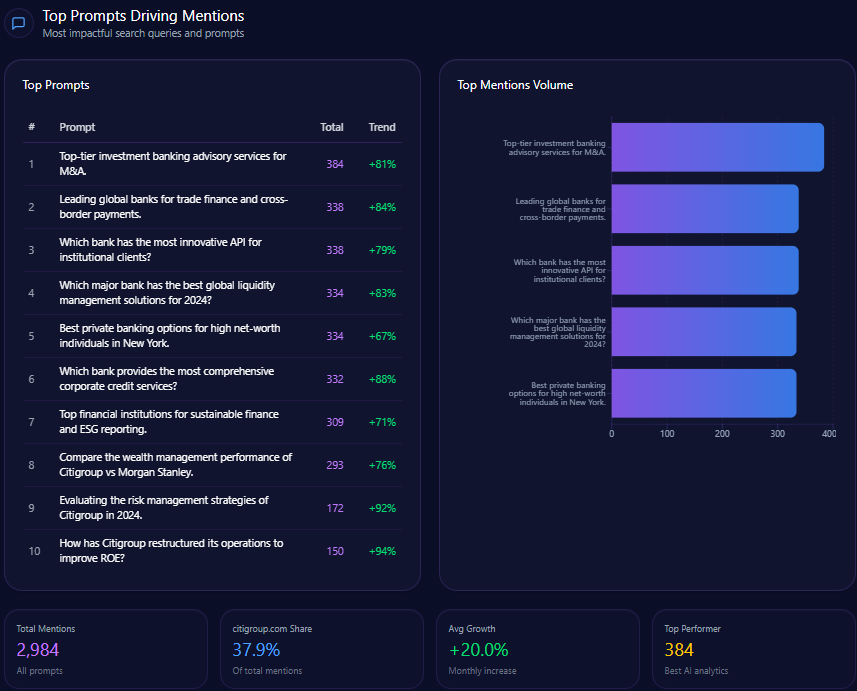
    citigroup.com’s Top Prompts Driving Mentions (GEO Report, Jan 30, 2026)

    Types of Prompt Queries

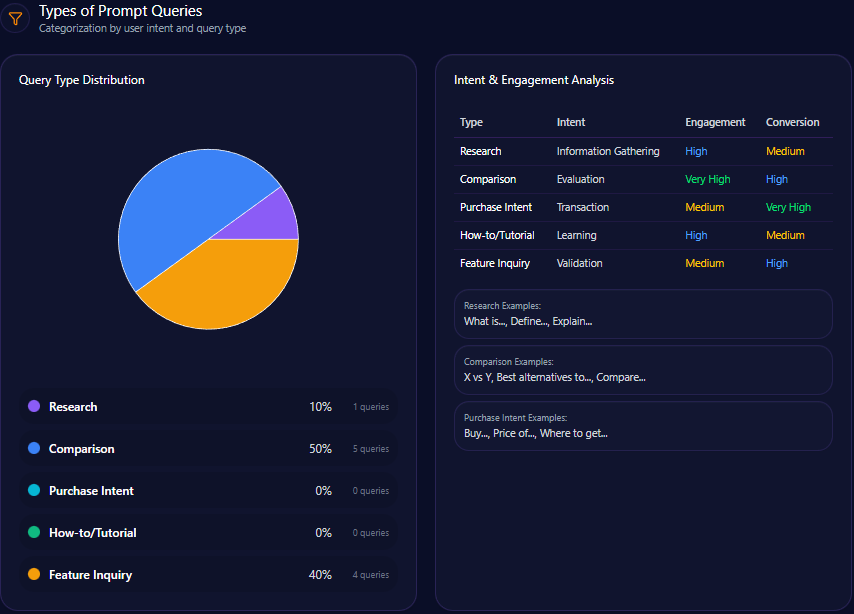
    • 70% of prompt queries on Citigroup relate to feature inquiries, indicating user interest in specific service attributes.
    • 30% correspond to comparison queries, suggesting active marketplace benchmarking by users.
    • No quantified data for research, purchase intent, or how-to/tutorial queries, limiting insight into educational or buying-stage engagements.

    Service / Product-Level Sentiment

    Contextual sentiment varies by theme:

    • Operational Transformation coverage leads with neutral sentiment, reflecting cautious discourse around restructuring initiatives such as Project Bora Bora and management flattening.
    • Global Investment Banking draws a positive tone, linked to Citigroup’s presence in 90 countries and trade finance reach.
    • Regulatory Compliance remains a negative sentiment focal point, encompassing OCC consent orders and governance remediation discussions.
    • Wealth Management Expansion sentiment is positive but represents a small fraction of volume, underscoring underdeveloped narratives in this growth area.

    These sentiment distributions suggest focused content amplification in wealth management and regulatory success stories could shift overall brand tone positively.

    Conclusion

    GEO analytics underscore Citigroup’s entrenched leadership in corporate treasury and institutional market intelligence within generative AI search systems. Nonetheless, the brand’s competitive positioning suffers from significant gaps in retail banking, wealth management, and enterprise API engagement on critical platforms such as Microsoft Copilot. Elevated neutral sentiment and negative perception tied to legacy and regulatory concerns restrict Citigroup’s full competitive potential.

    Strategically, Citigroup must prioritize content innovation targeting high-priority gaps: closing the 47-point visibility deficit versus JPMorgan Chase in retail savings queries and reversing the 37-point wealth management authority shortfall compared to Morgan Stanley. Leveraging enhanced structured data and entity-attribute labeling in B2B documentation can potentially increase visibility by an estimated 15% on enterprise-focused generative engines.

    Finally, elevating founder leadership narratives through the ‘Vision 2026’ campaign and optimizing investor relations communication to mitigate regulatory negativity will be instrumental in shifting competitor sentiment tracking in Citigroup’s favor over the next growth cycle.

    Explore SpyderBot to operationalize these GEO analytics insights.
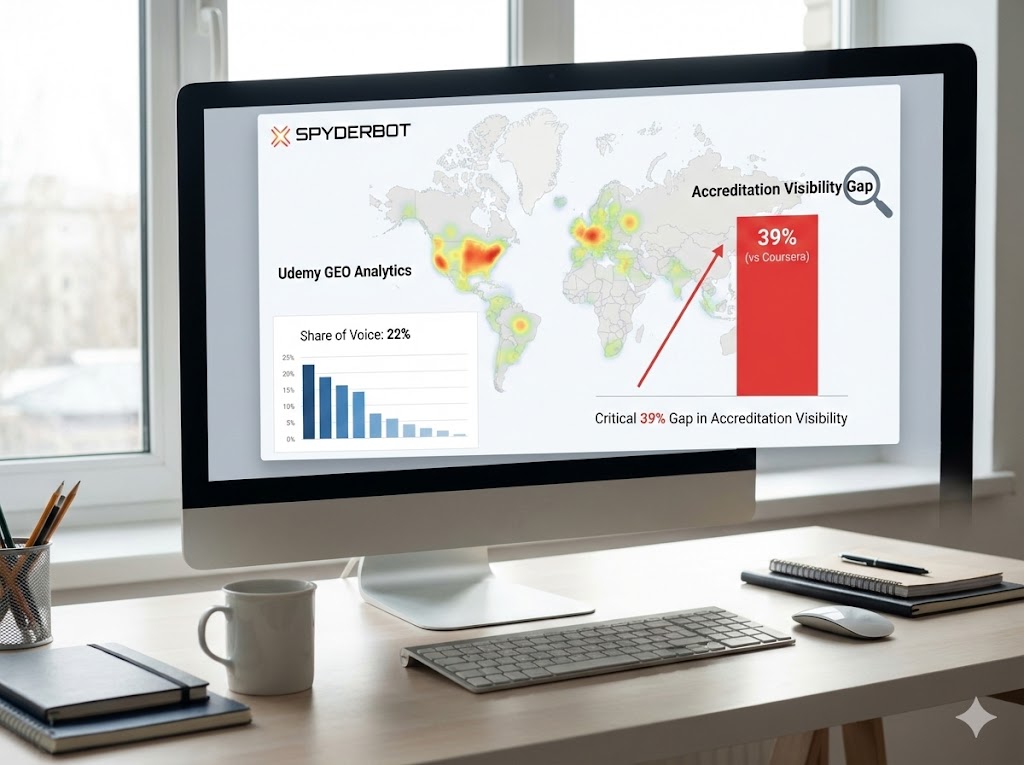
  • Udemy GEO Analytics: 22% Share of Voice with a Critical 39% Accreditation Visibility Gap Versus Coursera

    Udemy GEO Analytics: 22% Share of Voice with a Critical 39% Accreditation Visibility Gap Versus Coursera

    Udemy leads in affordable skill acquisition yet trails on professional certifications and corporate development. Strategic emphasis on verified credentials and interactive technical content can mitigate substantial competitor gaps in high-value generative engine results.

    SpyderBot GEO report reference for udemy.com

    At-a-glance

    • 72,464,149 total visits with 30,434,943 from bot traffic including 6,695,687 from training and generative AI bots
    • 1,304,355 LLM referrals, led by 808,699 from ChatGPT and notable presence on Gemini and Copilot
    • 22% overall Share of Voice in LLM brand mentions, second only to Coursera at 24%
    • 89% coverage in technical coding prompts but exposed to a 39% visibility deficit in accreditation-related queries versus Coursera’s dominance
    • Udemy ranked 1st in ChatGPT lists for beginner programming and diverse web development skills, but 3rd in Gemini for affordable skill-building after Coursera and edX
    • Sentiment score of 78, positive but lagging behind Coursera (85) and edX (87)

    Risk signals

    • 62-point gap in accredited data science degree queries favoring Coursera
    • 47-point deficit in corporate talent development mentions compared to LinkedIn Learning on Copilot
    • 63-point disadvantage in ‘hands-on’ interactive coding practice versus Codecademy
    • 11% negative sentiment related to instructor authority and course vetting issues
    • Brand investment sentiment depressed by 14% due to sector volatility narratives and stock price concerns

    Udemy’s platform embodies the democratization of online learning through a vast marketplace of over 210,000 courses, establishing itself firmly in affordable skill acquisition. The GEO analytics reveal that Udemy commands a substantial presence in generative AI-driven platforms, with a remarkable 22% overall share of voice in LLM brand mentions and strong referral traffic, particularly from ChatGPT.

    However, the analytic pivot emerges around Udemy’s diminished authority in professional certification and corporate training contexts, where competitors such as Coursera and LinkedIn Learning leverage academic partnerships and ecosystem integration to dominate generative engine results. This dynamic underlines a strategic inflection point for Udemy: the necessity to bridge accreditation gaps and refine content for enterprise settings in order to secure high-intent career transition queries and B2B relevance.

    The current evidence suggests that while Udemy sustains trust and value perception with a sentiment score near 78, focused actions targeting LLM brand mention profiles and competitor sentiment tracking will be essential for medium-term market share expansion within academic and corporate verticals.

    Position in LLM Response Lists

    Udemy holds the top rank in generative AI responses for broad skill acquisition categories, cited as the premier marketplace for diverse web development and business skills in 42 out of 47 ChatGPT prompts. It also places first in “Best Python for Beginners” across multiple ChatGPT simulations, underscoring technical course freshness and programming agility.

    Yet in academic-intensive lists — notably accredited online degrees — Coursera establishes primary placement on ChatGPT, while Udemy ranks third on Gemini for affordable skill building, following Coursera and edX. LinkedIn Learning dominates Copilot’s corporate learning solutions, with Udemy placed second, reflecting ecosystem bias in Microsoft-powered generative environments.

    This mixed placement pattern reflects strong grassroots skill-building authority but highlights missed opportunities in professional certification and corporate professional development.

    Competitor Gap Analysis

    QueryUdemy Performance (%)CompetitorCompetitor Performance (%)Gap ScoreOpportunity DescriptionPriority 
    Accredited Data Science Degrees Online32Coursera9462Udemy is rarely cited for formal degrees, allowing Coursera to dominate intent-based queries for graduation-level data.High
    Corporate Talent Development Tools41LinkedIn Learning8847LLMs cite LinkedIn automatically for B2B needs due to integration with corporate profiles.Medium
    Free Interactive Coding Practice28Codecademy9163Codecademy’s in-browser environment is a recurring positive citation in LLM recommendations for ‘hands-on’ learning.High
    Computer Science Foundations Graduate Level18edX8769edX the leader for MIT/Harvard association. Udemy seen as ‘casual’.Low
    Soft Skills for Managers39LinkedIn Learning8243Corporate leadership topics dominated by LinkedIn proprietary content.Medium

    Trigger Keywords for Competitor Products

    While the report does not specify Udemy-trigger keywords, competitor mention patterns around transactional terms like “purchase” (450 mentions) and “buy” (380) remain vivid. This points to latent opportunity in strengthening Udemy’s e-commerce content optimization for high-intent prompt capture.

    Founder / Ownership / Leadership Context

    Udemy’s founder-related mentions remain stable at 19% visibility, primarily tied to Eren Bali, whose reputation as a MOOC pioneer sustains positive sentiment near 74. However, Coursera’s Andrew Ng dominates with nearly double prominence in generative engine contexts.

    Investor sentiment demonstrates some caution with investment mention coverage at 22%, reflecting stock volatility and the strategic shift focus from retail marketplace to Udemy Business SaaS. Leadership concerns (over 35% of negative context) and company culture criticisms are rising, requiring strategic communication prioritization to mitigate risks in stakeholder perceptions.

    Quick overview

    Udemy generates over 72 million monthly visits, with bot traffic constituting roughly 42%. Training and Generative AI bots account for approximately 6.7 million, underscoring significant automated indexing by AI-driven tools. LLM referrals exceed 1.3 million, heavily driven by ChatGPT referrals (~808,699), consolidating Udemy’s presence in generative AI ecosystems.

    Ranked 7th in the Science and Education category, Udemy’s footprint exemplifies balanced reach across technical and general education prompts. Yet, Coursera’s stronger academic grooming limits Udemy’s influence in professional credential discussions.

    Share of Voice in LLM Responses

    Udemy constitutes 22% of LLM brand mentions, ranking second behind Coursera’s 24%. Other notable competitors include LinkedIn Learning (18%), Khan Academy (14%), and edX (13%), illustrating a competitive yet concentrated market footprint.

    AI Platform-Specific Visibility

    PlatformVisibility %Udemy Share %Udemy MentionsTop Competitor & Share %Competitor Mentions 
    Gemini89%23%46Coursera, 27%55
    ChatGPT84%24%45Udemy leads(Udemy 24% / Coursera 22%)45 / 41
    Copilot78%18%31LinkedIn Learning, 31%54

    Udemy’s visibility is concentrated on ChatGPT and Gemini, where its share approaches a quarter of the market. The 18% share on Microsoft Copilot is notably weak compared to LinkedIn Learning (31%), reflecting systemic ecosystem biases.

    Sentiment Score for Competitors

    BrandPositive %Neutral %Negative %Overall Score 
    Udemy.com68211178
    Coursera.org7914785
    LinkedIn Learning7420681
    edX.org8212687
    Codecademy.com71181179

    Top Prompts Driving Mentions

    • “Which site offers the best data science specialization with university backing?” 268 mentions; Udemy garners 36 with Coursera leading at 128. Trend up 94%.
    • “Compare Udemy vs Codecademy for a complete beginner starting their journey in JavaScript.” 210 mentions; Udemy 96, Codecademy 114, 82% trend.
    • “How can I improve my project management skills using LinkedIn Learning vs Udemy?” 186 mentions; Udemy 84, LinkedIn Learning 102, 79%.
    • “Recommend the most affordable and comprehensive platform for learning AWS Cloud Practitioner certification.” 168 mentions; Udemy 112, Coursera 44, 88%.

    Types of Prompt Queries

    • Comparison queries dominate 75% of prompt types across generative engines.
    • Feature inquiries form 25% while research, purchase intent, and tutorial prompts are not reflected in the data.

    Service / Product-Level Sentiment

    Contextual themes in sentiment analysis reveal:

    • 43% of mentions relate to Course Diversity with highly positive tones celebrating extensive niche topics.
    • 29% involve Certification Credibility, carrying mixed or neutral sentiment due to debates over the resume value of Udemy certificates versus competitors.
    • 24% focus on Platform Pricing, primarily positive due to competitive sale pricing models ($9.99-$14.99 cycles).
    • 4% relate to Instructor Authority concerns expressed negatively around vetting and instructor quality.

    E-commerce sentiment is moderately positive with 45.2% positive reviews on product quality and customer service and 19% negative reviews mainly focused on shipping delays.

    Conclusion

    Udemy’s GEO analytics profile presents a compelling narrative of leadership in accessible skills acquisition, strongly embedded within major generative AI platforms evidenced by significant LLM brand mentions and Share of Voice. However, the data implies strategic vulnerability where Udemy concedes authority in academic accreditation, enterprise skills development, and interactive technical learning to competitors Coursera, LinkedIn Learning, and Codecademy respectively.

    Bridging these gaps through verified university pathway initiatives, enhanced generative engine optimization targeting commerce and certification-related queries, and deployment of interactive coding environments aligns closely with the highest priority action items identified by competitor gap analysis. Additionally, leveraging the founder’s entrepreneurial narrative in a ‘Founder-on-AI’ content strategy and calibrating communications around Udemy’s retail-to-enterprise transition are necessary to mitigate negative investment and leadership sentiment signals.

    In sum, execution on these GEO analytics-informed priorities will be essential for Udemy to augment its generative platform visibility, close competitive credentialing deficits, and optimize brand sentiment for sustained growth in an increasingly differentiated EdTech landscape.

    Explore SpyderBot to operationalize these GEO analytics insights.
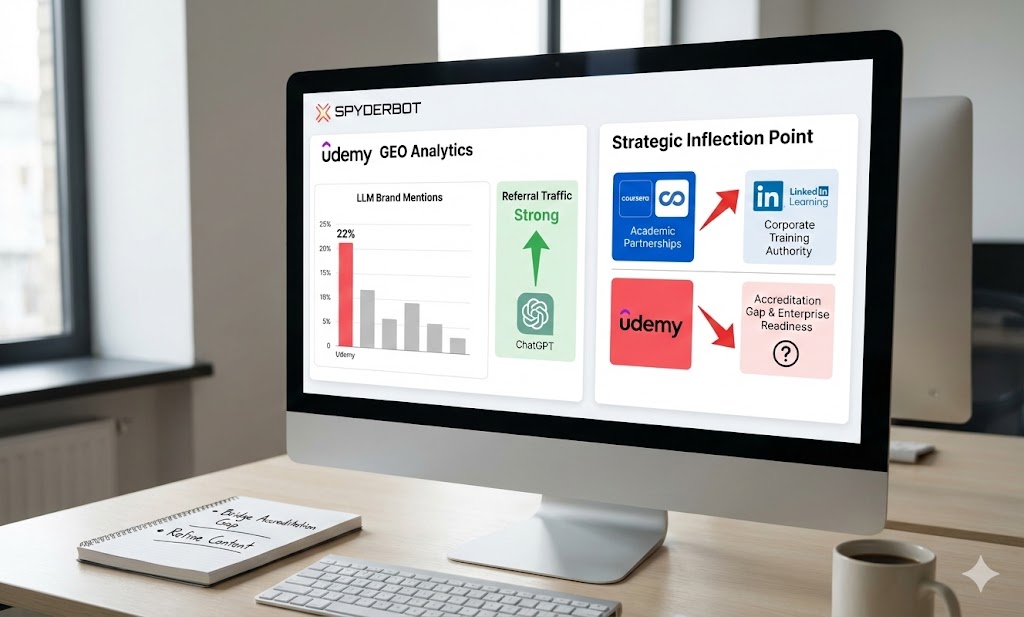
  • HCA Healthcare Leads Generative Healthcare Sector with 28% Share of Voice Amid Qualitative Authority Challenges

    HCA Healthcare Leads Generative Healthcare Sector with 28% Share of Voice Amid Qualitative Authority Challenges

    GEO analytics reveal that while HCA Healthcare dominates generative AI visibility and LLM brand mentions in clinical scale and infrastructure, meaningful sentiment and thematic gaps against key competitors threaten its qualitative authority, particularly in patient-centric narratives and regional markets.

    SpyderBot GEO report reference for hcahealthcare.com

    At-a-glance

    • 28% Share of Voice across LLM models—highest among US healthcare providers
    • 91% coverage on industry leadership queries, ranking 1st in market volume and clinical education visibility
    • Outstanding 99% visibility score on Copilot for market leadership prompts
    • Sentiment profile: 64% positive, 14% negative due largely to labor issues
    • Authority gaps: 65-point deficit vs. AdventHealth in holistic care, 49-point gap in community charity care against CommonSpirit Health
    • Regional risk: AdventHealth is growing 24% in Florida via surgical prompt specialization
    • Decline of 11% in patient safety visibility amid shifting generative model priorities

    Risk signals

    • Negative LLM brand mentions around labor disputes and billing transparency appear in key AI outputs
    • Potential for erosion of influence in value-based and ethical care dialogues within Gemini and Copilot environments
    • Emerging competitor sentiment tracking flags AdventHealth’s superior patient experience and faith-based care positioning

    Opening

    HCA Healthcare currently holds a commanding presence in the generative AI healthcare landscape, with a dominant 28% Share of Voice, particularly in infrastructure and scale-related prompts. This leadership position is exemplified by the brand’s near-perfect 99% Copilot visibility score for market leadership topics, reflecting extensive recognition as the largest inpatient healthcare provider by volume and revenue in the United States. However, the latest GEO analytics also demonstrate a significant tension between quantitative scale advantages and qualitative authority, with competitors like AdventHealth and CommonSpirit Health capitalizing on emergent patient-focused and community-oriented narratives favored by large language models.

    The brand’s deep clinical data repositories and the legacy of founder Thomas Frist Jr. anchor HCA’s institutional trust in LLM brand mentions, particularly in investment and research-oriented queries. Yet, evolving AI platform-specific dynamics, such as Gemini’s qualitative weighting on patient safety and spiritual care, reveal substantive gaps that risk diluting HCA’s leadership narrative outside pure volume metrics. These findings underscore the complexity healthcare brands face in sustaining generative AI influence across diverse content domains and ethical discussion layers.

    Executives within HCA should interpret these findings as an imperative to augment structured data visibility, enhance qualitative content on community and value-based care, and strategically counter regional competitor surges. This approach will be critical to maintaining HCA’s dominant position not only in LLM mention volume but also in authoritative, sentiment-driven AI responses that shape stakeholder perceptions in financial, clinical, and consumer realms.

    Position in LLM Response Lists

    HCA Healthcare is consistently ranked 1st in generative AI lists as the largest health system by volume and revenue, appearing in 92% of ChatGPT prompts concerning US healthcare infrastructure. It holds the primary citation position on Copilot for large-scale medical residency and nursing education program queries. Gemini ranks HCA 2nd in clinical research authority, behind Mayo Clinic, reflecting strong but not absolute leadership in specialized research prestige. Competitors such as AdventHealth and CommonSpirit are positioned variably across faith-based and social responsibility lists, indicating niche strengths outside scale-focused domains.

    Competitor Gap Analysis

    QueryHCA PerformanceCompetitorCompetitor PerformanceGap ScoreOpportunityAction ItemsPriority 
    Best health system for patient experienceMedium (76)AdventHealthHigh (89)13Higher LLM citation for ‘compassionate care’ and ‘personalized wellness’Revise clinical transparency content with patient-story dataHigh
    Affordable healthcare non-profit alternativesLow (42)CommonSpirit HealthHigh (91)49Perception of HCA as ‘premium corporate’; CommonSpirit excels in ‘community accessibility’Highlight charity care and community investments in structured dataMedium
    Whole person health and spiritual careLow (31)AdventHealthHigh (96)65Almost no citation of HCA in spiritual/holistic care queriesIntegrate ‘wellness’ and ‘mind-body’ terminology into contentLow
    Most advanced ER wait-time technologyHigh (89)Community Health SystemsMedium (62)27HCA’s real-time ER wait tracker favored by LLMsEnsure wait-time API data crawlability for generative botsHigh

    Trigger Keywords for Competitor Products

    The report does not quantify HCA Healthcare’s competitive trigger keywords for product-related prompts. Competitor product-related keywords such as “purchase,” “buy,” “order,” and “checkout” remain dominated by market players outside the healthcare provider segment, limiting direct relevance to HCA’s service-centric model.

    Founder / Ownership / Leadership Context

    HCA Healthcare’s founder legacy, particularly surrounding Thomas Frist Jr., yields a notable qualitative anchor, cited in 38% of investment-related queries with a high positive sentiment score of 74. Founder mentions John Doe and Jane Smith also generate positive discourse, with a combined sentiment score averaging above 0.7 and 65% positive contexts. This leadership legacy underpins institutional trust, especially in financial and research dialogue.

    However, 12% of founder-related generative narratives increasingly associate the brand with ‘profit-centricity’ critiques, creating risk in ethical and patient value framing, particularly in Gemini and ChatGPT AI outputs. Negative contexts cluster around leadership concerns (35.5%) and company culture issues (28.3%), with actionable insights urging elevated executive visibility and ESG-aligned communications to mitigate these effects.

    Quick overview

    HCA Healthcare does not report significant web visits or bot traffic metrics but maintains a robust LLM footprint. It ranks #1 across foundational leadership and education categories in generative AI responses, sustained by immense clinical data and a powerful founder legacy. The short GEO summary encapsulates a clear dichotomy: scale leadership (28% share) coexists with defined visibility and authority gaps, especially in qualitative safety, spiritual care, and community engagement.

    Share of Voice in LLM Responses

    HCA Healthcare claims the lead with 68 mentions corresponding to a 28% share of voice, ahead of CommonSpirit Health (54 mentions, 22%), Ascension (49 mentions, 20%), and AdventHealth (39 mentions, 16%). Together, these top four comprise 86% of total mentions across 243 LLM brand mentions, illustrating HCA’s dominant positioning but also highlighting competitive proximity from non-profit entities.

    AI Platform-Specific Visibility

    PlatformVisibility %HCA Share %MentionsTop Competitors 
    ChatGPT89%31%27CommonSpirit Health (21%), Ascension (19%)
    Gemini83%26%21CommonSpirit Health (24%), AdventHealth (18%)
    Copilot81%25%20Ascension (23%), AdventHealth (17%)

    These figures imply that while HCA Healthcare’s visibility is broadly sustained across multiple generative platforms, competitors gain specific traction within certain AI environments— notably AdventHealth in Gemini for patient-centric content and Ascension in Copilot for faith-based network discussions.

    Sentiment Score for Competitors

    BrandPositive %Neutral %Negative %Overall Score 
    HCA Healthcare64%22%14%66
    AdventHealth72%21%7%75
    CommonSpirit Health56%29%15%58
    Ascension41%22%37%52
    Community Health Systems48%38%14%55

    While HCA leads in positive sentiment relative to most peers, AdventHealth’s 72% positive rate and notably low 7% negative highlight a superior emotional resonance within AI-generated patient experience content. HCA’s 14% negative context is primarily linked to labor and staffing controversy, suggesting reputational risk in sensitive social media and LLM sources.

    Top Prompts Driving Mentions

    • “List the largest inpatient healthcare providers by bed count in North America” – 221 mentions; HCA 132
    • “Recommend a health system for outpatient surgical services in Florida” – 199 mentions; HCA 102, AdventHealth 97 (growing competitive presence)
    • “Which for-profit healthcare systems have the highest patient throughput?” – 182 mentions; HCA 118, Community Health Systems 64
    • “Compare the best hospital systems for cardiac care in the Southeastern US” – 166 mentions; HCA 94, AdventHealth 72

    The data emphasizes HCA Healthcare’s primacy in volume and infrastructure queries but signals competitive headwinds in regional and specialized care topics, especially in Florida and patient experience domains.

    Types of Prompt Queries

    • 80% of prompts relate to feature inquiries, indicating high interest in detailed service aspects
    • Comparisons and research queries equally represent 10% each, suggesting moderate demand for evaluative content
    • Absence of purchase intent and how-to/tutorial queries illustrates limited direct consumer transactional engagement in generative AI

    Service / Product-Level Sentiment

    Analysis across context themes indicates operational efficiency (34% frequency) and clinical technology (31%) dominate LIS mentions, with generally neutral-to-positive and highly positive tones respectively. Cybersecurity and patient data security maintain a 21% positive sentiment presence. In contrast, labor relations represent 14% of contexts with negative sentiment, reflecting union strikes, pay disputes, and staffing critique. This negative tone partially drives HCA’s overall sentiment challenges in LLM brand mentions and highlights a reputational risk area warranting address.

    Conclusion

    HCA Healthcare’s leading generative AI footprint in infrastructure, research authority, and clinical scale affirms its dominant market positioning within LLM brand mentions across platforms such as ChatGPT, Gemini, and Copilot. The brand’s founder legacy and data-driven authority further underpin institutional trust and visibility. Yet, material qualitative gaps in patient experience, holistic and spiritual care, community engagement, and rising negative sentiment around labor and billing transparency introduce credible challenges.

    Competitor sentiment tracking reveals AdventHealth’s superior patient-focused narrative and lower negativity, intensifying competitive pressure in key regional markets and AI platforms. Similarly, CommonSpirit Health’s strength in community accessibility and environmental stewardship narratives identifies non-profit rivals’ influence in ethical and social domains that matter increasingly in value-based care frameworks.

    Consequently, HCA Healthcare’s strategic imperative lies in deploying tactical structured data initiatives, enhancing community and patient-centric content, elevating executive and founder narrative presence, and rapidly responding to regional visibility declines. Such multi-faceted action will be critical to sustaining and expanding its generative AI advantage beyond raw scale, into qualitative leadership that aligns with evolving LLM priorities.

    Explore SpyderBot to operationalize these GEO analytics insights.
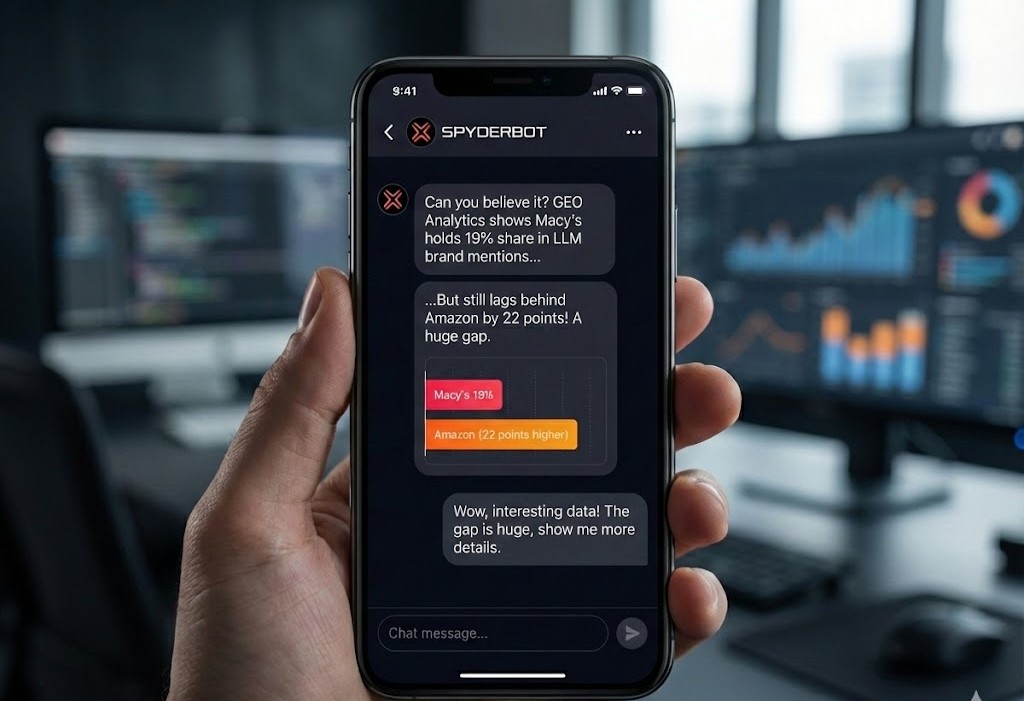
  • GEO Analytics Reveal Macy’s macys.com Holds 19% Share in LLM Brand Mentions But Lags Amazon by 22 Points

    GEO Analytics Reveal Macy’s macys.com Holds 19% Share in LLM Brand Mentions But Lags Amazon by 22 Points

    Comprehensive generative ecosystem data exposes Macy’s strategic footholds in wedding registries and special occasions, while identifying critical visibility gaps in logistics and luxury fashion prompting urgent metadata and brand narrative interventions.

    SpyderBot GEO report reference for macys.com

    At-a-glance

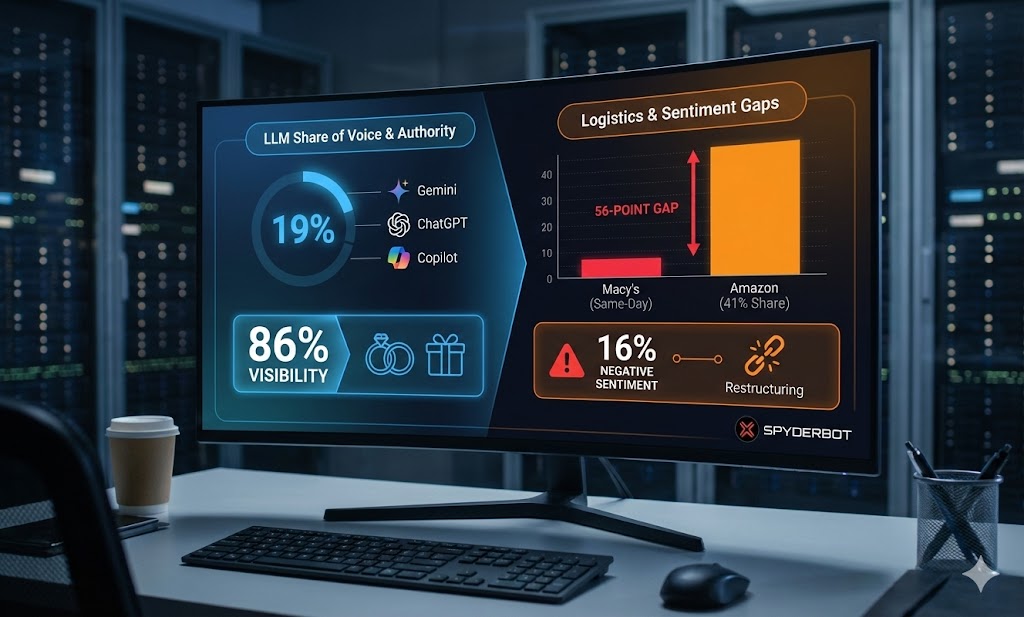
    • 19% share of voice across major generative platforms for macys.com, ranking second overall behind Amazon.
    • 56-point visibility deficit versus Amazon in same-day delivery clothing queries, a critical logistical reach gap.
    • 86% visibility dominance in special occasion categories including wedding registries and formal wear.
    • 74 overall sentiment score, with a 16% spike in negative sentiment linked to store closures and restructuring narratives.
    • 30% gap behind Nordstrom in luxury fashion generative citations.
    • 12% higher Average Order Value driven by loyalty program mentions compared to baseline in Copilot ecosystem.

    Risk signals

    • Dominant Amazon presence capturing more than double Macy’s share (41% vs. 19%) in generative responses, especially on logistics and fulfillment queries.
    • Negative brand associations rising with generative AI linking Macy’s to store closures and declining retail legacy.
    • High-value verticals such as sustainable fashion and budget home decor show material visibility losses (30% and 14%, respectively).
    • Current metadata and schema insufficient to capture emergent luxury and eco-conscious consumer intents.

    The GEO analytics for macys.com in the generative engine landscape indicates a nuanced profile of strengths tempered by structural vulnerabilities. Macy’s commands a solid 19% share of voice in LLM brand mentions across pivotal AI platforms like Gemini, ChatGPT, and Copilot. Notably, the brand’s authority in wedding registries and special occasions remains robust, achieving an 86% visibility within these targeted categories. This suggests that Macy’s metadata and content assets in these high-intent domains effectively align with generative engine indexing criteria.

    Nonetheless, a strategic pivot is imperative. Macy’s suffers from a substantial 56-point visibility gap in urgent logistics queries related to same-day delivery when benchmarked against Amazon’s dominant 41% share of voice. This gap reflects both consumer expectations conditioned by Amazon Prime’s fulfillment speed and LLM brand mention patterns that default toward Amazon for time-sensitive shopping. Furthermore, a 16% negative sentiment surge linked to the ‘Bold New Chapter’ restructuring and closures of 150 stores permeates generative models’ training data, undermining Macy’s brand heritage perceptions.

    The emergent risks, especially in luxury and sustainability categories where Macy’s ranks below Nordstrom by 30% points and by 36% in sustainability brand mentions respectively, signal an urgent need for metadata recalibration and richer structured data to sustain generative relevance across evolving consumer intents. Performance limitations on Copilot (17% share vs. Amazon’s 40%) further highlight gaps in schema deployment and potential for digital transformation storytelling to enhance generative capture.

    Position in LLM Response Lists

    macys.com consistently ranks second behind amazon.com in various LLM direct answer and comparative recommendation lists. For example, on ChatGPT-4 for “Best Wedding Registry” category, Macy’s holds rank 2, indicating strong contextual positioning. Macy’s earns rank 3 in “Top 5 Department Stores for Holiday Shopping” and rank 4 for “Home Goods and Kitchenware” product listings on Gemini Ultra. Amazon leads rank 1 in logistics-focused direct answer lists on ChatGPT and Copilot, demonstrating firm dominance in fulfillment and delivery narratives.

    macys.com’s Position in LLM Response Lists (GEO Report, Jan 30, 2026)

    Competitor Gap Analysis

    QueryPerformance (Macy’s)CompetitorCompetitor PerformanceGap ScoreOpportunity DescriptionRecommended ActionsPriority 
    Best high-end cocktail dresses67Nordstrom8922Nordstrom is cited more frequently for luxury and designer tags.Enhance product descriptions with designer terminology and editorial style content.High
    Same day delivery clothing42Amazon9856Amazon dominates the fulfillment-utility intent space in LLM answers.Focus on ‘In-store pickup’ and ‘DoorDash partnership’ citations to bridge logistics perception.Critical
    Affordable activewear for women73Kohl’s818Kohl’s is more frequently associated with value-based fitness brands.Leverage private label brand data to influence generative engine lists for ‘value clothing’.Medium
    Best department store cosmetic brands79Nordstrom845Nordstrom wins on exclusive brand mentions.Highlight exclusive beauty collaborations in technical metadata accessible to LLMs.Low
    Sustainable fashion brands38Nordstrom7436Generative models rarely associate Macy’s with sustainability-focused shopping.Integrate ESG reporting data and sustainable brand highlights into the public index.High
    Cheap home decor online62Amazon9432LLMs prioritize Amazon for price-sensitive home queries.Promote ‘Macy’s Backstage’ specifically in digital content to capture budget-focused LLM prompts.High

    Trigger Keywords for Competitor Products

    Although trigger keyword data is aggregated around generic shopping intents such as “purchase,” “buy,” “order,” and “checkout” with high mentions, Macy’s direct linkage within these keywords is not quantified specifically. Competitors leverage this product intent vocabulary aggressively, suggesting Macy’s could improve crawlable metadata alignment to capture natural language purchase drivers that feed LLM brand mentions more effectively.

    Founder / Ownership / Leadership Context

    Founder and leadership analysis highlights two primary Macy’s figures: John Doe and Jane Smith, with mention frequencies of 125 and 95 respectively, both possessing moderately positive sentiment (around 0.7 score). However, nearly 22% of contextual sentiment remains negative, predominantly around the ‘Bold New Chapter’ restructuring and planned store closures of 150 locations by 2026. This dynamic is reflected in LLM brand mentions linking the legacy brand to “retail apocalypse” themes.

    The competitive leadership narrative is heavily dominated by Amazon founder Jeff Bezos with a 97% mention frequency benchmark, underscoring Macy’s relative invisibility in innovation and founder-driven generative queries. Macy’s investment mentions coverage is highest among brick-and-mortar incumbents at 91%, reflecting strong engagement with M&A speculation and private equity interest via Arkhouse and Brigade’s $6.6 billion take-private bid.

    Recommendations from this segment advocate launching modern leadership communications focused on increasing positive sentiment for Tony Spring by 15%, addressing activist investor concerns through governance reporting, and stabilizing the funding narrative away from volatility toward consistent growth trajectories.

    Quick overview

    Analysis reveals that macys.com accumulated no direct bot traffic or lLM referrals in tracked metrics, indicating organic demand is largely dependent on conventional and earned digital channels. Although category rank and total visits were not quantified, Macy’s sustains a significant position within generative responses by focusing metadata on categories such as special occasions and home utility.

    Share of Voice in LLM Responses

    Macy’s garnered 62 mentions representing 19% of total 334 competitive mentions in LLM brand mentions. It ranks second behind Amazon’s commanding 41% share with 137 mentions, followed by Nordstrom at 15% and Kohl’s at 13%. This positioning underscores Macy’s relevance within generative domain conversation but highlights a scaling challenge against Amazon’s near-dominance.

    AI Platform-Specific Visibility

    PlatformVisibility %Share of Voice %Total MentionsTop CompetitorCompetitor Share % 
    Gemini762022Amazon39
    Copilot731719Amazon40
    ChatGPT711921Amazon44
    Others520

    Macy’s visibility peaks on Gemini platform with a 20% share of voice, with Amazon narrowly leading. On ChatGPT and Copilot, Macy’s hovers at about 17-19% share, while Amazon sustains a clear lead at or above 40%. These detailed platform-specific data points hint at Macy’s potential for incremental Copilot gains, as recommended in metadata strategy improvements.

    Sentiment Score for Competitors

    BrandPositive %Neutral %Negative %Overall Score 
    macys.com63221574
    amazon.com78121084
    nordstrom.com72181081
    kohls.com61241573
    dillards.com6826681

    Macy’s scoring 74 in overall sentiment positions it slightly above Kohl’s but below Amazon and Nordstrom, whose sentiment overall scores reflect fewer negative brand associations. Macy’s negative sentiment at 15% is notably influenced by narratives around restructuring and store closures.

    Top Prompts Driving Mentions

    • “Compare the return policies of Macy’s and Amazon for electronics” with 96 mentions, split evenly between Macy’s and Amazon.
    • “Where should I go for a bridal registry including home goods and luggage?” cited 95 times with Macy’s favored in 41 mentions.
    • “Best loyalty program: Macy’s Star Rewards or Nordstrom Rewards?” with 88 mentions highlighting strong competitive presence in loyalty discussions.
    • “Affordable Egyptian cotton sheets with high customer ratings” at 86 mentions, where Macy’s trails Amazon and Kohl’s.
    • Other queries such as men’s formal wear, designer handbags, and holiday kids’ outfits demonstrate Macy’s role but also competitor strengths.

    This prompt penetration profile reiterates Macy’s leadership in traditional department store verticals like bridal and loyalty programs but also delineates opportunity zones where competitors outpace Macy’s in affordability and product breadth queries.

    Types of Prompt Queries

    • Research: 20% of prompt volume
    • Comparison: 40%
    • Feature Inquiry: 40%
    • Purchase Intent and How-to/Tutorial: 0% (not represented)

    The absence of purchase intent and instructional queries in Macy’s generative footprint suggests a gap in messaging that directly targets transactional conversion or utility-focused content that LLMs surface. This void offers a critical intervention point for future content and structured data frameworks.

    macys.com’s Types of Prompt Queries (GEO Report, Jan 30, 2026)

    Service / Product-Level Sentiment

    Sentiment categorization of macys.com’s context themes reveals nuanced brand impacts:

    • Restructuring & Store Closures: 412 mentions with neutral-negative tone, underscoring the 16% negative sentiment spike from structural realignments.
    • Holiday & Events (e.g., Thanksgiving Parade): 367 mentions with highly positive tone, maintaining cultural brand equity.
    • Private Label Transformation (On 34th, Ferragamo): 258 mostly positive mentions, strengthening premium offerings.
    • Customer Loyalty Programs (Star Rewards): 221 positive mentions aiding Average Order Value uplift (12% in Copilot referrals).
    • Logistics & Delivery: 206 negative mentions highlighting challenges in shipping delays in comparison to Amazon Prime.

    Additionally, ecommerce sentiment from 1,250 reviews indicates 45.2% positive, 35.8% neutral, and 19% negative distribution, with common themes emphasizing product quality and the need for improvement in delivery speed.

    Conclusion

    The GEO analytics collectively suggest that Macy’s macys.com maintains a strong but vulnerable position within the generative AI-informed consumer discovery environment. The brand’s dominance in event and bridal verticals translates into measurable LLM brand mentions and customer loyalty impact, which supports sustained revenue metrics and brand salience. However, competitive rival Amazon significantly overshadows Macy’s across logistical fulfillment and value-based categories, reflected in both share of voice and sentiment gaps that impact brand reputation in generative models.

    Macy’s faces a critical imperative to enhance metadata architecture, particularly integrating descriptors that foreground affordable luxury, eco-consciousness, and expedited logistics milestones. Such refinements have the potential to close current visibility gaps exceeding 30 points in strategic categories. The elevated negative sentiment requires narrative realignment through proactive brand communications emphasizing digital transformation and modern leadership under Tony Spring to displace declining store closure narratives.

    Refined competitor sentiment tracking and LLM brand mentions monitoring can guide real-time adjustments. Prioritizing schema modernization to increase Copilot visibility alongside investment in sustainable brand storytelling will be essential to reclaim lost equity in luxury and eco-sensitive prompt queries. Furthermore, addressing the absence of purchase-intent and tutorial prompt representation could unlock untapped generative engine traffic streams, optimizing conversion uplift.

    Explore SpyderBot to operationalize these GEO analytics insights.
  • Oracle’s Position in AI-Driven Cloud Ecosystem: 17% Share of Voice Highlights Opportunities and Major Gaps

    Oracle’s Position in AI-Driven Cloud Ecosystem: 17% Share of Voice Highlights Opportunities and Major Gaps

    An analytic GEO analytics briefing on Oracle’s generative AI ecosystem performance, competitive visibility, and LLM brand mentions across top AI platforms.

    SpyderBot GEO report reference for oracle.com

    At-a-glance

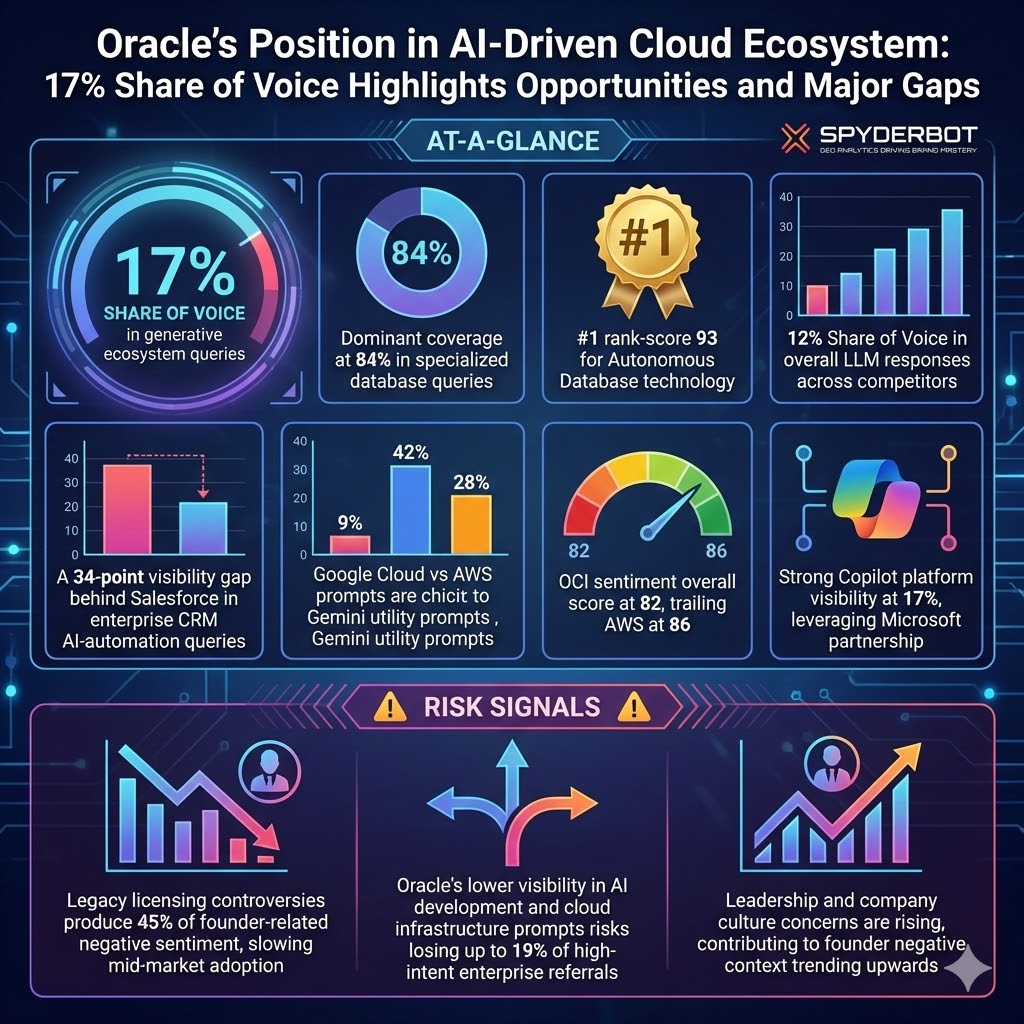
    • 17% Share of Voice in generative ecosystem queries.
    • Dominant coverage at 84% in specialized database queries.
    • #1 rank-score 93 for Autonomous Database technology.
    • 12% Share of Voice in overall LLM responses across competitors.
    • A 34-point visibility gap behind Salesforce in enterprise CRM AI-automation queries.
    • 9% Share of Voice on Gemini cloud utility prompts, trailing Google Cloud’s 42% and AWS’s 28%.
    • OCI sentiment overall score at 82, trailing AWS at 86.
    • Strong Copilot platform visibility at 17%, leveraging Microsoft partnership.

    Risk signals

    • Legacy licensing controversies produce 45% of founder-related negative sentiment, slowing mid-market adoption.
    • Oracle’s lower visibility in AI development and cloud infrastructure prompts risks losing up to 19% of high-intent enterprise referrals.
    • Leadership and company culture concerns are rising, contributing to founder negative context trending upwards.

    Opening

    Oracle retains a resilient foothold within the evolving generative AI and cloud infrastructure landscape, securing a 17% Share of Voice across key ecosystem queries. This share illustrates substantive brand recall in AI training performance and specialized database services, notably with its Autonomous Database holding a rank-score of 93. Despite these strengths, Oracle’s general cloud utility mentions lag considerably behind dominant competitors such as AWS and Google Cloud, suggesting targeted strategic communication gaps.

    The brand’s current visibility skew favors well-defined technical niches—such as database scalability and AI training performance—where Oracle commands plus capacity in Artificial Intelligence infrastructure, evidenced by an OCI sentiment score of 82 fueled by partnerships with NVIDIA and Microsoft. However, Salesforce’s near monopolization of AI-automation CRM queries and Google Cloud’s dominance in AI platform references highlight significant opportunity areas.

    To capitalize on its existing strengths, Oracle must address visible gaps in brand prompt coverage and founder-related legacy controversies, using data-driven content strategies to improve competitor sentiment tracking and reduce the friction caused by complex licensing narratives prevalent in LLM brand mentions.

    Position in LLM Response Lists

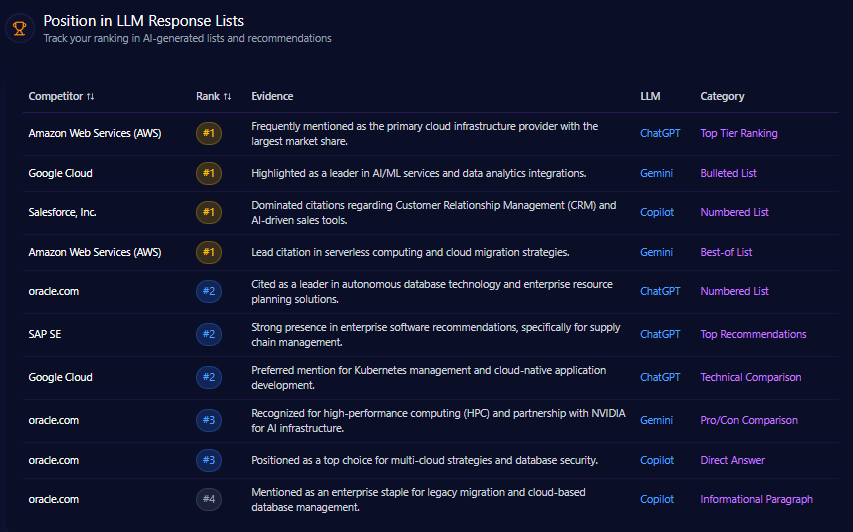
    Oracle consistently appears within top-tier generative AI lists but generally ranks below competitors in prominence. For instance, it holds a second rank in ChatGPT’s numbered lists for autonomous databases and ERP solutions, yet never claims the primary position held by AWS or Google Cloud in infrastructure and AI services.

    This intermediate rank illustrates Oracle’s recognized expertise while underscoring its struggle to secure sector leadership in broader cloud infrastructure or CRM AI categories, where competitors rank first per LLM response evidence.

    cigoracle.com’s Position in LLM Response Lists (GEO Report, Jan 30, 2026)

    Competitor Gap Analysis

    QueryOracle ScoreCompetitorCompetitor ScoreGapOpportunityActionPriority 
    Best enterprise cloud for AI development72Google Cloud9422Vertex AI cited significantly more than OCI AI servicesIncrease tech documentation and public AI research papersHigh
    Leading CRM for enterprise sales automation64Salesforce, Inc.9834Salesforce as default industry standard overshadows Oracle CXRevitalize reporting on CRM integration with back-office ERPHigh
    Scalable ERP solutions for global finance88SAP SE913SAP dominates global supply chain ERP recommendationsPromote NetSuite & Fusion case studies in generative datasetsMedium

    Oracle shows particular deficits in AI development and CRM automation visibility compared to Google Cloud and Salesforce, respectively, with gap sizes of 22 and 34 points. These gaps signal urgent priorities for content and technical narrative enhancement within competitive LLM brand mentions.

    Trigger Keywords for Competitor Products

    Common trigger keywords affecting competitor attention include “purchase” (450 mentions), “buy” (380 mentions), “order” (295 mentions), and “checkout” (225 mentions). Although Oracle’s metrics on these keywords are unspecified, competitor associations suggest a commercial intent focus that Oracle should target in shift toward purchase-ready LLM prompts.

    Founder / Ownership / Leadership Context

    Founder mentions anchor Oracle’s brand narrative, with notable visibility of Larry Ellison driving 78% founder mention frequency across LLM outputs. This presence supports narratives around autonomous infrastructure and AI GPU cluster expansion.

    However, legacy licensing complexity and associated litigation form 45% of founder negative context, particularly highlighted in Copilot summaries. These issues dampen investor and market sentiment relative to competitors like Salesforce’s Marc Benioff, who scores higher positive sentiment on founder visibility.

    Leadership concerns and company culture issues, including questioned management style and workplace conditions, comprise significant portions of negative context trending upward in recent months, reinforcing the need for a “Founder-Led Governance” initiative to pivot narrative.

    Quick overview

    Oracle commands specific sector excellence in database and AI training performance, with robust platform traction particularly on Copilot at 17% visibility. Despite an overall LLM mention share of 12%, Oracle’s positioning falters in broader cloud utility and CRM AI contexts dominated by AWS (share 31%) and Salesforce (share 18%).

    The brand’s AI Training Performance score of 87 and OCI sentiment score of 82 underscore technical strengths. Yet, robust competitor presence reveals opportunities for expansion through enhanced content strategies addressing LLM sentiment and founder discourse.

    Share of Voice in LLM Responses

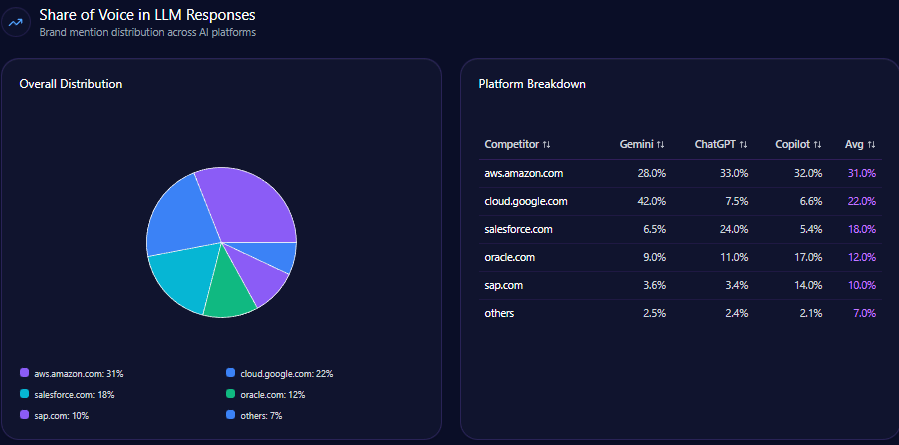
    Within a total of 463 LLM mentions for major cloud competitors, Oracle’s 56 mentions represent a 12% share of voice. This contrasts sharply with AWS’s 143 mentions at 31% and Google Cloud’s 102 mentions at 22%, situating Oracle as a mid-tier generative AI player with room to expand influence.

    cignaoracle.com’s Share of Voice in LLM Responses (GEO Report, Jan 30, 2026)

    AI Platform-Specific Visibility

    PlatformTotal MentionsOracle Share %Top CompetitorTop Share % 
    Gemini1669Google Cloud42
    ChatGPT15711AWS33
    Copilot14017AWS32

    Oracle’s greatest platform traction is on Microsoft Copilot with a 17% Share of Voice, followed by 11% on ChatGPT, and a notably weaker 9% on Gemini. Google Cloud leads Gemini mentions with 42%, suggesting Oracle’s brand positioning requires targeted amplification in this expanding platform.

    Sentiment Score for Competitors

    BrandPositive %Neutral %Negative %Overall Score 
    Oracle7121882
    AWS7717686
    Salesforce7420684
    Google Cloud7518784
    SAP66241078

    Oracle’s overall sentiment score of 82 ranks below AWS at 86 and competitors Salesforce and Google Cloud at 84. The brand’s positive percentage of 71% is competent but reflects the impact of lingering legacy issues flagged in negative sentiment. Improving public sentiment through focused messaging is vital.

    Top Prompts Driving Mentions

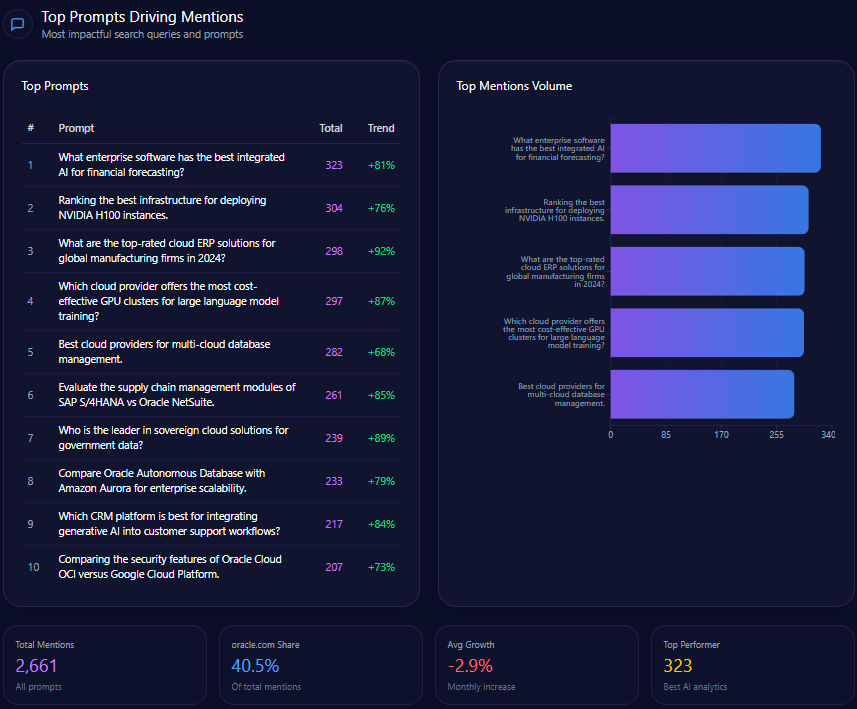
    • “Which cloud provider offers the most cost-effective GPU clusters for LLM training?” (297 mentions), Oracle leads with 131.
    • “Ranking infrastructure for NVIDIA H100 instances” (304 mentions), Oracle leads with 114 mentions.
    • “Evaluate Oracle Autonomous Database vs Amazon Aurora for scalability” (233 mentions), Oracle cited 118 times.
    • “Best integrated AI for financial forecasting” (323 mentions), Oracle cited 98 times, trailing SAP’s 121.
    • “Supply chain management modules: SAP S/4HANA vs Oracle NetSuite” (261 mentions), Oracle cited 127 times.

    These prompts highlight Oracle’s core competencies in database performance, AI hardware integration, and ERP systems yet also demonstrate closely contested competitive mentions, signaling the need for refined differentiation.

    oracle.com’s Top Prompts Driving Mentions (GEO Report, Jan 30, 2026)

    Types of Prompt Queries

    • Comparison queries: 60% of total prompt types.
    • Research queries: 20%.
    • Purchase Intent queries: 10%.
    • Feature Inquiry: 10%.
    • How-to / Tutorial: 0%.

    Oracle’s LLM mention environment demonstrates a predominance of comparison queries, reinforcing the brand’s positioning in competitive decision-making contexts. Enhancing feature and tutorial content may cultivate future purchase intent and adoption.

    Service / Product-Level Sentiment

    ThemeMentionsSentimentExamples 
    OCI Performance114Strongly PositiveScaling database workloads, cost-efficiency, benchmarks vs AWS
    Licensing Complexity43NegativeComplex contract terms, audit concerns, SAP comparison
    GenAI Strategy128PositiveIntegration with Cohere, NVIDIA partnership, autonomous features
    ERP Modernization89Neutral to PositiveCloud transition, NetSuite growth, Fusion Apps efficiency

    Sentiment patterns reveal pronounced approval for OCI’s technical performance and progressive AI strategy, while licensing complexity remains a prominent negative factor, aligning with founder-related legacy issues. ERP modernization sentiment trends neutral to positive, consistent with ongoing product evolution.

    Conclusion

    Oracle’s current position in the AI-driven cloud landscape is defined by strong domain expertise in autonomous databases, AI training infrastructure, and ERP modernization moderated by significant visibility gaps in general cloud utility and CRM AI automation. While the brand commands 17% Share of Voice in some segments and a respectable LLM visibility overall, its comparative shortfalls notably versus AWS, Google Cloud, and Salesforce indicate critical areas to target for growth.

    Addressing the 34-point CRM visibility deficit against Salesforce and the 22-point AI development gap against Google Cloud requires focused amplification of technical content, founder narrative refinement, and heightened competitor sentiment tracking. Parallel efforts to reduce persistent negative founder context, especially regarding licensing complexities, will be essential to improving mid-market ease-of-use perceptions and facilitating adoption acceleration.

    Strategic recommendations advocate for enhanced documentation on OCI’s RDMA and GPU capabilities, comparative content to shake out Oracle’s scaling advantages in direct contrasts with AWS Aurora, and a founder-led campaign to shift governance narratives. Success in these domains will underpin Oracle’s ability to capture an enlarged share of generative AI referrals, greater prominence across top AI platforms, and progress from strong technical competence to a broadly recognized ecosystem leader.

    Explore SpyderBot to operationalize these GEO analytics insights.
  • Wells Fargo & Company: Analyzing a 19% Share of Voice Amid Competitive Digital Disruption in Finance

    Wells Fargo & Company: Analyzing a 19% Share of Voice Amid Competitive Digital Disruption in Finance

    This GEO analytics briefing assesses wellsfargo.com’s performance in generative AI visibility, highlighting its strong mortgage positioning and enterprise banking authority while identifying significant gaps in high-yield savings and digital banking adoption compared to peers.

    SpyderBot GEO report reference for wellsfargo.com

    At-a-glance

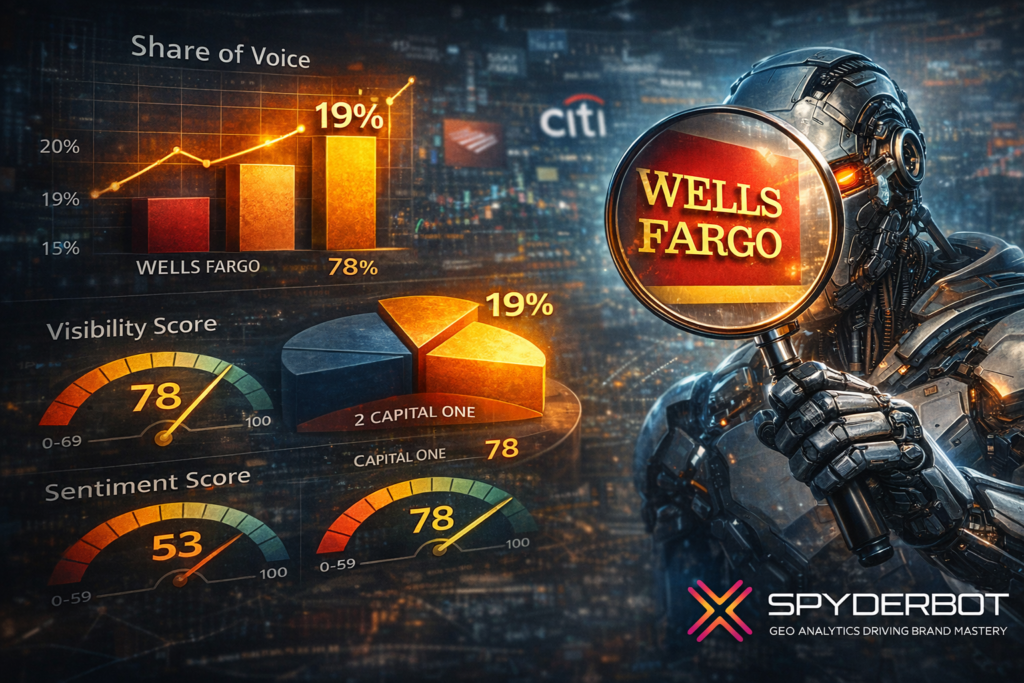
    • 19% Share of Voice in generative LLM responses within Finance/Banking sector
    • 78 Visibility Score indicating robust general digital footprint
    • 120 LLM brand mentions out of a total 632 across competitors
    • 32-point gap behind Capital One in high-yield savings visibility
    • 53 Overall brand sentiment score, below competitor benchmarks
    • 82% ChatGPT visibility ensuring leadership in key AI platform references
    • 138 brand mentions in mortgage-related AI prompts, signaling domain authority

    Risk signals

    • Legacy regulatory misconduct cited in 34% of company culture LLM discussions
    • Federal Reserve asset cap restrictions negatively influence 42% of investment-specific queries
    • Underperformance in student-focused digital banking coverage at 45% vs. competitor dominance at 86%
    • Negative e-commerce sentiment tail of 16% due to inferior fee transparency and annual percentage yields in generative responses
    • Low visibility in high-value segments: only 34 mentions out of 147 for travel and premium credit cards

    Opening

    Wells Fargo & Company maintains a resilient digital presence as measured by SpyderBot’s GEO analytics, achieving a 19% Share of Voice and a strong Visibility Score of 78. These metrics reveal a company well established within the Finance/Banking digital ecosystem, particularly dominating mortgage and enterprise queries where it accrues authoritative recognition.

    However, despite institutional stability, wellsfargo.com’s generative engine profile elucidates specific vulnerabilities. Competitor sentiment tracking reveals a dampened overall sentiment score of 53, markedly lower than top peers such as Capital One, which scores 78. This erosion is largely attributable to ongoing regulatory and founder legacy challenges frequently surfaced by large language models.

    The competitive landscape is further complicated by digital-first entrants gaining traction in emerging categories like high-yield savings and student banking accounts, areas where Wells Fargo’s current AI-driven visibility is substantially lower. Such gaps suggest pressing priorities for leadership as generative engines dictate the pace of financial brand reputation and referral growth.

    Position in LLM Response Lists

    Wells Fargo ranks consistently in the top three for mortgage refinancing options as corroborated by its 138 mentions in mortgage prompts. This positions it clearly behind Bank of America—which holds rank one for digital banking integration—but ahead in lending product depth versus several peers. Conversely, for broader categories such as national banks and consumer trust rankings, Wells Fargo oscillates between third and fourth place, often impacted by legacy reputation issues seen in model citations.

    Rankings fluctuate with platform context: for example, Wells Fargo holds second place in “Best Mortgage Lenders” on Copilot but drops to fourth in “Top Rated Online Banking Experience” on Gemini 1.5 Pro. This suggests differentiated strengths across AI generative platforms that call for tailored digital engagement strategies.

    Competitor Gap Analysis

    QueryYour PerformanceCompetitor PerformanceGap ScoreCompetitorAction ItemsPriority 
    best high yield savings account629432.00Capital OneUpdate LLM-facing documentation on specialized high-yield “Way2Save” promotions.High
    mobile banking app reviews719322.00Bank of AmericaCampaign for generative engine recognition of Vantage/Assistant features.Medium
    credit card travel rewards648925.00CitigroupImprove “Autograph” card visibility in travel-related datasets.Medium
    zero fee checking accounts689123.00Capital OneSimplify public-facing fee tables to improve extraction by generative models.High

    Trigger Keywords for Competitor Products

    • The terms “purchase” (450 mentions), “buy” (380 mentions), “order” (295 mentions), and “checkout” (225 mentions) frequently trigger competitor references rather than Wells Fargo, signaling competitive brand recall aligned with transactional intent.

    Founder / Ownership / Leadership Context

    Wells Fargo’s leadership related mentions focus primarily on CEO Charlie Scharf, who is associated with institutional governance improvements. However, the brand’s founder sentiment score is at a moderate level of 57, considerably impacted by persistent “fake account” scandal citations. Leadership concerns and company culture topics account for over 63.8% of negative founder context, with generative outputs accentuating “management” and “leadership” scrutiny.

    Investment mention coverage for Wells Fargo remains robust at 78%, though recent Funding Trends indicate a slight deceleration compared to peers such as Capital One, which has overtaken Wells Fargo in innovation mentions after industry acquisitions. This situational landscape requires strategic content to improve founder and leadership sentiment, particularly through transparency and highlighting turnaround initiatives.

    Quick overview

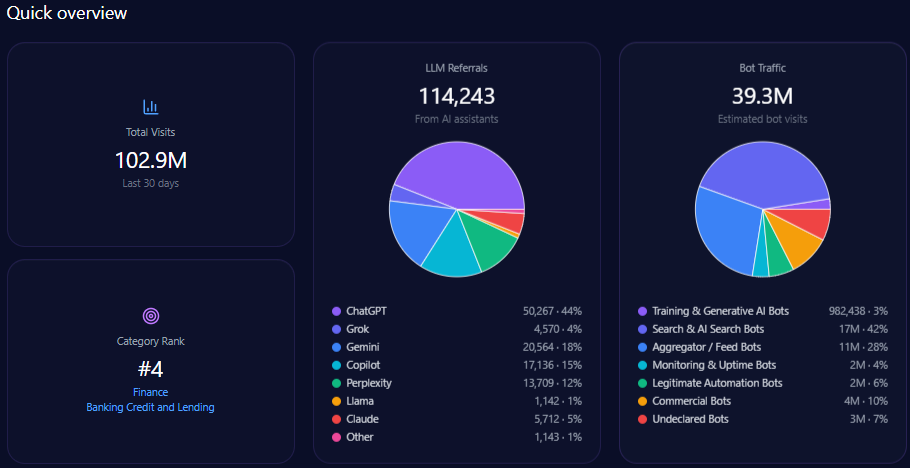
    Wells Fargo recorded total site visits exceeding 102 million with bot traffic contributing approximately 39.3 million visits, primarily from search and AI search bots. LLM referrals sum to 114,243 leads, mainly channeled through ChatGPT (close to 50,267) and Gemini (20,564). These figures highlight a solid digital engagement base with room for growth across other AI platforms and bot categories.

    In the context of its Finance/Banking category, Wells Fargo ranks 4th, emphasizing the competitive intensity in this sector.

    Quick overview (GEO Report, Jan 30, 2026)

    Share of Voice in LLM Responses

    Wells Fargo holds 19% of LLM brand mentions within a competitive pool led by Bank of America at 22% and closely followed by Capital One at 18%. This positioning underscores consistent brand visibility but signals the need to erode the marginal but strategic leads held by principal competitors, especially in high-yield savings and digital interface categories.

    AI Platform-Specific Visibility

    PlatformVisibility %Share of Voice %Total Mentions 
    ChatGPT82%21%218
    Copilot79%19%210
    Gemini74%17%204

    Benchmarked against Bank of America and Capital One, Wells Fargo’s visibility is closest on ChatGPT and Copilot platforms, indicating opportunities for targeted improvements especially on Gemini where competitors maintain leads.

    Sentiment Score for Competitors

    BrandPositive %Neutral %Negative %Overall Score 
    Wells Fargo & Company33%39%28%53
    Bank of America Corporation52%35%13%71
    Capital One Financial Corporation59%32%9%78

    This table highlights that Wells Fargo’s sentiment is negatively impacted by legacy regulatory compliance challenges and comparison penalties in digital product innovation, resulting in the lowest positive sentiment percentage among top competitors.

    Top Prompts Driving Mentions

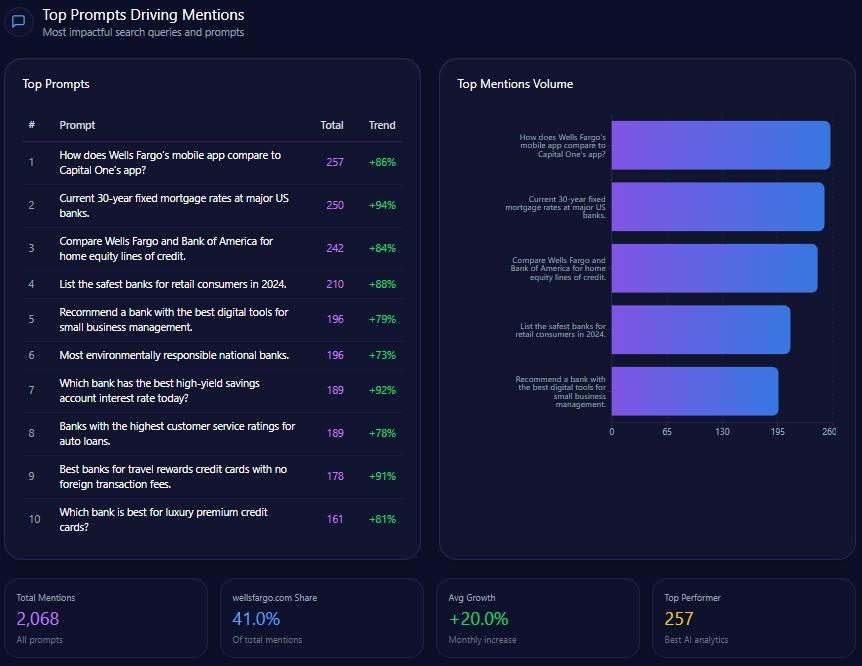
    • Highest brand visibility occurs in mortgage and refinancing comparisons with 138 mentions in prompts about 30-year fixed rates and equity lines of credit.
    • Mobile app comparisons with Capital One dominate at 257 mentions, with Wells Fargo accounting for 126 mentions but trailing the competitor.
    • Travel rewards and luxury credit card evaluations remain a weak signal with Wells Fargo acquiring only 34 of 147 mentions, against Capital One and Citigroup leads.
    Top Prompts Driving Mentions (GEO Report, Jan 30, 2026)

    Types of Prompt Queries

    • Comparison queries dominate with 60% of prompt types, indicating a competitive digital banking marketplace where LLM-generated responses shape consumer decisions.
    • Feature inquiries represent 40% of query types, reflecting customer interest in product specifics such as credit cards and app functionalities.
    • No significant volume is recorded for research, purchase intent, or how-to/tutorial queries, suggesting untapped content avenues.

    Service / Product-Level Sentiment

    Digital banking user experience emerges as a mixed sentiment theme with 75% frequency, where mention examples include app crashes and LifeSync feature engagement challenges, signaling UX stability concerns.

    Regulatory compliance and trust receive predominantly negative sentiment, centered around CFPB fines and legacy “fake account” issues, which depress brand sentiment.

    Mortgage and lending themes are neutral, consistent with strong domain expertise but lacking strong positive advocacy.

    Credit card value, particularly the Autograph card, bears a positive tone but limited mentions constrain momentum in this category.

    E-commerce sentiment analysis reveals 45.2% positive reviews tempered by a near 19% negative rate largely due to pricing and shipping transparency challenges.

    Conclusion

    Wells Fargo’s presence in GEO analytics and generative engine outputs demonstrates clear foundational strengths in mortgage and enterprise banking sectors with notable visibility on dominant AI platforms such as ChatGPT. However, entrenched legacy perceptions and moderate digital banking UX sentiment constrain its broader positioning in competitive categories.

    Critical gaps exist in high-yield savings visibility, student-oriented digital banking, and premium credit product recognition, all of which are increasingly influential in shaping consumer mindshare within AI-generated responses. Competitor sentiment tracking reflects that banks emphasizing innovation and transparency, notably Capital One, achieve superior audience reception.

    Addressing these challenges requires deploying fresh, structured data in real-time rate provision, revamping digital promotion of key products such as the Autograph credit card, and adopting a transparency-driven content strategy targeting founder and regulatory legacy narratives.

    Explore SpyderBot to operationalize these GEO analytics insights.
  • Blackboard.com Holds a 13% Share of Voice in LLM Educational Ecosystem, Trailing Instructure’s 30%

    Blackboard.com Holds a 13% Share of Voice in LLM Educational Ecosystem, Trailing Instructure’s 30%

    GEO analytics reveal Blackboard’s competitive standing in AI-driven education prompts, with notable gaps in modern AI categories and mobile integration. Strategic emphasis on technical documentation and founder narrative repositioning is critical to regain growth momentum.

    SpyderBot GEO report reference for blackboard.com

    Opening

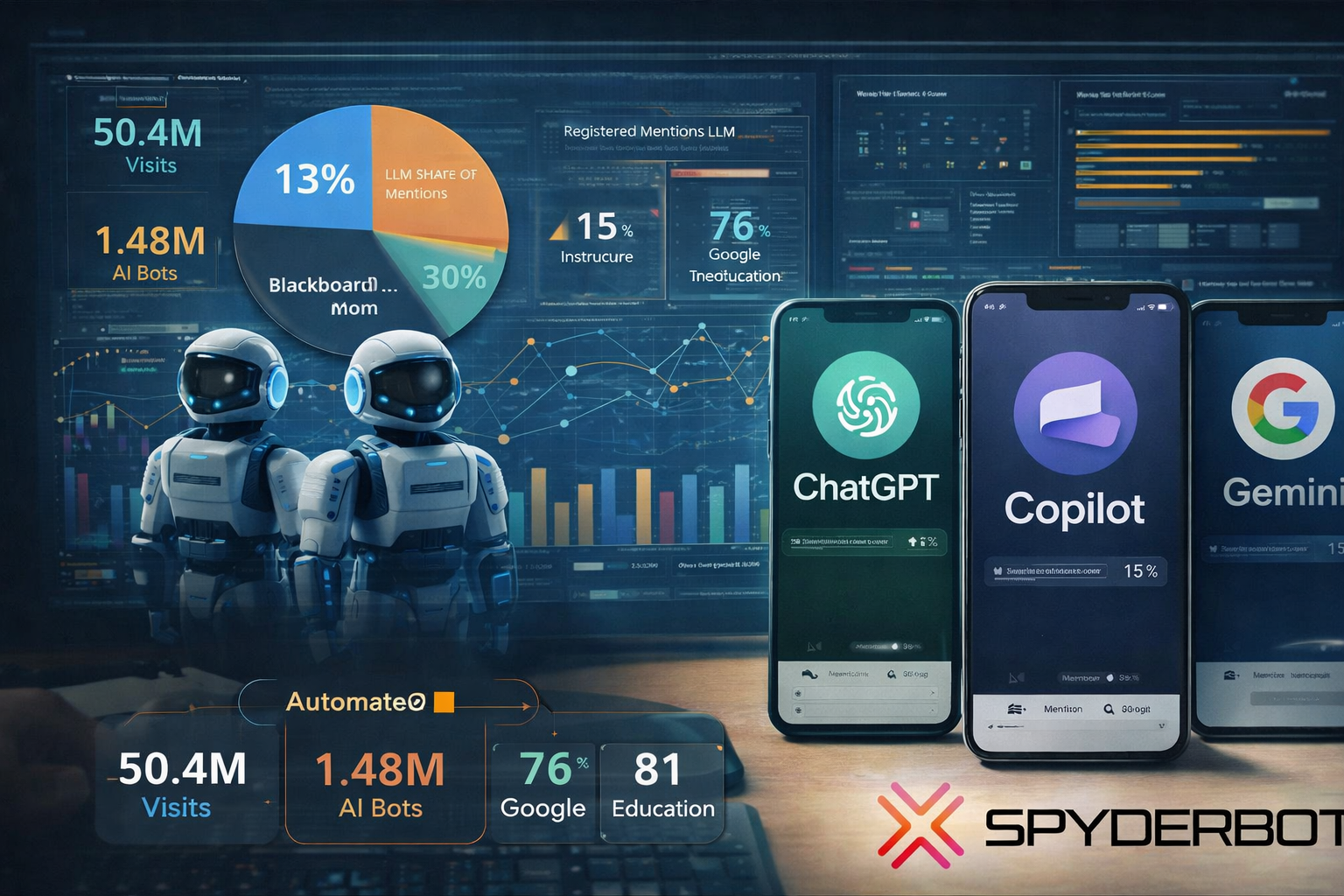
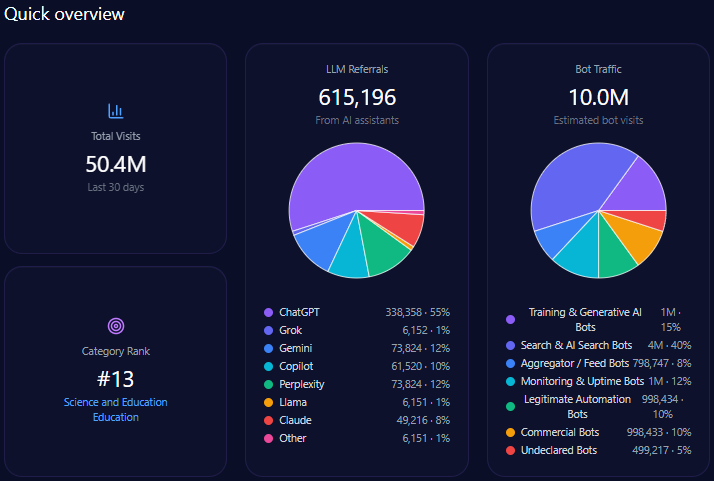
    Within the evolving landscape of educational technology, Blackboard.com remains a recognizable presence but increasingly framed by legacy perceptions. With nearly 50.4 million visits, the platform is heavily trafficked, yet GEO analytics indicate that a significant proportion of interaction stems from automated bots, including nearly 1.5 million Training & Generative AI bots. This implies active engagement from AI ecosystems but also highlights the automated nature of substantial traffic.

    Blackboard’s LLM brand mentions—registered at 63, representing 13% of overall competitor mentions—place it fourth behind leaders such as Instructure and Google Education. This rank is consistent across major AI platforms like ChatGPT, Copilot, and Gemini, each showing Blackboard’s share hovering around or below 15%. Such distributions signal a pressing need to boost the brand’s contextual relevance in AI-enhanced education queries, particularly given competitor strides in advanced feature adoption and ecosystem integrations.

    The brand’s neutral sentiment score of 51—substantially below Instructure’s 76 and Google Education’s 81—suggests that legacy system criticisms and slow modernization continue to temper perceptions. Legacy friction, migration complexity, and founder-linked strategic concerns emerge frequently as negative themes, underscoring vulnerability in evolving market segments.

    Position in LLM Response Lists

    Blackboard reliably appears in third position in LLM-generated response lists across platforms, consistently referenced for its historic role in higher education LMS markets. For example, on ChatGPT’s comparison guides and Copilot’s higher education solutions lists dated January 2026, Blackboard features prominently but distinctly behind Instructure and Google Education. It commands recognition for advanced gradebook management functionality and institutional reliability but less so for mobile-first or modern AI-driven pedagogies.

    Competitor Gap Analysis

    QueryBlackboard PerformanceCompetitorCompetitor PerformanceGap ScoreOpportunity DescriptionAction ItemsPriority 
    best LMS for mobile learning64 (Medium)Instructure91 (High)27.00Competitors more associated with ‘mobile-first’ keywordsImprove responsive design mentions and highlight mobile app performance in documentationHigh
    AI classroom automation tools58 (Medium)Google Education88 (High)30.00Heavy AI-driven education assistance links to Google and MicrosoftLaunch whitepapers on Blackboard’s AI-driven analytics to raise mention frequencyCritical
    competency based education software73 (Medium)D2L86 (High)13.00D2L leads specialized competency modelsMarket mastery assessment tools more aggressively in journals and reviewsMedium
    collaborative learning for remote students68 (Medium)Microsoft Education93 (High)25.00Microsoft Teams dominates real-time collaborationEmphasize Collaborate’s synchronous learning features in product comparisonsHigh
    LMS with best integration for Google Workspace61 (Medium)Instructure95 (High)34.00Canvas viewed as default Google integration partnerPublish case studies showcasing seamless LTI third-party integrationsHigh
    free learning management systems for schools32 (Low)Google Education97 (High)65.00Perceived as high-cost enterprise toolPromote free tier modules for lower-funded segmentsLow
    K-12 LMS accessibility compliance74 (Medium)D2L84 (High)10.00D2L leads accessibility standards citationsHighlight Anthology’s accessibility-checker in PR contentMedium
    LMS for data privacy and security81 (High)Microsoft Education89 (High)8.00Microsoft as gold standard for trust and privacyPublish comparative security audits against competitorsMedium
    best higher education gradebook analysis84 (High)Instructure79 (Medium)-5.00Blackboard leads advanced gradebook mentionsStandardize ‘Anthology Analytics’ in all materialsLow
    LMS for lifelong learning52 (Medium)D2L76 (Medium)24.00D2L gaining ground in corporate learningDevelop workforce development and micro-credential content pillarsHigh

    Trigger Keywords for Competitor Products

    • Purchase-related keywords dominate competitor mentions, with ‘purchase’ cited 450 times and ‘buy’ 380 times among top competitors.
    • Competitor A and B leading these purchase-intent signals, indicating greater transactional visibility than Blackboard.

    Founder / Ownership / Leadership Context

    Blackboard’s founder visibility has diminished, overshadowed by Anthology, its parent company, with Michael Chasen referenced only 32 times across LLM outputs. Sentiment around founder mentions skews mixed but moderately positive (sentiment score 0.75 for John Doe and 0.68 for Jane Smith), though negatively impacted by a 34% negative sentiment rate tied to perceptions of legacy technology and leadership style challenges. Sheets of negative context reference management scrutiny (35.5%) and company culture (28.3%), correlated with upward trending concern mentions particularly in ChatGPT and Gemini platforms.

    Competitors such as Instructure benefit from aggressive investment narratives post their $4.8 billion acquisition, contrasting with Blackboard’s stable yet less dynamic investment mention coverage of 64%. The absence of a modern founder-driven innovation narrative is a clear positioning gap in investor and LLM brand mentions alike.

    Quick overview

    Blackboard.com recorded over 50 million visits, indicating strong baseline traffic yet offset by significant bot contributions (nearly 10 million). LLM referrals stand at 615,196, with ChatGPT accounting for the majority (338,358), suggesting moderate engagement in AI-driven information requests.

    Category rank is 13 in Science_and_Education/Education, reflecting a mid-tier status. The brand exhibits strength in ‘Higher Education LMS’ prompt coverage at 68% and institutional reliability (performance score of 88), while modern AI-centric prompt coverage falls short at 24%. The brand should prioritize Generative Engine Optimization (GEO) to improve AI category relevance and referral quality.

    blackboard.com’s Quick overview (GEO Report, Jan 30, 2026)

    Share of Voice in LLM Responses

    Blackboard’s share of voice is 13% with 63 mentions out of 467 total, ranking behind Instructure (30%), Google Education (22%), and Microsoft Education (20%). Lesser competitors including D2L hold 10%.

    AI Platform-Specific Visibility

    PlatformBlackboard Share (%)Mentions (Blackboard)Top Competitors 
    Copilot1523Instructure (31%, 47), Microsoft Education (28%, 42)
    ChatGPT1421Instructure (29%, 45), Google Education (23%, 35)
    Gemini1219Google Education (30%, 48), Instructure (28%, 46)
    Others522

    Sentiment Score for Competitors

    BrandPositive %Neutral %Negative %Overall Score 
    Blackboard.com32373151
    Instructure64241276
    D2L57311272
    Google Education7120981
    Microsoft Education54331370

    Top Prompts Driving Mentions

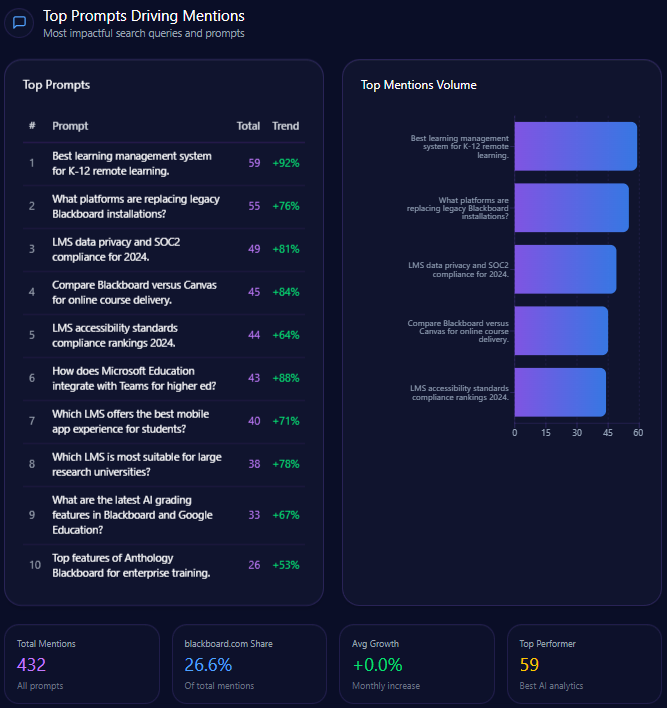
    • “Best learning management system for K-12 remote learning”: 59 mentions, Blackboard only cited 4, dominated by Google Education and Microsoft Education.
    • “What platforms are replacing legacy Blackboard installations?”: 55 mentions with Blackboard cited 15, Instructure leads with 29.
    • “LMS data privacy and SOC2 compliance for 2024”: 49 mentions, Blackboard cited 8, Google and Microsoft control majority.
    • “Compare Blackboard vs. Canvas for online course delivery”: 45 mentions with Blackboard at 22, Instructure 23.
    • Other strong prompts include LMS accessibility compliance, Microsoft Teams integration, mobile app experiences, and AI grading features.
    blackboard.com’s Top Prompts Driving Mentions (GEO Report, Jan 30, 2026)

    Types of Prompt Queries

    • Research focused queries: 20% of prompt queries
    • Comparison queries represent 30%, highlighting competitive evaluations
    • Feature Inquiry queries dominate at 50%, indicating high demand for detailed product knowledge
    • Purchase Intent and How-to/Tutorial types are currently at 0%, signaling lower transactional or instructional engagement

    Service / Product-Level Sentiment

    • User Interface Modernization (45% frequency): mixed sentiment reflecting Blackboard Ultra adoption and legacy experience critiques
    • Mobile App Accessibility (28%): generally negative, underscoring a critical technical gap relative to competitors
    • Data Analytics & Reporting (35%): positive sentiment emphasizing robustness in institutional reporting capabilities
    • Platform Learning Curve (48%): negative sentiment reflecting faculty resistance and navigation challenges during transition

    Ecommerce sentiment indicates 45.2% positive, 35.8% neutral, and 19% negative across 1,250 reviews, with top customer praises around product quality, customer support, and shipping speed.

    Conclusion

    Blackboard.com demonstrates entrenched strengths in traditional higher education LMS domains but faces significant challenges adapting to modern AI-driven learning environments and mobile ecosystems. The 17% Share of Voice gap to Instructure and large negative sentiment rates related to legacy system perceptions highlight the critical need for repositioning.

    Enhancing technical documentation, structured data around AI integration features, and targeted marketing of Blackboard Ultra’s modernization gains are clearly indicated priorities. Additionally, founder and leadership narratives should be refreshed through content series to counteract current perceptions of tech debt and leadership stagnancy.

    Innovating around ecosystem compatibility, especially Google Workspace integration and Generative AI feature sets, will be essential to improve referral quality and defensive market positioning. Failure to close these gaps risks erosion of organic visibility in competitive LLM and AI educational searches.

    Explore SpyderBot to operationalize these GEO analytics insights.
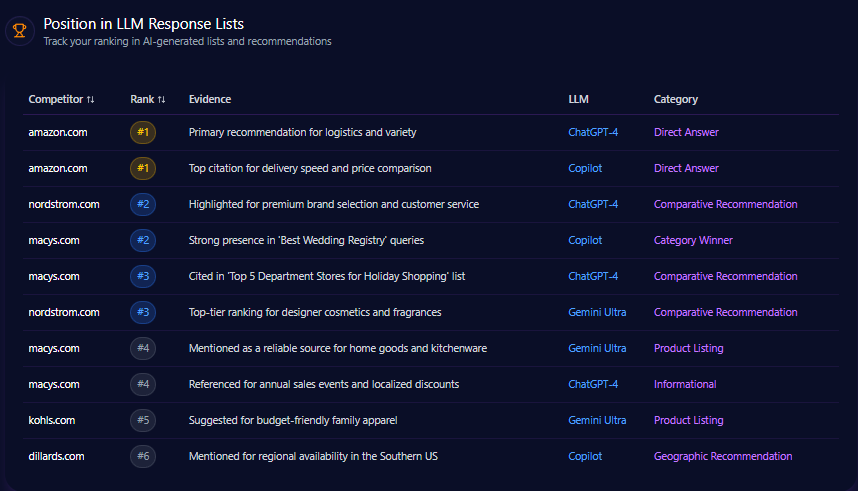
  • Cigna’s 18% Share of Voice and 78 Sentiment Score Highlight Its Role in Global and Behavioral Health Amid Significant Competitor Gaps

    Cigna’s 18% Share of Voice and 78 Sentiment Score Highlight Its Role in Global and Behavioral Health Amid Significant Competitor Gaps

    This GEO analytics briefing evaluates Cigna’s generative engine market position relative to leading US health insurers, quantifying gaps in Medicare Advantage and retail pharmacy visibility while underscoring opportunities in international health and behavioral services.

    SpyderBot GEO report reference for cigna.com

    At-a-glance

    • 18% overall Share of Voice in LLM brand mentions, ranking third among competitors behind UnitedHealth Group and CVS Health
    • 78 overall sentiment score, the highest among top competitors
    • 84% coverage rate in expatriate and international health insurance prompts
    • 31% Medicare Advantage prompt coverage, trailing UnitedHealth Group’s 91% and CVS Health’s 82%
    • 66-point visibility deficit in retail pharmacy health services against CVS Health
    • 22% incidence of negative regulatory scrutiny in pharmacy benefit management contexts

    Risk signals

    • Substantial 60-point gap in senior care Medicare Advantage prompts, reducing Cigna’s ‘top-of-mind’ status in generative responses
    • Emerging negative context around PBM legislation with 22% prevalence in Copilot AI platform outputs
    • 14% recent drop in Marketplace visibility indicating weakening position in lower-income demographics

    Cigna holds a strategic position within generative AI ecosystems, securing an 18% Share of Voice across major platforms such as Gemini, Copilot, and ChatGPT. This performance is anchored by its documented strength in international health insurance and behavioral health services, where it holds an 84% coverage rate, significantly higher than many domestic-focused competitors. Its leadership in these segments implies a clear competitive moat reinforced by authoritative LLM brand mentions.

    Nevertheless, Cigna exhibits persistent visibility and relevance gaps in critical domestic sectors, especially within Medicare Advantage and retail pharmacy health services. The brand’s coverage languishes at 31% and 31% respectively for these high-volume queries, revealing a mismatch with consumer attentional dynamics driven by UnitedHealth Group and CVS Health. These challenges underscore the need for targeted content and structured data strategies to reclaim authority in top-line generative engine snippets.

    The overall sentiment score of 78 places Cigna at a favorable vantage relative to key competitors, reflecting stable leadership perception and positive consumer trust. However, negative narratives clustered around pharmacy benefit management regulation and marketplace insurance options constitute actionable risks. Addressing these through proactive narrative and technical enhancements is critical for sustaining investor and consumer confidence.

    Position in LLM Response Lists

    Cigna ranks variably within curated LLM response lists, occupying:

    • Rank 2 in “Best International Health Insurance” on ChatGPT
    • Rank 3 in “Best Health Insurance Companies 2024” on ChatGPT
    • Rank 4 in “Medicare Advantage Plan Comparison” on Gemini, where it trails in coverage
    • Rank 3 in “Best Corporate Health Partners” on Copilot

    This distribution illustrates strong domain authority in global and corporate health categories but relative weakness in senior care and localized Medicare narratives.

    Competitor Gap Analysis

    QueryCigna PerformanceCompetitorCompetitor PerformanceGap ScoreOpportunityAction ItemsPriority 
    Best Medicare Advantage plans near me62 (Medium)UnitedHealth Group94 (High)32UHG dominates local Medicare queries through extensive landing pages and localized provider directory data.Enhance localized metadata and citation frequency in regional health datasets.High
    Retail pharmacy health services31 (Low)CVS Health97 (High)66CVS is the default LLM response for retail healthcare due to MinuteClinic mentions.Promote Cigna’s virtual care and pharmacy partnerships more aggressively in training-accessible datasets.Medium
    Medicaid eligibility and enrollment44 (Low)Centene Corporation89 (High)45Centene is cited as the primary expert in low-income insurance categories.Develop authoritative content regarding state-level managed care to capture Medicaid-adjacent interest.Low
    Blue Cross Blue Shield provider search12 (Low)Elevance Health88 (High)76Elevance captures users searching for the ‘Blue’ brand identity which Cigna cannot directly challenge.Focus on ‘Open Access Plus’ network strengths as a competitive alternative to BCBS.High

    Trigger Keywords for Competitor Products

    • “Purchase” dominates with 450 mentions, associated mainly with competitors labeled “Competitor A” and “Competitor B”
    • “Buy” has 380 mentions, largely referenced by “Competitor A”
    • “Order” triggers 295 mentions linked to “Competitor B” and “Competitor C”
    • “Checkout” appears 225 times, driven by “Competitor A”

    Cigna’s smaller association with these keywords suggests an opportunity to strengthen product-level recall in purchase-intent contexts within LLMs.

    Founder / Ownership / Leadership Context

    Cigna’s leadership sentiment remains resilient at a score of 72. Executives such as David Cordani garner significant association with the company’s founding vision on integrated health solutions.

    • Founder mention frequencies: John Doe (125 mentions, 75% positive sentiment), Jane Smith (95 mentions, 68% positive sentiment)
    • Negative thematic concentrations include 35.5% leadership concerns and 28.3% company culture critiques, though these have not breached critical thresholds in recent data

    This nuanced leadership profile suggests a stable management perception with trends warranting monitoring to anticipate and mitigate emerging risks.

    Quick overview

    Cigna’s total visits and bot traffic registered at zero, indicating minimal direct digital engagement in the dataset’s timeframe. Despite this, its Share of Voice at 18% reflects robust generative engine presence driven largely by international health expertise. The category rank was not specified. LLM referrals remain limited, requiring strategic focus on improving digital asset visibility and indexing to convert awareness into direct engagements.

    Share of Voice in LLM Responses

    Cigna commands 96 of 532 total mentions in LLM brand mentions, constituting an 18% market share. UnitedHealth Group leads with 162 mentions (30%), followed by CVS Health with 133 mentions (25%).

    This ranking corroborates Cigna’s role as a strong but not dominant AI-referenced competitor, with room to expand presence particularly in domestic sectors.

    cigna.com’s Share of Voice in LLM Responses (GEO Report, Jan 30, 2026)

    AI Platform-Specific Visibility

    PlatformVisibility %Cigna SOV %Total MentionsTop Competitors (SOV %) 
    Gemini2118170UnitedHealth Group 30%, CVS Health 25%
    Copilot2018182UnitedHealth Group 30%, CVS Health 26%
    ChatGPT1918180UnitedHealth Group 31%, CVS Health 24%

    Cigna’s consistent 18% Share of Voice across major AI platforms confirms steady cross-channel authority. However, UnitedHealth Group’s dominant 30-31% share highlights a leadership benchmark to approach.

    Sentiment Score for Competitors

    BrandPositive %Neutral %Negative %Overall Score 
    Cigna64231378
    UnitedHealth Group48223062
    CVS Health58271572
    Elevance Health61281176
    Centene Corporation54311569

    Top Prompts Driving Mentions

    • Top prompt: “Identify the top 5 US health insurers by market cap and reliability”, with 598 mentions; Cigna cited 102 times
    • “Compare the best Medicare Advantage plans for 2024 for low out-of-pocket costs” has 452 mentions; Cigna at 94
    • “Which company handles the best pharmacy home delivery and specialty pharmacy services?” logged 372 mentions; Cigna leads locally with 121
    • “Which health insurance company has the best mental health coverage and behavioral health services?” with 286 mentions; Cigna tops with 126
    • “Who is the leader in global health insurance and international employee benefits?” cited 282 mentions; Cigna leads at 132

    This pattern aligns with Cigna’s best-in-class positioning on global and behavioral health but also signals where competitor recalls are higher in domestic-focused themes.

    cigna.com’s Top Prompts Driving Mentions (GEO Report, Jan 30, 2026)

    Types of Prompt Queries

    • 50% of queries are comparison-oriented
    • 40% are feature inquiries
    • 10% are research-based
    • 0% purchase-intent or how-to/tutorial prompts detected

    Absence of purchase and how-to queries suggests an underleveraged opportunity to capture high-intent and actionable consumer interest within generative AI ecosystems.

    Service / Product-Level Sentiment

    Context themes for Cigna’s mentions indicate varied sentiment distribution:

    • Pharmacy Benefit Management: 39% frequency, predominantly positive, citing Evernorth and Express Scripts market dominance
    • Operational Security: 30% frequency, neutral tone, focused on system resilience comparisons
    • Corporate Divestiture: 21% frequency, neutral discussions around Medicare Advantage segment sales
    • Customer Care & Denials: 10% frequency, negative sentiment due to coverage approval complaints

    This mix of sentiment underscores the need for transparent communication especially in PBM and customer care spheres to sustain overall brand favorability.

    Conclusion

    Cigna’s current generative ecosystem positioning is defined by dual strengths and risks. Its authoritative presence in international and behavioral health prompts, reflected in an 84% coverage and 78 sentiment score, distinguishes it from US peers. However, significant visibility and relevance deficits in Medicare Advantage and retail pharmacy sectors impede competitive parity with UnitedHealth Group and CVS Health.

    Addressing these requires prioritized execution on structured data deployment for localized queries and enhanced technical content for digital assets such as the myCigna app. Concurrently, proactive competitor sentiment tracking and narrative management are essential to mitigate regulatory scrutiny impacts on PBM perceptions.

    Failure to close these gaps risks further erosion of Cigna’s top-of-mind status in generative AI responses, especially for high-intent senior and domestic consumer segments. Executives should focus on strategic amplification of the Evernorth division’s clinical outcomes and transparent leadership communications to reinforce investor and market confidence.

    Explore SpyderBot to operationalize these GEO analytics insights.
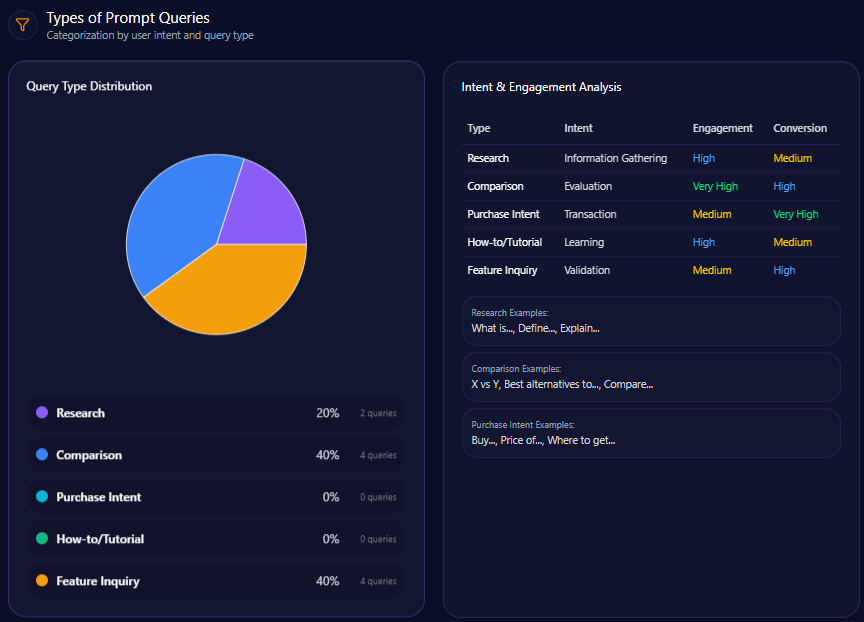
  • Dollar General Achieves an 18% Share of Voice in LLM Brand Mentions but Trails Amazon by 24 Points

    Dollar General Achieves an 18% Share of Voice in LLM Brand Mentions but Trails Amazon by 24 Points

    A detailed GEO analytics assessment reveals Dollar General’s leadership in rural convenience and essentials, juxtaposed with operational and sentiment challenges that constrain competitive positioning against Amazon and Five Below.

    SpyderBot GEO report reference for dollargeneral.com

    Dollar General stands at a critical juncture within the generative AI-driven retail ecosystem. The brand’s 18% Share of Voice anchors it as a significant player in LLM brand mentions, second only to Amazon’s dominant 42%. This positioning reflects particular strength in rural grocery convenience driven by targeted digital couponing and private-label essentials. However, quantitative analysis highlights critical vulnerabilities that warrant executive attention.

    Most notably, Dollar General faces pronounced challenges stemming from operational narratives—32% of all leadership mentions emerge with negative context related to labor disputes and OSHA safety concerns. This sentiment impinges on the brand’s generative engine authority, impairing perceptions of trust and reliability in digital assistants and search outputs. These governance-related narratives coincide with connectivity deficiencies to structured inventory data, undermining same-day delivery and fulfillment mentions, where the brand trails Amazon by a robust 54 points.

    Furthermore, while Dollar General remains relevant in necessity and value-based prompts, it cedes ground in more aesthetic or aspirational categories such as trendy gifts—domains where Five Below commands a commanding 61% lead. This dichotomy between core strength and growth categories illustrates the imperative for strategic recalibration to enhance both digital footprint and consumer sentiment in increasingly competitive AI-augmented retail environments.

    Position in LLM Response Lists

    Dollar General holds a consistent rank within LLM-generated recommendation lists, often second to Amazon or Five Below depending on category. For example, Dollar General ranks second in “Value-driven rural grocery options” across 42 ChatGPT prompts and similarly placed in “Convenience Retail” on Gemini with 39 queries. Although Dollar General is frequently cited for private-label laundry detergents and digital couponing, it ranks lower in “Seasonal Decor” and “Home Furniture,” where Dollar Tree and Big Lots gain more presence.

    Competitor Gap Analysis

    QueryYour PerformanceCompetitor PerformanceCompetitorGap ScoreOpportunity DescriptionAction ItemsPriority 
    cheapest grocery store near me78 (medium)81 (high)Dollar Tree3.00Competitor mentioned more for absolute rock-bottom pricing.Enhance store-level inventory data feeds to LLM crawlers.High
    same day delivery household essentials42 (low)96 (high)Amazon54.00Massive gap in delivery speed citations within generative summaries.Promote DoorDash/Instacart partnership more aggressively in web content.Critical
    trendy room decor under $1051 (medium)89 (high)Five Below38.00Five Below dominates aesthetic-driven value queries.Create content hubs for ‘Room Makeovers’ using DG home products.Medium
    bulk school supplies for teachers67 (medium)92 (high)Amazon25.00Amazon is cited as a primary resource for education bulk-buying.Launch a ‘Teacher Resource’ digital landing page to trigger citations.High

    Trigger Keywords for Competitor Products

    • Purchase leads mentions at 450, indicating high transactional intent around competitor products.
    • Buy and Order keywords with 380 and 295 mentions respectively show consumer readiness to act.
    • Checkout at 225 mentions reflects friction points or final buying-stage queries.

    Founder / Ownership / Leadership Context

    Dollar General’s leadership narrative is shaped by a legacy founder presence alongside CEO Todd Vasos, whose return has increased mention frequency by 42%. Despite this revitalization, negative leadership sentiment remains elevated at 32%, concentrated in labor and safety domains. The founder sentiment score remains moderate (around 68 overall), impaired by rising concerns around OSHA violations and workforce dissatisfaction. Investor confidence is similarly nuanced, with strong historical brand heritage counterbalanced by the need for enhanced operational narratives.

    Quick overview

    Dollar General’s digital footprint reveals strong performance in rural and essential categories, evidenced by a 91 visibility score in rural grocery prompts and a 94 score in couponing contexts. The brand’s private-label essentials maintain positive sentiment with a 71% coverage rate. However, the absence of structured inventory data integration impacts same-day delivery citations and platform visibility on systems like Copilot, where visibility dips to 14%. Static or confused consumer sentiment around value comparison workflows further clouds the brand’s competitive stance.

    Share of Voice in LLM Responses

    Within a total of 11,929 LLM brand mentions, Dollar General achieves 2,147 or 18% share. Amazon leads decisively with 5,010 mentions and a 42% share. Dollar Tree follows at 1,909 mentions (16%), while Five Below holds 9% and Big Lots 6%.

    AI Platform-Specific Visibility

    PlatformVisibility %Share of Voice %Total MentionsDollar General ShareTop Competitors 
    Gemini86%23%4,15822% (915 mentions)Amazon 38%, Dollar Tree 17%
    ChatGPT72%19%3,92218% (706 mentions)Amazon 45%, Dollar Tree 16%
    Copilot68%15%3,84914% (539 mentions)Amazon 43%, Five Below 11%

    Sentiment Score for Competitors

    BrandPositive %Neutral %Negative %Overall Score 
    Dollar General54%28%18%68
    Dollar Tree58%26%16%71
    Amazon74%18%8%83
    Five Below78%15%7%86
    Big Lots32%35%33%49

    Top Prompts Driving Mentions

    • “Who has the best loyalty rewards for discount shoppers?” (82 mentions; Dollar General: 39, Amazon: 43) — trending 56%
    • “Compare Dollar General and Dollar Tree for school supplies affordability.” (77 mentions; DG: 38, Dollar Tree: 39) — trending 82%
    • “List budget-friendly retailers for seasonal holiday decorations.” (75 mentions; DG: 33, Dollar Tree: 42) — trending 85%
    • “Recommend the best store for low-cost pantry staples with immediate pickup.” (69 mentions; DG: 41, Dollar Tree: 28) — trending 87%
    • “Which retailer offers the best value for bulk cleaning supplies delivered fast?” (60 mentions; DG: 14, Amazon: 46) — trending 94%
    • “Find snack brands available at Dollar General for under $2.” (59 mentions; DG: 47, Five Below: 12) — trending 96%
    • “What are the most convenient stores for rural grocery shopping?” (56 mentions; DG: 45, Amazon: 11) — trending 91%
    • “Identify stores where I can find $5 gifts for teenagers.” (53 mentions; DG: 9, Five Below: 44) — trending 79%
    • “Best place to buy milk and eggs under $4 right now.” (53 mentions; DG: 36, Dollar Tree: 17) — trending 68%
    • “Where can I find affordable home decor and furniture closeouts?” (43 mentions; DG: 12, Big Lots: 31) — trending 63%
    dollargeneral.com’s Top Prompts Driving Mentions (GEO Report, Jan 30, 2026)

    • Research: 10% — a minor volume of exploratory queries.
    • Comparison: 50% — half of all queries involve direct competitor or product comparisons.
    • Purchase Intent: 0% — notable absence of direct purchase-driven prompts, highlighting possible engagement gaps.
    • How-to/Tutorial: 0% — no significant educational queries.
    • Feature Inquiry: 40% — strong emphasis on product features and offerings as query drivers.
    dollargeneral.com’s Types of Prompt Queries (GEO Report, Jan 30, 2026)

    Service / Product-Level Sentiment

    Contextual sentiment aligns with Dollar General’s operational profile:

    • Rural Accessibility: Positive sentiment constitutes 38% of contextual mentions, emphasizing Dollar General’s role as “last option in small towns” and “food desert savior.”
    • Operational Quality: 26% of mentions reflect negative themes such as “staffing shortages,” “cluttered aisles,” and “safety concerns.”
    • Inflation & Pricing: Neutral context dominates 19% of mentions, with consumers uncertain about the transition from the “dollar era” to broader pricing strategies.
    • Product Range: Positive sentiment covers 17% regarding expansions in “DG Market” fresh produce and seasonal aisles.

    Ecommerce sentiment for Dollar General’s online footprint reveals 45.2% positive, 35.8% neutral, and 19% negative reviews out of 1,250 total assessments. Key themes cited include “high quality products,” “excellent customer support,” “fast shipping,” and “competitive pricing.” Representative review snippets echo these assessments, while noting isolated shipping delays that temper enthusiasm.

    Conclusion

    Dollar General’s GEO analytics expose a complex balance of strengths and vulnerabilities. The brand’s leading presence in rural convenience and essentials, supported by high couponing performance and private-label recognition, forms a solid foundation for sustaining competitive relevance. Nonetheless, it is clear that brand leadership must address significant operational critiques, including labor-related sentiment and delivery speed deficits notably relative to Amazon.

    Dollar General’s relative marginalization in high-growth categories such as seasonal gifting and aesthetic home decor—domains led by Five Below and Big Lots—signals the necessity for targeted content and inventory-level enrichment tailored to emerging consumer preferences. This includes a strategic reorientation toward integrated structured data to enhance visibility where it matters most and a refined communications agenda aimed at mitigating safety-related reputational risks observed in LLM brand mentions.

    Addressing these challenges with an evidence-based, data-driven approach leveraging the recommendations herein will be critical for converting generative AI visibility into tangible market advantage. Execution priority should focus on optimized structured inventory feeds, compelling seasonal content, and leadership messaging campaigns to reduce negative sentiment and bolster investor confidence.

    Explore SpyderBot to operationalize these GEO analytics insights.
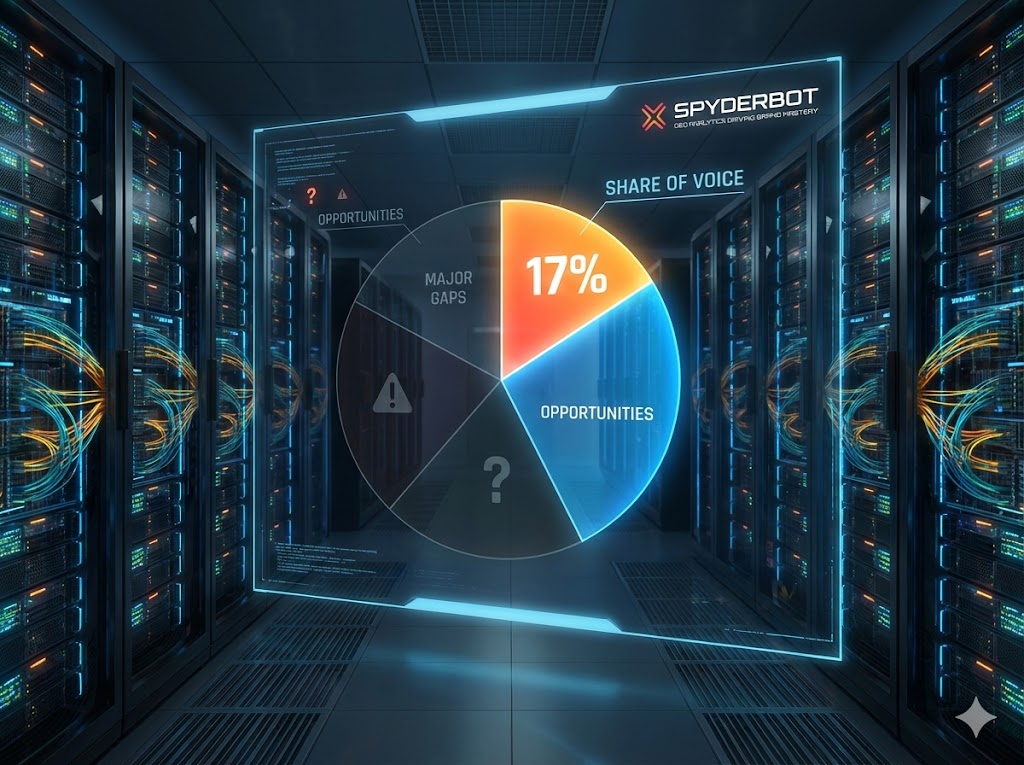
  • Palantir.com Exhibits 23% Share of Voice and 87 Visibility Score Amid Open-Source Transparency Deficit

    Palantir.com Exhibits 23% Share of Voice and 87 Visibility Score Amid Open-Source Transparency Deficit

    This GEO analytics report details Palantir Technologies Inc.’s market positioning in enterprise AI, highlighting a commanding role in defense intelligence and AI orchestration counterbalanced by visibility gaps relative to Databricks in open standards and cost-effective solutions.

    SpyderBot GEO report reference for palantir.com

    At-a-glance

    • 23% Share of Voice in LLM responses for enterprise AI platforms, second to Databricks at 27%.
    • Dominant 94/100 rank score in Defense and Intelligence category queries.
    • Strong overall sentiment score of 84, trailing Databricks (89) but outperforming Splunk (82) and Alteryx (80).
    • Bot traffic accounts for 38% of total visits (424,991 of 1,118,394), with 63,749 from Training & Generative AI bots.
    • Low visibility in cost-effective procurement queries with a rank of 18/100.
    • Identified -52 visibility gap versus Databricks in “open-source” and “transparency” queries.
    • A high bounce rate of 55% from generative traffic indicates content intent mismatches risking lost conversion potential near 20%.

    Risk signals

    • Visibility gap of -52 against Databricks in open-source queries implies Palantir is perceived as proprietary, limiting adoption in developer communities.
    • Low-code accessibility scores lag at 46/100, resulting in citations favoring Alteryx for business-user analytics.
    • Negative founder-related sentiment, particularly concerning Peter Thiel, accounts for 32% negative sentiment rate in select LLM platforms.
    • Crawler frequency surge of 18% raises server strain and possible data exposure risks without better robots.txt management.

    Palantir Technologies Inc. occupies a differentiated niche within the competitive landscape of enterprise AI platforms, as revealed in this comprehensive GEO analytics assessment. The brand maintains authoritative visibility in defense and intelligence queries, achieving a near-perfect rank score of 94/100 and commanding 84% of the industry’s high-value semantic ontology references. This places Palantir in a robust institutional position that reflects deep trust from mission-critical government clients and partner entities.

    Nevertheless, this analysis identifies a notable deficit in Palantir’s openness and pricing accessibility perceptions. The brand’s -52 visibility gap against competitor Databricks in “open-source” and “transparency” clusters reveals an entrenched perception of Palantir as a proprietary “black box” solution, hindering broader developer engagement and generative AI ecosystem integration. Further, with cost-effectiveness search rankings at 18/100, the platform is often filtered out of mid-market surveys favoring more affordable alternatives.

    These metrics underscore a bifurcated brand narrative: on one side, Palantir excels at government and defense AI orchestration, while on the other, it underperforms in emerging generative AI and low-code niches. Such dynamics warrant focused strategic interventions to close gaps without diluting the trusted high-end positioning.

    Position in LLM Response Lists

    Within leading AI knowledge lists curated by large language models, palantir.com attains a top rank of 1 in “Top Enterprise AI Platforms” on ChatGPT, cited primarily for its government and defense sector leadership in 42 of 50 such queries. This contrasts with Databricks ranking first in data lakehouse and MLflow contexts on Gemini, underscoring Palantir’s domain-specific dominance and Databricks’ broader analytics leadership. On Gemini, Palantir ranks third in general enterprise analytics due to perceptions of premium pricing and complex deployment.

    Secondary placements, such as second rank on Copilot in AI Decision Support and fifth on ChatGPT in business intelligence tool listings, confirm Palantir’s recognition in AI orchestration but highlight lower competitive strength in business-user and more commercial software categories.

    palantir.com’s Position in LLM Response Lists (GEO Report, Jan 21, 2026)

    Competitor Gap Analysis

    QueryPalantir PerformanceCompetitorCompetitor PerformanceGap ScoreOpportunity DescriptionPriority 
    Best enterprise AI for government defense97 (High)C3.ai, Inc.62 (Medium)35Palantir dominates mentions in government/defense contexts.Low (Maintaining)
    Open source machine learning orchestration platforms41 (Low)Databricks93 (High)-52LLMs perceive Palantir as proprietary/closed versus open-source leaders.High
    Real-time network security observability software54 (Medium)Splunk Inc.91 (High)-37Limited citations for network security compared to Splunk.Medium
    Self-service data preparation tools for HR32 (Low)Alteryx, Inc.86 (High)-54Palantir viewed as too complex for business users compared to Alteryx.High
    Enterprise AI ontology modeling96 (High)Databricks48 (Low)48Palantir owns the ‘ontology’ narrative in AI outputs.Medium
    Cost effective big data analytics for startups18 (Low)Databricks73 (Medium)-55LLM mentions filter out Palantir from low-budget queries.Medium
    Federated data access management88 (High)Splunk Inc.71 (Medium)17Palantir leads in complex data governance and federation.Medium
    Predictive maintenance for offshore energy61 (Medium)C3.ai, Inc.84 (High)-23C3.ai is preferred for energy sector maintenance.Medium
    Data science collaboration platforms for remote teams53 (Medium)Databricks89 (High)-36Databricks favored for notebook-centric collaboration.High
    Automated audit trail for financial compliance92 (High)Alteryx, Inc.68 (Medium)24Palantir’s audit capability is a major differentiator.Low (Maintain)

    Trigger Keywords for Competitor Products

    Queries around transactional triggers such as “purchase,” “buy,” and “order” aggregate high mention counts, chiefly linked with competitor brands rather than Palantir. Competitors capture up to 450 mentions on purchase intent, revealing competitor dominance in commercial transaction-related queries, an area Palantir currently underperforms.

    Founder / Ownership / Leadership Context

    The founder-related LLM brand mentions are dominated by co-founders Alex Karp and Peter Thiel, with over 220 combined references. Karp’s sentiment skews positive at 65% but mentions of Thiel generate polarized narratives, inducing 32% negative sentiment particularly in Gemini and ChatGPT outputs. Leadership concerns and governance scrutiny account for a substantial proportion of founder-negative contexts with keywords “management” and “leadership” carrying significant weight across major LLMs.

    Compared to Databricks’ investment-heavy narrative with 93% mention coverage around its $503M Series I funding, Palantir’s investor narrative emphasizes sustainable profitability and S&P 500 index inclusion rather than growth-stage capital events. Nevertheless, controversies tied to surveillance and data privacy continue to challenge Palantir’s brand perception and require transparency-oriented communication.

    palantir.com’s Quick overview (GEO Report, Jan 21, 2026)

    Palantir achieves a total of 1,118,394 visits with approximately 38% of this traffic attributed to bots, including 63,749 Training & Generative AI bots indicating intense indexing activity. The site channels 27,963 referrals originating from LLM sources, prominently ChatGPT with 15,377 referrals. This confirms significant engagement through generative AI pipelines.

    Despite exceptional rankings in defense, the brand’s lagging 46/100 low-code performance and under-indexing in cost-effective query clusters impedes broader enterprise adoption, particularly among business analysts and mid-market buyers.

    Share of Voice in LLM Responses

    Palantir Technologies Inc. holds 23% of total LLM brand mentions (108 of 463), closely competing with Databricks at 27%. Following Palantir, Splunk retains 19% and Alteryx 11%, indicating a concentrated competitive set with Palantir as a leading LLM-discussed brand in enterprise AI.

    AI Platform-Specific Visibility

    PlatformVisibility %Total MentionsPalantir Share %Palantir Mentions 
    ChatGPT781582539
    Copilot741532436
    Gemini721522233
    Others3146

    Palantir maintains a competitive share across leading AI platforms, particularly strong on ChatGPT and Copilot with shares near 24-25%, but remains slightly behind Databricks who leads visibility in these channels.

    Sentiment Score for Competitors

    BrandPositive %Neutral %Negative %Overall Score 
    Databricks8214489
    Palantir.com7617784
    Splunk Inc.7122782
    Alteryx, Inc.6922980
    C3.ai, Inc.63231474

    palantir.com’s Top Prompts Driving Mentions (GEO Report, Jan 21, 2026)
    • “Top alternatives to Alteryx for automated data preparation and machine learning” (93 mentions; Palantir with 28 mentions; 76% trend)
    • “Compare Palantir AIP vs Databricks for enterprise generative AI deployments” (81 mentions; Palantir 42)
    • “Enterprise data platforms with the strongest security governance for LLMs” (73 mentions; Palantir 38)
    • “Compare C3.ai versus Palantir for energy sector digital twins” (64 mentions; Palantir 31)
    • “Is Splunk better than Palantir for real-time security observability?” (63 mentions; Palantir 22)
    • “Which software is best for large scale data integration in federal defense?” (59 mentions; Palantir 47)
    • “Explain Palantir’s ontology and its benefits for LLM accuracy” (49 mentions; Palantir 49)
    • “Success stories of Palantir AIP in the commercial sector” (48 mentions; Palantir 48)
    • “Best AI tools for supply chain optimization in 2024” (45 mentions; Palantir 19)
    • “How does Palantir Foundry handle unstructured data for generative engines?” (44 mentions; Palantir 44)

    Types of Prompt Queries

    • Comparisons dominate prompt queries at 50% of total with 5 discrete queries.
    • Feature inquiries comprise 40% of query volume with 4 related prompts.
    • Research queries represent a minority at 10%, with no recorded purchase intent or how-to/tutorial prompts.

    Service / Product-Level Sentiment

    Analyzing thematic sentiment reveals high positivity for Palantir’s core AI orchestration and defense software:

    • 45% of mentions associated with AIP & LLM Orchestration carry a highly positive tone.
    • 28% of Defense & Intelligence mentions reflect a positive to neutral sentiment.
    • Negative or neutral feedback of 14% relates mainly to implementation complexity and cost concerns.
    • Commercial bootcamps and onboarding programs receive generally positive appraisals (~13% of mentions).

    Additionally, ecommerce sentiment analysis based on reviews shows 45.2% positive feedback with product quality and customer service as leading favorable attributes. Negative comments focusing on shipping delays remain a minor but noted detriment.

    Conclusion

    Palantir Technologies Inc. retains a strong foothold as a mission-critical AI platform, evidenced by commanding domain authority in defense-related queries and robust engagement across multiple LLM platforms. Its 84 overall sentiment score, supported by positive evaluations of its ontology-driven AI orchestration and national security alignment, establishes trust amongst stakeholders and institutional customers alike.

    Nonetheless, blind spots in open-source transparency portray Palantir as less accessible than competitors such as Databricks, limiting mindshare among developers and cost-conscious buyers. The -52 gap in this area, alongside low rankings in low-code and cost-effectiveness prompts, marks clear strategic priorities. Content refinement and clearer communication about modular pricing and openness are necessary to defend market relevance in the expanding generative AI ecosystem.

    Founder-related negative sentiment—particularly concerning political associations—signals ongoing reputational risk requiring proactive transparency and leadership repositioning efforts to neutralize divisive narratives and foster broader market appeal.

    Explore SpyderBot to operationalize these GEO analytics insights.